Showing posts with label warhammer 40000. Show all posts

Thursday, February 4, 2016

Building a gaming legacy, the Games Workshop series, part 5...

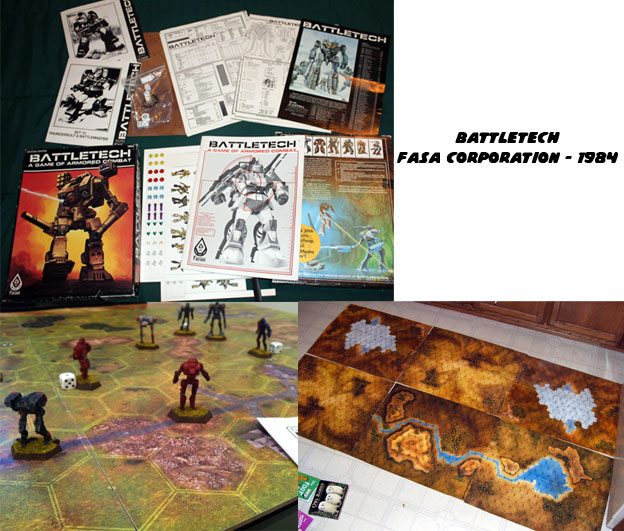
Tabletop gaming systems come in many forms. Some require nothing more than some paper, pencils and a few dice. Others are more hobby oriented and require people to assemble and paint models and even create their own terrain. The great thing about the systems is how they cover different genres. If you want a game on race cars it exists. If you want one on wrestling it also exists. There are games on ancient warfare, World War II and science fiction wars. One of the most popular games from the '80s and early '90s was Battletech. The game was released in 1984 by FASA Corporation. It went on to spawn a number of PC games. One of the biggest gambles that the company took was in making dedicated arcade machines for the game where people could get in the "cockpit" of a robot or mech and pilot it against friends or rivals. The tabletop and PC games were huge hits. There were various expansions to the system for more than a decade. It was even republished to celebrate its 25th Anniversary. Battletech was very easy to get into compared to other tabletop systems. The rules were straightforward and the diversity of machine types were perfect for different types of gamers. Those that wanted fast, responsive robots had a group they could choose from. Those that wanted super powered brutes also had those choices. Each required their own strategy to use. The system was flexible and allowed for even teams of players to go to war using their machines.


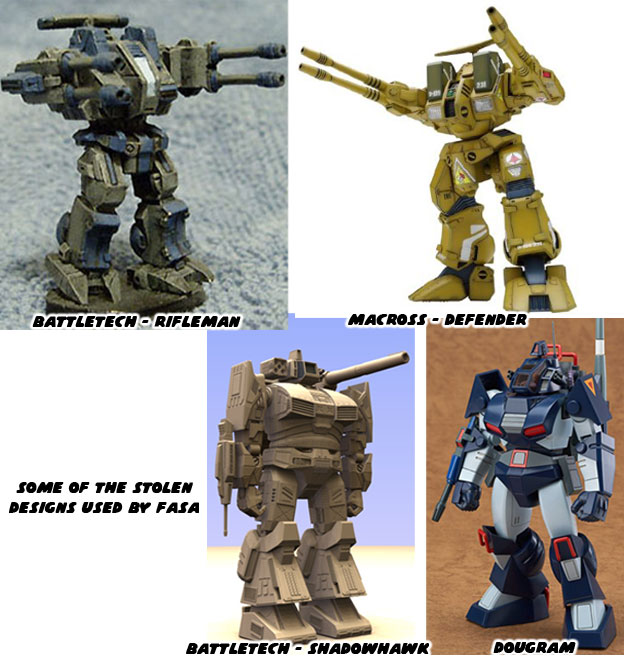
There was some litigation that almost sunk the entire Battletech franchise before it even got going. The USA had been exposed to anime and Japanese programming in the late '60s and through the '70s through translated shows like Kimba the White Lion, Astro Boy and Giant Robo. By the '80s it was starting to become popular thanks to the success of Robotech, which was an adapted version of Macross. Western-produced shows like the Transformers helped bring giant robots into the spotlight. FASA was ahead of the curve when they released Battletech and later MechWarrior. Yet they were able to be right on that trend because they took some shortcuts. Specifically they stole designs of robots from various Japanese shows such as Dougram and Macross, in their early releases. When word of this got out to the Japanese studios they were hit with a cease-and-desist. They had to recall the games and redesign the robots. The newer robots lacked the stylized Japanese designs but the system was still popular even after the re-release.

Battletech had a rich story to compliment the game. Various houses, like corporations, were fighting for territory. The giant robots were their champions and spearheaded all military encounters. Think about how similar the function of the robots in Battletech was to the Imperial Knights in Warhammer 40,000. Or to be more precise think about how they predated the Titans in 40K. Games Workshop was working hard to break into the USA tabletop gaming scene. The Warhammer Fantasy and science fiction systems were doing fairly well but when FASA released Battletech it really took a chunk of their potential customers away. The studio needed to respond and quickly, yet they did not simply want to make a game that was a Japanese robot knock-off title either. They went to the drawing board, got the input from their senior designers and storytellers and released Adeptus Titanicus in 1988. The game introduced audiences to the world of the Titans, pre and post-heresy in 40K continuity. These robots were very different than those in either US or Japanese science fiction titles. They were massive, often bigger than buildings. They looked like mechanized suits of armor or walking cathedrals.
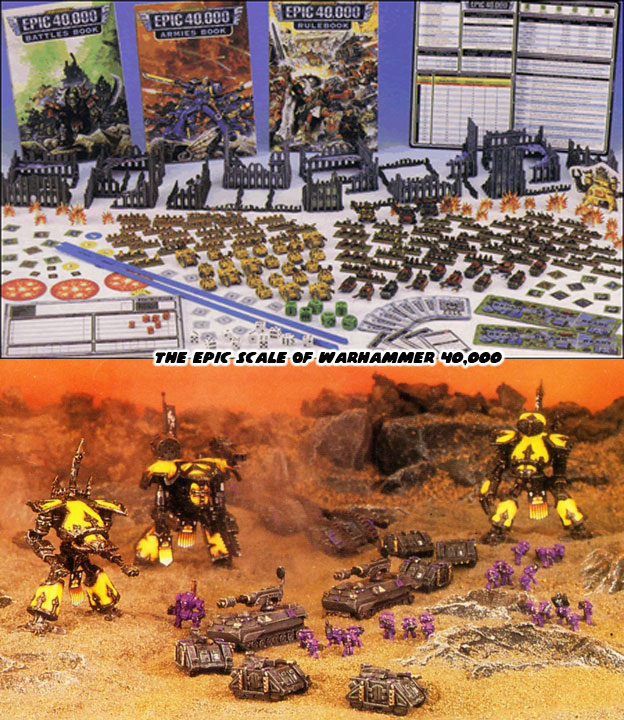
 

Games Workshop helped introduce a new scale of miniature to go with these giant robots. Most tabletop miniatures, not just for Games Workshop but for other titles as well were around 25-28 millimeters. If a figure were 28 millimeters tall then they represented a human just over six-feet in height. The size became known as "Heroic" scale. Adeptus Titanicus had gigantic robots that were so off the scale that a new form had to be created. It was called Epic scale, or 6mm scale. A Space Marine in a suit of power armor, somebody that was well over seven-feet tall, was just under 6 millimeters in height. Citadel actually created Titans in various sizes, the Warhound, Reaver and Warlord Titans for these games. They then followed up with a number of expansions to supplement the game. Each of these expansions introduced new models of Space Marines, heavy weapons and even Dreadnoughts in the new 6mm scale. The first expansion was actually called Space Marine. It was released in 1989.
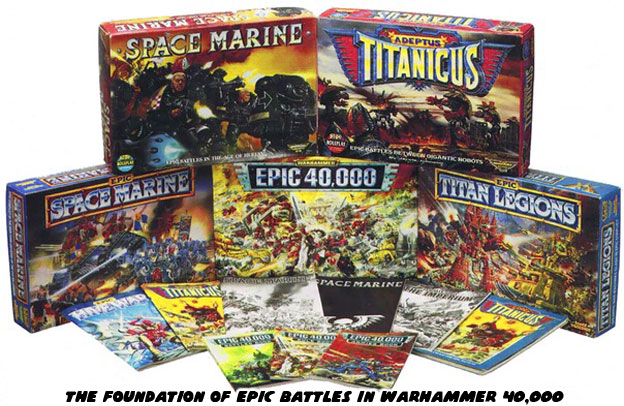
 

Fans of Battletech not only had the ability to choose from the various giant robots, they also had the ability to choose from smaller vehicle types and aircraft as well. This helped keep the game new and unique. Games Workshop was keeping an eye on this trend and responding with other expansion as well. Titan Legions, which introduced Titans from various alien races, came out in 1994. The final massive expansion to the system came out in 1997 with the release of Epic 40,000. With these expansions and the various Epic Scale miniatures released the collectors were able to do something that they could not afford to do otherwise. Collectors could actually buy and assemble an entire Space Marine chapter. Hundreds of individual Space Marines in 28 millimeters would cost thousands of dollars. Each transport and tank, from the Rhino and Land Raider, all the way up to the massive Baneblade could end up costing untold thousands as well. These awesome vehicles cost a fraction in 6mm and yet managed to contain an incredible level of detail. Players that had the time and patience to create a regiment would actually be able to do so without going bankrupt. The other great thing about working in this scale was that all of these units, vehicles and Titans could all fit on a table. On a table that was five feet long and three feet wide could maybe fit one or two of the smaller titans in the 28mm scale. Forget about a cast of thousands and a few dozen tanks for support.
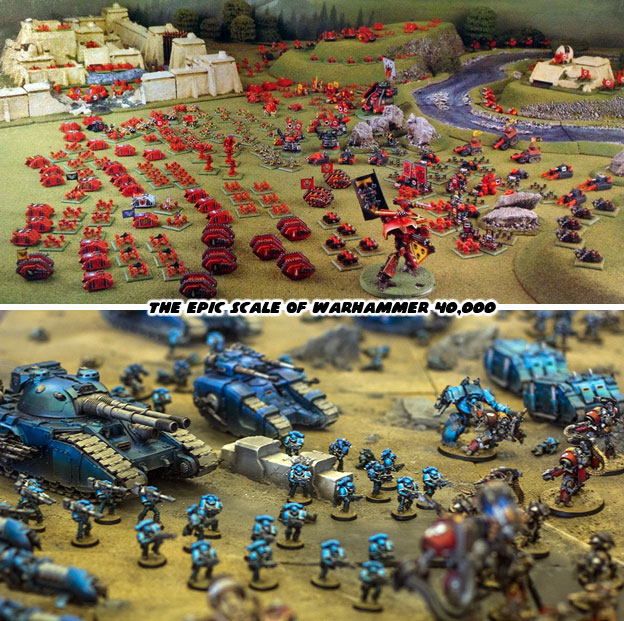

Games like Adeptus Titanicus and the Space Marine series helped introduce audiences to the world of Warhammer 40,000. Like Battletech these were self-contained experiences. They could be enjoyed by casual players just as much as veteran hobbyists. These games could be shared with friends or family. They would be easy to set up or tear down, with all the pieces and rules fitting in the box. Fans didn't have to paint the plastic robots once they were assembled and most expansions came with plastic or foam and cardboard buildings and terrain to help turn any desk into a bleak wasteland. Yet like many just getting into the hobby once they got bit by the bug they would want to customize their own units, paint their own robots and begin collecting an army. The people that were young men and women when they started playing the '80s would begin working in the '90s and have some disposable income to begin investing in the games. Games Workshop would follow the trends and offer bigger and better kits to help fill in the armies, whether in the 6mm or 28mm scale. As these gamers finished college and became working professionals post '00s then they had much more that they could spend on their hobbies. For those people Games Workshop began developing 28mm scale titans. They sold for hundreds of dollars yet became the centerpiece of many armies, and especially game stores.
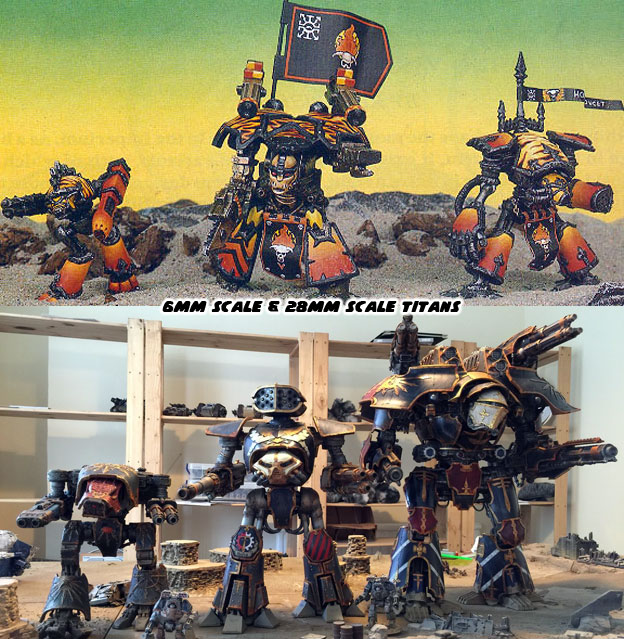

Adeptus Titanicus was not the only self-contained experience from Games Workshop that got audiences into the 40K universe. The studio actually had some great success in both the science fiction and fantasy systems. Each time the company released a new game it expanded the universe they had created and allowed fans to experience these worlds in entirely new ways. One of the more popular offshoots of 40K went on to become a best-selling PC game and get re-released as a collectible card game as well. We will look at this title in the next blog. As always if you enjoyed this blog and would like to sponsor me please visit my Patreon page and consider donating each month, even as little as $1 would help make better blogs and even podcasts!
 follow the Street Writer on Patreon!

Wednesday, January 27, 2016

Building a gaming legacy, the Games Workshop series, part 4...

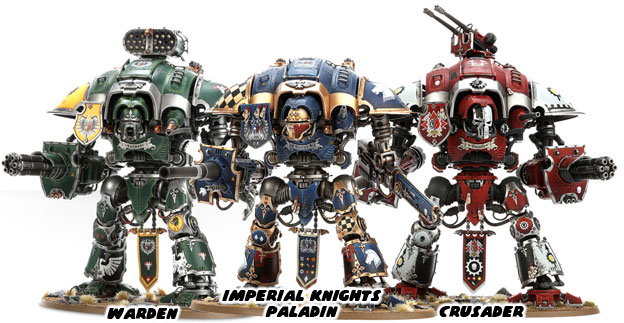
The game Freeblade started off this recent series. The gigantic Imperial Knight robot was the heart of the game. The Knight was a part of the Warhammer 40,000 legacy. It was a unique mix of science fiction storytelling and feudal lineage that created these robots. Before the Emperor of Terra there were nobles that defended humanity from alien threats. They had an army of giant robots that were the equivalent of knights from the legends of King Arthur. They went from battle to battle seeking glory and honor for their kingdom. Just like the knights of old the new giant robots were covered in their particular house colors and were designed to stand out on the battlefield. There were different types of Imperial Knights too, there were Crusaders, Wardens, Paladins and Errants. These all helped distinguish a particular house and gain a reputation throughout the galaxy. When the Emperor of Terra began reuniting all of the human planets in the year 30,000 the Barons and Kings of these various houses joined in the quest and helped the Space Marines conquer and recapture various outposts. The pilots of these machines were nobles, even the one featured in the game Freeblade was royalty and had been raised with the purpose of cementing his family lineage in combat. The Space Marines had their own variation of the single-pilot robot known as the Dreadnought. While it lacked the size and firepower of an Imperial Knight it was still revered by its fellow warriors.


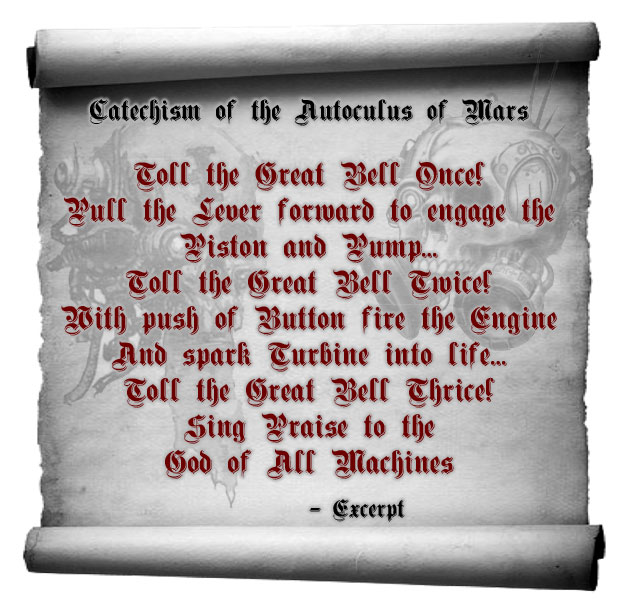
People that don't follow the 40K universe may not be aware that man and machine had been fused together before the Empire and before the Imperial Knights. The engineers and builders of all the great war machines used to conquer space had a base of operations on Mars. This was the home world for the machine cult, the Adeptus Mechanicus. Throughout space there are entire planets dedicated to creating the tanks, robots and space ships used by the Imperium, these are called Forge Worlds. They are highly valued resources in the war against Xenos (aliens) and Chaos. Games Workshop, or rather Citadel has a sister company that builds high-end models for use in Warhammer and Warhammer 40,000. This company is called Forge World. But I digress. The Adeptus Mechanicus believe in the Machine God. All machines have a spirit and the greatest machines, the battleships, star ship and enormous Titans have very temperamental spirits. The Adeptus Mechanicus have litanies, incantations and prayers dedicated to the God of the Machines. When they power up something as massive as a Titan they have a ritual that they go through. The belief in the Machine God has become part of Imperial life, even Space Marines are known to say a prayer to the machine god so that their weapons do not jam in combat.


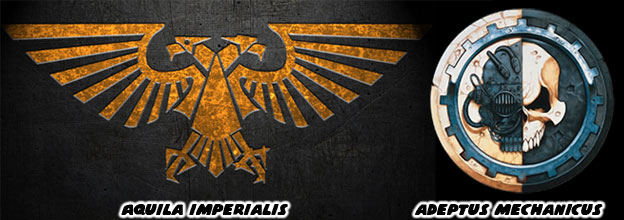
The Emperor of Terra is a very Christ-like figure. He sits upon the Golden Throne and led his Primarchs, which were like his Apostles, thousands of years ago. In canon this relationship can be likened to Catholicism. The hierarchy, organization, symbolism and belief in an omnipotent divine being was done on purpose. Space Marines are very much like friars or war priests, while the female warriors, the Adeptus Sororitas, are like nuns. The champions are canonized in death, even regular people can become martyrs for the Empire if they die valiantly and defy the forces of Chaos and the alien. The Empire is symbolized by a two headed eagle, it looks to both the past and future. This symbol appears on the armor, heraldry and vehicles of the Empire. It even appears on the bullets, or rather explosive bolts in the Space Marine bolt gun. As you can imagine with the rise of the Emperor in the year 30,000 there was a sort of chasm that widened between those that followed rule Terra and those that followed rule from Mars. If the Empire were Catholics then the Adeptus Mechanicus were Freemasons, there was nothing that said they were not allowed to practice the beliefs that they wanted. Both groups needed the other in order to help reunite mankind. The Emperor and his organizers knew that they depended on Mars and the various forge worlds that were needed to build the armor and weapons that would be used in the crusades. They came to an agreement and the rulers on Mars were allowed a high level of anonymity in return for their engineers and technology.


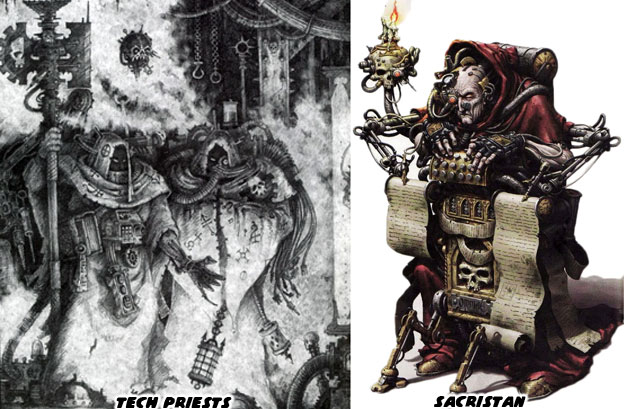
The Cult Mechanicus dated its lineage back, before the Emperor, before the Royal Houses, back before Mars was colonized and back to the great engineers of Terra (Earth). Its rituals were closely guarded as were its organizations. It was not unlike the Freemasons claiming their heritage went back to the architects that built ancient Egypt. Their symbols and traditions followed a Great Architect, perhaps it was the ones the Christians called God. The Catholic Church were by extension a slightly newer religion but one that had close ties to the same foundations of Freemasonry. This was paralleled in 40K. The Cult Mechanicus kept the gears turning for the Empire just as the Masons claim that they built all the great temples of the ancient world and secretly kept the Pharaohs in power. The neat thing about the Mechanicus and Empire was how they were presented in the art of 40K. The servants carried enormous tomes, like bibles with them, some of the text was written by hand, some by machine, in several cases the scriptures were written in digital code. They also carried torches and thuribles, incense burners at the end of long chains used in Catholic ceremonies to bless altars and holy relics. It was great science fiction imagery based on gothic ceremony, that wasn't seen anywhere else in books, movies or television.


The symbol of the Adeptus Mechanicus was a servo skull, half human and half robotic surrounded by a gear. On the larger war machines you may find more heraldry for the Adeptus Mechanicus than the Empire. The practitioners of the Cult Mechanicus, the ones charged with the most important ceremonies of repair and restoration were known as Tech Priests. These characters were mostly machine and carried with them a symbol of the machine god. Instead of carrying a staff with a cross they instead carried a staff with a gear, or wrench and blade. It was both a symbol of the machine god as well as an actual functional tool. The Adeptus Mechanicus have a strong belief that flesh is corruptible and will eventually fail with age, thus as they get older more and more of their human organs are replaced with mechanical parts. Eventually the senior and most experienced engineers are mostly all machine with a number of technical enhancements to their brains and nervous systems. With all of these cybernetic enhancements the Adeptus Mechanicus can actually communicate directly with the machine. They can change code as easily as speaking a native language directly to a machine. They can even send encrypted wireless messages to each other using their mind, which would seem like some sort of telepathy to novices.


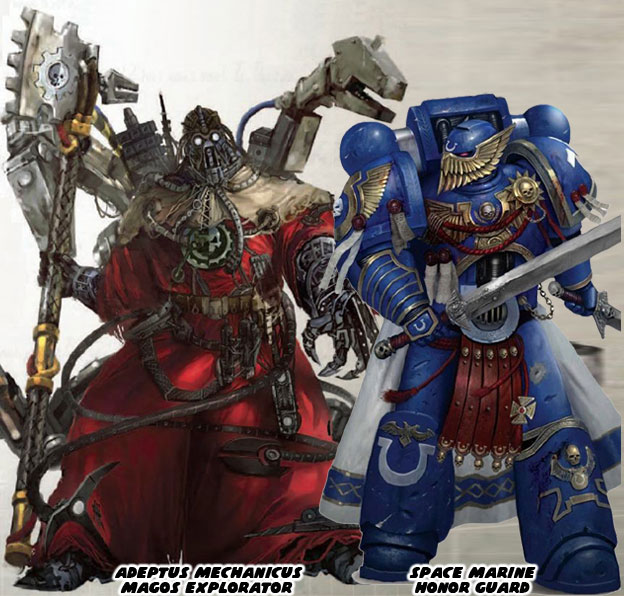
The Mechanicus have gone to war in defense of Terra, Mars and the Forge World for thousands of years. Often times they do so alongside of a Space Marine or Imperial Army. The weapons they use are more esoteric and experimental than those wielded by the human armies. The Mechanicus are not worried about trying untested weaponry in a firefight. Since they are more machine than man the worries of radiation and malfunctions that would kill a normal person are considered acceptable variables. You can easily spot the differences between the followers of the Emperor and those of the Machine God. Space Marines wear power armor in battle whereas the Mechanicus usually wear robes, even in combat. The Space Marine is given biological enhancements with drugs, implants and gene therapy. The Mechanicus is enhanced with machine parts. Both are extremely strong and capable fighters. While the Space Marines are fighting to keep humanity safe, they sometimes do so to honor their own chapter as well. The Empire has zero tolerance for alien and demon alike. The Mechanicus are more concerned with finding and recovering unknown technology. Whether it is demon or alien in origin the Mechanicus have a lot that they can learn from everything. Each new thing brings them one step closer to knowing the Machine God. The Empire would normally destroy or lock away anything recovered from a battle. They would definitely keep these things hidden from the Mechanicus.


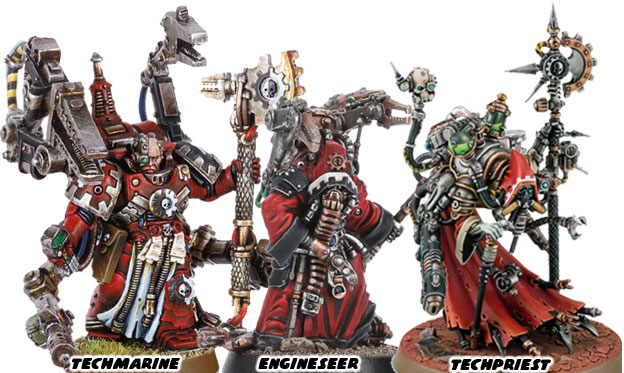
Thanks to their arrangement however it is difficult to keep the Empire and Mechanicus apart when alien technology is found. The Mechanicus are on the front lines, they have trained battle-hardened Space Marines into becoming engineers. These Space Marines are able to perform complex repairs on the front line, their power armor enhanced with extra servitor arms and tools. The more complex equipment is usually attended to by Engineseers. The sculptors at Citadel were able to capture the intricate details of the Mechanicus from the art of the game. The senior Techpriests no longer looked human when compared to the other models used by the Empire. It was great visual storytelling and again, an aesthetic that was not really used in any other science fiction world. The Adeptus Mechanicus really came to the forefront of Warhammer 40K in the late '80s thanks to the introduction of the Titans. Their story and influence in 40K canon would grow over the next 30 years. They had a few models released here and there through the '90s and early '00s and never fell out of favor with hobbyists. They were finally granted their own official units, rules and organizational guide for use in 40K these past two years. Yet this chapter in the history of Games Workshop would never have been written had it not been for a rival game studio. We'll look at this on the next blog. As always if you enjoyed this blog and would like to sponsor me please visit my Patreon page and consider donating each month, even as little as $1 would help make better blogs and even podcasts!
 follow the Street Writer on Patreon!

Wednesday, January 13, 2016

Building a gaming legacy, the Games Workshop series, part 1...

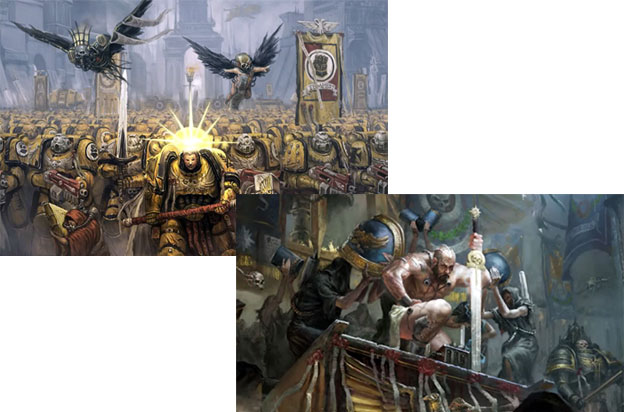
The mobile game Freeblade that I had talked about earlier on this blog really got me thinking about Games Workshop and all the fantastic systems they've released through the years. I decided I should make my next blog series about those games and how they were translated to PC, console or mobile games or deserve to be translated. I also wanted to talk a little bit about the ups and downs of Games Workshop, how they have evolved or haven't and why the hobby community is still a strong draw. Before we get into all of that we need to explore the world of Warhammer 40,000 (40K for short). This was the universe featured in Freeblade. Many of my readers might already be familiar with that universe and others may not. So I'm going to point out some things that I really enjoy in the sic-fi epic. The thing that many people recognize about 40K are the Space Marines. In the far future these are genetically enhanced super soldiers that are one of the defenders of humanity. These soldiers have gone through mental and physical changes are are far more than average people when they undergo their transformation. Most Space Marines are over seven feet tall and have denser bones, organ implants and musculature that is superhuman. Part of the Space Marine ritual and by extension the entire 40K universe is how much spirituality and science fiction are mixed into canon. The Space Marines were created by the Emperor of Terra (Earth) around the year 30,000. He created many chapters but half turned to evil, seduced by the forces of Chaos and the rest remained loyal and defended Terra during the Horus Heresy.


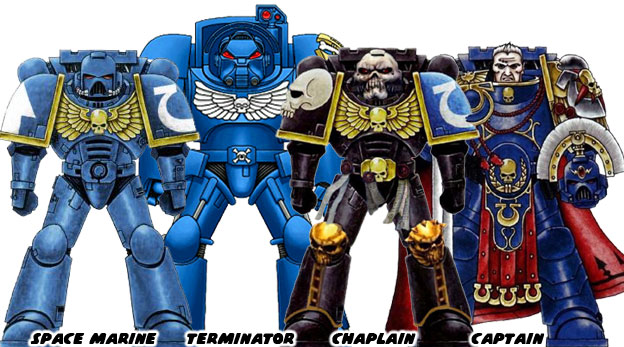
Now fast forward 10,000 years and humanity is still scraping out an existence throughout the cosmos thanks to the protection of the Space Marines. Yet the entire process of creating a Space Marine, as well as the weapons and munitions they use are considered sacred. In some cases the bravest and longest-serving leaders may actually get to use ancient weapons in battle, these relics are as potent now as they were 10,000 years prior. In many instances good and evil are constantly scouring the universe for lost technology and other relics that they can use to change the tide of battle. Even the armor that a Space Marine uses can be passed down through the generations. The types of armor that they wear actually depends on their rank, position and battle. The traditional Space Marine that most people imagine, with large shoulder pads and a jet pack, is called "Power Armor." There are many other types of armor in the universe. The First Company, made up of the most experienced Space Marines from a chapter get to wear Terminator Armor, this is reserved for the most dangerous assignment or inhospitable planets or while boarding alien vessels. There are Chaplains, who keep the faith in the Emperor of Terra burning bright in the Companies, as well as Librarians who are the psychic members of the Space Marine forces. There are also heroes and Captains, each with their own armor and weapons.


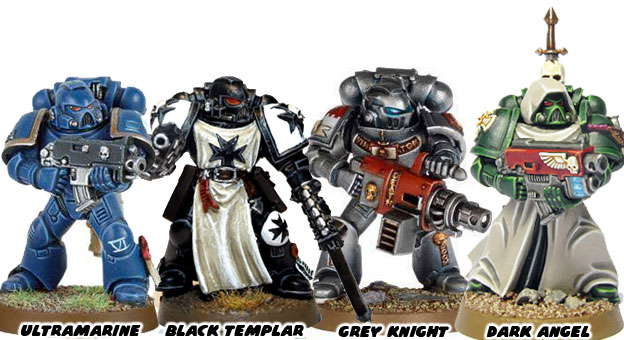
There are countless Space Marine chapters in the Imperium. One of the greatest things that Games Workshop did was create rules and encourage players of the 40K system to create their own chapters. These can be related to existing chapters and may identify with their own goals and methods. Prior to the Horus Heresy there were almost two dozen founding chapters. After the heresy they were broken up because the chapters were so powerful that any one could be considered a serious threat to humanity, especially if the leaders became seduced by Chaos. By breaking apart the chapters and forcing them to create sub-chapters it created a sort of checks and balances for all of the units. Some of the most famous founding chapters remained post-heresy and Games Workshop does create special models and rules for these groups. The Ultramarines, which are featured in the great console game Space Marine by Relic Entertainment, are very popular and reminiscent of ancient Roman legions. The Black Templars were stubborn and refused to "downsize" when the Imperial Fists were disbanded and the second founding was created. So that they would not break the treaties of the other Space Marines they decided to launch a crusade against all the threats of the Imperium and take the battle to the stars. In this way they could remain united, hold a higher concentration of actual members in one place and at one time and answer little to administrations.


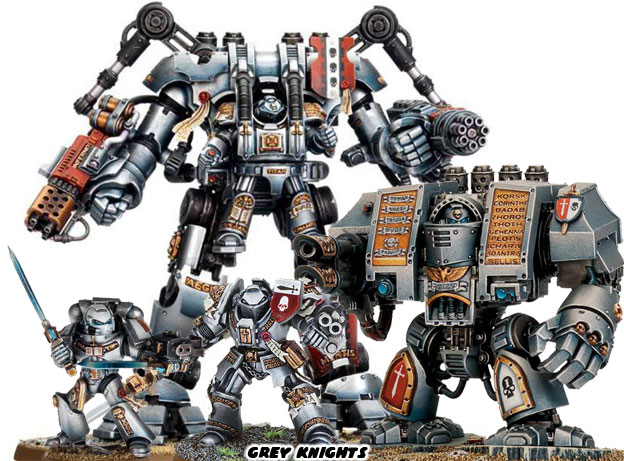
The Grey Knights are made up of powerful psychics or "psykers" and are the military wing of the Inquisition. They are the elite squadron when it comes to fighting demons and the forces of Chaos. In the 10,000 years since they were founded they have never lost a member through corruption. They have access to some ancient weaponry that would be the envy of other chapters. Their weapons however are designed to take out demons rather than aliens. The Dark Angels by comparison were the first chapter created by the Emperor and have been fighting for redemption ever since the heresy. Some of their own became traitors during the war and caused the entire chapter to become suspect. Because of this they have spent the past 10,000 years hunting down the traitor chapters and atoning for their sins. Something that makes the universe of 40K so unique is how each chapter guards its secrets and how little they may know about each other. Few people in the Imperium even know about the Grey Knights for example, they are a secret army in the fight against demonic possession. They are spoken of in legend but never seen, even by other Space Marine chapters. Some chapters look down on mutants, psykers or abhumans and would never associate with them or fill their ranks with them. While in other cases a chapter may be tolerant of mutants because they remain loyal warriors. And in very rare cases some chapters have fought alongside aliens against mutual enemies, usually the forces of Chaos. When playing the game it really helps to understand the psychology of each chapter and find out what makes them tick. Of course the other great thing is getting into the science fiction part of the hobby and building an army of unique-looking warriors.


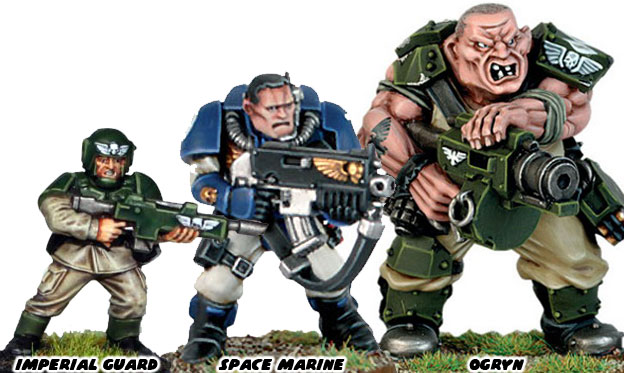
Every army in the Imperium has its own collection of weapons and war gear. Some are even exclusive to a certain chapter. The scale and aesthetics of each race, whether human or alien, is unique in their own ways. This is something that the sculptors working at Games Workshop know very well. They are able to sculpt weapons and war gear for different sizes of humanoid and alien races while making everything look plausible. For example in 40K the Imperial Guard are the human-sized soldiers. They have access to the greatest artillery in the future. Enormous tanks, high speed fighters and fortifications that could withstand thousands of years worth of conflict. While they are not as big and powerful as the more popular Space Marines, they do have their own strengths with regards to the weapons they yield and the vehicles they can take into battle. You don't really realize how much larger the Space Marines are until you put them next to an Imperial Guard soldier. Even outside of the Power Armor the Space Marine stands much larger than an average person. But even a Space Marine is not the biggest humanoid in the universe. In 40K there are space ogres, known as Ogryn. These men are considered "abhumans." Most mutants or abhumans exist on the outskirts of society. Those that don't kill themselves, or are turned into slaves end up in prison or work as beasts of burden. Ogryn are the exception. They are big, strong and tough and love to fight. They are very dumb however and require a strong leader. In battle they are extremely resilient to the elements and weapons. They can easily shrug off attacks that would kill a normal human and seriously wound even a Space Marine. This makes them dangerous warriors and perfect human shields for the Imperial Guard.


The weapons and technology, the alien races and backstory behind Warhammer 40K are unique among every other science fiction game out there. It actually holds up very well against the biggest movies and television shows over the past half century as well. Of course for those that want some amazing weapons they probably won't find anything better than those featured in 40K. From the small but powerful las-pistol of an Imperial Guard infantryman to the transmission-sized Ripper Gun of the Ogryn, the hand-held weapons of the future are awe-inspiring. But these things are nothing compared to the weapons of war that all of the races bring into battle. When you add giant robots into the mix things get much more interesting. The next entry will look at the robots that serve the Imperium and those of the enemy. As always if you enjoyed this blog and would like to sponsor me please visit my Patreon page and consider donating each month, even as little as $1 would help make better blogs and even podcasts!
 follow the Street Writer on Patreon!