Showing posts with label dougram. Show all posts

Thursday, February 4, 2016

Building a gaming legacy, the Games Workshop series, part 5...

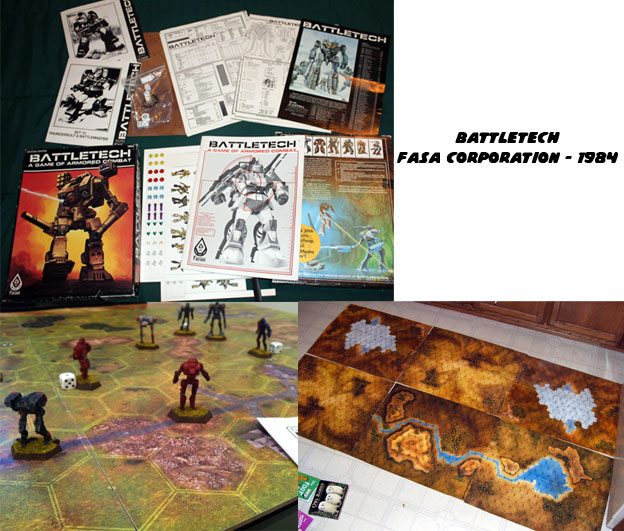
Tabletop gaming systems come in many forms. Some require nothing more than some paper, pencils and a few dice. Others are more hobby oriented and require people to assemble and paint models and even create their own terrain. The great thing about the systems is how they cover different genres. If you want a game on race cars it exists. If you want one on wrestling it also exists. There are games on ancient warfare, World War II and science fiction wars. One of the most popular games from the '80s and early '90s was Battletech. The game was released in 1984 by FASA Corporation. It went on to spawn a number of PC games. One of the biggest gambles that the company took was in making dedicated arcade machines for the game where people could get in the "cockpit" of a robot or mech and pilot it against friends or rivals. The tabletop and PC games were huge hits. There were various expansions to the system for more than a decade. It was even republished to celebrate its 25th Anniversary. Battletech was very easy to get into compared to other tabletop systems. The rules were straightforward and the diversity of machine types were perfect for different types of gamers. Those that wanted fast, responsive robots had a group they could choose from. Those that wanted super powered brutes also had those choices. Each required their own strategy to use. The system was flexible and allowed for even teams of players to go to war using their machines.


There was some litigation that almost sunk the entire Battletech franchise before it even got going. The USA had been exposed to anime and Japanese programming in the late '60s and through the '70s through translated shows like Kimba the White Lion, Astro Boy and Giant Robo. By the '80s it was starting to become popular thanks to the success of Robotech, which was an adapted version of Macross. Western-produced shows like the Transformers helped bring giant robots into the spotlight. FASA was ahead of the curve when they released Battletech and later MechWarrior. Yet they were able to be right on that trend because they took some shortcuts. Specifically they stole designs of robots from various Japanese shows such as Dougram and Macross, in their early releases. When word of this got out to the Japanese studios they were hit with a cease-and-desist. They had to recall the games and redesign the robots. The newer robots lacked the stylized Japanese designs but the system was still popular even after the re-release.
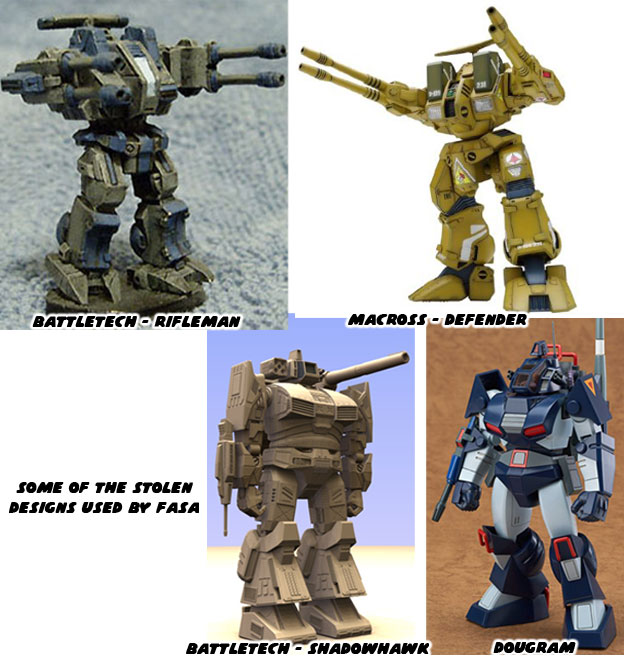

Battletech had a rich story to compliment the game. Various houses, like corporations, were fighting for territory. The giant robots were their champions and spearheaded all military encounters. Think about how similar the function of the robots in Battletech was to the Imperial Knights in Warhammer 40,000. Or to be more precise think about how they predated the Titans in 40K. Games Workshop was working hard to break into the USA tabletop gaming scene. The Warhammer Fantasy and science fiction systems were doing fairly well but when FASA released Battletech it really took a chunk of their potential customers away. The studio needed to respond and quickly, yet they did not simply want to make a game that was a Japanese robot knock-off title either. They went to the drawing board, got the input from their senior designers and storytellers and released Adeptus Titanicus in 1988. The game introduced audiences to the world of the Titans, pre and post-heresy in 40K continuity. These robots were very different than those in either US or Japanese science fiction titles. They were massive, often bigger than buildings. They looked like mechanized suits of armor or walking cathedrals.
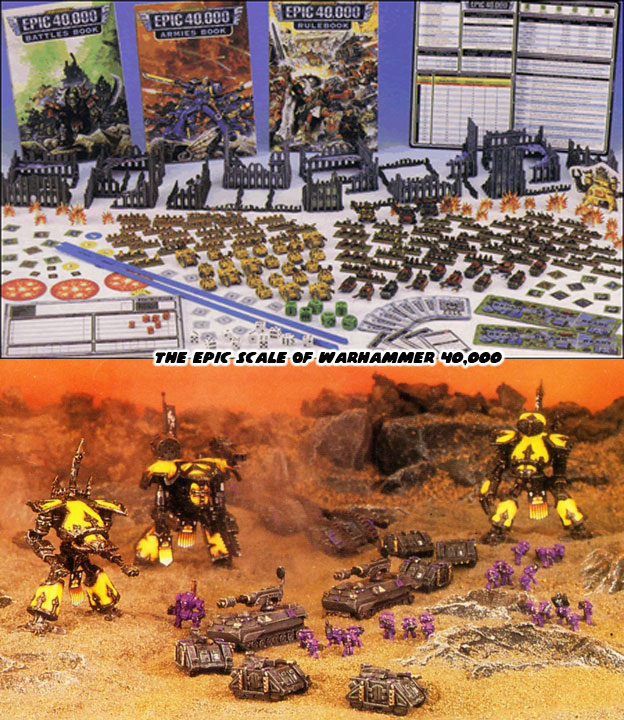
 

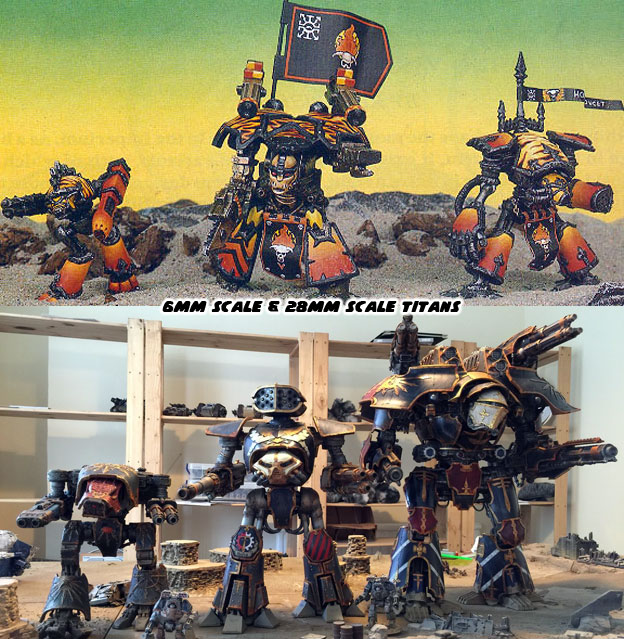
Games Workshop helped introduce a new scale of miniature to go with these giant robots. Most tabletop miniatures, not just for Games Workshop but for other titles as well were around 25-28 millimeters. If a figure were 28 millimeters tall then they represented a human just over six-feet in height. The size became known as "Heroic" scale. Adeptus Titanicus had gigantic robots that were so off the scale that a new form had to be created. It was called Epic scale, or 6mm scale. A Space Marine in a suit of power armor, somebody that was well over seven-feet tall, was just under 6 millimeters in height. Citadel actually created Titans in various sizes, the Warhound, Reaver and Warlord Titans for these games. They then followed up with a number of expansions to supplement the game. Each of these expansions introduced new models of Space Marines, heavy weapons and even Dreadnoughts in the new 6mm scale. The first expansion was actually called Space Marine. It was released in 1989.
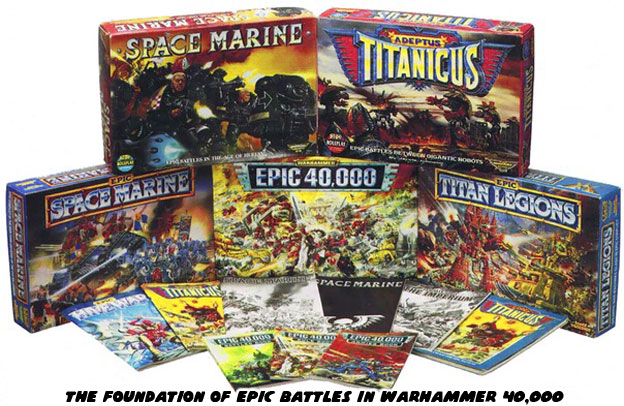
 

Fans of Battletech not only had the ability to choose from the various giant robots, they also had the ability to choose from smaller vehicle types and aircraft as well. This helped keep the game new and unique. Games Workshop was keeping an eye on this trend and responding with other expansion as well. Titan Legions, which introduced Titans from various alien races, came out in 1994. The final massive expansion to the system came out in 1997 with the release of Epic 40,000. With these expansions and the various Epic Scale miniatures released the collectors were able to do something that they could not afford to do otherwise. Collectors could actually buy and assemble an entire Space Marine chapter. Hundreds of individual Space Marines in 28 millimeters would cost thousands of dollars. Each transport and tank, from the Rhino and Land Raider, all the way up to the massive Baneblade could end up costing untold thousands as well. These awesome vehicles cost a fraction in 6mm and yet managed to contain an incredible level of detail. Players that had the time and patience to create a regiment would actually be able to do so without going bankrupt. The other great thing about working in this scale was that all of these units, vehicles and Titans could all fit on a table. On a table that was five feet long and three feet wide could maybe fit one or two of the smaller titans in the 28mm scale. Forget about a cast of thousands and a few dozen tanks for support.
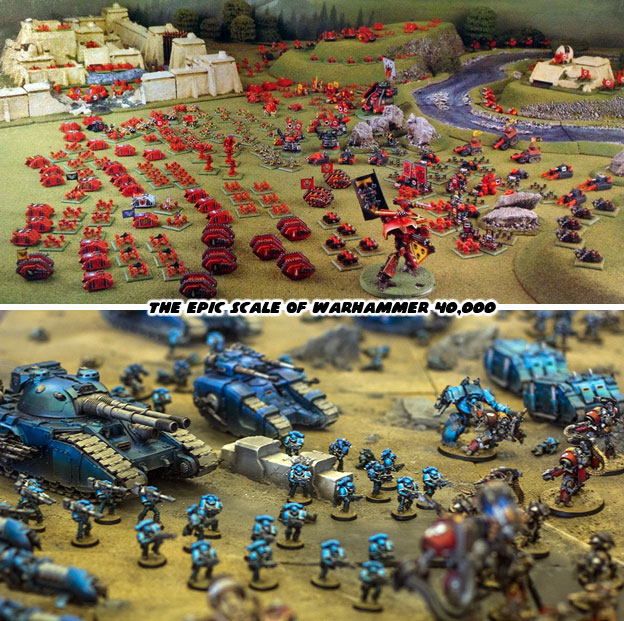

Games like Adeptus Titanicus and the Space Marine series helped introduce audiences to the world of Warhammer 40,000. Like Battletech these were self-contained experiences. They could be enjoyed by casual players just as much as veteran hobbyists. These games could be shared with friends or family. They would be easy to set up or tear down, with all the pieces and rules fitting in the box. Fans didn't have to paint the plastic robots once they were assembled and most expansions came with plastic or foam and cardboard buildings and terrain to help turn any desk into a bleak wasteland. Yet like many just getting into the hobby once they got bit by the bug they would want to customize their own units, paint their own robots and begin collecting an army. The people that were young men and women when they started playing the '80s would begin working in the '90s and have some disposable income to begin investing in the games. Games Workshop would follow the trends and offer bigger and better kits to help fill in the armies, whether in the 6mm or 28mm scale. As these gamers finished college and became working professionals post '00s then they had much more that they could spend on their hobbies. For those people Games Workshop began developing 28mm scale titans. They sold for hundreds of dollars yet became the centerpiece of many armies, and especially game stores.

Adeptus Titanicus was not the only self-contained experience from Games Workshop that got audiences into the 40K universe. The studio actually had some great success in both the science fiction and fantasy systems. Each time the company released a new game it expanded the universe they had created and allowed fans to experience these worlds in entirely new ways. One of the more popular offshoots of 40K went on to become a best-selling PC game and get re-released as a collectible card game as well. We will look at this title in the next blog. As always if you enjoyed this blog and would like to sponsor me please visit my Patreon page and consider donating each month, even as little as $1 would help make better blogs and even podcasts!
 follow the Street Writer on Patreon!

Thursday, October 15, 2015

The road to Rising Thunder, part 2...

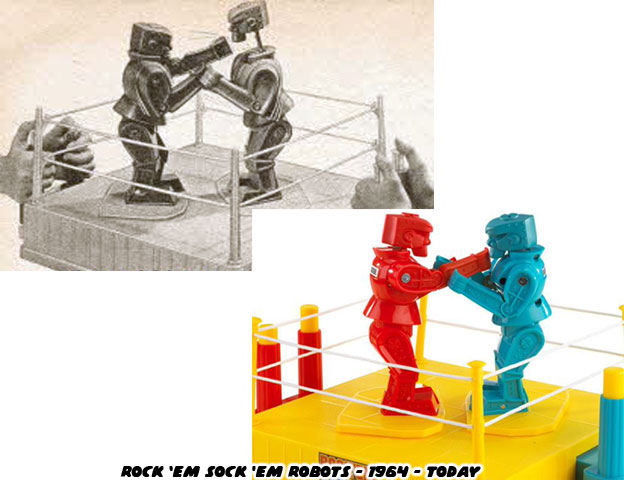
The giant robot genre really took off in the '60s thanks to the imaginative shows in Japan and the USA. Of course the shows were only half the fun, the other half were toys that celebrated the robots themselves. There were of course toys based on Astro Boy and Tetsujin 28 (localized as Gigantor in the USA). One of the most popular robot toys had nothing to do with comics or cartoons. In 1964 the Marx toy company released a two-player toy game called Rock 'em Sock 'em Robots. The game was a rapid paced affair with players looking to punch the jaw of the opponent and cause the spring loaded head to jump up. The generic red and blue figures became icons in the toy community.


Mattel eventually got the rights to the toys and continued releasing them over the next 40 years. The company did a good job of keeping the packaging, and designs unchanged through the decades. The only thing that they did do was make the figures and ring slightly smaller. Perhaps this was a cost-cutting measure, it did nothing to make the game any less fun. The hard edges, exposed bolts and blocky shapes of the Sock 'em robots were very classic. They looked like the robot designs from turn of the century magazines like Popular Science and Popular Mechanics. With heavy brows and chiseled jaws they looked like battle worn gladiators. They had a sort of endearing quality about them. It took a long time for robots in the US to have the same sort of appealing design in film.. In fact it was post 2000 when the success of the Transformers movies by Michael Bay made toy companies realize that they could option the rights to their toys and make a franchise film as well. Everything from board games (like Battleship) to dolls (like My Little Pony) was optioned to get a movie or at the vert least a television show. The film version of Rock 'em Sock 'em changed the title but kept the heart.


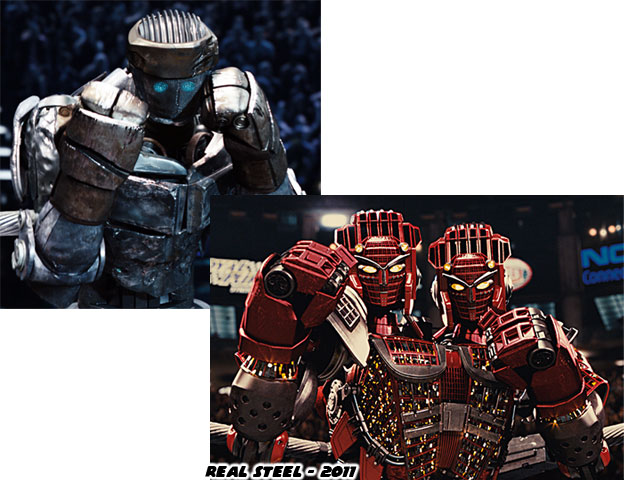
The 2011 family film Real Steel was based on a world where eight-foot tall robots did the boxing instead of people. The film starred Hugh Jackman and the robot he trained to fight named Atom (not a coincidence!). The title had a lot of imagination and introduced robots with over-the-top designs. They were actually well done updates of the classic Sock 'em robots. The studio could have gone a million different ways with the robot designs. They could have had them fighting with guns and weapons like the Transformers films. They could have made them into mechanical bugs and animals as well. But the design team learned that the more human traits they shared the easier it was for audiences to identify with them. So some robots had hair made out of plugs, eyes and in some cases jaws and teeth as well. The humanized designs worked well in Real Steel just as they had on Rock 'em Sock 'em almost 50 years earlier. The same lessons, use of proportions and human traits were applied to the cast in Rising Thunder. But where else did these robotic / humanoid cues come from?


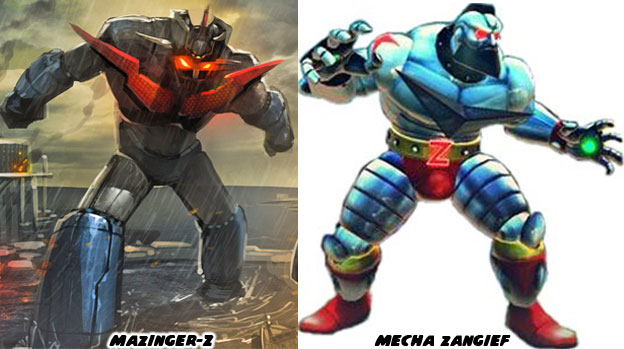
Japan by far had the biggest influence on giant robot culture. The 1972 series by Go Nagai (of infamous Devilman fame) created one of the most popular giant robots ever. Mazinger Z, adapted to Tranzor-Z in the USA, was a piloted robot with an assortment of non-traditional weapons. Unlike the robot designs that used missiles and artillery blasts as a form of attack Mazinger instead had a mix of mechanical and energy weapons. He had a patented rocket punch which allowed him to fire his fist at opponents. On his chest were two red shields that emitted the Breast Fire attack, allowing him to melt most opponents. These were only a few of the assortment of weapons he had at his disposal. The design and abilities of Mazinger Z would be copied again and again by the industry. Some were following the trends but others, like the Mecha Zangief in Street Fighter IV were well done homages. 

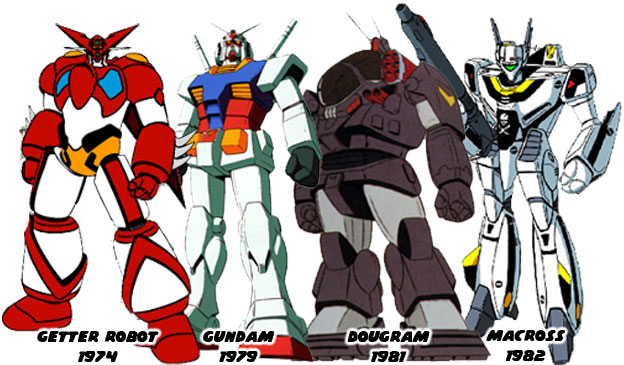
In the 1970's piloted robots became all the rage. These were considered less to be robots and more like mechanized suits of armor, or mecha for short. Writers and artists were looking for new ways to introduce their creations to audiences. Some were lighthearted adventures for kids and others were dramas set against an eternal war. During the era the robots themselves followed a common design trend. The 1974 series Getter Robo by Ken Ishikawa had a robot that was not unlike Mazinger Z. the colors were almost reversed but the character retained the same cylinder-shaped arms, legs and torso. The roots of those designs could be traced back to Tetsujin 28-go. By the end of the decade the artists working on the shows began experimenting with new styles. Possibly the most important was Gundam. The 1979 show by Yoshiyuki Tomino had robots using more angular shapes and sharper edges. The robots themselves reflected futuristic versions of samurai armor and helmets. The artists working on the series over the next 30 years kept a consistent design aesthetic.


The '80s would continue to build on the new trend started by Gundam. One of the most unique robot shows from this era was Fang of the Sun Dougram. The 1981 series by Ryosuke Takahashi had a unique blend of mecha-meets-western artillery. The shapes of the robots were very similar to US tanks and attack helicopters from the post-Vietnam era. It was easy to imagine that each robot was deployed depending on the type of conflict, whether it be a steamy jungle or the bottom of the sea. The Dougram series went on to influence the creation of the western tabletop game Battletech. The trend started by Dougram would be short-lived as another anime series was set to take over the world. The 1982 series Macross by Shoji Kawamori went one-step further towards Japanese mecha and western weapons. The robots in the series could change shape and become full-on aircraft and artillery. It subtracted the artificial intelligence of the Transformers for the piloted weaponized combat of Gundam. It was genius design and set a standard that would be copied around the world.


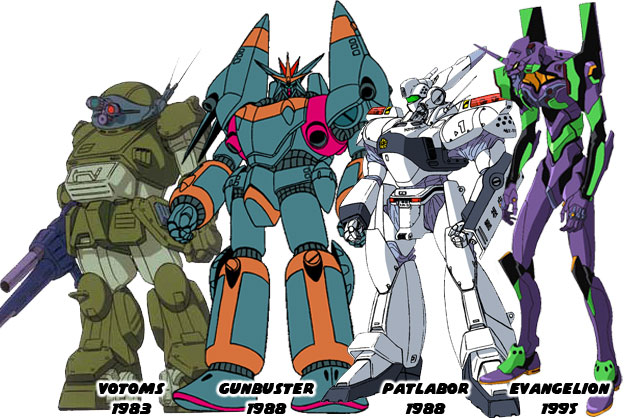
Through the '80s the creators of the robot shows would experiment with the scale and themes of their machines. Some robots were not very large, they were designed for urban combat environments. Some were created as the evolutionary replacement to tanks, such was the case for Armored Troopers VOTOMS, the 1983 series by Ryosuke Takahashi. Other robots were created as the answer to an alien invasion and had to be built on a massive scale with more high-tech weaponry than had ever been seen. This was true for the Gunbuster, a colossal giant robot created in 1988 by Hideaki Anno. that same year a new manga series asked the question of how would we deal with human-controlled robots if they were ever put in the wrong hands? Even something as standard as a construction machine could wreak havoc on a populace. So mecha police officers were introduced in Masami Yuki's Mobile Police Patlabor. Between Gundam and Patalabor the animation studios were allowed to explore all sorts of concepts. The 1983 series Aura Battler Dunbine by Yoshiyuki Tomino had robots that resembled giant beetles. Whereas the 1986 series The Five Star Stories by Mamoru Nagano had robots that resembled paladins and knights.

In the '90s the giant robot trend saw another aesthetic shift. This was due in part to the success of the OVA series Giant Robo: The Day the Earth Stood Still. The episodes debuted in 1992 and showed the industry that retro designs could find an audience as long as the character development and story supported it. About the same time animator Bruce Timm and writer Paul Dini had found success using the same formula with the Batman Animated Series. Years later Kazuyoshi Katayama combined the Giant Robo and Batman animated aesthetics with the series The Big O. The show from 1999 lacked character development and a story and relied more on looks rather than substance. The new Giant Robo broke the mold and allowed creators to go wild with their designs. The Gunbuster designer Hideaki Anno learned from this and went in a direction much different than Gunbuster with the new series Neon Genesis Evangelion. The new robots were rail-thin, enormous and quick, a far departure from the heavy-set Tetsujin 28. The series debuted in 1995, that's right, 20-years-ago! Are you starting to feel old? The evolving designs of these robots did not go unnoticed by the game industry. In the next blog we will explore how they were adapted to early arcade and console titles. As always if you enjoyed this blog and would like to sponsor me please visit my Patreon page and consider donating each month, even as little as $1 would help make better blogs and even podcasts!