Showing posts with label freeblade. Show all posts

Wednesday, January 27, 2016

Building a gaming legacy, the Games Workshop series, part 4...

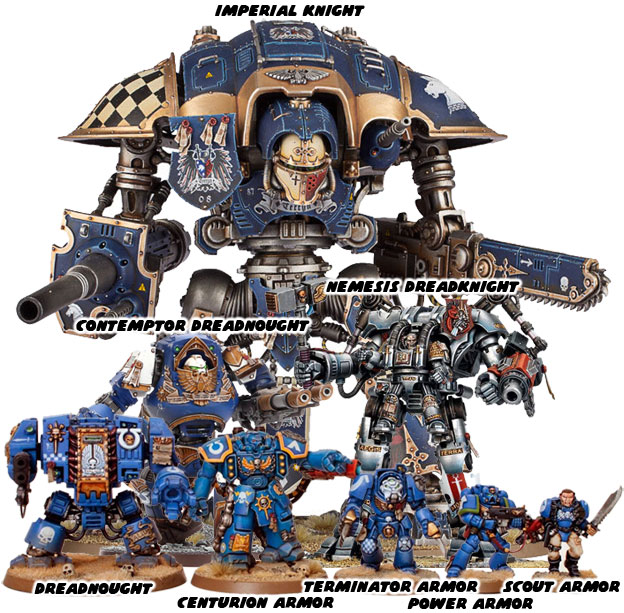
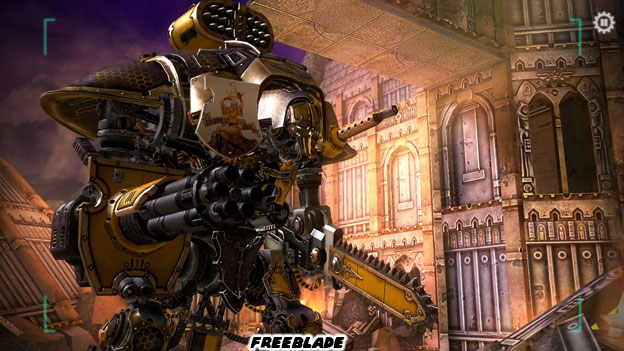
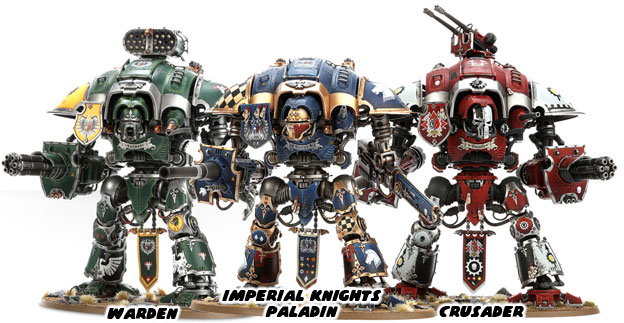
The game Freeblade started off this recent series. The gigantic Imperial Knight robot was the heart of the game. The Knight was a part of the Warhammer 40,000 legacy. It was a unique mix of science fiction storytelling and feudal lineage that created these robots. Before the Emperor of Terra there were nobles that defended humanity from alien threats. They had an army of giant robots that were the equivalent of knights from the legends of King Arthur. They went from battle to battle seeking glory and honor for their kingdom. Just like the knights of old the new giant robots were covered in their particular house colors and were designed to stand out on the battlefield. There were different types of Imperial Knights too, there were Crusaders, Wardens, Paladins and Errants. These all helped distinguish a particular house and gain a reputation throughout the galaxy. When the Emperor of Terra began reuniting all of the human planets in the year 30,000 the Barons and Kings of these various houses joined in the quest and helped the Space Marines conquer and recapture various outposts. The pilots of these machines were nobles, even the one featured in the game Freeblade was royalty and had been raised with the purpose of cementing his family lineage in combat. The Space Marines had their own variation of the single-pilot robot known as the Dreadnought. While it lacked the size and firepower of an Imperial Knight it was still revered by its fellow warriors.


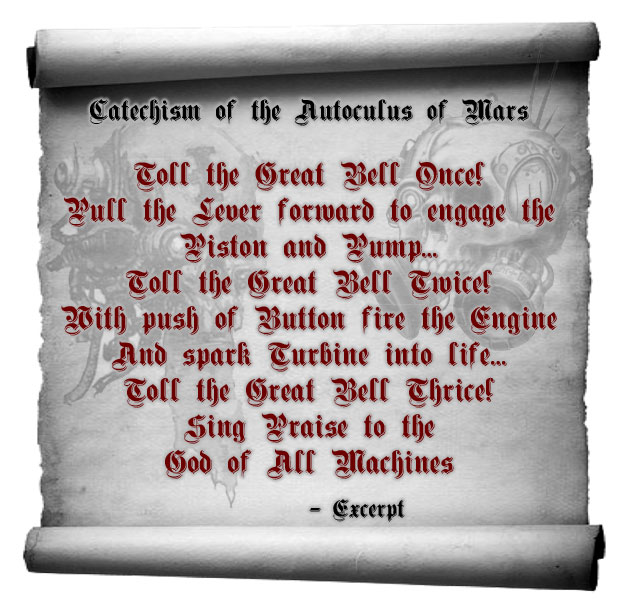
People that don't follow the 40K universe may not be aware that man and machine had been fused together before the Empire and before the Imperial Knights. The engineers and builders of all the great war machines used to conquer space had a base of operations on Mars. This was the home world for the machine cult, the Adeptus Mechanicus. Throughout space there are entire planets dedicated to creating the tanks, robots and space ships used by the Imperium, these are called Forge Worlds. They are highly valued resources in the war against Xenos (aliens) and Chaos. Games Workshop, or rather Citadel has a sister company that builds high-end models for use in Warhammer and Warhammer 40,000. This company is called Forge World. But I digress. The Adeptus Mechanicus believe in the Machine God. All machines have a spirit and the greatest machines, the battleships, star ship and enormous Titans have very temperamental spirits. The Adeptus Mechanicus have litanies, incantations and prayers dedicated to the God of the Machines. When they power up something as massive as a Titan they have a ritual that they go through. The belief in the Machine God has become part of Imperial life, even Space Marines are known to say a prayer to the machine god so that their weapons do not jam in combat.


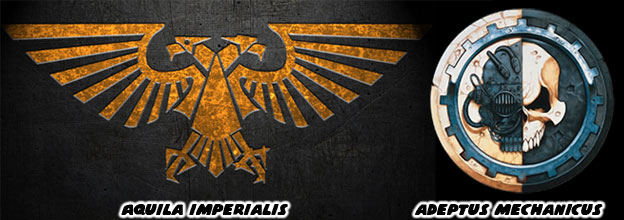
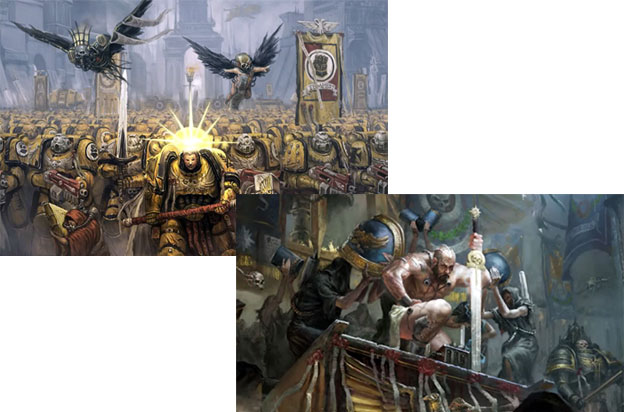
The Emperor of Terra is a very Christ-like figure. He sits upon the Golden Throne and led his Primarchs, which were like his Apostles, thousands of years ago. In canon this relationship can be likened to Catholicism. The hierarchy, organization, symbolism and belief in an omnipotent divine being was done on purpose. Space Marines are very much like friars or war priests, while the female warriors, the Adeptus Sororitas, are like nuns. The champions are canonized in death, even regular people can become martyrs for the Empire if they die valiantly and defy the forces of Chaos and the alien. The Empire is symbolized by a two headed eagle, it looks to both the past and future. This symbol appears on the armor, heraldry and vehicles of the Empire. It even appears on the bullets, or rather explosive bolts in the Space Marine bolt gun. As you can imagine with the rise of the Emperor in the year 30,000 there was a sort of chasm that widened between those that followed rule Terra and those that followed rule from Mars. If the Empire were Catholics then the Adeptus Mechanicus were Freemasons, there was nothing that said they were not allowed to practice the beliefs that they wanted. Both groups needed the other in order to help reunite mankind. The Emperor and his organizers knew that they depended on Mars and the various forge worlds that were needed to build the armor and weapons that would be used in the crusades. They came to an agreement and the rulers on Mars were allowed a high level of anonymity in return for their engineers and technology.


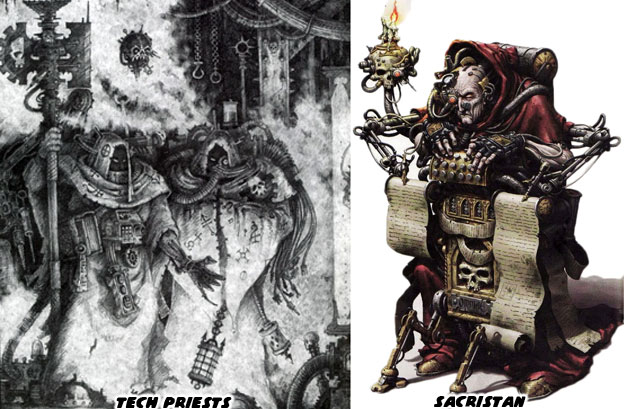
The Cult Mechanicus dated its lineage back, before the Emperor, before the Royal Houses, back before Mars was colonized and back to the great engineers of Terra (Earth). Its rituals were closely guarded as were its organizations. It was not unlike the Freemasons claiming their heritage went back to the architects that built ancient Egypt. Their symbols and traditions followed a Great Architect, perhaps it was the ones the Christians called God. The Catholic Church were by extension a slightly newer religion but one that had close ties to the same foundations of Freemasonry. This was paralleled in 40K. The Cult Mechanicus kept the gears turning for the Empire just as the Masons claim that they built all the great temples of the ancient world and secretly kept the Pharaohs in power. The neat thing about the Mechanicus and Empire was how they were presented in the art of 40K. The servants carried enormous tomes, like bibles with them, some of the text was written by hand, some by machine, in several cases the scriptures were written in digital code. They also carried torches and thuribles, incense burners at the end of long chains used in Catholic ceremonies to bless altars and holy relics. It was great science fiction imagery based on gothic ceremony, that wasn't seen anywhere else in books, movies or television.


The symbol of the Adeptus Mechanicus was a servo skull, half human and half robotic surrounded by a gear. On the larger war machines you may find more heraldry for the Adeptus Mechanicus than the Empire. The practitioners of the Cult Mechanicus, the ones charged with the most important ceremonies of repair and restoration were known as Tech Priests. These characters were mostly machine and carried with them a symbol of the machine god. Instead of carrying a staff with a cross they instead carried a staff with a gear, or wrench and blade. It was both a symbol of the machine god as well as an actual functional tool. The Adeptus Mechanicus have a strong belief that flesh is corruptible and will eventually fail with age, thus as they get older more and more of their human organs are replaced with mechanical parts. Eventually the senior and most experienced engineers are mostly all machine with a number of technical enhancements to their brains and nervous systems. With all of these cybernetic enhancements the Adeptus Mechanicus can actually communicate directly with the machine. They can change code as easily as speaking a native language directly to a machine. They can even send encrypted wireless messages to each other using their mind, which would seem like some sort of telepathy to novices.


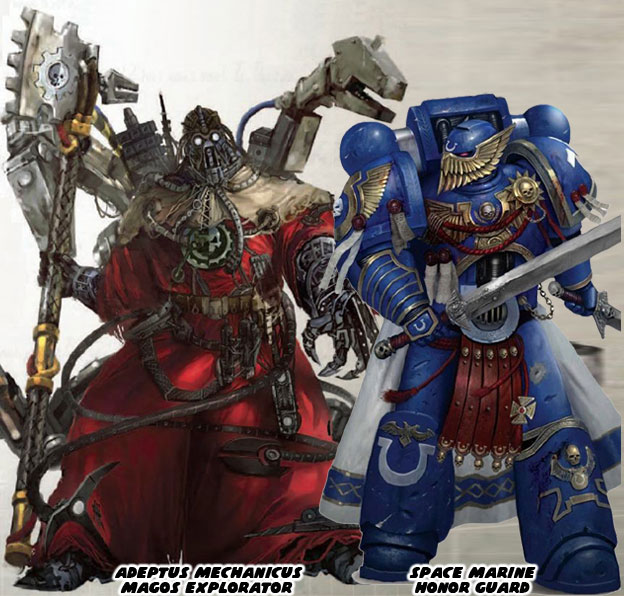
The Mechanicus have gone to war in defense of Terra, Mars and the Forge World for thousands of years. Often times they do so alongside of a Space Marine or Imperial Army. The weapons they use are more esoteric and experimental than those wielded by the human armies. The Mechanicus are not worried about trying untested weaponry in a firefight. Since they are more machine than man the worries of radiation and malfunctions that would kill a normal person are considered acceptable variables. You can easily spot the differences between the followers of the Emperor and those of the Machine God. Space Marines wear power armor in battle whereas the Mechanicus usually wear robes, even in combat. The Space Marine is given biological enhancements with drugs, implants and gene therapy. The Mechanicus is enhanced with machine parts. Both are extremely strong and capable fighters. While the Space Marines are fighting to keep humanity safe, they sometimes do so to honor their own chapter as well. The Empire has zero tolerance for alien and demon alike. The Mechanicus are more concerned with finding and recovering unknown technology. Whether it is demon or alien in origin the Mechanicus have a lot that they can learn from everything. Each new thing brings them one step closer to knowing the Machine God. The Empire would normally destroy or lock away anything recovered from a battle. They would definitely keep these things hidden from the Mechanicus.


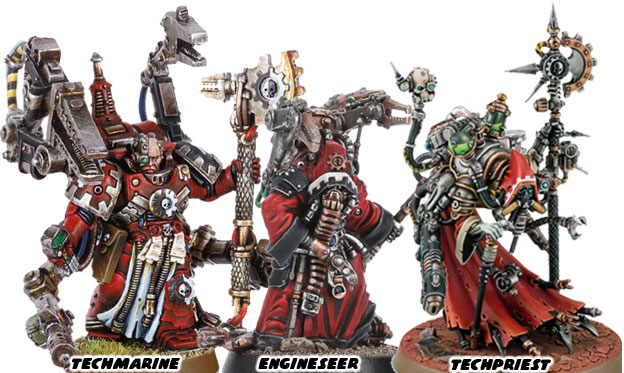
Thanks to their arrangement however it is difficult to keep the Empire and Mechanicus apart when alien technology is found. The Mechanicus are on the front lines, they have trained battle-hardened Space Marines into becoming engineers. These Space Marines are able to perform complex repairs on the front line, their power armor enhanced with extra servitor arms and tools. The more complex equipment is usually attended to by Engineseers. The sculptors at Citadel were able to capture the intricate details of the Mechanicus from the art of the game. The senior Techpriests no longer looked human when compared to the other models used by the Empire. It was great visual storytelling and again, an aesthetic that was not really used in any other science fiction world. The Adeptus Mechanicus really came to the forefront of Warhammer 40K in the late '80s thanks to the introduction of the Titans. Their story and influence in 40K canon would grow over the next 30 years. They had a few models released here and there through the '90s and early '00s and never fell out of favor with hobbyists. They were finally granted their own official units, rules and organizational guide for use in 40K these past two years. Yet this chapter in the history of Games Workshop would never have been written had it not been for a rival game studio. We'll look at this on the next blog. As always if you enjoyed this blog and would like to sponsor me please visit my Patreon page and consider donating each month, even as little as $1 would help make better blogs and even podcasts!

 follow the Street Writer on Patreon!

Tuesday, January 19, 2016

Building a gaming legacy, the Games Workshop series, part 2...

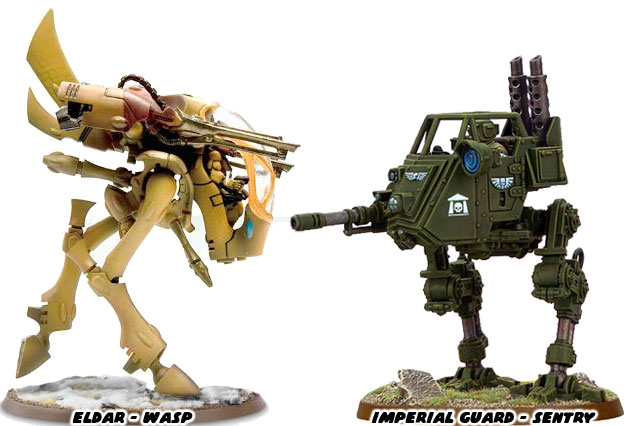
In the previous blog I mentioned that the sculptors working at Games Workshop create some fantastic miniatures for the Warhammer 40,000 system. Specifically these sculptors, sometimes freelancers, work for Citadel, the studio responsible for making the paints, models and tool kits for Games Workshop. Citadel is owned and operated by GW but have the responsibility of all the hobby elements that go into the system. In 40K the sculptors have to create vehicles and machines that reflect the aesthetics of each race. From human to alien, each species has a certain look, a certain style. The designers at GW help put together the back story and origin of each species. The sculptors at Citadel help translate the paintings and illustrations of the artists into three dimensional figures. The work that they do is beyond exceptional, they are awe-inspiring. For example in 40K there are aliens called the Eldar. Think of them like space elves. They are tall, slender and have weapons, armor and vehicles that are sleek. The lines on their war gear are smooth and flowing, inspired in many regards by the beauty of nature. Their weaponry is run on an exotic crystal fusion. By comparison the humans have weapons that we could imagine are forged from iron and steel and are run on diesel fuel. Take a look at the single-pilot walkers that the Eldar and Imperial Guard use in combat. Both machines are prime examples of science fiction storytelling. They have mounted weapons on a robotic frame with two legs but one seems to be half the weight and able to glide across the battlefield while the other stomps around like a clumsy wind-up toy.


These aesthetic choices are by design and help reinforce the species that make up 40K. The Eldar are very proud of themselves and think that all of the other aliens are primitive and crude. The word that they have for humans is Mon-kei. Some of the aliens that they speak of certainly fit the bill. The Orks for example have heavy, cumbersome weapons that double as clubs for the savage greenskins. They manage to cobble together weapons, artillery and spacecraft using whatever crude material they have on hand. In a way they are engineering savants. Their work is not pretty but it gets the job done. On the other side of the cosmos are the Tau. The gray-skinned aliens are very advanced and are trying to bring peace throughout the cosmos, by conquest of course! The technology they exploit is neither fluid like the Eldar or gothic like the humans but instead something completely different. I would compare the design aesthetic applied to the Tau like mecha designs featured in Japanese anime. Not surprising is how well it balances out the technology exploited by the other aliens. These things are especially obvious when you look at the robotic armor that the races can field. Space Marines have Power Armor, Terminator Armor and other forms of armor and battle suits that they can wear. They are not the only ones that benefit from this type of armor.


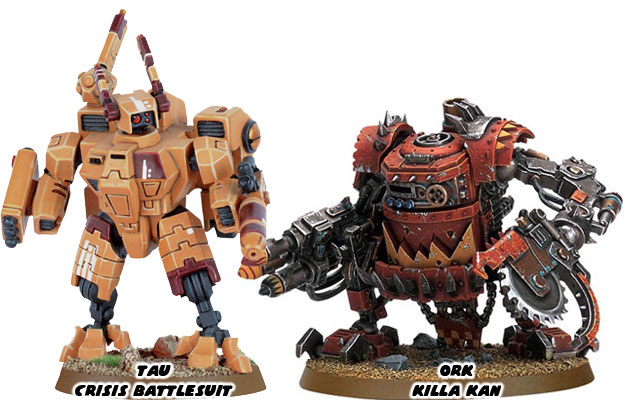
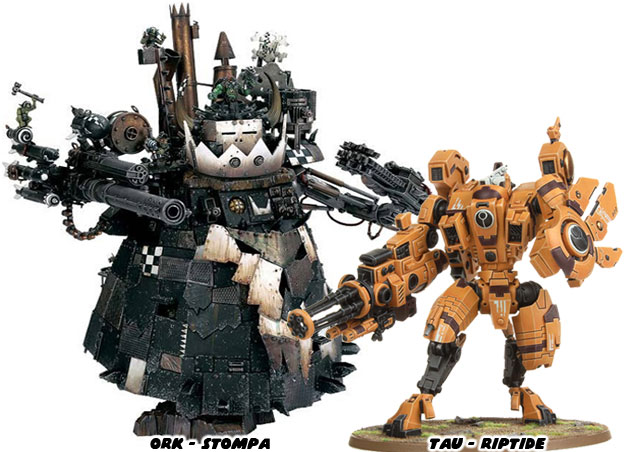
The Tau have a fast and powerful suit called the Crisis Battlesuit. By comparison the Orks have a crude, but equally lethal, robot they can pilot called the Killa Kan. Even though the subject matter of a future that was eternally at war was quite grim the game designers always found a way to put some humor in the system. It's easy to see the differences in alien technology when you compare the weapons side-by-side. When GW was designing the 40K system they learned early on that every alien race needed some sort of counterpart to a particular troop type or weapon. If an alien had a single-person speeder then humans and other species ended up with their own variation on that speeder. If an alien had a tank or transport then humans and other creatures had their own version as well. This sense of balance went from small handheld weapons and armor all the way up to gunships and space craft. The 40K universe always had a great sense of scale. The volumes written and drawn about the universe gave audiences an idea that there were countless other planets and stories waiting to be discovered. When it came to war there were giant robots that made human soldiers seem inconsequential. The artists and sculptors working on the gigantic models never forgot to reflect the technology behind each species. Take a look at the enormous Ork Stompa and Tau Riptide. They were not far removed from their smaller robotic suit counterparts.


Robotic suits of armor were the backbone of the Space Marine armies. I mentioned that there were more than one set of power armor that a unit could wear. There was a reason for these different types of armors and as you can imagine the bigger ones were designed for more dangerous encounters. The sculptors at Citadel had been refining the armor designs for almost three decades. These are easily some of the best miniature figures you will ever see. The detail applied to each piece is amazing. When you see them side-by-side you can only imagine that the team spent countless hours not only creating these models, but they had to turn around and create a balance for each of the alien races as well. Of the single-pilot suits of armor the largest is the Imperial Knight. This was the armor featured in the game Freeblade. This suit of armor was at a scale to combat the enormous robots like the Riptide and Stompa.


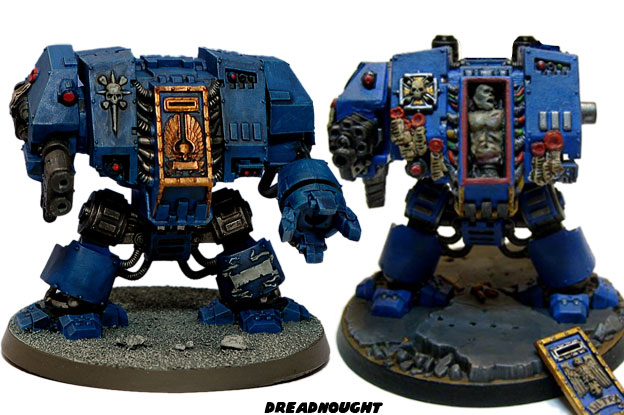
What made the robots used by humanity, and specifically by the Space Marines, different than those piloted by the aliens was the neural interface. Pilots of the Imperial Knight actually became a part of the machine. Their brains and life support systems were tied into the robot during a process called the "Becoming." The consciousness remained with the robot for centuries if not for thousands of years. Only in death would the service to the Imperium end. At which point the robot would be taken apart, reassembled and a new pilot be selected. The robotic host was a tradition that went back to the early days of 40K. The Space Marines were long-lived and super resilient yet even the greatest Space Marine eventually succumbed to injury. Rather than "retire" those warriors and lose much valued military knowledge and experience the best underwent something similar to the Becoming. Those marines were interred in Dreadnought Armor. Their life support systems were connected to the machine and they would be able to fight on for centuries more.


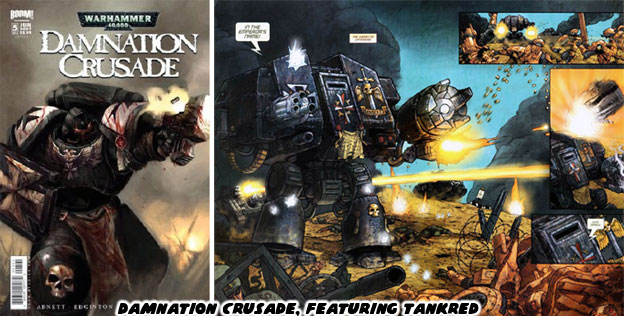
A collection of servitors, or robotic servants would attend to the Dreadnought when not in battle. A Dreadnought was treated like a holy relic. The servitors cared for the mechanical and organic parts with incantations, litanies and sacred oils. The robots received the same care that a nun would give a leper in the slums of poor countries. In many instances the warrior within would sleep for decades at a time until his services were needed once more. One of the great examples of the importance of a Dreadnought in the universe was explored in the comic book Damnation Crusade. A portion of the story is told from the point of view of Tankred, a member of the Black Templars. It's one of the best examples of the sacrifice that the Space Marines make in order to keep humanity alive against the cruel aliens and twisted demons of Chaos. It was great science fiction storytelling and went over amazingly well in the game system.


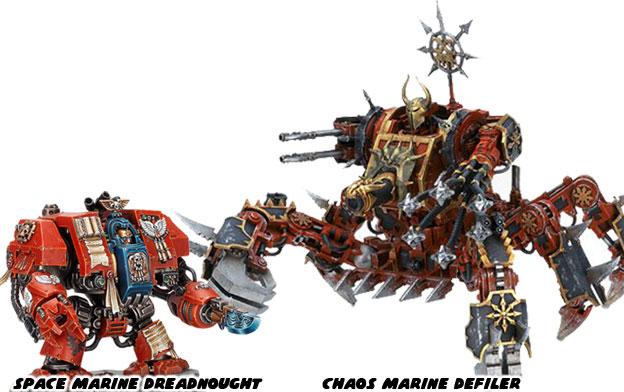
Each legion had its own unique Dreadnoughts, they were honored members and brought into battle an assortment of heavy weapons. The weapons they used, the literal arms on each robot, could be replaced depending on the battle. They had robotic hands that could tear open tank armor, flame throwers that could burn down buildings and plasma cannons that could blow holes through the biggest opponent. The idea of man and machine unified was something that made the science fiction in the world dark and foreboding. This technology was not exclusive to the Space Marines but had a variation in the alien races as well. The most interesting combinations of living tissue and robot came in the forms of the Chaos engines of destruction. The forces of chaos could turn man into beast and heroes into demons. Those that were previously pilots and crews on tanks and artillery became fused with the machines. Not thanks to technology but the magic of the warp, that part of the galaxy that exists beyond our concepts of time and space. Bones became forged into the structure of the machines and blood replaced oil in the infernal contraptions. Skin was stretched across the joins like some macabre hide. Just look at how more intense the Chaos Defiler looks when compared to the already enormous Dreadnought.


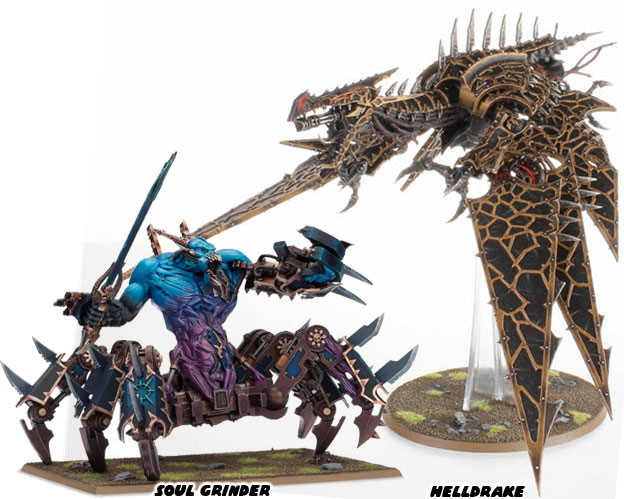
The more powerful the demon the more powerful the living weapon they would become. Some of the larger machine and creature hybrids dwarfed the mighty Dreadnought. Just take a look at the Soul Grinder. The multi-legged robot was far more than a Defiler and yet not quite a demon prince but instead something in between. The forces of Chaos rewarded their champions with awesome powers. Some became larger and more grotesque monsters, some were given weapons with magical properties. Other machinations of chaos were metal birds that could take on any assault jet. The larger weapons of chaos had a purpose, they were a counterpart for the most powerful artillery in an army. Citadel did a fantastic job bringing these creations to life. The designs created by the studio went on to influence other miniature gaming systems and even video game development as well. Several of these monsters-turned-vehicles began popping up in Games Workshop video games.


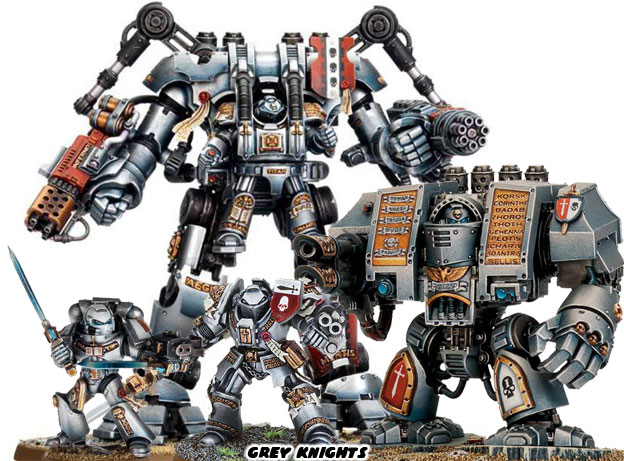
For years the Dreadnought was considered the most valuable single-pilot robot in canon. The Space Marines and Chaos Space Marines made great use of these machines. Just a handful of the robots could change the course of a battle. Yet as the system grew over the past 30 years the threats became bigger and stronger. Thanks to aliens that became more aggressive and dangerous it was not enough for a Dreadnought to take on the most powerful opponents. Games Workshop began creating more powerful armor for the Space Marines. The Terminator Armor was the best for a long time, then the studio introduced Centurion Armor as well. Gray Knights even had access to a gigantic walking frame so that they could face demon princes in hand-to-hand combat. Yet these bigger and better armor choices were not always enough for the biggest enemies in the 40K universe. This would become the task of an even larger robot. The Imperial Knight, the star of the mobile game Freeblade, would become the most powerful single-pilot robot in the ranks of the Imperial Army. The best part of this robot, aside from its awe-inspiring design, was that it was created so that it could freely move between armies. It did not have to adopt the livery of any particular army. Instead it was a freelance robot that had its own legacy recorded on its own armor. It could have its own insignia and even custom weapon choices to wear in battle. Then it was free to move to another sector of space where it was needed by a different legion.


The Imperial Knight was a force to be reckoned with. The forces of Chaos and the different races learned to feel the mechanical giant in battle. Yet when it came to the history of Warhammer 40,000 it turned out that the Imperial Knight was not at the top of the robotic food chain. If you can believe it there were robots even bigger helping keep the torch burning bright for humanity. The next blog will feature these colossal machines. As always if you enjoyed this blog and would like to sponsor me please visit my Patreon page and consider donating each month, even as little as $1 would help make better blogs and even podcasts!

 follow the Street Writer on Patreon!

Wednesday, January 13, 2016

Building a gaming legacy, the Games Workshop series, part 1...

The mobile game Freeblade that I had talked about earlier on this blog really got me thinking about Games Workshop and all the fantastic systems they've released through the years. I decided I should make my next blog series about those games and how they were translated to PC, console or mobile games or deserve to be translated. I also wanted to talk a little bit about the ups and downs of Games Workshop, how they have evolved or haven't and why the hobby community is still a strong draw. Before we get into all of that we need to explore the world of Warhammer 40,000 (40K for short). This was the universe featured in Freeblade. Many of my readers might already be familiar with that universe and others may not. So I'm going to point out some things that I really enjoy in the sic-fi epic. The thing that many people recognize about 40K are the Space Marines. In the far future these are genetically enhanced super soldiers that are one of the defenders of humanity. These soldiers have gone through mental and physical changes are are far more than average people when they undergo their transformation. Most Space Marines are over seven feet tall and have denser bones, organ implants and musculature that is superhuman. Part of the Space Marine ritual and by extension the entire 40K universe is how much spirituality and science fiction are mixed into canon. The Space Marines were created by the Emperor of Terra (Earth) around the year 30,000. He created many chapters but half turned to evil, seduced by the forces of Chaos and the rest remained loyal and defended Terra during the Horus Heresy.


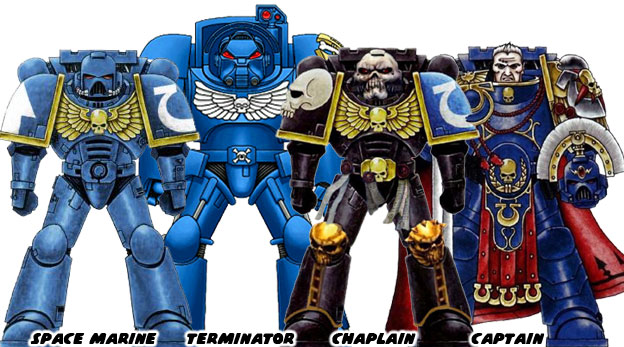
Now fast forward 10,000 years and humanity is still scraping out an existence throughout the cosmos thanks to the protection of the Space Marines. Yet the entire process of creating a Space Marine, as well as the weapons and munitions they use are considered sacred. In some cases the bravest and longest-serving leaders may actually get to use ancient weapons in battle, these relics are as potent now as they were 10,000 years prior. In many instances good and evil are constantly scouring the universe for lost technology and other relics that they can use to change the tide of battle. Even the armor that a Space Marine uses can be passed down through the generations. The types of armor that they wear actually depends on their rank, position and battle. The traditional Space Marine that most people imagine, with large shoulder pads and a jet pack, is called "Power Armor." There are many other types of armor in the universe. The First Company, made up of the most experienced Space Marines from a chapter get to wear Terminator Armor, this is reserved for the most dangerous assignment or inhospitable planets or while boarding alien vessels. There are Chaplains, who keep the faith in the Emperor of Terra burning bright in the Companies, as well as Librarians who are the psychic members of the Space Marine forces. There are also heroes and Captains, each with their own armor and weapons.


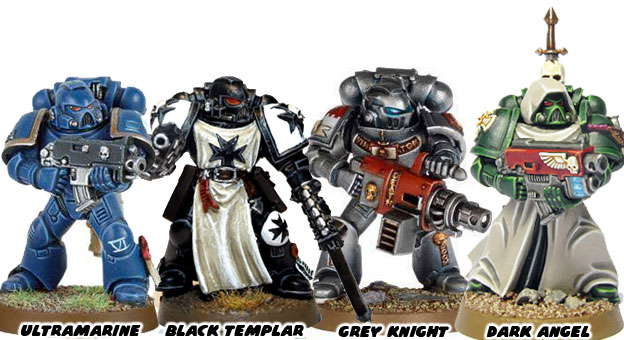
There are countless Space Marine chapters in the Imperium. One of the greatest things that Games Workshop did was create rules and encourage players of the 40K system to create their own chapters. These can be related to existing chapters and may identify with their own goals and methods. Prior to the Horus Heresy there were almost two dozen founding chapters. After the heresy they were broken up because the chapters were so powerful that any one could be considered a serious threat to humanity, especially if the leaders became seduced by Chaos. By breaking apart the chapters and forcing them to create sub-chapters it created a sort of checks and balances for all of the units. Some of the most famous founding chapters remained post-heresy and Games Workshop does create special models and rules for these groups. The Ultramarines, which are featured in the great console game Space Marine by Relic Entertainment, are very popular and reminiscent of ancient Roman legions. The Black Templars were stubborn and refused to "downsize" when the Imperial Fists were disbanded and the second founding was created. So that they would not break the treaties of the other Space Marines they decided to launch a crusade against all the threats of the Imperium and take the battle to the stars. In this way they could remain united, hold a higher concentration of actual members in one place and at one time and answer little to administrations.


The Grey Knights are made up of powerful psychics or "psykers" and are the military wing of the Inquisition. They are the elite squadron when it comes to fighting demons and the forces of Chaos. In the 10,000 years since they were founded they have never lost a member through corruption. They have access to some ancient weaponry that would be the envy of other chapters. Their weapons however are designed to take out demons rather than aliens. The Dark Angels by comparison were the first chapter created by the Emperor and have been fighting for redemption ever since the heresy. Some of their own became traitors during the war and caused the entire chapter to become suspect. Because of this they have spent the past 10,000 years hunting down the traitor chapters and atoning for their sins. Something that makes the universe of 40K so unique is how each chapter guards its secrets and how little they may know about each other. Few people in the Imperium even know about the Grey Knights for example, they are a secret army in the fight against demonic possession. They are spoken of in legend but never seen, even by other Space Marine chapters. Some chapters look down on mutants, psykers or abhumans and would never associate with them or fill their ranks with them. While in other cases a chapter may be tolerant of mutants because they remain loyal warriors. And in very rare cases some chapters have fought alongside aliens against mutual enemies, usually the forces of Chaos. When playing the game it really helps to understand the psychology of each chapter and find out what makes them tick. Of course the other great thing is getting into the science fiction part of the hobby and building an army of unique-looking warriors.


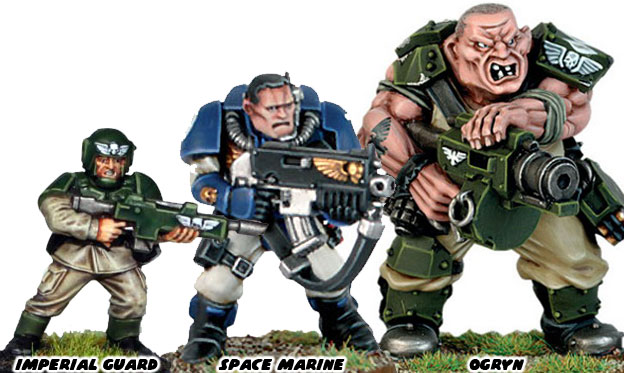
Every army in the Imperium has its own collection of weapons and war gear. Some are even exclusive to a certain chapter. The scale and aesthetics of each race, whether human or alien, is unique in their own ways. This is something that the sculptors working at Games Workshop know very well. They are able to sculpt weapons and war gear for different sizes of humanoid and alien races while making everything look plausible. For example in 40K the Imperial Guard are the human-sized soldiers. They have access to the greatest artillery in the future. Enormous tanks, high speed fighters and fortifications that could withstand thousands of years worth of conflict. While they are not as big and powerful as the more popular Space Marines, they do have their own strengths with regards to the weapons they yield and the vehicles they can take into battle. You don't really realize how much larger the Space Marines are until you put them next to an Imperial Guard soldier. Even outside of the Power Armor the Space Marine stands much larger than an average person. But even a Space Marine is not the biggest humanoid in the universe. In 40K there are space ogres, known as Ogryn. These men are considered "abhumans." Most mutants or abhumans exist on the outskirts of society. Those that don't kill themselves, or are turned into slaves end up in prison or work as beasts of burden. Ogryn are the exception. They are big, strong and tough and love to fight. They are very dumb however and require a strong leader. In battle they are extremely resilient to the elements and weapons. They can easily shrug off attacks that would kill a normal human and seriously wound even a Space Marine. This makes them dangerous warriors and perfect human shields for the Imperial Guard.


The weapons and technology, the alien races and backstory behind Warhammer 40K are unique among every other science fiction game out there. It actually holds up very well against the biggest movies and television shows over the past half century as well. Of course for those that want some amazing weapons they probably won't find anything better than those featured in 40K. From the small but powerful las-pistol of an Imperial Guard infantryman to the transmission-sized Ripper Gun of the Ogryn, the hand-held weapons of the future are awe-inspiring. But these things are nothing compared to the weapons of war that all of the races bring into battle. When you add giant robots into the mix things get much more interesting. The next entry will look at the robots that serve the Imperium and those of the enemy. As always if you enjoyed this blog and would like to sponsor me please visit my Patreon page and consider donating each month, even as little as $1 would help make better blogs and even podcasts!

 follow the Street Writer on Patreon!

Saturday, December 19, 2015

Freeblade, the elements of great game design...

The previous blog was my quick review of Freeblade, but today I would like to dissect it and explain why I liked it so much (and possibly why other game players did too!). Full disclosure though; I am a long time fan of the Games Workshop (GW) tabletop games. I've been a fan since the early '80s, which is rare for someone from Southern California instead of England. I've been following the ups and downs of the company and their systems for most of my life. I give credit where credit is due and believe that GW influenced other tabletop systems, and also designs in video games, movies and comics for almost half a century. I've always had a hope that someday the rest of my friends and the video game audience at large would recognize their contribution. I always hoped that a slew of great video games and movies would flow from their IP. After a great learning curve the best video games are starting to come out, and I'm going to talk about those beginning with Freeblade.
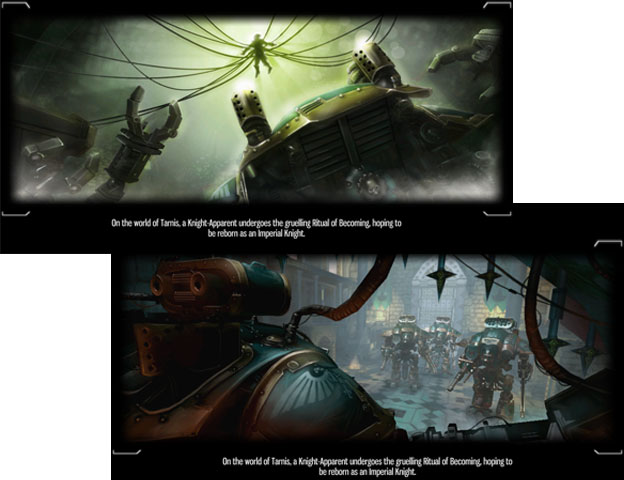
 

Freeblade was a perfect example of how to design and execute a video game. Those of you that were wondering what were elements of great game design should be taking notes. The story began right in the middle of the action. The audience was placed on the planet of Tarnis where a young Knight-Apparent, the person who would be controlling the gigantic Imperial Knight robot, was undergoing a ritual called the Becoming. This ritual would unite his mind an body with the machine. The choice of words was very important, technological and military organizations in the Warhammer 40,000 universe very often went through ceremonies with religious origins. Except instead of worshipping the traditional figures of Jesus, Buddha or Allah, those in the future were following the Emperor of Terra and the Machine God. The Emperor of Terra was blessed with amazing strength, intelligence and even psychic powers, he was the person that created the Space Marines and helped take humanity across the cosmos circa the year 30,000. He was very much a Christ-like figure for humans in the far future. The life of the Emperor and his accomplishments were spoken of in reverent terms, and in many instances the vehicles and weapons that were used in the future were regarded as holy relics.This bit of framing was by design going back to the roots of the tabletop gaming system itself. I will be speaking at greater length about this relationship in future blogs.
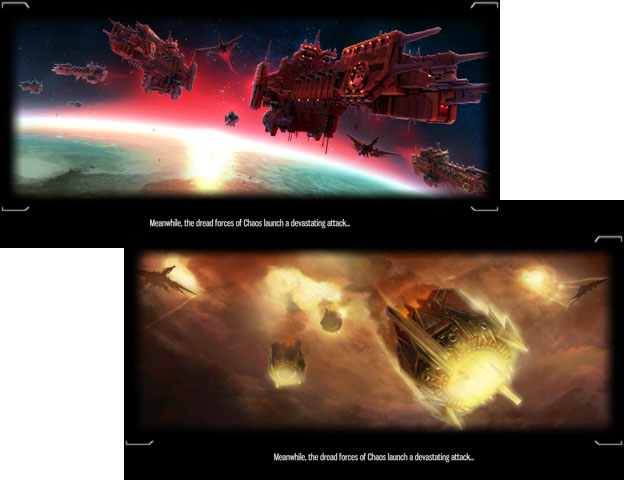
 

To return to the game however the Knight-Apparent was not simply a pilot in the machine. It was not like he could open a cockpit door and sit in a chair. He was instead becoming one with it, his neural receptors, his biological organs and entire body would be wired directly to the machine. He would be in service to his Emperor until he was completely destroyed. The game didn't waste time explaining how long Tarnis had been around or who the founders were. As the ritual was happening the planet was being besieged by the forces of Chaos. Specifically the followers of Khorne, the blood god, were doing the invading. There were four major Chaos Gods in Warhammer mythology and Khorne was the most violent and bloodthirsty. But again I will talk about the mythology in a future blog. The planet was being invaded undoubtedly for its technology and resources. The forces of evil were sending Chaos Marines, corrupted Space Marines, to the planet surface via Drop Pods. These were weaponized space capsules that allowed troops to be deployed from orbit. These pods landed right on the Imperial headquarters and began all of the action. If you look at the great adventure stories, games and movies you would spot a trend. The best works always started right in the middle of the plot. They did not spend chapters explaining where we were or how we got there, instead we began at the most important moment. Whether it was Star Wars opening with a space battle between the Rebels and the Empire, Harry Potter finding himself aboard the Hogwarts Express, or Kratos throwing himself off of a cliff at the beginning of God of War, the stories that hooked the audience right away were the ones that were remembered. Freeblade had the exact same thing going for it with the invasion. Budding game designers should have noticed that.
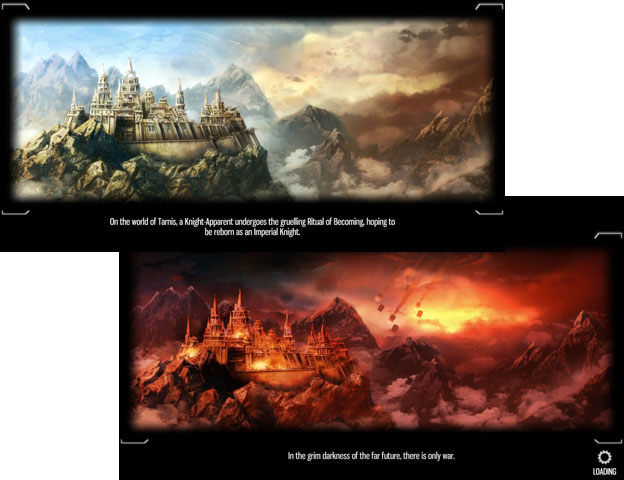
 

From a game design standpoint the audience had to be willing to pick up the controls and get into the action. There was no time to get settled in the role of Imperial Knight, this meant that there would be no boring tutorial to play through. The audience took control of the robot right away and had to survive a literal "trial by fire." The Knight would be attacked from all sides. Everything from infantry and assault vehicles to gigantic war machines had come in for the kill. Wave, after wave of enemies bombarded the players. The action did not stop from the time the stage started until it ended. That level of tension was a great motivator. It would help establish the type of experience Pixel Toys was trying to create. The player had to learn how to target opponents and manage their weapons as they made their way through the gothic Imperial streets. It was genius game design and something that worked well in the continuity of Warhammer 40,000. Different games required different levels of engagement and this universe required nonstop attention. In the far future there was only war. Humanity was fighting for survival on every planet and every outpost. There was always a sense of urgency in every story and every supplement that Games Workshop released. Billions of lives, an entire population would live or die depending on the outcome of a single conflict. That premise translated very well into a great tabletop and video game experience. That level of urgency had been used by many great action video games since.
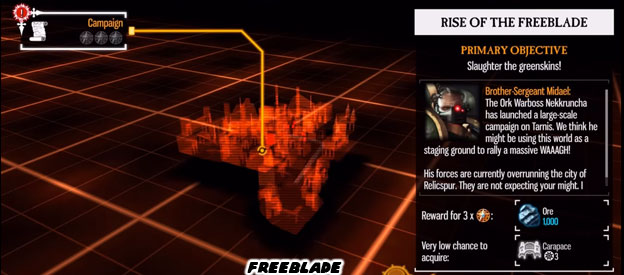
 

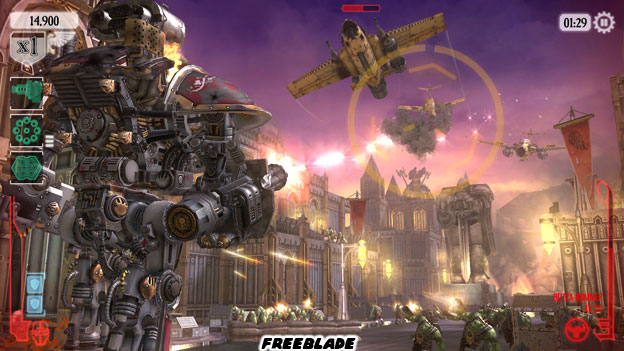
In Freeblade the player would try to recapture or defend the streets of Tarnis from the invaders one block at a time. It was a violent conflict that was completely unlike any shooting game that came before it, including the other Warhammer 40,000 games. In most first person or third-person shooting games the player had to constantly move and look for cover. They had to constantly hunt for weapons and ammo. In this game the Imperial Knight was fully loaded and walking in the dead center of the street. There was no cover as it was wide open to attack. But that exposure worked into the game mechanics. The Imperial Knight was like a tornado, tearing up everything in its path. Small arms fire and even small rockets were like pesky insects to the enormous robot. Characters that were over seven feet tall in canon couldn't even reach the knees of the robot. The player had a sense as to what being a 50-foot tall robot was like. It was an absolute rush. Players did not need to run for cover, they did not need to hide from any opponent. Even the largest tanks could not intimidate the Imperial Knight. If anything the opponents were the ones that had to hide because of the ease of which the a player could demolish a battalion.
 

As with any great game or adventure film there had to be a twist added to the story. It would be something that cranked up the tension even more than it already had been. Just as players assumed that the game would be about the Empire versus Chaos, a classic good versus evil plot, it turned out that a different enemy force had also landed on the planet. The brutish Ork's, green skinned monsters with crude weapons, had launched a campaign of their own. Tarnis had become a free-for-all. This was a fantastic plot twist and it happened early in the game. Think about how great books and films also used the exact same device. Star Wars built up to the Emperor, someone with even more power than Darth Vader. Harry Potter built up to Voldemort, someone to be feared more than Severus Snape. God of War built up to Zeus when Ares was assumed to have been the main villain. In Freeblade audiences now had to worry about the tactics and weapons that each type of enemy would use against them. They would have to learn how to react to the differences in technology used by each opponent. Orks for example had weapons that hit hard and fast but weren't necessarily the greatest in the armor department. They might strafe a player from the air or zoom past them on a motorcycle rather than dig in and battle like the Chaos Space Marines. Despite their rough-looking weapons the Orks were engineering savants. They could cobble together a tank or jet fighter with scrap pieces. This meant that they could also build their own giant robot to fight against the Imperial Knight.
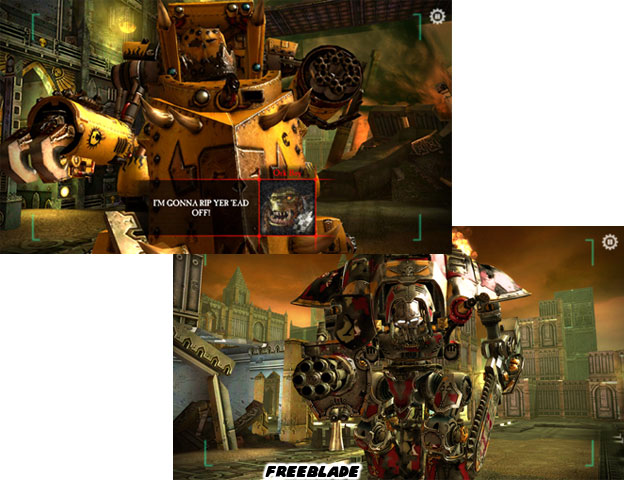


Pixel Toys actually created several different Gorkanaut's, or Ork giant robots, for players to do battle with. Like many of the Ork vehicles, these giant robots were rough around the edges. They had layers of armor plating over a blocky frame. It was a good contrast to the Imperial Knight's regal-yet-functional armor. These crude machines were also strapped with enormous cannons, missiles and melee weapons. The Orks would often unleash a Gorkanaut or two from a side building or blind alley. The giant Ork machines would instantly close off the advancement of the Imperial Knight. Not only that they would charge right at the knight and trigger the melee battle mechanic in the game. This completely changed the way that audiences were experiencing the combat and helped break up the long portions where all they did was point and shoot at targets. During the melee fights the player could not use their long rage weapons, instead they used an enormous chainsword (like a chainsaw arm) to cut the enemy in half.
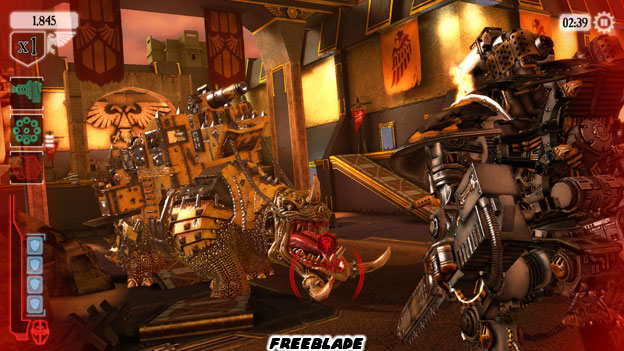
 

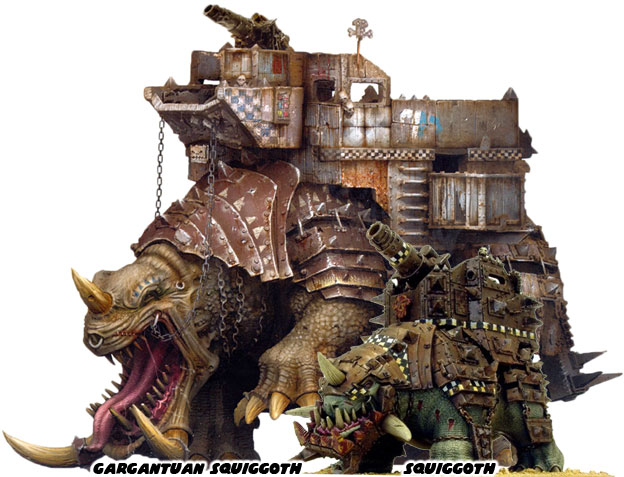
This was not the only oversized weapon that the Orks had at their disposal. They were known for developing weapons out of whatever was available on any planet they invaded. Instead of creating battle tanks the Ork's would sometimes commandeer a giant alien reptile, whose hide was as thick as armor, and place a small fort on its back. These giant alien monsters were better known as Gargantuan Squiggoths. They were often larger than the largest Imperial tanks. The Orks captured the Squiggoths on a far off planet and transported them around the cosmos to be used in all-out assaults. When it came to the actual tabletop gaming system the Gargantuan Squiggoth was a centerpiece in an Ork army. The models were huge, detailed and very pricey. If a player could afford one or more they were usually a veteran gamer with a lot of disposable income as well as time. Yet for younger generals there were also smaller Squiggoths, which were still larger than most artillery pieces. Pixel Toys went to great lengths to capture the look and feel of the 40K universe. I would sometimes miss an opponent because I was too busy looking at the details in the background. The Imperial buildings looked as if they came right off a tabletop campaign. There were statues honoring heroes of the Empire, there were towers and bridges that the player could not only see but also demolish. There were energy plants and ammo dumps that were as vibrant as the ones featured in the pages of White Dwarf magazine, the monthly magazine published by Games Workshop. As the player advanced through the streets we could often see Chaos or Ork soldiers holding a position behind sand bags. We could see them run along rooftops and try to set up positions for rocket-launcher attacks. These warriors would unload from their armored personnel carriers, tanks or drop pods and start shooting at the Imperial Knight. These figures were relatively tiny on the screen and could be picked off like bugs.


In many stages the player would be joined by Space Marines from the Dark Angels Chapter. As a crossroads a player would actually see a Rhino transport unload the Space Marines and then watch them start fighting opponents on the ground. Sometimes they would storm a building and try to recapture it. Sometimes they could be seen crossing a bridge, or engaged in a firefight on the rooftops as well. Pixel Toys went to the trouble of programming background details that helped bring this world to life. They were putting in the effort you would expect of a AAA console title but into a mobile device. All of the Space Marines were small on the screen but still possessed and amazing amount of detail. They had proper weapons, proper armor and moved exactly as one would imagine the tabletop miniature figures would if they could. Watching the tiny heroes and villains do battle in the background put the entire game in perspective. The majority of Warhammer 40K games, both the tabletop and video game kind, had been told from the point of view of the Space Marine. The Space Marine represented the ultimate human weapon. Thanks to intense genetic modifications (including getting new organs implanted to their biology!) the Space Marines were over seven-feet tall, incredibly strong and resilient to poisons, the elements and injuries. They had to be superhuman soldiers because of how dangerous the alien menace was. The Orks for example were slightly larger and stockier than the Space Marines. In a tabletop game the two sides looked evenly matched. When the figures were placed next to the human-sized Imperial Guard soldiers the contrast was striking. One would imagine that watching the Orks and Space Marines fight in real-life would be fearsome. Yet in Freeblade both sides looked insignificant. The destructive power of the Imperial Knight was simply too much for any humanoid opponent to withstand. Game designers were always searching for ways to make players feel as powerful as the characters they were controlling, Pixel Toys accomplished that many times over. The biggest contribution the studio made was in immersing the player into the world of Warhammer 40K.
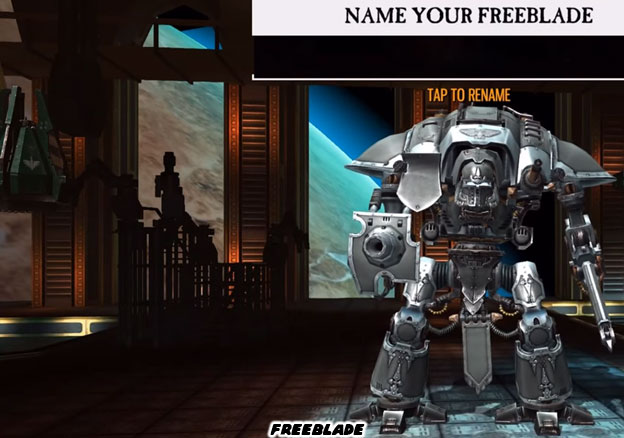


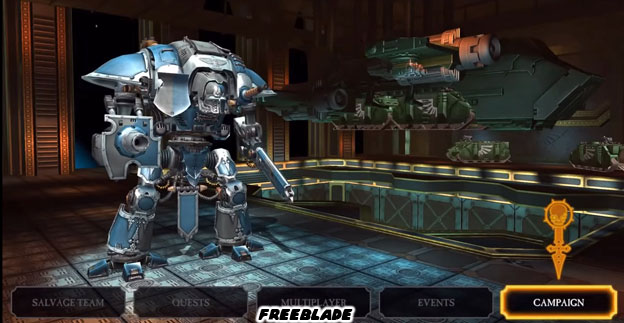
Right after the very first level the player found themselves orbiting Tarnis, aboard the Dark Angels Strike Cruiser: Fist of Caliban. It seemed like a throw-away detail but the menu screen where the player could customize their Knight was all set aboard the ship. In the background the planet Tarnis was slowly rotating, It was the type of eye-candy that science fiction fans longed for. And again, as a long-time fan of Warhammer 40K it was something that I could only imagine what being inside an Imperial Cruiser would have looked like. The studio made sure to convince players that they were in orbit above the home world. As such they could be deployed at any moment to any corner of the planet. While aboard the ship the players learned what their objectives were and watched the story play out. After the initial assault on the planet the gamer discovered that they were the last surviving Imperial Knight from House Drakkus. Lucius Irynblud, the House Sacristan, was the only other surviving member of the initial attack. The Dark Angels, well regarded in the lore of 40K, were the hosts. Brother-Captain Tigraine and Brother-Sergeant Midael would orient the player and give them updates.
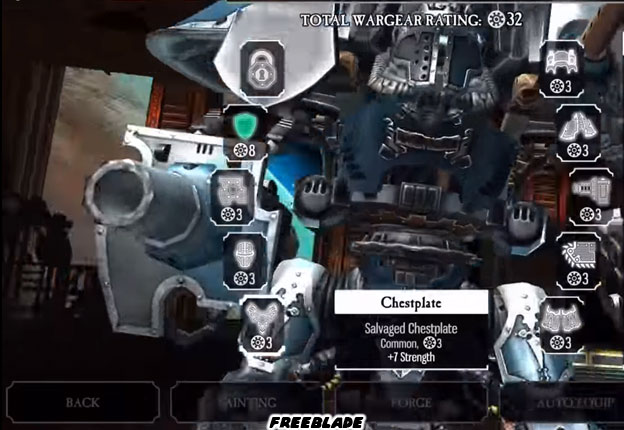
 

Story, graphics and control aside there had to be a reason for the player to keep coming back. Fans of 40K didn't need much convincing to return again and again. Most players did enjoy the awesome power of shooting at enemies from a giant robot but that experience would get old quick if it were the same each time they played. To mix things up Pixel Toys had daily objectives for the players to fulfill. To keep audiences engaged the players were rewarded for how well they performed in each stage, what secrets they found and even for how accurate they were. Players could upgrade their weapons with items they recovered. Ore that they brought back to the Fist of Caliban could even be forged into stronger weapons and armor. Players could not only customize and upgrade their weapon selection, they could also change the look and color of their Imperial Knight. Again these were details that one might expect in a AAA console title but the fact that it was in a free-to-play game made it all the more impressive.


Freeblade could be considered the new standard for mobile games. More than that it was an experience that could have, and perhaps someday might find a home on the new consoles. I hope that outside developers and designers would take a serious look at this title. There was much that even veteran designers could learn by studying it. At the very least they could learn the proper way to handle an IP from Games Workshop. For many years fans of tabletop gaming, and the publishers themselves, felt that the video game would kill the market for hobby systems. Yet decades had passed and tabletop gaming as well as board gaming were still very popular. What many publishers failed to recognize was the importance of video games and how they were an extension of the gaming hobby. A well made video game could serve as an introduction to the tabletop gaming systems. Thanks to games like Freeblade, and the exceptional Warhammer 40,000 Space Marine by Relic Entertainment, the traditional tabletop systems were undergoing a renaissance. Advances in technology benefited everyone in this regard. Freeblade was possibly the best example of this introductory experience because it was free and could be played on a mobile device. Games Workshop had found its best gateway title, but they had actually been at work for several years experimenting with the video game formula. Future blogs will look at how the tabletop systems were adapted for the mobile market, I hope to see you back for those. As always if you enjoyed this blog and would like to sponsor me please visit my Patreon page and consider donating each month, even as little as $1 would help make better blogs and even podcasts!
Thursday, December 17, 2015

Freeblade, one of the best mobile games ever made...


I want to do a quick review on the new iOS game Freeblade by Pixeltoys. The game was one of the featured titles on the iTunes Store and an Editor's Choice when it debuted in late 2015. The reviews so far have been very positive, earning a 4 1/2 star average on the iTunes Store from thousands of players. Why isn't it a perfect 5-star game? The answer is simple, the game entices you to receive bonuses if you sit through a 30 second commercial for other games. Which is nothing to complain about given that this is a free to download and free to play title. From a design, control and execution perspective the game itself deserves 5 stars but I would argue it is being penalized by the pay-to-play market. Those that buy the in-game features get to extend their play and enjoy the title in more ways. Microtransactions are the bane of many game players but they are the necessary evil of the mobile market. Let's face it, if the game was priced at $24.99 on the iTunes Store with everything unlocked from then nobody would buy it because there are thousands of free games available. It's a strange dilemma for developers to be in. After playing it however I'd say that at $49.99 the game would be a bargain. Why is that? Freeblade looks as good and plays as good (if not better!) than some of the best AAA titles you would find on the portable consoles. Sony and Nintendo, I'm looking right at you! The cheap and mindless games about birds and candy may be more popular with audiences, and may make more money for the developers, however the era of the heavyweight mobile games has officially arrived.


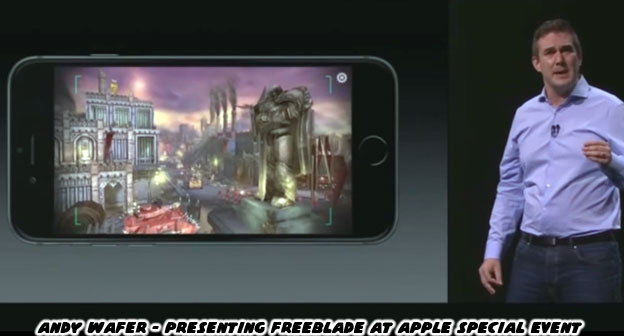
I wasn't sold when it was first announced. I love the universe that Games Workshop had created but most of their video games left much to be desired. But then something happened this fall. At an Apple Special Event the details on the new iPhone 6 and new iPad were announced. In order to highlight the leap in performance that it had over the previous models Apple had a few developers demonstrate some of the features using their software. One of the last presenters was Andy Wafer the CEO and Co-Founder of Pixel Toys. He used Freeblade to demonstrate the new graphics processor on the iPhone. It was almost twice as fast as the previous generation and capable of presenting graphics with greater fidelity and with far more effects than any previous mobile device. Not only that the new touch scheme meant that the control was much tighter and allowed for advances in the way the game controlled and played. The presentation almost won me over but there was some doubt in my mind. Would I really have to get a new phone in order to enjoy the game? After all the 5th generation of devices, including my iPod Touch, had some memorable games and were capable of displaying some amazing graphics as well. Have you seen Ridge Racer Slipstream for example?


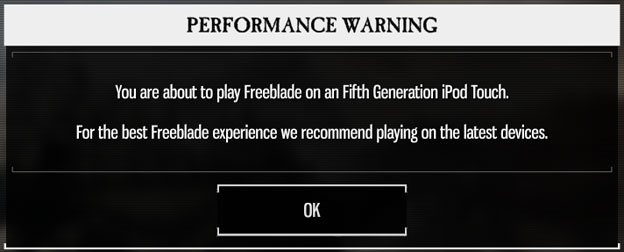
I downloaded the game on the iPod and right away I was warned that for best performance I needed to upgrade my hardware. I pressed OK and was presented with the opening story for the game but before it would ever load the first level the game would crash. I tried getting to run a few times. Tried resetting the iPod and uninstalling and reinstalling the game but it didn't work. So I had my coworker download the game on his iPhone 6 so I could test it out. Only then could I see why Freeblade required new hardware. The leap between gameplay and visuals on the handheld was like the leap from the Playstation 2 to the Playstation 4 consoles. Yes the PS2 had some incredible award-winning games, but the hardware was dated and incapable of presenting the next generation of visuals. As I was going through Freeblade I had an epiphany. Mobile games would only get better from here. If the console manufacturers didn't watch out they would become the second option for premium gaming experiences.


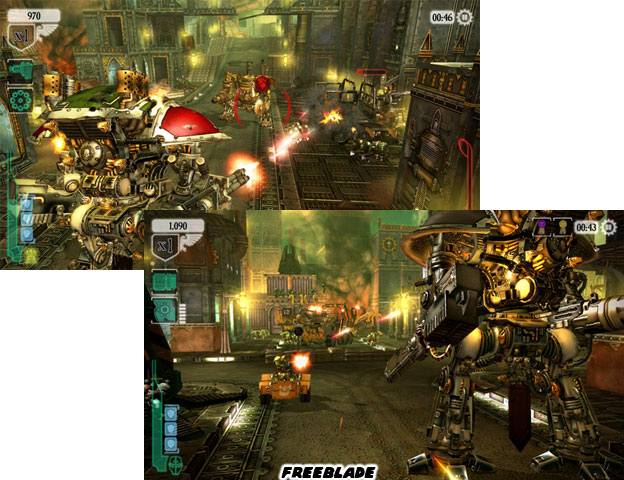
So what made Freeblade so great? If you are not familiar with Warhammer 40,000, the universe created by Games Workshop, it didn't really matter. The setup was relatively simple. It was the far future and you were on a distant planet. You were piloting a fully armed and fully armored 50-foot tall robot, known as an Imperial Knight against alien invaders. By touching the screen you got to shoot at just about anything that moved using your primary or secondary weapons. Freeblade took full advantage of the new touch features of the iOS devices. These devices recognized and responded to finger pressure instead of just finger contact. The devices and game also supported multi-finger gestures. Freeblade advanced the robot automatically during the fighting, all you had to do was aim and shoot. Essentially you were playing a mobile version of the classic arcade rail-shooter.


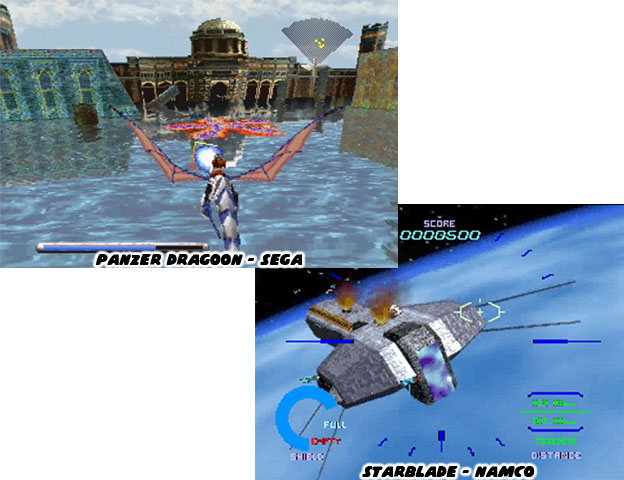
Pixel Toys developed a great game that brought back memories of some classic experiences. I wondered if the long-time arcade publishers were paying attention. Freeblade was doing to mobile devices what Panzer Dragoon had done for home consoles or Starblade had done for the arcade. Both games had cult-like followings. Sega and Namco, the respective publishers of those games hadn't really done much with the rail shooter in years. I could only imagine how great it would be if Sega developed a new Panzer Dragoon or if Namco released a new Starblade using the same mechanics of Freeblade. Yet I cannot think of a rail shooter that ever featured gigantic robot combat! In this way Freeblade stands apart from the other titles.


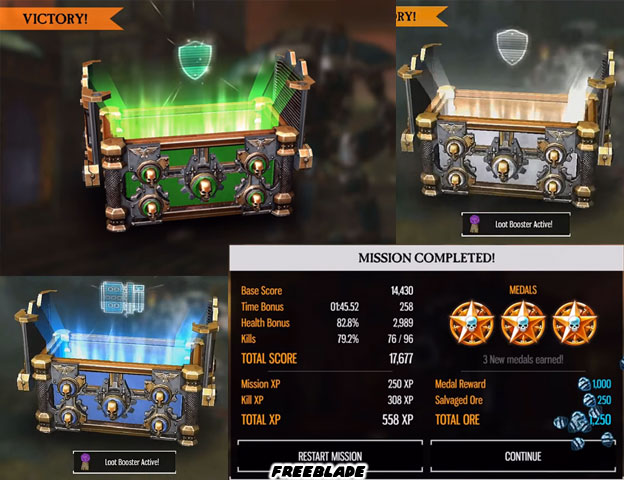
All of the hooks that mobile games depended on to keep players engaged were in Freeblade. Players could unlock secrets and upgrades as they went from battle to battle. They were rewarded for their accuracy, secrets found and point totals. They could apply some of these rewards by upgrading weapons, adding new weapons, and strengthening their armor. The player was encouraged to continue fighting through the level system. They gained experience based on how well they performed in each mission and what secrets they unlocked. Players could not only customize their weapons, they could even swap out colors to customize their robot. There were daily challenges which could make "grinding" or trying to level up your robot much more rewarding. Players did not have to spend real money in order to gain these rewards or upgrades. They simply had to be patient between sessions.


The visuals on the game were amazing. Among the best portable graphics you would ever see. The touch controls were responsive and become intuitive fairly quickly. The learning curve was relatively short, which allowed you to focus on the game itself. You had the ability to track and shoot you opponents using a gigantic machine gun, but beware of overheating! You could also fire a cannon blast or launch a barrage of missile to punch a hole through stubborn armor, roadblocks or other giant robots. Opponents emerged from every street corner and alley, in some cases they dropped in from space, rode by on motorcycles or flew overhead in jets. Sometimes the opponents were equally massive machines. When up close to other giant robots the game entered a quick-time event or melee mode. Ranged weapons were disabled and it was up to the player to use the Imperial Knight's enormous chainsaw(!) to chop an opponent down. The game was not all about offense however. The Imperial Knight was equipped with an energy shield and players could actually deflect incoming heavy fire if they responded quickly enough to the on screen cues. If the game was only graphics without the gameplay then fans would have voiced their disapproval right away. But Pixel Toys managed to make a game that looked great and played fantastic. The game only continued to grow and gain a new following on game forums and review sites. This could only be good news for the future of Pixel Toys. They had created a real winner and deserved some kudos. They were hopefully working on new content for this game as well. If you have a new iPhone or iPad and are looking for a great game then I couldn't recommend a better title. Download Freeblade now and tell me what you think. As always if you enjoyed this blog and would like to sponsor me please visit my Patreon page and consider donating each month, even as little as $1 would help make better blogs and even podcasts!