Showing posts with label mike haggar. Show all posts

Monday, July 4, 2022

Some details in the Street Fighter 6 trailer I wanted to talk about

Thank you to everyone that visited the blog as I went through all of the formerly announced, and leaked characters in Street Fighter 6. I wanted to take a moment, and talk a little bit about some of the other things that were shown in the first trailer. You may or may not know that I am a huge fan of the Final Fight series. I like to remind new fans of the fighting game genre that Final Fight was released after Street Fighter. It was originally called Street Fighter ’89. The success of Double Dragon made Capcom want to make their own version of a brawler. The team wanted to replace Ken, and Ryu with Cody, and Guy respectively. Plus a big wrestler named Mike Haggar to round out the lineup. Arcade owners liked the concept, but they also wanted to see a formal one-vs-one fighting game as well. So the studio relabeled it Final Fight, and started work on an actual Street Fighter II which was released in 1991. Over several games, manga, cartoons, and comics Capcom officially connected the characters, and events featured in Street Fighter, Final Fight, Muscle Bomber / Slam Masters, and Rival Schools games. Having the studio circle back to Metro City in the latest version of a Street Fighter was almost a love letter for long time fans.
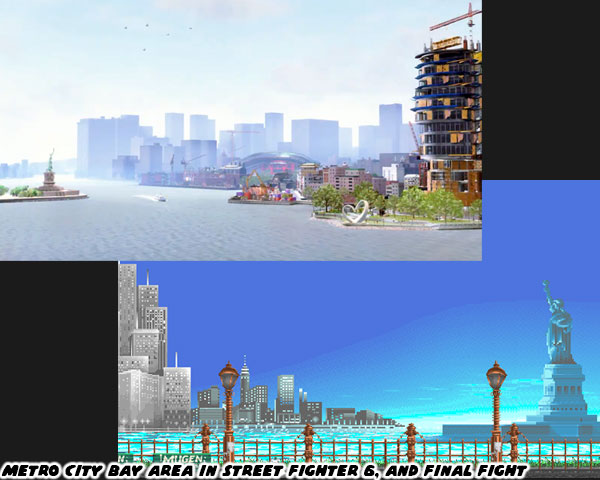
In the Luke preview I talked a little bit about Metro City, and how the SF6 trailer began in the Metro City gym. That was the same place where Final Fight began more than 30 years ago. If you had never played the game then let me set the scene. Mike Haggar was a former wrestler, and street fighting world champion. He was born, and raised in Metro City. He saw that it had become corrupt, and run down so he decided to clean it up. He was elected mayor, and no sooner was he settling into his new role than the Mad Gear gang tried to extort him. They kidnapped his daughter Jessica, and told him to stop trying to turn the city around. Instead of negotiating with the thugs he recruited Jessica’s boyfriend Cody, and his friend Guy to literally take the fight to the gang.
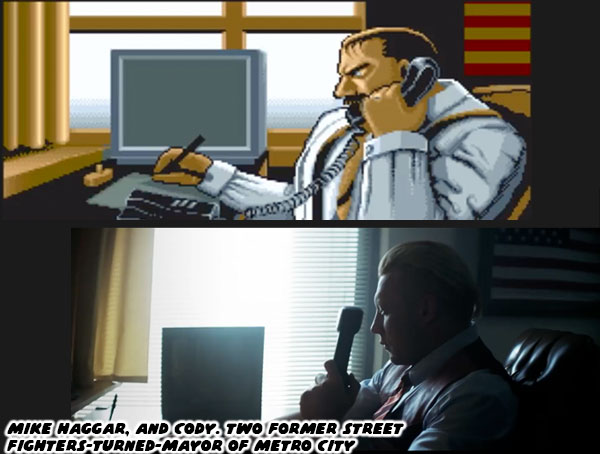
The trio fought through every borough on the trail of Jessica, and the ringleader of the gang. They discovered that they couldn’t even trust the cops of Metro City, as one of their biggest officers Edi E. was also a Mad Gear boss. This didn’t deter the heroes as they fought all sorts of memorable characters. The search for Jessica lead them all the way to the top of a skyscraper where they discovered that a kingpin named Belger was pulling the strings. The three defeated the gang, but Cody ended up throwing Belger out of his penthouse office. He would be arrested for the murder of the villain, and sadly there was nothing that Haggar could do to keep him out of jail. Cody spent a few years behind bars. Upon his release he was still a dangerous fighter, but decided to pick up where Mike had left off. He ran for, and became the new mayor of Metro City.
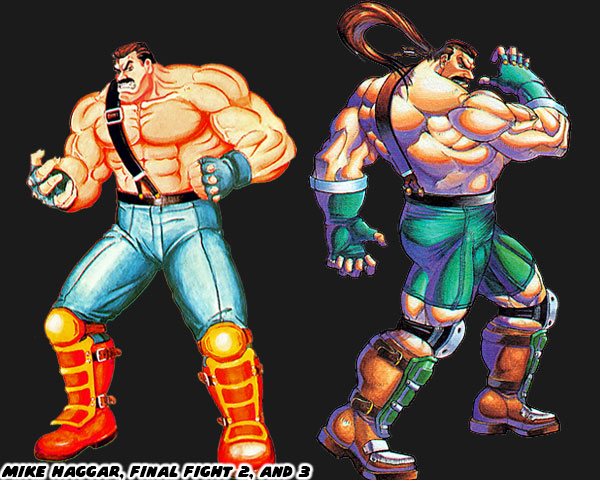
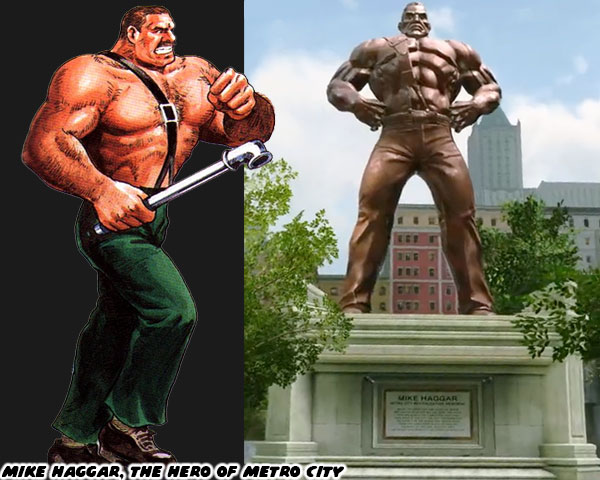
Haggar ended up fighting for the people a few more times. The Mad Gear gang had unfinished business with Mike, they kidnapped Guy’s finance’, and her father. So Haggar was recruited by Maki, a ninja that trained alongside Guy, and Carlos, a South American swordsman to take the battle around the world in Final Fight 2. By the time he returned to Metro City a new gang had set up operations. This time they were run by an evil general named Black. In Final Fight 3 Haggar recruited Guy, a good cop named Lucia, and a mysterious newcomer named Dean to take out the Skull Cross gang. We can assume after all of this traveling, and fighting it was time for the Mayor to retire. The Street Fighter 6 debut trailer featured a shot of multiple areas around Metro City. In on particular scene we saw a statue dedicated to Haggar. A lot of fans online, myself included, were worried that the statue was erected following the death of the former mayor. I’m hoping that the statue was built because he managed to actually turn the city around. He fought corruption, and crime with his bare hands. He made the people feel safe, turned the economy around, and made Metro City a beacon of hope. Perhaps the big reveal in the game was that Haggar was now running for Governor, Senator, or a higher office.
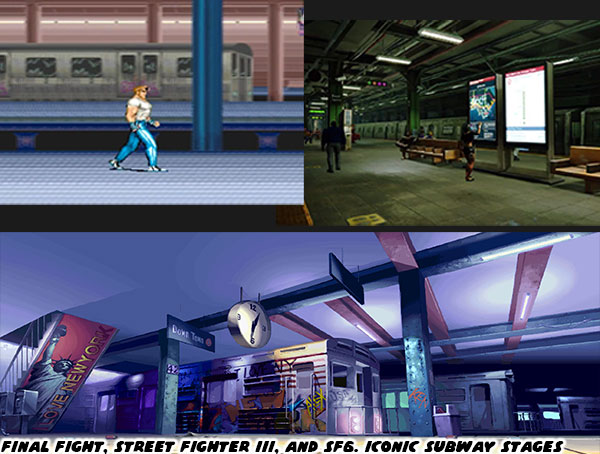
The SF6 developers were shouting out a lot of other Metro City locations in the debut trailer. I have a feeling that a number of them would be used as background stages in the SF6 tournament. For example we saw a subway. The subway took our heroes through the boroughs in Final Fight. But it was also used in one of the memorable stages in Street Fighter III. I’m wondering if players will be able to visit every corner of the city, and whether or not they will have to fight Mad Gear members along the way.
We saw China Town, basketball courts, and downtown Metro City as well in the footage. The studio made sure to give everybody a glimpse of Abigail’s Scrap Metal shop. Abigail was the biggest character in the Street Fighter universe. This was saying something because every member of the Andore family was well over seven feet in height. Abigail was eight-feet tall, and had a bad temper. He was one of the Mad Gear bosses, who happened to run his own small business on the side. I had talked about Hugo, and Abigail in the history of giant fighters.
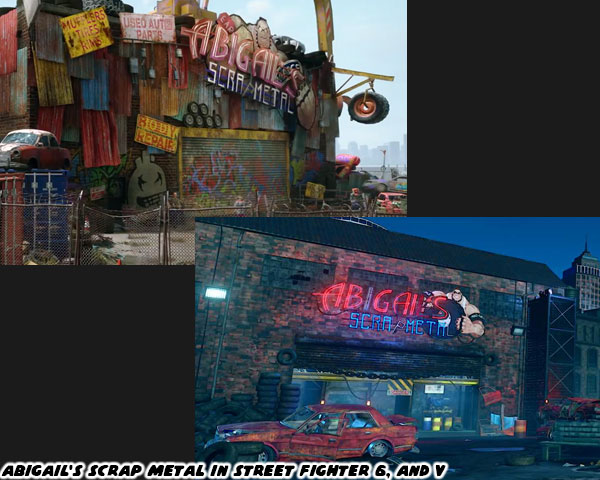
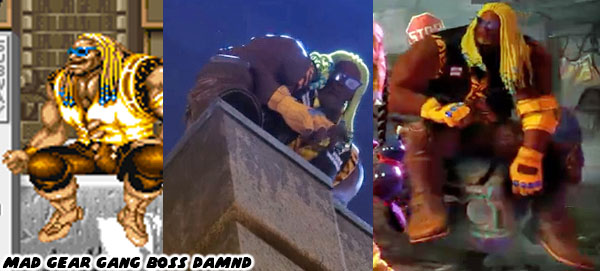
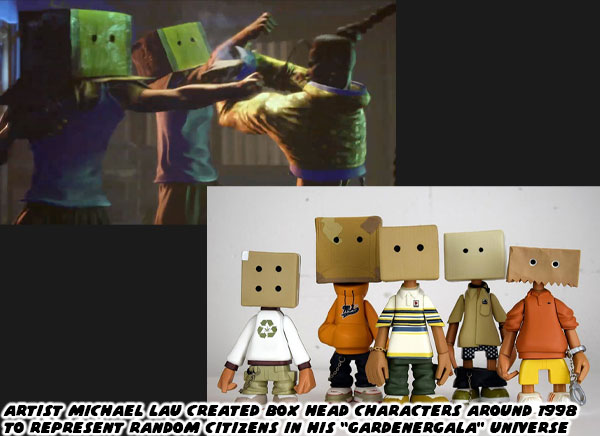
Even though Haggar had cut off the head of the snake, by defeating Belger, and Retu. The individual soldiers, and generals of the gang were still very much alive, and active. Even if we did not get Abigail as a playable character, it was a great nod to the history of the franchise to give him a shout-out. He was not the only general we saw in the trailer. Damnd / Thrasher was a low-level general in the organization, and the person that called Haggar in the very first Final Fight. He was the first general we had to fight in the game. He was a good brawler, but he tended to hang back, and whistle for reinforcements to do most of the fighting for him. Seeing him in the trailer now in the role as the President of the Mad Gear Gang Motorcycle Club was a nice touch. I had talked about the origins of the Mad Gear Gang, and its members earlier on the blog. Damnd seemed to be in charge of faceless villains taking on Jamie in the trailer. Well to be fair, they were not faceless, these people instead wore boxes over their heads.
The idea of generic people being represented with box heads had actually been done by Hong Kong artist Michael Lau. He had a comic strip in East Touch magazine featuring the “gardeners” they were kids from the street. He eventually made 12-inch figures out of his original characters, and helped spark the urban vinyl movement. He had gallery showings in Japan, and the US with these figures. They went on to influence character design in animation, gaming, and toys. The majority of the gardeners had distinct looks, then there were a handful of generic pedestrians that had boxes for heads. This was over 20 years ago, and I have no doubt had a hand in influencing the generic Mad Gear fighters in the trailer. Speaking of faceless characters, I’m wondering if Street Fighter 6 features a create-a-fighter option.
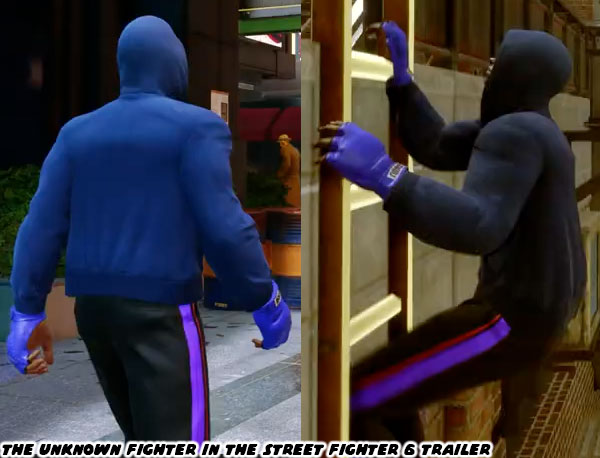
The trailer has a nameless, faceless fighter walking the streets of Metro City. It was inferred that SF6 would be the first open-world Street Fighter game. Yet instead of walking around as Ken, or Ryu we actually see a guy in a hoodie wandering around. The trailer made sure to hide the face, and identity of this person, but I could see from the corners of his face, finders, and ankles that this was a Black person. I’m pretty sure this is not supposed to be Black Cobra, but instead a generic fighter.
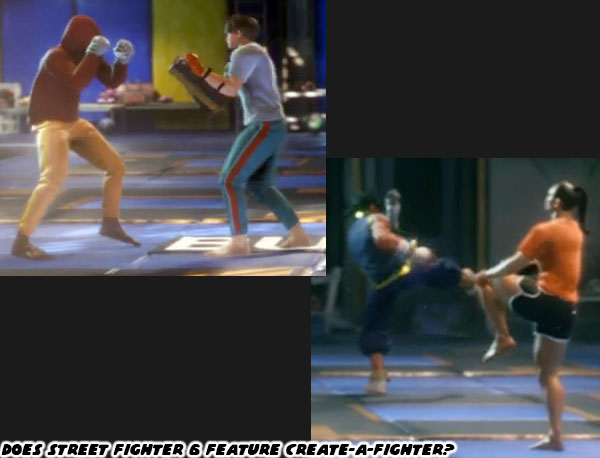
The thing about this generic person is that we see a number of them in the opening scenes at the Metro City gym. While Luke is punching a heavy bag there are a number of male, and female fighters sparring, stretching, and exercising as well. The thing about all of these background characters is that they are almost all the same build. They are the same height, and weight. They do have different skin colors, heads, and are barefoot or with shoes. I don’t think these models were created only to be background people. The gloves, striped pants, and sneakers of the person we follow around on the trailer were also used on the gym members. I have a feeling that players will be able to customize their walk around character as well.
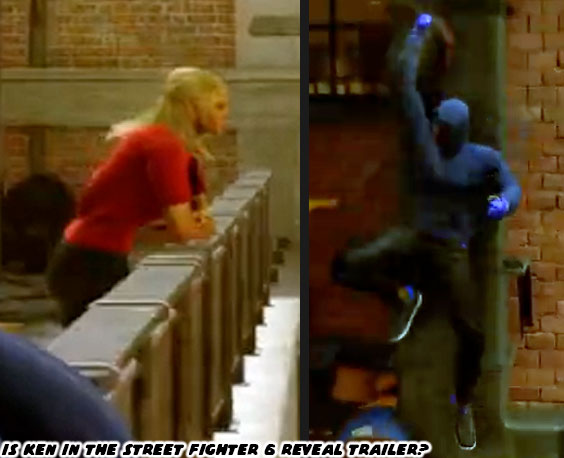
The other thing that I thing that I think was leaked, or suggested in the trailer was that this character can learn things from the various named Street Fighters they came across. Or they pick up new moves by completing side missions. It looked like the character climbed a ladder in China Town, and came across Ken Masters. Then in the next frame we see the character performing a Dragon Punch. Maybe the person in the background was some random long haired blonde, and not Ken, but that’s what I made out. Did you see anything different about this? Street Fighter 6 wouldn't be the first time in the series that you could have a character learn moves. The Cycloid cyborgs in Street Fighter EX had moves from every character in the game. The character ACE in SF EX 3 could copy moves as well. The Cyborg in the Street Fighter II Movie game could also steal moves. Twelve in Street Fighter III could copy an entire character. Of course the boss character Seth from Street Fighter IV could also copy moves from the cast. 
There were countless other call outs to Final Fight, and Street Fighter games of the past. The back alleys, China Town, downtown, and playgrounds all looked very familiar. Other web sites pointed out that stage backgrounds in SF III were recreated in parts of Metro City. Many people inferred that some of the levels took place in New York City, but Capcom might have been retconning it to take place in Metro City instead. There were plenty of shop signs, and billboards that made direct reference to characters like Hakan, Hugo, Gill, and Marisa. Did you notice any other details that piqued your interest? I’d like to hear about it in the comments section. As always if you would like to sponsor me please visit my Patreon page and consider donating each month, even as little as $1 would help make better blogs and even podcasts!
follow the Street Writer on Patreon!

Monday, February 17, 2020

Friday, October 28, 2016

The best championships in fighting games, part 2

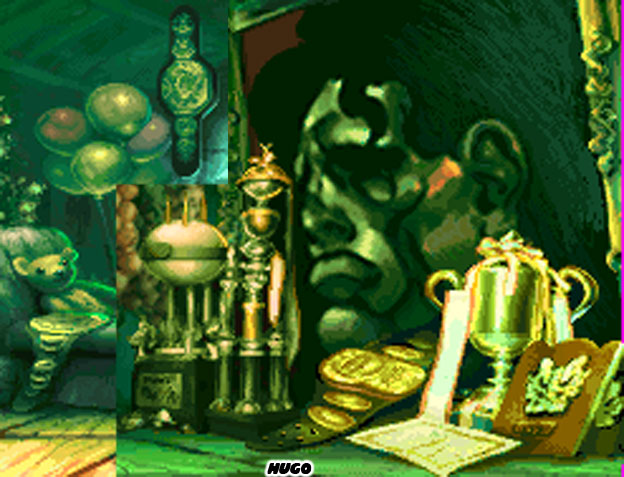
In the previous blog I had pointed out the unique belts and champions featured in fighting games. From the small symbolic belt of Russian boxer Andrei in the King of Combat to the gaudy bull horn belt of Antonov from King of Fighters. There was a championship for every form of fighting. The wrestlers in these games seemed to have the best titles. While Darun Mister of Street Fighter EX fame had a total of 3 championship belts he was nowhere near the most decorated champion. Hugo Andore, the German giant from Street Fighter III also had three championship belts and at least 5 other trophies and awards from different promotions. These were all visible in his stage from Street Fighter III 3rd Strike.


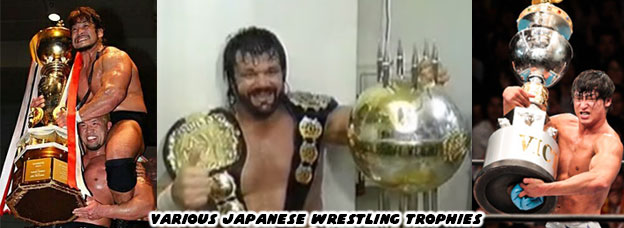
The accolades given to Hugo were based on real-world championships. Take a look below at some of the Japanese promotions that inspired the gold. In some promotions the best wrestlers are given statues, plaques or towering cups wrapped in streamers. They are the result of winning a tournament or even beating multiple opponents in a "battle royal." In the multiple endings in Street Fighter III: Giant Attack Hugo was written as having different tag team partners, there was a chance that one of his belts or trophies was won with the help of a partner. It was never established who the actual person was but many assumed it was Alex, the American MMA star.


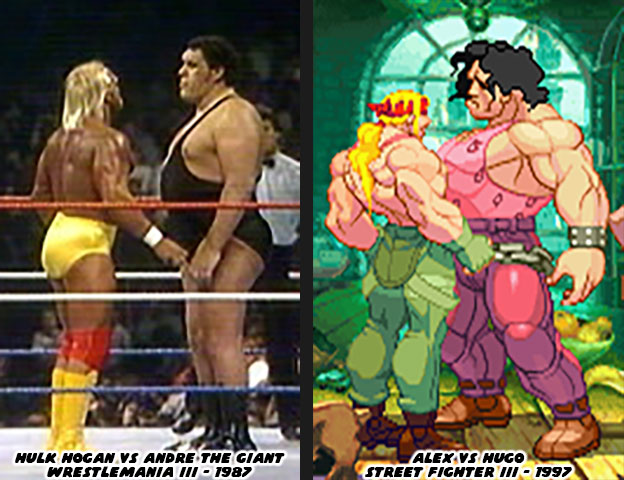
Hugo was a Mad Gear Gang-member-turned wrestler. He along with the Andore family from the Final Fight series was inspired by Andre the Giant. The French wrestling star was huge (pardon the pun) in the '70s and '80s. He traveled the world and made a following wherever he landed. In his younger days he was quite athletic and could actually perform some high risk 1st and 2nd rope leaping moves. He had a large head of hair, almost like an afro which gave him a wild appearance when he debuted. As he got older he gained some weight, slowed down and cut his hair a little bit shorter. Age did nothing to curb his awesome strength and legendary drinking ability. The character of Hugo is a sort of amalgamation of the young and old Andre. He has some of the speed, moves and hair of the younger version with the raw power of the older self. One of Andre's great rivalries, and even tag team friendships was with Hulk Hogan. This insight from the developers was celebrated as a special animation whenever he fought Alex. The two would have a stare down before the round, similar to the Wrestlemania III match.


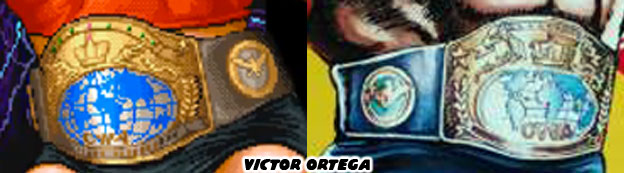
Andre had beaten many of the best wrestlers around the world. Yet he was not necessarily the person who would be considered the heavyweight champion for a particular company or promotion. He never held the title for any length of time because he was constantly travelling. Andre was a sort of sideshow attraction. He would only appear from time-to-time so that his marketability and thus legend would remain intact. Promoters knew that audiences would eventually tire of seeing him squash all of his opponents, so he was considered a gimmick fighter and only hired him for a few weeks at a time. Any belt he won was usually won back by the hometown champ before he left the country. Hugo on the other hand was a runaway terror. He took the belts and steamrolled every promotion he went to. There was no one in the Street Fighter universe that seemed capable of stopping the giant. But did that make him the best wrestler in the SF universe? I would argue no, he was not the best wrestler and certainly not the best fighter. Guy, Cody and Mike Haggar from Final Fight have all shown that they could take him, and his extended family of giants in a stand up brawl. Despite Hugo's collection of belts and trophies he is missing a very important one. He does not have the Capcom Wrestling Association or CWA belt. This would be THE title held by Victor Ortega in Muscle Bomber / Saturday Night Slam Masters. Hugo also does not possess the rival promotion Blood Wrestling Association or BWA belt.


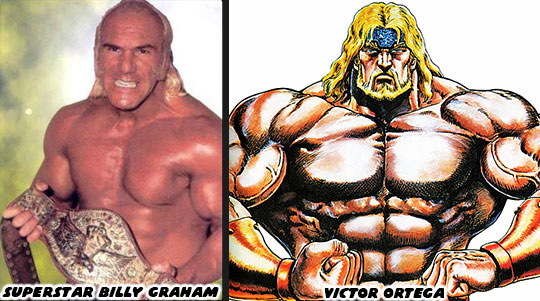
I have talked previously about the middle-aged phenom known as Victor Ortega on previous blogs. This character and his title was created by Tetsuo Hara. The co-creator and artist behind Hokuto No Ken / Fist of the North Star. is a huge wrestling fan. Many of the big wrestling names from the '70s inspired several of the characters in his comic book series through the '80s. These in turn inspired the artists working at Capcom through the '80s and '90s. When they began designing the villains in Street Fighter and Final Fight series a few were based on the work of Mr. Hara. When the company wanted to create a wrestling-inspired brawling and later fighting game they went directly to Tetsuo Hara. He created a cast of characters and set the pro wrestling canon of the Street Fighter universe. At the top of the chain was Victor Ortega, based on the flamboyant and photogenic Superstar Billy Graham. Billy had a bodybuilder physique and looked incredible in televised matches. It didn't matter if other wrestlers were technically more sound, because they didn't look and act like a champion they often had to "work" (lose a match) to Graham.


The version of a champion that Mr. Hara created may have been visually inspired by wrestlers like Graham, however his in-ring skills were the real deal. Ortega had legitimate punching, kicking and grappling skills. Despite his size he was also very fast and very flexible. He needed to be a great all-around champion considering the different styles of wrestlers that filled both the CWA and BWA rosters. Some were technicians, some brawlers, some were high flyers and some were shooters (submission fighters). Victor Ortega was easily the most muscular character set in the Street Fighter universe. This undoubtedly made him intimidating, even to a giant like Hugo. I would like to think that not only did Hugo fail to capture the CWA title, but that he was afraid of Ortega.

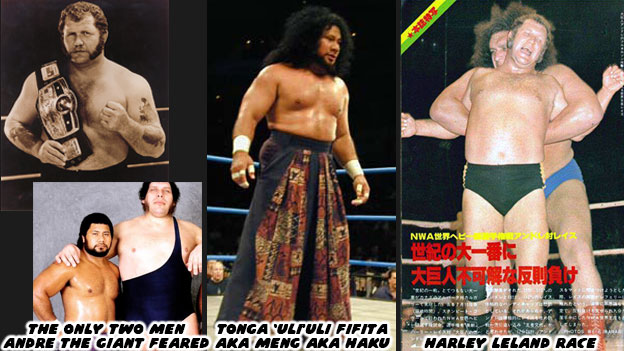
In the real world Andre the Giant faced all sorts of opponents, including some almost as tall and as strong as he was. Outside of the ring he sometimes had to fight off hecklers, drunks and angry wrestlers. He beat just about all of them, most with ease. After all of his travels and all of his victories there were only two men that Andre was afraid of. According to former wrestler and manager Bobby "the Brain" Heenan the two men were Harley Race and Tonga Uli'uli Fifita. Both men had reputations for being tough as nails. They were strong, intimidating and did not appreciate being messed with. Both were also fiercely loyal, good to their friends and stand-up men whose word was their bond. The two men were also a foot shorter than Andre.


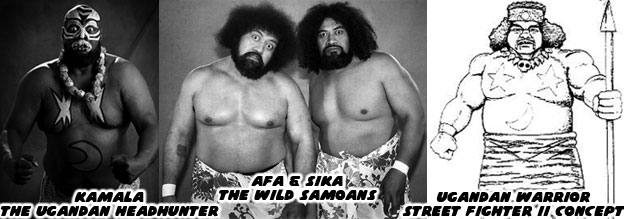
Tonga was the younger of the two hard legends. He was a trained martial artist and had actually been picked up as a teen to learn the art of Sumo by a Japanese stable. While in Japan he was able to adapt to life in the squared circle. He was gifted with great strength and stamina. These things came in handy as he fought many Japanese legends. They were trained in the "hard style" of wrestling where people barely pulled their kicks and punches. Karl Gotch was a pioneering grappler that took his classic techniques with him to Japan. Pro wrestling in Gotch's day was much more about grappling and submission holds than the "sports entertainment" it tries to be on television. He wanted his students and opponents to come at him with the same ferocity of the turn-of-the-century wrestlers. He wanted them to know how to legitimately catch holds and counter attack. Tonga was already a tough person but his time in Japan tempered him into a dangerous weapon. It was not hard for him to find work in any promotion acting as a heel or bad guy. In the '70s and '80s the large Pacific Islanders were often marketed as savages or wild men by the various promotions. This worked to their advantage as they intimidated opponents and audiences alike. The gimmick had gone over so well that one of the concept fighters for Street Fighter II was a Ugandan warrior. This character had elements of the Wild Samoans, the body paint of Kimala (the original Ugandan warrior) and the frame of Tonga.

The bar fights that Tonga participated in were the stuff of legend. The majority of the time all he wanted was a drink and to be left alone but trouble would find him. Many of his friends were astonished by how often people would pick fights with him. There are stories of how he took on groups of people and even the police in the melees. The scariest were stories of how he bit the nose off of an attacker, or how he reached into a man's mouth and pulled out his teeth. The stories were gruesome and certified by witnesses. He worked with Andre a few times and they got along great, possibly because Andre avoided him outside of the ring and never tested him. It would be interesting to see a redesign of this character by the people at Capcom, one that captured more of the presence of Tonga without pandering to the wild man mystique. The other person that Andre feared had an equally interesting history.


Harley Race was similar to Karl Gotch in that he came from a different era. Harley was a tough guy, even at a young age. As a teen he was thrown out of school for beating up his teacher. He decided that he wanted to be a wrestler and actually joined up with a carnival where he learned the ropes from actual carney catch-as-catch can fighters and strongmen. This was a direct link to another time, literally a connection to the 19th Century, when wrestling was real. Before promotions divided the talent and before television turned it into a soap opera. Harley had no amateur wrestling experience, unlike his opponents which often came from college backgrounds. As he went from town to town he had to take on any and all challengers. Some were men, some were teens but most had experience on the mat. Harley learned that he had to adapt quickly to these people and try to get a pin or submission right away. If he lost then he didn't get paid. Not only that but his handlers would beat him up as well. Harley survived a car accident as a young man and was told he'd never walk, let alone wrestle again. Harley recovered and became one of the hardest men in the business. He was a legit shooter and knew a countless number of ways to hurt someone. He picked up many things along the way from pro wrestlers which complimented his street experience. Harley was soft spoken but intense, his promos became legendary. It was his mastery of the ring and respect for the business that earned him followers the world over.


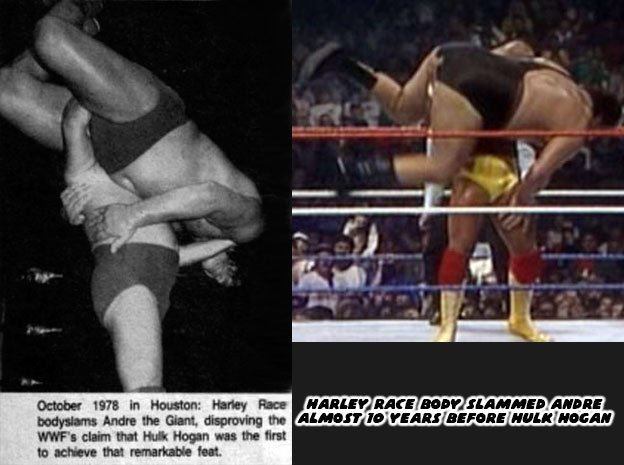
Harley, like Tonga, did not get into wrestling the easy way. He knew many different ways to seriously hurt people but instead worked to make his opponents look great and have long careers. He was just over 6 feet tall but had worked with many bigger men including Andre. Audiences soon forgot about the size difference in their matches because his presence was so commanding. It was Harley and not Hulk Hogan that had first slammed Andre the giant. Harley would often chaperone the big wrestlers when they traveled abroad. It was said that just a look from Race was enough to make the biggest wrestler back down when they crossed the line. Harley's old-school origin and NWA championship, which represented some 30+ or 40+ independent promotions / territories was the ultimate prize for a pro wrestler. There were other "world's" titles, including those from WCW, ECW, WWF and NJPW but among the purists you could not really consider yourself the heavyweight champ unless you held the same belt that Harley did. Andre the giant did not hold that belt. He once wrestled Harley to a 60-minute draw but that's as close as he ever got. When Harley joined the WWF he won the first Royal Rumble and became the King. When he felt ready to leave the business there was only one person he felt appropriate to lose the crown to and his name was Tonga.

Hugo may have been a beast but he was not the best. Mike Haggar had the chops to be the true CWA champion. Zangief and Darun probably have the chops too. As for Hugo, well, if he doesn't have the belt then he has not beaten the best. Or more likely he is scared to fight Ortega. Do you have a favorite video game champion? Or a favorite title? Who do you think is the best game wrestler? I'd like to read about it in the comments. As always if you enjoyed this blog and would like to sponsor me please visit my Patreon page and consider donating each month, even as little as $1 would help make better blogs and even podcasts!

 follow the Street Writer on Patreon!

Wednesday, May 11, 2016

The Abridged History of the Brawler, part 18


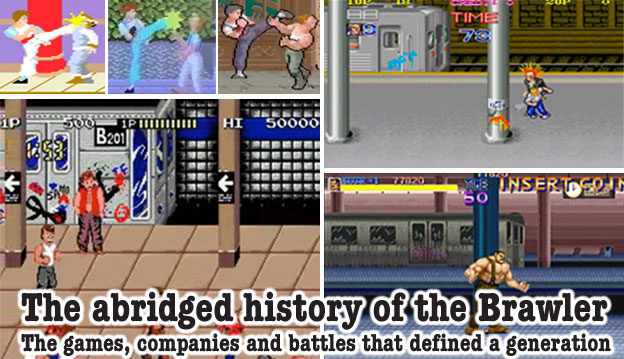
Home consoles had been trying to get in on the brawling action through most of the 90's by the turn of the millennia they had found their rhythm. Unfortunately at that point the brawler had lost popularity. This blog will highlight the arcade influence on console versions of the brawler as well as independent brawlers inspired by arcade hits.


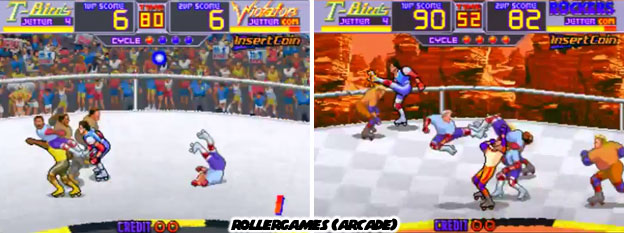
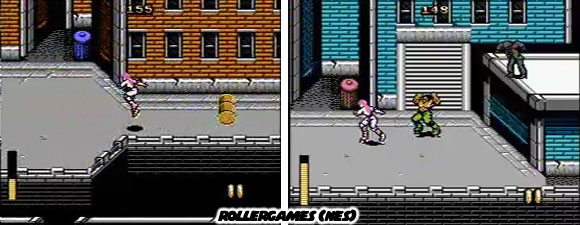
In 1990 Konami released RollerGames in the arcade as well as on the Nintendo Entertainment System. The game was licensed from the television show about an updated version of roller derby. The teams and players in the league were very over-the-top, not unlike pro wrestlers. It was great fun on TV and part of that spirit made it into the arcade. The game took place on one of several roller rinks located throughout the USA. Players actually could move all over the screen as they could in other brawling games while their characters automatically skated on the rink. The effect could be dizzying if players focused on the changing track instead of the approaching opponents. While fun the arcade version was a shameless quarter waster.


The player had to win a set amount of matches between the male and female teams. All the while the opponents were relentlessly dropping teammates and earning points. The battles were nonstop as teams seemed to have an unlimited supply of opponents right up until the clock ran out. Players that did not manage to throw, dropkick or punch out enough opponents could kiss their quarters goodbye.

The experience changed completely when RollerGames was brought to the NES. The game became an adventure platformer featuring one playable character from each team. The character traveled from city to city, avoiding obstacles and pitfalls en route to defeating a boss, or manager from each team. At the end they fought through a corporate tower and defeated the big boss. It was nonsensical, just like many things that were popular in the 80's!


Very few brawling titles worked well on the 8-bit systems. The limit on sprite sizes, animations and colors made the brawler look like a minimalist genre. The next generation of hardware would be able to create experiences much closer to the arcade.

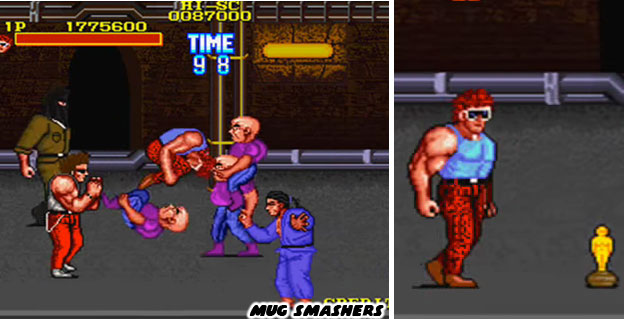
Of course there was always the PC, which promised to bring arcade-quality graphics home. For the most part they did. The gameplay, design and animation however were sorely lacking in many of the independently produced PC brawlers. One of the worst of the lot was by a British company called Electronic Devices. In 1990 they created a brawler set in San Francisco that was simply horrendous.


There were generic heroes and villains. Audiences could tell that they had poached various titles in order to recreate the genre. The control was bad, the villains were silly, there was one bad guy made up of three little people riding on each other's shoulders! The power ups made no sense, one even looked like an Academy Award! The prize for worst PC brawler was clearly won here.

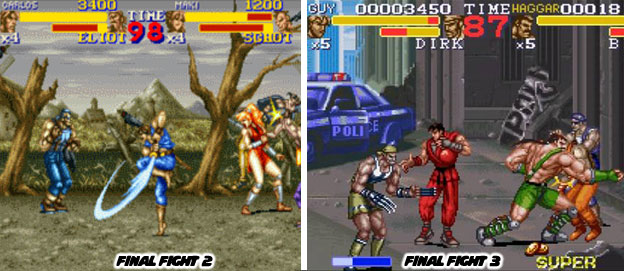
The consoles on the other hand had a lot of promise, especially once they transitioned to 16-bit systems. Capcom, as always, was one of the first to develop console titles based on their popular arcade games. Final Fight 2, released in 1993, was a Super Nintendo exclusive. The sequel to the arcade gem came out years after the original and featured new characters, locations and gameplay elements. It expanded the universe of Final Fight by taking Mike Haggar and his associates Maki and Carlos out of Metro City on a trip around the world.


Players learned that Mad Gear was a global crime syndicate that touched just about every continent. The bosses in this game were as memorable and diverse as they were in the original. The control was solid and Capcom had finally learned how to make a brawler that featured three characters. In the original Final Fight release for the SNES only Cody or Haggar were playable characters. A special edition featured Guy and cost more because of the memory costs associated with storing the information for one more sprite-based character.


In 1996 Final Fight 3 had returned to the streets of Metro City. Haggar returned to clean out the scourge of a new gang that had moved into town. The game introduced super attacks for the main characters. Dean and Lucia had replaced the other supporting characters in this story. A separate energy bar could be filled up and a screen-clearing super attack could be unleashed on bosses or groups of Skull Cross gang members alike.


It was a fun play mechanic that helped keep things fresh. The details in the sprites, animations and character designs did well to mirror the original title, however the sprite-based engine was beginning to show its age. Consoles were quickly moving to 3D experiences and players expected the genre to follow suit.


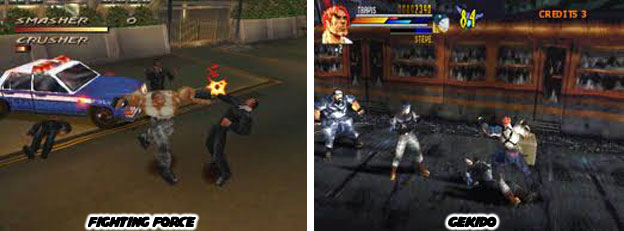
Fighting Force, released by Core Design in 1997, was originally pitched to Sega as Streets of Rage 4. Sega passed on the title so the title name was changed. The game was an early attempt at moving the brawling franchises to 3D. The polygon characters were large and animated slowly. The fighting mechanics lacked the speed or accuracy of 2D titles. The camera focused the attention of the player towards a particular direction and could not be changed. Core Design gave a clear example of how difficult it was to create the brawler in 3D using console hardware.


A few year later, in 2000, Naps Team tried to improve o the 3D brawler formula with Gekido. The animation was faster, camera improved, levels slightly more interactive and designs a bit more polished than Fighting Force. The console still lacked the raw 3D rendering power of most arcade cabinets but they were quickly catching up.


Very shortly the Playstation 2, Dreamcast and original Xbox would debut 3D brawling titles that were visually as impressive as anything released in arcades. Gekido could have been considered a forerunner to the Bouncer, which had been looked at in the previous blog.


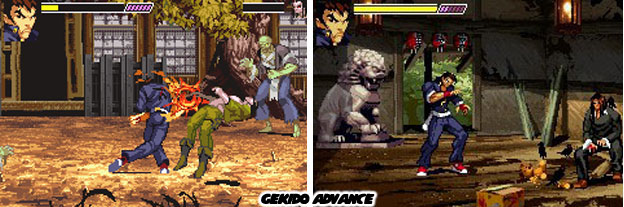
Naps Team had released a sequel on the GameBoy Advance in 2002. Gekido Advance; Kintaro's Revenge was a step back to traditional 2D, sprite-based gameplay. Which at this point was very unique. Most studios were struggling to bring 2D franchises into 3D. Naps Team made a sequel that convinced most gamers that the series was originally rooted in 2D. It was well done, well animated with solid character designs.


The game was decidedly Japanese animé influenced. The villains ranged from typical goons to monsters and mutants, a sort of Night Slashers meets the King of Fighters. The main character, Tetsuo, looked and moved similarly to Kyo from the KOF series. The game did well at recreating the classic feel of a brawler but kept things fresh by incorporating some fighting game mechanics and visuals.

The PC market in the west had a lackluster history with original brawlers however in the east things were different. In parts of Asia the PC market was often more popular than the console. The PC allowed DVD playback of course but also homebrew apps and small publishers could flourish. The PC's were of course online well before the consoles. Places like China and South Korea had a rapidly growing PC market. The studios in both countries were catching up with the trends in gaming. They were creating their own brawlers and fighting games less than a decade after they hit it big in the USA and Japan. That window of following the trends had grown shorter and shorter every year after 2000. The countries were able to develop and release their own mobile and MMO games a year or less after a popular title in the west had debuted. In other cases they were experimenting with the genres at a rapid pace.


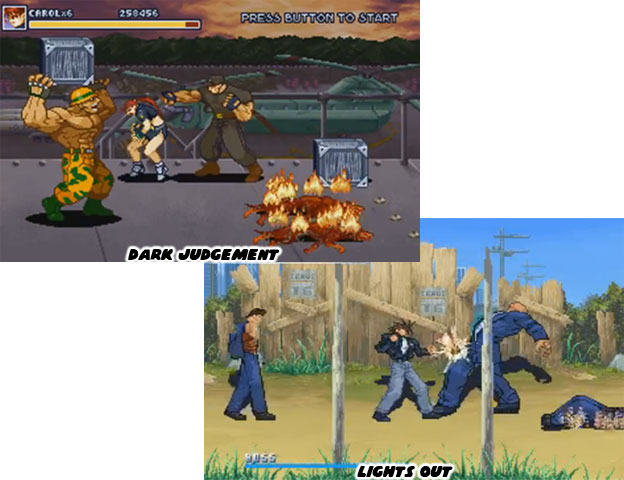
Two of the better brawlers released in South Korea were Dark Judgement: by SOHO Studio of Hong Kong and localized in Korean by Frankenstein Studio, the other was Eojjeonji Joheun Il-i Saenggil Geot Gateun Jeonyeok by TG Entertainment. The second game had a long title but it was based on the manhwa "Lights Out."  Comics in Korea were known as manhwa, comics in China were called manhua and you probably know that comics in Japan were manga. The two games came out in 1997 for Windows. Dark Judgement borrowed the aesthetic from the Capcom brawlers and mixed in some of the action of the Konami ones as well. It was created by a small team from Hong Kong and distributed by a Taiwanese Publisher. The SOHO Studio name was removed when it was released in South Korea. Thanks to the graphic artist, Lambonbon, who worked on the game for the bit of insight. Lights Out had a more distinct Korean style of animation and character design that was based on a bunch of high school tough guys fighting. Both of the games were well done and helped bring back a sense of the classic era of the brawler. There was something to be said about 2D graphics. They seemed to work better for the genre. In the arcade an indy developer would do similar things and release fantastic sprite-based titles within a sea of 3D releases. This game and more will be featured in the next blog. As always if you enjoyed this blog and would like to sponsor me please visit my Patreon page and consider donating each month, even as little as $1 would help make better blogs and even podcasts!
 follow the Street Writer on Patreon!

Friday, April 8, 2016

The Abridged History of the Brawler, part 4


The games featured today were the best examples of how the brawler was shaping the game industry and creating sub-genres in its wake. 1989 was the year that showed it was not simply enough to follow the trend, studios had to innovate and change the genre in order to keep the momentum going. The first title was a sort of high water mark for the brawling sub-genre better known as the hack-and-slash.

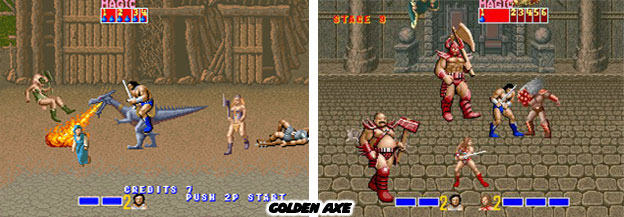
Golden Axe developed by Sega was a sword and sorcery take on the brawler. It featured three characters, a barbarian like warrior known as Axe Battler, a dwarf named Gilius Thunderhead and a female warrior named Tyris Flare. All three fought with weapons instead of their bare hands across a medieval fantasy setting. They could take down rogues, bandits and monsters. In several portions the characters could even mount dragon-like creatures and burn down opponents. The trio of fighters were set to defeat a barbarian lord named Death Adder (which always was a cool name) before he could claim the Golden Axe and the kingdom that followed it.


The game was important to the history of the brawler for the design and magic system that went along with it. Although it was infamous for a sound bite or two they ripped off of the movie Conan the Barbarian. The characters were fun but for the adolescent boys playing, the warrior Tyris was the memorable one. A perfect tan, a toned figure and a tiny white bikini weren’t quite the things people thought of as suitable for a warrior until Tyris came along. Tyris also sported the most powerful magic attacks in the game making her a practical choice and not just a sex object.

The fantasy themes worked well for the genre but were cemented by the exotic locations featured on the travels to find Death Adder. One level, which appeared like an island actually took place atop a giant sea turtle as it moved from port to port. Another branching path was set on the back of a giant eagle. Branching paths was a new feature in video games and Golden Axe was among the first, if not the first arcade title to use them. Incorporating a tremendous sense of scale had not been done in any previous brawler. The magic system itself was completely unique among brawlers. Players collected magic vials by hitting tiny thieves. Each level of magic required a set amount of vials. Once the player had collected them they could activate the magic at any time. The more vials required to activate a spell then the more damage it did to opponents. Players learned to save a magic attack for when they were surrounded by opponents or the final boss himself.


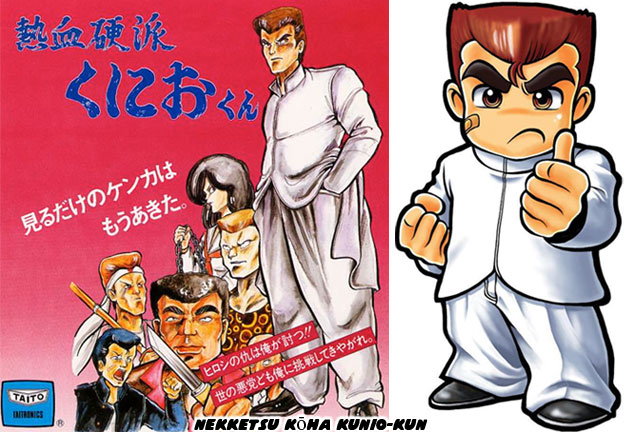
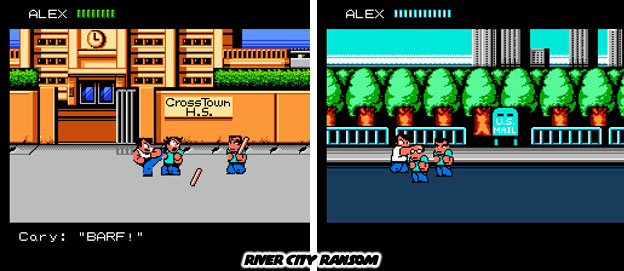
By this point the industry was clearly interested in the brawler and they were trying to bring the experience to home systems. Technos released a variation of the brawler with a Japanese High School theme titled Downtown Nekketsu Monogata. It was set in the same continuity as the arcade title Nekketsu Kōha Kunio-kun. For a while Technos actually had Kunio-kun act as a mascot. When that game came out for the Nintendo Entertainment System in North America we knew it better as River City Ransom. The limited processing power, color palette and memory of the NES meant that there was no way that the 8-bit console would be able to match anything the arcade had.


Technos succeeded in creating a memorable brawling experience by creating small stylized figures out of the Japanese high school characters. The smaller figures required less details and animations and the memory saved on limiting the detail on each character meant that more rivals could be drawn on screen by the processor. To keep the NES from being overworked the environment was limited to a strict, flat battleground while still allowing for backgrounds to change and show that characters were advancing through the city. In the end it was a pocket version of the brawler and proof that consoles were capable of carving their own niche with the genre.

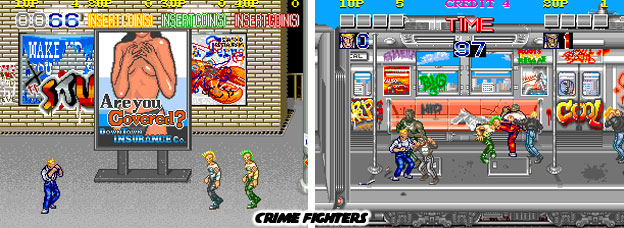
With that said Konami was going to point out how the arcade brawler could get away with things not allowed by Nintendo’s policies which were a form of game censorship. In the arcade they released Crime Fighters. It was a large 4-player cabinet featuring generic characters wearing white shirts and four different colored pants. Talk about taking the quick road to character design! The game was notable for a few reasons. The designers created large, detailed environments for the four players to fight in an around. The characters were smaller than those featured in other brawlers but proportional unlike the River City Ransom figures.


The game pandered to just about every adolescent boy’s fantasy. It was a cool version of New York with plenty of brightly colored graffiti covering the walls and lots of fighting. It was extremely violent as well, more so than even Double Dragon. Rivals could knee the player in the groin players could hit opponents with lead pipes and even use a handgun, which was against the code of fair fighting for most brawlers. There was also a bit of sex appeal with a lot of cleavage shown in a billboard early on in the game, not to mention that rival female gang members were dressed like dominatrix’s and used whips on the players. Crime Fighters would never have been released on a Nintendo console without some serious retooling.

The game itself was fun but very difficult. Every credit gave players a set amount of health and that health counted down slowly. Taking damage from opponents caused the energy to drain faster. Thankfully some of the damage could be recovered at the end of the level based on how many opponents were defeated. That was of course if the player managed to beat the boss characters. The bosses were larger variations on the gang members, each boss having a gimmick like wielding a chainsaw or fighting with wrestling moves.


The hardest part of the game was the end in which all of the bosses had to be defeated in a battle royal. Konami wasn’t mincing things, they wanted one of the most difficult and quarter-hungry games of all-time. It did fairly well in arcades, however there was another brawler released that same year which took the lion’s share of profits.

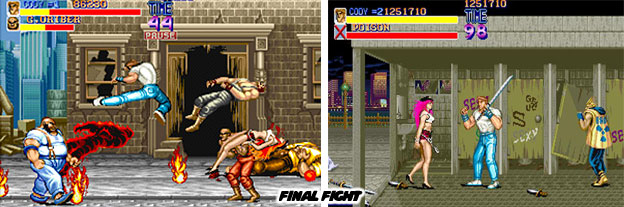
Final Fight by Capcom was the heir apparent to Double Dragon. In fact the producers went into the project trying to dethrone the game. For the most part it was mission accomplished. Visually the game was a great leap ahead of the Taito brawler. The sprites were larger, more detailed and better animated. The designs of the heroes and rival Mad Gear gang members would become brawling archetypes. For players there was a large and powerful character that moved slowly but could deal great damage with his wrestling moves. There was also a smaller martial artist that struck very quickly and whose quick punches and kicks could stun opponents approaching from any direction. Then there was a character in the middle that had strength and speed at his disposal. For the gang members there were character types that mirrored the heroes. The world that they inhabited, a certain Metro City, would become part of Street Fighter canon.


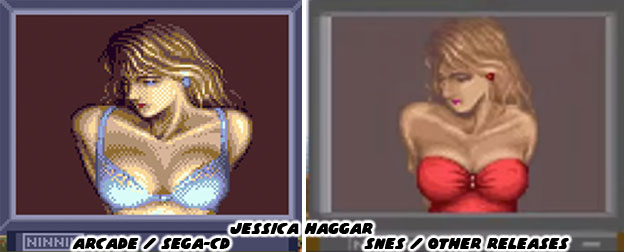
The plot was familiar, a girl was kidnapped and a team had to come to her rescue. Arcade players were treated to a shot of Jessica Haggar in her bra tied to a chair. This bit of skin already made the game more mature than other brawlers. This show would be toned down and even removed in future revisions and home versions. It turned out that she was the daughter of Mike Haggar the mayor of Metro City. The former champion pro wrestler recruits Jessica’s fiancé Cody and his martial arts trainer Guy to go into battle. The rest of the game was a lesson in flawless design and execution.

Players were taken through the boroughs of Metro City on the way to rescue Jessica from the crime lord Belger. The Mad Gear gang members hanging out, seemingly every few feet, waiting for their chance to take on the advancing heroes. Along the way new boss characters were introduced. Sodom, Rolento and Andore, that would become legendary in future Capcom fighting games. The game had the right amount of difficulty and challenge. Patient players could pick off most opponents and use all the time available to them to clear each stage with a minimal amount of health lost. Those that wanted to go all out and have all three players on screen at once for some mayhem could do the same at the risk of wasting plenty of quarters. Those that went full tilt into the game experienced the best that the brawler had to offer.


The arcade was the original social gaming experience. Players did not have the luxury of being connected to a network and having players across the country or around the world be able to drop into the action. If a player needed help clearing a stage then a friend or family member would have to be standing with them, fighting the good fight. Ask any player that remembers clearing a fighting game how much fun was had when the battle was a shared experience. Memories were made and bonds grew stronger when players could say that they fought from beginning to end with a good friend. It was that way for my brother and our friends when we visited the Cal State Long Beach campus while still in high school.

We were on a school field trip and Final Fight had been released earlier. A brand new cabinet was waiting in the campus arcade. Instead of enjoying our lunch my brother and friends decided we were going to beat the game and earn the bragging rights among the other gamers at school. The risk of not eating was not as big as missing the bus back to school. We were determined that nothing was going to stop us and played through level after level. Frantically running back and forth between the change machine and the cabinet to keep us engaged when the lives started running out. Defeating wave after wave of the relentless Mad Gear gang members with a combination of shoulder throws, jumping piledrivers and spinning back kicks. Surviving the cheap shots by bosses and their countless minions. Getting a small group of classmates gathered around the machine rooting us on and at long last kicking Belger out of a window and reuniting Cody with Jessica. Those memories would never be replaced in our collective consciousness. It was more than 20 years ago today yet the memories remain vivid as ever. Proof that gaming could have a profound impact on our lives. Yet the brawler would not be done shaping our gaming tastes The new decade would see the genres pulled in many different directions all at once. I hope to see you back for the next blog which will look at how the 1990s saw some of the defining moments in all of gaming. As always if you enjoyed this blog and would like to sponsor me please visit my Patreon page and consider donating each month, even as little as $1 would help make better blogs and even podcasts!
Tuesday, July 14, 2015

Representation Matters! Or, what happened to Birdie, part 6...


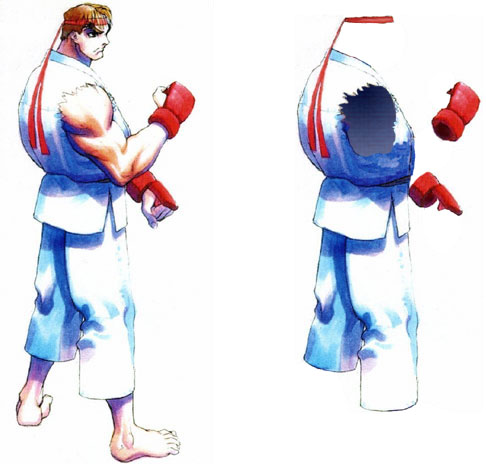
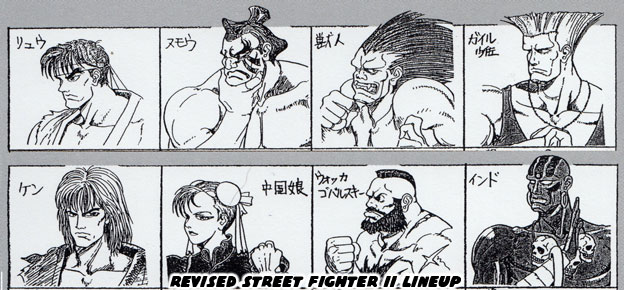
The Street Fighter II team was off to a rough start. Their character designs were falling flat and Capcom was trying their best to turn the project around in the quickly changing arcade market. They needed to get a new game out and one that set itself apart from Street Fighter and Final Fight. There was an influx of artists and designers working on the cast. They were looking for the elements that worked, the styles of fighting that needed representation and a way to balance the library of characters. Each artist brought a unique perspective with them along with their talents. Some of these artists were familiar with the various schools of fighting and even had some insight on pro wrestling and action films. Some of the artists were well read in science fiction and fantasy stories. Some of the artists enjoyed traveling and history. The collective was able to pick the designs apart and begin remaking them with a few unique touches. Sakurada Gashou and the Kenshiro-looking Ryu were out. If karate was going to be the star of the game then the fighter had to be become an icon, or exaggerated caricature depending on your point of view of what a karate master should look like. The updated Ryu had torn sleeves to show off his powerful arms, a red headband and red punching gloves to break up the all-white uniform.


Capcom then brought back Ken. In was done in part to have a character that the Americans would gravitate to. The blonde hair and yellow punching gloves contrasted his all-red gi. To audiences this was just a pallet swap with different heads. Internally the art team made a distinction between the two characters. Ken had hemmed sleeves on his gi. He was careful about the way he presented himself. Ryu by comparison had torn sleeves and worn edges on his pants. He cared more about the fight than about trophies. They were both very simple designs and the unique touches were subtle, so subtle that many other studios missed the individual elements and couldn't create better karatekas in 25 years of trying.

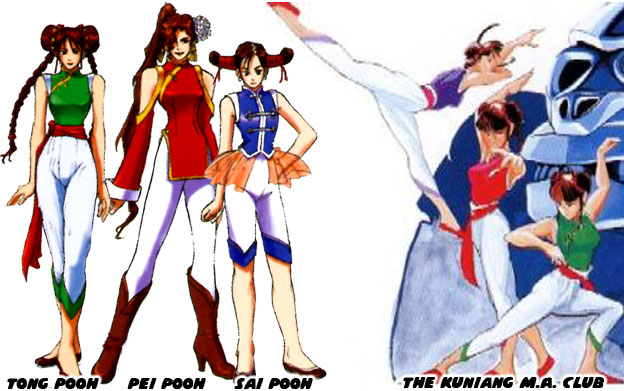
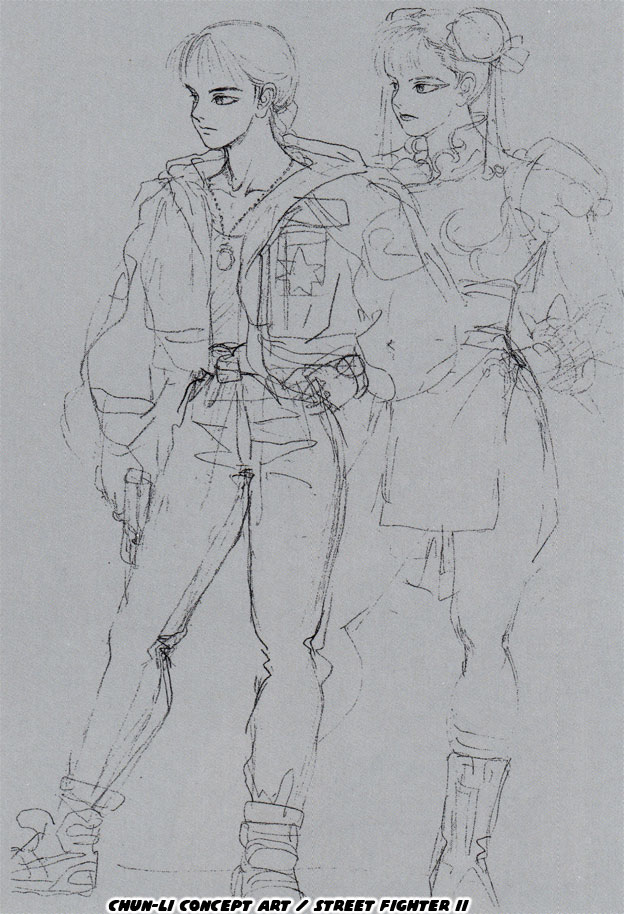
With the stars of the game figured out the studio then went after the Chinese figure, then called Zhi Li. They looked at her costume, her age and purpose. The were something lacking with the young female fighter. She looked too much like an anime or manga character. Artist Akiman said that it was a period of time where you couldn't get by without creating a Chinese Beauty. Zhi Li had a look that was borrowed from the Pooh sisters aka the Kuniang Martial Arts Club from the 1989 sci-fi action game Strider. The sisters had kicks that were almost as powerful as Strider Hiryu's cypher sword Zhi Li would never be believable as a serious fighter in a cast of adult men. The team decided to make her older, turn her into a woman. It worked for the Pooh Sisters and would probably work again.


As the plot of the game was being developed they realized that Chun-Li needed a reason to be in a fighting tournament. Simply being a female fighter may have worked in a movie but games required more effort. Games allowed the audience to see the same story but from different points of view, including those of villains. By making the Chinese girl older they knew that she would never be a damsel in distress. She was not a prize for the competitors, and this was a refreshing change of pace. In fact it was even better because her purpose for competing was to bring the organizer to justice. It was decided that she was actually an undercover cop. The team was elated with the possibilities. This could be something that they kept a secret from audiences until the ending of the game. They took apart the traditional Chinese wushu uniform that Chun-Li had and turned it into a costume. The character would wear makeup, put her hair up in buns and be very "girly" in the tournament. At the same time she would wear wrestling boots and weighted spiked bracelets so that she had a better chance of winning each fight.


What the designer Akira "Akiman" Yasuda did to Chun-Li was a stroke of genius. It would become something that other designers would look to when they were stumped by a character redo. Unfortunately some artists misread the design. They did not catch how Chun-Li was matured to balance out the rest of the cast. They did not even bother to consider that there may have been a precedence set by actual Chinese martial arts practitioners that were women. Imagine that if Mas Oyama and Yoshiji Soeno inspired the development of Ryu then perhaps Wing Chun and the actresses in Hong Kong cinema might have helped shape Chun-Li as well. Instead the subsequent designers thought that it was important to give new characters some sort of "day job" in order to make them appealing. Since the fighters could not all be cops then people with all sorts of random backgrounds began turning in later versions of the series. Dee Jay was a musician, El Fuerte was a chef, Hakan loved oil, Rufus was fat, etc. The other artists, the ones that "got" what Akiman had done were able to turn around the more offensive characters.

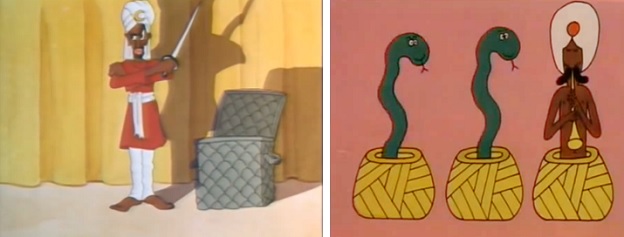
Great Tiger was supposed to be an Indian mystic but his look was very bland. He was a dark-skinned character with a turban, he could have been pulled right out of any comic book. Not much else was known about this figure, what form of fighting he represented or what his abilities were. This was when the team looked to a few new points of reference. Where had they seen Indian fighters before and what made them special? Of course the Indian was well known in television and cartoon tropes. Who does not remember seeing a cartoon of an Indian lying on a bed of nails, or running swords through a basket with their apprentice inside? What about the classic Indian rope trick or the Madari better known as the snake charmers?


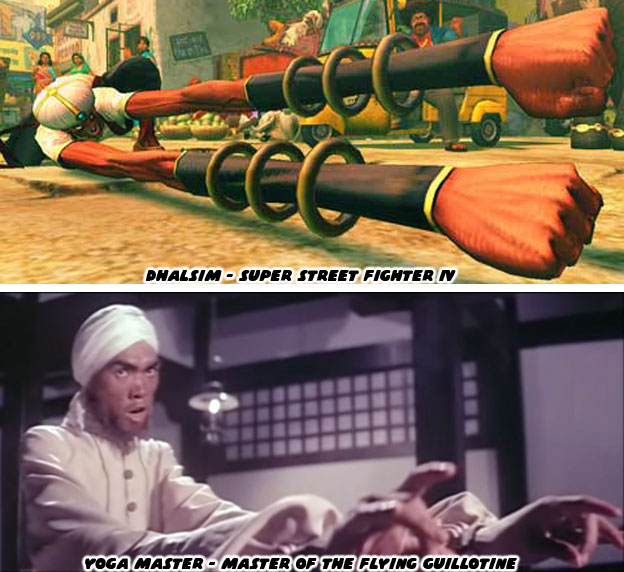
These were things that everyone had seen and was familiar with. Yet these things could have also been negative subconscious cues about a particular culture. India had introduced words like Guru and Yogi into Western language. Whether true or not these images of Indians colored pop culture the world over. In Hong Kong cinema there were two hit films by Jimmy Wang Yu. The One Armed Boxer and the Master of the Flying Guillotine. Actors in blackface portrayed the Indians as having unique powers. In the One Armed Boxer the Indian was impervious to weapons, he stabbed himself in the chest to prove it. He could also teleport around the room by standing on his hands. Magicians from India were part of folklore and many assumed that there was some truth to these legends. The second Indian character feature in the Wang Yu films was even more memorable. He had arms that stretched, creating a very unique challenge for the hero of the film. It was an impressive effect in the film, using prosthesis and a second person to create the illusion. This character, blackface and all, had a profound influence on the development of the Great Tiger.


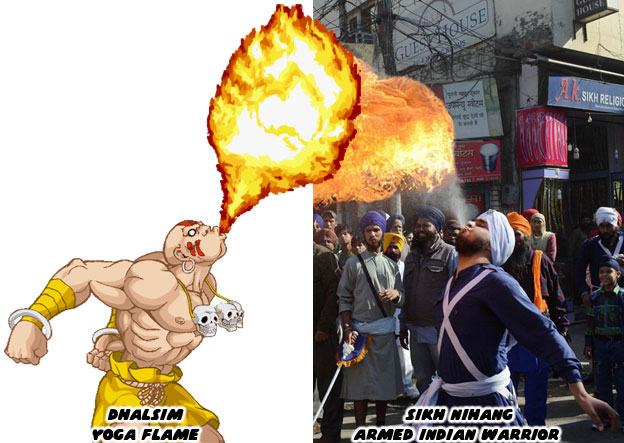
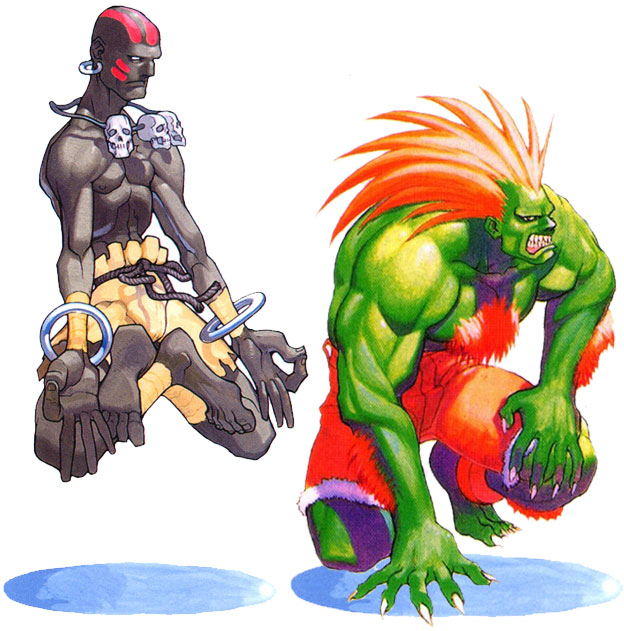
As Dhalsim began to emerge the designers wanted to know how else they could make him unique. Again they used the Indian mystic as a point of reference. In legend the magicians from India and Arabia were highly tolerant of fire. They could walk on hot coals and even breathe fire. These performers ended up in travelling caravans and helped create the myth that found its way to film and television centuries later. The best thing about Street Fighter was that there was a hint to truth to the icons. There was a caste of Sikh Warriors that were armed with weapons and trained in the art of war. During celebrations they would parade in uniform and sometimes put on a show for audiences, singing, dancing and breathing fire. It was an amazing visual. Imagine an animated version of a Sikh warrior in a battle against a karate master. There was real potential in trying to recreate these different arts for game playing audiences.

The team at Capcom began experimenting with the look and moves of the Great Tiger. They stripped away the turban and Sikh costume and made him appear very humble. In Sikh practice hair was a sacred, it was never exposed and was kept wrapped up. Dhalsim was supposed to appear more like a beggar. Literally someone that gave up his worldly possessions and even shaved himself bald to humble himself. A pair of ragged trunks and a rope belt became his new costume. Around his neck he wore three small skulls. It would be revealed that these were children from his village that had died. As a pacifist the only reason he entered the Street Fighter tournament to win the prize money to help his village. His backstory would be revealed at the end of the game. Like Chun-Li and Ryu the developers learned that it was important to know what each character was fighting for and why it made them interesting. At the same time that purpose was not pushed on audiences, like say a Mexican luchador showing up to battle with a frying pan because you know… cooking. The developers respected their characters and audience enough to let players discover what made them unique through the endings of the game.


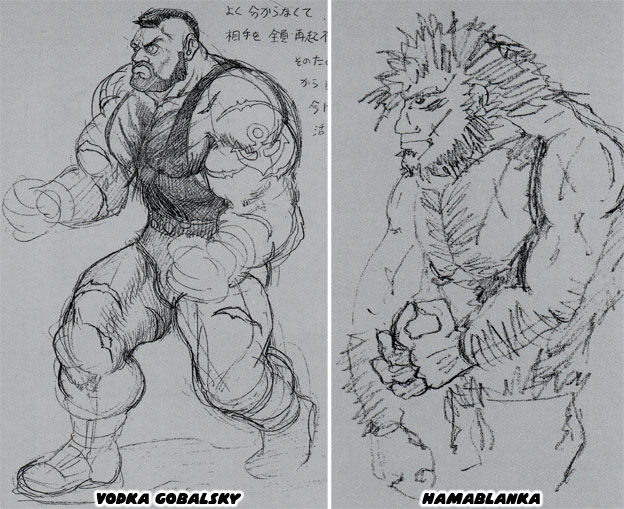
The team then looked at Anabebe and realized that the character had to go. The artists knew however that Anabebe was too ugly and controversial a design. People in North (and Central and South) America would find the character highly offensive. At the same time a wild man was needed to break up the consistency of traditional forms of fighting. Just as they had done with Dhalsim the studio knew that they had to go to extreme lengths to make the character unique. They decided that the new character might be covered in long hair, making him appear more feral. Instead of giving him a skin tone they decided to paint him up in bright colors. The studio looked at the bright colors used by poisonous creatures, snakes and reptiles, to warn predators.

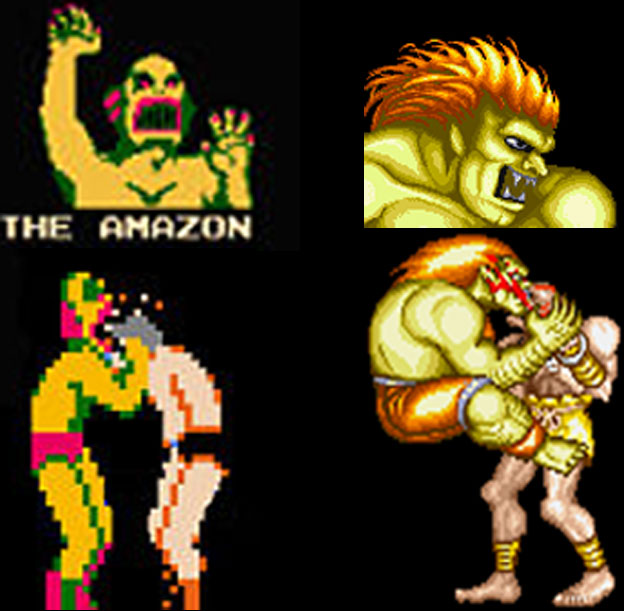
Again Akiman helped with the redesign. He remembered playing against planner Akira Nishitani and being frustrated. Nishitani was good at finding exploits in games and then using them against his opponents. The two would play Pro Wrestling on the Famicom (NES) when it came out in 1986. Nishitani would use a character called the Amazon, he was a green skinned wild man, that looked like a piranha. Anyhow he would use this character to bite the heads of opponents. It was impossible to break out of the hold. Akiman wanted players feel the frustration he did with Blanka's chomping attacks. So the beast man design was pulled from Pro Wrestling rather than black stereotypes.


Blanka, shortened from Hamablanka, ended up being a bright neon green, almost lime with an equally bright orange hairdo. He was given sharp teeth and nails to make him appear like a beast. He ended up being not very far removed from the Amazon. On his ankles they left broken shackles, as if he were indeed an escaped wild man. It was the only carry-over from Anabebe's original design. What they abandoned thankfully was his original skin color and even ethnicity. In the end it worked out well for the character.

Both Dhalsim and Blanka started off as ugly if not outright racist caricatures of a culture. Both went on to represent the two most extreme character designs in the Street Fighter universe. They did by going beyond the stereotypical conventions and created figures that audiences had never seen before. Despite these extreme makeovers they were still acceptable in the lineup. In the game series and in canon they were sometimes partnered together. Despite looking very different the duo did a great job visually of balancing each other out. Because Capcom was able to pull away from their highly dubious origins the two became some of the most popular characters ever created. They were an example of how almost any design could be salvaged with enough insight and hard work.


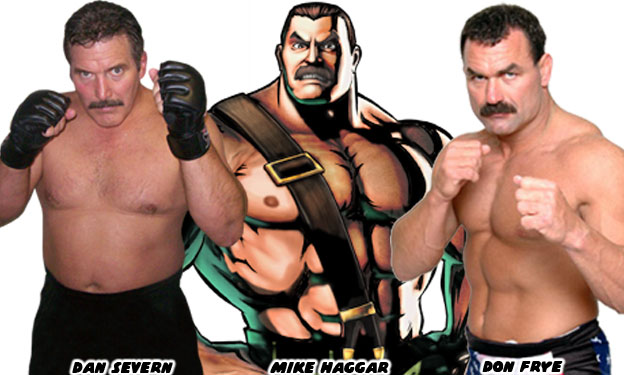
Some of the other characters that were in the planning stages were actually very close to their finished counterparts. The team cut down the wrestlers planned for Street Fighter II from two to one. The studio had found great success with the strong man / wrestler archetype in Final Fight. They had created a large brawler named Mike Haggar. His assortment of suplexes and piledrivers was impressive and never before seen in a brawler. The figure looked very much like MMA pioneers Dan Severn and Don Frye. The two represented the USA in international competitions and Severn had fought in Japan as early as 1982, making him a likely influence on the Capcom staff. By using Haggar as a template the planners could create new moves that were similar to but even more powerful.


The USA was getting two representatives, Ken and Guile, so the studio decided to give a different nation the wrestler. Mexico was cut out of the countries that would be represented when Capcom dropped the masked wrestler. They looked at the burly grapplers from the Eastern block countries. People like Ivan Poddubny and Stanislaus Zbyszko were legendary wrestlers and world champions that gave Europe a chapter in wrestling history. The team at Capcom decided to make the next character Russian. What needed saving was not the design as much as the name. The burly sailor on the table would have been named Vodka Gobalsky.


The teamed toned down the sailor image and instead focused on making him a wrestler. Thankfully some of the creators knew that names could be just as offensive as skin color. They came to this realization much faster than those working elsewhere.

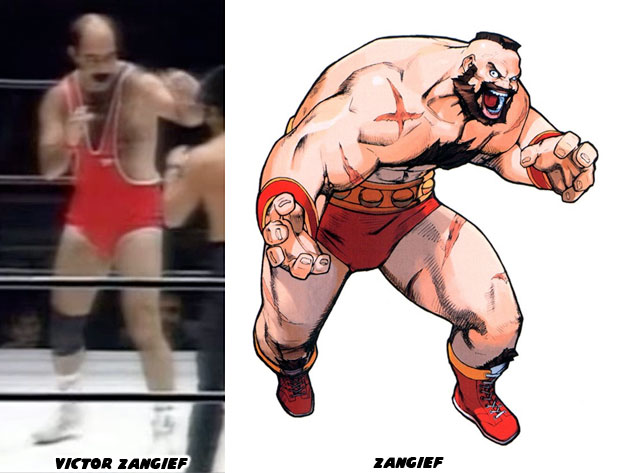
A few years earlier the people at Nintendo created a boxer named Vodka Drunkensky. The Punch Out!! series by Nintendo had some very stereotypical characters in the lineup, like the Japanese Piston Honda, the Italian Pizza Pasta and the Indian Great Tiger (how about that!). When audiences saw Vodka Drunkensky many thought they had gone too far. It was one thing to give a character an offensive name but to show him drinking in between rounds really took the cake! A few of the planners at Capcom remembered seeing a wrestler on Japanese TV named Victor Zangief. The last name seemed to work well for the character and would be much easier to pronounce than Poddubny and Zbyszko.


The final few spots in the roster were filled in by the team. Guile the soldier (whom Americans would naturally gravitate to) and E. Honda the sumo wrestler helped add a little more diversity to the cast. The different backgrounds and different fighting styles were a great compliment to the other forms. The revised lineup was much closer to the version that players would see in the arcade. The rest as they say was history...


So what happened to the designers after Street Fighter II. Why has it been so hard for Capcom to create a fighter that matched the legacy of the original World Warriors? We will explore these things in the next blog. As always if you enjoyed this blog and would like to sponsor me please visit my Patreon page and consider donating each month, even as little as $1 would help make better blogs and even podcasts!