Showing posts with label bwa. Show all posts

Monday, October 30, 2023

Muscle Bomber - the Capcom wrestling series, part 3

Muscle Bomber / Saturday Night Slam Masters had moderate success in the arcade. It certainly had a following among wrestling game fans. Capcom learned a lot from the reception of the first title. They made a few tweaks, added more multiplayer options, and released the Muscle Bomber Duo upgrade. As fun as it was, and as well as the Super Famicom / Super Nintendo version sold they knew that they had to change their approach for a proper sequel. Muscle Bomber had the control, and gameplay of a brawler-meets-wrestling game. If you had played any of the classic Capcom brawlers; Final Fight, Captain Commando, the King of Dragons, Warriors of Fate, Alien vs Predator, etc. then you could instantly pick up and play Muscle Bomber. The downside was that brawler fans were used to fighting waves of opponents, rather than one person for minutes on end. It felt kind of stale in that regard. Of course in the early ‘90s the brawler had also taken a back seat to the fighting game. Capcom needed to approach their wrestling sequel from a completely new angle.
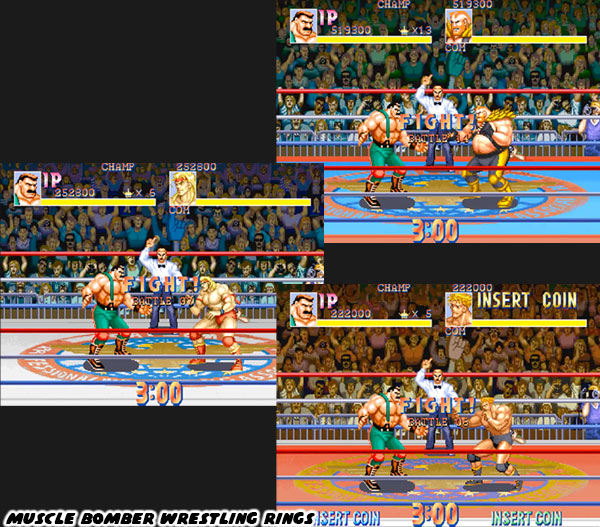
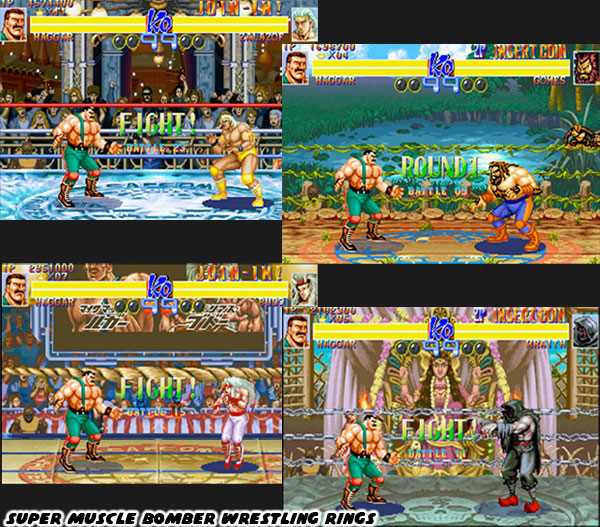
The first thing the studio did was decide that Super Muscle Bomber - The International Blowout needed to be a fighting game. The sprites, control, and animation from the first game were easily adapted for 2D combat. The levels themselves also had to change drastically. In the original MB the matches were supposed to take place all around the world. The problem was that the stages all looked the same with the exception of the colors of the ropes, and ring. In Final Fight, and the other brawlers actually made players feel like they were traveling to new locations. Super Muscle Bomber would have a few traditional-looking rings, however every background was original. For example the British giant Titan the Great fought inside a palace, with the Queen of England in attendance. The Russian Aleksey Zalazof fought in the snow, and the mat was made of ice. The wild Missing “IQ” Gomez fought in the jungle, with ropes made of vines. As with other great fighting games every stage told a story through its details. Unlike the first game Capcom made sure that the audiences were unique in each stage. Some mats were made of metal, wood, or stone, and some of the ropes were replaced with chains.
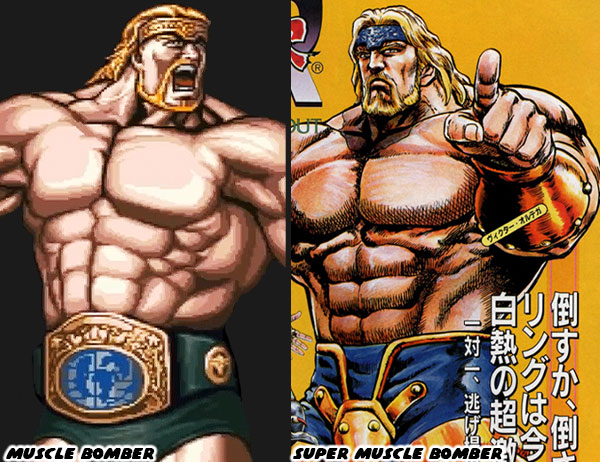
The other, and more important visual edit that Capcom did was return to Tetsuo Hara’s original designs. They were featured in all of the win, and loss character profiles. Unfortunately there were no makeovers for the original sprites. All of the sprites from the first game were brought over. They were created by the Capcom art team, and had the softer edge of all the classic Capcom brawlers. The new characters introduced for Super Muscle Bomber were much bolder. They had the proportions, muscularity, and shading that we had come to expect from Mr. Hara’s renders. For example the former CWA champion Victor Ortega returned, this time as a playable character. Capcom stuck closely to Mr. Hara’s original design which was previously only seen in the opening animation of the Super Famicom version of MB. For Super Muscle Bomber Capcom created what was arguably the most muscular sprite ever. His proportions were nowhere near the way that they presented him in the ending scene of the original Muscle Bomber. To show that he was competing fairly in the tournament he was designed wearing armored trunks, and not the CWA belt.
Two of the new characters; Rip Saber, and The Wraith were members of the Blood Wrestling Association. They would be joining Astro, and Kimala the Bouncer in trying to takeover the CWA. The BWA characters were reflective of the “hardcore” wrestling movement. This really took off in Japan first in the early ‘90s with promotions like Frontier Martial Arts Wrestling (FMW), and then later in the US with Extreme Championship Wrestling (ECW). Many wrestling purists in Japan considered this garbage wrestling. Mr. Hara saw a lot of potential to make over-the-top, almost Hokuto no Ken-type villains, for Capcom with these new BWA opponents.
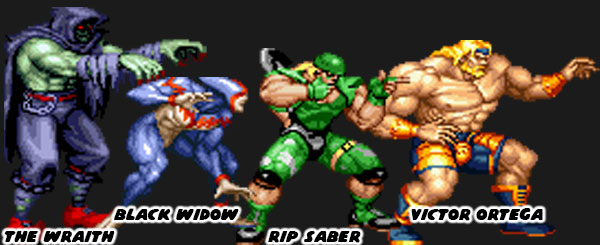
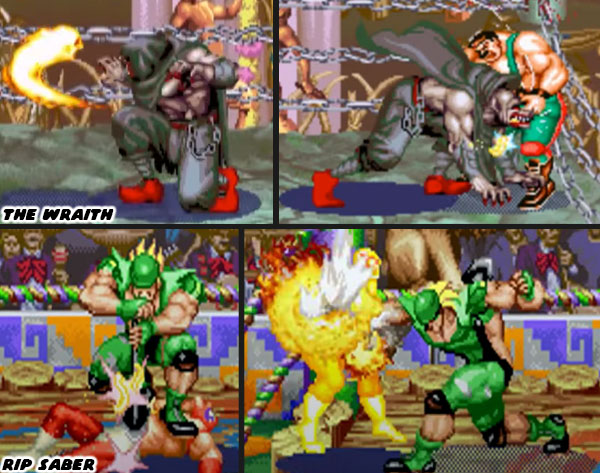
Hardcore wrestlers were notorious for bleeding in matches. They would use foreign objects at every opportunity to cut each other open. Light tubes, panes of glass, razor wire, and cinder blocks were often used to beat each other half to death. The former soldier Rip Saber was one such dirty character. He would hack at opponents with his combat shovel. He would also toss grenades at opponents, similar to Rolento, one of the bosses in Final Fight. The Wraith was a different kind of hardcore wrestler. He was akin to the original Sheik, or his nephew Sabu. He was a callback to the reckless foreign wrestlers. The Wraith used his height, and ghoul-like powers to absolutely shred opponents. We would see lots of pro wrestling characters over the decades, but Mr. Hara was ahead of the curve when he included hardcore archetypes into a fighting game way back in 1993. We wouldn’t see these types of villains again until Exodus from ARIKA’s Fighting Layer in 1998.
The other thing Mr. Hara was known for was creating eccentric fighters. Hokuto no Ken was known for its hyper masculine designs, and story. There were however many characters that were effeminate, had long hair, and wore makeup in the series as well. They were supposed to conjure images of the glam metal bands like Poison, and Mötley Crüe. In other cases the homoerotic overtones were very obvious, especially with characters like Yuda. That didn’t always translate to anime, but it did let audiences know that sometimes the most beautiful fighters were also the most dangerous. Mr. Hara wanted to throw a curveball into the new lineup with this logic. Missing “IQ” Gomez was the strange character in the first game. Super Muscle Bomber needed another odd character. Thus he gave us a lanky, androgynous wrestler named Black Widow.
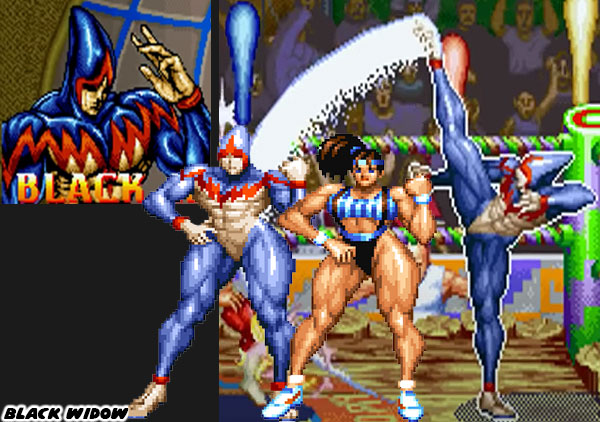
B. Widow had a strange latex-like costume, and mask. She was tall too, 6’ 7” to be precise. This made her taller than most of the lineup including Sheep the Royal. She was a hair taller than Mike Haggar, Kimala the Bouncer, and even Victor Ortega. Of course the game had actual giants. The Wraith was 7’ 2”, and Titan the Great was 7’ 9.” B. Widow was muscular, but lean. She moved awkwardly, and had strange poses. She also had an odd digitized voice that we could hear before, and after matches. These things made her sex, and gender hard to figure out. Every other character had a deep masculine voice in the game. We wouldn’t see B. Widow’s true identity until the end of the game. She took off her mask and revealed that she was the only female in the tournament. As Mr. Hara was well versed in wrestling history I would argue that he based her on Mariko Yoshida. Audiences wouldn’t see another massive female in the Street Fighter universe until 2023 when we got Marisa in Street Fighter 6. She by the way was 6’ 8”.
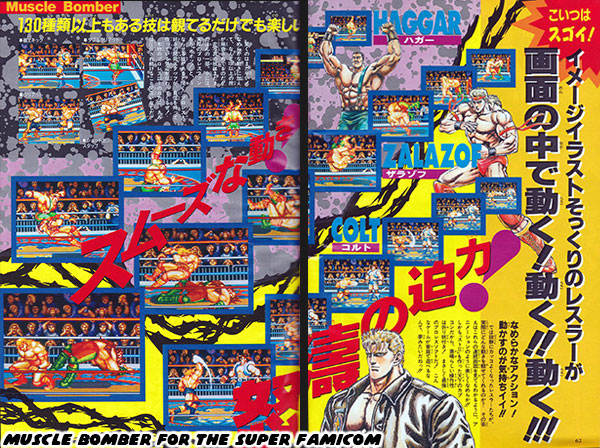
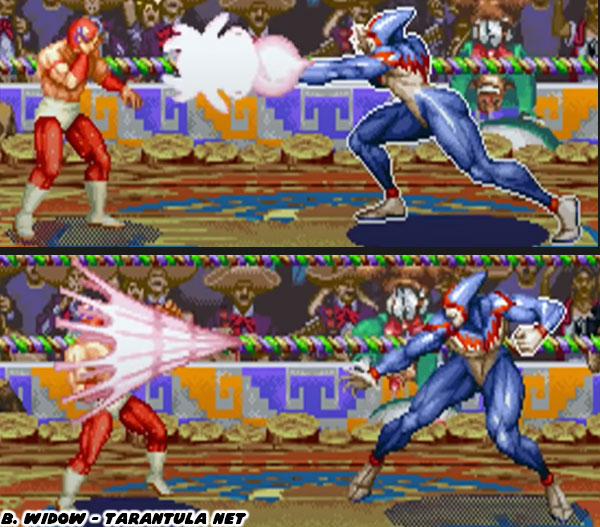
The new character designs, and stages were welcome, but that there was much more to making a good fighting game. The animation, and balance were decent in MB, but it needed a lot of refinement for Super MB. This was especially true if it were to appeal to fans of Street Fighter. The other thing that the game needed were special attacks. Muscle Bomber wasn’t just a wrestling game, it had to have characters, and moves that were every bit as amazing as the ones in Street Fighter. If Ken, and Ryu were head-and-shoulders above the greatest karate masters ever, then how much better did the Mysterious Budo have to be over other Japanese wrestlers? Or how much more of a high flyer did El Stinger have to be when compared to the greatest lucha libre enmascarados? Thankfully Capcom had answered this right away. Every character in the original Muscle Bomber had a special attack that were plausibly impossible. These attacks were expanded in Super MB. Some characters had sweeps, and tackles. Many had spinning grapples that would have made Zangief proud. Some even had ranged attacks. Black Widow for example had a fireball-like ranged web attack that allowed her to stun, and even draw opponents closer. This move predated Ed’s “Psycho Snatcher” special attack in Street Fighter V.
Capcom, and their fans certainly believed in their game. They made sure to promote it on the convention circuit, and all of the media outlets. The publisher made a few rare collectables, including some posters, and small plastic figures. They even made plush figures that could be found in crane games. These items were mainly Japanese exclusives. Sadly the following that Capcom hoped for never materialized. The bar that Street Fighter II set was impossibly high to beat. Well to be honest, the bar that Super SFII set was high. It addressed the control, combo, balance issues from earlier SFII releases (Champion, Turbo). It was obvious how much better Super MB was when compared to the first edition of SFII. The Muscle Bomber series would build a cult following, but it was not the massive hit that the company wanted it to be. It would remain a fondly remembered title to audiences from the arcade generation. Like Rival Schools, Star Gladiator, Power Stone, and other gems from the studio, the hope for a reboot was the only thing that remained.
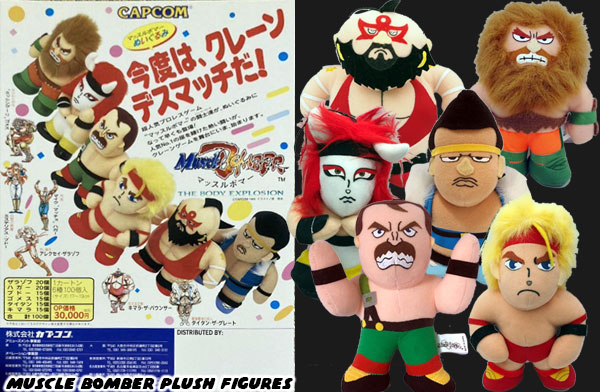
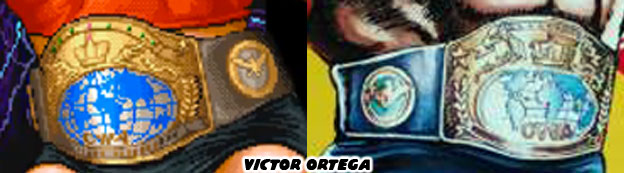
I was a big fan of the series. It married my love of the Street Fighter universe, pro wrestling, and the art of Tetsuo Hara. I never collected too may Muscle Bomber items, aside from the guides. I hoped to get all the plush figures someday. The MB item from my collection that I’m most proud of was a poster of the original release. Capcom didn’t design too many posters for it, especially when compared to the number that they released for SFII. Sadly there was never a Super Muscle Bomber poster to the best of my knowledge. I spent years hunting down the Ortega poster because it featured the original Tetsuo Hara art. More important it featured his original design for the CWA championship belt. As an obsessive fan of Street Fighter I made myself a promise. One day I would own a replica of that belt. Going back to 2008 I started work on an illustration of it. Little by little I spent more than a decade on that piece. I recreated as many tiny details as I could pull from screen grabs. This was in the hopes that I could get my vector file to a belt maker someday. I didn’t touch that illustration again until a few years ago. It was because my working conditions had changed dramatically.
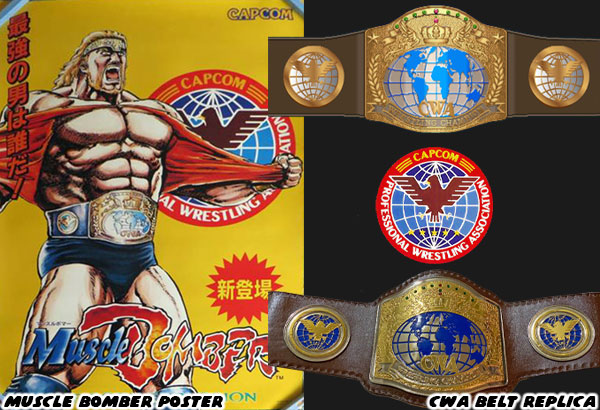
The office that I used to travel to had closed down due to COVID-19. Half the staff was moved to Canada. Many friends, and coworkers were let go. Those that remained were put on remote access. After years of working from home I could feel myself going stir crazy. No matter how many games I played, or how much I wrote, or drew it just didn’t feel rewarding. I knew that I needed an extra special treat to break out of the depression cycle. I bit the bullet, and got the blessing of my wife to commission a belt maker. Not long after I was holding the CWA title. It was perfect down to the tiniest detail. I wish I could share with you the feeling that it gave me. One day I hope to go to a fighting game tournament in either Zangief, or Mike Haggar cosplay with it. It would be great to see you there.
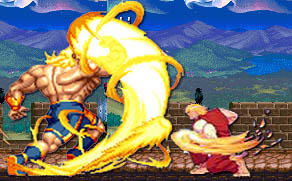
I also have a long-term goal. Many years from now I’d like to visit Japan with my family. If there was a chance that Mr. Hara would autograph the belt then I would bring it with me in a heartbeat. I think it’s good to set goals, but it’s also fun to have dreams. If I can get enough people talking about Muscle Bomber then maybe we’ll see some wrestlers turn up in the Street Fighter series again. What do you think? Should Capcom take another crack at this game, or perhaps other fighters like Vampire / Darkstalkers, and Rival Schools? I’d like to hear about it in the comments section. As always if you would like to sponsor me please visit my Patreon page and consider donating each month, even as little as $1 would help make better blogs and even podcasts!
follow the Street Writer on Patreon!

Friday, October 28, 2016

The best championships in fighting games, part 2

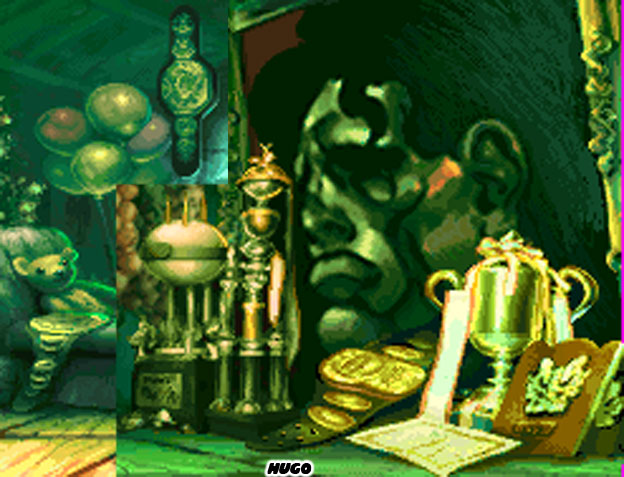
In the previous blog I had pointed out the unique belts and champions featured in fighting games. From the small symbolic belt of Russian boxer Andrei in the King of Combat to the gaudy bull horn belt of Antonov from King of Fighters. There was a championship for every form of fighting. The wrestlers in these games seemed to have the best titles. While Darun Mister of Street Fighter EX fame had a total of 3 championship belts he was nowhere near the most decorated champion. Hugo Andore, the German giant from Street Fighter III also had three championship belts and at least 5 other trophies and awards from different promotions. These were all visible in his stage from Street Fighter III 3rd Strike.


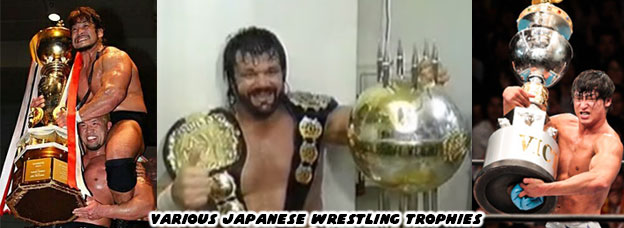
The accolades given to Hugo were based on real-world championships. Take a look below at some of the Japanese promotions that inspired the gold. In some promotions the best wrestlers are given statues, plaques or towering cups wrapped in streamers. They are the result of winning a tournament or even beating multiple opponents in a "battle royal." In the multiple endings in Street Fighter III: Giant Attack Hugo was written as having different tag team partners, there was a chance that one of his belts or trophies was won with the help of a partner. It was never established who the actual person was but many assumed it was Alex, the American MMA star.


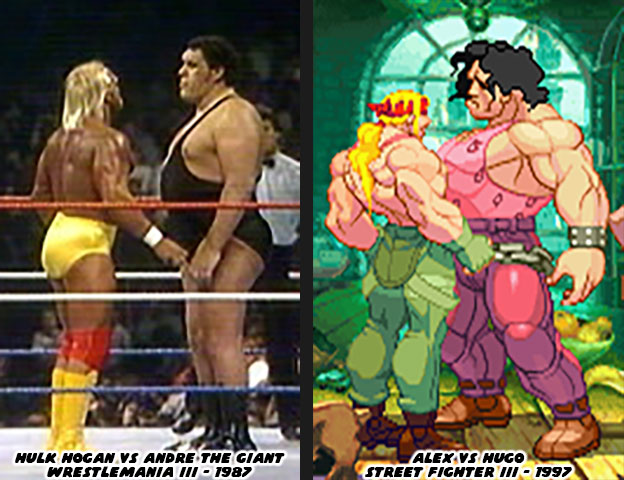
Hugo was a Mad Gear Gang-member-turned wrestler. He along with the Andore family from the Final Fight series was inspired by Andre the Giant. The French wrestling star was huge (pardon the pun) in the '70s and '80s. He traveled the world and made a following wherever he landed. In his younger days he was quite athletic and could actually perform some high risk 1st and 2nd rope leaping moves. He had a large head of hair, almost like an afro which gave him a wild appearance when he debuted. As he got older he gained some weight, slowed down and cut his hair a little bit shorter. Age did nothing to curb his awesome strength and legendary drinking ability. The character of Hugo is a sort of amalgamation of the young and old Andre. He has some of the speed, moves and hair of the younger version with the raw power of the older self. One of Andre's great rivalries, and even tag team friendships was with Hulk Hogan. This insight from the developers was celebrated as a special animation whenever he fought Alex. The two would have a stare down before the round, similar to the Wrestlemania III match.


Andre had beaten many of the best wrestlers around the world. Yet he was not necessarily the person who would be considered the heavyweight champion for a particular company or promotion. He never held the title for any length of time because he was constantly travelling. Andre was a sort of sideshow attraction. He would only appear from time-to-time so that his marketability and thus legend would remain intact. Promoters knew that audiences would eventually tire of seeing him squash all of his opponents, so he was considered a gimmick fighter and only hired him for a few weeks at a time. Any belt he won was usually won back by the hometown champ before he left the country. Hugo on the other hand was a runaway terror. He took the belts and steamrolled every promotion he went to. There was no one in the Street Fighter universe that seemed capable of stopping the giant. But did that make him the best wrestler in the SF universe? I would argue no, he was not the best wrestler and certainly not the best fighter. Guy, Cody and Mike Haggar from Final Fight have all shown that they could take him, and his extended family of giants in a stand up brawl. Despite Hugo's collection of belts and trophies he is missing a very important one. He does not have the Capcom Wrestling Association or CWA belt. This would be THE title held by Victor Ortega in Muscle Bomber / Saturday Night Slam Masters. Hugo also does not possess the rival promotion Blood Wrestling Association or BWA belt.


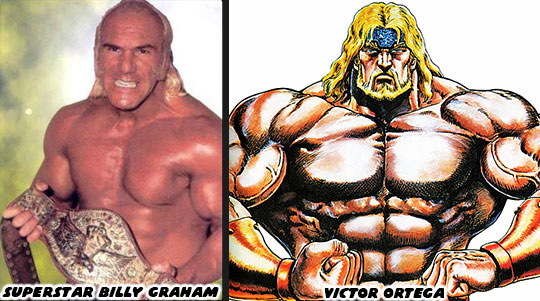
I have talked previously about the middle-aged phenom known as Victor Ortega on previous blogs. This character and his title was created by Tetsuo Hara. The co-creator and artist behind Hokuto No Ken / Fist of the North Star. is a huge wrestling fan. Many of the big wrestling names from the '70s inspired several of the characters in his comic book series through the '80s. These in turn inspired the artists working at Capcom through the '80s and '90s. When they began designing the villains in Street Fighter and Final Fight series a few were based on the work of Mr. Hara. When the company wanted to create a wrestling-inspired brawling and later fighting game they went directly to Tetsuo Hara. He created a cast of characters and set the pro wrestling canon of the Street Fighter universe. At the top of the chain was Victor Ortega, based on the flamboyant and photogenic Superstar Billy Graham. Billy had a bodybuilder physique and looked incredible in televised matches. It didn't matter if other wrestlers were technically more sound, because they didn't look and act like a champion they often had to "work" (lose a match) to Graham.


The version of a champion that Mr. Hara created may have been visually inspired by wrestlers like Graham, however his in-ring skills were the real deal. Ortega had legitimate punching, kicking and grappling skills. Despite his size he was also very fast and very flexible. He needed to be a great all-around champion considering the different styles of wrestlers that filled both the CWA and BWA rosters. Some were technicians, some brawlers, some were high flyers and some were shooters (submission fighters). Victor Ortega was easily the most muscular character set in the Street Fighter universe. This undoubtedly made him intimidating, even to a giant like Hugo. I would like to think that not only did Hugo fail to capture the CWA title, but that he was afraid of Ortega.

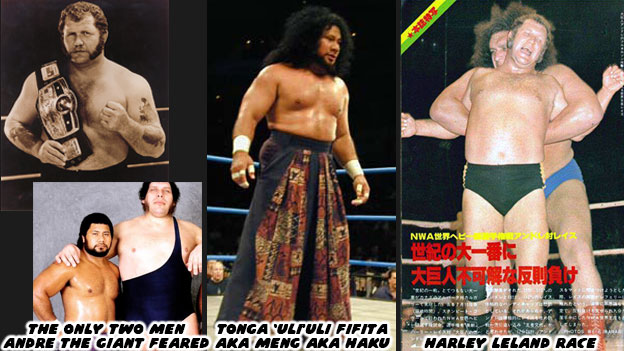
In the real world Andre the Giant faced all sorts of opponents, including some almost as tall and as strong as he was. Outside of the ring he sometimes had to fight off hecklers, drunks and angry wrestlers. He beat just about all of them, most with ease. After all of his travels and all of his victories there were only two men that Andre was afraid of. According to former wrestler and manager Bobby "the Brain" Heenan the two men were Harley Race and Tonga Uli'uli Fifita. Both men had reputations for being tough as nails. They were strong, intimidating and did not appreciate being messed with. Both were also fiercely loyal, good to their friends and stand-up men whose word was their bond. The two men were also a foot shorter than Andre.


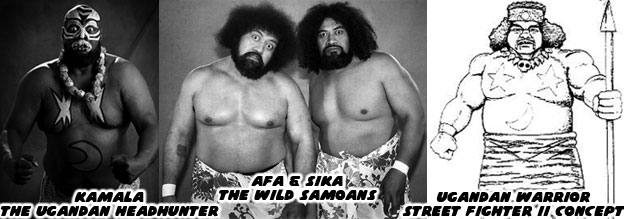
Tonga was the younger of the two hard legends. He was a trained martial artist and had actually been picked up as a teen to learn the art of Sumo by a Japanese stable. While in Japan he was able to adapt to life in the squared circle. He was gifted with great strength and stamina. These things came in handy as he fought many Japanese legends. They were trained in the "hard style" of wrestling where people barely pulled their kicks and punches. Karl Gotch was a pioneering grappler that took his classic techniques with him to Japan. Pro wrestling in Gotch's day was much more about grappling and submission holds than the "sports entertainment" it tries to be on television. He wanted his students and opponents to come at him with the same ferocity of the turn-of-the-century wrestlers. He wanted them to know how to legitimately catch holds and counter attack. Tonga was already a tough person but his time in Japan tempered him into a dangerous weapon. It was not hard for him to find work in any promotion acting as a heel or bad guy. In the '70s and '80s the large Pacific Islanders were often marketed as savages or wild men by the various promotions. This worked to their advantage as they intimidated opponents and audiences alike. The gimmick had gone over so well that one of the concept fighters for Street Fighter II was a Ugandan warrior. This character had elements of the Wild Samoans, the body paint of Kimala (the original Ugandan warrior) and the frame of Tonga.

The bar fights that Tonga participated in were the stuff of legend. The majority of the time all he wanted was a drink and to be left alone but trouble would find him. Many of his friends were astonished by how often people would pick fights with him. There are stories of how he took on groups of people and even the police in the melees. The scariest were stories of how he bit the nose off of an attacker, or how he reached into a man's mouth and pulled out his teeth. The stories were gruesome and certified by witnesses. He worked with Andre a few times and they got along great, possibly because Andre avoided him outside of the ring and never tested him. It would be interesting to see a redesign of this character by the people at Capcom, one that captured more of the presence of Tonga without pandering to the wild man mystique. The other person that Andre feared had an equally interesting history.


Harley Race was similar to Karl Gotch in that he came from a different era. Harley was a tough guy, even at a young age. As a teen he was thrown out of school for beating up his teacher. He decided that he wanted to be a wrestler and actually joined up with a carnival where he learned the ropes from actual carney catch-as-catch can fighters and strongmen. This was a direct link to another time, literally a connection to the 19th Century, when wrestling was real. Before promotions divided the talent and before television turned it into a soap opera. Harley had no amateur wrestling experience, unlike his opponents which often came from college backgrounds. As he went from town to town he had to take on any and all challengers. Some were men, some were teens but most had experience on the mat. Harley learned that he had to adapt quickly to these people and try to get a pin or submission right away. If he lost then he didn't get paid. Not only that but his handlers would beat him up as well. Harley survived a car accident as a young man and was told he'd never walk, let alone wrestle again. Harley recovered and became one of the hardest men in the business. He was a legit shooter and knew a countless number of ways to hurt someone. He picked up many things along the way from pro wrestlers which complimented his street experience. Harley was soft spoken but intense, his promos became legendary. It was his mastery of the ring and respect for the business that earned him followers the world over.


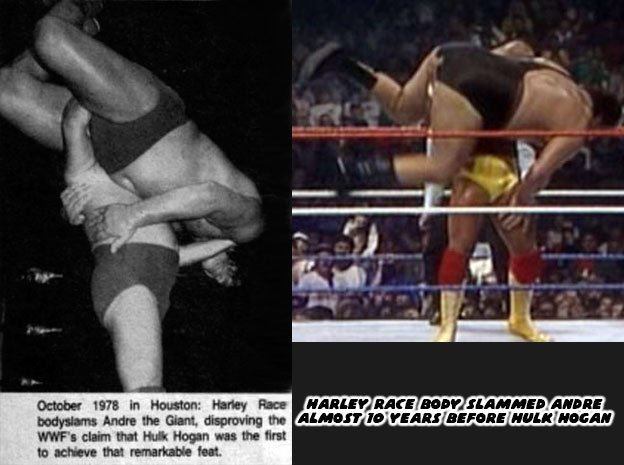
Harley, like Tonga, did not get into wrestling the easy way. He knew many different ways to seriously hurt people but instead worked to make his opponents look great and have long careers. He was just over 6 feet tall but had worked with many bigger men including Andre. Audiences soon forgot about the size difference in their matches because his presence was so commanding. It was Harley and not Hulk Hogan that had first slammed Andre the giant. Harley would often chaperone the big wrestlers when they traveled abroad. It was said that just a look from Race was enough to make the biggest wrestler back down when they crossed the line. Harley's old-school origin and NWA championship, which represented some 30+ or 40+ independent promotions / territories was the ultimate prize for a pro wrestler. There were other "world's" titles, including those from WCW, ECW, WWF and NJPW but among the purists you could not really consider yourself the heavyweight champ unless you held the same belt that Harley did. Andre the giant did not hold that belt. He once wrestled Harley to a 60-minute draw but that's as close as he ever got. When Harley joined the WWF he won the first Royal Rumble and became the King. When he felt ready to leave the business there was only one person he felt appropriate to lose the crown to and his name was Tonga.

Hugo may have been a beast but he was not the best. Mike Haggar had the chops to be the true CWA champion. Zangief and Darun probably have the chops too. As for Hugo, well, if he doesn't have the belt then he has not beaten the best. Or more likely he is scared to fight Ortega. Do you have a favorite video game champion? Or a favorite title? Who do you think is the best game wrestler? I'd like to read about it in the comments. As always if you enjoyed this blog and would like to sponsor me please visit my Patreon page and consider donating each month, even as little as $1 would help make better blogs and even podcasts!

 follow the Street Writer on Patreon!