Showing posts with label victor ortega. Show all posts

Monday, October 30, 2023

Muscle Bomber - the Capcom wrestling series, part 3

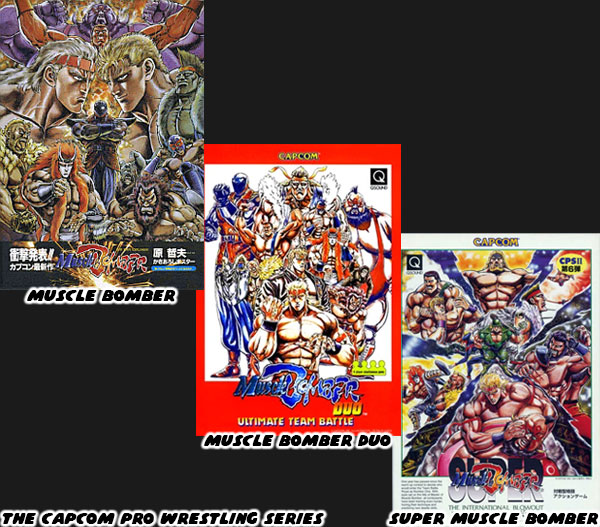
Muscle Bomber / Saturday Night Slam Masters had moderate success in the arcade. It certainly had a following among wrestling game fans. Capcom learned a lot from the reception of the first title. They made a few tweaks, added more multiplayer options, and released the Muscle Bomber Duo upgrade. As fun as it was, and as well as the Super Famicom / Super Nintendo version sold they knew that they had to change their approach for a proper sequel. Muscle Bomber had the control, and gameplay of a brawler-meets-wrestling game. If you had played any of the classic Capcom brawlers; Final Fight, Captain Commando, the King of Dragons, Warriors of Fate, Alien vs Predator, etc. then you could instantly pick up and play Muscle Bomber. The downside was that brawler fans were used to fighting waves of opponents, rather than one person for minutes on end. It felt kind of stale in that regard. Of course in the early ‘90s the brawler had also taken a back seat to the fighting game. Capcom needed to approach their wrestling sequel from a completely new angle.

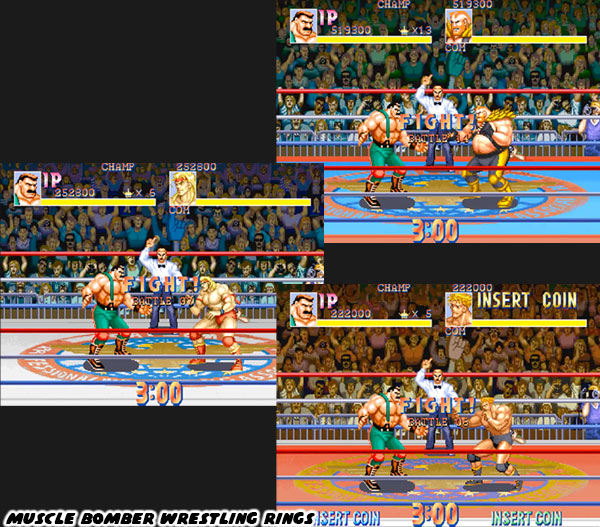
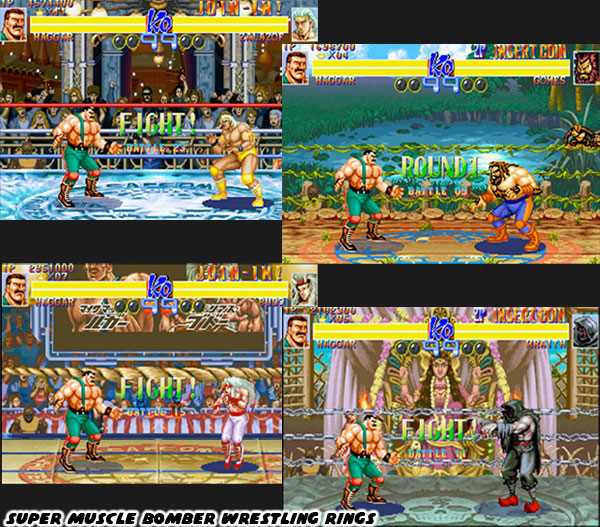
The first thing the studio did was decide that Super Muscle Bomber - The International Blowout needed to be a fighting game. The sprites, control, and animation from the first game were easily adapted for 2D combat. The levels themselves also had to change drastically. In the original MB the matches were supposed to take place all around the world. The problem was that the stages all looked the same with the exception of the colors of the ropes, and ring. In Final Fight, and the other brawlers actually made players feel like they were traveling to new locations. Super Muscle Bomber would have a few traditional-looking rings, however every background was original. For example the British giant Titan the Great fought inside a palace, with the Queen of England in attendance. The Russian Aleksey Zalazof fought in the snow, and the mat was made of ice. The wild Missing “IQ” Gomez fought in the jungle, with ropes made of vines. As with other great fighting games every stage told a story through its details. Unlike the first game Capcom made sure that the audiences were unique in each stage. Some mats were made of metal, wood, or stone, and some of the ropes were replaced with chains.

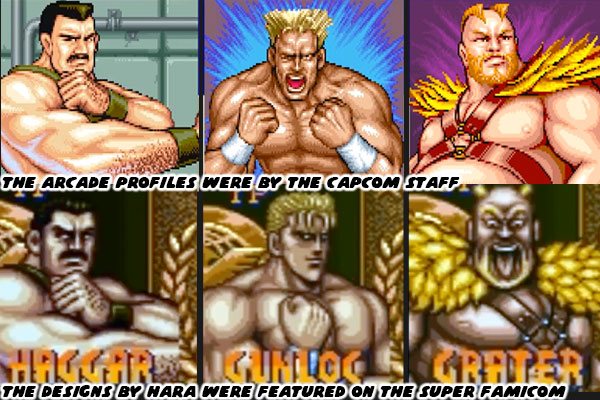
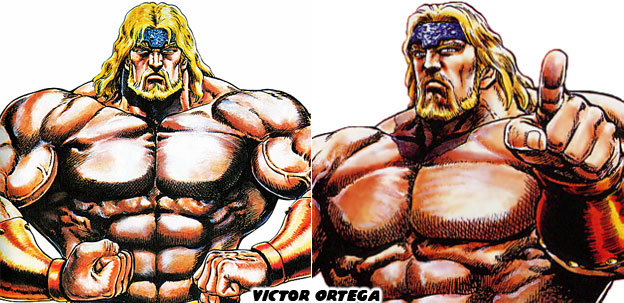
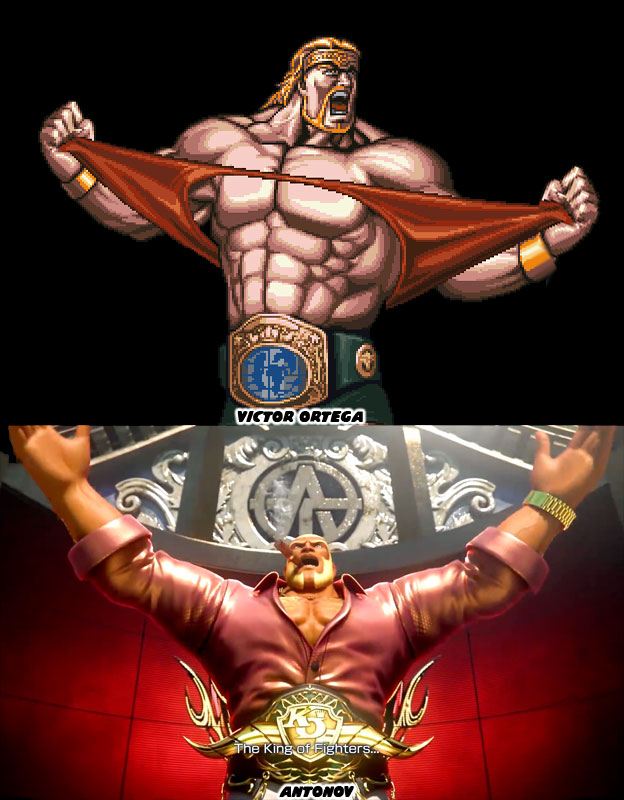
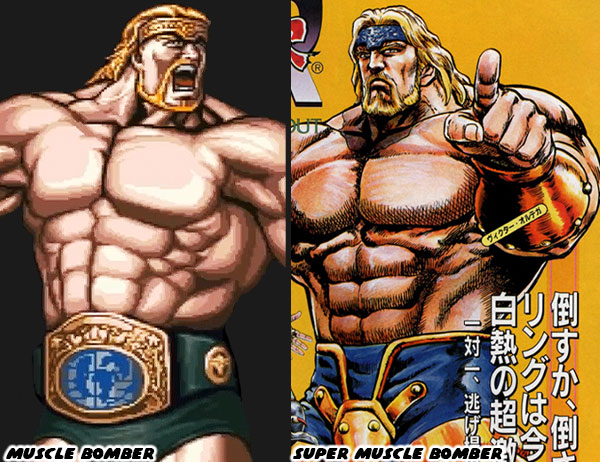
The other, and more important visual edit that Capcom did was return to Tetsuo Hara’s original designs. They were featured in all of the win, and loss character profiles. Unfortunately there were no makeovers for the original sprites. All of the sprites from the first game were brought over. They were created by the Capcom art team, and had the softer edge of all the classic Capcom brawlers. The new characters introduced for Super Muscle Bomber were much bolder. They had the proportions, muscularity, and shading that we had come to expect from Mr. Hara’s renders. For example the former CWA champion Victor Ortega returned, this time as a playable character. Capcom stuck closely to Mr. Hara’s original design which was previously only seen in the opening animation of the Super Famicom version of MB. For Super Muscle Bomber Capcom created what was arguably the most muscular sprite ever. His proportions were nowhere near the way that they presented him in the ending scene of the original Muscle Bomber. To show that he was competing fairly in the tournament he was designed wearing armored trunks, and not the CWA belt.

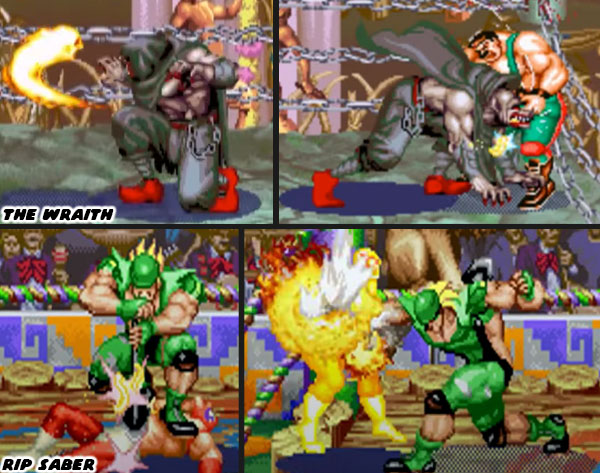
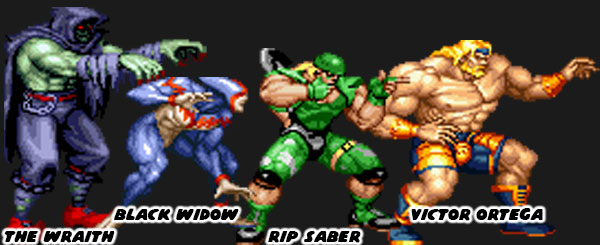
Two of the new characters; Rip Saber, and The Wraith were members of the Blood Wrestling Association. They would be joining Astro, and Kimala the Bouncer in trying to takeover the CWA. The BWA characters were reflective of the “hardcore” wrestling movement. This really took off in Japan first in the early ‘90s with promotions like Frontier Martial Arts Wrestling (FMW), and then later in the US with Extreme Championship Wrestling (ECW). Many wrestling purists in Japan considered this garbage wrestling. Mr. Hara saw a lot of potential to make over-the-top, almost Hokuto no Ken-type villains, for Capcom with these new BWA opponents.

Hardcore wrestlers were notorious for bleeding in matches. They would use foreign objects at every opportunity to cut each other open. Light tubes, panes of glass, razor wire, and cinder blocks were often used to beat each other half to death. The former soldier Rip Saber was one such dirty character. He would hack at opponents with his combat shovel. He would also toss grenades at opponents, similar to Rolento, one of the bosses in Final Fight. The Wraith was a different kind of hardcore wrestler. He was akin to the original Sheik, or his nephew Sabu. He was a callback to the reckless foreign wrestlers. The Wraith used his height, and ghoul-like powers to absolutely shred opponents. We would see lots of pro wrestling characters over the decades, but Mr. Hara was ahead of the curve when he included hardcore archetypes into a fighting game way back in 1993. We wouldn’t see these types of villains again until Exodus from ARIKA’s Fighting Layer in 1998.

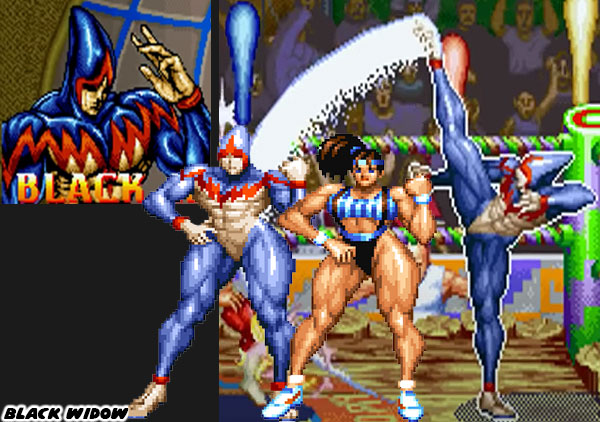
The other thing Mr. Hara was known for was creating eccentric fighters. Hokuto no Ken was known for its hyper masculine designs, and story. There were however many characters that were effeminate, had long hair, and wore makeup in the series as well. They were supposed to conjure images of the glam metal bands like Poison, and Mötley Crüe. In other cases the homoerotic overtones were very obvious, especially with characters like Yuda. That didn’t always translate to anime, but it did let audiences know that sometimes the most beautiful fighters were also the most dangerous. Mr. Hara wanted to throw a curveball into the new lineup with this logic. Missing “IQ” Gomez was the strange character in the first game. Super Muscle Bomber needed another odd character. Thus he gave us a lanky, androgynous wrestler named Black Widow.

B. Widow had a strange latex-like costume, and mask. She was tall too, 6’ 7” to be precise. This made her taller than most of the lineup including Sheep the Royal. She was a hair taller than Mike Haggar, Kimala the Bouncer, and even Victor Ortega. Of course the game had actual giants. The Wraith was 7’ 2”, and Titan the Great was 7’ 9.” B. Widow was muscular, but lean. She moved awkwardly, and had strange poses. She also had an odd digitized voice that we could hear before, and after matches. These things made her sex, and gender hard to figure out. Every other character had a deep masculine voice in the game. We wouldn’t see B. Widow’s true identity until the end of the game. She took off her mask and revealed that she was the only female in the tournament. As Mr. Hara was well versed in wrestling history I would argue that he based her on Mariko Yoshida. Audiences wouldn’t see another massive female in the Street Fighter universe until 2023 when we got Marisa in Street Fighter 6. She by the way was 6’ 8”.

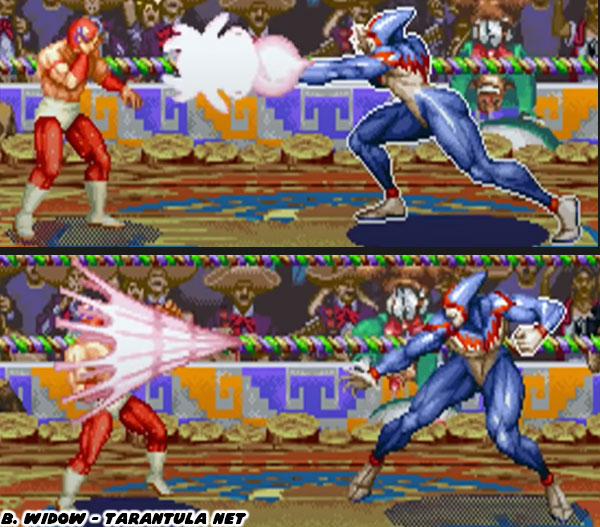
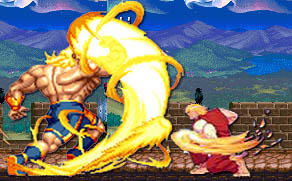
The new character designs, and stages were welcome, but that there was much more to making a good fighting game. The animation, and balance were decent in MB, but it needed a lot of refinement for Super MB. This was especially true if it were to appeal to fans of Street Fighter. The other thing that the game needed were special attacks. Muscle Bomber wasn’t just a wrestling game, it had to have characters, and moves that were every bit as amazing as the ones in Street Fighter. If Ken, and Ryu were head-and-shoulders above the greatest karate masters ever, then how much better did the Mysterious Budo have to be over other Japanese wrestlers? Or how much more of a high flyer did El Stinger have to be when compared to the greatest lucha libre enmascarados? Thankfully Capcom had answered this right away. Every character in the original Muscle Bomber had a special attack that were plausibly impossible. These attacks were expanded in Super MB. Some characters had sweeps, and tackles. Many had spinning grapples that would have made Zangief proud. Some even had ranged attacks. Black Widow for example had a fireball-like ranged web attack that allowed her to stun, and even draw opponents closer. This move predated Ed’s “Psycho Snatcher” special attack in Street Fighter V.

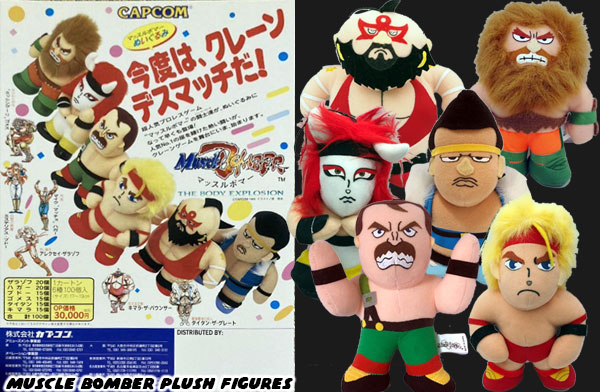
Capcom, and their fans certainly believed in their game. They made sure to promote it on the convention circuit, and all of the media outlets. The publisher made a few rare collectables, including some posters, and small plastic figures. They even made plush figures that could be found in crane games. These items were mainly Japanese exclusives. Sadly the following that Capcom hoped for never materialized. The bar that Street Fighter II set was impossibly high to beat. Well to be honest, the bar that Super SFII set was high. It addressed the control, combo, balance issues from earlier SFII releases (Champion, Turbo). It was obvious how much better Super MB was when compared to the first edition of SFII. The Muscle Bomber series would build a cult following, but it was not the massive hit that the company wanted it to be. It would remain a fondly remembered title to audiences from the arcade generation. Like Rival Schools, Star Gladiator, Power Stone, and other gems from the studio, the hope for a reboot was the only thing that remained.

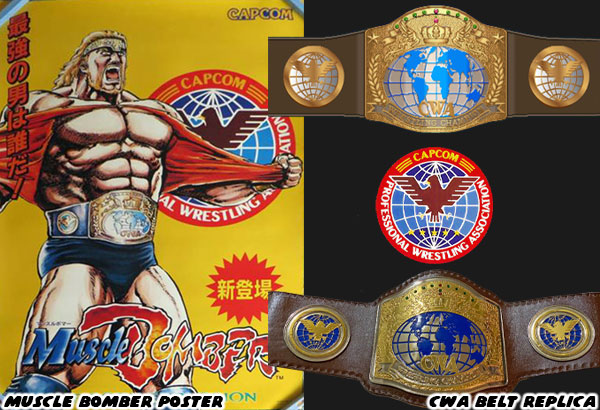
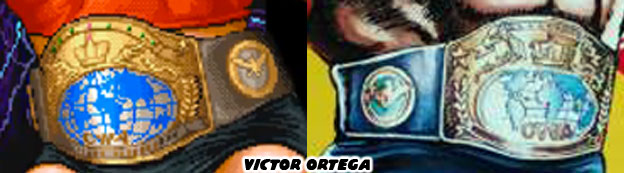
I was a big fan of the series. It married my love of the Street Fighter universe, pro wrestling, and the art of Tetsuo Hara. I never collected too may Muscle Bomber items, aside from the guides. I hoped to get all the plush figures someday. The MB item from my collection that I’m most proud of was a poster of the original release. Capcom didn’t design too many posters for it, especially when compared to the number that they released for SFII. Sadly there was never a Super Muscle Bomber poster to the best of my knowledge. I spent years hunting down the Ortega poster because it featured the original Tetsuo Hara art. More important it featured his original design for the CWA championship belt. As an obsessive fan of Street Fighter I made myself a promise. One day I would own a replica of that belt. Going back to 2008 I started work on an illustration of it. Little by little I spent more than a decade on that piece. I recreated as many tiny details as I could pull from screen grabs. This was in the hopes that I could get my vector file to a belt maker someday. I didn’t touch that illustration again until a few years ago. It was because my working conditions had changed dramatically.

The office that I used to travel to had closed down due to COVID-19. Half the staff was moved to Canada. Many friends, and coworkers were let go. Those that remained were put on remote access. After years of working from home I could feel myself going stir crazy. No matter how many games I played, or how much I wrote, or drew it just didn’t feel rewarding. I knew that I needed an extra special treat to break out of the depression cycle. I bit the bullet, and got the blessing of my wife to commission a belt maker. Not long after I was holding the CWA title. It was perfect down to the tiniest detail. I wish I could share with you the feeling that it gave me. One day I hope to go to a fighting game tournament in either Zangief, or Mike Haggar cosplay with it. It would be great to see you there.

I also have a long-term goal. Many years from now I’d like to visit Japan with my family. If there was a chance that Mr. Hara would autograph the belt then I would bring it with me in a heartbeat. I think it’s good to set goals, but it’s also fun to have dreams. If I can get enough people talking about Muscle Bomber then maybe we’ll see some wrestlers turn up in the Street Fighter series again. What do you think? Should Capcom take another crack at this game, or perhaps other fighters like Vampire / Darkstalkers, and Rival Schools? I’d like to hear about it in the comments section. As always if you would like to sponsor me please visit my Patreon page and consider donating each month, even as little as $1 would help make better blogs and even podcasts!
follow the Street Writer on Patreon!

Friday, October 27, 2023

Muscle Bomber - the Capcom wrestling series, part 2

Through most of the ‘80s, and ‘90s there were many gaming magazines in Japan covering all of the latest releases. Famitsu was among the biggest covering the entire industry. Then there were the magazines that focused on specific consoles, like the Famicom / Nintendo Entertainment System, Mega Drive / Sega Genesis, Playstation, etc. These magazines often featured interviews with the developers, in addition to previews, and reviews of the latest releases. One of my favorite magazines was Gamest. It was focused on the arcade industry. The best part of the magazine was how it did deep dives on each game, and would write detailed strategy guides. These magazine-type guides were called Mooks, for magazine-books. Gamest also had a monthly manga series where many of the fighting games were serialized. These were among the earliest places where fans could find out the canon of their favorite games. Not every game got an official guide for the arcade, and even less had its story fleshed out, and universe explained.
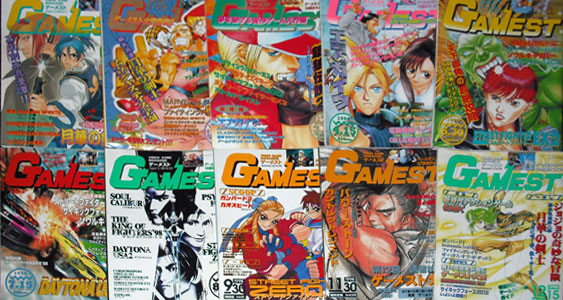
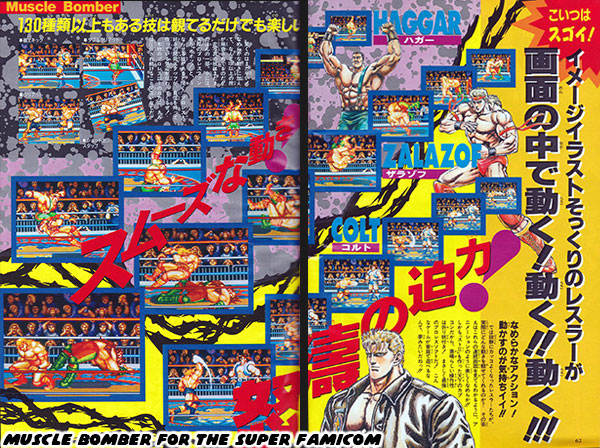
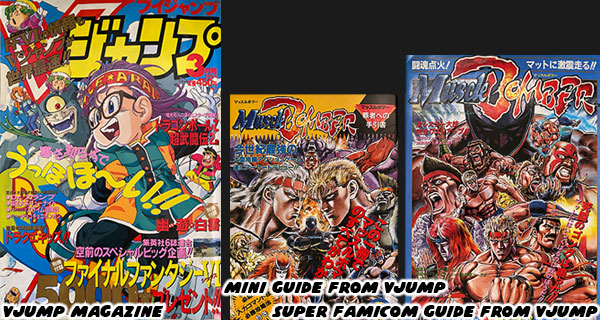
I was able to pick up a lot of material on fighting games from the local import bookstores in the early ‘90s. I was a fan of Hokuto no Ken, and was fascinated with Tetsuo Hara’s design work for Muscle Bomber. Especially since it was an extension of Final Fight, and Street Fighter, which were highly influential to me. Unfortunately it was hard to find any information about the game when it was in arcades. As far as I know there was never an arcade guide published, however when it came to the home consoles I managed to hit the jackpot. Various publishers in Japan would cover console guides. Sometimes there would be small guides, or previews in their magazines. Shonen Jump (Boy’s Jump) comics had a video game journal called V-Jump. It mostly covered home releases. I was thankful to have been at the right place, at the right time. I was visiting the Japanese bookstore in Little Tokyo with my friends, and brothers in the ‘90s when I spotted a gem. V-Jump was previewing Muscle Bomber for the Super Famicom, and covering the various changes between the arcade, and home versions. Shortly after they published a formal guide where they revealed the entire story. I managed to pick both up on sale, and held onto them for the next 30 years.
Final Fight had a very specific set of heroes, villains, and story. It would be canonized over several games by Capcom. Street Fighter by comparison had a more open-ended interpretation. Which characters actually fought against each other? Which ones had crossed paths, who were friends, or enemies? These things were explored in various game endings, manga, anime, and comic books. Some stories from Japan contradicted other stories from China, or the USA. This made a definitive timeline of events hard to agree on. Muscle Bomber on the other hand actually had an entire mythos planned out. It all started many years ago. There was a merger between various wrestling organizations, and the Capcom Wrestling Association (CWA) was born. The very first champion was Victor Ortega. The massive wrestler steamrolled his opponents. Once he ran out of competition he simply disappeared.
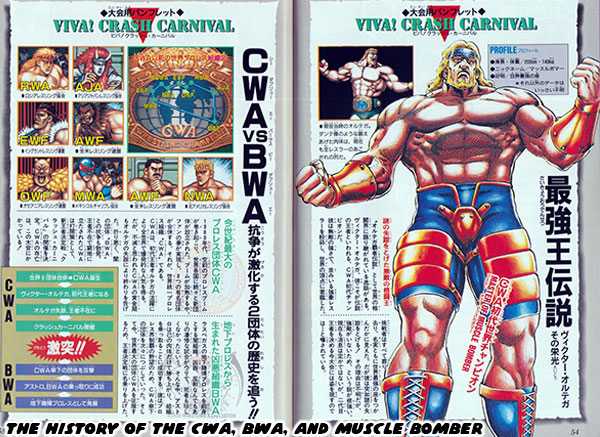
With Ortega out of the picture there was a power vacuum between the different organizations. To make things worse there was a rival group called the Blood Wrestling Association (BWA) that was trying to take over the sport. This group was founded by illegal gambling outfits. Leadership of the BWA was assumed by a masked wrestler called Astro. He was literally from parts unknown. He knew various forms of marital arts, his body glowed with electricity, and no one knew his true identity. He was arguably the coolest wrestler ever featured in the SF universe. His number two was the massive Kimala the Bouncer. The 440 lb. bruiser loved nothing more than making his opponents bleed. The duo had entered themselves into what was called the Crash Carnival.
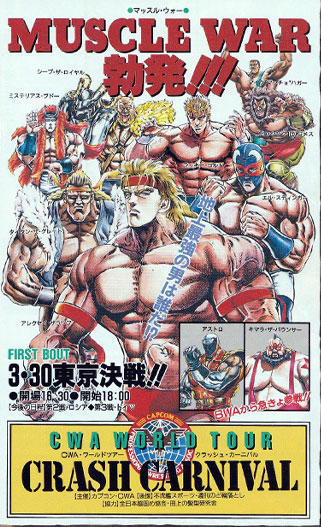
It was decided that each league would send their best representative in order to determine who would become the new CWA champion. There were fighters from around the world; El Stinger from the MWA - Mexican Lucha Libre Association, the Mysterious Budo from the AJA - Asia Japan Wrestling Association, Missing “IQ” Gomez from the AWF - American Wrestling Federation (Dominican Republic / Santo Domingo), Lucky Colt from the NWA - North American Wrestling Association. As well as Kimala who I just mentioned. You can imagine that each person fought their way to the top of the ladder in their native country. Who knows how many other memorable characters were waiting in their various organizations, or if Capcom was ever planning on featuring them?
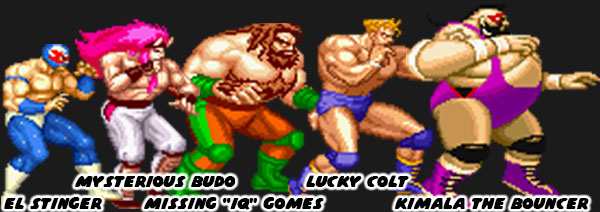
Then there was Aleksey Zalazof from the RWA - Russian Wrestling Association, the sadistic Sheep the Royal from the OWF - Oceana Wrestling Federation, our favorite mayor Mike “Macho” Haggar from the AWF - American Wrestling Federation, Titan the Great from the EWF - England Wrestling Federation, and Astro the champion from the BWA. There were a lot of different personalities on display. Tetsuo Hara created a good cross section of the different wrestling archetypes. There were brawlers, technical performers, high flyers, hardcore, and submission experts in the lineup. It was up to the players to learn the nuances between each of the characters.
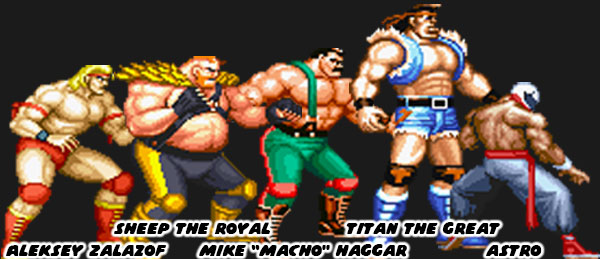
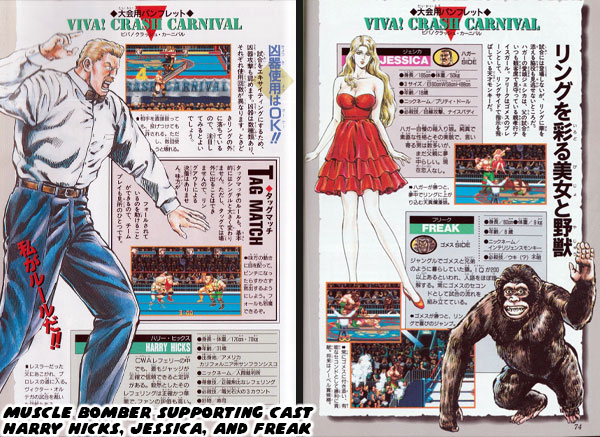
Matches observed the traditional rules of pro wrestling. The majority of the fighting took place within the confines of the ring. Players however could roll under the ropes, and take the action to the outside. There they could make use of foreign objects. A match could be won by a three-count pin, submission, or if the opponent was counted out of the ring. There was a referee in the matches, the highly respected Harry Hicks. Harry would be traveling the globe with the finalists of the tournament, and help crown the new CWA champion. He wasn’t the only supporting member of the Crash Carnival. Mike Haggar was accompanied by his daughter Jessica who had been nicknamed the Pretty Doll. We had last seen her in Final Fight, when she was rescued by Mike, Cody, and Guy. The other valet was a bit unusual, a cute monkey named Freak. Missing “IQ” Gomez (relabeled King Rasta Mon in the US) was a wild man that lived in the jungles of Santo Domingo. He had a short fuze, and was known for freaking out in the ring. His wild nature served him well. He lived with the apes, and one in particular named Freak was like a brother to him. It turned out that Freak was a genius, he had an IQ of over 200, and could understand most languages. He helped Gomez come up with strategies against his opponents. All of this was explained in the official Crash Carnival program.
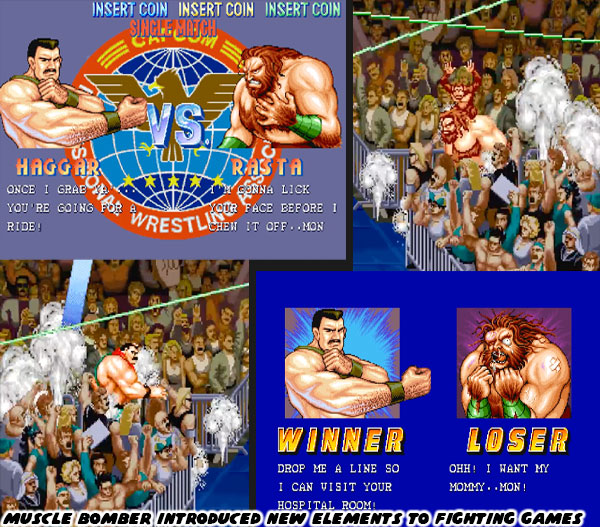
Muscle Bomber introduced a number of elements into the Capcom fighters that would be expanded upon in future games. Since the birth of the genre a character would typically appear on each stage, and start fighting once prompted. They might walk in from off camera, sometimes there was a ref, sometimes there wasn’t. Most titles from Capcom, and their contemporaries started the action in a similar fashion. The Crash Carnival was treated like an actual wrestling show. Before each match we had the rivals talk about what they were going to do to their opponent. Then we saw a ring entrance, reminiscent of the biggest promotions. There were pyrotechnics going off, fireworks, smoke, and lasers lights flashing as the wrestlers walked out of the backstage area. After the match the crowd would go wild. If you were playing as Mike Haggar sometimes Jessica would run into the ring, and celebrate with her father. We even had commentary from the victor, and loser. Again these things were very similar to what was shown in actual wrestling shows. These special intros, and animations predated the elements that would appear in Street Fighter’s IV, V, and 6 by years, if not decades.
I would argue that working on Muscle Bomber, and its successors the tag team Muscle Bomber Duo: Heat Up Warriors / Ultimate Team Battle, and Super Muscle Bomber: Ring of Destruction really affected the approach that the Capcom art team had with stages, animation, game play, and especially character designs. They saw firsthand that the more a character was stylized the stronger the reaction was from audiences. Aesthetics had a lot to do with how players responded to the game. If a design was bold, and unlike the work from rival companies, then it would help the game stand apart from the competition. The hyper muscular wrestlers in Muscle Bomber demonstrated that. The question was how would that lesson be applied to Street Fighter? We would get our answer as BENGUS became the lead on SF Zero which was being developed during the tail end of working on Super Muscle Bomber. Nobody had seen work as brilliant as his. This was doubly true when Vampire / Darkstalkers was released. The exaggerated proportions that BENGUS used in SF Zero would not only influence contemporary studios, but also the animation, and comic book industry for years to come.
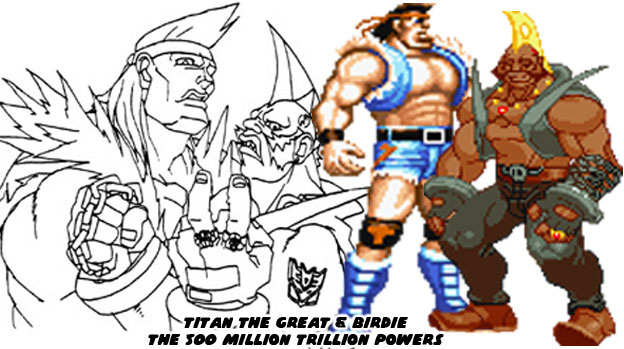
The publisher also wanted to make sure that audiences understood the relationship between Street Fighter, Final Fight, and now Muscle Bomber. Every game was taking place in a shared universe. It wasn’t enough that Mike Haggar had appeared in all three games. The company wanted to make sure that stages reflected locations visited in the various games. Places like Metro City, Brazil, Hong Kong, India, and Thailand were all revisited in Zero, and its sequels. Even in rare character art it was revealed that there was specific overlap between games. For example Birdie was a British punk from the original SF. Titan the Great had actually partnered with him for tag team matches in the EWF. The duo were known as the 500 Million Trillion Powers.
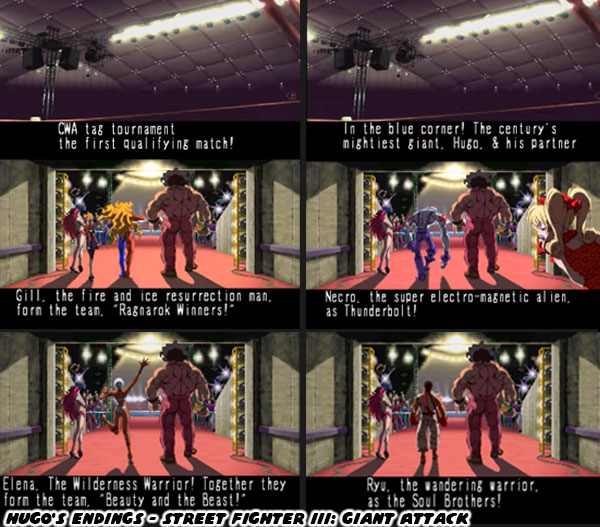
A more direct connection was made during Street Fighter III: Giant Attack. The wrestler Hugo was scouring the world looking for a tag team partner. His manager Poison accompanied him at each stop. At the end of the game he finally settled on a match. The game actually gave us four possible endings depending on who the last person was that he fought. Ryu, Necro, Gill, and Elena were all possible tag members, each with a unique tag name. The ending even mentioned that they were in the CWA Tag Tournament, against one of two teams. The US, and Russian team of Aleksey Zalazof and Lucky Colt, or the team of Mike Haggar and Black Widow. B. Widow was the only female Muscle Bomber character designed by Tetsuo Hara. She would appear in Super Muscle Bomber. This inter-gender team was used if Elena was Hugo’s partner. But I digress…
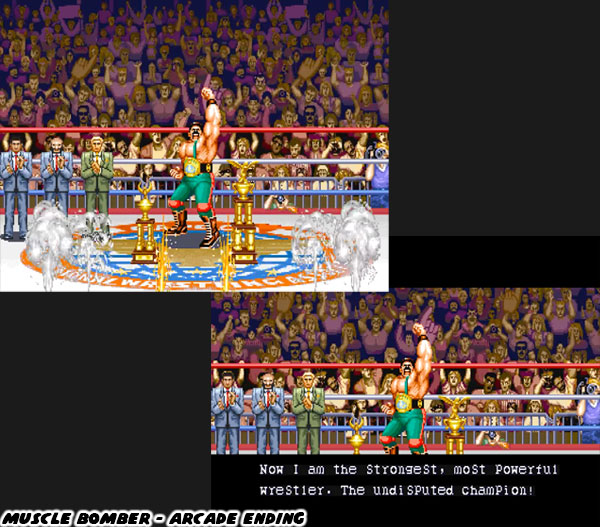
The original Crash Carnival event was designed to crown the new CWA Champion. In the ending of Muscle Bomber your character was given the belt, and also a few tournament trophies reminiscent of actual championships. In any other game that would have been the end of it. Some wrestling games would usually have you defend your title against all of the other characters one more time before the actual ending. This title was a little different. Mr. Hara, and Capcom were keenly aware that a good storyline is what kept pro wrestling fans coming back. Just as your character was celebrating a new rival popped up. Victor Ortega, the former CWA champion had returned from the shadows. He was wearing a decorated cape, and standing ringside. He said that in order to claim the title you had to defeat him.
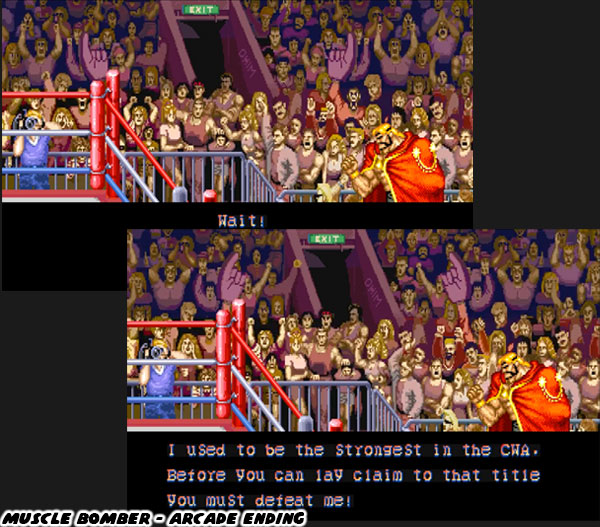
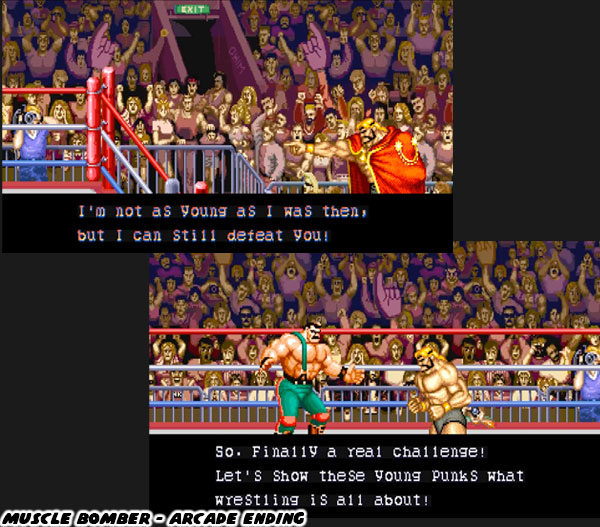
Microphone drop moments like this were expected in every major wrestling promotion. Fans would tune in every week for years on end just to see how the story for their favorite wresters shaped up. For the case of Ortega his return was an unexpected surprise. He also had a valid point. He was never defeated in the ring, he simply disappeared after all the worthy opponents had dried up. The organization assumed that he had abdicated the belt. Technically he was still the true CWA champion. This was when Capcom revealed that the first Crash Carnival was just to determine the qualifiers for the CWA championship. They traveled the world finding the best from the various promotions. Now with Ortega in the mix the battle for the actual CWA title would be decided in the next tournament. We would find out who the true king of the ring was in the events of the arcade sequel called Super Muscle Bomber.
We will explore this title, and the legacy that Capcom left in the next blog. Did you ever play this game? Were you a fan of the series, or pro wrestling? I’d like to hear about it in the comments section. As always if you would like to sponsor me please visit my Patreon page and consider donating each month, even as little as $1 would help make better blogs and even podcasts!
follow the Street Writer on Patreon!

Wednesday, October 25, 2023

Muscle Bomber - the Capcom wrestling series, part 1

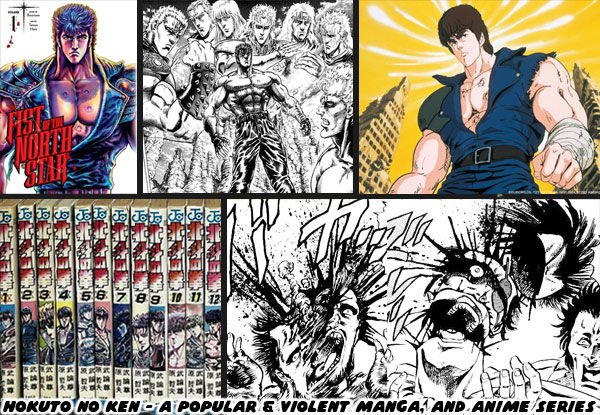
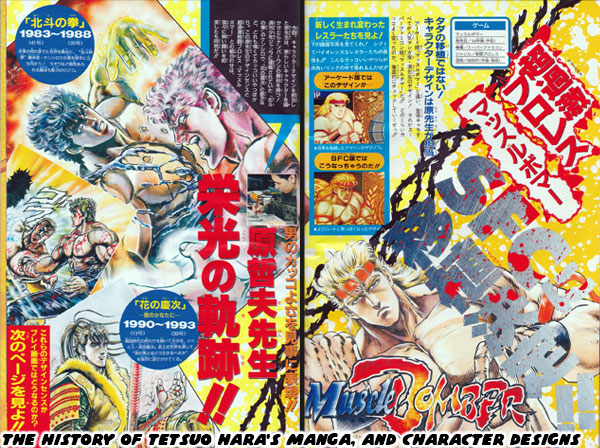
The developers at Capcom that brought us the early hits were heavily influenced by pop culture. The movies, manga, and anime that they grew up with helped shape the creation of their games. One of the most influential manga, and anime shows that influenced the creation of Street Fighter (as well as World Heroes, and many other titles) was Hokuto no Ken (HNK), better known in the USA as Fist of the North Star. The manga issues were published by Shonen Jump from 1983-1988, it would be collected, and translated into multiple languages over the next 30+ years. It was so successful that it got a 109 episode TV series from 1984-1987, and an additional 43 episodes from 1987-1988. Not to mention an anime movie in 1986. It should not be understated how important that series was in shaping the tastes, and presentation of games coming out of Capcom.

For those unfamiliar with HNK, it was a post-apocalyptic story that revolved around Kenshiro, the master of Hokuto Shinken. It was a fictional martial art that allowed practitioners to control the pressure points, or meridians of a person. Kenshiro wandered the wastes, righting wrongs with his bare hands. He could cause body parts to explode with a few touches. His victims, often marauding gang member had grisly deaths. Their arms, and legs would break backwards, heads would split open, with bones, and brain shooting in every possible direction. The violence in the series was very graphic, even with a lot of censorship, and selective edits the anime shows were almost as gory as the manga. The series was more than just violence, a very colorful cast of heroes, and villains were as memorable as the biggest comic book stars. Most of the characters influenced the designs coming from Japan, and the West for decades.

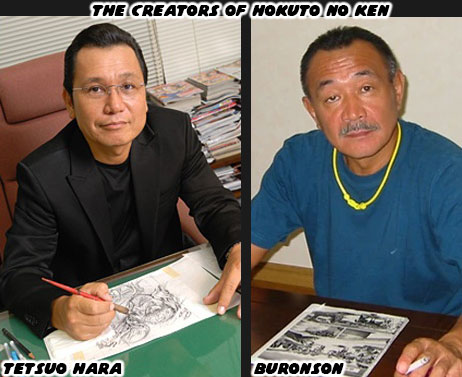
The series was illustrated by Tetsuo Hara, and written by Buronson. The duo didn’t just create a fantastic manga, they shaped pop culture for years to come. Hokuto no Ken ranked among the most successful properties ever created. As far as brands went it had generated some $22 billion in revenue. This was of course split across licensors, and not the creators themselves. The comics inspired many games over the years. I had discussed Hokuto no Ken in the history of the brawler. There were even a few fighting games in the arcade, and home consoles based on HNK. The most successful franchises however were influenced by the series, rather than based on it. Nowhere else was this more apparent than with Capcom, and the development of Street Fighter.

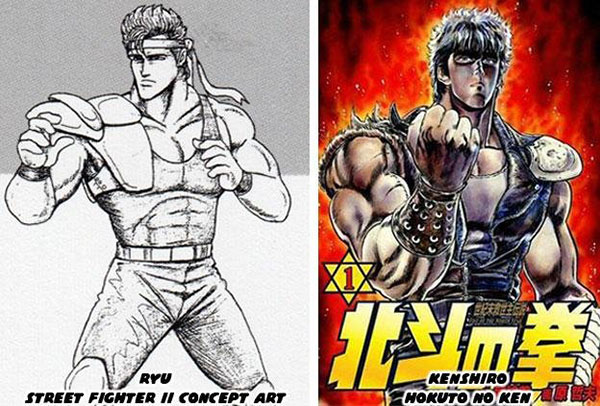
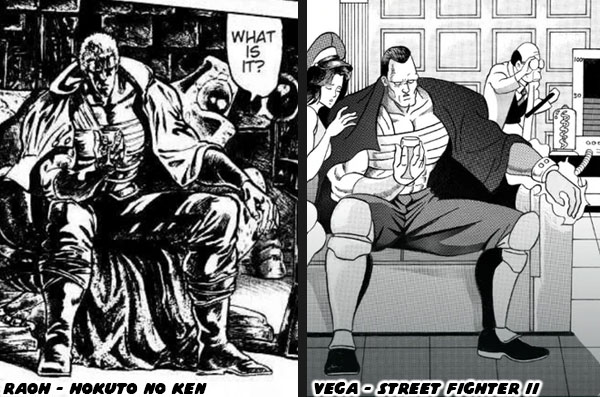
The first Street Fighter was inspired by the real world adventures of master karate fighters Mas Oyama, and Yoshiji Soeno. The karate hero had a redesign for SFII, and had become more of an action star. Early concept art had Ryu ditch the karate gi for a costume more like Kenshiro’s. The similarities didn’t end there. The giant characters in Hokuto no Ken influenced the creation of giants in the Street Fighter series. Even the villains like Rolento was inspired by Colonel from HNK. Meaning the series had influenced the world of Street Fighter, and Final Fight through the ‘80s, and early ‘90s. Some of the influences were subtle, and others were very overt. Look at the official art for Vega / Dictator, he was posed just like Raoh, the ultimate rival to Kenshiro.

In 1991 Street Fighter II put the fighting genre on the map. Capcom couldn’t release updates to the game, and begin developing home ports fast enough. At the same time they wanted to strike while the market was hot. The publisher wanted expand their library of fighters, but without cutting into the success of SF. They were successful, and experienced with brawler games, but needed something that played more than a fighter. They were indebted to Tetsuo Hara for his influence on their biggest hits. They decided to work with him on a new project. The publisher looked at what might work in that format, but wouldn’t take people away from their hit. The wrestling game was an obvious solution, and Capcom owed Tetsuo Hara some work. They asked him to design the cast of characters. These fighters would be set in the shared universe of Street Fighter, and Final Fight. The game would be called Muscle Bomber (MB). It would spark the creation of a trilogy.

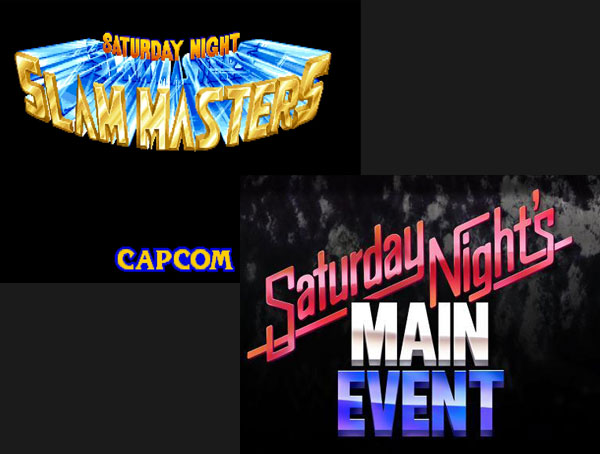
Muscle Bomber - The Body Explosion came out in 1993, Muscle Bomber Duo came out later that same year, and Super Muscle Bomber - The International Blowout debuted in 1994. Muscle Bomber Duo was an expansion to the original game, sort of like Turbo was for Street Fighter. Duo added tag team matches to the story of the original. The first two MB games in the series were not well known to many arcade visitors. The mix of wrestling, brawler, and fighting game moves didn’t capture the magic of Street Fighter. The third game in the series Super Muscle Bomber played more like a traditional fighting game. It was a rarely seen cabinet, and not really known to the majority of first generation SF fans. When the games were being brought over to the US the studio renamed it Saturday Night Slam Masters. This was most likely due to the popular late night WWF (WWE) show Saturday Night’s Main Event.

Capcom made sure to get the collaboration in front of as many gaming outlets as they good. All of the magazines, and even weekly manga anthologies made sure to write about the father of Hokuto no Ken creating a library of wrestlers for the Street Fighter universe. The stakes for this new franchise were pretty high after all. During development of SFII Capcom had more people working on designs than at any other point in time. Each employee poured their heart, and soul into a the fighters. Countless revisions were made in order to ensure that The World Warriors were as strong as they could be. They built a following in the few years they were around. The challenge was whether or not Mr. Hara’s style worked for the genre, and if he could make anybody as memorable. Audiences were worried that his style of art, his character work had become dated. After HNK the artist worked on a feudal-era piece called Hana no Keiji / The Flowery Keiji, between 1990 - 1993. It didn’t have the same impact as his previous series.

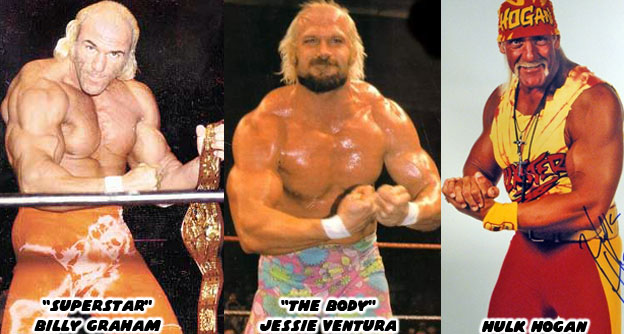
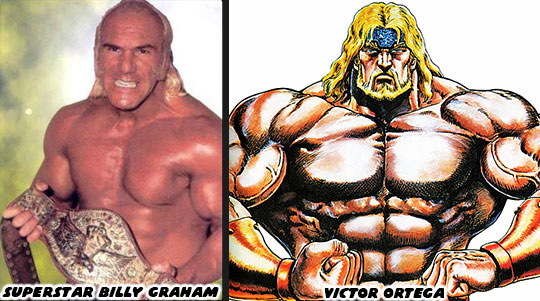
It turned out that Mr. Hara was more than up for the challenge. He let the various outlets know that he was a huge fan of pro wrestling. He wasn’t just familiar with the happenings in Japan, but also with international wrestlers as well. It was apparent that many of the villains in HNK were based on actual wrestlers. For example King Heart was inspired in part on Abdullah the Butcher. This deep understanding translated to the game. Sheep the Royal was based on Big Van Vader, and Victor Ortega was inspired by ‘70s wrestling icons like Superstar Billy Graham, Jessie “the Body” Ventura, and Hulk Hogan. Fans of Mr. Hara’s work noticed that although his concept art was used in magazine articles, and the game cover, it was not seen in the actual game itself. All of his work was redone by the staff at Capcom, I think it was Kinu Nishimura in a number of portraits. I’m sure these changes disappointed Mr. Hara. I’d like to think there was a backlash for this change from fans, as well as some of the developers when the game was published. When the game was adapted for the Super Famicom / Super Nintendo, they made sure to go back to all of the original art.

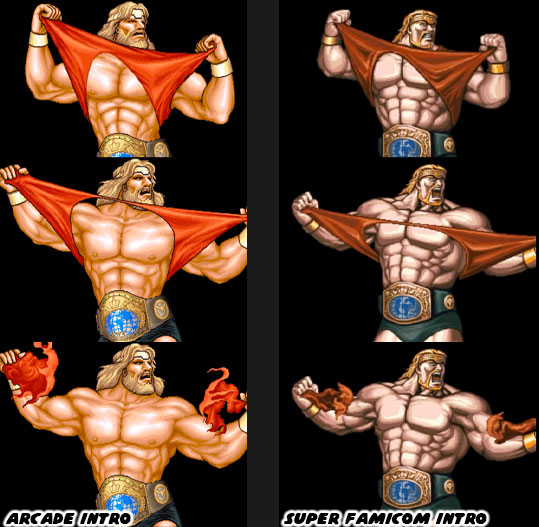
This was not to knock the Capcom art team. After all they had Akiman, SHOEI, Sensei, Bengus, and other icons. However the wrestlers that they presented were watered-down versions of what had been promised in previews. Mr. Hara stood out from his manga, and even US contemporaries, by creating hyper masculine figures. He predated, and influenced Karate Apocalypse, Berserk, JoJo’s Bizarre Adventure, Grappler Baki, and Toriko to name a few. His heroes, and villains were not only strong, they had bodybuilder physiques. They were far more swollen than any other heroes on the market. It was no where more apparent than with the introduction of Victor Ortega, the first Capcom Wrestling Association (CWA) champion. He was featured in the intro animation.

In the arcade he was strong, but not absurdly huge. The original arcade intro version of Victor seemed anemic compared to what Mr. Hara had designed. The studio not only returned the original character profiles from Mr. Hara in the Super Famicom version. They also redid the intro animation to match Mr. Hara’s vision. The story, and characters of Muscle Bomber were fleshed out by Mr. Hara, and Capcom in far greater detail than either Final Fight or Street Fighter. Audiences wouldn’t know the full story until the game hit home consoles. We will dig into this in the next blog. Did you ever play this game? Were you a fan of the series, or pro wrestling? I’d like to hear about it in the comments section. As always if you would like to sponsor me please visit my Patreon page and consider donating each month, even as little as $1 would help make better blogs and even podcasts!
follow the Street Writer on Patreon!

Saturday, June 2, 2018

30 Years of Street Fighter, 30 Days of Characters; #29


Victor Ortega is probably someone that you don't even think about when it comes to Capcom fighting games. This is probably because Ortega has never been in a numbered Street Fighter. He appears in the extended universe, in the Muscle Bomber / Saturday Night Slam Masters series to be precise. This character is important to the history of Street Fighter for a number of reasons.

Victor represents the pinnacle of pro wrestling in the Street Fighter universe. He was the only CWA (Capcom Wrestling Association) athlete to go undefeated in his career. He retired with the belt but came back years later when a new crop of wrestlers sprang up. Victor's design was very much rooted in actual wrestling history. Going as far back as the '70s with bodybuilder-turned-wrestler Superstar Billy Graham. Graham had an amazing physique and was brilliant on the microphone. Some of the best wrestlers were memorable for their interviews rather than their in-ring ability. The Superstar was the template from which characters like Jessie Ventura and Hulk Hogan were cut.


The person that designed the majority of the pro wrestlers in the Capcom universe was Tetsuo Hara. He was the artist and half the creative team behind Hokuto No Ken / Fist of the North Star. I have already mentioned that the muscular boss with facial hair was most likely inspired by the character Toki. Mr. Hara was a big fan of pro wrestling and helped create a variation of many of the top babyfaces (good guys) and heels (bad guys) for Capcom. It stood to reason that the wrestling champion for the Capcom universe would look like an exaggerated version of a real title holder. Victor Ortega had an amazing physique, possibly the most muscular person in the Capcom universe, including Mad Gear bosses Abigail and Freddie.


Despite his age Victor Ortega is impossibly fit but thanks to his age he is also an incredibly experienced. Combining his insane strength with his striking and grappling ability makes him one of the most underrated fighters in the universe. It would be nice to see this undefeated champion make an appearance in the Street Fighter series. Who do you think was the best wrestler in the Street Fighter universe? I'd like to know. As always if you enjoyed this blog and would like to sponsor me
please visit my Patreon page and consider donating each month, even as little as $1 would help make better blogs and even podcasts!

 follow the Street Writer on Patreon!

Friday, October 28, 2016

The best championships in fighting games, part 2

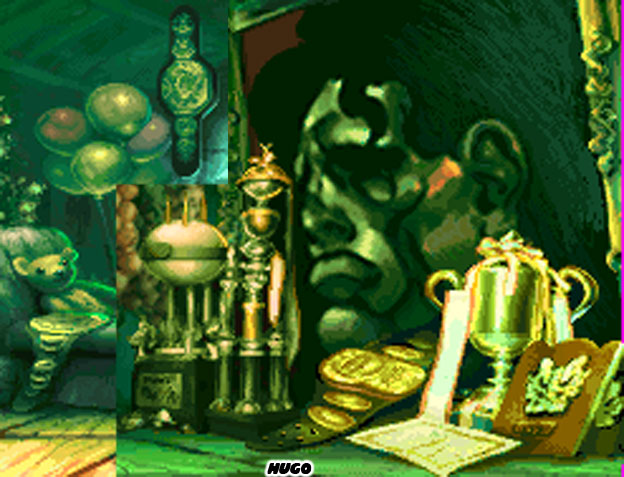
In the previous blog I had pointed out the unique belts and champions featured in fighting games. From the small symbolic belt of Russian boxer Andrei in the King of Combat to the gaudy bull horn belt of Antonov from King of Fighters. There was a championship for every form of fighting. The wrestlers in these games seemed to have the best titles. While Darun Mister of Street Fighter EX fame had a total of 3 championship belts he was nowhere near the most decorated champion. Hugo Andore, the German giant from Street Fighter III also had three championship belts and at least 5 other trophies and awards from different promotions. These were all visible in his stage from Street Fighter III 3rd Strike.


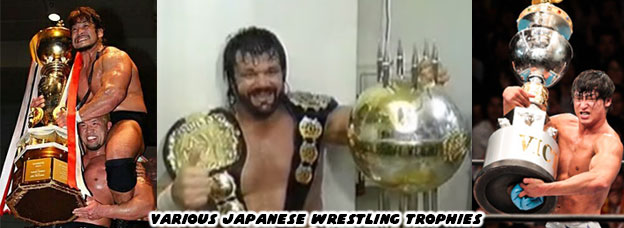
The accolades given to Hugo were based on real-world championships. Take a look below at some of the Japanese promotions that inspired the gold. In some promotions the best wrestlers are given statues, plaques or towering cups wrapped in streamers. They are the result of winning a tournament or even beating multiple opponents in a "battle royal." In the multiple endings in Street Fighter III: Giant Attack Hugo was written as having different tag team partners, there was a chance that one of his belts or trophies was won with the help of a partner. It was never established who the actual person was but many assumed it was Alex, the American MMA star.


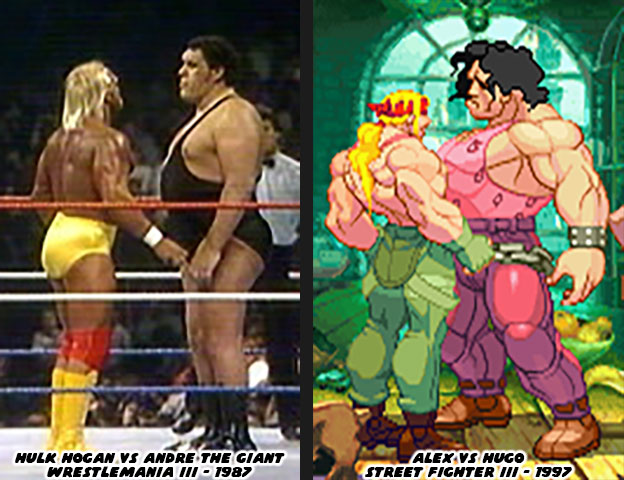
Hugo was a Mad Gear Gang-member-turned wrestler. He along with the Andore family from the Final Fight series was inspired by Andre the Giant. The French wrestling star was huge (pardon the pun) in the '70s and '80s. He traveled the world and made a following wherever he landed. In his younger days he was quite athletic and could actually perform some high risk 1st and 2nd rope leaping moves. He had a large head of hair, almost like an afro which gave him a wild appearance when he debuted. As he got older he gained some weight, slowed down and cut his hair a little bit shorter. Age did nothing to curb his awesome strength and legendary drinking ability. The character of Hugo is a sort of amalgamation of the young and old Andre. He has some of the speed, moves and hair of the younger version with the raw power of the older self. One of Andre's great rivalries, and even tag team friendships was with Hulk Hogan. This insight from the developers was celebrated as a special animation whenever he fought Alex. The two would have a stare down before the round, similar to the Wrestlemania III match.


Andre had beaten many of the best wrestlers around the world. Yet he was not necessarily the person who would be considered the heavyweight champion for a particular company or promotion. He never held the title for any length of time because he was constantly travelling. Andre was a sort of sideshow attraction. He would only appear from time-to-time so that his marketability and thus legend would remain intact. Promoters knew that audiences would eventually tire of seeing him squash all of his opponents, so he was considered a gimmick fighter and only hired him for a few weeks at a time. Any belt he won was usually won back by the hometown champ before he left the country. Hugo on the other hand was a runaway terror. He took the belts and steamrolled every promotion he went to. There was no one in the Street Fighter universe that seemed capable of stopping the giant. But did that make him the best wrestler in the SF universe? I would argue no, he was not the best wrestler and certainly not the best fighter. Guy, Cody and Mike Haggar from Final Fight have all shown that they could take him, and his extended family of giants in a stand up brawl. Despite Hugo's collection of belts and trophies he is missing a very important one. He does not have the Capcom Wrestling Association or CWA belt. This would be THE title held by Victor Ortega in Muscle Bomber / Saturday Night Slam Masters. Hugo also does not possess the rival promotion Blood Wrestling Association or BWA belt.


I have talked previously about the middle-aged phenom known as Victor Ortega on previous blogs. This character and his title was created by Tetsuo Hara. The co-creator and artist behind Hokuto No Ken / Fist of the North Star. is a huge wrestling fan. Many of the big wrestling names from the '70s inspired several of the characters in his comic book series through the '80s. These in turn inspired the artists working at Capcom through the '80s and '90s. When they began designing the villains in Street Fighter and Final Fight series a few were based on the work of Mr. Hara. When the company wanted to create a wrestling-inspired brawling and later fighting game they went directly to Tetsuo Hara. He created a cast of characters and set the pro wrestling canon of the Street Fighter universe. At the top of the chain was Victor Ortega, based on the flamboyant and photogenic Superstar Billy Graham. Billy had a bodybuilder physique and looked incredible in televised matches. It didn't matter if other wrestlers were technically more sound, because they didn't look and act like a champion they often had to "work" (lose a match) to Graham.


The version of a champion that Mr. Hara created may have been visually inspired by wrestlers like Graham, however his in-ring skills were the real deal. Ortega had legitimate punching, kicking and grappling skills. Despite his size he was also very fast and very flexible. He needed to be a great all-around champion considering the different styles of wrestlers that filled both the CWA and BWA rosters. Some were technicians, some brawlers, some were high flyers and some were shooters (submission fighters). Victor Ortega was easily the most muscular character set in the Street Fighter universe. This undoubtedly made him intimidating, even to a giant like Hugo. I would like to think that not only did Hugo fail to capture the CWA title, but that he was afraid of Ortega.

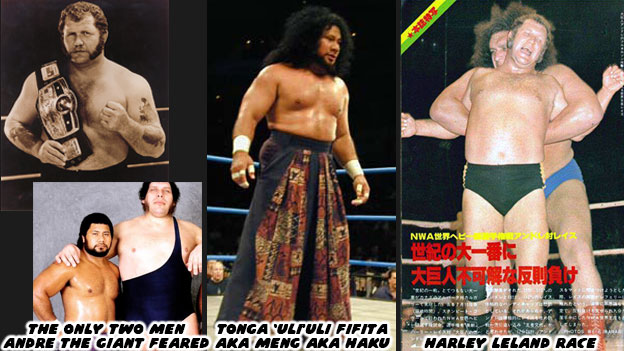
In the real world Andre the Giant faced all sorts of opponents, including some almost as tall and as strong as he was. Outside of the ring he sometimes had to fight off hecklers, drunks and angry wrestlers. He beat just about all of them, most with ease. After all of his travels and all of his victories there were only two men that Andre was afraid of. According to former wrestler and manager Bobby "the Brain" Heenan the two men were Harley Race and Tonga Uli'uli Fifita. Both men had reputations for being tough as nails. They were strong, intimidating and did not appreciate being messed with. Both were also fiercely loyal, good to their friends and stand-up men whose word was their bond. The two men were also a foot shorter than Andre.


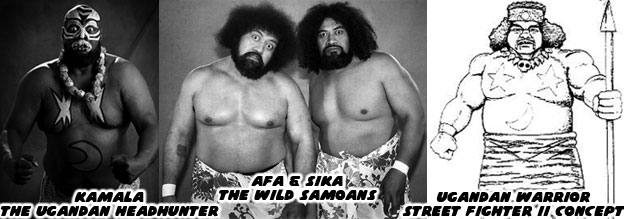
Tonga was the younger of the two hard legends. He was a trained martial artist and had actually been picked up as a teen to learn the art of Sumo by a Japanese stable. While in Japan he was able to adapt to life in the squared circle. He was gifted with great strength and stamina. These things came in handy as he fought many Japanese legends. They were trained in the "hard style" of wrestling where people barely pulled their kicks and punches. Karl Gotch was a pioneering grappler that took his classic techniques with him to Japan. Pro wrestling in Gotch's day was much more about grappling and submission holds than the "sports entertainment" it tries to be on television. He wanted his students and opponents to come at him with the same ferocity of the turn-of-the-century wrestlers. He wanted them to know how to legitimately catch holds and counter attack. Tonga was already a tough person but his time in Japan tempered him into a dangerous weapon. It was not hard for him to find work in any promotion acting as a heel or bad guy. In the '70s and '80s the large Pacific Islanders were often marketed as savages or wild men by the various promotions. This worked to their advantage as they intimidated opponents and audiences alike. The gimmick had gone over so well that one of the concept fighters for Street Fighter II was a Ugandan warrior. This character had elements of the Wild Samoans, the body paint of Kimala (the original Ugandan warrior) and the frame of Tonga.

The bar fights that Tonga participated in were the stuff of legend. The majority of the time all he wanted was a drink and to be left alone but trouble would find him. Many of his friends were astonished by how often people would pick fights with him. There are stories of how he took on groups of people and even the police in the melees. The scariest were stories of how he bit the nose off of an attacker, or how he reached into a man's mouth and pulled out his teeth. The stories were gruesome and certified by witnesses. He worked with Andre a few times and they got along great, possibly because Andre avoided him outside of the ring and never tested him. It would be interesting to see a redesign of this character by the people at Capcom, one that captured more of the presence of Tonga without pandering to the wild man mystique. The other person that Andre feared had an equally interesting history.


Harley Race was similar to Karl Gotch in that he came from a different era. Harley was a tough guy, even at a young age. As a teen he was thrown out of school for beating up his teacher. He decided that he wanted to be a wrestler and actually joined up with a carnival where he learned the ropes from actual carney catch-as-catch can fighters and strongmen. This was a direct link to another time, literally a connection to the 19th Century, when wrestling was real. Before promotions divided the talent and before television turned it into a soap opera. Harley had no amateur wrestling experience, unlike his opponents which often came from college backgrounds. As he went from town to town he had to take on any and all challengers. Some were men, some were teens but most had experience on the mat. Harley learned that he had to adapt quickly to these people and try to get a pin or submission right away. If he lost then he didn't get paid. Not only that but his handlers would beat him up as well. Harley survived a car accident as a young man and was told he'd never walk, let alone wrestle again. Harley recovered and became one of the hardest men in the business. He was a legit shooter and knew a countless number of ways to hurt someone. He picked up many things along the way from pro wrestlers which complimented his street experience. Harley was soft spoken but intense, his promos became legendary. It was his mastery of the ring and respect for the business that earned him followers the world over.


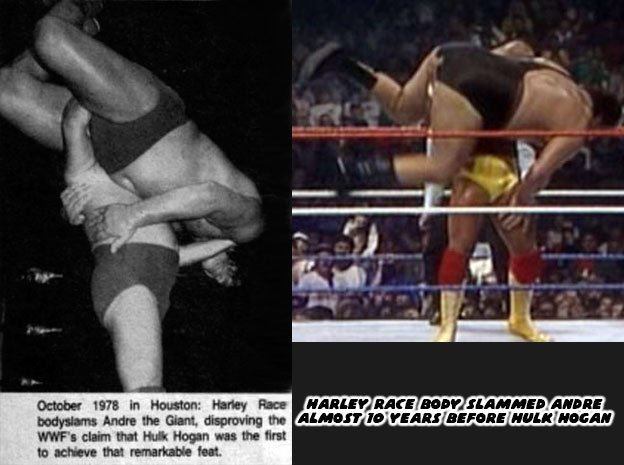
Harley, like Tonga, did not get into wrestling the easy way. He knew many different ways to seriously hurt people but instead worked to make his opponents look great and have long careers. He was just over 6 feet tall but had worked with many bigger men including Andre. Audiences soon forgot about the size difference in their matches because his presence was so commanding. It was Harley and not Hulk Hogan that had first slammed Andre the giant. Harley would often chaperone the big wrestlers when they traveled abroad. It was said that just a look from Race was enough to make the biggest wrestler back down when they crossed the line. Harley's old-school origin and NWA championship, which represented some 30+ or 40+ independent promotions / territories was the ultimate prize for a pro wrestler. There were other "world's" titles, including those from WCW, ECW, WWF and NJPW but among the purists you could not really consider yourself the heavyweight champ unless you held the same belt that Harley did. Andre the giant did not hold that belt. He once wrestled Harley to a 60-minute draw but that's as close as he ever got. When Harley joined the WWF he won the first Royal Rumble and became the King. When he felt ready to leave the business there was only one person he felt appropriate to lose the crown to and his name was Tonga.

Hugo may have been a beast but he was not the best. Mike Haggar had the chops to be the true CWA champion. Zangief and Darun probably have the chops too. As for Hugo, well, if he doesn't have the belt then he has not beaten the best. Or more likely he is scared to fight Ortega. Do you have a favorite video game champion? Or a favorite title? Who do you think is the best game wrestler? I'd like to read about it in the comments. As always if you enjoyed this blog and would like to sponsor me please visit my Patreon page and consider donating each month, even as little as $1 would help make better blogs and even podcasts!
 follow the Street Writer on Patreon!

Wednesday, June 22, 2016

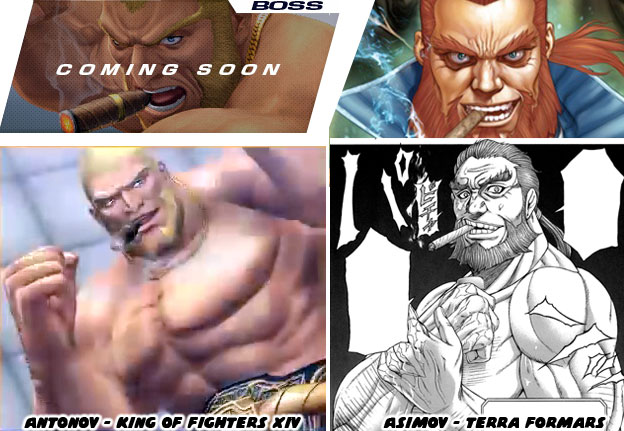
Before Antonov there was Asimov, a take on the King of Fighters XIV host.

A question I get asked all the time is "Noe, what do you think of the new boss of the King of Fighters Tournament? Is he a good design? Where did he come from?" Well actually nobody talks to me. I never get asked that question, not once. Also the new boss character, recently revealed on YouTube courtesy of SNK Playmore and Atlus is not the actual final boss of the game but rather the host of the tournament. The cigar-chomping muscular man with a hefty KOF champion belt goes by the name of Antonov. He is a Russian billionaire who looks to be middle-aged yet in extreme physical condition. He has supposedly purchased the rights to the KOF Tournament. I can only suppose he bought the rights from Geese Howard or Rugal Bernstein or Magaki, or whomever had the previous rights. Anyhow, this new character has declared himself the "First Champion." Of course whether that means he was a former KOF champ that retired and decided to give it one more go or is claiming to be the new champ for a new generation has yet to be revealed. But I digress. The origins behind the character design are easier to understand.


I believe that Antonov was heavily influenced by Sylvester Asimov. The wickedly powerful Russian character with the unique hair style, beard and cigar. He debuted in the manga, later turned animé Terra Formars. The series was written by Yu Sasuga and illustrated by Kenichi Tachibana. It debuted on January 2011 in Miracle Jump, and was later picked up by Weekly Young Jump. Asimov is a strong fighter that has been genetically modified. On top of superhuman strength and endurance he has the ability to regenerate lost limbs. This is especially important on distant planets where his soldiers have to sometimes perform hand-to-hand combat against powerful aliens. Asimov actually works out heavily and supplements his modifications with drugs via his cigar which is more like a vape machine. I have a strong suspicion that his features, the sharp facial hair, overall physique, national origin and cigar-chomping look of Asimov was the basis for Antonov. What do you think? If we turn the way-back machine on and connect the dots we can actually find some precedence for Antonov and Asimov. Specifically where did the middle-aged-champion strongman came from and how he got into fighting games.

The early generation of fighting game heroes were based on real-world figures. They may have been wrestlers, karate practitioners or mythical kung-fu fighters. In some instances they were also inspired by fictional characters in movies and comics. One of the comic book artists that influenced the early fighting game icons was Tetsuo Hara. His landmark title, Hokuto No Ken / Fist of the North Star (HNK) debuted in 1983. Hara, along with writer Buronson created a world where masters of fictional fighting arts fought on a colossal scale. The lead character, Kenshiro, was a post-apocalyptic martial arts hero. The techniques he used were far more fantastic than any move in real life. He and some of his opponents could kill people with a single touch, slice arms and legs off of people with their fingertips and decimate small armies using their bare hands. When two or more of these masters fought against each other it was a site to behold. The comics would build up for a showdown over several issues and then have some of the most violent, and bloody, exchanges in any comic series. The heroes and villains of the comic would use all sorts of amazing super attacks against each other in order prevail. The designers behind Street Fighter and Fatal Fury were inspired by HNK and other martial arts manga. The games they created captured just a fraction of the energy and violence from the comics. They didn't necessarily steal characters from a comic or movie in order to get the job done. Yet at the same time it didn't hurt the developers to poach some characters when they started running low on ideas.


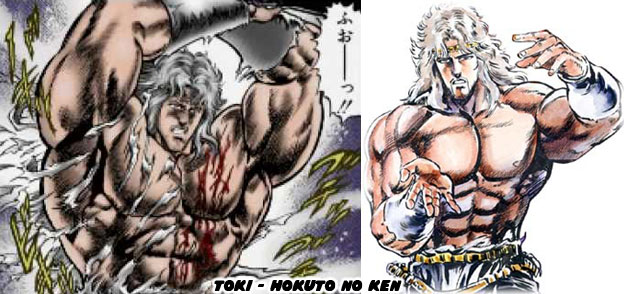
The middle-aged strongman archetype of Asimov and Antonov could be traced back to some of the recurring characters in HNK. Most of the fighters in the series were adults, as opposed to the young teenage fighters in more modern fighting manga. Some of the important figures, including the main villain Raoh and his pacifist brother Toki were even middle-aged. Toki was a master of Big Dipper fighting school and possibly the one most naturally inclined to its secrets. The character was a pacifist however and didn't really figure into the heart of the series until 1985. Toki was designed as a post-apocalyptic Christ-like character. With his beard, long hair and headband he was supposed to invoke a comparison to Jesus. Of course this would be a "swole," world-champion bodybuilder Jesus and not the lean Jesus featured in most paintings and statues. Toki was a healer, considered a miracle worker wherever he went. He fought only as the last resort. While his adoptive and blood brothers could kill people with a single punch, their opponents died in agony. Toki could also kill with a single touch but his enemies experienced a pain free bliss as they died. His particular form of fighting was known as JuNo Ken aka the Gentle Fist. The super-powerful yet older fighter template was unique to Mr. Hara. In other comics there were often elderly martial arts masters that were thin and frail but that wasn't really seen in the older characters in HNK. Instead his characters just got bigger and stronger. Mr. Hara had himself been influenced by television and movie characters. Kenshiro was based in part on Bruce Lee. His mannerisms and even trademark yell made it into the comic and anime series. His larger, stronger, more muscular characters, were inspired by professional wrestlers.


Tetsuo Hara was a huge fan of pro wrestling. Through the late '60s and '70s he watched the best in Japan and the US compete. He learned many things from modern pro wrestling. A wrestler did not necessarily have to know actual moves and holds in order to be liked or even be remembered by fans. The people that talked a good game on the mic or had an impressive physique were the ones that went over well. If a wrestler were a stiff on the microphone they often had a manager that did all the talking. Television turned these people into celebrities. The cornerstone of the top physical specimen could be traced back to "Superstar" Billy Graham. He was a bodybuilder-turned-wrestler that used to work out with Arnold Schwarzenegger. He created the template that would be copied by Jessie "The Body" Ventura, Hulk Hogan and "Big Poppa Pump"Scott Steiner. Graham was not exactly a young man when he peaked in popularity. His physique took years to develop and at the height of his career he was wrestling people much younger than him. Not that it mattered, fans couldn't get enough of the Superstar. In addition to his chiseled body he wore bright costumes and really stood out on television. His tan, blonde hair and sharp sideburns gave him a distinct look. Elements of his style would be found on other wrestlers that followed. It would trickle down to the characters created by Tetsuo Hara and by extension the fighting games that followed. Toki had a lot of the counter-culture, free spirit, massive bodybuilder look that Graham was famous for. Almost a decade after HNK debuted Capcom asked Hara to design the characters for a wrestling game called Muscle Bomber / Saturday Night Slam Masters. It didn't take Mr. Hara long to design the champion, a non-playable character known as Victor Ortega. Like Toki this new character was a surrogate to Graham. The middle-aged bodybuilder that still had some gas in the tank.


Victor Ortega would be revised and become bigger and stronger in the follow-up. Super Muscle Bomber / Ring of Destruction: Saturday Night Slam Masters II debuted in 1994. The character had retired as the first undefeated champion from the Capcom Wrestling Association (CWA). When he ran out of worthy opponents he simply disappeared. He was lured out of retirement with the promise of new challengers from the CWA as well as the rival promotion the Blood Wrestling Association (BWA). Ortega was massive to the point of being grotesque. Despite his age he was the most muscular character in the Street Fighter universe. He even made Zangief look small. It was a unique aesthetic that Mr. Hara had created. Just because a character got older there was no reason they could not become more powerful. After 1994 the frail retired master was a dated concept for fighting games. Ortega would challenge convention, show up with his belt and clean house. It was up to SNK to make audiences believe that Antonov was cut from the same cloth. Could he take on characters half his age that were well established and still make for a believable champion?


I am eager to see what sorts of moves Antonov is assigned. Will he be a striker, a brawler, a grappler or have nothing but power moves? Will he be a playable character when KOF XIV comes out? We should hopefully find out these answers soon. What do you think of Antonov's design? Would you consider playing as a character that was a little older than the main cast? As always if you enjoyed this blog and would like to sponsor me please visit my Patreon page and consider donating each month, even as little as $1 would help make better blogs and even podcasts!
 follow the Street Writer on Patreon!