If you would like to sponsor me please visit my Patreon page and consider donating each month, even as little as $1 would help make better blogs and even podcasts!
Showing posts with label teenage mutant ninja turtles. Show all posts
Showing posts with label teenage mutant ninja turtles. Show all posts
Monday, July 27, 2020
The Street Writer Podcast, Episode 11
We end the '80s on a high note. Konami lays down the law and creates some of the best licensed brawling games of all time. Sega starts off slow but then shines when they enter the console arena. Find out more on this episode.
If you would like to sponsor me please visit my Patreon page and consider donating each month, even as little as $1 would help make better blogs and even podcasts!
If you would like to sponsor me please visit my Patreon page and consider donating each month, even as little as $1 would help make better blogs and even podcasts!


Friday, May 20, 2016
The Abridged History of the Brawler, part 22
In China Shanda Games partnered up with SNK to develop a new sprite-based MMO named King of Fighters World. The game was set to feature the same dot-arts technology used to create the amazing graphics for the King of Fighters XII game.
The title was cancelled in 2011 after several years in development. Had it been completed the title would have turned out to be more of a brawler than the fighting game. Allowing multiple characters to take on opponents on multiple 2D planes, similar to Guardian Heroes. It would have been a slightly different experience than what was proposed in the original trailer. The sprites would have been among the most detailed ever produced for any fighting game or brawler. Unfortunately the game never came to be, killing any chance of rekindling the classic brawler by throwing in new technologies.
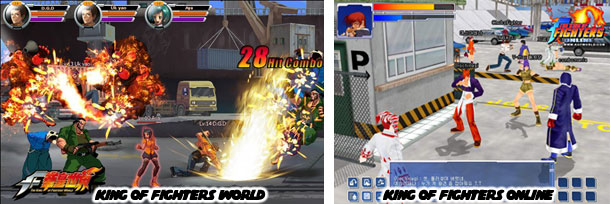
By a similar token the King of Fighters Online game was an MMO designed for Korea by Dragonfly. The beta version of the PC-only title lacked the cel-shaded stylings of the promotional video
It too would be scaled back for retooling in 2010. No news on when (or if) the final build would be ready for audiences.
The final title I would be mentioning in the brawler series would bring the genre full circle. Double Dragon II, Wander of the Dragons was announced as a remake by Barunson Interactive Co. for the Xbox 360. The game would be a complete remake of the arcade classic with updated 3D graphics. Unfortunately the game seemed to contain nothing of the classic gameplay from the arcade original. Based on the preview footage the game seemed to be a fixed side scrolling title with a full 360 degrees of control. Making it more like The Warriors Street Brawl or Demolish Fist than the original title.
The developers had clearly made themselves blissfully unaware of the failings with the 3D format for the brawler. Worse they ignored how remakes had been received by game players. Final Fight Streetwise showed that "updated" realistic art and graphics did nothing to win back long-time fans or help the experience. Nor did the change of characters from sprites to 3D models do anything to help the game. It was not the only 3D remake to suffer a strong backlash from players. Konami's arcade gem, Teenage Mutant Ninja Turtles: Turtles in Time, a sequel from the original TMNT arcade game got a remake for PSN and XBLA. The Reshelled version was a 3D remake that rated a 55 to 60 point average out of 100 on Metacritic. It lacked the humor, control, animation and art of the original title. The villains, levels and characters were all there but the combat was frenetic, redundant and more difficult than the original. The classic experience had suffered during the migration to 3D. It was so poorly received that it was pulled from the DLC services shortly after release. The exact same things that plagued the Reshelled Turtle game seemed to be happening to the Double Dragon II remake.
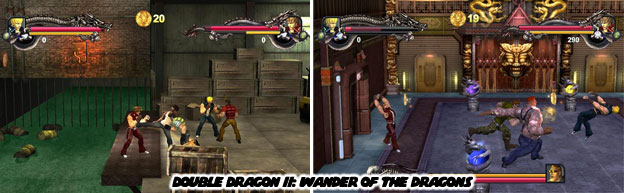
Unless the game were delayed at the end of 2011 to address all of the concerns and pay attention to the failures of other 3D brawlers then it too would be destined to fail. New players would look at this game and ask why older gamers were so passionate about the genre. An insipid game would harm the name of the brawling godfather. It would be a sad way to end the legacy of the genre and this series.
If readers were to go by this blog alone it would have appeared that the brawler died a slow and humiliating death over the past decade. While the more familiar version of the genre did indeed lose popularity it never completely went away. The brawler actually evolved and became something more profound on consoles than it was in the arcades. I am not talking about re-releases of classics on the Wii, Xbox Live Arcade or Playstation Network either. The brawler itself became part of a bigger gaming picture. In order to find out how it got there we have to go back in time to the era of Kung-Fu Master and find out how the experience evolved. I hope to see you back for the first part in a new series. As always if you enjoyed this blog and would like to sponsor me please visit my Patreon page and consider donating each month, even as little as $1 would help make better blogs and even podcasts!
Monday, April 11, 2016
The Abridged History of the Brawler, part 5
Good arcade games based on movies or TV shows were very sparse. Great licensed brawlers were even rarer. Konami changed all of that in the end of 1989 by releasing an arcade version of the wildly popular Teenage Mutant Ninja Turtles cartoon. This game was far more memorable than Crime Fighters, their previous brawling effort.
The game was layered with amazing details pulled right from the cartoon series. Plenty of gags, inside jokes, sound bites and hidden animations were crammed into the game. It was fanservice of the highest caliber, but it was quality fanservice that tried out new directions for the genre. The majority of the game was the traditional brawling experience. However that branched out when players were zipping down the streets fighting the evil Foot Clan on rocket powered skateboards. The illusion of moving quickly through a location while still being able to fight opponents with the existing play mechanics had not been done better than that previously. Konami was definitely onto something with this game.
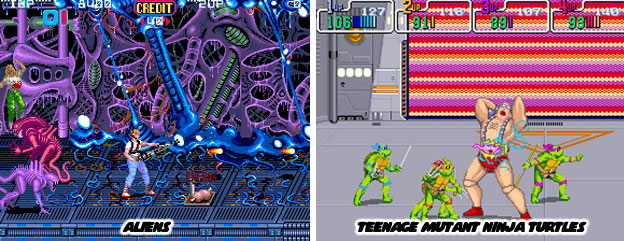
In 1990 Konami turned Aliens, a groundbreaking science fiction movie, into a different type of brawler. Despite being two completely different types of subject matter, the lessons they learned from TMNT were carried over into Aliens. They preserved the attention to detail from canon and shaped that as a game narrative.
Where Aliens differed from the other brawlers was that the players did not use their hands or feet. Instead programmers put different types of high powered machine guns in the hands of players. Several of these weapons were pulled right from the movie. Each gun, rather than each player, had its own effective range, strength and weakness. This distinction made for a unique gameplay element. In the traditional brawler each player was free to explore the screen and take on any rival they could. It was very much every man for himself in those games. In Aliens some of the species took several shots to put down and by that time there would be another following it or sneaking up on the player from the opposite direction. Gamers that worked closely together, perhaps one with a short range flamethrower and one with a long range assault cannon could get further into the game than players that went on their own.
That year was not filled entirely with great advances in the genre. Studios were quickly developing their own take on the brawler and they weren’t all great or memorable. Several were applying the formula as fast as they could and pushing a title right to market. That was the sense I got from Taito when they released GROWL. A brawler set in the '30s-'40s about a group of adventurers tackling poachers in the jungle. The game was a thinly-veiled Indiana Jones rip off as scores of thugs went after fedora wearing heroes.
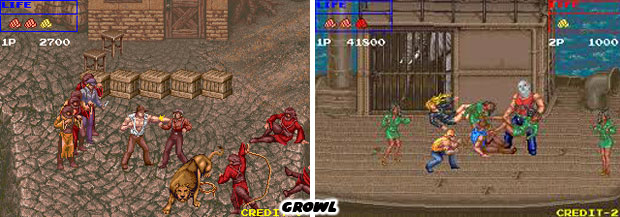
The handful of rival designs had nothing more than color palette swaps. Random men and women wearing the same costumes in different colors would simply show up to fight players over and over. The only interesting elements going for the brawler were some of the stage designs. Fighting aboard a steam ship as it sailed down a river, or atop a train as it sped through the jungle made for memorable levels. Everything aside from that was truly forgettable.
Technos was guilty of exploiting their own Double Dragon formula when it released the Combatribes. They added a third, black character, to the lineup of Billy and Jimmy Lee clones just to keep things fresh. I will go on record to say that the first time I saw the famous Guile haircut from Street Fighter II. It was with the blonde character in the game a full year before Capcom revolutionized the fighting genre. Granted the graphics and animation were improved over Double Dragon, but the case was true for every other game released three years after Double Dragon.
The things that made this game unique had to do with the combat system. Downed opponents could be kicked, picked up or swung around by the ankle. Swinging opponents around and throwing them into each other was truly my favorite part. Rarely did brawling games allow for rivals to be struck while they were down. If they were allowed to fight dirty why couldn’t the players be allowed the same luxury? The game also exploited the health allowance that Konami charged in Crime Fighters. Quarters granted players a set amount of health. Thankfully unlike Konami that health did not go down by the second.
After Konami had pushed the genre forward with TMNT and Aliens players had an elevated expectation for brawlers. Taito and Technos seemed to have missed that expectation and as such GROWL and Combatribes saw a limited following. The next year would be the defining moment for the brawler. Unfortunately it got off to a rough start.
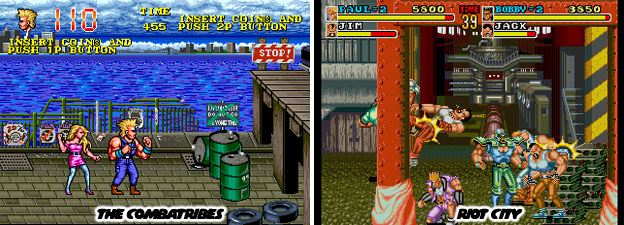
Westone (a publisher I never heard from again) developed a game for Sega. Riot City would be one of the companies first forays into the genre. The game was a pretty forgettable brawler, with a questionable design team and lackluster graphics.
About the only thing I remember from the game was the funny strut that the black character had. I guess he had to be even cooler than the white guy in the game so he walked like a rooster. Seriously Sega, what was that all about? Thankfully the rest of 1991 would give Sega another chance to get things right. In fact every major developer and publisher seemingly released at least one brawling game that year. Some were fantastic, some were okay and a few ones were real stinkers. We shall explore these over the next few blogs.
As always if you enjoyed this podcast and would like to sponsor me please visit my Patreon page and consider donating each month, even as little as $1 would help make better entries!
Subscribe to:
Posts (Atom)