Showing posts with label console. Show all posts

Saturday, December 14, 2024

The Street Fighter 6 master class index

I am grateful for all the new readers to the blog at the end of 2024. I noticed that a number of different entries into my Street Fighter 6 master class were getting shares. For those that do not know I did a 30-part series in 2023. It took a lot out of me, in fact I got super sick because I was spending so much time working on it. I’m pacing myself better now. For those that are interested here are all the links. I discuss the history of Capcom, Street Fighter, Final Fight, and the arcade legacy. We look at the mechanics of fighting games. We dissect the origins of the cast, and how they were improved over time. Plus how the new developers were making everyone a better fighting game player. Please share this if your friends love fighting games. 


As always if you would like to sponsor me please visit my Patreon page and consider donating each month, even as little as $1 would help make better blogs and even podcasts!
follow the Street Writer on Patreon!

Friday, May 12, 2023

The rail shooter revolution, part 2 - Originally published on 1UP - October 21, 2011

The previous blog talked about rail shooting games and talked slightly about their evolution. As technology advanced so did the gaming experience. Thanks to new processors and more powerful software games moved from pixels onto polygons. Thanks to advances in hardware arcade machines were changed from stationary to immersive experiences with moving seats, force feedback controls and surround sound. At home the rail shooter was experiencing a shift as well. There was a quantum leap in graphics technologies from the previous polygon attempts featured in Silpheed and Star Fox to the new 32-bit generation. Many could pinpoint the start of the era to 1995 with the release of Panzer Dragoon on the Sega Saturn.

The game was still set on rails, yet like Star Fox players could fly around on the screen, while tracking and shooting down opponents. The game was visually stunning. The new consoles were able to render polygons with textures, transparencies and a myriad of colors. The designers at Team Andromeda created some fantastic designs including flying creatures, floating battleships and citadels that defied gravity and were able to present them convincingly in game form. They took full advantage of the 32-bit processing power and expanded memory available to them. While Panzer Dragoon was not the commercial success of Star Fox it did herald the arrival of the arcade quality rail shooter to home consoles.
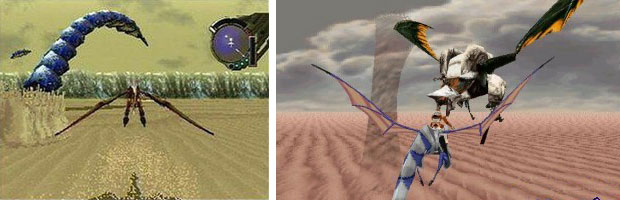
A year later Sega expanded on the elements of the rail shooter through the sequel Panzer Dragoon Zwei, released in 1996. This new game featured improved visuals and even more intense boss battles than before. The game also featured a dynamically evolving dragon as part of the gameplay. In the story the new dragon was young and lacked the speed and maneuverability of the original dragon. Players were encouraged to explore the game and paths by flying through them or having the dragon run along the ground similar to a horse. The more time the player spent doing either activity the better the dragon became at it. Speed and maneuverability in one environment were sacrificed so the dragon could become stronger in the other. Players that balanced their time between flying and running had a dragon that had good all around skills, attacks and defense. No rail shooter in the arcade had ever given the player a dynamically changing protagonist. These changes effected the gameplay in profound ways but not as much as Team Andromeda's magnum opus, Panzer Dragoon Saga. Released in 1998 this game really fleshed out the universe of Panzer Dragoon.

Panzer Dragoon Saga was a hybrid title combining the rail shooting mechanics with a role-playing experience. Players could upgrade the stats and abilities of their dragon after major boss battles. These changes affected the physical appearance, including the color and armored scales of the dragon as much as the way it handled in far more dimensions than was possible in Zwei. Players could make their dragon defensive with lots of heavy armor and stubby wings, or speedy with long skinny wings and physical features. They could also blend in the changes that came along with having an attack or magic based dragon. Of course there could be a blend of all four types to have a well rounded dragon that looked unique as well.
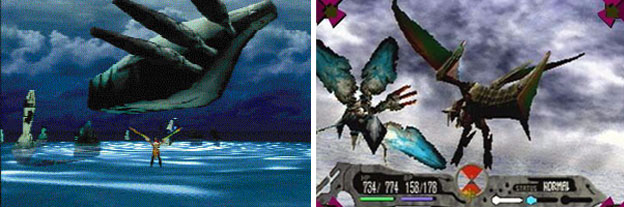
Where the home consoles lacked in the physical aspects of the arcades, things like moving seats and force feedback controls, they made up for with exclusive gameplay elements. A linear, level by level version of Panzer Dragoon could have been made in the arcade. However an RPG using the same Dragoon mechanics spread over an entire world with customizable dragons that play differently would be very hard to recreate in the arcade. Console games allowed for broader experiences with more freedom of gameplay while arcade titles were focused on very intense but controlled gameplay. The final, formal, title in the series was Panzer Dragoon Orta. Released in 2002 it was a bare-bones Dragoon experience. Harkening back to the original game in which graphics and gameplay were the major selling points.

By the year 2000 the rail shooter seemed to have run out of steam. The indy game and mobile gaming were beginning to wean players away from arcades and the rail shooter genre.
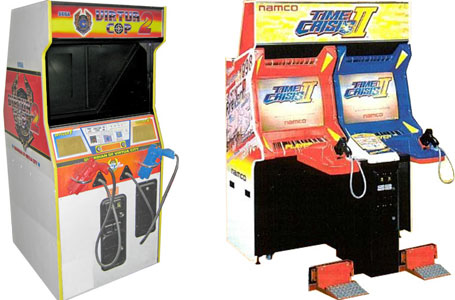
A few years earlier, after publishers had moved exclusively to polygons for arcade titles Sega had created a new generation of light gun game that required more physical effort than usual. Gunblade NY, released in 1995, put the player in the role of a SWAT officer shooting at high-powered opponents from a helicopter. Already the . Up until that point the light guns in the arcade were molded after automatic or revolver type pistols. Players could easily handle the weapons and target opponents as they moved across the screen. Gunblade NY featured a much heftier gun, undoubtedly meant for older players. The gameplay was still rail based as the screens automatically progressed as the helicopter camera system flew over and around objectives. What made Gunblade unique was that the light gun was very large. It was a heavy machine gun that was mounted to the cabinet itself. The gun was difficult to move and recoiled with some force. It vibrated far more violently than any rumble-based controller and gave players quite an upper body workout.

The light gun mechanics used in some rail shooters made the transition to consoles very well. Gunblade NY and its sequel LA Machine Guns (released in 1998) was ported over for the Wii. Part of the arcade experience was lost as handling the Wiimote would be much easier than swinging around the hefty machine guns. It was good to see the rail shooters get a new lease on life. Games that started out in the arcade, like House of the Dead from 1996, found their way onto consoles as well. An arcade style console exclusive sequel titled House of the Dead Overkill was released on the Wii in 2009 and the PS3 in 2011.

The rail mechanics were a stark contrast to the wide-open survival horror FPS title Left 4 Dead. The scenarios, levels and designs were similar but the gameplay was different. Some players enjoyed the freedom than came with exploring the world in Left 4 Dead while others enjoyed the quick point and shoot mechanics with a tangible gun controller in hand.

After years of honing the rail shooter on consoles and arcade cabinets Sega married those technologies with amusement park attractions. In 1997 Sega built a roller coaster titled Rail Chase, themed after the videogame. The ride appeared at their Joypolis location in Tokyo Japan and at Sega World, the Sydney version of Joypolis. At the time it was Sydney’s only indoor roller coaster. Players went through a series of scenarios which were inspired by the locations featured in the game, including snowy peaks, dark caves and desert valleys. Best of all the riders could shoot at targets with light guns and interact with the scenery.

Sega also married the dark ride with arcade technology. The attraction Ghost Hunters was not based on any particular arcade game, although one of their earliest rail shooters released in 1990 was titled Laser Ghost. In that game players took on the role of ghost fighters, shooting at ghosts with laser firing machine guns. The title, like many early Sega arcade games was based heavily on Western pop culture. Shinobi for example had unlicensed cameos of Spider-Man, Batman, the Terminator and Godzilla.

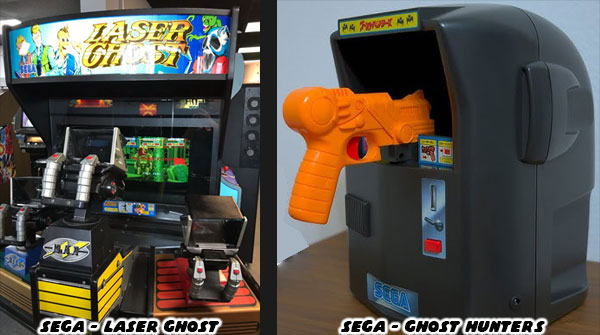
Laser Ghost was poaching the successful Ghostbusters movie and animated series. The gameplay was set around a big city (which looked an awful lot like New York) being invaded by ghosts. The three ghost catchers traveled through the city shooting up everything in sight. The 1991 follow-up Laser Ghost on the Master System console was not an arcade port. Instead players used a light gun to help protect a little blonde girl as she made her way through a haunted house. The blonde girl and scenarios for the console version were lifted from the film Poltergeist. A small cabinet for the home was released of the evolved Ghost Hunters attraction. The toy featured light up plastic ghosts in a miniature cabinet for kids to shoot with the included light gun.

Ghost Hunters was a sit down ride that went through a dark maze. On the walls were mirrors and projections with holograms, black light paintings and polygon-generated spirits. Players could use the plastic cannons mounted in front of their seats to shoot projected beams of energy at the ghosts on the screens. The effect was somewhere between an electrical arc and the wavy beams from the Ghostbuster’s Proton Packs.
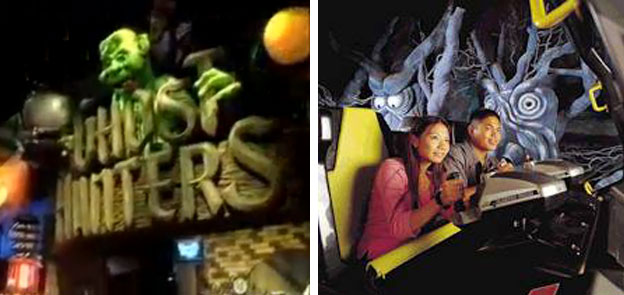
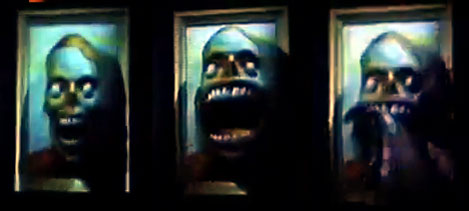
The visuals shifted between scary, macabre and humorous. It was very much a riff on Disneyland’s Haunted Mansion as much as it was on the Ghostbusters. Audiences were welcome not to be passive participants on the ride and be startled or creeped out by the visuals but instead fight back against the spirits and demons inhabiting the house. Sadly all the rides at Sydney’s Sega World were sold off or torn down in 2001 leaving only a rare glimpse online and the occasional shared memories for those that got a chance to experience the park.

The rides at Joypolis and Sega World paved the road of interactive attractions at theme parks. One of the adopters of the format would be the biggest name in the industry. Disney merged the dark ride, animatronics and the interactive light gun experience in 2004 through Buzz Lightyear's Astro Blasters. In that attraction audiences got to play the part of a Space Ranger taking on Zurg. Guests were able to shoot at targets and score points using a light gun as they traveled through a series of rooms. Scores were tracked by the ride itself. What made the attraction unique was that the rooms were painted in fluorescent paint which had a soft glow under the black light. Plus all throughout the ride there were giant models, moving props and a couple of large animatronic figures. Everything in the ride was a tangible object.

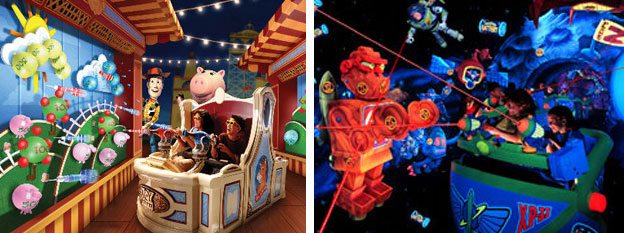
Disney’s next interactive ride did away with the animatronics, save for a great Mr. Potato Head in front of the attraction. Midway Mania, which made its debut in 2008 was a mix of classic carnival games with light gun mechanics. Riders would wear 3D glasses and shoot at targets on a series of giant displays. The rides would spin down tracks and keep score on an LCD build into the cab. Some of the games would blast players with a shot of air to add a little more dimension to the experience.

By using LCD screens instead of building physical animatronics Disney would be able to go back into the attraction and add new games and characters whenever they wanted. Such was the case when Toy Story 3 was released. The Disney Imagineers were able to incorporate the characters introduced in the film within a year of its release. Visitors to the park were amazed at the fast turnaround that the game technology provided.

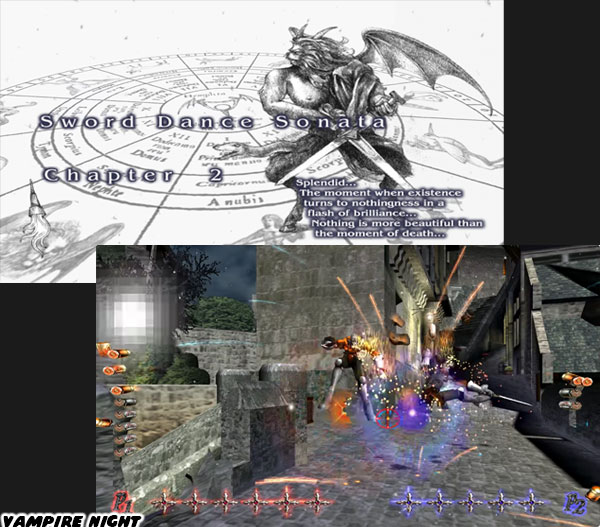
The end of the 90’s and start of the 2K era saw a global decline in arcade sales and a shift to console and mobile gaming. Long time market rivals Sega and Namco even partnered up in 2000 to release a rail shooter Vampire Night on the PS2. The shift away from the arcade combined with poor business planning hurt many companies. Many publishers were forced to merge to stay afloat or become profitable again. SNK merged with Playmore, Sega and Sammy partnered up and Bandai merged with Namco. These changes in the companies did not mean that they stopped innovating in the arcade. They simply had to be more practical with their titles.
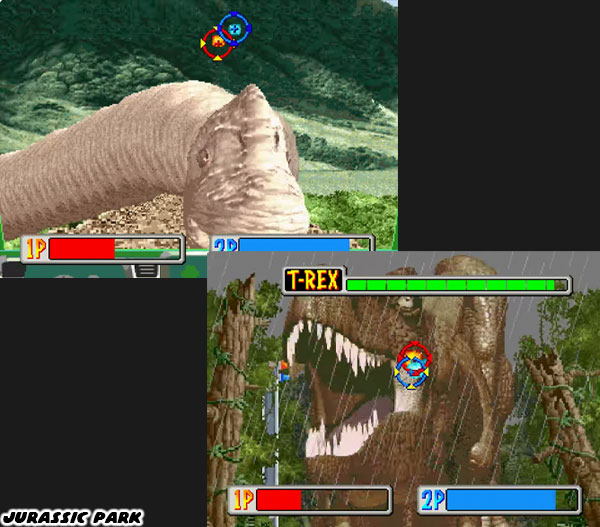
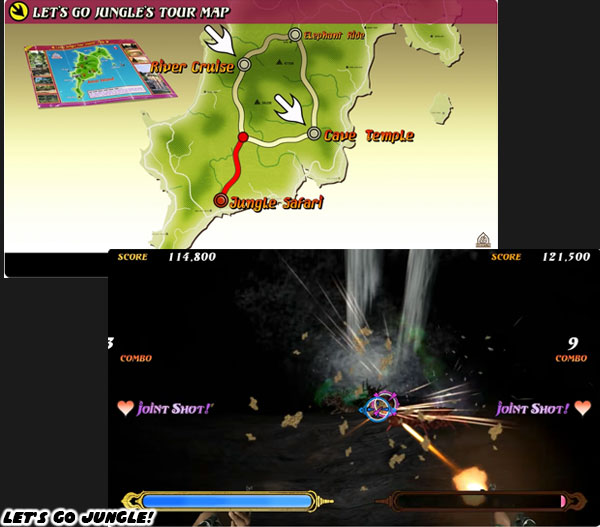
Sega found its rail shooting rhythm in 2006 with the release of Let's Go Jungle! The game was a frenetic rail shooter. Players assumed the role of tourists trapped on an island with giant angry animals. Hordes of bats, spiders and other creatures threw themselves at players in relentless waves. The artistic design for the characters was more comedic and campy than Sega had done in the past. The pacing of the game was also much faster than anything they had done before. The tempo of the game made it more difficult than previous titles, causing players to use plenty of credits to try to beat it. This made arcade owners happy as you could imagine but left some long-time players wondering what happened to the creativity Sega used to exploit. Where did the Rail Chase or Jurassic Park experiences go?

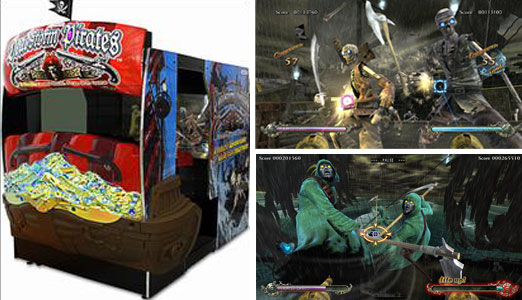
Actually those experiences were being created by Namco. In 2010 they released Deadstorm Pirates, an arcade shooter that incorporated both light guns and a ship’s wheel. The light gun was for shooting down waves of opponents of course but the several of the quick time events were handled by turning or spinning the ship’s wheel. In other portions of the game the wheel actually steered the ship or row boat around obstacles.

The game was well received by audiences. It presented some amazing battles and scenarios using a great rendering engine. Like Let’s Go Jungle! this game was one of the early rail shooters in the arcade to be presented on a high definition display. The themes featured in the game were very rich, combining classic Western pirate designs with a hint of anime and other Japanese aesthetics. It did not hurt that the game came on the heels of the Pirates of the Caribbean trilogy. As Sega had found success taking cues from pop culture in the 80’s and 90’s Namco was now doing by poaching many of the ideas from the PotC films and attractions. The game did so well in the arcade that Namco updated the technology for new builds and offered a stereoscopic (glasses free) 3D version of the game and a motion-based 4D version. The game eventually found its way onto the Playstation 3.
Not to be outdone Sega had stepped up the development of the Let’s Go series by releasing a glasses free 3D version of the sequel, Let’s Go Island in 2011.

The deluxe versions of the games incorporated the motion seat technology and encapsulating themed cabinets, going so far as blasting players with air as Disney had done in Midway Mania. The mix of the classic arcade and amusement park designs was a step at bringing Sega back to the elements that made their earlier rail shooters memorable.

Where the rail shooter goes from here is only limited by the imagination of designers and of course the budget allotted to them by the publishers. In this regard Disney is in a favorable position over game developers. Disney has a built in audience visiting the parks and usually a tremendous budget to satisfy expectations. Interactive attractions at their parks are built to reward visitors at every skill level, not just the gamers. Unlike arcade games the theme park experience does not end if the player fails to score enough points.
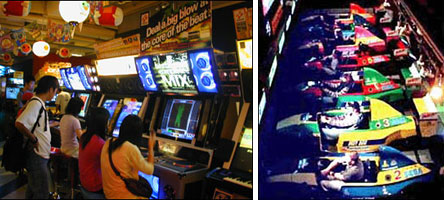
The arcade industry survives by squeezing money out of players for each interactive experience. The games have to start easy enough for beginning players but the challenges then have to ramp up quickly to keep them engaged and spending money. The games also have to be difficult enough for advanced players and not easy enough for most of them to get through on their very first credit. It is a fine line between design and difficulty, arcade owners can actually set each cabinet for how difficult it should be and how many credits the title requires based on the market. The smaller the turnout at a local arcade then the lower the price is for playing. Arcades or restaurants that can pack in the customers can get away with charging a dollar or more a game instead of a quarter. 

Theme parks do not charge visitors for every ride they get on nor do the interactive experiences ever change in difficulty. The visitors themselves choose how hard they are willing to play while the park makes a profit elsewhere, like in food and merchandising. Visitors to theme parks do not expect to get kicked out of an interactive ride for playing poorly, so each ride through Astro Blaster or Midway Mania is guaranteed to come to a conclusion. There are no guarantees that gamers in the arcade will ever see the final screen. However to their credit the games in the arcade usually last much longer than any dark ride, some games could go for 45 minutes or more, the Pirates of the Caribbean attraction lasts around 16 minutes by comparison.
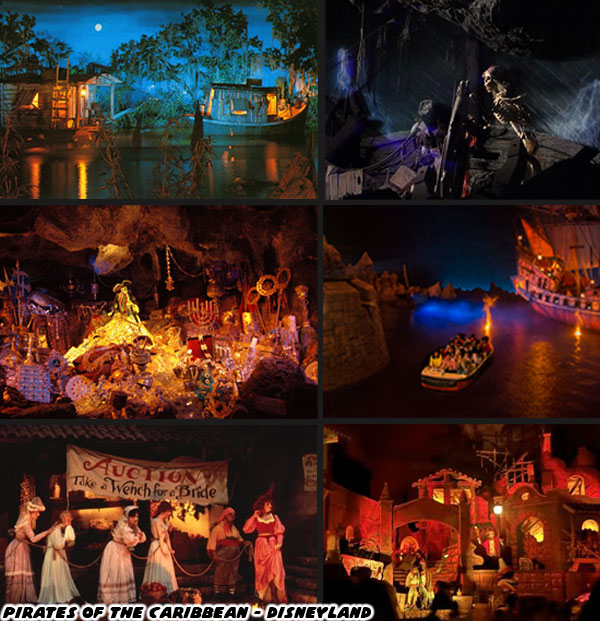
Some of the better interactive arcade games could feel more rewarding to players because of the participation they demanded. There was a stark difference between watching the Last Fighter and playing through Operation Star Blade for example. The interactive experience could make many feel more connected to a game than any other form of entertainment in this regard. However what Sega, Namco, Disney and other developers were finding out through the early 2K’s was that the arcade and interactive ride experience did not have to be mutually exclusive.

The rail shooter has a bright future in parks, arcades and at home. The best ideas and technologies seem destined to meet for the benefit of gamers. The evolution of pixels to polygons, from stand up arcade cabinets to immersive “4D” motion rides, the rail gunner has pushed the development of some of the greatest titles ever made. I would like to be around for another century just to see where else the genre could take players. Of course the greatest rail shooter in my book was never released at home and not many people got a chance to experience the title themselves.

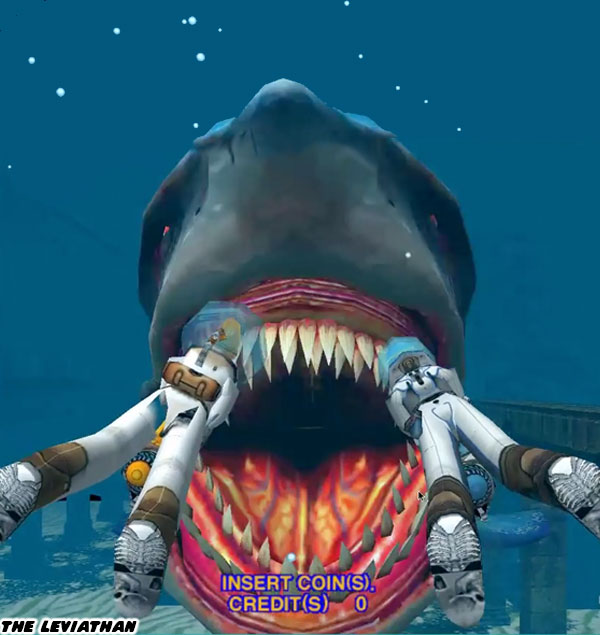
Sega’s The Ocean Hunter, released in 1998, set a standard for storytelling and design yet to be topped. Now that the publisher is revisiting their library of classic games and re-releasing them on consoles then perhaps there is a chance that many more people might get a chance to experience one of my favorite games of all-time. Until that day comes I implore the reader to support the local arcades and share with us experiences with the rail shooter genre. What were your favorite games and why? Let me know in the comments section please. As always if you would like to sponsor me please visit my Patreon page and consider donating each month, even as little as $1 would help make better blogs and even podcasts!

follow the Street Writer on Patreon!

Monday, April 10, 2023

My favorite Games of All-Time #12: Resident Evil - Originally published on 1UP - June 2, 2006

When I think of a game that moves and feels like a horror movie come-to-life I think of one title and one title alone. Resident Evil (RE) began a genre revolution and coined the term "survival horror." By appealing to fans of horror and mystery movies the game was far unlike others at the time. The pairing of puzzle and action elements was superbly crafted. Even the popular PC title Alone in the Dark didn't approach its subjects in the same way, with the same intensity as RE.

The game did not have much of a prelude. You were a member of an elite police force known as S.T.A.R.S. You were sent to a secluded mansion in the mountains of Raccoon City to find your missing comrades. After running from a pack of vicious dobermans you are left with a small group. The mission was clear. Find a way out of the mansion and try not to die in the process.

Right from the get-go the theme was set. Using one of two main characters it was up to you not only to survive but also figure out the mystery behind the mansion. The graphics pushed what was possible on consoles at the time. With a creative use of camera angles highly detailed rooms could be rendered with only the actual characters being animated. These dramatic camera angles, and the accompanying score, helped keep the mood of a horror movie.

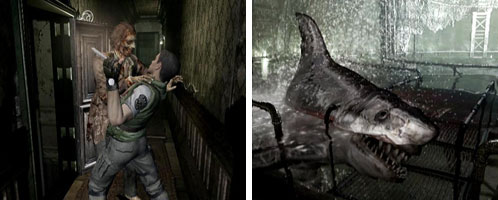
It really doesn't take very long to get into the hook of the game. Turn a few corners and a cinematic would play, introducing gamers to the zombies. ZOMBIES! The animated dead are presented right for the first time in a long time. Not since George A. Romero introduced the masses to the zombie in the classic Night of the Living Dead have they ever been presented "right."

Capcom has backpedaled and now claims that RE doesn't really have zombies. Yeah just creatures that I like to call zombies-that-really-aren't-zombies-just-very-zombie-like. BAH! Whatever to Capcom. I call a rose a rose and I call the zombies in RE exactly what they are... zombies! Anyhow, the "rules" of the classic zombie monster all apply here. You can down a zombie with many, many shots from a gun. Or it will take far less bullets if you aim for the head. Zombies shot in the legs can still crawl and reach our heroes.

The game has multiple cinemas, and changing outcomes that help explain the story and even allow for different endings. This was one of the first action/puzzle games to feature that type of gameplay. One of the best dynamics that changed the game was the limited ammo supply. Players learned quickly that they had to conserve their firepower and look for ways around the zombies. Players also learned to conserve medical packs. By searching for certain colored plants they could make a homebrew medicine to treat their injuries.

By exploring the many rooms in the mansion not only did you find more ammunition but you also discovered that the dobermans and zombies that have been attacking were part of a scientific experiment gone wrong. A corporation by the name of UMBRELLA was developing a virus that caused the zombie state in humans and animals. The secrets of the "T-Virus" experiment weren't just lying around in locked cabinets either! Players had to search high and low, discover secret passages and find keys in order to turn the next chapter in the game.

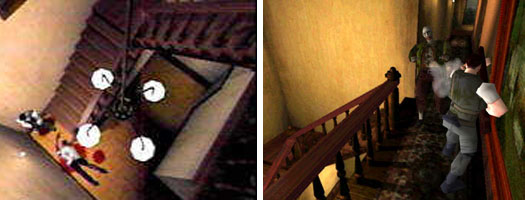
This puzzle element was heightened by the knowledge that in the very next room, at the very next turn of the corner there could be another zombie. RE is filled with many jump-out-of-your-seat moments. The best of which was the dobermans crashing through the windows. These same dogs that attacked your friends at the start of the game were discovered to be genetic monsters code-named the MA-39 Cerberus. You either run or fight in many instances. My gut told me to run or stop playing the game. But of course the desire to rescue these virtual friends and get to the bottom of the T-Virus conspiracy kept me pushing forward.

No videogame would get the best of me!

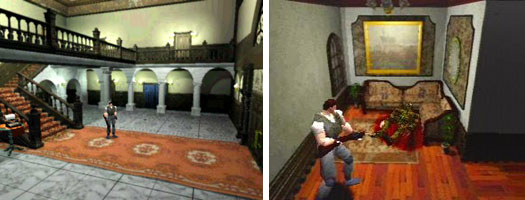
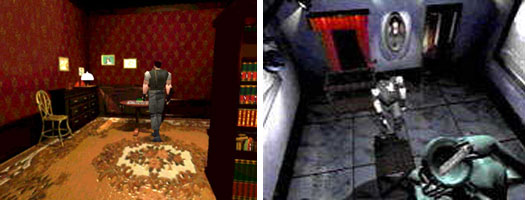
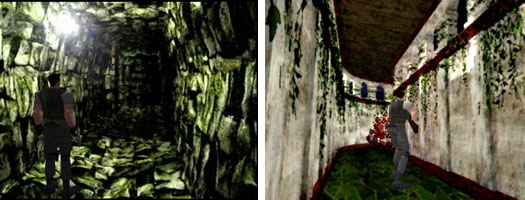
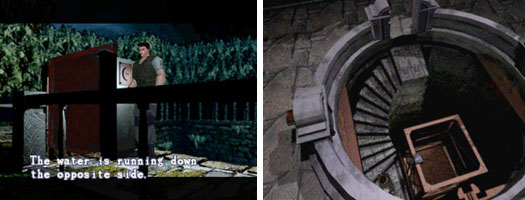
The further you progressed in the game the more unique the environments became. The game is not only set on and around the grounds of a mansion. It also stretched into the nearby mountain. The longer you play, the more absorbed in this virtual world you become. No detail is spared either. The floors and wallpaper change from room to room, there are paintings on the walls, regal furniture, elaborate tile work in other rooms. Kitchens, generator rooms, bathrooms, private studies, labs... this truly was a fleshed out world.

At no point in time do the people behind RE ever let up on the suspense either!

The world is set in perpetual midnight. There is no sunrise to change the mood. No change in the foreboding music. The atmosphere surrounding the game stays heavy from beginning to end. RE would not have worked any other way. It is a game that becomes something more than the sum of its parts. To me if is the very definition of a cinematic experience. NO! Strike that!

Resident Evil transcends the cinematic experience. It captures the pace of an action movie, of a horror movie and a Hitchock-esque suspense thriller and then takes it a step further. This is what Roger Ebert will never understand about the medium. A great game is not passive entertainment. It requires the player to use both sides of their brain. To be creative and figure out a puzzle, or series of steps in the puzzle before advancing, before simply pulling the trigger.

Participation is what makes an good game experience into a great one. It is that participation that has been lacking in many Final Fantasy titles as of late. Too much watching and not enough do-ing. All of the important elements in Resident Evil require participation. All of the cinemas in the game only last a few seconds, the rest of the game actually puts you in the scene.

There is much more I want to expand upon, not the least of which would be the "Hollywood" battle at the end of the game. But some things I cannot say because certain friends still have not beaten it. So I will leave it as this. The original Resident Evil is the best in the survival horror lot and worthy of this spot. If you have not played this game then you have not played anything great! Buy it, borrow it or steal it. Nobody should miss the experience. Just make sure you aren't of the faint of heart!


NOTE: Today is the second anniversary of my father's death. Time may heal all wounds but some wounds still sting. I will always hate June 2nd. Take care and have a great weekend.

I’d like to hear your personal top-10, top-20, top fighting games, top sports games, or top games in any genre. Let me know in the comments section please. As always if you would like to sponsor me please visit my Patreon page and consider donating each month, even as little as $1 would help make better blogs and even podcasts!
follow the Street Writer on Patreon!

Friday, April 16, 2021

A trip back to 1982. A 1UP classic...

There's not much to report in game news. I'm trying to figure out why they call Cliffy B. "Dude Huge" now. What's that about? He seems like an average size guy to me. Looking forward to Gears of War 2, well at least my brother is. I'm still waiting to see something that piques my interest for the Xbox 360, especially since the new Hulk game wasn't as well made as the previous one. I did find something rather awesome, or kind of sad, depending on your point of view. My brother found an old catalog in the doctor's office while waiting for a checkup, he took it home to share with me. The electronic game section was so amazing that I had to scan the pages in.

The Hartman Catalog Showrooms seem to be no more. I searched online and in the phone books and it looks like they closed shop a while back. These pages were taken from their 1982 catalog. Good gravy! Were some of you even born then? I was 8-years-old at the time and sure-enough, have fond memories of the handheld electronics. Some of the manufactures disappeared along with the arcade crash of the 80's. For a while some of the electronic handheld games were better than the consoles. I remember seeing the Pac Man 2 game and wondered if the handheld version fell in canon with the Pac Man and Ms. Pac Man titles.

Yes, even as a kid I was obsessed with the order and relationships between videogames and sequels. What was the plot and purpose of Pac Man 2? Would the blue and black color scheme replace the yellow and blue of the arcade cabinet? Were these new ghosts chasing Pac Man, were the mazes really going to become horizontal rather than vertical? These things fascinated me. Talk about a kook in the making!

The 3D Dungeons & Dragons game by Mattel fascinated me. My uncle and cousin each had a copy of the LCD D&D game from the year before. The various handheld titles were expensive for the time. Considering we had a couple of led lights in place of a real screen and no memory worth measuring, these titles were the cornerstone of technology and warranted the price tag. The most expensive game in the lineup was the Mattel Computer Chess game. It cost $119 in 1982, if you figure inflation that would be around $250 today.

The idea of having a single handheld game system that had interchangeable cartridges was a pipe dream. Each handheld game had to have a theme and custom-built input. Just like their arcade counterparts. Maybe someday in the far future, in the time of Buck Rogers, would we ever see such technology that allowed for a universal portable gaming device. Seven years later, practically another half of my lifetime, we were introduced to the Gameboy. The era of limited portable gaming was over.

The consoles at the time were pricey and underpowered, by today's standards. The most expensive of these, the Intellivision was $329 in the catalog. If you figure inflation that is like spending $700 today. The Odyssey and 2600 would have been around $425 in today's currency. Suddenly the PS3 doesn't seem so pricey anymore. Parents had to scrape and save to get those items in time for Christmas. My parents made a lot of sacrifices getting the 2600 to my brother. Being the only kids on the block that brought the arcade home was worth it. I have yet to find a person that owned one or two of these systems back in the day and did not have warm memories of them. Most of my generation here on 1UP, and a lot of the editors past and present, they can recall similar stories. The Atari 2600 forever changed us and gave us something to look forward to at the end of the day.

It is very interested to think about how far we have come in 26 years. The three major console developers highlighted in the catalog, Atari, Magnavox and Atari are no longer major players in the game. Even the name of Atari carries little value in the market today. It's kind of sad in a way but the memories of those rare handheld systems and early consoles will forever remain special to us gamers. Before I get all weepy I'll get back to work. Later today I have a live jazz performance. If the weather cooperates then I might have some video for you tomorrow! Keep your fingers crossed and let me know what you were up to in 1982... that is if you were even born yet. If you would like to sponsor me please visit my Patreon page and consider donating each month, even as little as $1 would help make better blogs and even podcasts!

follow the Street Writer on Patreon!

Friday, September 5, 2014

The Ridge Racer Legacy, the Namco Chronicles, final part...

When the original Ridge Racer developers left Namco they broke the trust from their teammates in the process. The camaraderie that they shared with those they left behind had been shattered. It didn't seem to matter how much they had grown personally or professionally on all the titles they had worked with. In the eyes of the publisher only those that stayed behind were truly loyal employees and worthy of carrying forward the Ridge Racer name. Unfortunately those that remained were casual fans of racing. They had not poured their heart and soul into Ridge Racer. They did not grasp the level of insight and passion that the original team had brought to the project until it was too late.

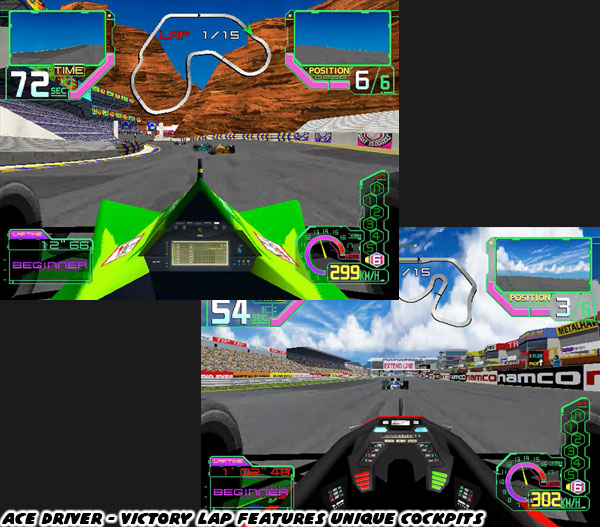
What the remaining members had was experience in multiple genres and in 3D programming. They could guarantee that the very next racing game from the company would at least look good as their rivals, and be playable. It might not be the greatest racing experience but it would be enough to keep the company moving forward. The designers that stayed behind had cut their teeth on the brilliant UGSF arcade shooters. They had a certain aesthetic in mind and wanted to redefine the genre. The rides featured in Ridge Racer were very nice but they weren't revolutionary. So the new project members challenged themselves to create a whole new breed of race car. Each car would look like a traditional open-wheel racer but upon further inspection they would begin to resemble space ships.

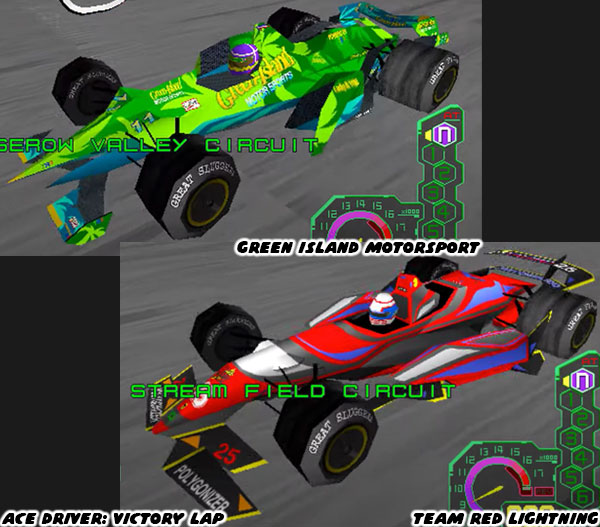
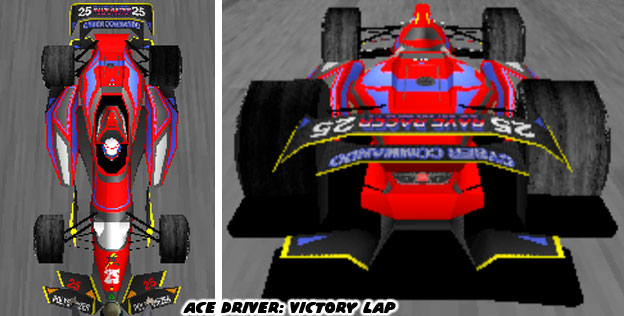
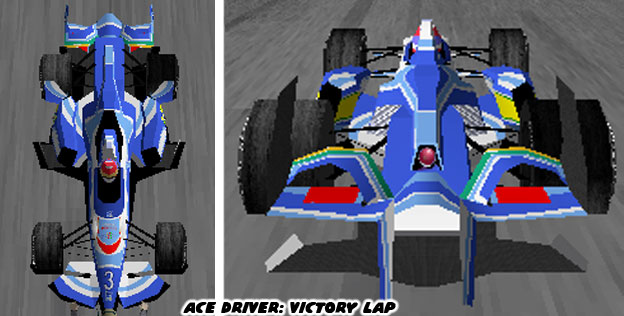
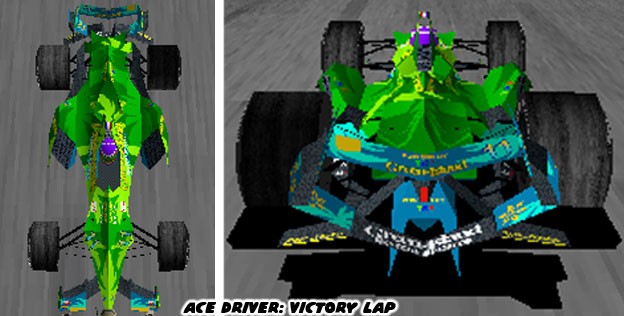
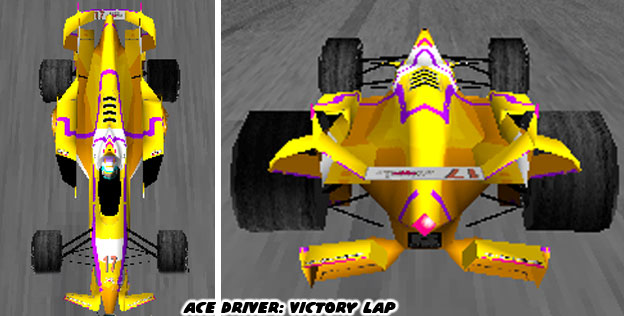
The designers envisioned the Ace Driver: Victory Lap cars as being the peak of race technology. They would be the race cars that were being driven around the time of Cyber Sled and Cyber Commando. They would be in a class above every category in Ridge Racer. Each of these new rides featured power plants, transmissions and aerodynamics superior to those on all of the Ridge Racer production cars. This would become the distinction made between actual GT-class cars and Formula-1 racers. While both racing leagues featured millions of dollars worth of R&D in the cars only one type of car was specifically designed for racing. The GT cars by comparison were rooted in production autos.

With the exception of the prototype class most GT cars had been sports cars that were converted for racing duty. The multi-wing technology that Namco featured on the Ace Driver cars was not a new concept for Formula-1 or INDY racing. It was the layout and position of the wings, air splitters, spoilers and bodies that were radically different than those in real-life open wheel racers. In many instances the game from 1994 would predict the trends that the actual Formula-1 racing cars would use almost 20 years later.

The cars in Victory Lap took on the characteristics of the UGSF space ships. There was a hint of Galaga, Nebulas Ray, Solvalou and even Starblade in each car. It made sense that the Ridge Racer and Ace Combat games were connected. The manufactures sponsoring the Ridge Racer tournament were using the cars as test beds for new technologies. Many of these advances were meant for mass production. This was a reflection of the real world. The big auto manufacturers would enter rolling tests beds into endurance races. They were great for advertising but were also used so that engineers could gain a lot of insight by pushing new technology to the breaking point. What about the companies that had a very specific goal in mind? Perhaps the ones that wanted to manufacture parts for a smaller market, like airplanes and space ships. These manufacturers needed a way to advertise their presence and test out the reliability of their equipment as well. Should they be prohibited from creating race cars? Of course not!

There was an evolutionary gap between the vehicles featured in Ridge Racer and the planes from Ace Combat. The majority of the rides in Ridge Racer looked like those that could be bought at a local dealership. The radical designs of a pure racing machine was lacking in the series. The open wheel cars in Ace Driver filled that gap. They were as close as Namco had ever come to creating land-based fighter jets. The cars had modern suspensions to shift the balance between turns and even wings that were flexible and helped steer the cars around the most brutal turns. Wings in actual Formula-1 cars were fixed and engineers were not allowed to adjust them in the middle of a race. These cars honestly looked like the wheeled cousins of the ADF-01 Falken. They looked like the ancestors of the GeoSword and Dragoon. Although there were only four of these cars created for the series each one had a tremendous presence. The most "conservative" of the racers was still far bolder than the most recent F-1 car. It would be a shame if audiences around the world never got another chance to pilot these cars. Especially on the consoles!

With the numbered Ridge Racer series on an indefinite hiatus I could only speculate what Namco was working on. They had learned a tremendous amount over the past 20 years, the most important being that they could outlive Sega so long as they believed in their own titles. The best games they created during that era had withstood the test of time. The classic hits were still referenced as examples of greatness across multiple genres. Perhaps the company was trying to figure out how to present a new generation of Ridge Racer to audiences. One that would connect the dots between Ace Driver, Ace Combat and the UGSF continuity. Whatever the case was I would be eternally grateful to the company for every experience they provided my brothers and I in the arcade. For every great console moment and for every carpal-tunnel inducing mobile game I would also say thanks.


This has been the Ridge Racer Legacy, my blog chronicling the contributions of Namco (now Namco Bandai Games) to a generation. I hope you enjoyed the series. If you have any questions or comments please feel free to leave them. Thank you for following along and I wish you all the best. As always if you would like to sponsor me please visit my Patreon page and consider donating each month, even as little as $1 would help make better blogs and even podcasts!
follow the Street Writer on Patreon!