A blog about my interests, mainly the history of fighting games. I also talk about animation, comic books, car culture, and art. Co-host of the Pink Monorail Podcast. Contributor to MiceChat, and Jim Hill Media. Former blogger on the old 1UP community site, and Capcom-Unity as well.
Hello friends, in the previous post I mentioned that the blog hit more than a million views. That milestone actually happened on the same day as my favorite Disney character celebrated a birthday. That’s right, Oswald the Lucky Rabbit was now 98-years-old! I had to create an illustration to mark the occasion. Now I have to think about what I’m going to do for the 100th birthday. Maybe have all sorts of classic characters splitting cake with him?
In case you didn’t know I am a huge fan of Oswald. Like a super-huge fan. I’ve been collecting Oswald merch for decades. One of the nicest gifts I received recently was from my sister-in-law. She created an Oswald cross stitch for me. It was a brilliant piece with well over 16,000 stitches in it! Can you imagine the patience it took to make something like this?
She created this piece because she knew I was a huge fan. In case you didn't know how obsessed I was about the character I was interviewed for the I Want that Too podcast on Jim Hill Media. Which you can see below.
In case you are not familiar with the character I did a deep dive on him many years ago. The links are below, including snapshots that I talked about in the interview with Jim Hill, and Lauren Hersey.
Do you have any favorite classic cartoon characters? What about comic book characters? I’d like to hear about it. Tell me about it in the comments section. As always if you enjoyed this blog, and would like to sponsor me please visit my Patreon page and consider donating each month, even as little as $1 would help make better blogs and even podcasts!
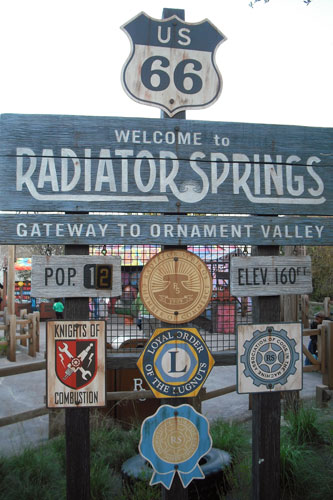
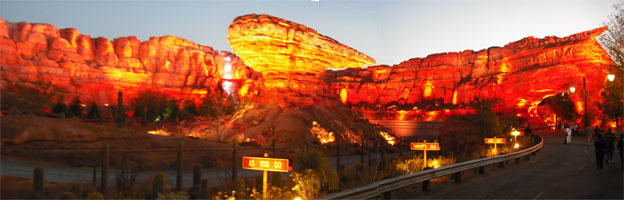
The largest expansion in Disneyland Resort history is finally ready. Between Buena Vista Street which I previewed yesterday and Cars Land which we will look at today the park has opened up around 12 acres for visitors. Cars Land is completely unlike the other portions of any other Disney park. Save for the Swiss Family Robinson Treehouse, this is the first time that the park has recreated a location from a film into a permanent attraction. For Cars Land the fictional town of Radiator Springs, set in Ornament Valley, from the feature film Cars is as close to perfect as you could imagine.
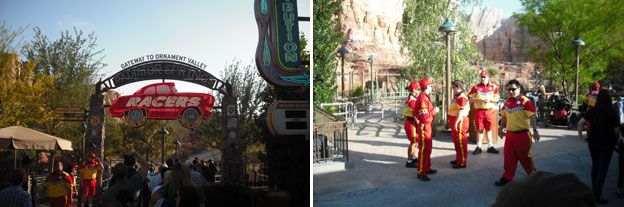
Cars Land actually has two major entrances, the main drag starting at the end of Buena Vista Street and one side entrance from Bug’s Land.
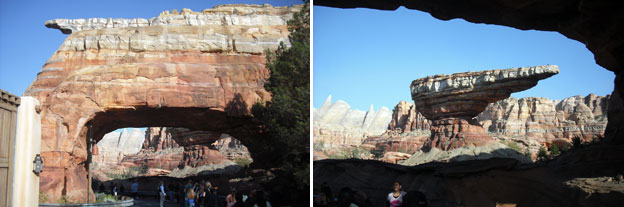
The entrance from Pacific Warf takes guests underneath a realistic stone archway.
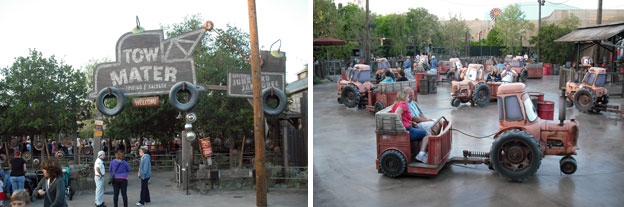
There are three attractions in Cars Land. The first one is Tow Mater’s Junkyard Jamboree. This ride is meant more for kids than adults. Parents can join their little ones as the small tractors tow guests around and dance to the music.
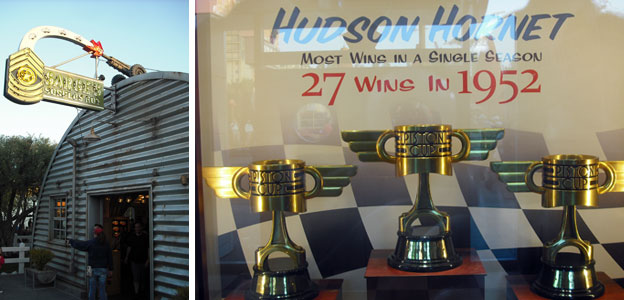
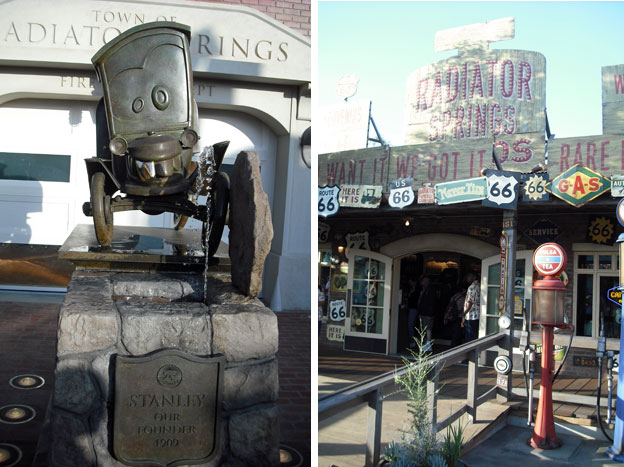
As you walk down the main street all of the locations shown in the movie are reproduced to scale. Some of the spots are shopping areas.
Just like Buena Vista Street there are many exclusive items that can only be found in this area of the park.
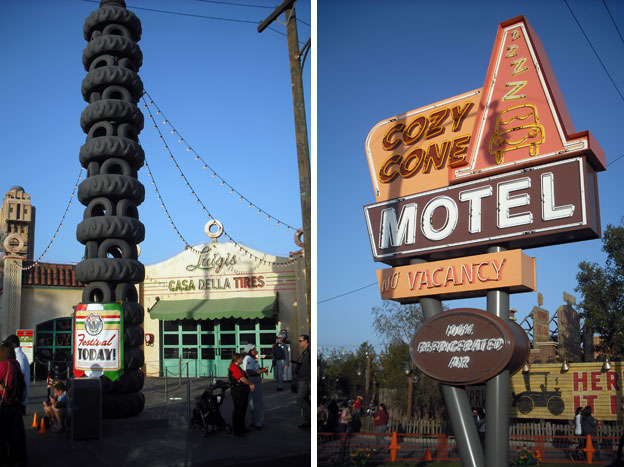
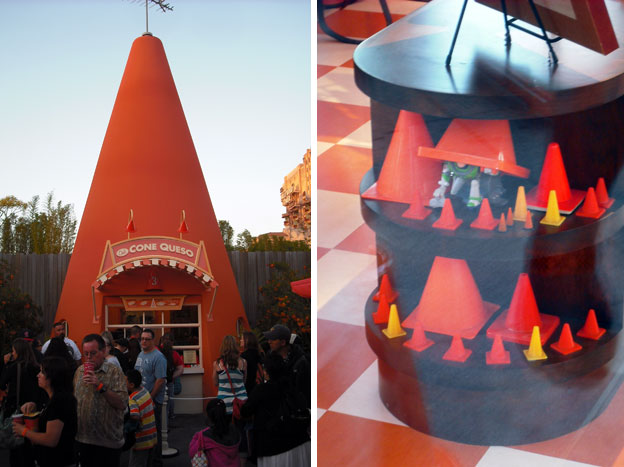
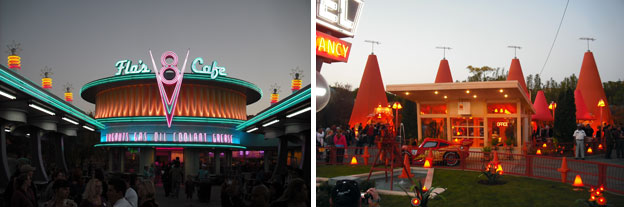
The attention to detail is amazing as the Imagineers did a great job at creating physical objects out of CGI data. The Cozy Cone Motel is a good place to get food for example, it is also the place to go if you want to get your picture taken with one of the Cars.
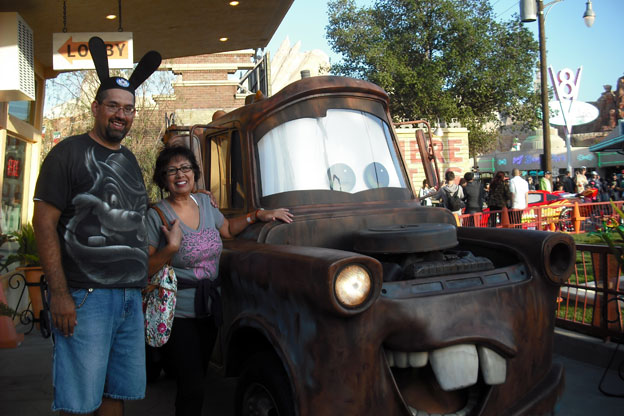
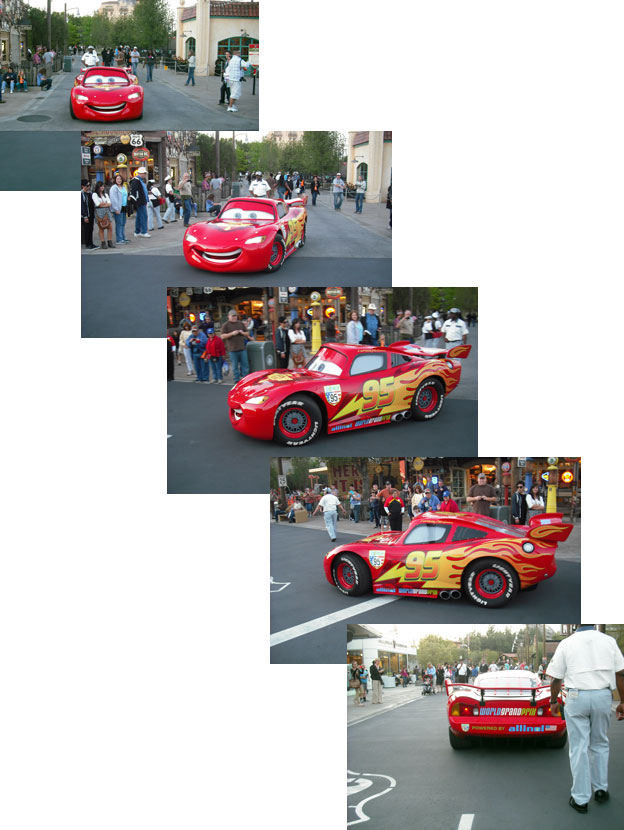
My mom and I got a picture with Mater. The tow truck actually interacts with guests, his exposed engine rumbles and he can look around and crack jokes. What is even more amazing is that the cars actually take turns posing with guests, as the mascot characters would in Disneyland.
When Mater’s turn was over hamming it up in front of the Cozy Cone, Lightning McQueen rolled over from backstage to give him a reprieve.
Eagle-eyed fans to the Cozy Cone could probably find a nod to another classic Pixar film…
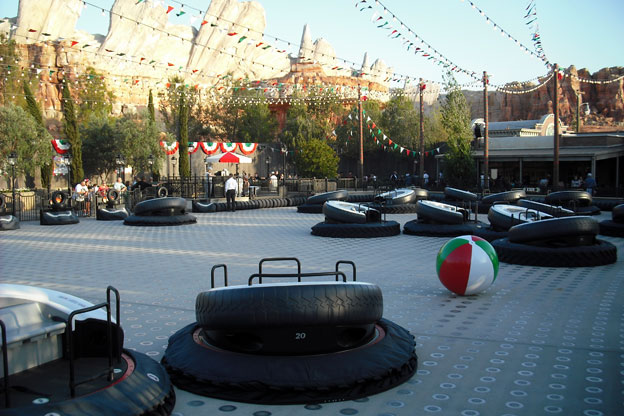
Luigi’s Casa Della Tires is actually the location of the second attraction. The soon-to-be famous Flying Tires. The ride is actually an homage to a classic attraction, the Flying Saucers no longer in Tomorrowland. Unfortunately for us there was a problem with the air compressor and the ride was unavailable during our visit. I can’t wait to give it a spin though.
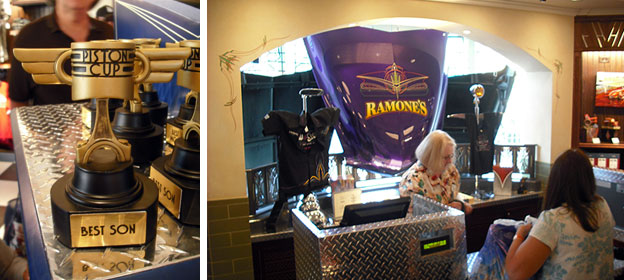
Right across from Luigi’s is Ramone’s Paint and Body Shop. This is the larger store for gearheads. Lots of clean automobile inspired designs on clothing and cool collectables can be found here.
More odds and ends can be found in Lizzy’s shop, and at the end of the street is the Fire Dept. and the fountain dedicated to Stanley, the town founder.
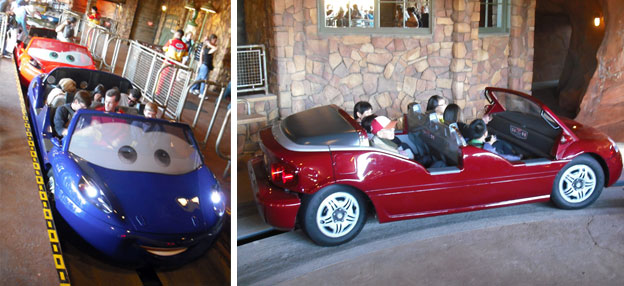
The major attraction for the expansion is Radiator Springs Racers. This attraction is part dark ride and part coaster but more on that later.
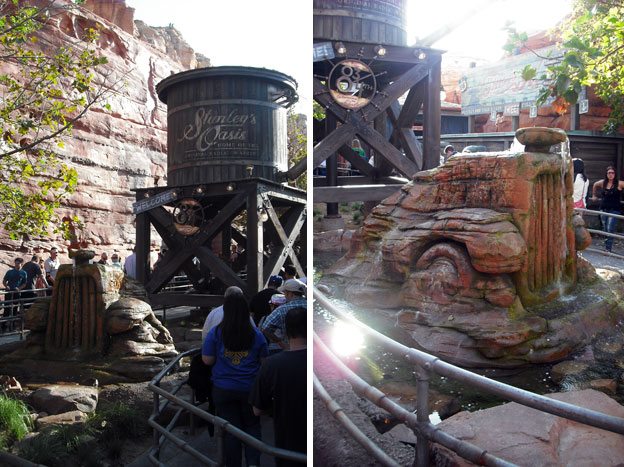
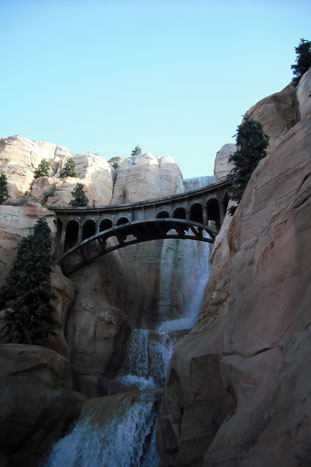
The queue is great as visitors get to see the original settlement in Ornament Valley and the actual bubbling Radiator Springs that the town was named after.
Guests buckle up six at a time in brightly colored cars with smiling faces.
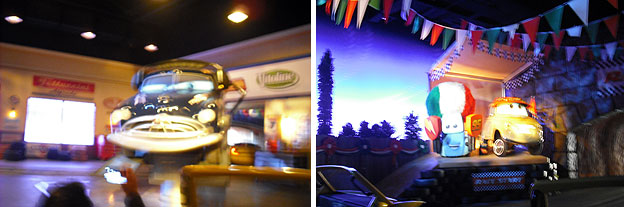
Guests drive all over Radiator Springs and get a close look at the memorable locations featured in the film.
Suddenly visitors are plunged into the story of the ride. They experience almost point-for-point the same things that Lightning did in the movie. The animatronics on the cars themselves are breathtaking. The mouths move convincingly and eyes dance around as the massive vehicles bounce around just like they did in the movie.
Guests get warned by the Sheriff to stay out of trouble as they sneak out to go tractor tipping with Mater.
The ride then turns right down the middle of main street where full-sized vehicles talk to guests and each other.
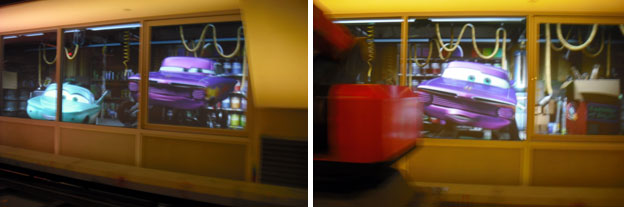
The ride then takes one of two possible turns. Riders that go into Luigi’s tire shop are treated to a change of tires on their ride. The car lifts up and bounces around as the tires are swapped out. A mirror shows off the newly installed white wall tires before you are sent to talk to Doc Hudson.
The alternate route has guests go into Ramone’s where some mechanical arms “paint” the cars. It actually smells like paint as the mechanical arms spray a mist of water at riders. After the paint job riders see Doc Hudson giving them a final pep talk before they have to race against another car filled with guests. The race is pretty spectacular as both cars race side by side on banked turns and over large bumps. The race is rigged to create the illusion that riders are always in the winning car by the time they cross the finish line and end up back at the beginning.
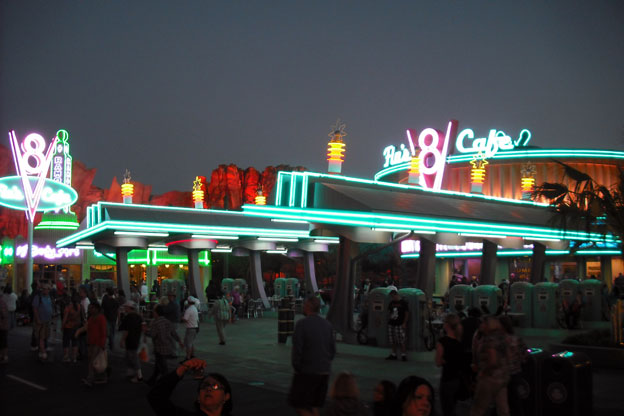
The real charm of Cars Land happens at night. In a scene right out of the movie the town springs to life and tons of neon lights illuminate the streets as the song Sh-boom plays over the PA system.
I thought that scene was the best part in the film and it was humbling to see that it could be recreated for guests night after night.
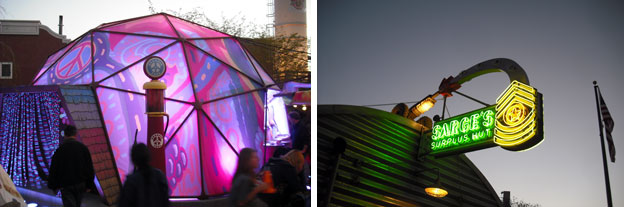
Even the neon blacklight of Fillmore’s Organic Gas Hut and Sarge’s military surplus neon are just like they are in the film.
Expect to see a record turnout this weekend as locals and international travelers set their site on DCA.
The wait was absolutely worth it!
As always if you would like to sponsor me please visit my Patreon page and consider donating each month, even as little as $1 would help make better blogs and even podcasts!
Hello friends, in anticipation of the big expansion set to debut at Disney California Adventure (DCA) this weekend I decided to give you a preview of what to look forward to. For those that don't know, DCA is the park opposite of Disneyland in Anaheim. Reviews for the park were lackluster and the attractions were not up to the classic Disney standards. As attendance dropped so did park profitability. The studio needed to turn things around and they did so by changing leadership. Michael Eisner was out and Bob Iger was in. He changed around the organizational structure and switched around the roles of some key management people. Principal among these was making John Lasseter, the Chief Creative Officer at Pixar, into the Creative Consultant for Disney Imagineering. Lasseter and the Imagineers set about trying to put the "heart" back into DCA. It would be a multi-year, multi-billion dollar proposition that didn't sit too well with all of the shareholders. However as Walt had demonstrated years earlier, some things simply could not be compromised because it would not be "cost effective." This expansion was necessary and long overdue for a park that seemed vastly inferior to Disneyland.
I joined my mom, wife and daughter on a preview day this weekend. It was a benefit for members of D23 the official Disney fan club, and the proceeds were used to help the Children's Hospital of Orange County. We were able to walk down Buena Vista Street, the new entranceway to the park and see everything that had been added for guests. Many of these details were presented at the D23 convention last year. However no presentation or model could capture our surprise when we actually got to walk through the park. The new entrance to DCA is actually a sort of reflection of Disneyland. Main Street on Disneyland USA features turn-of-the-20th-century architecture, sights, smells and sounds that might have been around when Walt Disney was growing up in Marceline Missouri. The street actually guides patrons towards a destination, in the distance there is a castle marking the beginning of Fantasyland. The narrative is amazing, from humble beginnings and small-town origins the world becomes a fantastic playground.
The new Buena Vista Street at DCA is a bookend to Main Street USA. The entrance to Disneyland celebrates the influences of a young Walt while DCA highlights his move to LA and the creation of his studio. The sights, sounds and smells of the new entrance all capture the classic Hollywood feel. Right away there is a service station featuring a familiar icon. Oswald has finally returned home and is the mascot for the store. My wife and I wore our rabbit ears from the E3 as we walked the streets. We were asked by visitors and employees about them. The ears weren't on sale yet in the parks and were pending the official opening of the resort. Most everyone there could not wait to get their own rabbit ears. I have a feeling that Mickey will remain the star of Disneyland but Oswald is going to own DCA.
Everywhere we went we were reminded of how Los Angeles looked back in the day. The architecture and signage was spot-on, a mix of Art Deco and the tail end of Art Nouveau. Just like Main Street the area was impeccable and absolutely pristine. Plenty of shade from local trees and benches surrounded the buildings, offering comfort to visitors not used to the hot Southern California summers.
Main Street has several modes of transportation to get visitors from one end to the other, several vintage-looking cars, busses and a horse-drawn trolley. However the entrance to DCA is not nearly wide enough to support that much traffic. That didn't stop the Imagineers from installing a brand new draw. The Pacific Electric Red Car was a staple of Los Angeles during the 20's and 30's. The various Red Car lines ran all over the city from as far east as Redlands to as far north as San Fernando and as far south as Newport Beach, all-in-all around 450 Square Miles were covered by the service. The cars were fondly remembered by those that got a chance to enjoy them just before the 1960's. For those that came after this would be a rare instance to recapture the magic on a reproduction LA street. The cars were not refurbished trolleys either. Just like every vehicle in the park they are built from scratch and only look period correct. These vehicles have to bear tremendous loads, accommodate wheelchairs, service dogs and people with disabilities. They have to be able to run for 16-hour days and be highly reliable. For the Red Cars they wanted to make them electric as well.
The Imagineers went above and beyond the call and created cool, comfortable and wide Red Cars that are electric and offer the smoothest possible ride on rails. The tracks were welded together and grinded down to be perfectly seamless, even the wheel technology uses shock absorbers to dampen the sound and vibrations from the road. The engineers used inductive power transfer (aka wireless charging) to get the cars up and running. The cables suspended above the streets are actually decorative, that way there is no chance of getting hurt should a cable snap. The cars charge themselves at each stop. It's a tremendous feat of engineering to make something that looks so simple be state-of-the-art.
The rest of Buena Vista Street is just as magical as Main Street USA. Every sign and detail tells a story. Some of the names are chosen from actual LA landmarks and streets, while others are based on classic cartoon characters. The signage matches the era as well, helping to reinforce Walt's studios when he was set up at the old Hyperion address. Even the monorail bridge that runs through the middle of the street has been redone to look like the classic Hyperion-Glendale Bridge that was featured in several movies.
Of course what good are all the businesses on Buena Vista Street unless people can do a little shopping inside? Lasseter made sure that there would be merchandise not only exclusive to DCA, but to some of the shops themselves. One of the things that used to make Disneyland merchandise so desirable in the early days was the exclusivity of it. Clothing, art and toys used to be specific for each shop and area of the park. When Eisner took over the company (and after the death of Frank Wells) the focus became more profit driven. Every corner of the park became saturated with mall kiosks selling trinkets. More and more of the shops had begun carrying identical items, turning the stores into very generic outlets. Recently the parks have been going in the opposite direction and are starting to give customers more boutique options. Downtown Disney, an outdoor mall complex has several shops selling exclusive items and now both Disneyland and DCA are starting to get in on the trend as well.
Visitors to DCA can now look forward to exclusive collectables in several shops as well. This exclusivity should help restore some of the Disney name and keep collectors coming back.
The details and themes placed on every building facade applies to the interior of each shop as well. The color selection, flooring, tiles and furnishings all reinforce the turn-of-the-century theme. Even the music piped through the shops is right out of the roaring' 20's. Visitors can't help but imagine that they've stepped back through time.
One of the things that helps separate the Disney parks from the others is the attention to detail. Most parks might have a theme on the outside of a building but few carry it indoors. Disney does that in spades. The walls and windows on Buena Vista Street are covered in vintage or reproduction items. The employees or "cast members" are wearing period correct costumes as well and have some knowledge on the area they represent. No detail is too big or too small for the Imagineers. For example in the candy store there is a refurbished nickel candy machine. The candy bars in the window look authentic but on closer inspection they too carry some inside knowledge of the company and the classic cartoon legacy.
Of course what Disney park is complete without some mascots? Mickey Mouse and Pluto look very dapper, if a little green in their costumes. Don't worry Mickey, I'm sure you'll be a hit!
Buena Vista Street does point visitors in a specific direction but at the end of the street there isn't a castle. Instead visitors can see a reproduction of the classic Carthay Circle theater. This was the same theater that Walt Disney premiered Snow White and the Seven Dwarfs. Walt gambled big on that movie, most people thought that animation could not hold the interest of people, especially children for a full feature. They couldn't have been more wrong as the movie became a global success. The new Carthay Circle is actually a restaurant. Hidden inside is a lounge called 1901. It is exclusively for Club 33 members.
The theater looks great in the day as well as at night. Like the castle it is very regal and inviting. Disney certainly has done well with the expansion, yet the best is yet to come! Come back tomorrow for a review of Cars Land!
As always if you would like to sponsor me please visit my Patreon page and consider donating each month, even as little as $1 would help make better blogs and even podcasts!
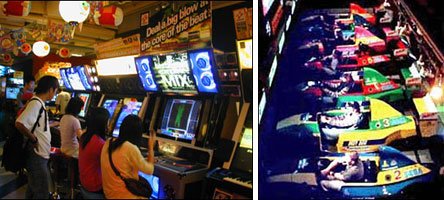
The previous blog talked about rail shooting games and talked slightly about their evolution. As technology advanced so did the gaming experience. Thanks to new processors and more powerful software games moved from pixels onto polygons. Thanks to advances in hardware arcade machines were changed from stationary to immersive experiences with moving seats, force feedback controls and surround sound. At home the rail shooter was experiencing a shift as well. There was a quantum leap in graphics technologies from the previous polygon attempts featured in Silpheed and Star Fox to the new 32-bit generation. Many could pinpoint the start of the era to 1995 with the release of Panzer Dragoon on the Sega Saturn.
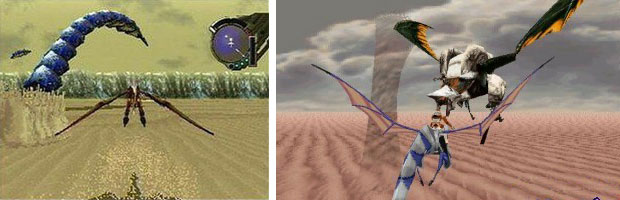
The game was still set on rails, yet like Star Fox players could fly around on the screen, while tracking and shooting down opponents. The game was visually stunning. The new consoles were able to render polygons with textures, transparencies and a myriad of colors. The designers at Team Andromeda created some fantastic designs including flying creatures, floating battleships and citadels that defied gravity and were able to present them convincingly in game form. They took full advantage of the 32-bit processing power and expanded memory available to them. While Panzer Dragoon was not the commercial success of Star Fox it did herald the arrival of the arcade quality rail shooter to home consoles.
A year later Sega expanded on the elements of the rail shooter through the sequel Panzer Dragoon Zwei, released in 1996. This new game featured improved visuals and even more intense boss battles than before. The game also featured a dynamically evolving dragon as part of the gameplay. In the story the new dragon was young and lacked the speed and maneuverability of the original dragon. Players were encouraged to explore the game and paths by flying through them or having the dragon run along the ground similar to a horse. The more time the player spent doing either activity the better the dragon became at it. Speed and maneuverability in one environment were sacrificed so the dragon could become stronger in the other. Players that balanced their time between flying and running had a dragon that had good all around skills, attacks and defense. No rail shooter in the arcade had ever given the player a dynamically changing protagonist. These changes effected the gameplay in profound ways but not as much as Team Andromeda's magnum opus, Panzer Dragoon Saga. Released in 1998 this game really fleshed out the universe of Panzer Dragoon.
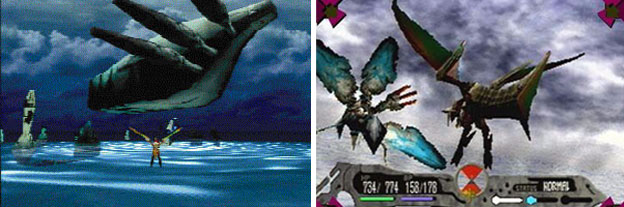
Panzer Dragoon Saga was a hybrid title combining the rail shooting mechanics with a role-playing experience. Players could upgrade the stats and abilities of their dragon after major boss battles. These changes affected the physical appearance, including the color and armored scales of the dragon as much as the way it handled in far more dimensions than was possible in Zwei. Players could make their dragon defensive with lots of heavy armor and stubby wings, or speedy with long skinny wings and physical features. They could also blend in the changes that came along with having an attack or magic based dragon. Of course there could be a blend of all four types to have a well rounded dragon that looked unique as well.
Where the home consoles lacked in the physical aspects of the arcades, things like moving seats and force feedback controls, they made up for with exclusive gameplay elements. A linear, level by level version of Panzer Dragoon could have been made in the arcade. However an RPG using the same Dragoon mechanics spread over an entire world with customizable dragons that play differently would be very hard to recreate in the arcade. Console games allowed for broader experiences with more freedom of gameplay while arcade titles were focused on very intense but controlled gameplay. The final, formal, title in the series was Panzer Dragoon Orta. Released in 2002 it was a bare-bones Dragoon experience. Harkening back to the original game in which graphics and gameplay were the major selling points.
By the year 2000 the rail shooter seemed to have run out of steam. The indy game and mobile gaming were beginning to wean players away from arcades and the rail shooter genre.
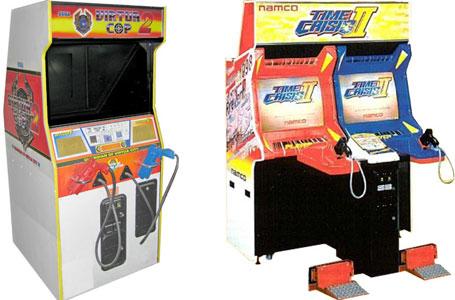
A few years earlier, after publishers had moved exclusively to polygons for arcade titles Sega had created a new generation of light gun game that required more physical effort than usual. Gunblade NY, released in 1995, put the player in the role of a SWAT officer shooting at high-powered opponents from a helicopter. Already the . Up until that point the light guns in the arcade were molded after automatic or revolver type pistols. Players could easily handle the weapons and target opponents as they moved across the screen. Gunblade NY featured a much heftier gun, undoubtedly meant for older players. The gameplay was still rail based as the screens automatically progressed as the helicopter camera system flew over and around objectives. What made Gunblade unique was that the light gun was very large. It was a heavy machine gun that was mounted to the cabinet itself. The gun was difficult to move and recoiled with some force. It vibrated far more violently than any rumble-based controller and gave players quite an upper body workout.
The light gun mechanics used in some rail shooters made the transition to consoles very well. Gunblade NY and its sequel LA Machine Guns (released in 1998) was ported over for the Wii. Part of the arcade experience was lost as handling the Wiimote would be much easier than swinging around the hefty machine guns. It was good to see the rail shooters get a new lease on life. Games that started out in the arcade, like House of the Dead from 1996, found their way onto consoles as well. An arcade style console exclusive sequel titled House of the Dead Overkill was released on the Wii in 2009 and the PS3 in 2011.
The rail mechanics were a stark contrast to the wide-open survival horror FPS title Left 4 Dead. The scenarios, levels and designs were similar but the gameplay was different. Some players enjoyed the freedom than came with exploring the world in Left 4 Dead while others enjoyed the quick point and shoot mechanics with a tangible gun controller in hand.
After years of honing the rail shooter on consoles and arcade cabinets Sega married those technologies with amusement park attractions. In 1997 Sega built a roller coaster titled Rail Chase, themed after the videogame. The ride appeared at their Joypolis location in Tokyo Japan and at Sega World, the Sydney version of Joypolis. At the time it was Sydney’s only indoor roller coaster. Players went through a series of scenarios which were inspired by the locations featured in the game, including snowy peaks, dark caves and desert valleys. Best of all the riders could shoot at targets with light guns and interact with the scenery.
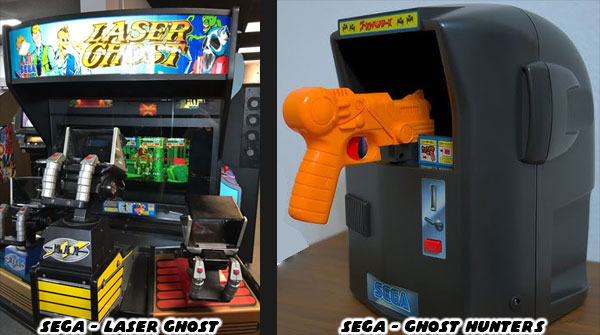
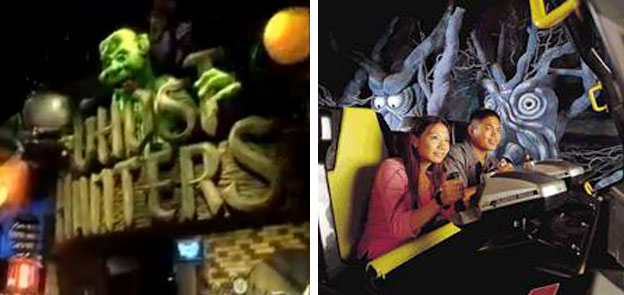
Sega also married the dark ride with arcade technology. The attraction Ghost Hunters was not based on any particular arcade game, although one of their earliest rail shooters released in 1990 was titled Laser Ghost. In that game players took on the role of ghost fighters, shooting at ghosts with laser firing machine guns. The title, like many early Sega arcade games was based heavily on Western pop culture. Shinobi for example had unlicensed cameos of Spider-Man, Batman, the Terminator and Godzilla.
Laser Ghost was poaching the successful Ghostbusters movie and animated series. The gameplay was set around a big city (which looked an awful lot like New York) being invaded by ghosts. The three ghost catchers traveled through the city shooting up everything in sight. The 1991 follow-up Laser Ghost on the Master System console was not an arcade port. Instead players used a light gun to help protect a little blonde girl as she made her way through a haunted house. The blonde girl and scenarios for the console version were lifted from the film Poltergeist. A small cabinet for the home was released of the evolved Ghost Hunters attraction. The toy featured light up plastic ghosts in a miniature cabinet for kids to shoot with the included light gun.
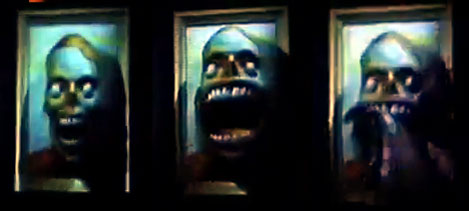
Ghost Hunters was a sit down ride that went through a dark maze. On the walls were mirrors and projections with holograms, black light paintings and polygon-generated spirits. Players could use the plastic cannons mounted in front of their seats to shoot projected beams of energy at the ghosts on the screens. The effect was somewhere between an electrical arc and the wavy beams from the Ghostbuster’s Proton Packs.
The visuals shifted between scary, macabre and humorous. It was very much a riff on Disneyland’s Haunted Mansion as much as it was on the Ghostbusters. Audiences were welcome not to be passive participants on the ride and be startled or creeped out by the visuals but instead fight back against the spirits and demons inhabiting the house. Sadly all the rides at Sydney’s Sega World were sold off or torn down in 2001 leaving only a rare glimpse online and the occasional shared memories for those that got a chance to experience the park.
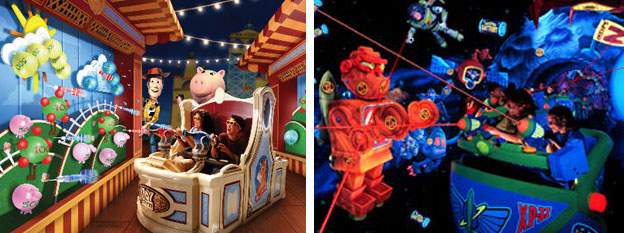
The rides at Joypolis and Sega World paved the road of interactive attractions at theme parks. One of the adopters of the format would be the biggest name in the industry. Disney merged the dark ride, animatronics and the interactive light gun experience in 2004 through Buzz Lightyear's Astro Blasters. In that attraction audiences got to play the part of a Space Ranger taking on Zurg. Guests were able to shoot at targets and score points using a light gun as they traveled through a series of rooms. Scores were tracked by the ride itself. What made the attraction unique was that the rooms were painted in fluorescent paint which had a soft glow under the black light. Plus all throughout the ride there were giant models, moving props and a couple of large animatronic figures. Everything in the ride was a tangible object.
Disney’s next interactive ride did away with the animatronics, save for a great Mr. Potato Head in front of the attraction. Midway Mania, which made its debut in 2008 was a mix of classic carnival games with light gun mechanics. Riders would wear 3D glasses and shoot at targets on a series of giant displays. The rides would spin down tracks and keep score on an LCD build into the cab. Some of the games would blast players with a shot of air to add a little more dimension to the experience.
By using LCD screens instead of building physical animatronics Disney would be able to go back into the attraction and add new games and characters whenever they wanted. Such was the case when Toy Story 3 was released. The Disney Imagineers were able to incorporate the characters introduced in the film within a year of its release. Visitors to the park were amazed at the fast turnaround that the game technology provided.
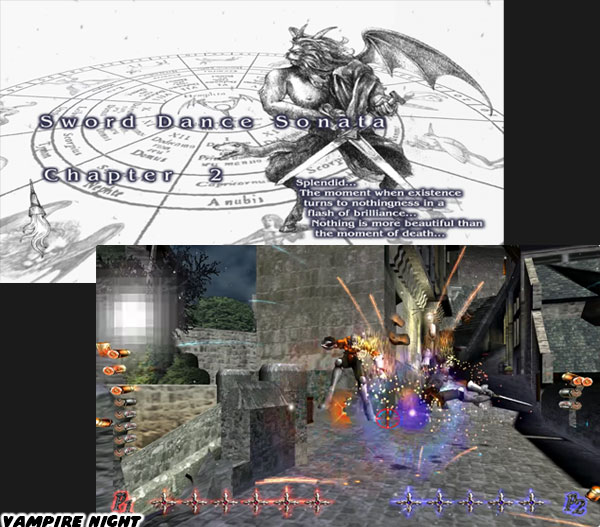
The end of the 90’s and start of the 2K era saw a global decline in arcade sales and a shift to console and mobile gaming. Long time market rivals Sega and Namco even partnered up in 2000 to release a rail shooter Vampire Night on the PS2. The shift away from the arcade combined with poor business planning hurt many companies. Many publishers were forced to merge to stay afloat or become profitable again. SNK merged with Playmore, Sega and Sammy partnered up and Bandai merged with Namco. These changes in the companies did not mean that they stopped innovating in the arcade. They simply had to be more practical with their titles.
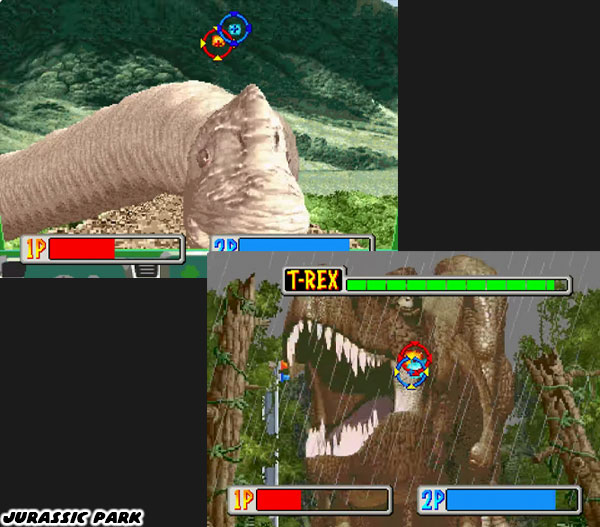
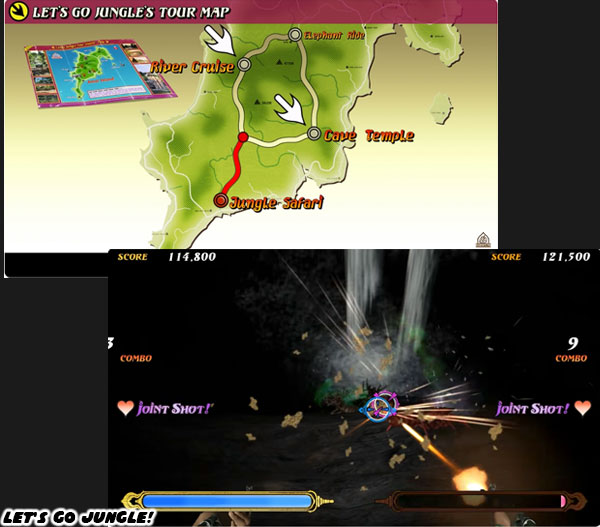
Sega found its rail shooting rhythm in 2006 with the release of Let's Go Jungle! The game was a frenetic rail shooter. Players assumed the role of tourists trapped on an island with giant angry animals. Hordes of bats, spiders and other creatures threw themselves at players in relentless waves. The artistic design for the characters was more comedic and campy than Sega had done in the past. The pacing of the game was also much faster than anything they had done before. The tempo of the game made it more difficult than previous titles, causing players to use plenty of credits to try to beat it. This made arcade owners happy as you could imagine but left some long-time players wondering what happened to the creativity Sega used to exploit. Where did the Rail Chase or Jurassic Park experiences go?
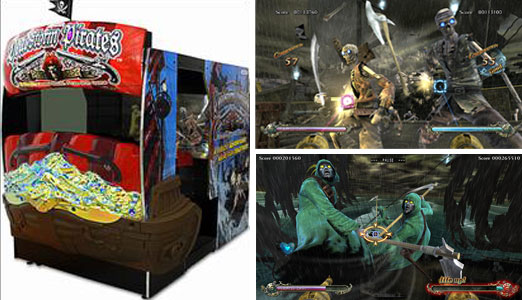
Actually those experiences were being created by Namco. In 2010 they released Deadstorm Pirates, an arcade shooter that incorporated both light guns and a ship’s wheel. The light gun was for shooting down waves of opponents of course but the several of the quick time events were handled by turning or spinning the ship’s wheel. In other portions of the game the wheel actually steered the ship or row boat around obstacles.
The game was well received by audiences. It presented some amazing battles and scenarios using a great rendering engine. Like Let’s Go Jungle! this game was one of the early rail shooters in the arcade to be presented on a high definition display. The themes featured in the game were very rich, combining classic Western pirate designs with a hint of anime and other Japanese aesthetics. It did not hurt that the game came on the heels of the Pirates of the Caribbean trilogy. As Sega had found success taking cues from pop culture in the 80’s and 90’s Namco was now doing by poaching many of the ideas from the PotC films and attractions. The game did so well in the arcade that Namco updated the technology for new builds and offered a stereoscopic (glasses free) 3D version of the game and a motion-based 4D version. The game eventually found its way onto the Playstation 3.
Not to be outdone Sega had stepped up the development of the Let’s Go series by releasing a glasses free 3D version of the sequel, Let’s Go Island in 2011.
The deluxe versions of the games incorporated the motion seat technology and encapsulating themed cabinets, going so far as blasting players with air as Disney had done in Midway Mania. The mix of the classic arcade and amusement park designs was a step at bringing Sega back to the elements that made their earlier rail shooters memorable.
Where the rail shooter goes from here is only limited by the imagination of designers and of course the budget allotted to them by the publishers. In this regard Disney is in a favorable position over game developers. Disney has a built in audience visiting the parks and usually a tremendous budget to satisfy expectations. Interactive attractions at their parks are built to reward visitors at every skill level, not just the gamers. Unlike arcade games the theme park experience does not end if the player fails to score enough points.
The arcade industry survives by squeezing money out of players for each interactive experience. The games have to start easy enough for beginning players but the challenges then have to ramp up quickly to keep them engaged and spending money. The games also have to be difficult enough for advanced players and not easy enough for most of them to get through on their very first credit. It is a fine line between design and difficulty, arcade owners can actually set each cabinet for how difficult it should be and how many credits the title requires based on the market. The smaller the turnout at a local arcade then the lower the price is for playing. Arcades or restaurants that can pack in the customers can get away with charging a dollar or more a game instead of a quarter.
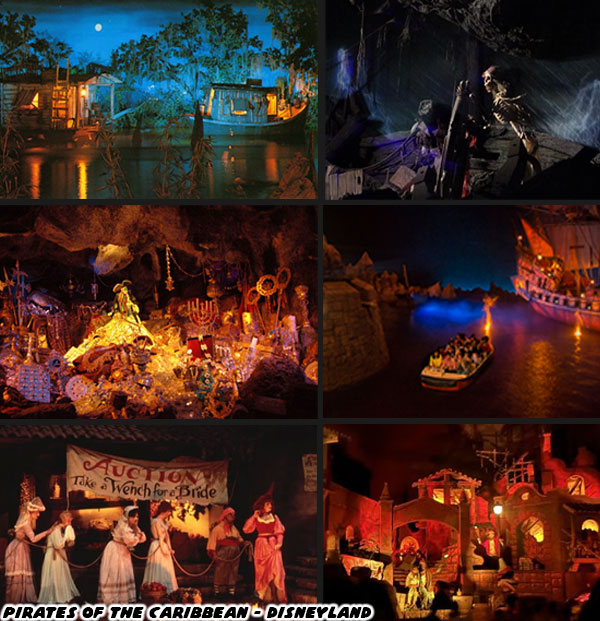
Theme parks do not charge visitors for every ride they get on nor do the interactive experiences ever change in difficulty. The visitors themselves choose how hard they are willing to play while the park makes a profit elsewhere, like in food and merchandising. Visitors to theme parks do not expect to get kicked out of an interactive ride for playing poorly, so each ride through Astro Blaster or Midway Mania is guaranteed to come to a conclusion. There are no guarantees that gamers in the arcade will ever see the final screen. However to their credit the games in the arcade usually last much longer than any dark ride, some games could go for 45 minutes or more, the Pirates of the Caribbean attraction lasts around 16 minutes by comparison.
Some of the better interactive arcade games could feel more rewarding to players because of the participation they demanded. There was a stark difference between watching the Last Fighter and playing through Operation Star Blade for example. The interactive experience could make many feel more connected to a game than any other form of entertainment in this regard. However what Sega, Namco, Disney and other developers were finding out through the early 2K’s was that the arcade and interactive ride experience did not have to be mutually exclusive.
The rail shooter has a bright future in parks, arcades and at home. The best ideas and technologies seem destined to meet for the benefit of gamers. The evolution of pixels to polygons, from stand up arcade cabinets to immersive “4D” motion rides, the rail gunner has pushed the development of some of the greatest titles ever made. I would like to be around for another century just to see where else the genre could take players. Of course the greatest rail shooter in my book was never released at home and not many people got a chance to experience the title themselves.
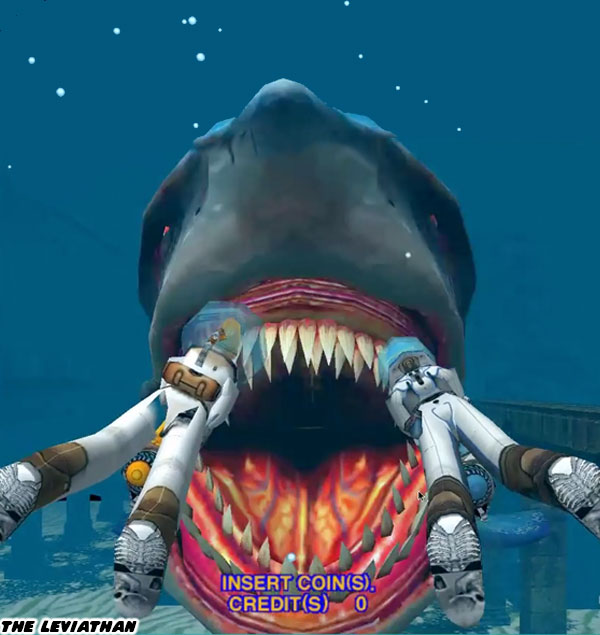
Sega’s The Ocean Hunter, released in 1998, set a standard for storytelling and design yet to be topped. Now that the publisher is revisiting their library of classic games and re-releasing them on consoles then perhaps there is a chance that many more people might get a chance to experience one of my favorite games of all-time. Until that day comes I implore the reader to support the local arcades and share with us experiences with the rail shooter genre. What were your favorite games and why? Let me know in the comments section please. As always if you would like to sponsor me please visit my Patreon page and consider donating each month, even as little as $1 would help make better blogs and even podcasts!