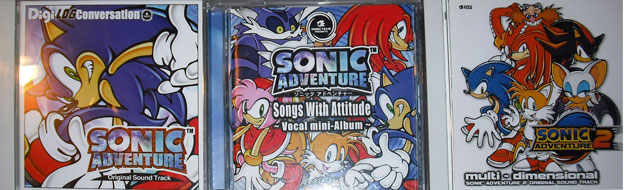
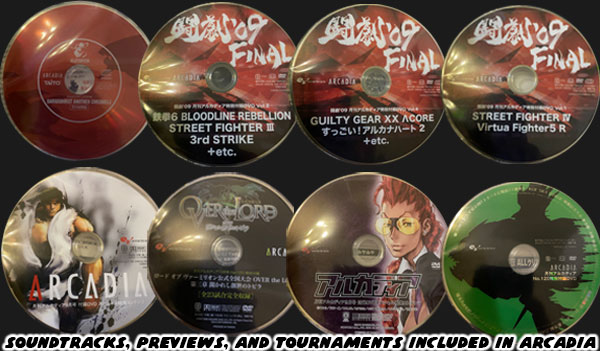
Today the gems are being imported to the playlist. Here are the rarest gaming CD's that I have.

The Jet Grind Radio and Jet Set Radio Future soundtracks are a must-own item for any player. These two can be picked up on Amazon and a few other sites.

The rarer releases that complimented the original soundtracks were the music samplers. They had some of the songs featured in the game yet which weren't on the official soundtrack. Even with all these releases Sega never managed to have one definitive soundtrack which had all of the music featured in the original Jet Set Radio.

Ollie King was a sort of spiritual successor to JSR. The soundtrack was created by Hideki Naganuma, the person that wrote about half of the songs featured in both JSR games. Crackin' DJ was from the rare Sega arcade title which featured original scratch DJ tunes.

The NiGHTS soundtracks and remixes are probably not as rare as the JSR Samplers, except for the original NiGHTS into dreams… soundtrack that is. The OST is probably the jewel of my entire CD collection. I keep the soundtrack in mint condition. It goes for a king's ransom on eBay and I plan on holding onto my copy forever. As always if you would like to sponsor me please visit my Patreon page and consider donating each month, even as little as $1 would help make better blogs and even podcasts!
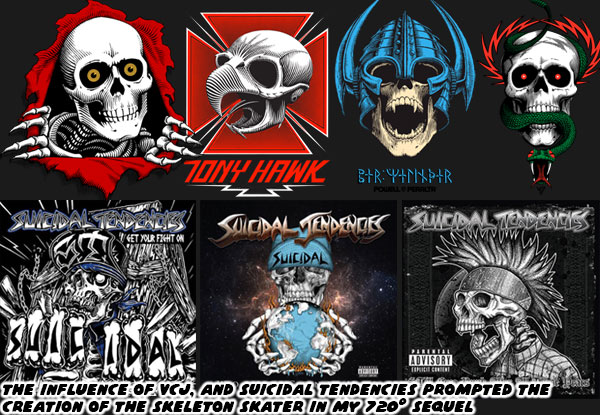
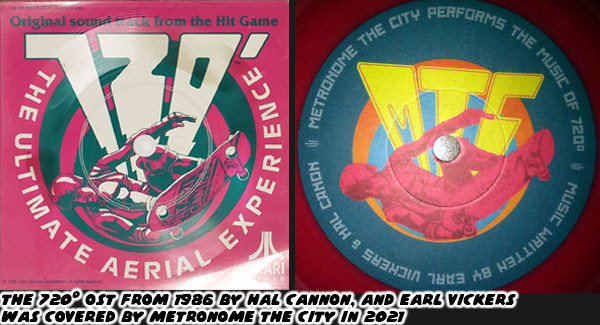
I did have one other idea for the 720° sequel that didn’t fit in with the other blog entries. I was focused on the graphics, controls, and changes to both Skate City, and the competitions that I forgot to mention the soundtrack to the game. I would feature remixes of the classic songs by Earl Vickers, and Hal Cannon. I think that they are both still alive, I’d see if I could get them out of retirements for a few new pieces. Also we have the great cover of the OST by Metronome the City, I’d be sure to incorporate that as well. The game is an homage to the ‘80s skate culture, and classic arcade gaming. I’d try to put together a greatest hits of New Wave, and punk bands that shaped the generation. Groups like Oingo Boingo, Stiff Little Fingers, and The Toy Dolls covered a broad spectrum of US, and British influences. Then there were the faster thrash, and punk songs from Suicidal Tendencies, and Pennywise who helped shape the biggest arcade, and console skate hits. Although Pennywise, and a few other acts were born in the ‘90s, they were still an important part of the scene, and should be included.
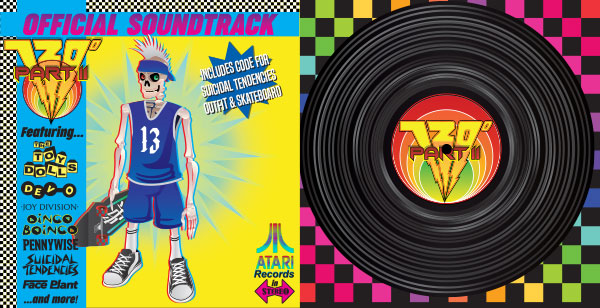
In addition to digital format downloads, I would offer a limited edition run on vinyl. The original soundtrack was the very first one to be released on Flexi-Disk. It is highly desired by skate collectors, and arcade fans alike. When Metronome the City released their version they also offered it in a digital, and vinyl format. Putting the 720° sequel soundtrack on a physical record would be a nod to the legacy. Not only that, I would have secret outfits, and skateboards available for those that purchased the soundtrack. Perhaps something inspired by the “Cyco Punk” outfits of Suicidal Tendencies. Which are based in part on Southern California Latino Gang culture. Then there’s the even more iconic outfits worn by DEVO, including the “Energy Dome” helmets worn by the band. I'd certainly enjoy rocking out to the game while my character sported this look.
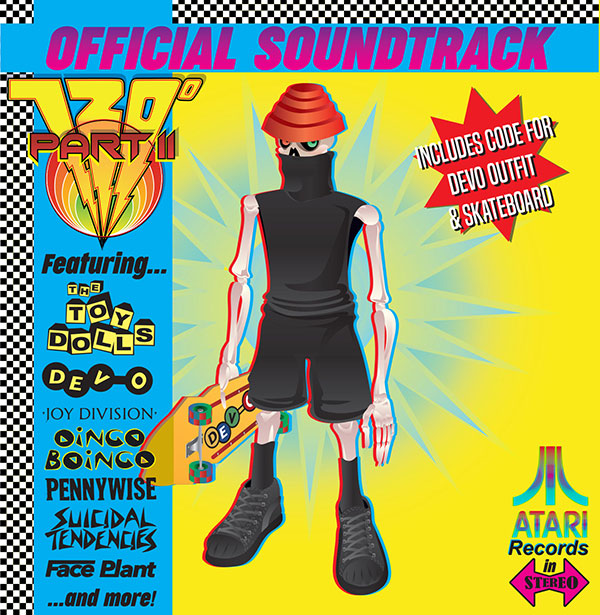
Do you remember any video game soundtrack ever offering unique in-game items? I’m sure this would be a welcome surprise for fans of the game, and help build enough support to get another game off the ground, if not inspire a team of developers to revisit Skate or Die. What do you think about that? Would you get a limited-edition soundtrack if it offered unique items for the game? Or do you just like listening to rad music? Let me know in the comments section, and I hope I have inspired you to check out skate games from any era. If you would like to sponsor me please visit my Patreon page and consider donating each month, even as little as $1 would help make better blogs and even podcasts!

It turned out that the studio had put much more time into the game than just about any other title. I wasn’t aware of that until I started digging through its history. I found that there was an interview with the team in the March 1987 issue of Thrasher magazine. That issue also featured a full-color ad featuring pro skater Steve Caballero. Thrasher back then ran mostly black and white, with spot color in certain pages. It wasn’t as polished, or professional as Transworld Skateboarding magazine, but it was certainly respected by the most hardcore of skaters. It surprised me that they would be the people that published the story. Arcades were fairly mainstream at that point, and Thrasher was seen as more core or underground, but the game was loved by skaters, and non-skaters alike.
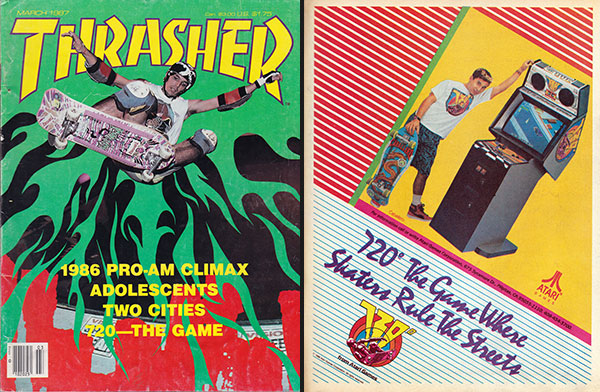
Just for perspective Atari was a California Bay Area company based in Milpitas. They were founded by Nolan Bushnell in 1972. This was the era when Silicon Valley was being paved. Steve Jobs, and Steve Wozniak worked at Atari for a short spell before founding Apple Computers in 1976. In the Thrasher article Rob Rowe was credited as an Atari Technician, and the man who came up with the idea for 720°. Rowe said he worked with Programmers John Salwitz, and Paul Kwinn, plus game designer Dave Ralston. The development of the game took 18 months of full-time involvement from the core team, according to Thrasher. It was released in December 1986.
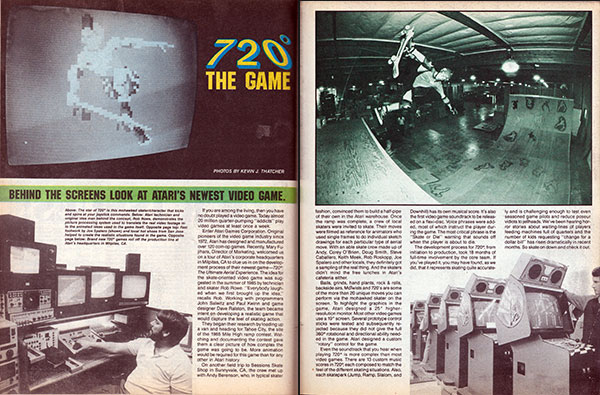
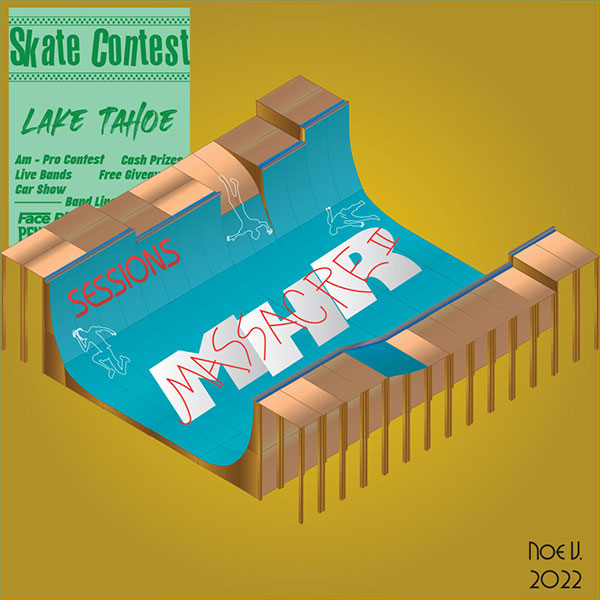
As any skater could tell you the animation was very spot on to actual skateboarding, and skate tricks from the mid-‘80s. It turned out the company had done a tremendous amount of research. The studio first recorded a Mile High halfpipe contest in Tahoe City, possibly the “Terror in Tahoe” contest from 1985 which resulted in the county tearing down the ramp afterward. Rowe, and his teammates learned they needed to do more research. While visiting the Sessions Skate Shop in Sunnyvale CA pro skater Andy Berenson convinced them to build a ramp in the Atari warehouse. He skated with other pros including Corey O’Brien, Doug Smith, Steve Caballero, Keith Meek, Rob Roskopp, Joe Spalero and others from the San Jose area. The list of credits includes animators Sam Comstock, Mark West, and Will Noble. Music by Hal Cannon, and Earl Vickers. Audio by Brad Fuller. General thanks to Dave Cook, Dennis Harper, Russell B. Dawe, and Jess Melchior. A number of these people had their initials appear as graffiti within the streets of Skate City.
The team working on the game had to be massive (for the time) because of how ambitious the project was. In addition to the skaters being used for early rotoscoping efforts, the studio had to put together entirely new hardware. Atari designed a higher resolution 25"monitor for the game, most cabinets used 19" displays at that time. The hardware the game was programmed on was known as the Atari System 2. It was also used on Paperboy, Super Sprint, Championship Sprint, and A.P.B. The soundtrack was the biggest highlight in my opinion. With 13 custom tracks it was the first video game soundtrack released on flexi-disk. Years ago I managed to find an actual disk to add to my collection of gaming artifacts. Earl Vickers, and Hal Cannon composed many of the great tunes featured in the golden era of Atari. If you look at the initials that pop up on Atari arcade leaderboards they were listed as HAL, and EAR.

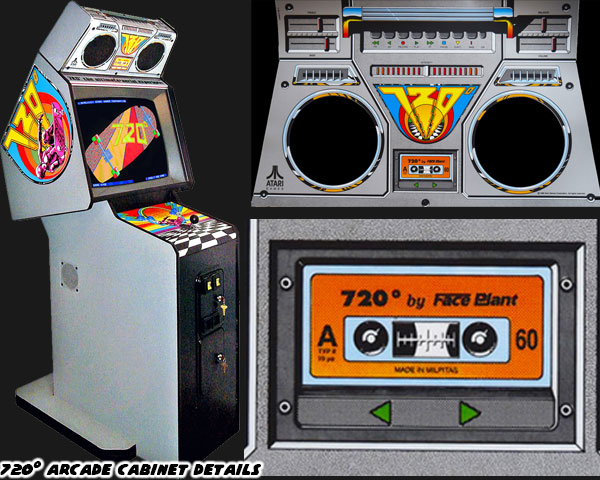
The music they laid out in 720° was arguably their best work. It was influenced by punk rock, which along with New Wave, was the default soundtrack of many skaters of the time. Atari let players know their efforts wouldn’t get lost in the mix. The company built that faux boombox with huge speakers atop the arcade cabinet, blasting players in the face with the high energy music. This helped pull you into the world they created. I can only imagine that this detail was taken from real life. The crew that skated the Atari ramp undoubtedly put a boombox up there during their sessions.
The game was a revelation. It was one of the hottest games in the arcade the holiday of 1986, going through the rest of ’87, and ’88. It was hitting at the peak of skate mania. With the Bones Brigade, and other skate teams were becoming household names. People like Tony Hawk, Steve Caballero, Neil Blender, Christian Hosoi, and Lance Mountain were becoming influential in the art, and mainstream communities as well. Audiences were dying for great skate video games. There was nothing that could touch 720° in the arcade for more than a decade. The home market was different. The NES version of was horrible, there was thankfully another game that was just as influential. Skate or Die by Electronic Arts was a certifiable hit on the PC, and later on the home consoles.
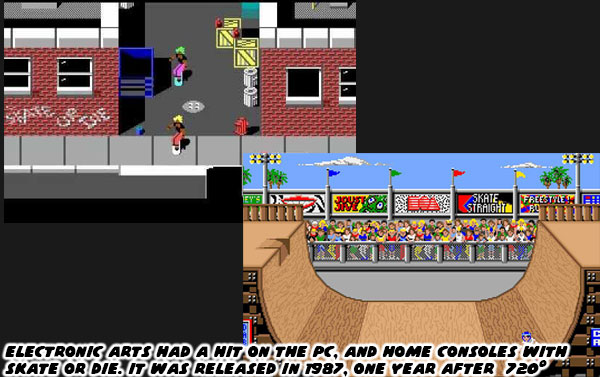
The team behind Skate or Die wasn’t as big as Atari’s, but they nonetheless hit the experience out of the park. Producer Don Traeger, Designers Michael Kosaka, Stephen Landrum, and David Bunch worked with programmer Stephen Landrum, artists Michael Kosaka, and Nancy Fong, as well as composer Rob Hubbard. They allowed players to explore different events, similar to 720°, but without a timer, or angry bees forcing the player to go from place to place. There was a ramp, race, and pool contest. They didn’t have as much realism in the graphics, and animation department as Atari’s hit, but they made up for it by providing completely different game play. For example the game created virtual rivals to challenge the player. Starting with Poseur Pete, and becoming harder through Aggro Eddie, and the ultimate rival Bionic Lester. These skaters would race you down alleys, and beat you senseless in a game of pool joust. The addition of events, names, and faces, especially the uncredited visage of Rodney Dangerfield helped add dimension to the game.
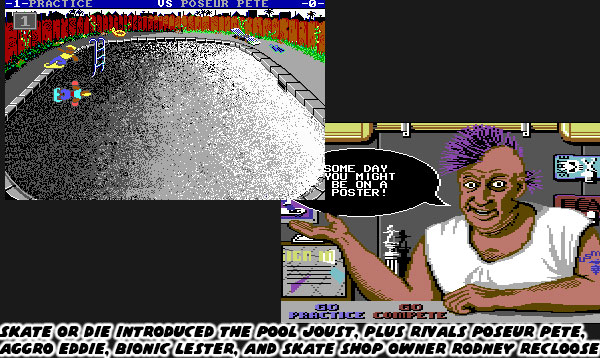
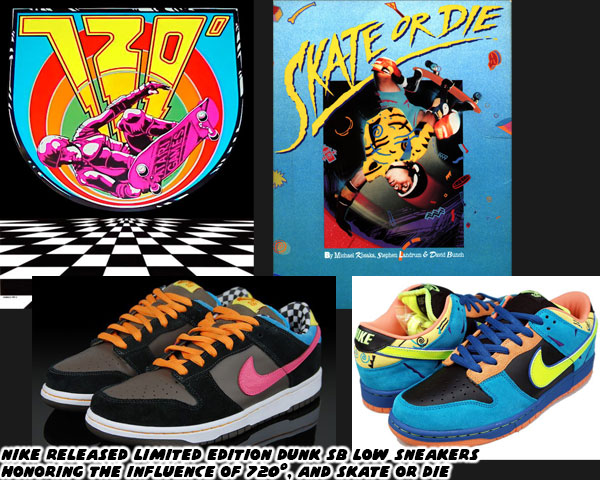
720° never received a sequel, but Skate or Die did. The sequel played like a typical NES adventure game, with the character skating instead of walking everywhere. The ramp portion was well done, but that was about the highlight of the title. Most people still hold the original Skate or Die in high regards. Its influence could be felt on a generation of game players. I know more than a few people that mistakenly thought 720° was called Skate or Die. Or that somehow Skate or Die was the sequel to 720°. The games had no relation, with the exception that the words “Skate or Die” are featured as a sound bite in 720°. Both games acted as cultural touchstones for the skate community. Some 30 years later as Nike was trying to establish themselves as players in the skate shoe market they released limited edition Nike DB Dunk Low’s in the colors featured in the game logos.
Skateboarding games would evolve greatly from the late ‘80s, but only a handful of them could be considered great. In the next blog I’m going to look at trilogy of arcade games that forever changed the landscape of action sport games. I hope to see you back for that. If you would like to sponsor me please visit my Patreon page and consider donating each month, even as little as $1 would help make better blogs and even podcasts!