Showing posts with label nes. Show all posts

Wednesday, June 28, 2023

The little big world of RC Pro AM - Originally published on 1UP - March 24, 2009

RC Pro Am is the definitive combat racing game for those that grew up with the NES as their first console. Just ask my friend Jai about his experiences and memories of the game. For those that are unfamiliar with the Rare gem from 1988, it was an isometric racing game with weapons thrown into the mix. Unlike the Sprint series where players could see the entire track RC Pro Am would scroll across the track depending on the players position. This made guessing twists, turns and obstacles very hard. It was crucial for players to learn the course or at the very least keep an eye on the map to find their position. Of course while trying to race players also had to keep an eye on opponents and fight them off with an assortment of missiles.

The game was frenetic. The racing element was hard by itself, when combined with weapons then it became insane. Like many of the classic games it was the challenge that also made it memorable. If it were difficult because of the controls then it would have been forgotten. But the control was dialed in, the graphics were as good as any other NES racer if not better and the balance amazing. Rare had truly crafted a title that was head and shoulders above many combat racers of the day. RC Pro Am predated Atari's Badlands by two years and to many, if not all, it was a superior experience. I know my friends on 1UP have much love for this game. The isometric racer has rarely been done better since. Although the racing and combat genres have all gone 3D since every now and then we see some really fun isometric racers.

The spiritual successor to RC Pro Am was created by David Jaffe and the good folks at Eat Sleep Play (former Incog Inc. and SingleTrac employees). Calling All Cars was an isometric car combat game that owed a lot to Rare's influence. They ditched the track in favor of an open world environment where players tried to return escaped prisoners back to jail. Players could use weapons on each other in an attempt to steal the ragdoll-like prisoners. It was very fast-paced with point leaders changing pace from moment to moment. The cel-shaded graphics were a nice touch, helping keep the theme light and arcade-like. If you're on PSN then you owe it to yourself to check this game out. Just talking about it makes me want to go over the cousin's house for some more matches.

The spirit of RC Pro Am continues even in the Flash game market. RC Rally is a simple racing game, no weapons in the title, but the look of this isometric racer owes a lot to Pro Am. I tool around with the game from time to time at work and wish that perhaps some day Rare might think about resurrecting the game. Of course once weapons were added to cars things would never be the same. The light hearted feel of Pro Am would give way through the grim 90's. David Jaffe and his crew defined the genre years before Calling All Cars with a dark series that was a macabre comedy. You might have heard of it, it was called Twisted Metal.

Did you ever play a classic NES, PC, or arcade car combat game? I'd like to hear about it. Let me know in the comments section please. As always if you would like to sponsor me please visit my Patreon page and consider donating each month, even as little as $1 would help make better blogs and even podcasts!
follow the Street Writer on Patreon!

Wednesday, June 7, 2023

Power Drive & Bigfoot, the almost great monster truck games - Originally published on 1UP - March 15, 2009

NOTE: I have the original images for this blog, but I could not find the HTML files. So I'm rewriting it from memory. I hope you understand.

I am and have always been a HUGE fan of monster trucks. On this blog I've written extensively about my obsession with them, as well as a general history of the culture. You can read the posts below:  


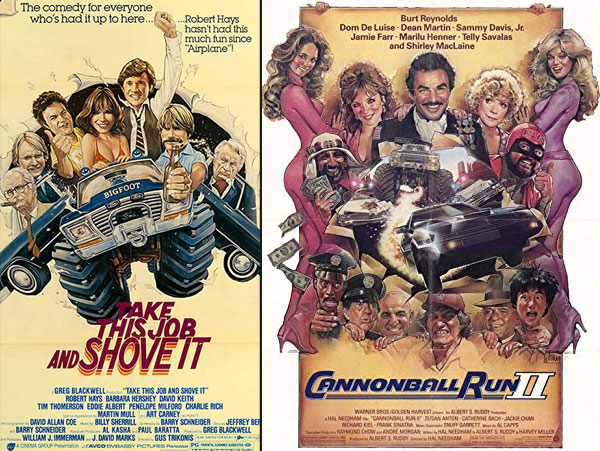
Naturally as a little kid I was drawn to every video game featuring those gigantic trucks, which back in the day were few and far between. To give you a sense as to how little there was for me to enjoy think of it this way. The very first monster truck I ever saw was Bigfoot the King of the Monster Trucks. It was featured in the 1981 film Take this Job, and Shove it. As many young boys could tell you the love was instant. I had never seen a truck as big, and as bad. Unless you were like me, and scouring the 4x4 magazines every month then you wouldn't see it in action again until the television show That's Incredible in 1983, and the movie Cannonball Run II in 1984. 

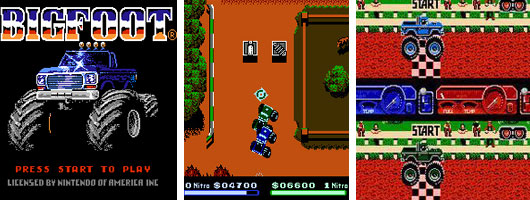
Bigfoot created a new type of off road culture, and when racing against contemporaries like King Kong, and USA-1 had also created an entirely new form of motorsports. It started in the midwest in the late '70s, but would reach global popularity in less than a decade. Yet despite all this Bigfoot wouldn't appear in a video game until much later. I don't think you grasp how painful the wait was for me. I was in elementary school when I first saw Bigfoot, but wouldn't get to play a game featuring the truck until I started high school. When you are young this literally feels like a lifetime has passed. The Bigfoot game was developed by Acclaim Entertainment, and released on the Nintendo Entertainment System in July 1990. By then it seemed to be too little too late. Worse yet it was built on outdated technology. To put it in perspective the Sega Genesis 16-bit console came out in 1988, and the Super Nintendo would debut in November 1990. Games that were coming out for the 8-bit NES were less, and less notable. 

Bigfoot on the NES turned out to be a popular, but ultimately a crappy game. I'm sure if it had come out four years sooner my opinion on it would have been different. The game was split between overhead, and side-scrolling racing. Careful timing of using boosts and weapons helped ensure a victory. I couldn't afford a copy as a kid. Thankfully I could rent it for a buck from the local video store. I got a chance to play it during a sleepover at my friend's house. He knew I was a huge fan of the truck, and made sure that it was one of the games we had rented for the weekend. I managed to destroy all of the levels with a little practice. Visually the game was nice, but limited. After playing for most of the evening I quickly grew bored of it, and looked for other challenges. I was glad I didn't buy it on day one. I might pick it up for much less today just to have it in my collection. 

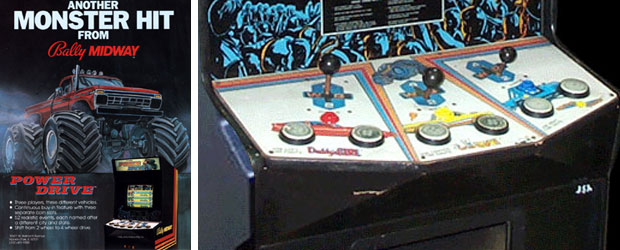
It would take a long time for a decent monster truck game to appear. The first one of any merit was Power Drive by Bally Midway. It was a mildly successful arcade game from 1987. There was actually one at my local bowling alley arcade. After playing it a few times I was disappointed in the execution of it. It showed how little developers knew about monster trucks, or how they could work in video game form. You could tell something was wrong with it by just looking at the cabinet. There was a gear shifter, and two buttons, but no steering wheel, or gas pedal to control the action. It wasn't like the technology to steer video game cars didn't exist. Atari had introduced that into arcades in 1974 with the game Gran Trak 10. 

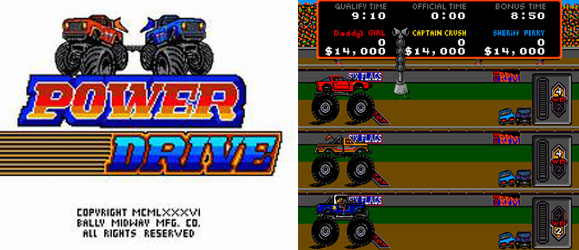
As with other Bally-Midway 84-86 arcade titles, Power Drive was designed to separate you from your quarters as fast as possible. You earned credits by winning competitions, but also had to spend credits paying entry fees, and fixing up your truck. So no matter how good you were you would eventually run out of money, and had to put in another quarter to continue. This game was just about pushing the buttons as fast as you could, and executing timed boosts. Sort of like Konami's classic Track and Field. Only this time you were crushing cars, instead of jumping over hurdles. Power Drive featured the staples of early monster truck competitions, these included car crushing, sled pulling, wheelies, and long-distance jumps. It was fun but you would wear out against the ruthless computer within a couple of rounds. 

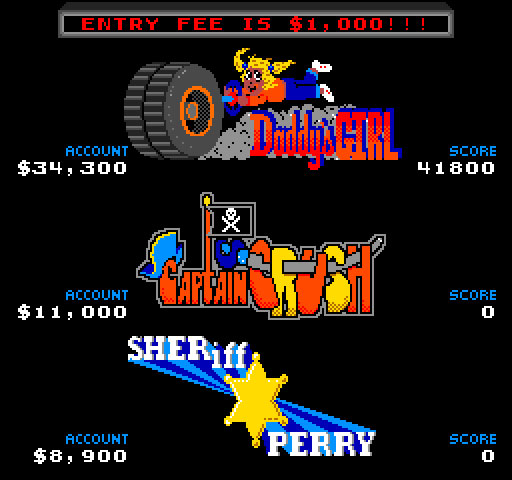
The thing I enjoyed the best were the graphics, and three playable monsters. There was a red corvette nicknamed Daddy's Girl, a yellow truck named Captain Crush, and a blue Jeep named Sheriff Perry. The computer controlled truck was called Black Lightning. They reflected the imagination that went into early monster trucks. They were all unique. In the early days there was no template to work from. The builders of the first generation of monster trucks were experimenting with different frames, engines, tires, and building techniques. No two looked alike, and I was grateful for their creativity. After the disappointment of Bigfoot I had just about given up hope that there would ever be a good monster truck video game. That literally changed one year later when an amazing game appeared out of nowhere. I'm going to talk about it in the next blog.

Were you ever let down by a video game you were waiting on? Let me know in the comments section please. As always if you would like to sponsor me please visit my Patreon page and consider donating each month, even as little as $1 would help make better blogs and even podcasts!
follow the Street Writer on Patreon!

Wednesday, March 29, 2023

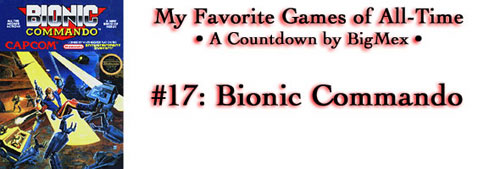
My favorite Games of All-Time #17: Bionic Commando - Originally published on 1UP - April 21, 2006

Bionic Commando should need no introduction. 1UP's Crucial Classics rank Bionic Commando in the #20 spot. If you are a fan of the action platformer then Bionic Commando should be a game that you not only play but have to beat. The version that makes my #17 spot is the Nintendo one, not the arcade and not the Gameboy versions.

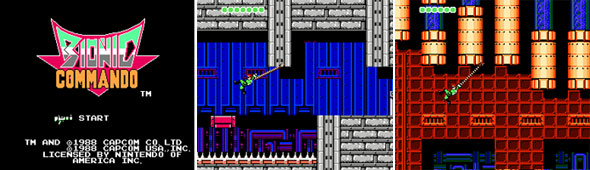
Bionic Commando came out during the 8-bit golden era, when arcade classics were being turned into console titles by the boatload. Capcom had mastered a gameplay technique rarely used in a platformer or in the arcade. Pitfall was the first game that allowed players to swing from vines, Jungle King/Jungle Hunt soon followed. The game mechanic in Bionic Commando blew these games out of the water. The main character, Captain Rad Spencer, ran and used a gun, not unlike his Contra contemporaries. What made him special was that he could also attack enemies and swing through a level via a mechanical claw.

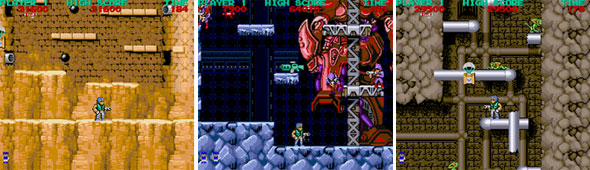
The arcade version did look better than the NES one. However the NES version had changes to the story, tighter control, hidden features and more polish with the ending. Just like the other Capcom arcade to home games (Trojan, Gunsmoke) these details helped make the NES version better than the arcade game.

Bionic Commando will be most remembered for the swinging element. Players could perform, and often times had to, death defying movements through enemy compounds. All the while avoiding spike pits and soldiers. The high ratio of near misses and miracle claw grabs helped keep gamers on their toes. Those that bothered to snoop around levels were rewarded with not only weapon upgrades but plot advancements as well.

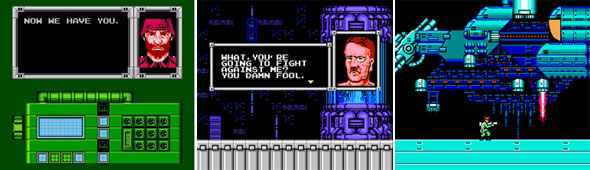
The story in the game was one for the ages. It still ranks as one of the favorite game plots for my brothers and I. Despite censorship and translation issues we could tell right away that the opponents were Neo-Nazis trying to bring Hitler back from the dead. To make things worse they also planned on taking over the world with a giant airship called the Albatross. Solid Snake and Metal Gear eat your heart out!

As Rad Spencer you not only did you have to defeat the Nazi menace and their diabolical machine but you also had to rescue "Super Joe" the previous super soldier sent to stop the Albatross. If you want to read all about the plot and characters just visit these two sites. They have all the particular details that I'm leaving out.

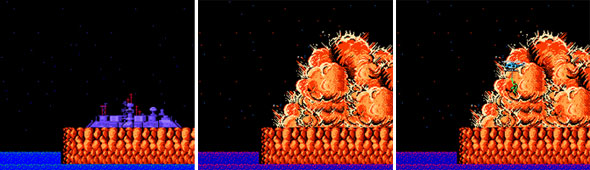
There are very few games that capture the sense of high adventure in the way that Bionic Commando does. The final level was one of the most memorable levels of all time. After defeating Albatross you must swing up to reach a hangar, then in one fluid motion swing out and drop down and fire a missile into the cockpit on Hitler's escape helicopter.

As if that wasn't difficult enough you have to locate Super Joe and get out of the military base before it explodes. And you thought the end of Metroid was a nail-biter! The ending to Bionic Commando was one of the best, if not the best videogame endings ever.

After defeating the Nazi menace and saving Super Joe you are caught in the middle of an explosion. Cut scenes tell us that your rescue helicopter can't stick around because the base is about to explode. When it does you are left wondering what happened to our hero.

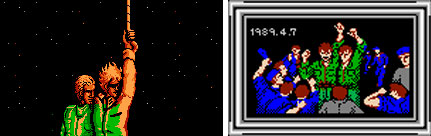
Suddenly out of the fire a helicopter emerges. The bionic claw attached to the landing gear. We pan back and see our hero holding onto the other end of the claw. Rad Spencer and Super Joe are alive!!!

That was one of the first videogame endings that my brothers and I remember cheering for. The adventure was worth the payoff. The game delivered the complete package. It controlled great, had a fantastic story and delivered an ending better than Hollywood could ever do.


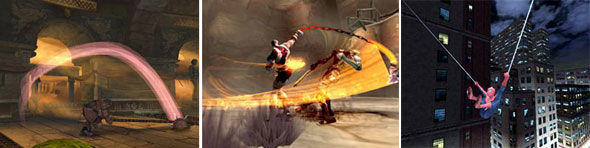
Since that time the mechanic of a ranged weapon and a way of locomotion that worked for Bionic Commando has come up in games. Most recently with Rygar, God of War and of course Spider-Man.


It looks like Kratos will even get to use his Blades of Chaos to do some swinging in the next God of War. See, even David Jaffe knows that the Bionic Commando had something special. To see a speed run of the game just check this link. Until next time, have a great weekend!

I’d like to hear your personal top-10, top-20, top fighting games, top sports games, or top games in any genre. Let me know in the comments section please. As always if you would like to sponsor me please visit my Patreon page and consider donating each month, even as little as $1 would help make better blogs and even podcasts!
follow the Street Writer on Patreon!

Monday, April 11, 2022

720° - the Ultimate Aerial Experience, a look at the original skateboard hit, part 2...

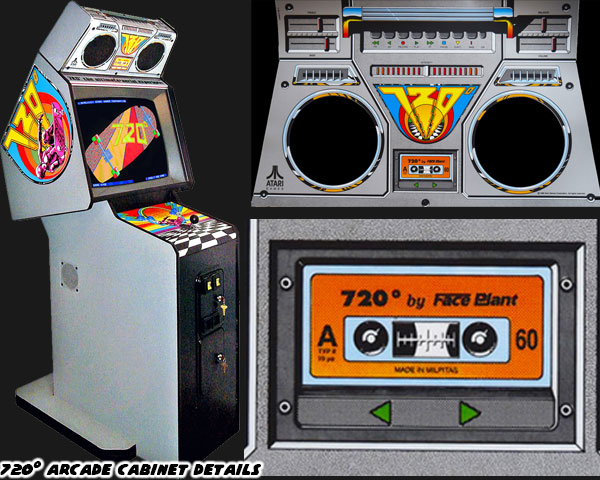
The thing that initially caught my eye with 720° was the arcade cabinet. It looked unlike any other cabinet of that time. With it’s oversized monitor, speakers hidden inside a “boombox” attached to the top, enormous multicolored skateboard stickers, and checkerboard pattern. I always enjoyed the fictional band name “Face Plant” listed on the cassette tape graphic. The whole package made it look like a Vision-meets-Vans skate ad come to life. Studios tried to create cabinet art, and marquees that stood out. There was only so much they could do as just about every cabinet was the same size. 720° broke the mold, no game looked even remotely close to Atari’s best. It was impossible to pass up the title in any lineup.

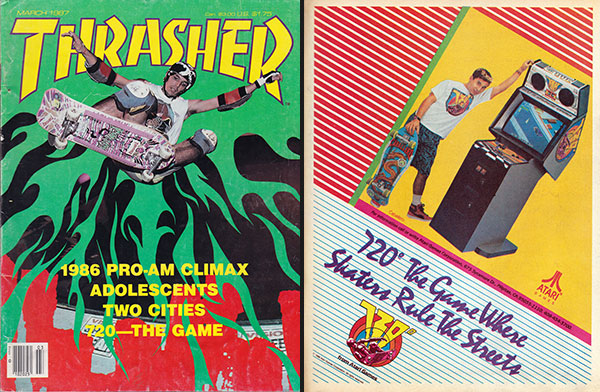
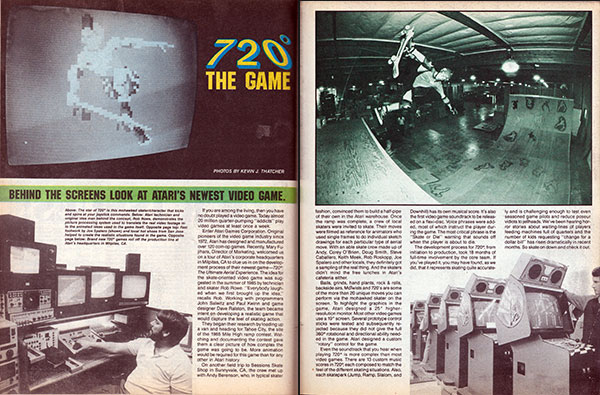
It turned out that the studio had put much more time into the game than just about any other title. I wasn’t aware of that until I started digging through its history. I found that there was an interview with the team in the March 1987 issue of Thrasher magazine. That issue also featured a full-color ad featuring pro skater Steve Caballero. Thrasher back then ran mostly black and white, with spot color in certain pages. It wasn’t as polished, or professional as Transworld Skateboarding magazine, but it was certainly respected by the most hardcore of skaters. It surprised me that they would be the people that published the story. Arcades were fairly mainstream at that point, and Thrasher was seen as more core or underground, but the game was loved by skaters, and non-skaters alike.

Just for perspective Atari was a California Bay Area company based in Milpitas. They were founded by Nolan Bushnell in 1972. This was the era when Silicon Valley was being paved. Steve Jobs, and Steve Wozniak worked at Atari for a short spell before founding Apple Computers in 1976. In the Thrasher article Rob Rowe was credited as an Atari Technician, and the man who came up with the idea for 720°. Rowe said he worked with Programmers John Salwitz, and Paul Kwinn, plus game designer Dave Ralston. The development of the game took 18 months of full-time involvement from the core team, according to Thrasher. It was released in December 1986.

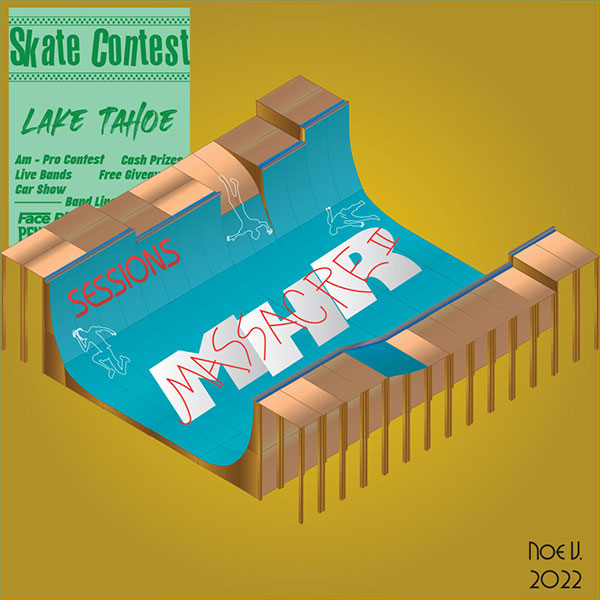
As any skater could tell you the animation was very spot on to actual skateboarding, and skate tricks from the mid-‘80s. It turned out the company had done a tremendous amount of research. The studio first recorded a Mile High halfpipe contest in Tahoe City, possibly the “Terror in Tahoe” contest from 1985 which resulted in the county tearing down the ramp afterward. Rowe, and his teammates learned they needed to do more research. While visiting the Sessions Skate Shop in Sunnyvale CA pro skater Andy Berenson convinced them to build a ramp in the Atari warehouse. He skated with other pros including Corey O’Brien, Doug Smith, Steve Caballero, Keith Meek, Rob Roskopp, Joe Spalero and others from the San Jose area. The list of credits includes animators Sam Comstock, Mark West, and Will Noble. Music by Hal Cannon, and Earl Vickers. Audio by Brad Fuller. General thanks to Dave Cook, Dennis Harper, Russell B. Dawe, and Jess Melchior. A number of these people had their initials appear as graffiti within the streets of Skate City.

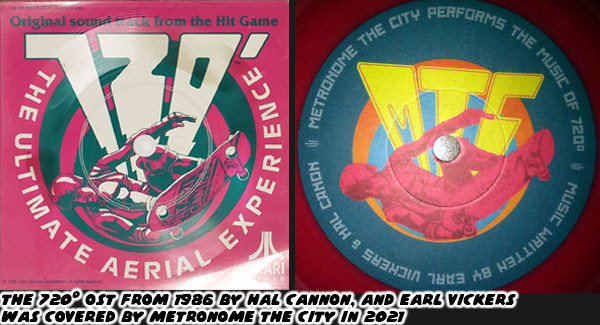
The team working on the game had to be massive (for the time) because of how ambitious the project was. In addition to the skaters being used for early rotoscoping efforts, the studio had to put together entirely new hardware. Atari designed a higher resolution 25"monitor for the game, most cabinets used 19" displays at that time. The hardware the game was programmed on was known as the Atari System 2. It was also used on Paperboy, Super Sprint, Championship Sprint, and A.P.B. The soundtrack was the biggest highlight in my opinion. With 13 custom tracks it was the first video game soundtrack released on flexi-disk. Years ago I managed to find an actual disk to add to my collection of gaming artifacts. Earl Vickers, and Hal Cannon composed many of the great tunes featured in the golden era of Atari. If you look at the initials that pop up on Atari arcade leaderboards they were listed as HAL, and EAR.

The music they laid out in 720° was arguably their best work. It was influenced by punk rock, which along with New Wave, was the default soundtrack of many skaters of the time. Atari let players know their efforts wouldn’t get lost in the mix. The company built that faux boombox with huge speakers atop the arcade cabinet, blasting players in the face with the high energy music. This helped pull you into the world they created. I can only imagine that this detail was taken from real life. The crew that skated the Atari ramp undoubtedly put a boombox up there during their sessions.

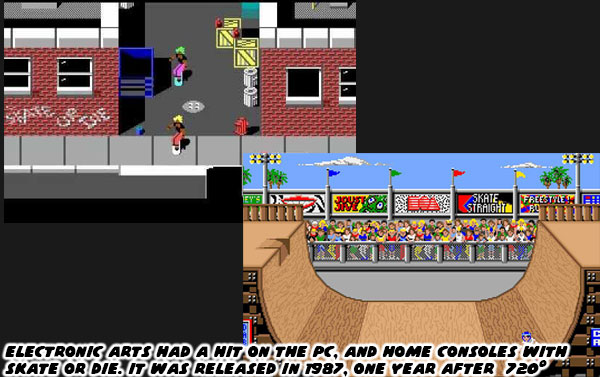
The game was a revelation. It was one of the hottest games in the arcade the holiday of 1986, going through the rest of ’87, and ’88. It was hitting at the peak of skate mania. With the Bones Brigade, and other skate teams were becoming household names. People like Tony Hawk, Steve Caballero, Neil Blender, Christian Hosoi, and Lance Mountain were becoming influential in the art, and mainstream communities as well. Audiences were dying for great skate video games. There was nothing that could touch 720° in the arcade for more than a decade. The home market was different. The NES version of was horrible, there was thankfully another game that was just as influential. Skate or Die by Electronic Arts was a certifiable hit on the PC, and later on the home consoles.

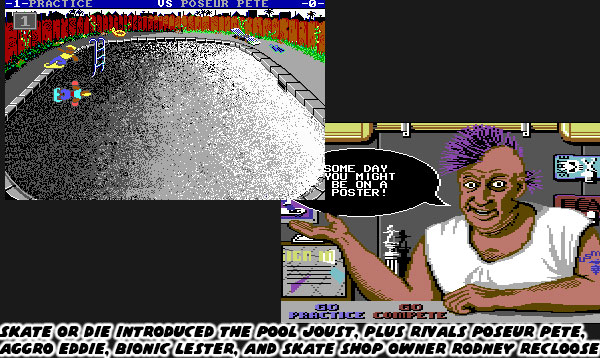
The team behind Skate or Die wasn’t as big as Atari’s, but they nonetheless hit the experience out of the park. Producer Don Traeger, Designers Michael Kosaka, Stephen Landrum, and David Bunch worked with programmer Stephen Landrum, artists Michael Kosaka, and Nancy Fong, as well as composer Rob Hubbard. They allowed players to explore different events, similar to 720°, but without a timer, or angry bees forcing the player to go from place to place. There was a ramp, race, and pool contest. They didn’t have as much realism in the graphics, and animation department as Atari’s hit, but they made up for it by providing completely different game play. For example the game created virtual rivals to challenge the player. Starting with Poseur Pete, and becoming harder through Aggro Eddie, and the ultimate rival Bionic Lester. These skaters would race you down alleys, and beat you senseless in a game of pool joust. The addition of events, names, and faces, especially the uncredited visage of Rodney Dangerfield helped add dimension to the game.

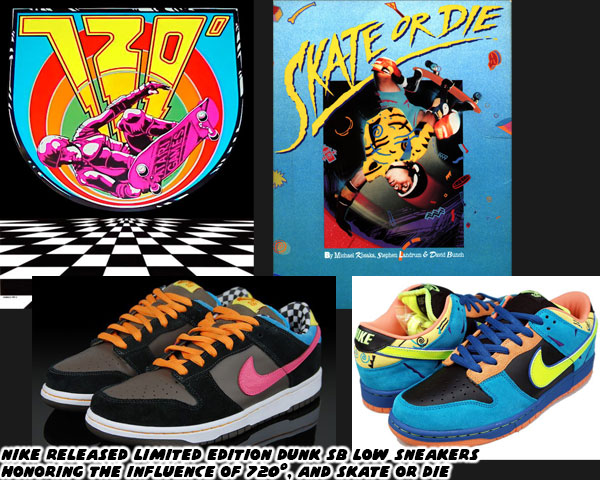
720° never received a sequel, but Skate or Die did. The sequel played like a typical NES adventure game, with the character skating instead of walking everywhere. The ramp portion was well done, but that was about the highlight of the title. Most people still hold the original Skate or Die in high regards. Its influence could be felt on a generation of game players. I know more than a few people that mistakenly thought 720° was called Skate or Die. Or that somehow Skate or Die was the sequel to 720°. The games had no relation, with the exception that the words “Skate or Die” are featured as a sound bite in 720°. Both games acted as cultural touchstones for the skate community. Some 30 years later as Nike was trying to establish themselves as players in the skate shoe market they released limited edition Nike DB Dunk Low’s in the colors featured in the game logos.

Skateboarding games would evolve greatly from the late ‘80s, but only a handful of them could be considered great. In the next blog I’m going to look at trilogy of arcade games that forever changed the landscape of action sport games. I hope to see you back for that. If you would like to sponsor me please visit my Patreon page and consider donating each month, even as little as $1 would help make better blogs and even podcasts!

follow the Street Writer on Patreon!

Monday, October 19, 2020

Rad surf designs, or trying to emulate my cartoon heroes...

Earlier this year I talked about emulating my artistic heroes when I draw certain subjects. For example I said when I draw skateboarders I try and capture the skeleton imagery of Vernon Courtlandt Johnson (VCJ), the illustrator behind the Powell Peralta “Bones Brigade” art. When I draw basketball players I try and capture the energy and lanky proportions of the painter Kadir Nelson. Like many artists out there I have a ton of influences, and that is just the tip of the iceberg. When I draw cars I have many influences from the pages of CARtoons magazine. Steve Austin (not the wrestler) is an amazing cartoonist. It’s one thing to render a realistic car, but to make a caricature of it takes much more work. You have to capture the lines, and stance of each car. You have to make them easy to identify to the audience. 


Mr. Austin can do this with any vehicle, make, and model. His lines are clean, and the ability to draw each car from every angle is astounding. Steve, is an artist that follows closely in the steps of Ed “Big Daddy” Roth (RIP), Ed “Newt” Newton, and Dave “Big” Deal (RIP). These were artists who were able to create a career turning cars into works of art. In my honest opinion there are very few people that can create art at this level. Joe Borer is another such person. What separates his work from the previously aforementioned legends is that his cars are always in the middle of the action. They have weight, they have movement. The tires are glued to the road, at the same time the rubber is separating from the wheels. Even when his cars are standing still they look like they’re ready to peel off the page. 
 

Mr. Borer approaches his vehicle art in the same way an animator does characters. They have to be fluid, dynamic, and filled with personality. Joe is able to “stretch and squash” his cars with the ease of the best Disney cartoonists. For anyone not used to cartooning trying to make a car look flexible is very difficult. After a lifetime of drawing it’s something that I cannot do easily. That was the thing about the artists that I grew up studying. They made everything look so amazing. One of the most underrated artists in my book was Shawn Kerri. She was an impeccable cartoonist, but also an accomplished painter. She could render realistic scenes, as easily as she could caricature people. Sadly she died young, but not before producing some of the best CARtoons issues ever. 
 

In the action sports world there was only one other artist that I could compare to Ms. Kerri. His name is Damien Fulton. He is the artist behind the comic strip Radical Rick, as it appeared in the pages of BMX Plus magazine. Damien had very expressive cartoons, but whose BMX bikes, and races were rendered with a bit of realism. When he painted his characters, sometimes for the cover of the magazine, they were beautiful works of art. I would try my best to emulate Damien’s attention to detail when drawing BMX bikes. His poses, his understanding of the culture was super deep. Studying his panels made me a better artist. It helped me understand the history, and movements behind BMX. The same lessons went for every cartoonist I followed. 


Not all of the artists I enjoyed studying were as prolific as those in the pages of CARtoons magazine, or BMX Plus. Some of the art was seen sparingly, like VCJ’s designs for Powelll Peralta. Only when a new skateboard was released, perhaps a few a year, would I see a new rendering by VCJ. I poured over the designs in the skateboard magazines, as I couldn’t afford to actually buy the decks. Other art that inspired me was seen on soft goods, like tee shirts, hats, and the occasional sticker. Pop fashion for the early, and mid ‘80s was a mix of action sports culture. Surf, skate, and BMX all had a hand in influencing the look, and feel of the generation. Colors were bright, and some of the hottest labels had created their own mascots. Surf line Maui and Sons had a shark man mascot. Other brands like Airwalk, Rip Curl, Billabong, and Gotcha worked hard to create their own branding as well. 


Mascots on ‘80s clothing became very en vogue. It turned out that Disney, and Warner Bros. did not have a monopoly on the market. Arguably the king of the era was an artist named Steve Nazar. A company called Town & Country Surf Designs, out of Pearl City Hawaii was looking for an artist. In the early ’80s Steve showed them his original cartoon characters, many with a heavy surf vibe, and the rest as they say was history. Steve’s original characters, including Joe Cool, Thrilla Gorilla, the Kool Kats, and the tiki-headed Wave Warriors were instant hits. 
 

Nazar’s designs, went on the brightest shirts imaginable. These mascots were often seen in many humorous situations. Their shirts, stickers, and other goods were sold, and seen, seemingly everywhere in the decade. I don’t remember a time when I didn’t see the art in magazines, at school, the playground, or even at church through the ‘80s. This repetition of imagery in multiple shops made sure that the brand was becoming recognizable in every market. It was a win-win for the small company out of Hawaii, and the artist just trying to pay some bills. The characters were not only popular with the surf crowd, but with just about every demographic. Anybody could wear the shirts, and everybody knew who Thrilla Gorilla was. 


The mascots were so well known that LJN created a game for the Nintendo Entertainment System (NES). Think about that for a moment. The majority of early console games were either ports of an existing arcade game, or they were based on a sport. Licensed games came from comic book, or movie franchises. This title was based on the art from tee shirts. The game was well received by most audiences. It let players compete in both skateboard and surf competitions. The control took a little used to, but before long most were able to breeze through the courses, and perform some radical tricks. The game demonstrated that a solid idea, with great visual storytelling, could be enough to get a video game made. Although Steve Nazar didn’t program, or animate the game, his characters were as well received as the biggest mascots of the era, including the Mario Bros. and Mickey Mouse. T&C would end up getting a sequel, called Thrilla’s Surfari. This game was more of a platform adventure, where Thrilla had to fight angry natives, and giant weird monsters in order to save his girlfriend Barbi Bikini. He still surfed, and skated, just not in competition. 
 

Just as the characters had hit the big time the partnership between Mr. Nazar, and T&C would end less than amicably. The parent company in Hawaii decided to take their art in a different direction. Since they did not own the rights to the characters they went with other, more generic, surf looks. The characters were sadly without a home for 30 years. Many would ask T&C why they didn’t have a line of retro shirts, but they never wanted to revisit the era that really helped put them on the map. A few years ago Nazar decided to bring back all of his designs, and launch a small company called Thrilla Krew. He reprinted just about all of the classic characters on soft goods, and stickers. He was very careful to remove the trademark T&C yin-yang symbol from his new products. 
 

Which actually takes me to some designs that I have been working on over the end of the summer. Since the pandemic started I have been very busy, at work, and at home. My job has me working out of the house, and at the same time I have been taking care of a few family issues. I have had zero time, to write, record, or post any new blogs. As you can tell. I’d hit a creative road block, as the pandemic, and political climate were draining. I looked back at the artists, and movements that inspired me. I remembered Steve Austin, Joe Borer, and Shawn Kerri. I longed to see new art from Damien. But more than that I was missing the mascot characters from T&C Surf Designs. I was wondering what would it be like if they had a new video game. How would their levels work out? What new challenges could I come up with. 
 

As I was planning out a sequel to the game I began sketching out ideas for monsters attacking the characters out of the surf. That in turn inspired me to create tee shirt designs that were in the style of Mr. Nazar, and those early designs that I fell in love with. After several weeks of illustrating little bits at a time I finally completed these drawings. I may still do more in his style, featuring his characters, but for now I’m happy to bring you these cartoons. 
 

I want budding game designers, artists, and creatives to remember the power of storytelling. When people can see great art, including cartoon characters, and imagine a narrative then you're doing something right. If you're struggling with a piece, or are having some writers block just look at what your influences did. See how they made things work. Take it apart, and try to emulate it. You'll then have a better insight on how visual storytelling works.


Whether you’ve never heard of these characters, or whether they are like old friends I’d like to get your feedback. Is there an old video game that you wish had a remake? Would would you like to see if you were the producer. Or how about this if I were to design tees like these would you be interested in buying them? Would you like to see me take another crack at cartoon art? Are there long lost characters that you’d like to see get a come back? I’m interested in hearing from you! 


I do plan on recording more episodes, as the holiday season rolls up. I may have some time open up, which will allow me more creative breathing room. It would be much welcome, as this summer has been a pressure cooker. For now please enjoy these illustrations, and let me know what you think. 


If you would like to sponsor me please visit my Patreon page and consider donating each month, even as little as $1 would help make better blogs and even podcasts!
follow the Street Writer on Patreon!

Friday, June 28, 2019

American Daredevil, the monster trucks that changed the world, part 2...


The USA has always had a fascination with cars. That deep interest is a reflection of our pop culture. It is constantly changing and evolving. Trends flow from state to state, cross pollinating with local car scenes. Southern California for example gave rise to hot rod's Kustom Kulture. Enthusiasts could express themselves through their cars. The freshly paved freeways of post-WWII America were ripe for cruising and racing. People began modifying old cars and turning them into sporty coupes, race cars, or dragsters. All over the country similar opportunities were happening for DIY mechanics, engine builders and fabricators. Trucks were included in the changing landscape.


In the American Southwest trucks and buggies were modified to cross the desert, quickly and easily. Suspensions evolved to clear brush and rocks. Four-wheel drive technology was essential in taming the Rockies in the mountain states. Jeeps, and trucks were outfitted with aftermarket parts, winches, roll bars, and lights to safely get out of the worst situations. In the South trucks had to power through swamps and mud. In the Midwest trucks had to be workhorses on the farm, capable of handling any terrain, and strong enough to double as a tractor. Four wheel drive culture evolved from every corner of the USA. It influenced the evolution of both sport, and work trucks. Monster trucks were almost a mash up of all of these influences.


In St. Louis Missouri a guy named Bob Chandler would take his 1974 blue Ford F-250 truck out on weekends and show it off with friends. He would often drive it too hard and break something. He’d manage to get his truck back to work, the Midwest 4 Wheel Drive Center. His general manager Ron Magruder would ask “what did you and your big foot break this time?” Chandler would rebuild the truck, trying to make it bigger and badder than the rest. He made the engine more powerful, changed out stock parts for military components that could take much more abuse. Every time it went out it turned heads. It was fun and free advertising for his shop. The truck was quickly gaining a reputation. He thought that the oversized tires he and his friends used made the trucks look silly. He called them “silly trucks.” His wife Marylin said no, they looked more like monsters. He recorded himself driving over some old junk cars and would play the video in his shop. One day a promoter named Bob George saw this, and asked if he could recreate the stunt in front of a live audience. He would be paid handsomely of course.


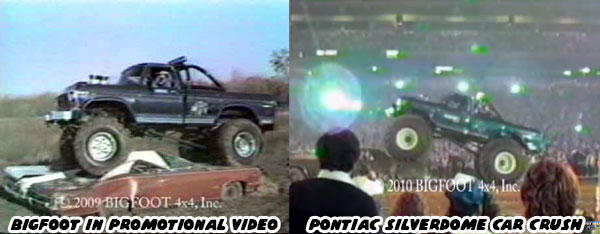
Chandler pulled off many crushing exhibitions in small venues, but one night opportunity struck. In 1983 the Pontiac Silverdome was filled to capacity, some 70,000+ people were watching a tractor pull motorsports spectacular. The big blue Ford was a sideshow. It was bigger and more powerful than any other truck they had ever seen. Chandler had introduced 4-wheel steering, which he said made his truck a 4x4x4. It allowed him to “crab walk” the truck almost sideways. He quickly became the main attraction. The stunt that he pulled off was the most insane thing anybody had ever seen. The reaction would tear the roof off of the building, and thankfully video proof exists. The audience couldn’t believe that Bigfoot, now equipped with 66 inch terra tires, drove right over some cars. It was like the moon landing for the four wheel drive community. In fact the audience at the Silverdome went so wild that they surrounded the truck, and Chandler couldn't move it for 30 minutes. Monster trucks were about to take over our collective consciousness.


Bigfoot had been featured in off road magazines years before the Silverdome. Four wheel drive enthusiasts and manufactures were always looking for the next big thing. Magazines would send out reporters to look for the hottest reader builds. Few trucks were as big as Bigfoot. It was much more than a show truck, whose polished chrome engine and accents could have collected ribbons at car shows. It was a fully functional four wheel drive truck. It proved its worth at every possible challenge. It performed exhibition hill climbs, mud bog runs, drag races, and tractor pulls. These were things that sometimes required a dedicated vehicle. A tractor for example wouldn’t run a mud bog, a hill climber wouldn’t be much use in a pulling competition. The Ford seemed unstoppable, crushing any obstacle in its path. It was a true star and it wouldn’t be long before Hollywood came calling.


Its breakout role was in the 1981 film Take this Job and Shove it. Sadly getting wrecked by stuntmen in the middle of filming, it forced a sloppy rebuild. It appeared on screen many more times. In Cannonball Run II in 1984, and in Police Academy 2: Their First Assignment in 1985. On and on through many features over the years. To say that Bigfoot absolutely owned the ‘80s would be an understatement. I was smitten by the big blue Ford. I had seen the aforementioned movies, and had started gathering tidbits of information in the various off road magazines with articles on Bigfoot and his contemporaries. I think the mainstream breakout for the truck wasn’t in the movies as much as it was in the television show That’s Incredible!


The show filmed people all over the country performing daredevil feats, crazy stunts, or showing off inventions. Sometimes they would invite guests to perform in front of the studio audience. A young Tiger Woods and Rodney Mullen appeared on the show, respectively they grew up to become the most influential pro golfer and skateboarder for a generation. Bigfoot was tasked with competing in the first televised monster truck race. Chandler was pitted against his friend Everett Jasmer and his truck USA-1. I couldn’t wait for the race, and counted down the days for the next episode. It was all my kid brain could think about morning, noon and night. Just like the Brodozer jump some 36 years later captured my imagination. My brothers were hopeful that the truck I idolized would come out victorious. I bugged all my friends at school to see if they would be watching the telecast. They didn’t believe me when I told them that two giant trucks would be racing each other on top of parked cars. They simply couldn’t wrap their heads around the idea. Secretly I was praying that my hero would win in the end. Thankfully I was not disappointed!


Most kids my age in So Cal were rooting for Kareem Abdul-Jabbar, and Magic Johnson. They were the star players with the Showtime-era Lakers. Others at school were all about the Dodgers, Angels, Rams or Raiders. I tended to gravitate more towards motor-sports, and drivers. I had a list of favorites, Richard Petty for NASCAR, Don “ Big Daddy” Garlits and Shirley “Cha Cha” Muldowney in top fuel dragster, Don “the Snake” Prudhomme in funny car, and Mario Andretti in Formula-1 and Indy Car. Of these Bigfoot and Bob Chandler were unique. They were the stars in an entirely new type of motorsport. A sport where ordinary people started with a stock truck and turned it into an absolute beast. It was something that anybody could do. It carried the same spirit that founded hot rod culture decades earlier.


The whole DIY mentality was the heart and soul of the four wheel drive community. It was the same thing that sparked hot rod culture for cars. As I learned from magazines no two trucks were alike. The way they looked, handled and performed spoke volumes about each builder. Some were mild, but several were outrageous, featuring engines pulled from jets, and helicopters! None of the trucks seemed to have the class or pedigree of Bigfoot and his growing family. Chandler went from rebuilding Bigfoot to starting from scratch and making better versions. Bigfoot II, III, IV... were seemingly coming out every year. Money for these new builds was not from winning races as much as from licensing deals. The Bigfoot brand grew to include toys, games, and even a cartoon show. Everyone wanted a piece of the truck, myself included.


The technology behind Bigfoot evolved along with the sport. Despite the hundreds of monster trucks that would appear over the next two decades, only a handful could compete at the same level as the big blue Ford. The best often had corporate sponsors helping pay for the builds. Veteran four wheeler enthusiasts teamed up with race car builders, and engine tuners to shape future trucks. Monsters began touring the country year-round. Appearing at state fairs, in organized competitions, and car shows. The biggest names commanded thousands just to show up. With multiple Bigfoots available, the team could appear every weekend at different venues. They did this over the next 40 years. With monster trucks going mainstream there were bound to be some accidents.


Chandler began pushing for increased safety for the trucks, drivers and spectators. His contemporaries were suffering severe neck and back injuries while driving the trucks. Worse yet runaway trucks had injured and killed spectators in small venues. The industry needed to learn how make things safer for everyone. Chandler and George Carpenter helped establish the nonprofit Monster Truck Racing Association (MTRA) in 1987. Almost 50 owner / drivers showed up for the first meeting. The MTRA drafted rules and regulations for operators and invited promoters to attend meetings. The US Hot Rod Association (USHRA) was recognized as the organizing body of the racing events. They helped standardize safety rules while brokering deals to get events on network and cable TV. Essentially helping expose monster trucks to the rest of the world.


The USHRA was acquired by Live Nation and Monster Jam was born in 1992. Feld Entertainment took over for Live Nation in 2008. Feld was a family-owned company that ran the Disney on Ice, and also the Ringling Bros. and Barnun & Bailey Circus. Feld went on to buy the rights to several classic monster trucks. This created the appearance that they founded the sport. Many owners thought that Feld would continue to push the circus-like atmosphere when Live Nation ran the organization. With colorful, over-the-top monster truck bodies, and camera-friendly personalities on television the veterans weren’t far off the mark. Monster Jam became a traveling show featuring racing and “freestyle” competitions with dozens of trucks jumping over giant piles of dirt. The DIY uniqueness of Chandler and his friend’s trucks gave way to corporate branded monsters, with licensed names, and homogenized construction. The “best” trucks were the ones that performed the most outrageous stunts. Often these were either wrecks or incredible saves.


While Monster Jam provided exposure, and paid drivers well, they controlled many of the names, and prohibited some trucks from appearing on other circuits. If you were familiar with the world of professional wrestling then I want you to think about the McMahon family, the WWE company which they own, and the wrestlers they hired. Yes the wrestlers were famous and got paid well, but they were all treated like independent contractors and not employees. They sometimes didn’t own their “gimmick” or stage name. They were prohibited from appearing at outside promotions, and did not have health or retirement benefits. Any appearances in games, or merchandising were shrewdly negotiated. The lion's share of the profit stayed with the WWE and the McMahons. The family didn’t create wrestling, they just cornered the market, and bought out the competition. Feld was essentially using the same business model since 1992.


Chandler refused to have Bigfoot appear under the Feld umbrella. He was one of the few owner / operators to go independent and survive. Others would join Monster Jam for a season or two and drop out. They’d either retire, sell their name, or join independent shows as well. Of course no other circuit had guaranteed television broadcasting rights, meaning that the competition would be small at best. It was the price to pay to control your own brand. Indy shows such as the Monster Truck Throwdown, Monster Truck Nationals, Monster X Tour, and Toughest Monster Truck Tour continued to build a following. They were organized by owner / operators, highlighted the veteran trucks, as well as the new blood keeping the sport fresh. Coincidentally the indy wrestling promotions seemed to do the same for the wrestling community.


Some of this might be common knowledge to you. Some of it may be completely new. I recalled a lot of this history while watching the Brodozer stunt on Memorial Day. It made me realize that it had been 36 years since Bigfoot raced USA-1. So much had happened in that time. The Brodozer was a star on the Monster Jam circuit. It joined legends like Max-D (Maximum Destruction) and the Grave Digger. Incidentally Dennis Anderson sold Feld the Grave Digger team in 1998. I wanted to make sure that people didn't forget the origins of the sport. We shall dig even deeper, and explore the pioneers that made the Brodozer possible in the next blog. If you would like to sponsor me please visit my Patreon page and consider donating each month, even as little as $1 would help make better blogs and even podcasts!
follow the Street Writer on Patreon!