Showing posts with label god of war. Show all posts

Friday, November 15, 2024

Freeze frame, my poster collection, part 8…

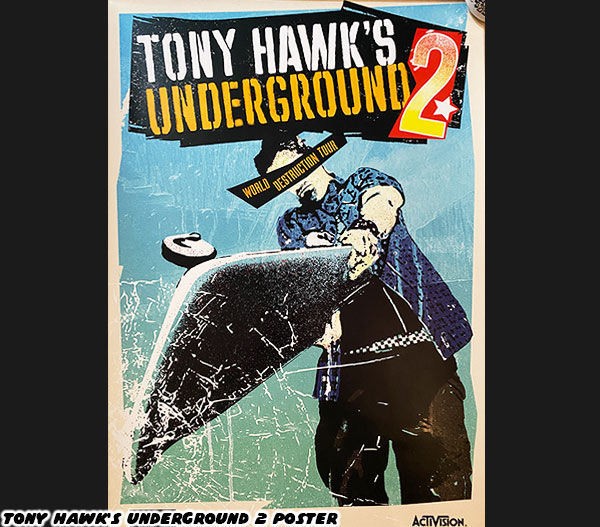
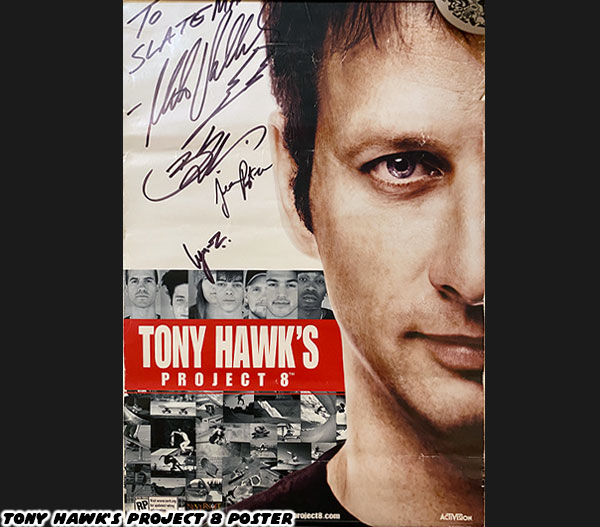
Today’s collection of posters is for mostly western games. Many of these I got from the E3. I’ve said it before but I really miss that expo. I was the west coast correspondent on Planet Tony Hawk.com and when I could I’d secure an autograph for the site founder Trevor “Slateman.” Here’s an autographed poster I sent to him. It had Mike Vallely's autograph, along with Bob Burnquist, Lyn-Z Adams Hawkins, and I'm not sure who the last one was.

I loved all the games in the series but do think the high point was Tony Hawk’s Pro Skater 2. By the time Underground 2 came out the series was feeling burned out. I blame Activision for that because Neversoft was made of talented developers that could have done any genre well.

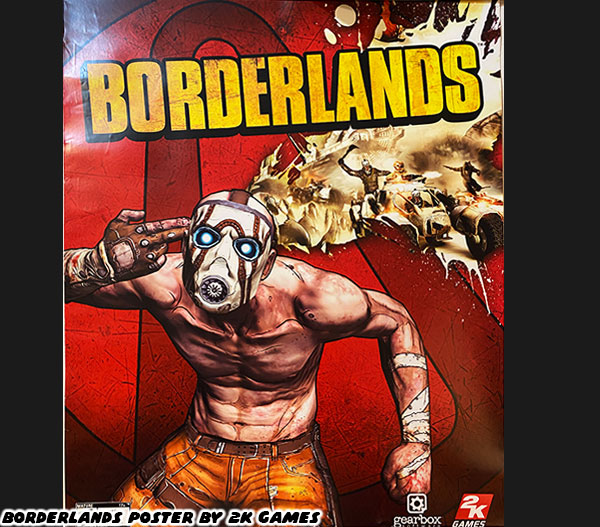
I’m not big on first person, or third person shooters, but I do think the Borderlands designs were great.

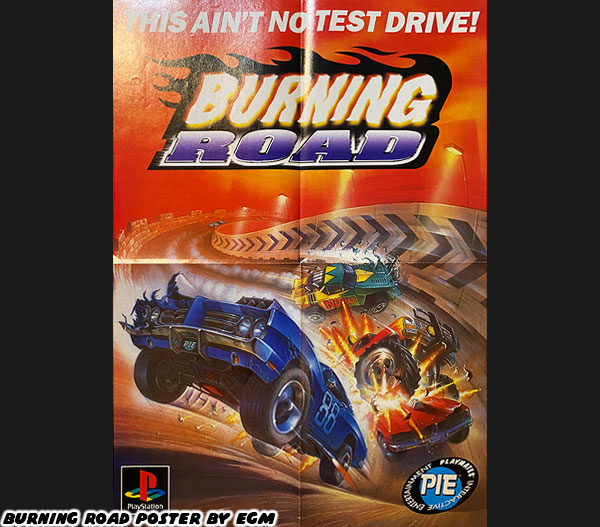
Burning Road was one of those early Playstation games that captured the spirit of the great arcade racers. It felt like Sega Rally and Ridge Racer’s little brother. It gave me hope that other studios were going to create some knock out experiences for the home.

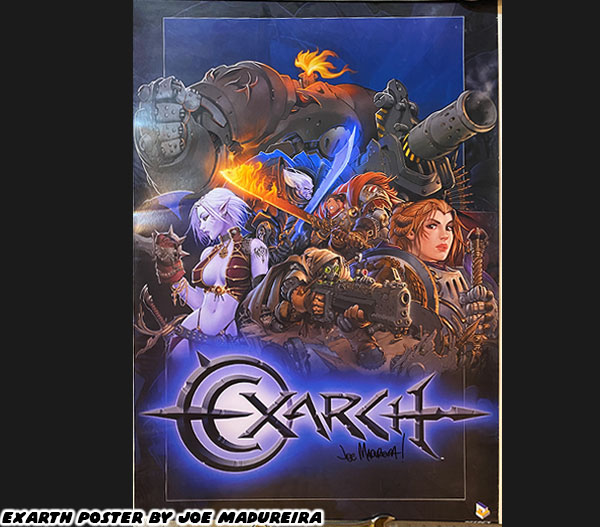
I never saw or played Exarch (Exarth?) but I was, and will always be a fan of Joe Mad’s art. I was happy to get an autographed poster at the E3.

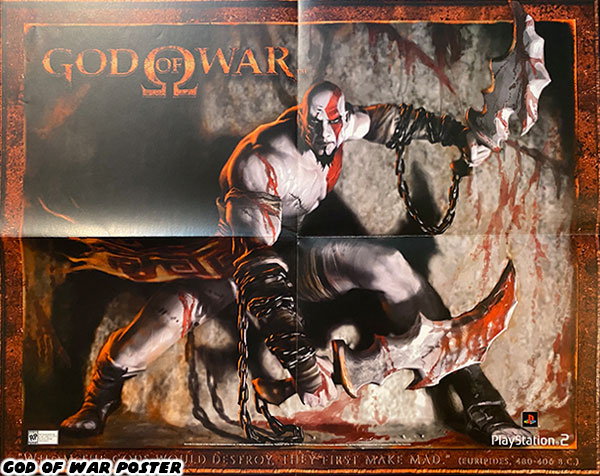
I think this God of War poster came with a magazine. It’s hard to believe it’s almost 20 years old.

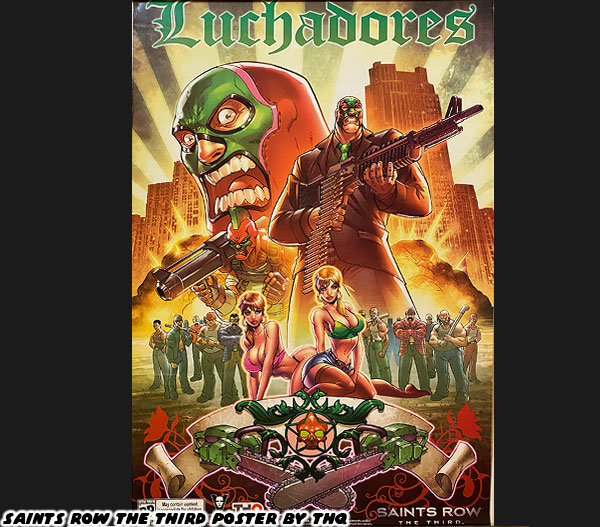
I’m also not a fan of Grand Theft Auto or Saints Row-type games but I am a fan of luchador hijinks.

I'm a big fan of skateboarding, not only in game form, but in real life as well. I attended the premier of the Mike Vallely documentary titled DRIVE. He was kind enough to sign this poster for me.

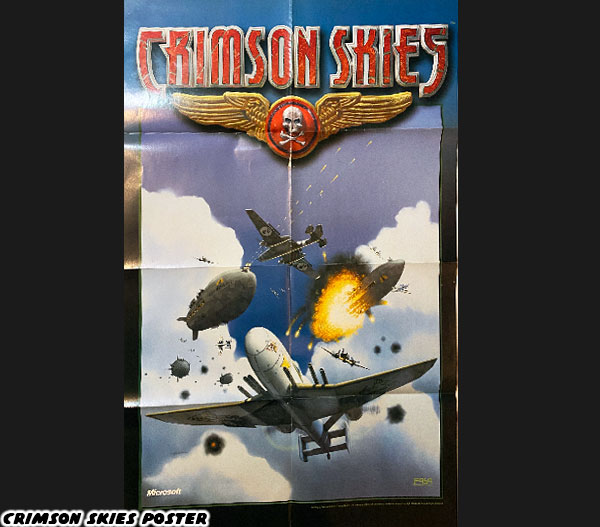
One of the greatest games I've ever played deserved a series. Sadly Crimson Skies came and went relatively quickly. It's a shame too, there was such potential to make it a franchise, I dare say on par with the Star Wars Rogue Squadron.

Are there any old western video game posters in your collection? I’d like to read about it in the comments section. As always if you would like to sponsor me please visit my Patreon page and consider donating each month, even as little as $1 would help make better blogs and even podcasts!
follow the Street Writer on Patreon!

Wednesday, February 21, 2024

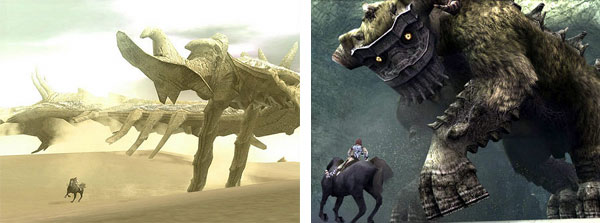
Returning to Shadow of the Colossus - A 1UP classic from September 23, 2008

Apologies for the tardiness of this blog my friends. There are multiple workshops going on. I'm even lending my chair out to a student and typing this blog on my knees in front of the screen. I'll keep it short before the circulation to my legs gets any worse. I just got Shadow of the Colossus back from my cousin. I lent it to her a year ago after I let her borrow God of War and GoW II. Her and her boyfriend were feeling pretty confident in their game playing skills so I told her I had something equally epic yet more artistically presented. I lent them SotC yet after a year they couldn't pass the second colossi. So I just told her to give it back so I could play some more.

It says a lot about the state of game design. We take games and the ability to play games for granted. The button combinations and boss strategies are second nature to most of my friends. But for those that aren't die-hard gamers then a title like SotC is simply confounding. My cousin is no slouch, she plays games all the time including Guitar Hero but I am wondering if both GoW titles are really that much "easier" or that they are simply more forgiving in their challenges. With GH it is easy to see that repetition and button memorization gets non-gamers through the levels. But what of SotC? What is the challenge there? Perhaps it is a right brain versus left brain struggle. Minimalist cues are used to help gamers locate and defeat each of the colossi. Those that explore the game and learn the nuances of control are rewarded for their efforts. A gamer that isn't used to experimenting in such a way, while at the same time being able to control Wander and target moving colossi would be stumped. Those more casual are used to being "spoon fed" the next location or strategy for defeating bosses. Somehow they get the same sense of accomplishment for beating the title as a core gamer would. OR do they? I'm not sure.

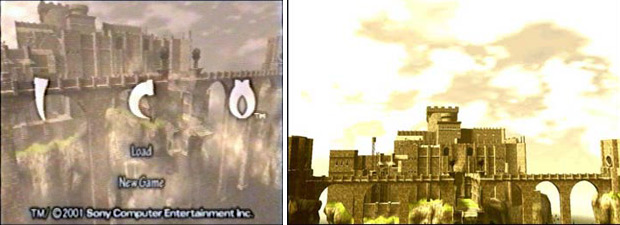
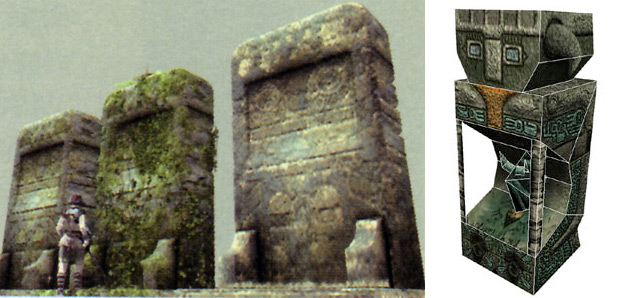
Shadow of the Colossus is a game layered in detail. A tremendous visual and emotional treat for those that are willing to go completely into Fumito Ueda's world. The more you look the more you will see, even year's after the game's release. These things may be coincidence, glitches or programming oversights but many fans have convinced themselves that Ueda and team left a lot of clues about the game's relationship to Ico hidden throughout the level. For example there is a beach in SotC named Ico Beach by fans. It was named after the ending location of Ico. There is even a "Secret Garden" with gems that tie the universe of SotC and Ico together.

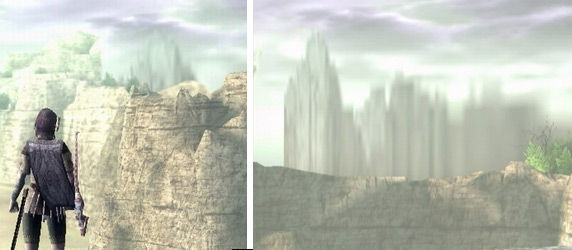
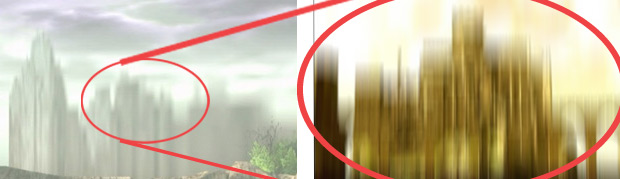
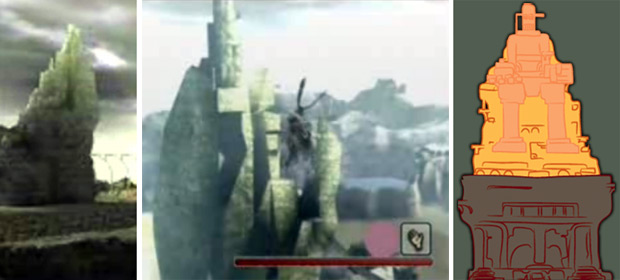
One thing debated amongst fans is the existance of the Queen's castle from Ico in SoTC. There is a large blurry texture, tucked away in a far corner of the map and not visible from the rest of the world. Are fans seeing something that is not there? A texture that was supposed to represent a mountain range perhaps?

I think it's a stretch to say that it's the same castle featured throughout Ico but if we were to run it through a Photoshop motion blur and stretch it a little then it becomes more apparent. Perhaps the Queen's castle won't materialize from magic to reality for another few centuries so it is distorted? What do you think?

Or perhaps the charm of SotC is seeing how the world is set to evolve and how the icons and magical totems would change between games. It's all reasonable if you stop and think about it.

When I first got the game I used to imagine what each of the colossi would look like. As great as they were I was kind of let down with the final one. I thought that Ueda had set us up from the get-go and the final colossi was actually in plain site the entire time. From a distance the castle and temple that Mono is lying in looks to me like a throne with a colossi sitting atop.

This stone man would have been even larger than the final colossi and had he stood from his throne and walked about the forbidden land for the final showdown then my head would have exploded from the awesomeness. Although that never happened I can always wonder can't I?

A game that is filled with tremendous wonder and a feeling that the universe is infinitely larger than the story we are presented. It allows our imaginations to run wild and fill up the spaces in between. That is the legacy that Ueda has left us with. Now, if only he could be so kind as to drop a hint for his next project. As always if you would like to sponsor me please visit my Patreon page and consider donating each month, even as little as $1 would help make better blogs and even podcasts!

follow the Street Writer on Patreon!

Wednesday, March 29, 2023

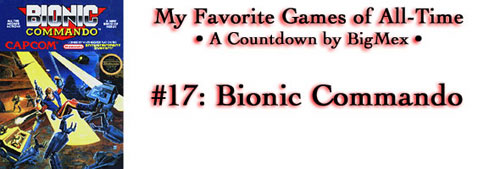
My favorite Games of All-Time #17: Bionic Commando - Originally published on 1UP - April 21, 2006

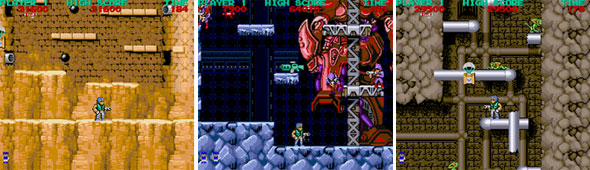
Bionic Commando should need no introduction. 1UP's Crucial Classics rank Bionic Commando in the #20 spot. If you are a fan of the action platformer then Bionic Commando should be a game that you not only play but have to beat. The version that makes my #17 spot is the Nintendo one, not the arcade and not the Gameboy versions.

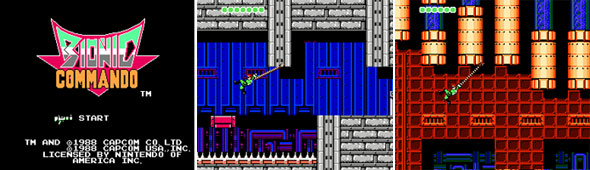
Bionic Commando came out during the 8-bit golden era, when arcade classics were being turned into console titles by the boatload. Capcom had mastered a gameplay technique rarely used in a platformer or in the arcade. Pitfall was the first game that allowed players to swing from vines, Jungle King/Jungle Hunt soon followed. The game mechanic in Bionic Commando blew these games out of the water. The main character, Captain Rad Spencer, ran and used a gun, not unlike his Contra contemporaries. What made him special was that he could also attack enemies and swing through a level via a mechanical claw.

The arcade version did look better than the NES one. However the NES version had changes to the story, tighter control, hidden features and more polish with the ending. Just like the other Capcom arcade to home games (Trojan, Gunsmoke) these details helped make the NES version better than the arcade game.

Bionic Commando will be most remembered for the swinging element. Players could perform, and often times had to, death defying movements through enemy compounds. All the while avoiding spike pits and soldiers. The high ratio of near misses and miracle claw grabs helped keep gamers on their toes. Those that bothered to snoop around levels were rewarded with not only weapon upgrades but plot advancements as well.

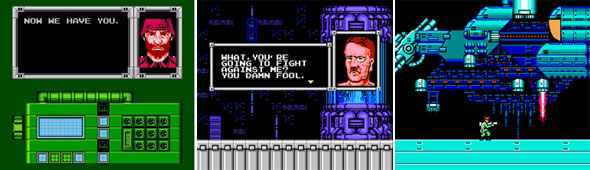
The story in the game was one for the ages. It still ranks as one of the favorite game plots for my brothers and I. Despite censorship and translation issues we could tell right away that the opponents were Neo-Nazis trying to bring Hitler back from the dead. To make things worse they also planned on taking over the world with a giant airship called the Albatross. Solid Snake and Metal Gear eat your heart out!

As Rad Spencer you not only did you have to defeat the Nazi menace and their diabolical machine but you also had to rescue "Super Joe" the previous super soldier sent to stop the Albatross. If you want to read all about the plot and characters just visit these two sites. They have all the particular details that I'm leaving out.

There are very few games that capture the sense of high adventure in the way that Bionic Commando does. The final level was one of the most memorable levels of all time. After defeating Albatross you must swing up to reach a hangar, then in one fluid motion swing out and drop down and fire a missile into the cockpit on Hitler's escape helicopter.

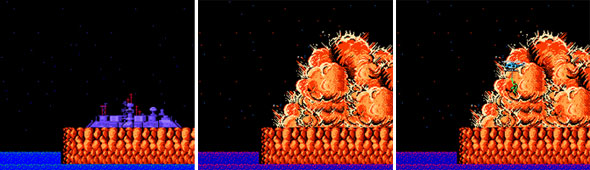
As if that wasn't difficult enough you have to locate Super Joe and get out of the military base before it explodes. And you thought the end of Metroid was a nail-biter! The ending to Bionic Commando was one of the best, if not the best videogame endings ever.

After defeating the Nazi menace and saving Super Joe you are caught in the middle of an explosion. Cut scenes tell us that your rescue helicopter can't stick around because the base is about to explode. When it does you are left wondering what happened to our hero.

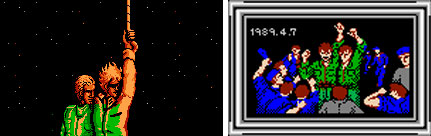
Suddenly out of the fire a helicopter emerges. The bionic claw attached to the landing gear. We pan back and see our hero holding onto the other end of the claw. Rad Spencer and Super Joe are alive!!!

That was one of the first videogame endings that my brothers and I remember cheering for. The adventure was worth the payoff. The game delivered the complete package. It controlled great, had a fantastic story and delivered an ending better than Hollywood could ever do.


Since that time the mechanic of a ranged weapon and a way of locomotion that worked for Bionic Commando has come up in games. Most recently with Rygar, God of War and of course Spider-Man.


It looks like Kratos will even get to use his Blades of Chaos to do some swinging in the next God of War. See, even David Jaffe knows that the Bionic Commando had something special. To see a speed run of the game just check this link. Until next time, have a great weekend!

I’d like to hear your personal top-10, top-20, top fighting games, top sports games, or top games in any genre. Let me know in the comments section please. As always if you would like to sponsor me please visit my Patreon page and consider donating each month, even as little as $1 would help make better blogs and even podcasts!
follow the Street Writer on Patreon!

Monday, March 13, 2023

God of War, the runaway elephant

While doing research for my God of War series I had a little bit of extra material that didn’t quite fit in with the other chapters. I’d like to share this final bit of concept work that never made it into the finished game, and perhaps give it some context. I’ve mentioned earlier on the blog that the Piraeus Lion was the best sub-boss in the series. There is an entire stage, and sub-plot in the Ghost of Sparta featuring Kratos stalking an escaped prisoner called the Dissenter. The player does this in the underground prison of Sparta. The atmosphere of the stage, level design, mood, and sound effects all lead up to a battle with the gigantic lion. It resonated with me more than any other sub-boss encounter in the franchise. The fact that they didn’t reuse the lion in any other part of the story made it mean more than any battle with a minotaur, or cyclops. I believe that the inspiration for the Piraeus Lion was due to another encounter that was planned in the previous game, the Chains of Olympus.

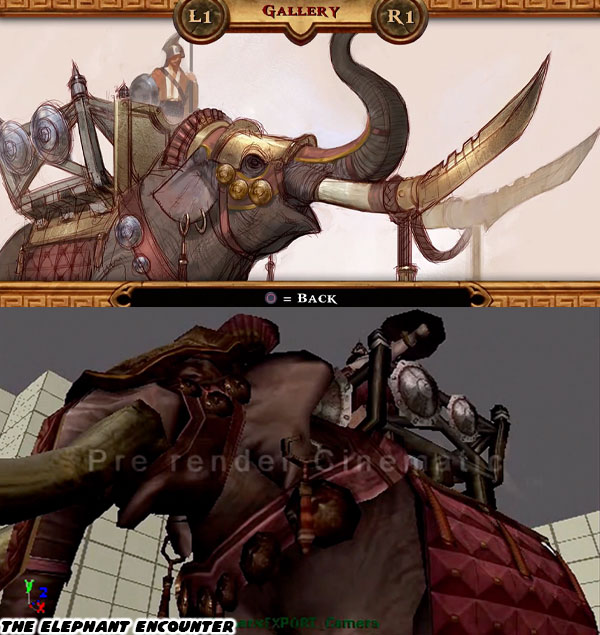
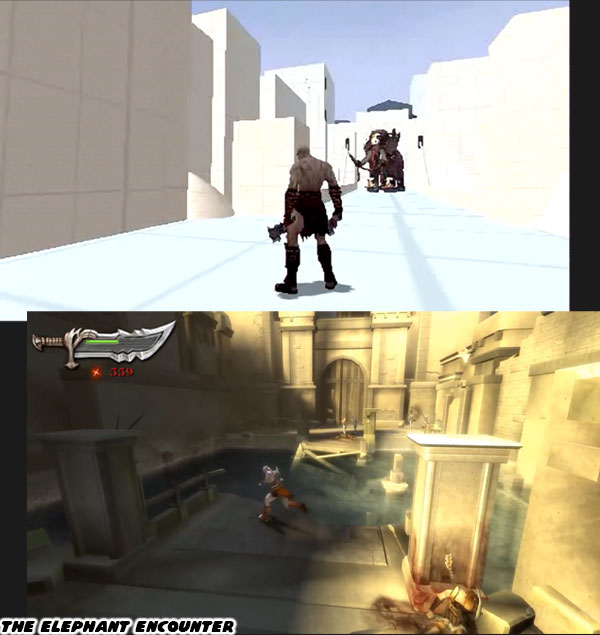
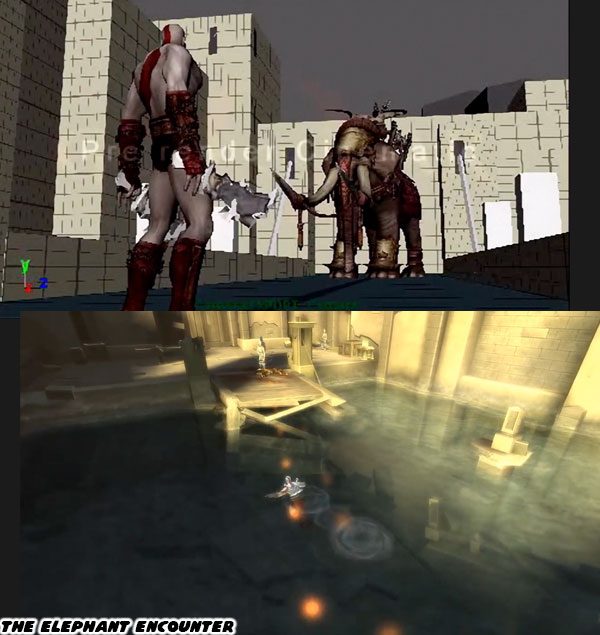
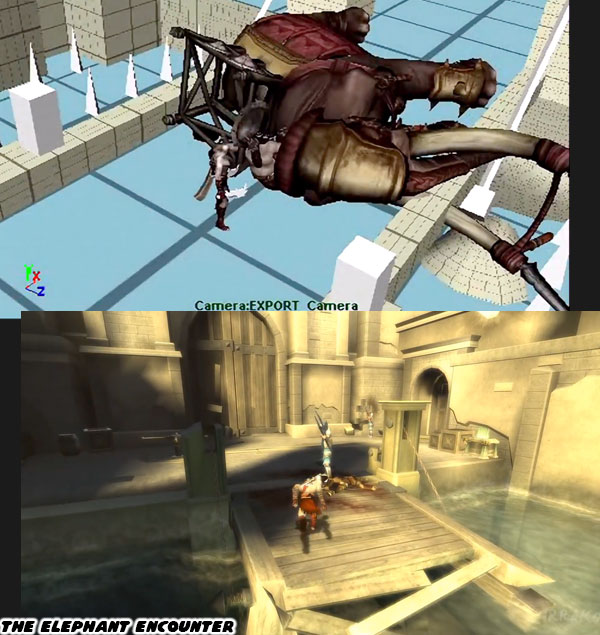
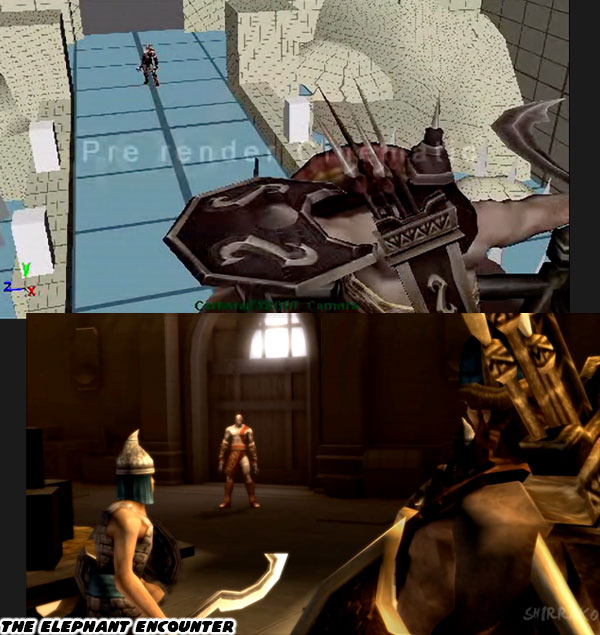
In the concept art for the game there is a war elephant. It is probably one of the best unused enemy designs in the series. It was so amazing that the studio even created a 3D model, and rendered a few scenes as to where this encounter would have happened. At the start of the game Kratos is with his Spartan army helping the Athenians defend Attica from a Persian invasion. This was an actual encounter from history. It was made fantastic with the inclusion of the Basilisk, an enormous fire-breathing reptile that was unleashed by the Persians. Kratos gives the monster chase, fights on the beach, and makes his way to the city gates. He breaks through the armored door by using a battering ram, and turns the corner. This is where he was supposed to see the war elephant for the first time, and its rider, a Persian King. The high walls of the city gate, and bridge make for a constricted fighting platform. Just as the locked cells in the jails of Sparta raised the stakes for the lion reveal.

In the final version of the game Kratos is on one side of a moat, there is a collapsed bridge between him, and some Persian archers on the opposite side. They are taking shots at the future god of war. Remember during this timeline Kratos hasn’t killed Ares yet. He isn’t at full-power, nor reputation. I like to think that it was the elephant that destroyed this bridge in the finished version of Chains of Olympus. I only wish the studio had placed it at the bottom of the moat to complete the story. Anyhow I think that this encounter highlights the approach that Ready at Dawn had over the pacing of the game when compared to Sony Santa Monica. Up until this point the GoW series followed a familiar template. The games start in the middle of the action. A fight scene teaches the basic controls. These are usually against humans, or human-sized monsters. Then an enormous opponent is introduced. It might be the Hydra, the Colossus of Rhodes, the Scylla, or the Basilisk. The fight against these enormous creatures seems impossible, but is manageable with the strength of Kratos, his indescribable toughness, and the magical Blades of Chaos. The rest of the game is a series of smaller encounters until a mid, or final boss is reached. The games would recycle the same characters again, and again throughout the quest. Sometimes they would be reskinned, were still cool looking, but essentially the same rivals. The lack of unique opponents was something that I would consider the only weakness to the GoW franchise.

Ready at Dawn wanted to break the cycle by introducing sub-bosses that were tailor-made to the game. They weren’t as enormous as the final bosses, but more grounded in reality. We’ve seen Kratos take on mountain-sized opponents, and while those fights are fun, we sometimes forget how amazing he is in close combat. That is why the developers had him take on the kings of the jungle. Fighting supernatural lions, boars, bulls, and serpents are the types of challenges that Hercules, Theseus, Jason, and Perseus conquered in their classic adventures. At the same time the creatures in the Chains of Olympus are more than typical wild animals. The Piraeus Lion is bigger than any horse. It is covered in arrows, and swords, showing that it is impervious to most weapons. While the War Elephant is armored, has blades on his tusks, and is trained to fight. To raise the stakes the encounters are set in a tight space. Ready at Dawn knew that they were delivering something memorable. These fights served the story. They helped develop the character of Kratos, and fleshed out the fantastic world he lived in.

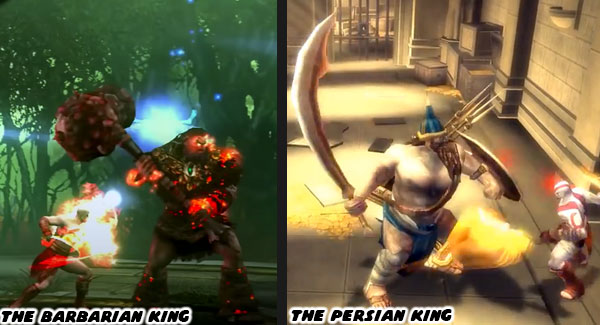
The studio was still able to create a memorable stage despite having to make cuts in the final version of the game. On the back of the Elephant was a Persian King. He undoubtedly taunted Kratos at the gates of Attica, just as he did in the final version. This character was massive. He was as big as Alric, the Barbarian King that almost killed Kratos in God of War, and had returned for a rematch in God of War II. The Persian King was going to be every bit Alric’s equal, and then more. He was on an elephant after all, which was much bigger than a draft horse. He also fought with a gigantic scimitar instead of a hammer, giving him a lethal reach advantage. He could even summon an Efreet, a sort of fire demon to create a burning ring around him. Alric did not gain magical attacks until he was already dead. On his back the Persian carried golden spears. Although he doesn’t use them in the game I have a feeling these would have been his ranged attacks against Kratos. He could have easily struck the Ghost of Sparta from across the stage thanks to his high perch.

The final version of the battle had the Persian taunting some slave girls when Kratos shows up. He says the Spartan is nothing but a messenger for some puny gods. This is of course raises the ire of Kratos. Traditional Persian soldiers surround, and attack him while the king hacks away. It’s a fun battle, and I can almost imagine that the War Elephant would have been a two-part fight. Kratos would have to find a sweet spot to fight on the bridge. If too close then the elephant could have swiped him with his tusks, thrown him to the ground with his trunk, or trampled him with his feet. If Kratos were too far then the king could have rained spears down on him. Once the elephant was defeated then I bet the king would have fallen back, and entered the slave girl room.

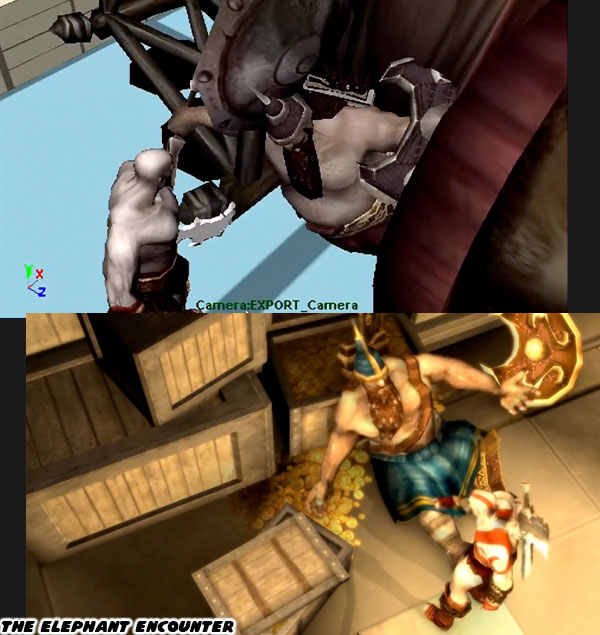
While large, and strong the King shares something in common with the Dissenter from Ghost of Sparta. They are both bullies when they think they are winning. Despite talking big they instantly change their tune once Kratos has them beat. The Dissenter called Kratos an impostor, and that Ares was the true god of war while Kratos is getting pounced on by the lion. The King mocks Kratos when they first meet, but then tries to bribe Kratos when he is knocked down. He offers him gold, and women. Kratos turns down the bribe, and then bashes a gold chest over his face. The brutal ending of the king was as satisfying as it was to the Dissenter. I have a feeling that the same person at Ready at Down had scripted both encounters.

If I had any programming, or modeling experience I’d love to restore this battle the way it was originally meant to be seen. Even if just to watch Kratos get thrown around by an elephant for a minute. I’m grateful that the artists shared their work online, and that Sony also posted additional content. So many game studios never publish art books, or share their concept work. It will hopefully inspire future designers to push the boundaries of their own art, and think about how to plot out a game, or story. I’d like to know if there was a concept character, or stage from God of War, or any other game that you wish had made it into production. Let me know in the comments section please. As always if you would like to sponsor me please visit my Patreon page and consider donating each month, even as little as $1 would help make better blogs and even podcasts!
follow the Street Writer on Patreon!

Friday, March 10, 2023

God of War, the story of the Suicide Tree

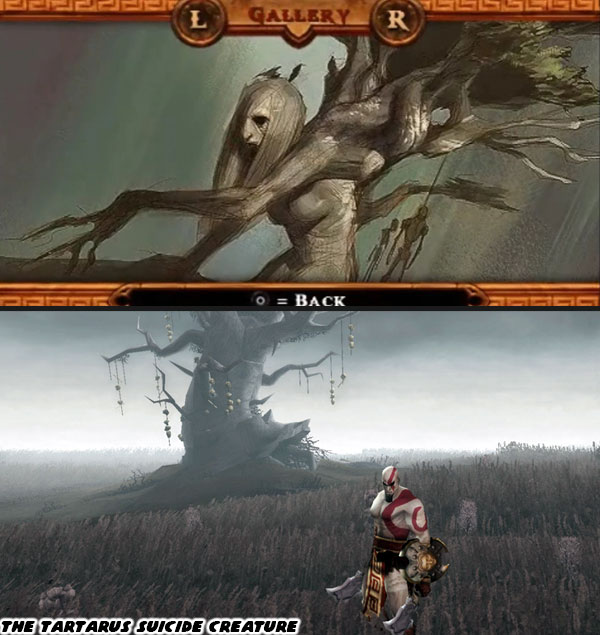
While doing research for my God of War series I had a little bit of extra material that didn’t quite fit in with the other chapters. I’d like to share this little bit of concept work that never made it into the game, and perhaps give it some context. The first is actually a grotesque monster whose origins may be the most disturbing in the franchise’s history. In the early drafts of the game there was a proposed location, that evolved into a monster. Let’s take a look at the literal roots of this creature. Kratos is pulled into Hades during the events of the Chains of Olympus. He is trying to figure out where Helios, the god of the sun, has disappeared to. The team at Ready at Dawn Studios wanted to make the realm of Hades, and the pits of Tartarus look truly unique. They wanted the landscape to appear as dangerous as the monsters lurking within. They proposed a sort of mini boss that grew from a tree. You could see it in the concept art. The tree was covered with bodies hanging by their necks. It was also known as the Tartarus Suicide Creature.

The studio went so far as to create a portion of a level around this beast. In at least one rare screenshot you could see where this encounter would take place. I’m not for certain if this was meant to be in Hades, in Tartarus, or in the mist created by Morpheus in the city of Marathon. There were no buildings, or other signs of life in this location. We could see a curtain of fog hung in the distance. There were gentle rolling hills with waist high fields of grain. There was nothing else on the stage except for a tree with a thick trunk, and exposed gnarled roots. Ropes with multiple skulls hung from the short branches. You could almost imagine Kratos coming up to the tree when it suddenly started rising from the ground. I’m betting that it would have been hiding, or protecting the entrance to the deepest bowels of Hades. It would have been a scary sight.

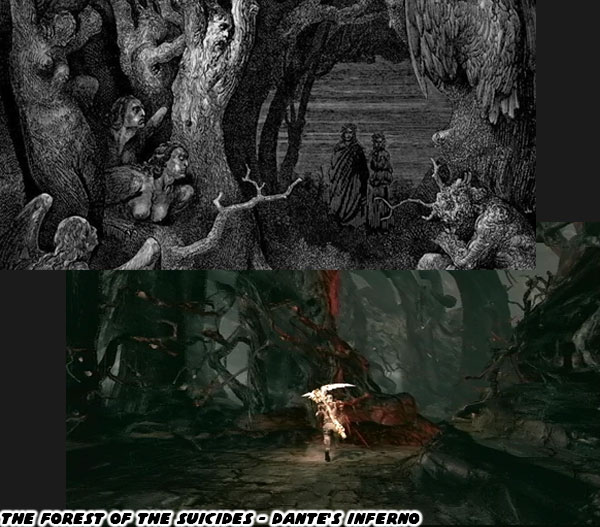
There was something about the tree, and environment that was unnerving. The collection of skulls was of course a huge warning sign, but that was only part of the draw. How did they get there? How long has this tree been used to hang the dead? Were they there by choice, or punishment? Spooky forests are nothing new in classical literature. We can all think of a fairy tale that takes place in some creepy woods. Hansel & Gretel, Snow White, Sleeping Beauty are all stories that share pivotal scenes where the protagonists are lost in the woods. There was one forest that itself became a character in a story. The forest of the suicides was detailed by the Italian author Dante Alighieri in his poem known as Inferno. The forest was made of living trees, which were actually the souls of people that had killed themselves. The spirits could only speak if their limbs were broken. They were tortured by harpies that would break their limbs just to hear them wail in pain.

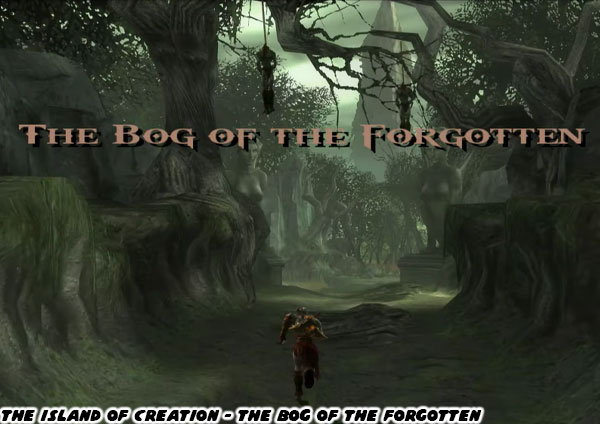
There was a game based on Dante’s Inferno. It was developed by Visceral Games, and published by Electronic Arts in 2010. In it a templar knight named Dante visited the nine levels of hell written about in the poem. He was trying to save his love Beatrice from Lucifer, who we might think of as Satan. It wasn’t hard to see how the dark origin of Kratos, and his adventures didn’t help inspirit the creation of this title. Many publishers were eager to recreate the success that Sony had with the God of War franchise. Unfortunately no amount of sex, violence, or eerily-similar puzzles, encounters, and music was enough to get audiences to switch titles. Of course game play also had a lot to do with the success of GoW. Sony Santa Monica had given us a dark, and twisted forest previously. The Bog of the Forgotten was the early portion of the Island of Creation. In it we could clearly see bodies hanging from the trees. It gave the swamp an ominous feeling. Ready at Dawn wanted to see if they could turn that location into a character.

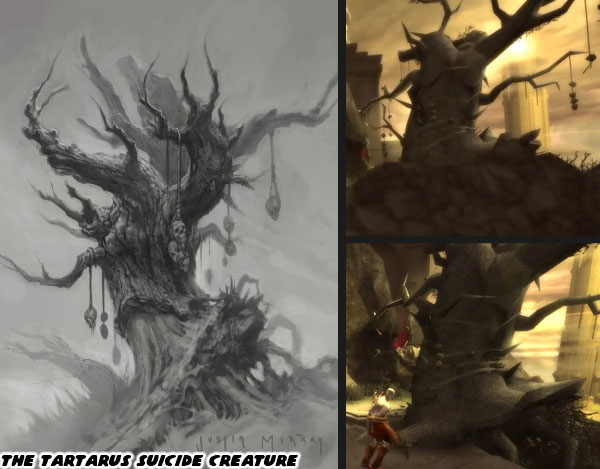
Illustrator Justin Murray sketched out his idea for the Suicide Tree. He was responsible for a lot of the character designs in the Ghost of Sparta. His tree was oozing with personality. It could have been one of the rare places in the franchise where the terrain evolved into a living monster. Sadly many great ideas have to be cut due to time, and money. This would become one of them. Since the studio had already gone to the trouble of creating a model for it they found a way to incorporate it into the finished game. When Kratos reaches the Gates of Hades we see the tree at the edge of a cliff. Still as ominous as ever, even without any additional context. I’m glad that the studio found a way to use this set piece. I’m grateful that the artists shared their work online, and that Sony also posted additional content. So many game studios never publish art books, or share their concept work. It will hopefully inspire future designers to push the boundaries of their own art. I’d like to know if there was a concept character, or stage from God of War, or any other game that you wish had made it into production. Let me know in the comments section please. As always if you would like to sponsor me please visit my Patreon page and consider donating each month, even as little as $1 would help make better blogs and even podcasts!
follow the Street Writer on Patreon!

Wednesday, March 8, 2023

God of War, where were the Amazons?

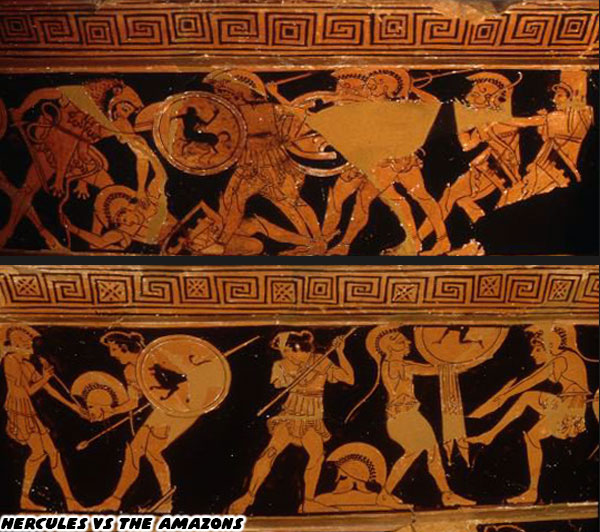
While doing research for my God of War series I had a little bit of extra material that didn’t quite fit in with the other chapters. I’d like to share this bit of concept work that never made it into the game. Today I’d like to talk about the Amazons. For a game that features a good chunk of Greek mythology it was surprising that the Amazons were not featured more prominently in the games. The female warriors from were legendary in the fables of Homer, Euripides, Herodotus, and other ancient writers. Queen Hippolyta, sometimes written Hippolyte was the daughter of Ares, and Otrera. She was by far the best warrior of the women, and was gifted a magical war belt by her father. This belt did more than hold her sword, it provided her protection from mortal wounds. Without it she could be killed. Hercules was tasked to retrieve this belt for Admete, the daughter of King Eurystheus. Admete was obsessed with the Amazons, and wished to have a possession of theirs. Getting this item for the young princess would become his ninth labor. Hippolyta freely gave Hercules the belt when he explained his labors. Sadly the queen of the gods Hera had gone in disguise as an Amazon. She had sewn discord with the tribe, causing them to attack Hercules, and his men. They killed most of his men, and Hercules killed Hippolyta before escaping. In other stories she was taken by Theseus, and married him while in Athens. The Amazonians tried to steal her back, and she was killed in the ensuing conflict, either by her husband, or accidentally by her own warriors.

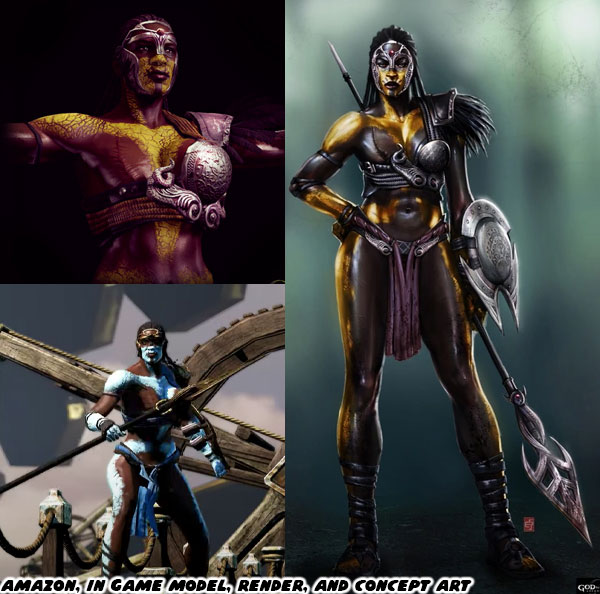
The name Amazon was used thousands of years before the South American river was named. In fact the river had multiple names in Pre-Columian history such as Guainí, Tambo, Apurimac, Orinoco, Solimões, and Amaru Mayu. The Amazon is actually a word from Ancient Greek meaning “missing one breast.” This was because the warriors were rumored to cut off one breast so that it wouldn’t get in the way of their archery, or spear throwing. They lived apart from men by choice. This didn’t mean they didn’t have relationships with men. If they got pregnant then they would only keep the female offspring. In some versions of the legends they would kill the male children, or cripple them, and turn them into slaves. They had a reputation for being merciless in combat. Plus they were known for raiding many outposts, and pillaging whatever they needed. With such a lengthy history you would think that the Amazons would have been a part of the GoW series since day one. Sadly they were only seen once. The female warriors were painted in blue body paint, had a spear, and small Greek shield. They popped up on the Isle of Delos in GoW Ascension. This was the very last of the Greek saga games.

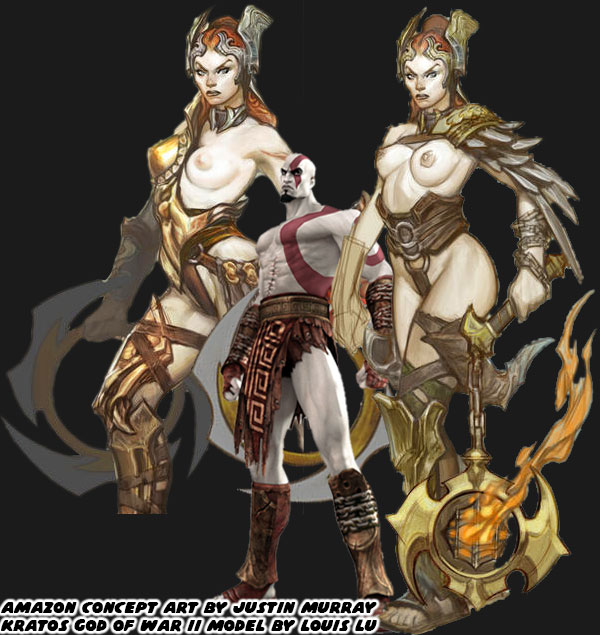
The version of the characters in the game was fairly accurate. Moreover it was great to see some Black representation in the game, better late than never I suppose. Just an FYI, Hercules was Black in a couple of the earliest concept art. But I digress. Although it was sometimes difficult to make out on the screen the warriors actually had only one breast. You could make out a scar across the chest whenever the in-game camera zoomed in. This was usually when Kratos was performing a killing blow. What I never knew was that Amazons were in the plans for my other favorite GoW title, the Ghost of Sparta. Concept artist Justin Murray designed a great chunk of the characters for the game. His stylized characters were not quite comic book, nor were they manga. They fit in perfectly with the majority of the aesthetic used in the GoW series.

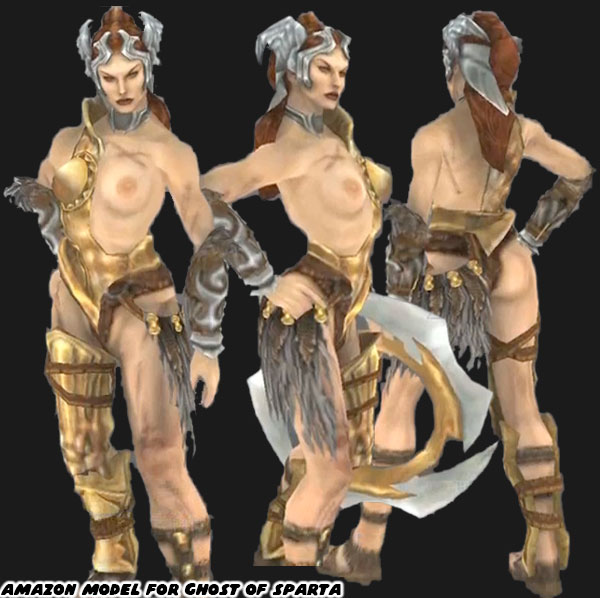
There were at least two proposed designs for the characters. Given the diversity of the Hoplite, Persian, and Rhodes soldiers featured in other games then at least two different Amazons would have been featured in Ghost of Sparta. The designs for Mr. Murray were not dainty warriors. They were a few heads taller than Kratos, who is well over six-feet-tall. They were as big as Zeus, or Thanatos based on the concept art. Mr. Murray kept their breasts intact, however they were proposed to have armor go over one breast, or perhaps have some scarring just under their collarbone. Each of the designs also had a unique weapon. One wielded a chakram, sometimes called a chakar. These were circular throwing blades from India. They were best known as the weapon used by Xena: Warrior Princess from the ‘90s television show. Like most of the weapons in the GoW series this version would be huge, and far more intimidating than the historical armament. It had a brass body, with three angry blades on the outer edge. The other proposed Amazon weapon was even more fantastic. It was an axe with a burning core, attached by a chain to a handle. It was unlike any other weapon I had seen from history.

The difference between the thousands of concept illustrations created for the series, and the Amazons was that there was at least one model was created, and rigged for animation. This was years before God of War Ascension. This Amazon looked just like the concept art, and matched the stylized world of the classic GoW games. I can almost imagine how she would have fought. With a chakram larger than the Blades of Chaos she would have had ranged attacks, and close up strikes in equal measure. It makes me a little bit sad knowing that they never appeared in Ghost of Sparta. I’m grateful that the artists shared their work online, and that Sony also posted additional content. So many game studios never publish art books, or share their concept work. It will hopefully inspire future designers to push the boundaries of their own art. I’d like to know if there was a concept character, or stage from God of War, or any other game that you wish had made it into production. Let me know in the comments section please. As always if you would like to sponsor me please visit my Patreon page and consider donating each month, even as little as $1 would help make better blogs and even podcasts!
follow the Street Writer on Patreon!

Monday, March 6, 2023

God of War, exploring the roots of Kratos' design

While I was working on the God of War blogs I was going back through a lot of concept art of the series. It reminded me of some early behind the scenes footage. I'd like to explore the origins of Kratos, and how the games could have gone in a completely different direction. I'd like you to use your imagination, and ask yourself what if Kratos had looked like he did in his early art. For starters let's talk about his final design. David Jaffe is credited as the father of Kratos, but he defers the look, and especially animation to Cory Barlog. David wanted the hero of his story to be a rage filled monster. He didn't necessarily have to have the physique of a swollen bodybuilder as most games, or comic book characters did at the time. Instead he wanted someone that was strong, but aggressive. The template he pointed to was the Neo Nazi character Derek Vinyard from the film American History X. Derek was played by actor Ed Norton.
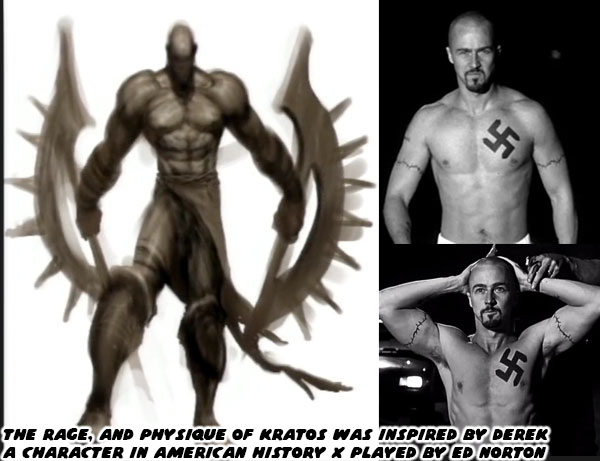
The film is an ugly, but realistic portrayal of Neo Nazis in the USA. The ways in which they are recruited, and groomed by their betters to spread their agenda. Derek is by all means an unforgivable character, especially after killing two Black men, and being sent to prison. What happens next is an unraveling of the character, the roots of his hate, and rage. Ultimately he has to find a way to keep his hate from spreading to his younger brother. It's a great film, but not for everybody. But I digress. The character of Kratos is meant to have a similar tragic origin as Derek, and share the same emotive qualities. With that in mind I think Mr. Barlog nailed what Jaffe was asking for. It was a far cry from the earliest prototypes for the character.
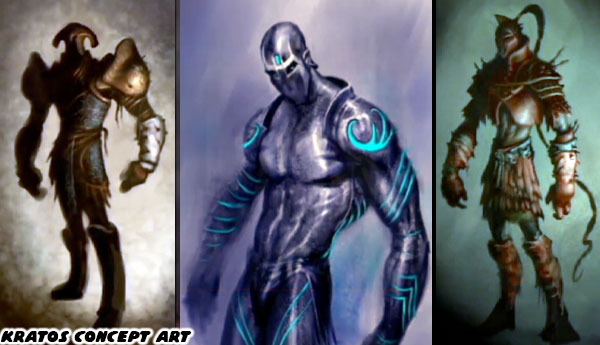
The studio knew they wanted to tell a swords, and sandals adventure. So they tasked the art team to create a legendary warrior. This fighter didn't necessarily have to be based on an actual historical figure. Their armor, and weapons didn't have to be rooted in reality. Leaning on fantasy was acceptable. Dozens, if not hundreds of drafts were submitted. In the earliest forms the character was completely armored. You couldn't really make out a face, skin color, or any other distinguishing figures. It could be the type of character that any game player could place themselves in. It was rarely done in gaming, but it had worked previously with characters like Master Chief from Halo, and Issac from Dead Space. The armored warrior was okay, but audiences needed a reason to root for them. Some of the early drafts also gave this warrior a baby to care for, or transport.
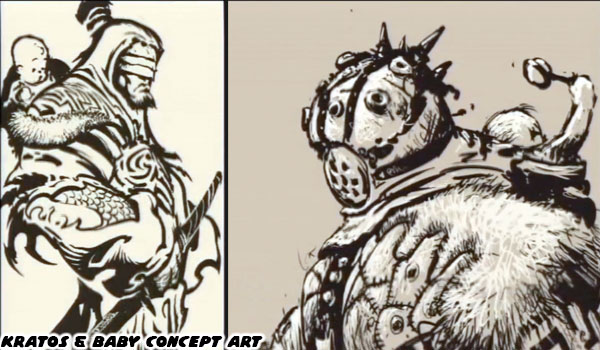
The studio considered this draft of Kratos the Lone Wolf and Cub. The idea was copied many times from the works of a manga series of the same name from 1970. The story of Ogami Itto the former executioner, and his son Daigoro is set feudal Japan during the 1700's. Written by Kazuo Koike, and illustrated by Goseki Kojima the series has been published in multiple languages, and been adapted to anime, and film. It is easily one of the greatest stories of all time, and the fact that the majority of the adventures were told without dialogue helped make it an international hit. Many of the people working on the God of War franchise would have probably been familiar with the manga, if they didn't grow up reading it. I can imagine that the early faceless warrior would have instantly have a ton of pathos if he had to raise his kid in a harsh environment. Yet that was one proposed idea to get audiences to root for the hero. The other idea that was floating around in the early days was to give our hero a puppy.
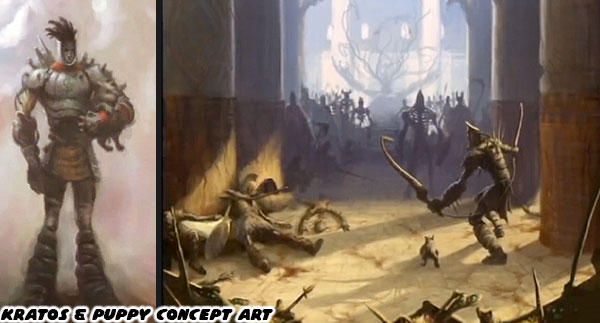
Imagine how the game would have played if our adventurer was raising a dog, or wolf cub. It's not hard to guess that the combat system, enemies, and stage designs would have to be built around what this little sidekick was capable of. There had actually been a precedent for this type of adventure. You would have to go all the way back to 1989 to see where it started. Sega had a side scrolling action game called Shinobi that they released in arcades in 1987. In it the ninja Joe Musashi has to infiltrate a crime organization armed with his sword, and throwing stars. The sequel Shadow Dancer: The Secret of Shinobi has Joe fighting alongside an attack dog named Shadow. He can send the dog to distract enemies while he then strikes them down. It made for an interesting idea, and a memorable game. I'm not sure if that mechanic would work in 3D, but it was interesting that Sony Santa Monica had considered it.
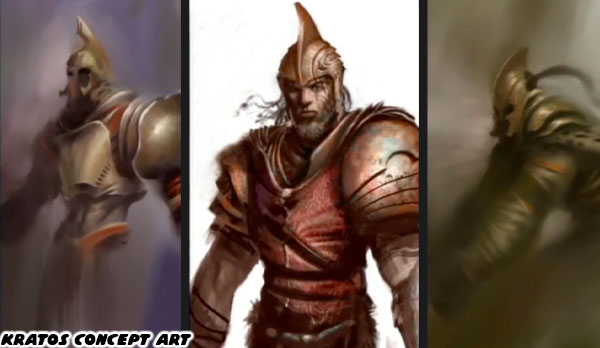
Jaffe would challenge his art team to try different things to help visualize the main character, and type of game he wanted to create. Instead of just going for realistic, or fantasy warriors he would say draw what the physical embodiment of rage would look like. What about war, or anger, or hate? What does that look like if those intangibles were a person? Lots of ideas were submitted. Characters made of fire, and spikes. Assassins covered in blades. All sorts of drawings flowed in. Little by little they discovered that they could humanize what they were going after if audiences could see the face of the protagonist. At first it was just an open face helmet that they wore. Perhaps some war paint, or a tattoo to give them personality. But if this character was going to have face markings then it made more sense to get rid of the helmet completely. Little by little the ideas for Kratos were starting to come together.
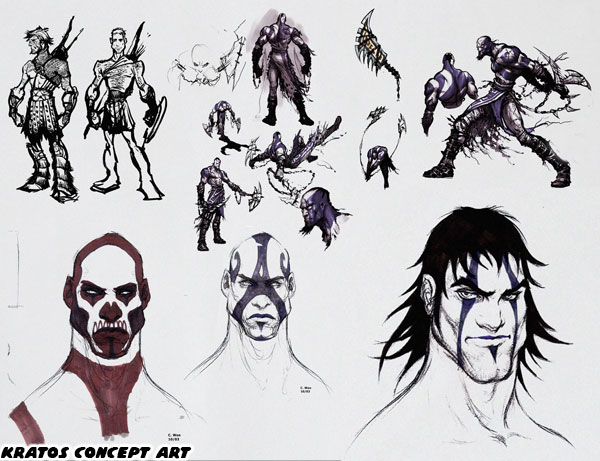
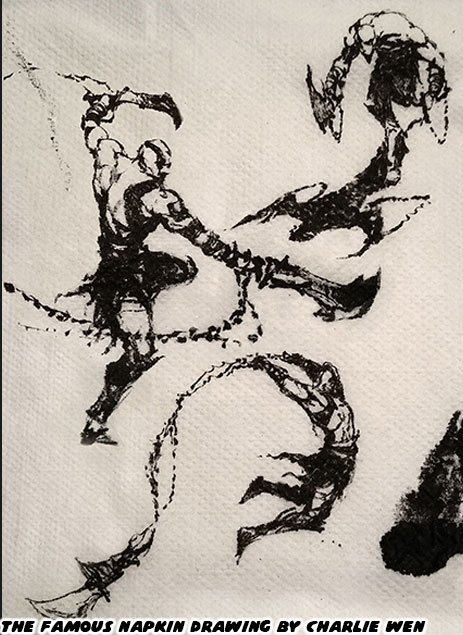
Would this character have hair? Would they be covered in scars? Were they covered in paint, or tattoos? If so were these markings tribal in nature? The team went back to the drawing board. They started stripping away the armor, and in doing so they learned it was easier to read the physicality of the character. To make him appear more animated. They saw how much they could take away from him, while still making him look like a warrior. In the end the costume was essentially from the waist down. It was the pteruges, the pleated skirts worn by Greek, and Roman soldiers, shin guards, and sandals. The rest was tattoos, and an attitude. Figuring out the weapons he would be using was a challenge in itself. Swords, throwing spikes, axes, everything was considered. As the game engine was coming together one of the senior artists, Charlie Wen, was sketching on a napkin at lunch. The form, weapons, and poses were an amalgamation of the best ideas from the studio. He brought his idea back to the studio where Jaffe pretty much confirmed that was exactly what they were looking for.
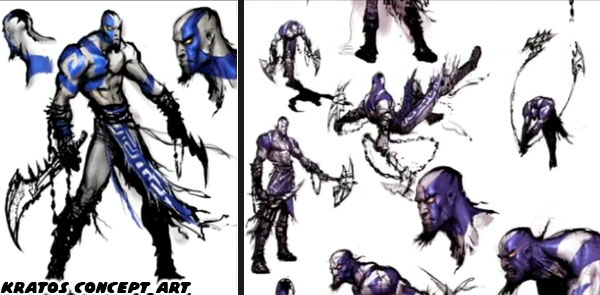
The question then came what to color the character. Jaffe noticed that some other sketches had a ghostly white character. The artists planned on going back, and painting the skin after they had colored in the armor, and weapons. Jaffe said to keep the character pale, and they would create a story as to why he was colored like that. This is how the ashes of his slaughtered family worked into the canon of the game. The team had to figure out what the markings would look like. Were they earth-tones, like mud or camouflage? In the earliest drafts the iconic tattoos were blue, and purple. Purple was a rare color to create in ancient times. It would really only be seen on royalty, or the very rich. The warrior was anything but an elite. Blue was a strong choice, but red popped even more on the screen. So Kratos came together little bits at a time, and after lots of fine tuning with many fantastic artists. It was more than just giving swords to a Neo Nazi movie character.
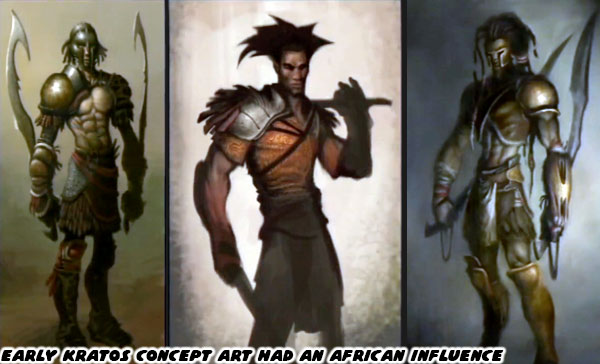
There were a few drafts that I especially enjoyed. These were the ones where Kratos had a distinct African origin. The character was not only Black, but his armor, and weapons were unlike anything that we had seen in traditional media. I like to go back, and think about how the franchise would have turned out if the settings were Africa. Not Egypt necessarily, although their pantheon would be a good place to end up. Do you think this character had potential? Do you think it would be fun to revisit the classic GoW gameplay, but with a different leading character? Perhaps set in the same universe, but another part of the world?
I hope you enjoyed this dive into the origins of Kratos. Is there a favorite draft of the character that you enjoyed best? Maybe it was a skin you could unlock in one of the game. Would you have enjoyed the game more or less if Kratos were dragging a baby, or puppy along with him? Let me know in the comments section please. As always if you would like to sponsor me please visit my Patreon page and consider donating each month, even as little as $1 would help make better blogs and even podcasts!
follow the Street Writer on Patreon!