Showing posts with label italian. Show all posts

Monday, April 22, 2024

Disney, the Italian Legacy, part 2 - A 1UP classic from July 11, 2011

The Italians were noteworthy not solely for creating new interpretations of classic characters like Paperinik and Paperotto, but also for diverging from USA Disney canon. For example, in the USA the character of John D. Rockerduck was introduced once by Carl Barks into the Uncle Scrooge adventure the Boat Busters to help push along a plot. Rockerduck was a fellow business tycoon and he challenged McDuck to a race to find out who sold the better gasoline. Donald Duck won the race on behalf of Scrooge but was unfortunately using Rockerduck’s gasoline. In the USA the character would not be seen again save for a cameo in a “Life and Times” story by Don Rosa. Most Disney fans in the USA would recognize that Flintheart Glomgold was the older character, meant to be business rival and mortal enemy of Scrooge McDuck. Yet even Scrooge McDuck was also once meant as a one-shot character in the Bark’s universe. It was not until the character was revisited and fleshed out that he became a comic icon. In Italy and in other European stories John Rockerduck would be brought back and fleshed out as well.
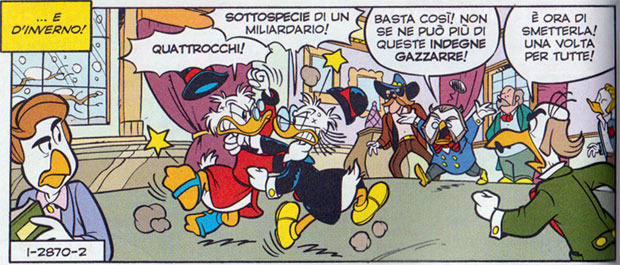
Rockerduck instead of Glomgold would take a starring role against Scrooge. The design and appearance of the character was in fact meant to balance out Scrooge more than Glomgold. Visually Rockerduck’s suit, hat, tie, glasses and sideburns were more contemporary than Scrooge’s. Rockerduck was a brash younger tycoon that did not seem to value his wealth in the same way as McDuck. His fortune was handed down by his father Howard Rockerduck, a self-made business man that helped mentor a young Scrooge decades earlier. John Rockerduck had a different approach to his business empire than Scrooge did. He believed that it took spending money in order to make money, whereas Scrooge was a notorious hoarder and penny pincher. In the comics the ducks rarely got along and were constantly getting into fights while trying to prove who was the superior businessman.

To settle things in fumetti both ducks often had a wager, this part of canon was preserved from the original Barks story. The bet was rarely over money but instead prestige in the clubs for which both ducks were members of. The loser for most of the contests had to eat their own hat. Rockerduck was often presented chewing on the brim of his bowler hat, if not for the contest bet then because he was completely fed up with Scrooge.
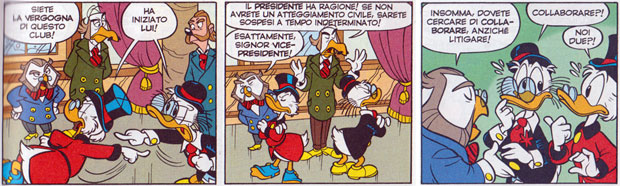
As if one powerful tycoon rival was not enough for the pages of Topolino, a second was added shortly after Rockerduck. The Italian Marco Rota added Brigitta MacBridge to canon in 1960. Similarly to Rockerduck and Scrooge she was originally introduced to help push along a single story. She turned out to be a memorable character and would return again and again to drive Scrooge mad.

In canon she was an old acquaintance of Scrooge and was absolutely crazy about him. She was also good friends with Daisy Duck and would often cross paths with Donald and his uncle. She was convinced that the two were meant to be together. As a self made business tycoon she was clearly not in it for Scrooge’s money either.
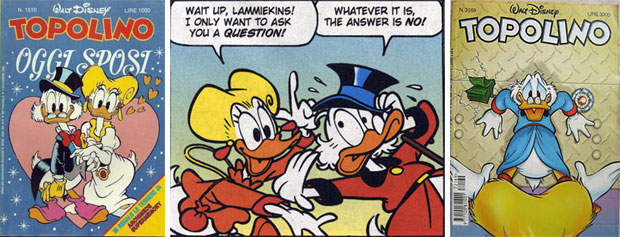
Brigitta would often hatch a plot to try to get Scrooge to confess his feelings for her, or worse, to trick him into getting married. This character seemed to balance out the Rockerduck dynamic. Both were constantly trying to undo Scrooge for their own gain. Both had enormous fortunes so that they could keep up with Scrooge no matter where he went or what business he got into. Brigitta’s appearances were thankfully more comedic than dramatic though.

Yet many western audiences were not fans of the Brigitta character, or even aware of her. Scrooge had a female rival years before Brigitta, someone that was not falling over Scrooge at every instance but instead his equal, not in a monetary sense but in personality. Italians would have to ignore one of Carl Bark’s greatest creations, Goldie O’Gilt aka Glittering Goldie, in order for Brigitta to be his main female lead.
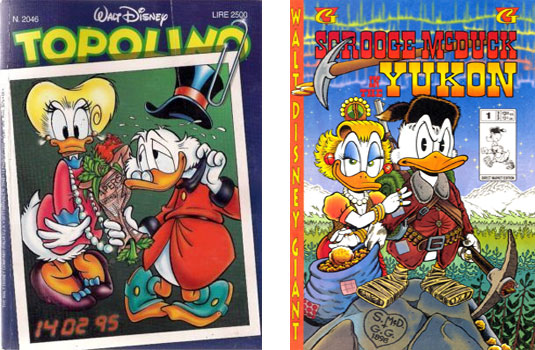
Goldie was a rival for Scrooge during his formative years in the Yukon. Over several seasons of hardship the two would grow to respect each other and more important to develop feelings for the other. Unfortunately both were too proud and stubborn to ever admit to those feelings. Scrooge left the Yukon behind and seemingly his heart as well. In flashbacks Scrooge would think fondly of his time spent up north. Goldie would always consider Scrooge the one that got away. This interesting dynamic left audiences wanting for closure to a relationship half a century in the making.

Adding superhero alter egos to established characters and creating new relationships within the canon were some of the major contributions by the Italians. One of the more controversial elements featured in the pages of Topolino, the inclusion of firearms in some of the stories, would have been a hard sell to American audiences, especially licensors and Disney stock holders. Many in the US would have never imagined seeing an icon like Mickey Mouse handling a weapon, let alone be threatened by one in a comic or cartoon.
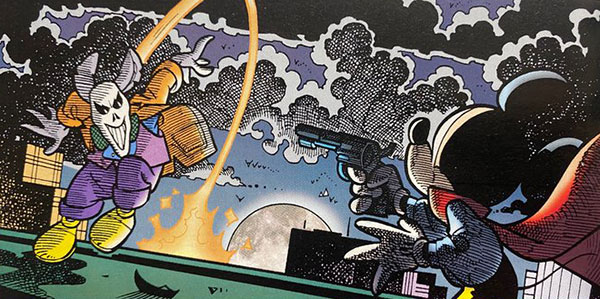
Yet guns had appeared for decades in Disney comics in the US and even animation. For example when Glittering Goldie wasn’t flirting with Scrooge she was shooting him with a shotgun. This happened in both the cartoon and comic books.

This revelation was not to say that weapons were commonplace in fumetti or other European Disney comics. If and when they showed up they fit the form of the story and certain mature themes. Paperino for example had an alter ego as a spy. In addition to being Paperinik Donald also had the responsibility as a spy for his country, known to fans as Double Duck. In the Double Duck (DD) stories sometimes a villain showed up carrying a weapon, sometimes DD had to also carry one along with his tuxedo ala James Bond. Very rarely did these comics have shoot outs and never were any of the characters depicted as getting shot or injured during the battles. The violence of the weapon was implied rather than shown. A gun served as a tool to intimidate not as an excuse by artists to draw graphic violence.
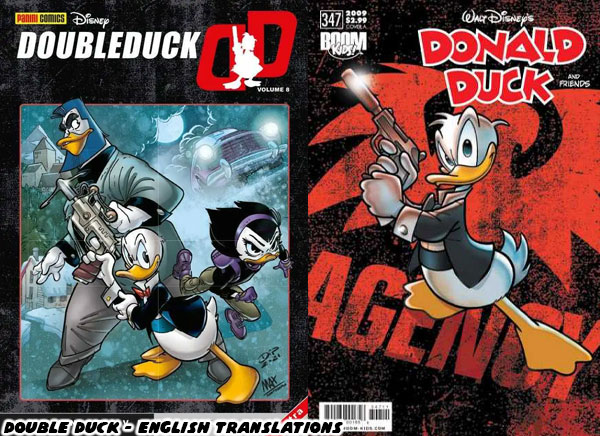
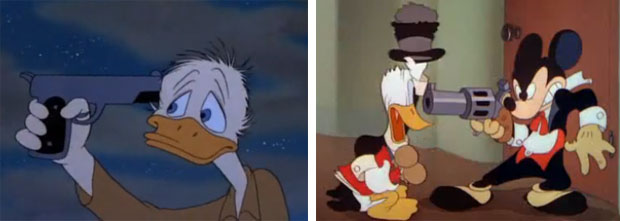
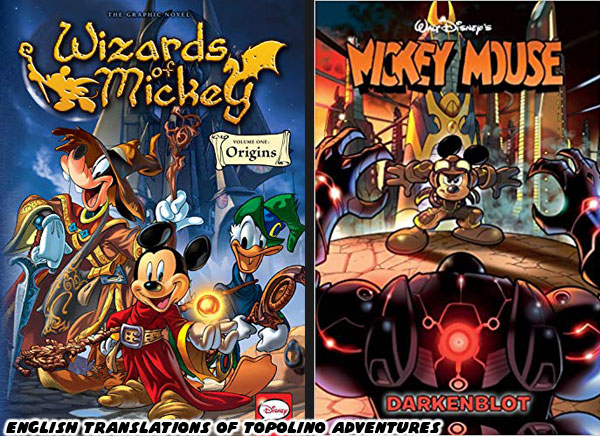
Boom Studios actually published the DD stories in the US and did not censor out the guns as most had expected them to. Many in the west could not imagine an icon being threatened with a firearm but the precedence was set in the earliest Disney short films. Donald was once threatened with a gun by Mickey Mouse in the 1942 film the Symphony Hour. Not to mention the time Donald Duck tried to commit suicide by handgun in the 1943 film the Old Army Game or that Daisy Duck tried to do the same in 1947’s Donald’s Dilemma.

Disney Studios once used firearms in their animated projects and comics only now they seemed to shy away from any form or actual or implied violence. Topolino also used firearms but they certainly never put them flush to the temples of the icons as if they were in any real danger.

If Topolino and fumetti in general were geared only towards children then the writers and artists would certainly never have presented any weapons in the stories. At the same time they would never have produced as many memorable stories and adventures because of their audience. They would not have advanced the art of cartooning or showed how Disney comics could be written for every age.
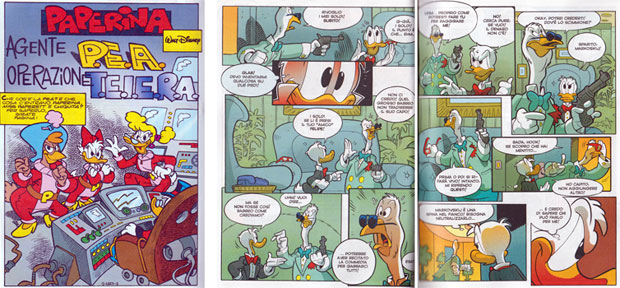
These were a few examples of the creative risks that the Italians took in the pages of Topolino. These were things that would not have been allowed if the comic were limited to a specific audience.

There was a major difference between how Disney was perceived and marketed in the USA versus Italy, or for that matter the rest of the world. Topolino was family entertainment. The comics and anthologies could be enjoyed by both kids and adults. Best of all the fumetti brought the characters to life. The Disney cartoon icons as well as original characters were featured in ongoing stories. These were certainly not reprints for aged collectors but living, breathing volumes. Not every Disney comic published in Europe was approached in the same way.
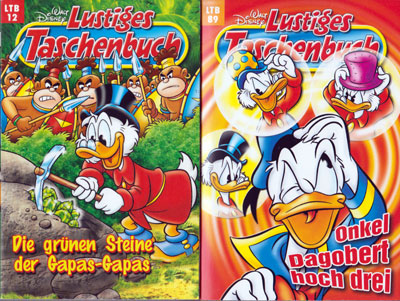
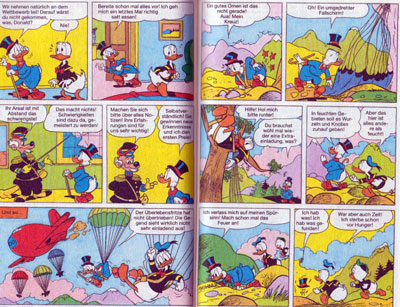
In Germany for example the anthologies featuring the Disney characters could be picked up in local bookstores. These simple 4-color books featured reprints or stories, most meant for kids with very little done in production value. Colors bled into each other and no sort of cleanup was done to enhance the original art. These issues were stale and formulaic when compared to the work featured in the fumetti.
Other European countries did not settle for reprints. They were as passionate about the Disney comics and cartoons as anywhere else in the world. For example Donald Duck cartoons were viewed on Christmas Eve in Sweden as a tradition. Additionally fellow game writer Audun Sorlie mentioned how most stores in Scandinavia did not have a few Disney comics but instead had entire racks filled with the books.
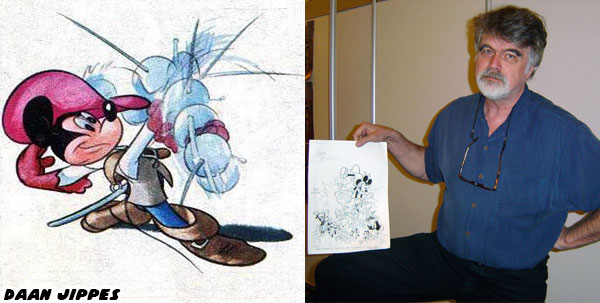
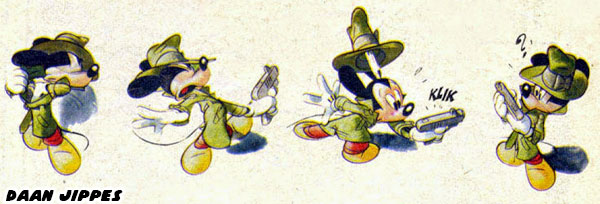
These countries would develop new stories and art for the Disney books. However unlike the Italians the writers and artists from Northern European countries tried very little to deviate from the art and storytelling elements established in early comics. They would go so far as to look for artists that could draw in the same style as the classic Disney cartoonists. Of these artists none was better than Amsterdam's own Daan Jippes. Daan was an exceptional artist that could emulate the styles of the American masters, including Floyd Gottfredson and Carl Barks.

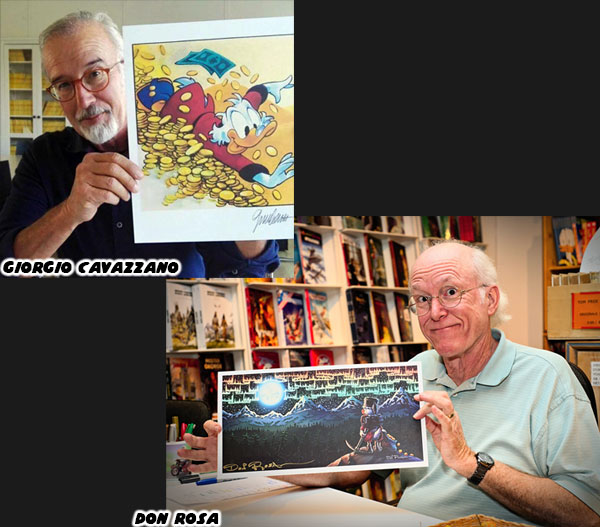
He was so good at emulating the Barks style that he was contracted to redraw stories written but not illustrated by Barks from the 1970's into new collections for the 1990's. Daan Jippes was considered a master of modern comics alongside the US's Don Rosa and Italy's Giorgio Cavazzano. The preference by the Scandinavians for classic characters and little deviation from the Barks canon meant that many of their comics progressed very little, as if they were stuck in a time loop. The Italians had a different perspective, while they respected the work of the early artists they pushed forward into new territory.

Even if the parent company in the USA had not released any new comics or animation featuring the Disney characters in decades they were all still fresh in the pages of the fumetti. Disney in Italy managed to keep the mascots relevant by allowing them to grow within the pages of Topolino. They were willing to introduce new characters and re-imagine classic characters equally. They enticed new collectors by offering toy sets with subscriptions and held onto long-time fans by maintaining a high level of quality in art and storytelling. In the USA most cartoon comics were labeled and marketed towards children specifically. The US publishers did not go out of their way to appeal to diverse audiences or interests. Nor did they offer any toys or figures featuring rare mascots. As such the Disney comic market in the US was nowhere near as big as it was in Europe.

As any business analyst could tell you the best and most successful forms of Disney entertainment were family oriented rather than obsessively kid-friendly. This distinction between entertainment for children and entertainment for families was too often missed by studios, not solely Disney. Mistaking comics and even videogames as a medium for children instead of for families did nothing to help promote the titles. Producing little content in print and toy form for fans and followers above the age of 10 also hurt the brand in the USA. This lack of connection with audiences and the lack of any new content featuring the icons was stifling. The Italian contribution to making the Disney name relevant was not limited to comics either. The next blog will explore how publishers were able to help keep the mascots fresh with collectibles. As always if you would like to sponsor me please visit my Patreon page and consider donating each month, even as little as $1 would help make better blogs and even podcasts!
follow the Street Writer on Patreon!

Friday, March 10, 2023

God of War, the story of the Suicide Tree

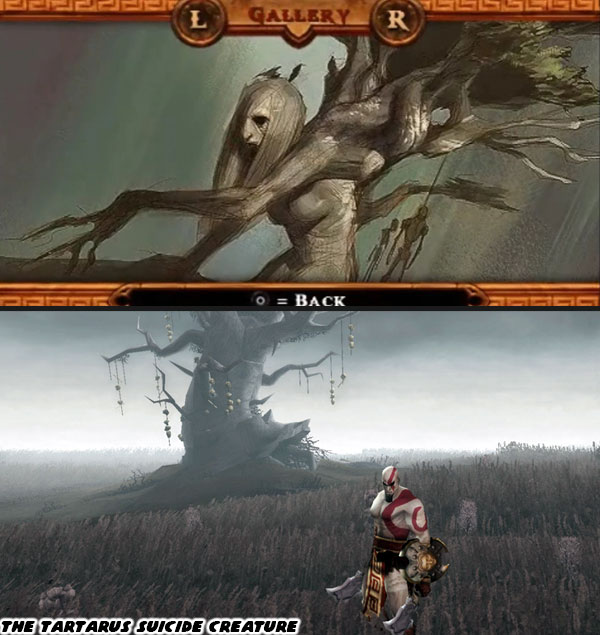
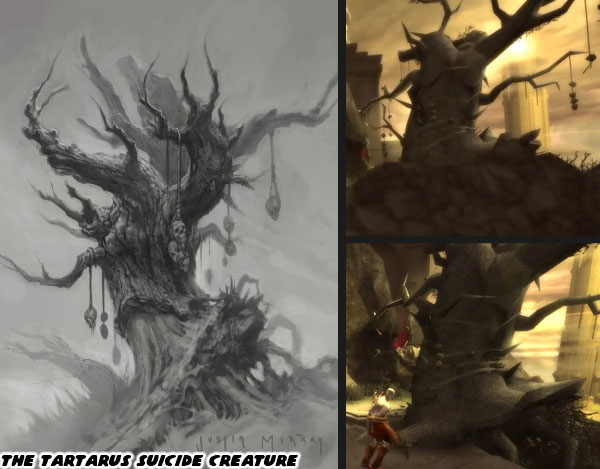
While doing research for my God of War series I had a little bit of extra material that didn’t quite fit in with the other chapters. I’d like to share this little bit of concept work that never made it into the game, and perhaps give it some context. The first is actually a grotesque monster whose origins may be the most disturbing in the franchise’s history. In the early drafts of the game there was a proposed location, that evolved into a monster. Let’s take a look at the literal roots of this creature. Kratos is pulled into Hades during the events of the Chains of Olympus. He is trying to figure out where Helios, the god of the sun, has disappeared to. The team at Ready at Dawn Studios wanted to make the realm of Hades, and the pits of Tartarus look truly unique. They wanted the landscape to appear as dangerous as the monsters lurking within. They proposed a sort of mini boss that grew from a tree. You could see it in the concept art. The tree was covered with bodies hanging by their necks. It was also known as the Tartarus Suicide Creature.

The studio went so far as to create a portion of a level around this beast. In at least one rare screenshot you could see where this encounter would take place. I’m not for certain if this was meant to be in Hades, in Tartarus, or in the mist created by Morpheus in the city of Marathon. There were no buildings, or other signs of life in this location. We could see a curtain of fog hung in the distance. There were gentle rolling hills with waist high fields of grain. There was nothing else on the stage except for a tree with a thick trunk, and exposed gnarled roots. Ropes with multiple skulls hung from the short branches. You could almost imagine Kratos coming up to the tree when it suddenly started rising from the ground. I’m betting that it would have been hiding, or protecting the entrance to the deepest bowels of Hades. It would have been a scary sight.

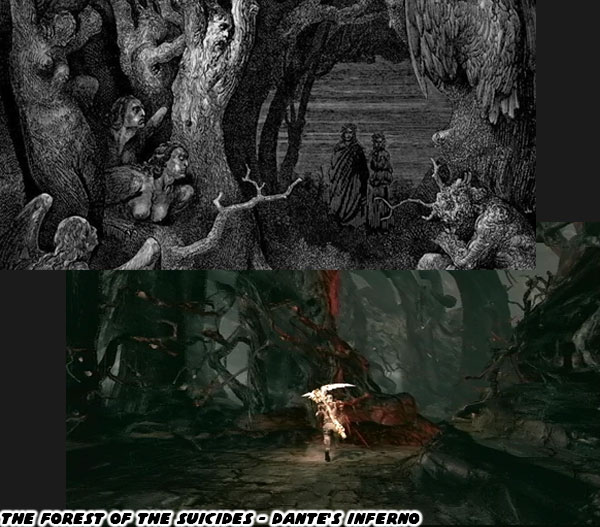
There was something about the tree, and environment that was unnerving. The collection of skulls was of course a huge warning sign, but that was only part of the draw. How did they get there? How long has this tree been used to hang the dead? Were they there by choice, or punishment? Spooky forests are nothing new in classical literature. We can all think of a fairy tale that takes place in some creepy woods. Hansel & Gretel, Snow White, Sleeping Beauty are all stories that share pivotal scenes where the protagonists are lost in the woods. There was one forest that itself became a character in a story. The forest of the suicides was detailed by the Italian author Dante Alighieri in his poem known as Inferno. The forest was made of living trees, which were actually the souls of people that had killed themselves. The spirits could only speak if their limbs were broken. They were tortured by harpies that would break their limbs just to hear them wail in pain.

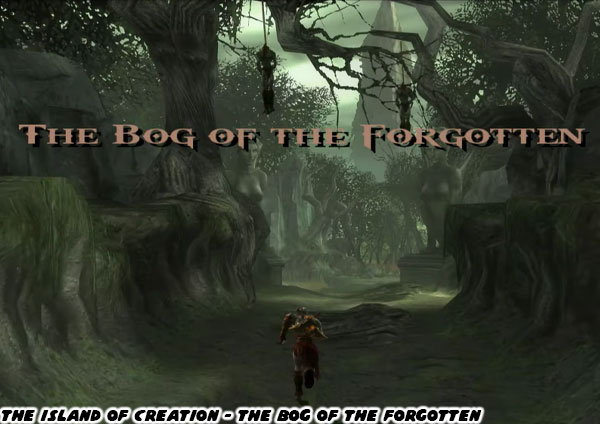
There was a game based on Dante’s Inferno. It was developed by Visceral Games, and published by Electronic Arts in 2010. In it a templar knight named Dante visited the nine levels of hell written about in the poem. He was trying to save his love Beatrice from Lucifer, who we might think of as Satan. It wasn’t hard to see how the dark origin of Kratos, and his adventures didn’t help inspirit the creation of this title. Many publishers were eager to recreate the success that Sony had with the God of War franchise. Unfortunately no amount of sex, violence, or eerily-similar puzzles, encounters, and music was enough to get audiences to switch titles. Of course game play also had a lot to do with the success of GoW. Sony Santa Monica had given us a dark, and twisted forest previously. The Bog of the Forgotten was the early portion of the Island of Creation. In it we could clearly see bodies hanging from the trees. It gave the swamp an ominous feeling. Ready at Dawn wanted to see if they could turn that location into a character.

Illustrator Justin Murray sketched out his idea for the Suicide Tree. He was responsible for a lot of the character designs in the Ghost of Sparta. His tree was oozing with personality. It could have been one of the rare places in the franchise where the terrain evolved into a living monster. Sadly many great ideas have to be cut due to time, and money. This would become one of them. Since the studio had already gone to the trouble of creating a model for it they found a way to incorporate it into the finished game. When Kratos reaches the Gates of Hades we see the tree at the edge of a cliff. Still as ominous as ever, even without any additional context. I’m glad that the studio found a way to use this set piece. I’m grateful that the artists shared their work online, and that Sony also posted additional content. So many game studios never publish art books, or share their concept work. It will hopefully inspire future designers to push the boundaries of their own art. I’d like to know if there was a concept character, or stage from God of War, or any other game that you wish had made it into production. Let me know in the comments section please. As always if you would like to sponsor me please visit my Patreon page and consider donating each month, even as little as $1 would help make better blogs and even podcasts!
follow the Street Writer on Patreon!