Showing posts with label level design. Show all posts

Monday, March 13, 2023

God of War, the runaway elephant

While doing research for my God of War series I had a little bit of extra material that didn’t quite fit in with the other chapters. I’d like to share this final bit of concept work that never made it into the finished game, and perhaps give it some context. I’ve mentioned earlier on the blog that the Piraeus Lion was the best sub-boss in the series. There is an entire stage, and sub-plot in the Ghost of Sparta featuring Kratos stalking an escaped prisoner called the Dissenter. The player does this in the underground prison of Sparta. The atmosphere of the stage, level design, mood, and sound effects all lead up to a battle with the gigantic lion. It resonated with me more than any other sub-boss encounter in the franchise. The fact that they didn’t reuse the lion in any other part of the story made it mean more than any battle with a minotaur, or cyclops. I believe that the inspiration for the Piraeus Lion was due to another encounter that was planned in the previous game, the Chains of Olympus.

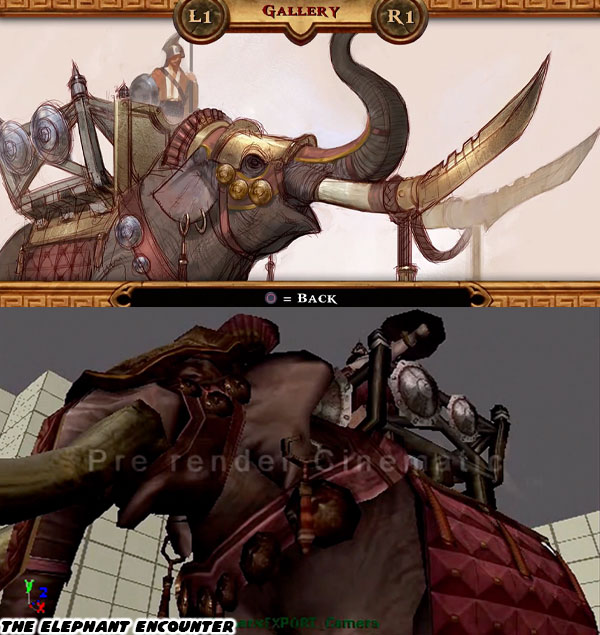
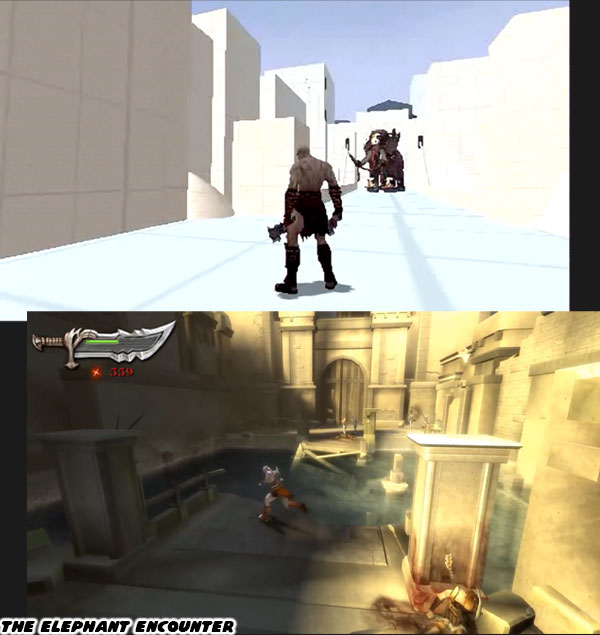
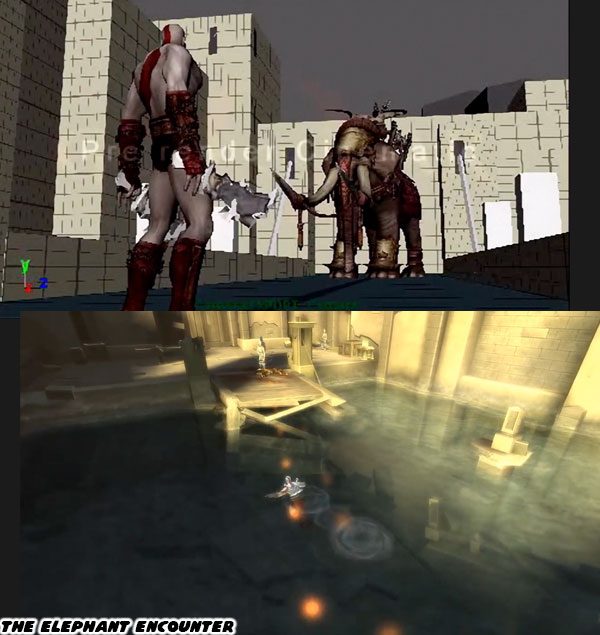
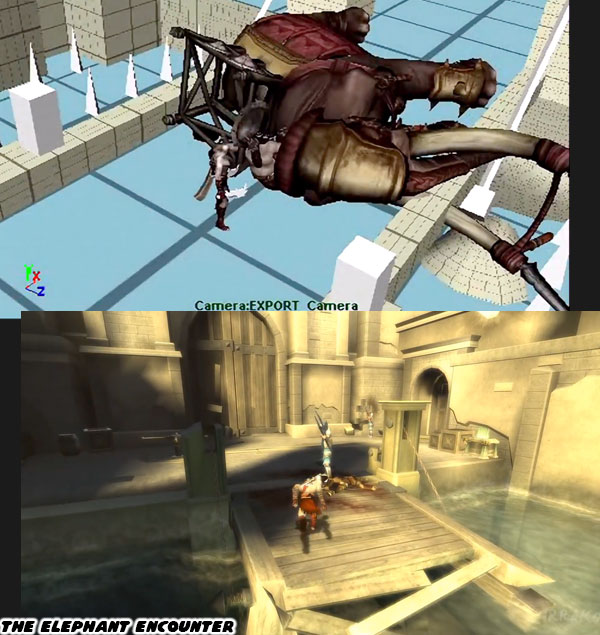
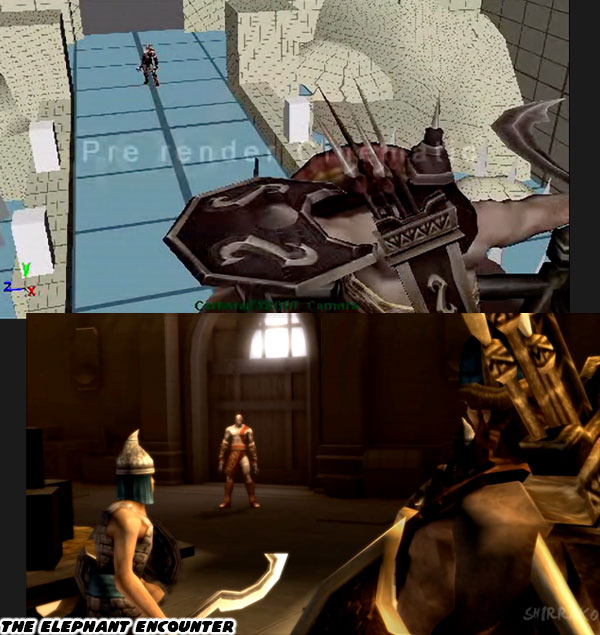
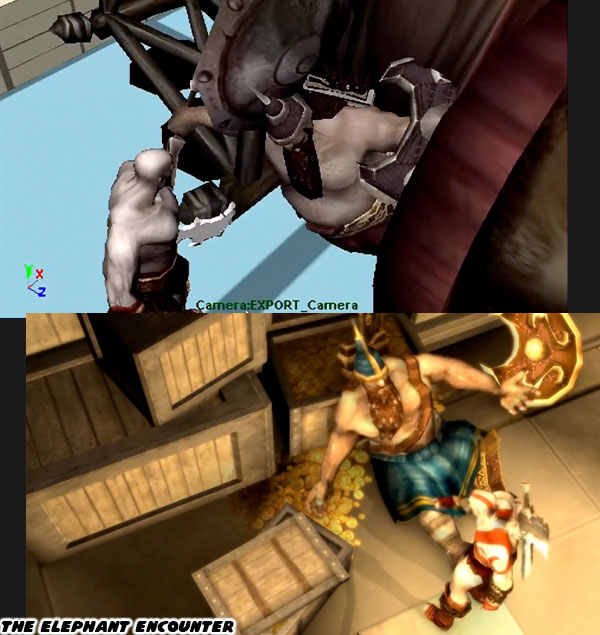
In the concept art for the game there is a war elephant. It is probably one of the best unused enemy designs in the series. It was so amazing that the studio even created a 3D model, and rendered a few scenes as to where this encounter would have happened. At the start of the game Kratos is with his Spartan army helping the Athenians defend Attica from a Persian invasion. This was an actual encounter from history. It was made fantastic with the inclusion of the Basilisk, an enormous fire-breathing reptile that was unleashed by the Persians. Kratos gives the monster chase, fights on the beach, and makes his way to the city gates. He breaks through the armored door by using a battering ram, and turns the corner. This is where he was supposed to see the war elephant for the first time, and its rider, a Persian King. The high walls of the city gate, and bridge make for a constricted fighting platform. Just as the locked cells in the jails of Sparta raised the stakes for the lion reveal.

In the final version of the game Kratos is on one side of a moat, there is a collapsed bridge between him, and some Persian archers on the opposite side. They are taking shots at the future god of war. Remember during this timeline Kratos hasn’t killed Ares yet. He isn’t at full-power, nor reputation. I like to think that it was the elephant that destroyed this bridge in the finished version of Chains of Olympus. I only wish the studio had placed it at the bottom of the moat to complete the story. Anyhow I think that this encounter highlights the approach that Ready at Dawn had over the pacing of the game when compared to Sony Santa Monica. Up until this point the GoW series followed a familiar template. The games start in the middle of the action. A fight scene teaches the basic controls. These are usually against humans, or human-sized monsters. Then an enormous opponent is introduced. It might be the Hydra, the Colossus of Rhodes, the Scylla, or the Basilisk. The fight against these enormous creatures seems impossible, but is manageable with the strength of Kratos, his indescribable toughness, and the magical Blades of Chaos. The rest of the game is a series of smaller encounters until a mid, or final boss is reached. The games would recycle the same characters again, and again throughout the quest. Sometimes they would be reskinned, were still cool looking, but essentially the same rivals. The lack of unique opponents was something that I would consider the only weakness to the GoW franchise.

Ready at Dawn wanted to break the cycle by introducing sub-bosses that were tailor-made to the game. They weren’t as enormous as the final bosses, but more grounded in reality. We’ve seen Kratos take on mountain-sized opponents, and while those fights are fun, we sometimes forget how amazing he is in close combat. That is why the developers had him take on the kings of the jungle. Fighting supernatural lions, boars, bulls, and serpents are the types of challenges that Hercules, Theseus, Jason, and Perseus conquered in their classic adventures. At the same time the creatures in the Chains of Olympus are more than typical wild animals. The Piraeus Lion is bigger than any horse. It is covered in arrows, and swords, showing that it is impervious to most weapons. While the War Elephant is armored, has blades on his tusks, and is trained to fight. To raise the stakes the encounters are set in a tight space. Ready at Dawn knew that they were delivering something memorable. These fights served the story. They helped develop the character of Kratos, and fleshed out the fantastic world he lived in.

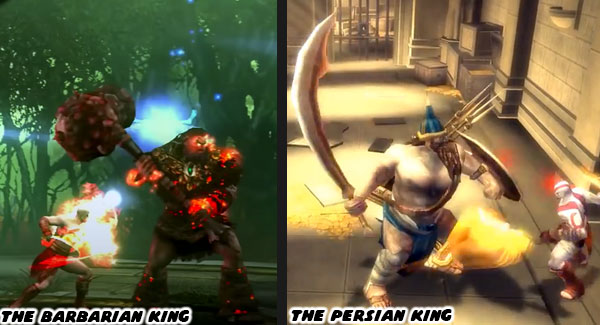
The studio was still able to create a memorable stage despite having to make cuts in the final version of the game. On the back of the Elephant was a Persian King. He undoubtedly taunted Kratos at the gates of Attica, just as he did in the final version. This character was massive. He was as big as Alric, the Barbarian King that almost killed Kratos in God of War, and had returned for a rematch in God of War II. The Persian King was going to be every bit Alric’s equal, and then more. He was on an elephant after all, which was much bigger than a draft horse. He also fought with a gigantic scimitar instead of a hammer, giving him a lethal reach advantage. He could even summon an Efreet, a sort of fire demon to create a burning ring around him. Alric did not gain magical attacks until he was already dead. On his back the Persian carried golden spears. Although he doesn’t use them in the game I have a feeling these would have been his ranged attacks against Kratos. He could have easily struck the Ghost of Sparta from across the stage thanks to his high perch.

The final version of the battle had the Persian taunting some slave girls when Kratos shows up. He says the Spartan is nothing but a messenger for some puny gods. This is of course raises the ire of Kratos. Traditional Persian soldiers surround, and attack him while the king hacks away. It’s a fun battle, and I can almost imagine that the War Elephant would have been a two-part fight. Kratos would have to find a sweet spot to fight on the bridge. If too close then the elephant could have swiped him with his tusks, thrown him to the ground with his trunk, or trampled him with his feet. If Kratos were too far then the king could have rained spears down on him. Once the elephant was defeated then I bet the king would have fallen back, and entered the slave girl room.

While large, and strong the King shares something in common with the Dissenter from Ghost of Sparta. They are both bullies when they think they are winning. Despite talking big they instantly change their tune once Kratos has them beat. The Dissenter called Kratos an impostor, and that Ares was the true god of war while Kratos is getting pounced on by the lion. The King mocks Kratos when they first meet, but then tries to bribe Kratos when he is knocked down. He offers him gold, and women. Kratos turns down the bribe, and then bashes a gold chest over his face. The brutal ending of the king was as satisfying as it was to the Dissenter. I have a feeling that the same person at Ready at Down had scripted both encounters.

If I had any programming, or modeling experience I’d love to restore this battle the way it was originally meant to be seen. Even if just to watch Kratos get thrown around by an elephant for a minute. I’m grateful that the artists shared their work online, and that Sony also posted additional content. So many game studios never publish art books, or share their concept work. It will hopefully inspire future designers to push the boundaries of their own art, and think about how to plot out a game, or story. I’d like to know if there was a concept character, or stage from God of War, or any other game that you wish had made it into production. Let me know in the comments section please. As always if you would like to sponsor me please visit my Patreon page and consider donating each month, even as little as $1 would help make better blogs and even podcasts!
follow the Street Writer on Patreon!

Friday, March 10, 2023

God of War, the story of the Suicide Tree

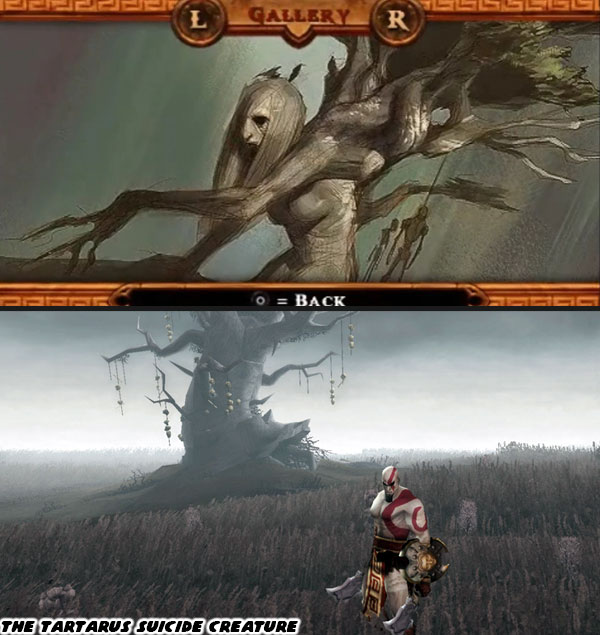
While doing research for my God of War series I had a little bit of extra material that didn’t quite fit in with the other chapters. I’d like to share this little bit of concept work that never made it into the game, and perhaps give it some context. The first is actually a grotesque monster whose origins may be the most disturbing in the franchise’s history. In the early drafts of the game there was a proposed location, that evolved into a monster. Let’s take a look at the literal roots of this creature. Kratos is pulled into Hades during the events of the Chains of Olympus. He is trying to figure out where Helios, the god of the sun, has disappeared to. The team at Ready at Dawn Studios wanted to make the realm of Hades, and the pits of Tartarus look truly unique. They wanted the landscape to appear as dangerous as the monsters lurking within. They proposed a sort of mini boss that grew from a tree. You could see it in the concept art. The tree was covered with bodies hanging by their necks. It was also known as the Tartarus Suicide Creature.

The studio went so far as to create a portion of a level around this beast. In at least one rare screenshot you could see where this encounter would take place. I’m not for certain if this was meant to be in Hades, in Tartarus, or in the mist created by Morpheus in the city of Marathon. There were no buildings, or other signs of life in this location. We could see a curtain of fog hung in the distance. There were gentle rolling hills with waist high fields of grain. There was nothing else on the stage except for a tree with a thick trunk, and exposed gnarled roots. Ropes with multiple skulls hung from the short branches. You could almost imagine Kratos coming up to the tree when it suddenly started rising from the ground. I’m betting that it would have been hiding, or protecting the entrance to the deepest bowels of Hades. It would have been a scary sight.

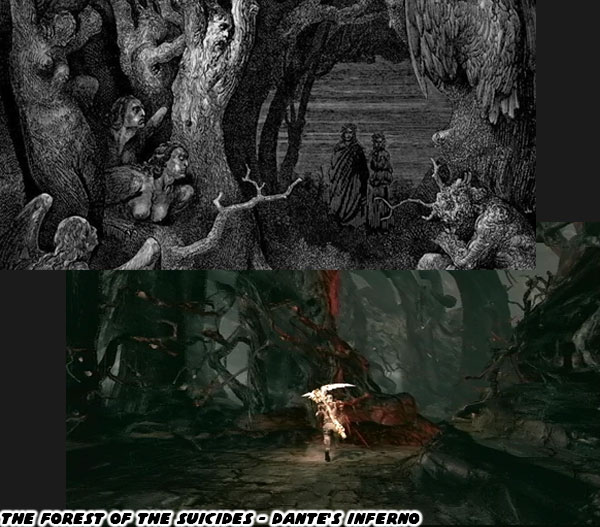
There was something about the tree, and environment that was unnerving. The collection of skulls was of course a huge warning sign, but that was only part of the draw. How did they get there? How long has this tree been used to hang the dead? Were they there by choice, or punishment? Spooky forests are nothing new in classical literature. We can all think of a fairy tale that takes place in some creepy woods. Hansel & Gretel, Snow White, Sleeping Beauty are all stories that share pivotal scenes where the protagonists are lost in the woods. There was one forest that itself became a character in a story. The forest of the suicides was detailed by the Italian author Dante Alighieri in his poem known as Inferno. The forest was made of living trees, which were actually the souls of people that had killed themselves. The spirits could only speak if their limbs were broken. They were tortured by harpies that would break their limbs just to hear them wail in pain.

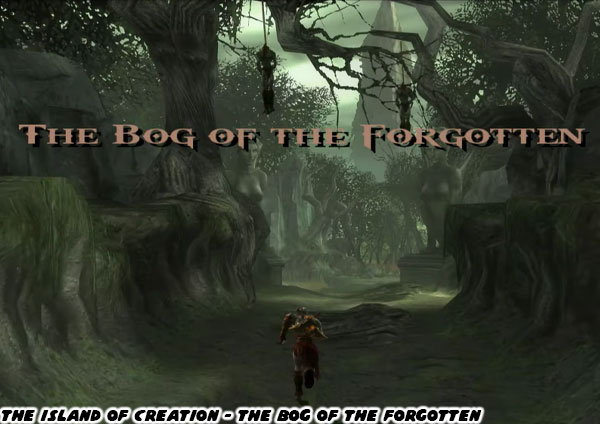
There was a game based on Dante’s Inferno. It was developed by Visceral Games, and published by Electronic Arts in 2010. In it a templar knight named Dante visited the nine levels of hell written about in the poem. He was trying to save his love Beatrice from Lucifer, who we might think of as Satan. It wasn’t hard to see how the dark origin of Kratos, and his adventures didn’t help inspirit the creation of this title. Many publishers were eager to recreate the success that Sony had with the God of War franchise. Unfortunately no amount of sex, violence, or eerily-similar puzzles, encounters, and music was enough to get audiences to switch titles. Of course game play also had a lot to do with the success of GoW. Sony Santa Monica had given us a dark, and twisted forest previously. The Bog of the Forgotten was the early portion of the Island of Creation. In it we could clearly see bodies hanging from the trees. It gave the swamp an ominous feeling. Ready at Dawn wanted to see if they could turn that location into a character.

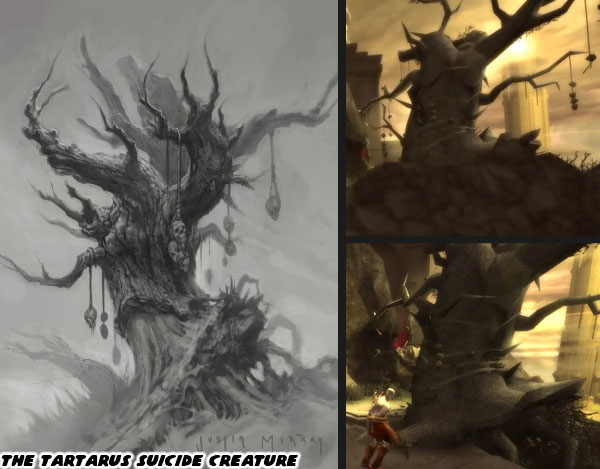
Illustrator Justin Murray sketched out his idea for the Suicide Tree. He was responsible for a lot of the character designs in the Ghost of Sparta. His tree was oozing with personality. It could have been one of the rare places in the franchise where the terrain evolved into a living monster. Sadly many great ideas have to be cut due to time, and money. This would become one of them. Since the studio had already gone to the trouble of creating a model for it they found a way to incorporate it into the finished game. When Kratos reaches the Gates of Hades we see the tree at the edge of a cliff. Still as ominous as ever, even without any additional context. I’m glad that the studio found a way to use this set piece. I’m grateful that the artists shared their work online, and that Sony also posted additional content. So many game studios never publish art books, or share their concept work. It will hopefully inspire future designers to push the boundaries of their own art. I’d like to know if there was a concept character, or stage from God of War, or any other game that you wish had made it into production. Let me know in the comments section please. As always if you would like to sponsor me please visit my Patreon page and consider donating each month, even as little as $1 would help make better blogs and even podcasts!
follow the Street Writer on Patreon!

Monday, April 18, 2022

Designing a sequel to 720°, part 1...

In the previous blog I talked a little big about the look, and feel of my 720° sequel. So let’s expand on it a little bit more. The engine would be in 3D, but presented in an isometric format. The bold use of colors, and patterns would help give the appearance that it is still a sprite-based classic. I would go out of my way to include dozens of Easter eggs, and callbacks to skate game, and arcade history. Not-so-obvious things like putting the Atari symbol as a skateable feature in a park that looks like it was based on a Marble Madness stage. Then there would be more obvious things, like a bike riding kid that looks a lot like the Paperboy, and sci-fi movie billboards for films based on Asteroids, and Missile Command. Well, you start to get the idea...
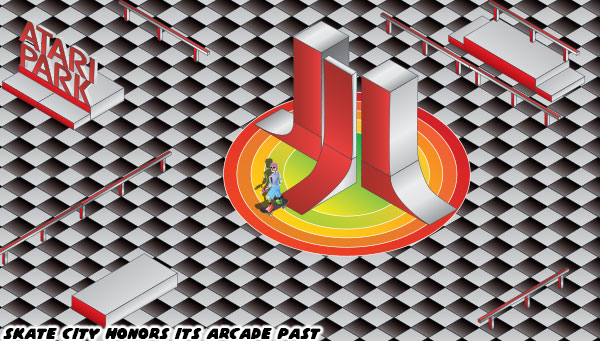
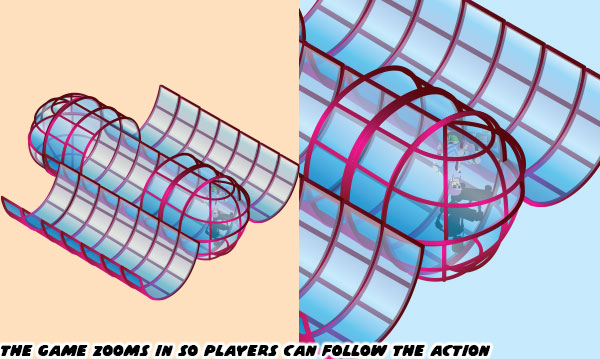
Then there’s the placement of the camera to consider. Modern consoles are capable of putting more information on screen. The resolution on the original Atari hardware for 720° was 512 x 384, at a 4:3 ratio, by comparison the Xbox One S, and newer console resolutions goes up to 3,840 x 2,160 (4K), at a 16:9 ratio. This means that proportionally the game would appear to have twice the screen space. It would be easier to see potential lines connecting objects, and gaps in Skate City. The camera wouldn’t be fixed at a specific distance however. It would zoom in to let you see more detail, especially during contest runs. This would come in handy so you don’t lose your character especially on ramps, or pipes that show transparency.
I thought the main character in my 720° sequel should be a skeleton kid. Skeletons, and skateboarding have been attached at the hip for decades. I talked earlier about the influence of artist Vernon Courtlandt Johnson (VCJ) on skateboarding graphics. His work for Powell Peralta cemented the connection to skeletons, and skateboarding. Even the products that Powell created used the motif. The wheels from the company were called “Bones” because of their color. The construction of a fiberglass-reinforced deck was called “Bonelite.” The plastic rails that they put under their boards so they could slide further were called Rib-Bones. The companies first sponsored skater was Ray “Bones"Rodriguez. VCJ’s first skate graphic was for Ray. Powell couldn’t escape their destiny even if they tried. This was partially the reason why I went with a skeleton lead, instead of a regular human for the sequel.
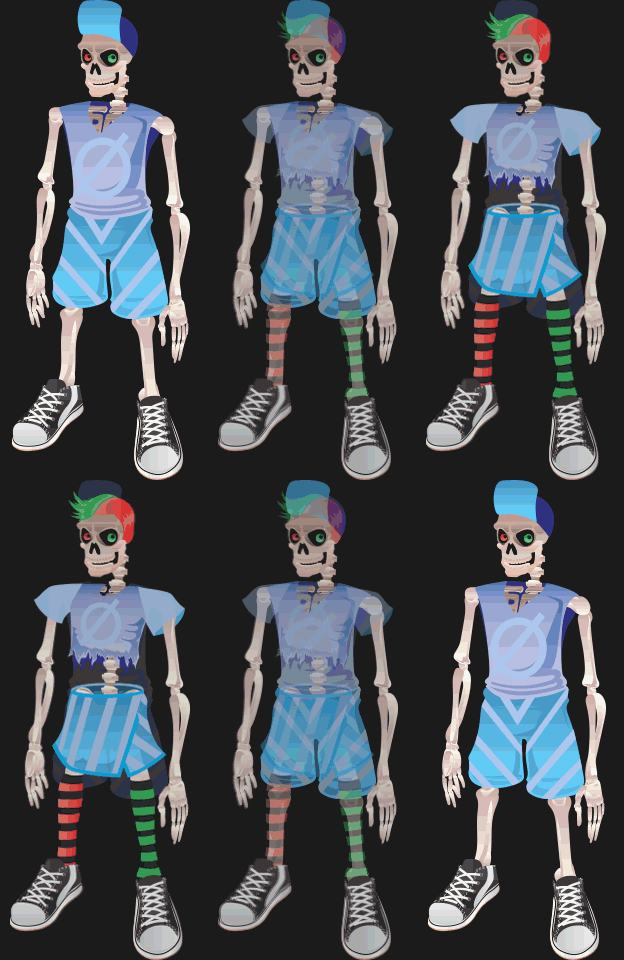
The idea behind going with a skeleton actually has to do with creating a truly neutral avatar. This character is without gender, or race. They are entirely open to interpretation. It could be a white boy in a dress, it could be a black girl with a mohawk. It is entirely up to the player to make the character their own. Of course I'm presenting outfits, colors, and patterns that would have fit in with the '80s aesthetic. Having the ability to change outfits, and shoes is something we take for granted today, but was impossible in the early days of the arcade. The reason I selected the default colors, logo, and costume for the novice was a nod to the arcade original. This character is an amalgamation of the NPC kid found in the parks, as well as the Bones roller skater. 
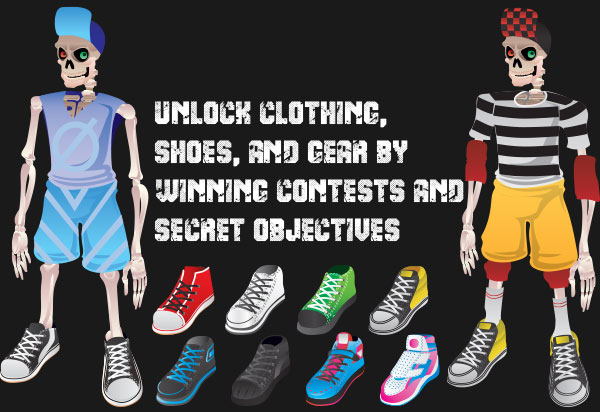
When a player begins the game they start as a Novice. All of the controls in the game are unlocked from the get-go. If I had my way the hints would be disabled from the beginning. There would be no tutorial. Just as in real skating it is up to the player to figure out what they can, and can’t do as they push around Skate City. Getting close to a ledge, or rail while performing a no-comply or ollie can result in an automatic grind, or board slide. The distance of the slide depends on the speed of the character as always, but also on how many times they’ve tried the trick. Players that repeatedly ollie, or grind start to notice that their character jumps a little bit higher, or goes a little bit further on a grind before automatically popping off. Repetition of tricks ensures that they will be landed successfully. Rails that appeared impossible to grind at the start of the game, seem less intimidating by the end. Just as in real life the more you try the tricks the easier they are to pull. The same goes for frontside, and backside spins.
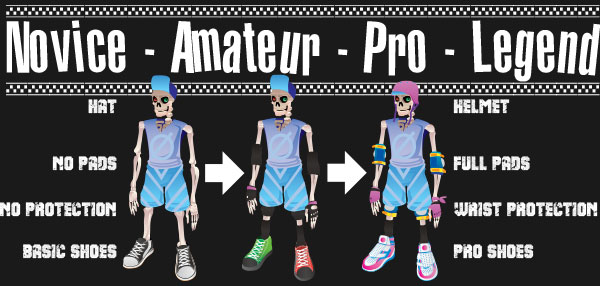
As the character gets greater stats they start to unlock items. At first these are aesthetic things. New clothes, and shoes. Eventually they become Amateur skaters, and start to get invited to contests. Some of the contests take place on parts of Skate City, but others take place in dedicated arenas. The more time the gamer puts into the game the greater the stats, and the greater the ability of their character. Pro rank, and eventually Legendary skaters can go faster, ollie higher, grind further, and spin more rotations than Ams. The game actually helps keep track of these things, and shows your progress. Even details like furthest rail grind, or number of tiles slid on a pool are saved for posterity. If a player finds winning a contest is too difficult then they can always work on leveling up before trying again. Yet if a player is constantly close to winning, but comes up just a hair short then the gear they unlock can help put them over. Earning the right gear, and putting them on the character boosts their stats during a contest. Ensuring that they spin a little bit faster, or stay balanced a bit longer.
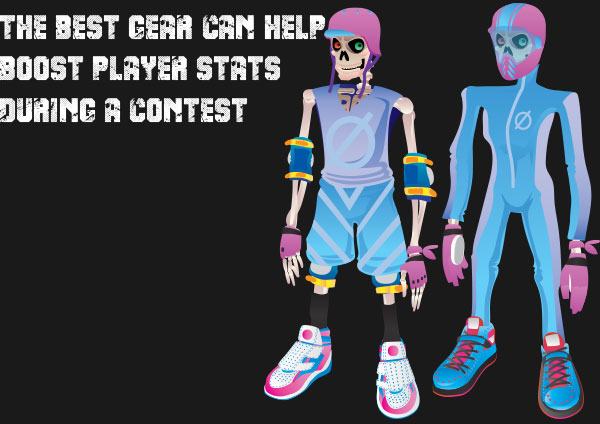
This focus on leveling up, and gear would apply to the skateboards in the game. Since the game pulls a heavy ‘80s aesthetic then the decks, wheels, and colors would be period correct as well. This means that boards would have very distinct shapes. In the ‘80s decks had a distinct nose, and tail. Modern skateboards are almost perfectly symmetrical “popsicle” shape. My sequel would allow players to not only unlock unique shapes, but also change things like the cut of the griptape, color, and even full graphics on it. Players would also be able to add pads, or rails under their deck so they could slide further, and faster. Again, all of these would be based on actual ‘80s skate technology.

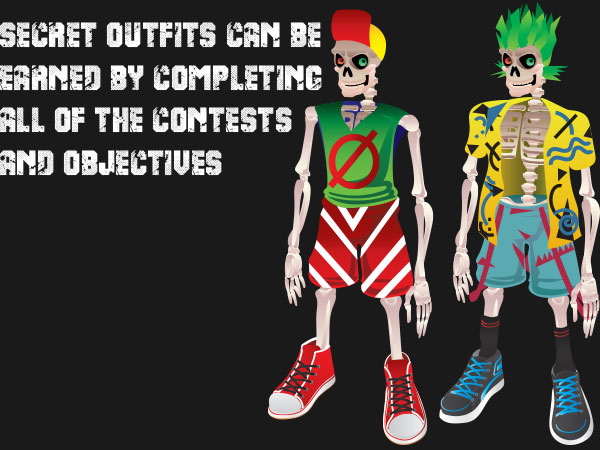
Being obsessive about skate history means that I would hide all sorts of Easter eggs in the game. For example I’d make the last two outfits you could unlock be the outfit worn by the kid in 720°, and an outfit inspired by the box art of Skate or Die, with Bionic Lester’s wild green hair. In my mind the avatar represents the spirit of skateboarding. They will go on skating, and inspiring future generations to skate well after I’m gone.
There’s so much more that I have planned for the sequel. I will spend more time fleshing out Skate City, and the new contests in the next blog. I hope to see you back for that. If you would like to sponsor me please visit my Patreon page and consider donating each month, even as little as $1 would help make better blogs and even podcasts!

follow the Street Writer on Patreon!

Monday, February 4, 2019

The Marvel Contest of Champions Legacy, final part.


Designing fighting game characters was an art form. It was something that I had been studying a long time. For the past 20 years I had been writing about fighting games, specifically dissecting the Street Fighter characters by Capcom. On occasion I had also looked at the designs from Namco, Sega, Midway, and SNK. The majority of the studios were Japanese. I never had reason to bring up the comic book fighting games because they were not my cup of tea. This changed with the Contest of Champions. Kabam was doing a brilliant job adapting the look of 2D characters into 3D models. Their figures were dynamic, colorful, and easy to read. Essentially all of the things that audiences needed fighting game characters to be. The models captured the details perfectly, whether from the pages of a comic book, film, or television. The artists and modelers at Kabam were really doing the characters justice. The heavy hitters, like the Abomination, and Juggernaut had mass, and heft. The small agile characters like Ms. Marvel, and Spider-Man looked elastic, and flexible. The characters the studio created for the game were among my favorite looks for these icons. These were the designs I wish I had seen in animated, toy, and game form while growing up. The reverence for each character showed in the details that Kabam included. This hopefully put the (sometimes) rabid fan base at ease. If not they certainly won me over.


Little by little Gabriel Frizzera and the team at Kabam in Vancouver introduced new things into the Marvel Universe, and they were accepted by the community at large. Their respect for the various properties was tangible. They didn't introduce a new character, or a new Chapter without a reason. Every hero and villain dropped into the contest served a purpose. They all helped drive a bigger story. Kabam had earned enough trust from Marvel to begin putting their own spin on the multiverse. They even created a few new faces in the process. The first of which was Civil Warrior. In the comic book story arc Dark Reign there was a star-spangled version of Iron Man, known as the Iron Patriot. In the absence of Tony Stark this armor was actually piloted by Norman Osborn aka the Green Goblin. Kabam presented an alternate timeline where Steve Rogers killed Tony Stark. Riddled with guilt he donned the metal armor and took on the identity of the Civil Warrior. Having both the Marvel, and Kabam originals be playable characters, each with their own library of moves and abilities was inspired design. It demonstrated the level of commitment that the studio had with the game.


Not every multiverse character featured in MCC was so serious, some were decidedly out of left field. An alien Symbiote infected Peter-Parker during the events of the original Secret Wars. It replaced his tattered costume, and covered him in a black and white mesh that enhanced his strength and abilities. He kept the new look for a while after he returned to Earth. He eventually tore away from this alien, and it stuck to Eddie Brock who was a rival of Peter Parker. This was when they became Venom. In the MCC there were timelines where the symbiote didn't end up with Brock but instead went to Wade Wilson, better known as Deadpool. Venompool was an extreme party animal, but also a dangerous fighter. Again, having moves in MCC that were all his own. The most bizarre multiverse hybrid happened when Howard the Duck, inter-dimensional detective, gained the powers from the symbiote. Venom the Duck was a servant of darkness, and easily the strangest looking fighter in MCC.


It took much more to making a mobile game than filling the roster with fan-favorite characters. The game had to be balanced, no particular class of characters could have an overall advantage. This meant months of tweaking, updates and roster changes. The control had to be simple, and accessible. It had to be something simple to pick up but difficult to master. There had to be an object to playing over, and over again. A series of in-game rewards, daily missions, and more kept people engaged. It also had to to require some skill and strategy to play. Even without using the familiar Marvel characters that was a tall order. Any fighting game, let alone a mobile game, could be undone by the slightest oversight. If a studio spent too much time on the graphics while sacrificing game play then it showed. Fighting game aficionados were a fickle bunch. They wouldn't support a title that was poorly made. There were hundreds of fighting games that had come and gone in the past 30+ years. Few had been as successful, or had lasted as long as MCC. The majority of the survivors were created by Japanese studios, this was one of the few franchises created in the west.


Great fighting games also featured eye catching stages. Most of the levels in MCC had to be spectacles, like the remains of a Celestial in the deep cosmos. This site was better known as Knowhere from the Guardians of the Galaxy. MCC had gorgeous stages by the boatload. They were pulled from the various comics, live action films, and television shows. New audiences could identify the places in the Battlerealm that were pulled out of a movie screen. The Avengers Tower, the location from the first Avengers film was one such place. It was breathtaking when it was illuminated at night. Players almost expected Tony Stark to walk on to the helipad with a drink in hand. Then there was the golden throne on Asgard. Formerly occupied by Odin. Audiences could see ornate filigree carved on the throne and columns. Giant banners swung in the breeze over polished stone floors. It was a stage truly worthy of a king.


Long time fans were surprised to see classic locations also make the transition to 3D. Those that had grown up on the X-Men comics knew about Asteroid-M. It was an enormous planetoid floating near the moon, it had been pulled into orbit by Magneto. He used it as his base of operations, and treated it as a sanctuary for the persecuted mutants of Earth. This place was central to the original X-Men pilot cartoon. It was also used as levels in arcade games by Capcom and Konami. Then there was the Astral Plane, a nexus of magic users often visited by Dr. Strange in the comic books. Seeing this in game form left me giddy. Spreading out the locations for the Battlerealm across the different franchises worked in the favor of Kabam. The studio was not limited to a specific movie, timeline or event. It had room to grow and that was what excited me most about the future of MCC. The universe was completely wide open to them.


Kabam was celebrating four years with the Marvel Contest of Champions. This celebration coincided with Marvel regaining the rights to the X-Men, and Fantastic Four (FF) movies. A good number of mutant characters were already in the title, but the Fantastic Four were notoriously absent. All of this changed at the end of 2018. The Silver Surfer appeared in a trailer and teased their return. Over 2019 new Chapters were planned for the game. Each was supposed to bring back one of the four. January saw the introduction of Ben Grimm, aka the ever-lovin' blue eyed Thing. Who was next would be anyone's guess. Perhaps it was Reed Richards "Mr. Fantastic", or his wife Sue Storm "The Invisible Woman", or maybe even his brother-in-law Johnny Storm "The Human Torch." Gabriel Frizzera and Kabam weren't saying.


The Fantastic Four had always enjoyed some notoriety in comics. They were also the ones that helped lead the charge against two of Marvel's biggest bad guys. Dr. Doom had not appeared in MCC either. There were many timelines in the multiverse where he was the supreme ruler of the world. He was a brilliant scientist, and master of the dark arts after all. Imagine someone with the scientific brilliance of Tony Stark, and the magical abilities of Dr. Strange. He was also underused in cinema for too long, but would undoubtedly get his due in a video game. Having the Silver Surfer in the trailer also hinted that he would be a playable character at some point in the future. And if the Surfer was planned for the game then it also meant that his master Galactus, the "Devourer of Worlds" would not be far behind.

From this point on the game could only grow, and evolve. As long as Kabam continued to explore the Marvel universe there was no telling how long the series could continue. I eagerly waited to see what they had planned this year and beyond. If you want to find out more about this game make sure you pick up Marvel Contest of Champions: The Art of the Battlerelam by Paul Davies. It will get you caught up to the events thus far. Do you have a favorite character or team from this game? What were your favorite comic book games? I'd like to read about it in the comments section! If you would like to sponsor me please visit my Patreon page and consider donating each month, even as little as $1 would help make better blogs and even podcasts!
follow the Street Writer on Patreon!

Tuesday, May 20, 2014

Fighting Layer, return of the dragon, part 8...

As Fighting Layer progressed gamers moved deeper and deeper into Zausu Island. They also moved higher into the property of the host Vold Ignitio. The stages went from open air arenas to enclosed rooms. You would think that at some point the designers at ARIKA would paint themselves into a corner but that wasn't the case. At no point did the levels make gamers feel claustrophobic. Each room in Vold's castle seemed to take up 5000 square feet. Even the corners of the castle seemed to stretch out forever. The Entrance Hall was possibly the smallest room on the estate. There were three doors leading to one of three animal bosses. I'll start at the top and work my way down through these rooms.


The second highest point in the castle was an observatory called the Bird Room. A mis-translation labeled it the Bard Room in the arcade screen. The dome was the perfect setting for the giant Falcon that Vold Ignitio kept as a pet. An enormous painted mosaic of the sky framed the dome. Players fought the Falcon on top of an elevated platform. The bird was difficult to reach as he could fly higher than any player could jump. He would then swoop down suddenly and strike with claws extended. Players that managed to get the bird down to their level had to strike it in rapid succession and hope that they could connect with a special attack. Otherwise it would fly back up and wind down the clock. The alternate animals were no easier to fight.

Players that chose the second door from the Entrance Hall went right to the heart of the castle. It turned out that the host of the tournament had prison cells located underneath his opulent rooms, enough to hold an entire populace. Perhaps the missing residents of the island in fact. The Spawn Room was where the Tiger waited. Players found themselves locked in the cage with the creature. There was of course only way out, to defeat the man-eater himself.


Players could actually reach the Spawn Room if they took the alternate underground path but they could not reach the Bird Room from the underground passageway. The final animal room could only be reached by going through the Aquarium. Players found themselves on the ocean floor in an eerily illuminated cave underneath the castle. There was no rhyme or reason for how players were able to survive underwater without breathing apparatus. I would simply chalk it up to sorcery of some sort. There were many unexplained things about Zausu Island and this was just another one.

The Sea Zoo was the home to a great white shark that enjoyed feasting on fighters and whomever else crossed Vold. An unknown number had met a watery grave in this stage. No manga or animé series had even attempted to explore the possibility that a fighter might stand a chance against a shark. Tigers, bears, lions and giant falcons were plausible in the comics but sharks were absurd. ARIKA gave players a chance to try their hand against the perfect killing machine. Punches and kicks seemed ineffective against the Shark. The best strategy would be to strike with a fast combo and then get out of the way. If it got close enough to players it would grab them with its mouth and shred them to pieces. It only took a couple of bites to kill the strongest fighters.


Players that managed to defeat one of the animal bosses would be able to advance to the next stage. It was assumed that the bosses on each level following had proven their worth by defeating the animal boss as well. Starting at the topmost level there was the Blue Room. It was set in the same observatory as the Bird Cage. This time the platform was lowered to floor level so that players could make out the intricate details on the walls. An enormous Chinese Zodiac dial was hanging on the wall. It was pointing at two sets of characters. The zodiac actually consisted of multiple animals, there were the 12 animals known popularly for the year. However there were also animals assigned by month, day and even hour. These were known respectively as the inner animals, true animals and secret animals. The dial in the Blue Room was pointing at the Dragon Year and Dragon Month, which meant that the Fighting Layer tournament took place between April and May every 12 years. This "Double Dragon" competition had been going on for centuries. One dragon would be crowned and would have to face the dragon that resided in the castle. The Blue Room was the stage where players faced Joe Fendi. The flashy Fendi fit right in with the ornate decorations and gold filigree that covered the walls of the room. Dark burgundy corridors lead to unknown rooms and unknown challenges off in the distance. The Blue Room had a lot of storytelling elements applied to it. Budding game designers could learn a few things by dissecting the construction of each room.


The core of the castle was known as the Red Room. It seemed that Vold had amassed a private army and kept it well hidden. Enormous war machines lined the walls. They were parked row after row and level after level. Players could see that they ran all the way into the distance, into one of the cavernous antechambers underneath the castle. The room lived up to its title as players fought on red iron grates. The room was the stage where players fought Preston Ajax. It made sense that Vold would have the mercenary acting as the leader of his military force. Ajax had seen combat action all around the world and was responsible for the deaths of untold numbers. With his wire garrote and explosives Preston may have been the most dangerous of the sub-bosses in the game.


The Green Room was in the lowest level of the castle but it certainly wasn't treated like a basement. In fact it may have been the original location for the final match of the tournament. A multistory library was hidden behind enormous red tapestries that hung from the ceiling. There was a wrestling ring in the center of the room and the canvas of which had an ornate pattern woven into it. Fancy hardwood chairs were arranged along the wall, for unseen dignitaries and other guests for the tournament. A harpsichord was situated ringside to provide entertainment between matches. A terrace for the host complete with a throne overlooked the entire ring. This was certainly the most regal arena ever created for a match. Players fought Clemence Kleiber, the king of old-school catch-as-catch-can wrestling here. Clemence actually had an extra special attack that he could only use while in this ring. The character could use the turnbuckles to superplex his opponents off of. Players learned quickly to stay away from the ropes or run the risk of being brutally punished.


If a player managed to defeat an animal boss and a sub boss then they would finally get a chance to take on the host of the tournament. The highest point on the island was a tower in the castle named the Dragons Room. The room had open wall panels that offered a glimpse to the mossy stones that made up the exterior of the tower. The level promised a drop of a few hundred meters if players could not stay on the platform. Actually much to the chagrin of many gamers there was an invisible wall that prevented players or opponents from falling off any platform in the game. The dragon motif that symbolized the Fighting Layer tournament decorated the walls and floor of the Dragons Room. Vold Ignitio used the open area to demonstrate his full power. He could climb the walls and plunge down onto opponents like some sort of vampire bat. He could also pounce onto opponents and drag them around by the neck like a jungle cat. Despite his outward noble appearance Vold was a vicious animal, much more dangerous than any creature he kept hidden in his castle.


There were actually multiple endings for each character depending on how well they had done in the tournament and whether or not they had lost a single match. Players that beat Ignitio but lost a match along the way got the basic ending. After defeating the boss the castle and island began collapsing. During the credits an animation would show their character running through a tunnel that was falling apart around them. They would then get the Game Over screen.

Players that met the right criteria however would go onto a final challenge. They would be thrown into the abyss of Zausu Island where the True Knight was waiting for them. They literally went from the highest point to the lowest point of the island in one stage. The Underground 2 was similar to the original Underground stage, only now the Knight had a red lance and was much more difficult to defeat. If players beat him then they had a more complete ending. During the credits they would see their player run through the collapsing tunnel and actually end up on a raft floating in the Sea of Japan. The character would be looking at Zausu Island burn from a distance. Whatever dark secrets the island hid and whatever evil forces had created Vold would remain a mystery.


Fighting Layer was not the hit that ARIKA had anticipated. The genre had lost steam through the mid to late '90s because the market had become completely saturated with fighting games. A revised version of the Street Fighter II myth was lost to most gamers. The lessons provided by the studio within the game were still valid for designers though. The next and final blog in this series will close this chapter on fighting game history. If you would like to sponsor me please visit my Patreon page and consider donating each month, even as little as $1 would help make better blogs and even podcasts!
follow the Street Writer on Patreon!

Monday, May 19, 2014

Fighting Layer, return of the dragon, part 7...

Fighters were drawn from around the world to Zausu Island in the Sea of Japan to participate in the first Fighting Layer tournament. The island was a nation run by a mysterious figure named Vold Ignitio. Only the best of the best were invited to compete and these included two participants from the Street Fighter EX tournament. The team at ARIKA had approached their new fighting game with the same intent that they had in the original Street Fighter II. As the tournament began the first place that players would visit would be the port. As the game progressed the stages would get harder as the players wandered deeper into the island. Ultimately they would reach the literal peak of the island, which was a castle that seemed to go on forever.


Two of the first stages conceived in SFII were those of the port and factory. The two levels would become tied to the characters Ken and Zangief. This time around the stages had random characters appear on them. Only the sub bosses could be expected in the same place near the end of the game.


At the onset Zausu Island appeared like an industrial paradise. The first stage, the Factory, had a ring set out in the port. The walls were made of iron girders. The walls and floors of each arena reflected the stage itself. In the distance were giants pipes from an oil refinery. The refinery stretched off in the distance for a full 360-degrees around the arena. Arika had gotten plenty of practice creating stages in pseudo 3D in Street fighter EX. Prior to that all of the important information or the supporting details in most stages had to be presented straight on in one angle. The camera might pan left or right but not rotate. Audiences had no idea what was around the corner or behind the camera in Street Fighter II, III or Zero. That all changed in Street Fighter EX when the camera rotated a full 360 degrees and the entire stage had the same level of detail as the 2D screens.

When ARIKA began developing stages for 3D fighting games they often lamented the lack of storytelling elements that the 3D arenas in Sega's Virtua Fighter and Namco's Tekken had. Most 3D engines in the mid '90s did not have enough processing powers to render an actual 3D level with much detail. So instead shortcuts were used. Sega limited the draw distance of each stage, used simple textures or created walls to keep the action close to the characters where the rendering engine could animate the complex character models. By comparison Namco and ARIKA used pre-rendered 3D backgrounds that were "stitched" together into a 360-degree panoramic canvas. These backgrounds were highly detailed even if they lacked animated elements. The game engine would only render a small bit of the arena floor underneath the fighters and obscure the rest in shadow. Players could never actually move any closer to the backgrounds no matter how much they ran in a particular direction.


Based on the gigantic pipes and infrastructure it appeared as if Zausu Island had a lot of natural resources. The Factory level was reminiscent of the stages designed for Zangief in the Street Fighter EX series.

As players went further into the island they discovered that the modern factory had been built on the outskirts of an older factory. The architecture and details in Factory 2 looked like they were pulled from 19th century western mining colonies. There were steam engines, ore carts and rusted trains in the distance. Perhaps this was the area that gave birth to Zausu Island's industrial revolution. It now looked like a ghost town, lacking employees. There was an eerie stillness to the level which gave rise to the questions; how old was the island, where were its inhabitants or employees and how long had the sponsor been living there. Surely Vold Ignitio was not the founder of the centuries-old colony, or was he?


Players did not get to stick around at the factories for very long before the true face of the island began to show itself. After two stages the characters were thrown into a pit. The underground arena was a caged off island surrounded by menacing iron fences and the boiling glow of lava. The Underground was more like the Underworld from mythology. In the distance there were eerie carvings on the walls and gigantic chains lining the walls and plunging deep into the bowels of the Earth. This was where the Knight first showed up. Players learned very quickly that the Knight moved slowly and methodically but had the strength of a tank.


If a player managed to defeat the Knight then they were able to climb out of the Underground. The path took them to an enormous Garden. The stage was very reminiscent of the garden that Lady Clarisse d'Cagliostro, from the film the Castle of Cagliostro, used to visit. The ground seemed overgrown and not well tended to. It was overrun with ivy and hanging vines. A statue of two enormous dragons was in the distance. The twin dragons were the symbols of the Fighting Layer tournament but also symbolized the evil that lived within the island. If players had managed to defeat all their rivals up until that point with special attacks and without losing a round then the first surprise boss would show up. Blair Dame would kick out whatever character was waiting to face the player and challenge them instead.


If a player did not manage to defeat the Knight within the time limit then the game was not over. Instead they would be put on the outskirts of the island on a floating stage. The level was dubbed the Airplane and a wreckage of a jet was slowly decomposing in the shallow water. There was even a cargo ship that had run aground near the stage. It appeared as if the area had been a runway at some point. The island must have sank or flooded at some point and this area had become a graveyard for commercial vehicles. The stage was very much like a last chance for competitors. If they wanted to continue in the tournament they had to defeat whatever opponent had also been banished to the outskirts. If they failed then they were at least part of the way back to China or Japan.

Notice that each stage featured so far had a distinct color palette. The colors reinforced the theme for each level. They made a factory look modern or aged depending on the tones and hues selected. Vibrant colors helped add intensity to the levels and muted colors helped create a sense of age and neglect. The colors used on the Airplane stage were ominous. Night was closing in on the player and if they didn't get back to land then they would be stuck on a metal island floating on the pitch black ocean.


If players managed to defeat their opponent at the Airplane level then they made their way back to Zausu Island. However they did not climb right to the top. Instead they took a subterranean passage through the island. The only way to experience this branching path was to actually lose to the Knight in the first Underground encounter.

This approach to level design was unique to Fighting Layer. Street Fighter II was very linear in comparison and offered little diversity for players. In SF II the same opponents were waiting in every stage each play through, unlike the random opponents and even surprise mid bosses that would turn up in Fighting Layer. The next level in Fighting Layer was comparable to the Garden, only underwater. There was plenty of eye candy in the Aquarium. Instead of observing fish inside of a tank the roles were reversed. Contestants fought within a glass arena while the sea life swam all around them. It was one of the more beautiful stages in all fighting game history.


Meanwhile, a few hundred meters above the Aquarium the contestants that managed to get past the Garden finally made their way into the castle where the tournament host lived. The floors and walls of the Entrance Hall was covered in ornate polished marble. Golden statues illuminated the doorways, the portals to the other enormous rooms in the castle. This was the second location where a mid boss might appear if players met the right criteria. This time it was Allen Snider, the other cameo character from Street Fighter EX.


The most memorable challenges would take place if a player defeated his opponent on this stage. Each of the doors in the Entrance Hall offered a choice to players. Beyond would be an opponent unlike any they had ever faced in any other fighting game. The next blog will look at the stages that made up the castle on Zausu Island. If you would like to sponsor me please visit my Patreon page and consider donating each month, even as little as $1 would help make better blogs and even podcasts!
follow the Street Writer on Patreon!