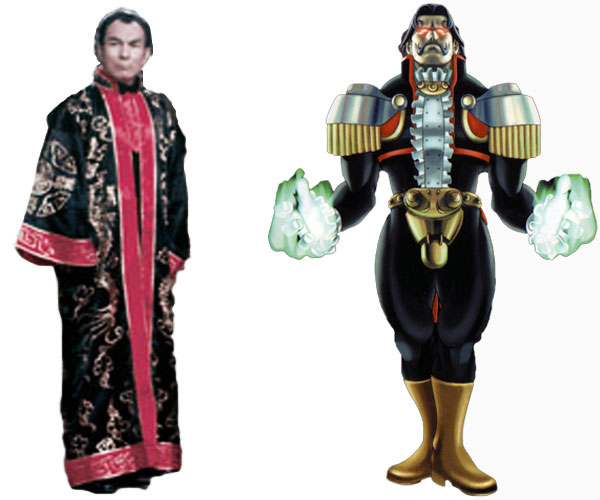
This series began by looking at the film Enter the Dragon and ended by exploring the game Fighting Layer which was created by many of the same people that developed Street Fighter II. Fighting Layer had many of the same elements that made Enter the Dragon unique. There was a powerful and dangerous host that had gathered fighters from around the world. The competition was held on a private island in international waters where no government could intervene. An entire underground complex that housed lethal surprises was waiting for competitors. Even the dragon motif that was featured in the film made its way into the game.

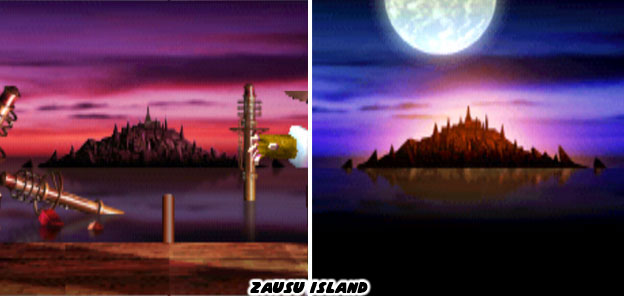
Fighting Layer mixed much more mysticism into the story than any other version of Street Fighter. Although he looked human the host of the tournament was some sort of creature of darkness. He had apparently been alive for centuries and was capable of defying physics and logic. People that lived in the rural areas of China and Japan spoke in superstitious tones about the cursed island in the Sea of Japan. Villagers living near the coast had gone missing for generations. They had been taken by the "dragon" that lived on Zausu Island. Not all of the tournament competitors were familiar with the legends but when they set foot on the island they could tell there was something odd about it. Some fighters were so foolhardy and so confident in their fighting prowess that they welcomed any challenge. When tested against animated suits of armor and man eating tigers they learned quickly that the island would take their life if they stopped fighting even for a moment. Of course the other competitors were just as lethal as any wild animal and willing to do whatever it took to become the greatest fighter ever.

The diversity of characters provided in Fighting Layer was broad and different than those in other fighting games. Although they were set in fantastic circumstances the characters didn't really have the same mythical "fireball" attacks of the Street Fighter characters. Not to mention that the characters had more believable proportions unlike the Street Fighter lineup. This mix of realism and fantasy was unique to the genre. The game offered hidden moves, unique branching paths, secret bosses and alternate endings. The amount of control and gameplay features for the title made it one of the most robust fighting games ever created. Multiple animals that had faced martial arts masters in the comics were for the first time playable against and as. Finally manga geeks or otaku could settle the debate as to what would win in a fight, a shark or a tiger.

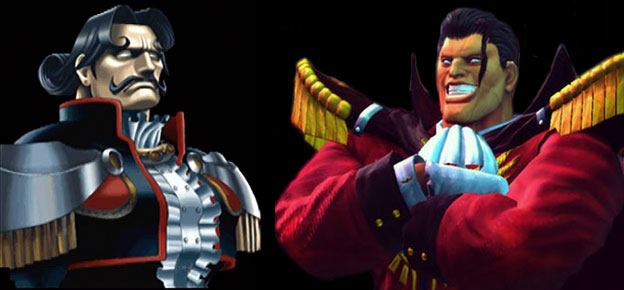
The animals and cursed Knight in the game were not half as colorful as the characters and bosses themselves. Each contestant brought with them a unique story and a reason for fighting. Some wanted to prove themselves in the ring, others wanted riches and notoriety. Some were even looking to assassinate the host and bring peace to the villagers on the mainland. Each of the main characters got a piece of the story if they defeated Vold Ignitio. The truth could only be known to players that beat the game with every possible character. Vold was a master of illusions. He could make himself appear like any contestant and even use their own techniques against them.

If he were defeated he might tempt the winner with riches. Players would find out that the treasures he offered were traps. More often than not he would try to attack players from behind when they were distracted by a prize. Several characters were powerful enough to stop him in his tracks while others fell for his lies and got knocked into the underworld. Sometimes he would hit an opponent and simply run away. Those that broke through his illusions saw the character fall to the ground and burn into a ball of bright light. His shadow would be left burned onto the floor. For one character the source of Vold's power was revealed. Tetsuo Kato, the main character saw Vold burn into the ground. He left behind a large crystal containing a DNA double helix. The blue and red strands mirrored the red and blue dragon logo of the tournament. Perhaps it was dragon DNA that gave Vold his powers, bloodlust and longevity. Kato did not succumb to temptation and shattered the crystal with a punch.

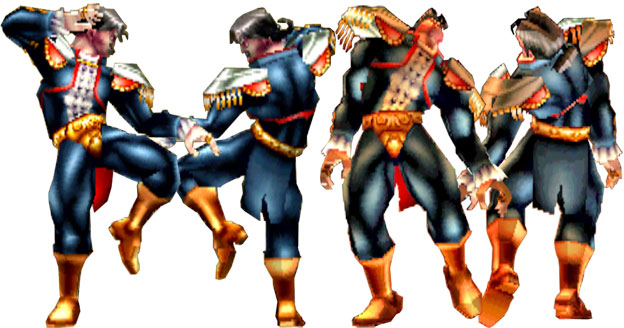
The sub boss characters were not as fortunate as the main characters. Not one of them made it off the island as it collapsed. Some of the endings were bittersweet. The assassin Preston Ajax was almost killed in a bomb blast. He had been pieced together with the remains of his brother, who was a mercenary killed in the explosion. He owed Vold Ignitio his life however cursed it was. The character could hear his brother speaking to him in his mind. Both knew that Vold deserved to die for his crimes against humanity. Ajax fought his way to the top in order to kill Ignitio and bring his island down on top of him. The wrestler Clemence Kleiber died of his own arrogance. He wanted to prove to himself that he was the greatest wrestler that ever lived. If he defeated Vold then he stayed on the island and celebrated, oblivious to the fact that the curse that held the island together was broken. The castle came down on top of the one-eyed wrestler as he waved to his adoring fans. Almost as melancholy was the character of Joe Fendi. The boxing champ had a flair for showmanship. He wore expensive jewelry and watches as he battled and would often swap out his sunglasses in between rounds.

The sunglasses were actually a front. Fendi had gone blind in one eye. He wore sunglasses to keep his secret from becoming public knowledge. Because he would not allow doctors to examine him Fendi was banned from professional boxing. He felt cheated by the system and swore that he would go out as the champ. If he managed to defeat Vold Ignitio then he would become the greatest undisputed fighter on the planet. He did not realize that he would have to deal with the castle as it collapsed. Unfortunately for Fendi a stone that fell from the ceiling hit him on the head and knocked off his designer sunglasses. A near blind Fendi crawled along the ground, searching desperately for his shades. Fendi had a personal trainer that would celebrate with him between rounds. In the ending credits the trainer ran through a collapsing tunnel without Fendi. The trainer ended up alone on a raft as he saw Zausu Island burn in the distance.

Fighting Layer may have revisited the sub boss and final boss designs for Street Fighter II but the game did not set itself up for a sequel. All of the villains ended up dead in every possible ending of the game. Perhaps it was Akira Nishitani's way of getting closure on his original plans for SF II. The producers on Street Fighter, SFII, SFEX, SF Zero and SF III did not want to keep developing sequels for their games. They wanted to tell a distinct story and close it out. They did not want to get locked into a series of upgrades either. Capcom hoped to capitalize on a successful game and turn it into a series. That was a pitfall of market based production. The majority of Capcom fighting game producers had only one story that they wanted to tell in each game. These were never meant to be a jumping off point for any other sequel. The producers wanted fighting games to be treated like other genres and be enjoyed as stand-alone arcade experiences. By killing off the villains and burning down Zausu Island Mr. Nishitani ensured that if he made a Fighting Layer 2 that almost none of the original characters or locations would be revisited.
ARIKA had put enough into Fighting Layer that it could stand on its own and not have to draw comparisons to Street Fighter II or any other fighting game. The first thing they addressed were the visuals. Game production for consoles and the arcade had moved to 3D. The era of the sprite had passed and there was no getting around that fact. The downside for most fighting games were the aesthetics that sprites provided. The Street Fighter series was established in 2D and the work of the 20+ designers created a cast that still has not been surpassed. Characters in the 2D fighting games had undeniable style. The artists could get away with exaggerated proportions and scale in 2D and still make the designs visually appealing. In Street Fighter EX it was obvious that the characters did not transition well to 3D. They looked bulky and generic. ARIKA learned from EX and created a cast that had more visual flair by the use of strong contrasting colors which would stand out more in 3D. In order to help bring over the influences from 2D design the studio added lighting and modeling effects that made their characters pop off the screen. The costume of Exodus for example actually reflected light as if he were wearing a gold flake painted singlet, the
YouTube video of the character barely catches those details. That was not the only visual innovation that the company had added to 3D fighters.

In traditional animation a "smear" was a technique used to create blurry shapes indicating speed. Game characters in 3D moved quickly without any blur or smear effects. Other studios like Sega had experimented with effects to make their 3D characters look blurry while moving fast but none of the studios could quite get the effect right. ARIKA found a way to program an effect similar to a smear. The filter made streaks matching the colors of the character uniforms to create the illusion of speed. It didn't matter if the character were dashing forward or leaping backwards or even if they were dropping down from the rafters. The direction of the streaks followed the characters and the length and intensity of the lines were directly related to how fast they were moving. For example Vold Ignitio was capable of zipping back and forth between the walls with his leaping attacks. He looked like a long narrow streak of red, gold and black while doing so. Jigjid Bartol was large and slow by comparison and rarely got any sort of speed lines applied to his animations. The game also made great use of particle effects and transparencies. Flame and smoke for example were very well done in the game. This was important to Exodus as he could set his opponents on fire and then hit them with a chair.
In addition to the colorful cast of characters the biggest contribution that ARIKA gave the genre were its stage designs. Each stage in Fighting Layer told a story. The entire design was a narrative about Zausu Island and the empire that Vold controlled. Everything the camera showed, from the volcanic underground to the highest point in his castle was ruled by Ignitio. As the camera rotated 360 degrees around the players there was always something interesting to look at. The color choices, details and architecture complimented the theme of the game. When ARIKA wanted to show gamers a village that had been neglected for over a century then they went with faded colors, splintering wood and steam engines in the distance. When ARIKA wanted to show players what the new industrial heart of the island was then they created an enormous futuristic refinery. When ARIKA wanted players to see how opulent the castle of Vold was then they created room after room made of polished marble, stained hardwood and gold statues. All these visual cues grounded the characters into the reality that ARIKA was going for. There were places like this on Earth, countries that had a mix of the old world and the new world in a relatively small area. Of course there were also barons and business tycoons that had amassed fortunes and ran small nations. Without his dragon powers Vold very well may have been a crazed royal, dictator or mafia boss.

The idea to infuse the location with supernatural elements while keeping the fighters grounded with plausible fighting styles made the game unique. ARIKA had done similar things with the locations and characters introduced in Street Fighter EX. Fighting Layer was a more complete version of the themes they had previously explored. It was a worthy way of closing out their original fighting games. They did go on to adapt Namco's Tekken series for the Nintendo 3DS but they never created a new fighting game on their own. They teased a 3DS version of
Street Fighter EX called Fighting Sample as an April Fools Joke but had no real intention of following up with an actual game.
Most of the original Street Fighter II developers had long since moved on from Capcom. They appreciated the institution that their fighting game became but had no intention of revisiting it. They wanted to try their hand at puzzle games, racing games, simulation games and more original properties. Fighting Layer was the last time the senior Capcom team members created a fighting game in the same vein as Street Fighter II. When it came out it was overlooked by most gamers as well the gaming press. The genre had grown and collapsed by then. Gamers were looking for new experiences. New team members were scouted and groomed by Capcom. New developers that grew up playing Street Fighter II tried to reinvent the game and call it Street Fighter IV. It played well but did nothing innovative with the IP. Instead it played up to the nostalgia for the various characters through the years. It was a reminder of why ARIKA, DIMPS and the other companies started up by former Capcom employees decided to leave.
Street Fighter II was a groundbreaking game but it was in the past and instead the producers wanted to focus on the future. They had new ideas and took bold chances with the genre. Not all of these ideas worked for the Street Fighter universe or even with the Street Fighter mechanics but they did help make Dragon Ball Z, Naruto, Yu Yu Hakusho and Tekken games much better. The legacy that the developers left behind would last as long as gaming remained a part of pop culture. We must remind ourselves that they would not have had created Street Fighter II had they not been influenced by martial arts films like Enter the Dragon and The Master of the Flying Guillotine. Pop culture would continue to influence the creators and the creators would continue to change pop culture. It wouldn't hurt for the current crop of fighting game developers to look at more films and read more comics from time to time. Inspiration could be found from just about anywhere. I hope you enjoyed this series. If you have any comments or questions be sure to ask.
If you would like to sponsor me
please visit my Patreon page and consider donating each month, even as little as $1 would help make better blogs and even podcasts!