Showing posts with label shadow of the colossus. Show all posts

Monday, May 11, 2026

Bookmark This Page; The Giant Monster Series

I love kaiju, I love daikaiju, I love giant monsters of all sorts. If you want to see how giant monsters made their way into gaming then Bookmark This Page.

The Giant Monster Series, part 1…

The Giant Monster Series, part 2…

The Giant Monster Series, part 3…

The Giant Monster Series, part 4…

The Giant Monster Series, part 5…

The Giant Monster Series, part 6…

The Giant Monster Series, part 7…

The Giant Monster Series, part 8…

The Giant Monster Series, part 9…

The Giant Monster Series, part 10…

The Giant Monster Series, part 11…

The Giant Monster Series, part 12…

The Giant Monster Series, part 13…

The Giant Monster Series, part 14…

The Giant Monster Series, part 15…

The Giant Monster Series, part 16…

The Giant Monster Series, part 17…

The Giant Monster Series, part 18…

The Giant Monster Series, part 19…

The Giant Monster Series, part 20…

The Giant Monster Series, Final Part

Manifesting a press kit, or how much I love War of the Monsters…

Did you have a favorite monster movie? Did you have a favorite daikaiju? Mines was Rodan. Let me know yours in the comments section. As always if you enjoyed this blog, and would like to sponsor me please visit my Patreon page and consider donating each month, even as little as $1 would help make better blogs and even podcasts!

follow the Street Writer on Patreon!

Monday, November 10, 2025

The $1,400 collectable for serious gaming fans...

Hello friends, I hope that you are doing well. We are getting into the rush of the holiday season, and speeding towards the end of 2025. This year has been full of ups and downs on the work, and family side. We had some milestones happen, and unfortunately some tragedies as well. I can only hope that things are great wherever you are. I am sending you positive vibes if you are going through any challenges. My birthday also happens to be in the middle of the month. I look forward to relaxing, and spending quality time with family, and friends. I already know what some of my birthday presents are because I bought them for myself earlier in the year. I’m notoriously hard to shop for, so I let my family know when there was a sale on a few super rare items much earlier in the year. With that said I still look forward to getting some treats in a couple of weeks. One thing that I wish I could afford was announced earlier this year.

genDESIGN, Akishi Ueda, and Torch Torch collaborated to create a statue of Trico from the Last Guardian. The gorgeous piece is 20 inches tall and costs about $1,400. If I had the money, and the space I would have picked it up in a heartbeat. The game was one of the greatest titles released in my lifetime. It was an absolute masterpiece. Just like everything that Fumito Ueda had released. On the blog I said you must play ICO before you die. I also highlighted how its successor Shadow of the Colossus forever changed the industry. The third game in his run was The Last Guardian. Which I might write about someday. For now I would say that it was an absolute masterpiece. From storytelling, to design, animation, control, music, and direction. There was nothing else that could compare.

I couldn’t believe that the Mr. Ueda released only three games in 18 years. ICO debuted in 2001, however it started development in 1998. Shadow of the Colossus came out in 2005, and The Last Guardian in 2016. Other developers pushed crunch culture, while they cut corners, and publishers forced teams to rush games to market. It was nothing short of a miracle that Sony Playstation Japan supported Mr. Ueda through it all. They allowed him the grace to complete his vision. In doing so they built a legacy of AAA titles in different genres that no other company could compete with. From the birth of the Playstation we could see that certain studios were creating something unique. Polyphony redefined the driving experience with Gran Turismo, while Sony Santa Monica graced action fans with the God of War. genSTUDIO was the one that brought us the “artsy” games that took forever to come out, but were always worth it.

Unless I win the lottery I won’t get the brand new Trico statue. However I already have a great item featuring the fantasy creature. When the game was released for the PS4 there was a collector’s set that included a highly detailed statue. The base even had flocked “grass.” It was one of the nicest collectables I ever got from a game. It was also one of the very few collector’s sets I ever spent lots of money on. I’d like to know what great collector sets you have, or you wish you got. How much would you be willing to spend on a game related item? Tell me in the comments section. As always if you enjoyed this blog, and would like to sponsor me please visit my Patreon page and consider donating each month, even as little as $1 would help make better blogs and even podcasts!
follow the Street Writer on Patreon!

Wednesday, February 28, 2024

Play this before you die - A 1UP classic from August 10, 2006

That's right true believers. This is the game that you can enjoy best after beating Shadow of the Colossus. You see, I got my friends to play SotC recently, I was pushing the game quite hard. Why shouldn't I? It was an exceptional game, an award winner, art on the plasma screen... but my friends recently beat it. The ending was melancholy, it didn't settle with some of them.

The ending was the reason I didn't touch the game again for months after beating it. I wasn't sure my heart take that type of punishment again. I don't mean the stress of fighting wave after wave of enemies in Ninja Gaiden. Or the pressure of entering a FPS match for big money. The punishment I mention was the emotional kind.

I'm a big guy as you may know. But I'm also a kid at heart, a big softy, I fall for the stories. The game I could beat without breaking a sweat. Anyone that knows their videogames and has played adventure titles could beat it too. The story got to me. It was the ending that beat me.

It wasn't a bad ending, but very melancholy. I wouldn't say bittersweet because you've just been had. A trick by Fumito Ueda to get you into his world. Subtle with his use of everything that goes into a great design, so subtle you don't even realize he's playing you, not the other way around. You fall for the game hook, line and sinker. At least I did.
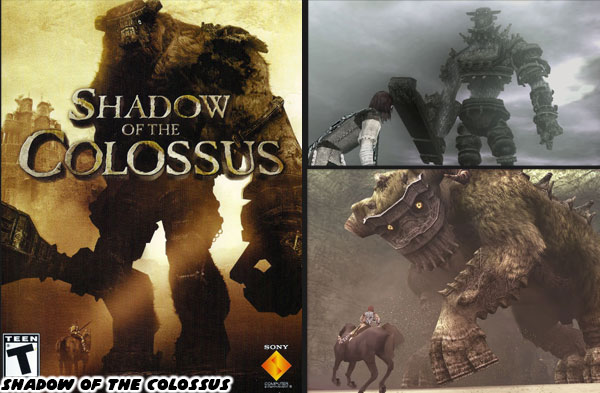
Jane Pinckard asked a long time ago when games would be able to disturb us. I never posted a comment on her blog. Shadow of the Colossus disturbed me, in the way she mentions. How could we keep playing a game if it was no longer "fun?" (ask GH about his Resident Evil 4 experiences). Take a step back and look at the themes that SotC conveys.

Wander is hurt for every colossus he defeats. The scars are quite visible by the end of the game. Is the life of Mono, the girl worth it? What about his self-sacrificing horse Agro? Was it his love or something else that kept us pushing forward? Maybe we just wanted to see what happens at the end. It is our own morbid curiosity that takes us there. It was then that I was unsettled by the outcome, when I was disturbed just a little.

Fumito Ueda is no fool. I've already said that he's carrying the Prince of Persia torch for Michael Ancel. There was a reason for his design, his plot and the outcome of the game. Shadow of the Colossus is not the end but rather the beginning of the legacy. It is supposed to be the prequel to Ico.
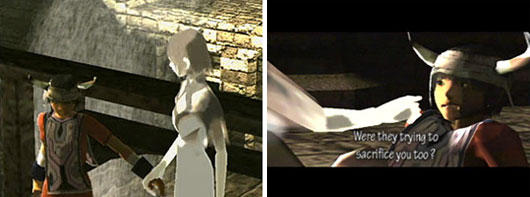
Although Ico doesn't immediately follow SotC in continuity it could be interpreted as such. Is there a relationship between the protagonists in Ico and SotC? There is one! In fact Ueda has said that both games are open to many possible interpretations. The themes of both games are universal. They cross ethnic, political and religious borders. They are games based on good versus evil, right and wrong. Ico frames that better than any puzzle game to date.

Ico is a child sent to a prison because he was born with horns. In the opening moments of the game you really feel sorry for the kid. He is a sympathetic character with wide eyes and a simple way about him. If and when the opportunity to escape arrives you are ready to lead him out of danger. That is until you realize that the mysterious castle in which you are trapped also has another prisoner, a princess named Yorda. In order to escape you have to take Yorda with you. Not that many a gamer would choose to be selfish and escape by themselves. In pursuit of Yorda are some shadowy monsters, sent to recapture her by Yorda's own mother, the Queen.

Talk about an epic adventure!

Ico is a puzzle game, practically a three dimensional retelling of Prince of Persia. You can see exactly where the SotC team learned their chops. You can see where other games like PoP the Sands of Time and God of War took some inspiration. The control in Ico is simple and intuitive, the puzzles are very clever, the graphics amazing and a straightforward plot that beats all. Ico is nothing short of a perfect game, it becomes epic when played right after SotC and not the other way around. Go on and play it again if you have it, pick it up if you don't.
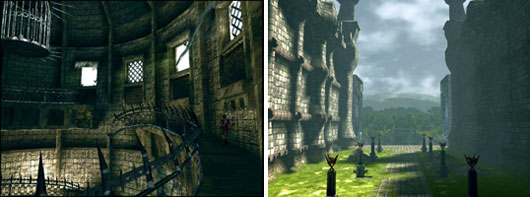

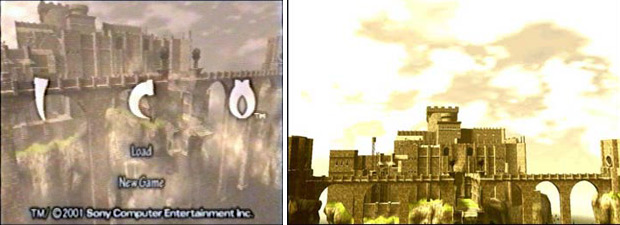
The environments will absorb you. This is part of the world that was on the other side of the forbidden valley in SotC. A castle built on an island, apart from an unseen kingdom in the woods. A giant stone monolith that was built ages ago, with some of the castle lying in ruin. You can tell that Ueda and his team were thinking of a fully-realized world when they began work on Ico.

As far as the eye can see there are details. Birds in the distance, the sound of crickets and frogs. Flowing water, an ocean, clouds and fog to change the mood of the level. All the while you lead Yorda, taking her hand and helping her through the labyrinth of a castle. Ueda says that holding hands is a very powerful symbol of affection in Japan, more so than in any other culture. Most couples just do not do that in Japan. So when Ico first takes Yorda's hand we see the beginnings of a romance. As gamers we have to do our best to get both characters away from the castle and the Queen. To see if they are given the chance to live their lives together, a fate complicated to Wander and Mono in SotC.
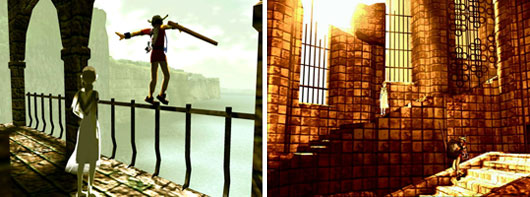

Ico teaches us to be brave in the face of adversity. To take a risk and yet always be mindful of using your brain. Every puzzle has a solution and we have to look and listen for the clues. Sometimes we have to leave Yorda behind to figure out how to escape a room, those few moments apart feel like an eternity. Will she be okay? Will the shadow monsters come for her in Ico's absence? Why should we care? After all she is just a polygon model, a device to get us from point-a to point-b.

If that's the case then we are playing games for all the wrong reasons.

Nintendo fanboys have nothing to get worked up over because Link will always save Zelda, whether they play the game or not. Gears of War is not really a battle to save humanity. The zombies aren't really killing people in Dead Rising. This is not really the Final Fantasy and Grand Theft Auto is not about the GT or the A.

Ueda is no fool. He plays with our emotions in Ico just as easily as he did in SotC and does so masterfully. Ico has an ending, something unique. While open to interpretation it is less melancholy than SotC.

For the scope of both games Ueda delivers a story that is the videogame equivalent to the Star Wars trilogies. What unsettled me in SotC was what could have been in the turn of Anakin Skywalker to Darth Vader. What worked in Ico was the redemption of Luke and his father. Had Lucas done it right the Anakin to Vader story should have disturbed audiences. Fortunately Ueda doesn't fall for the same traps, there are no Jar-Jar's, CGI does not replace plot and Han always shoots first.

The US version of Ico doesn't have the secrets found in the European and Japanese versions. It still delivers one hell of an experience. Ico is a game that everyone should play before they die, especially if they have just finished Shadow of the Colossus.
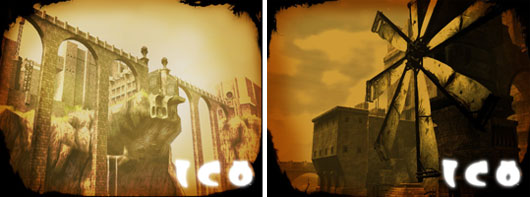
Now if you'll excuse me, I have a lawn to mow and work to catch up on. Peace. As always if you would like to sponsor me please visit my Patreon page and consider donating each month, even as little as $1 would help make better blogs and even podcasts!
follow the Street Writer on Patreon!

Wednesday, February 21, 2024

Returning to Shadow of the Colossus - A 1UP classic from September 23, 2008

Apologies for the tardiness of this blog my friends. There are multiple workshops going on. I'm even lending my chair out to a student and typing this blog on my knees in front of the screen. I'll keep it short before the circulation to my legs gets any worse. I just got Shadow of the Colossus back from my cousin. I lent it to her a year ago after I let her borrow God of War and GoW II. Her and her boyfriend were feeling pretty confident in their game playing skills so I told her I had something equally epic yet more artistically presented. I lent them SotC yet after a year they couldn't pass the second colossi. So I just told her to give it back so I could play some more.

It says a lot about the state of game design. We take games and the ability to play games for granted. The button combinations and boss strategies are second nature to most of my friends. But for those that aren't die-hard gamers then a title like SotC is simply confounding. My cousin is no slouch, she plays games all the time including Guitar Hero but I am wondering if both GoW titles are really that much "easier" or that they are simply more forgiving in their challenges. With GH it is easy to see that repetition and button memorization gets non-gamers through the levels. But what of SotC? What is the challenge there? Perhaps it is a right brain versus left brain struggle. Minimalist cues are used to help gamers locate and defeat each of the colossi. Those that explore the game and learn the nuances of control are rewarded for their efforts. A gamer that isn't used to experimenting in such a way, while at the same time being able to control Wander and target moving colossi would be stumped. Those more casual are used to being "spoon fed" the next location or strategy for defeating bosses. Somehow they get the same sense of accomplishment for beating the title as a core gamer would. OR do they? I'm not sure.

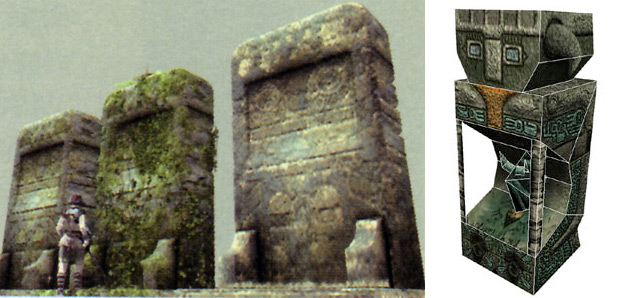
Shadow of the Colossus is a game layered in detail. A tremendous visual and emotional treat for those that are willing to go completely into Fumito Ueda's world. The more you look the more you will see, even year's after the game's release. These things may be coincidence, glitches or programming oversights but many fans have convinced themselves that Ueda and team left a lot of clues about the game's relationship to Ico hidden throughout the level. For example there is a beach in SotC named Ico Beach by fans. It was named after the ending location of Ico. There is even a "Secret Garden" with gems that tie the universe of SotC and Ico together.

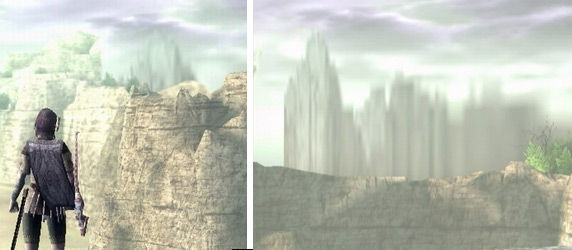
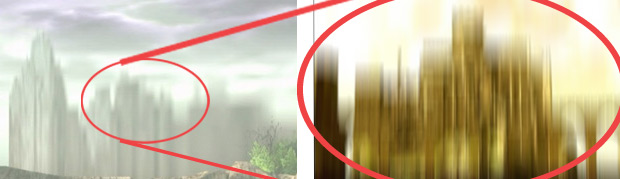
One thing debated amongst fans is the existance of the Queen's castle from Ico in SoTC. There is a large blurry texture, tucked away in a far corner of the map and not visible from the rest of the world. Are fans seeing something that is not there? A texture that was supposed to represent a mountain range perhaps?

I think it's a stretch to say that it's the same castle featured throughout Ico but if we were to run it through a Photoshop motion blur and stretch it a little then it becomes more apparent. Perhaps the Queen's castle won't materialize from magic to reality for another few centuries so it is distorted? What do you think?

Or perhaps the charm of SotC is seeing how the world is set to evolve and how the icons and magical totems would change between games. It's all reasonable if you stop and think about it.

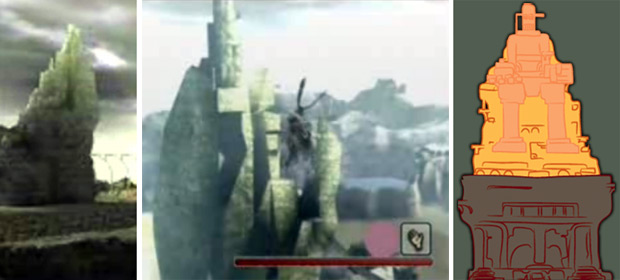
When I first got the game I used to imagine what each of the colossi would look like. As great as they were I was kind of let down with the final one. I thought that Ueda had set us up from the get-go and the final colossi was actually in plain site the entire time. From a distance the castle and temple that Mono is lying in looks to me like a throne with a colossi sitting atop.

This stone man would have been even larger than the final colossi and had he stood from his throne and walked about the forbidden land for the final showdown then my head would have exploded from the awesomeness. Although that never happened I can always wonder can't I?

A game that is filled with tremendous wonder and a feeling that the universe is infinitely larger than the story we are presented. It allows our imaginations to run wild and fill up the spaces in between. That is the legacy that Ueda has left us with. Now, if only he could be so kind as to drop a hint for his next project. As always if you would like to sponsor me please visit my Patreon page and consider donating each month, even as little as $1 would help make better blogs and even podcasts!

follow the Street Writer on Patreon!

Monday, February 5, 2024

Thank you Michael Ancel - A 1UP classic from July 20, 2006

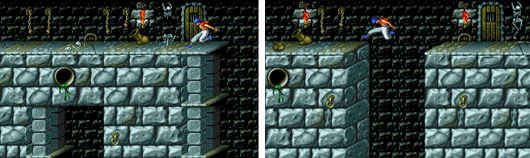
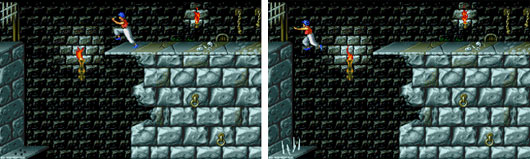
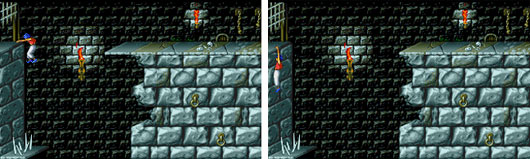
This summer I've been plugging away at one of my all-time favorite titles (that didn't make the top-20 list). Michael Ancel's original Prince of Persia.

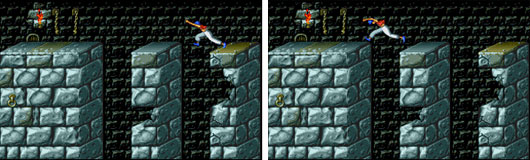
The game is filled with many cliffhanger moments and spectacular jump sequences. Mario can get away with flubbing a jump every now and then, in this game one misstep can cost you five minutes of progress. That can get very tiring very fast.

Prince of Persia is an adventure game in the loosest sense of the word. It is also a puzzle game. Not in the sense that you pick locks and figure out magical boxes. The puzzles are the labyrinths, some paths lead to certain doom, others to reward.

The only thing you can do is keep headed forward. Hope that in the next screen there is a way out and not a trap. It's the first game that I know of where you could take a leap of faith. Nope, you had to take a leap of faith in order to progress.

Step on a gate release, turn around and run full tilt for three and a half screens and at the very last possible moment leap off of a falling tile, over a chasm and a pit of spikes and catch a ledge on the other side of the room. Hurry now and climb the ledge before the gate closes on you!

That magic, wonder and simplicity of the first game was gone in the remakes. The Prince had become a jaded hero with attitude. You know, the stuff that was really popular in the late 90's? The original Prince was like Indiana Jones... timeless.

I'm thankful for Michael Ancel's original game. It taught me to be brave in the face of adversity. Always be willing to take that leap of faith.

The closest thing to capturing the spirit of the original Prince of Persia has to be Fumito Ueda's Shadow of the Colossus.

My friends have started playing it. Because of them I decided to give the game another go around, this time on hard mode. Possibly the time attack on hard mode once it's all said and done. The rewards are worth the sacrifice, I know that's what the Prince of Persia would do in the same situation. As always if you would like to sponsor me please visit my Patreon page and consider donating each month, even as little as $1 would help make better blogs and even podcasts!
follow the Street Writer on Patreon!

Friday, February 16, 2018

The Giant Monster Series, part 6...


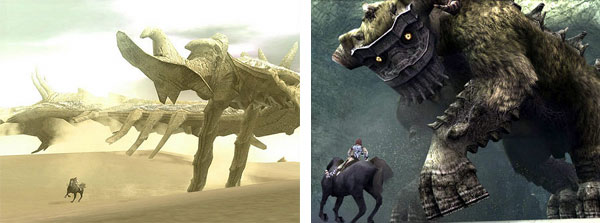
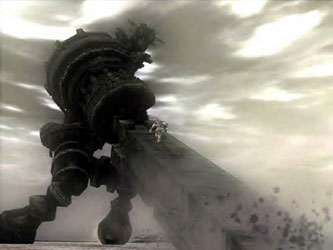
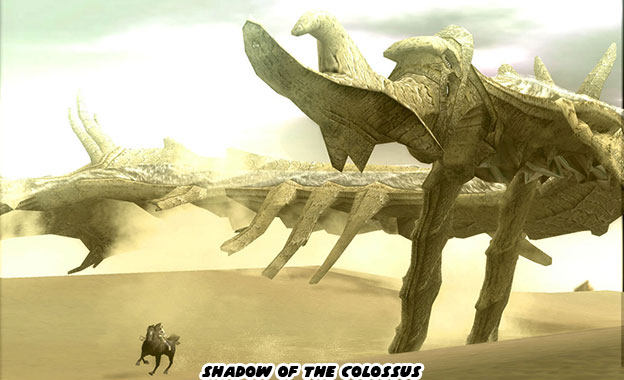
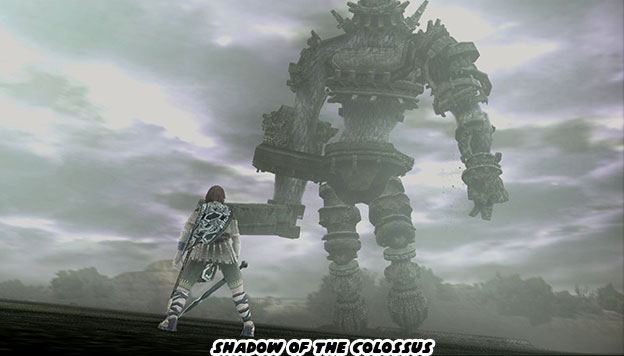
The first game featured today should be enshrined in the gaming hall of fame. Shadow of the Colossus (2005) was an international sensation when it was released. Very rarely were games so universally accepted that they required little if any localization. In order to be played the game required nothing more than the time, patience and practice. The game did not really need dialogue or lengthy cut scenes in order to be enjoyed but it didn't hurt that they were included. Fumito Ueda's tragedy featuring Wander, Mono and a very brave horse named Agro showed the industry that the giant monster could be a stand alone genre. The game used every lesson taught by giant monster films and classic literature and then created an original play experience out of them. The game isolated players in a forbidden land. They were enclosed by high cliff walls that couldn't be scaled and an ocean that could not be crossed.


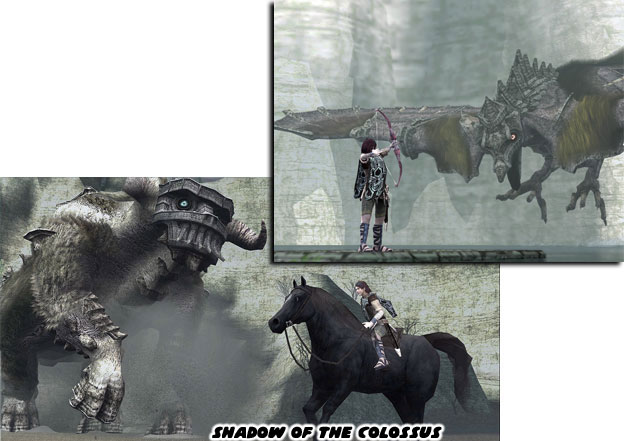
Players could do nothing more but explore the environment and search for enormous creatures that were part living and part stone. Wander was equipped with two weapons, a bow and arrow and an enchanted sword. The creatures were invulnerable to both weapons with the exception of some strategically placed magical tattoos. When Wander stabbed the colossi on those tattoos the monsters could be defeated. Players did not know about the rules of combat regarding the colossi or how the sword worked. They were trained by the levels on how to run, scale, roll and jump around the environment. Little by little everything in the game was learned simply by playing rather than by going through a tutorial. Knowing how to perform multiple actions would come in handy as the colossi they fought were harder and harder to reach and defeat.


Just one of the genius details in the game design was in creating tension before each encounter. The levels were spread out far enough for players to develop a sense of isolation as they went from battle to battle. The music and sound effects reflected this emotional pull. Each colossi was introduced in a short cinematic that showed players the enormous scale of the creatures. They were very intimidating and no two were exactly alike. The music would pick up and increase the pressure for the duration of the battle. The colossi would focus their attention on the player with bright unblinking eyes. They would search for them, stomp and scratch at them as they ran and hid in corners of temples and pits. It was an amazing action experience that was highlighted by the giant monsters themselves.


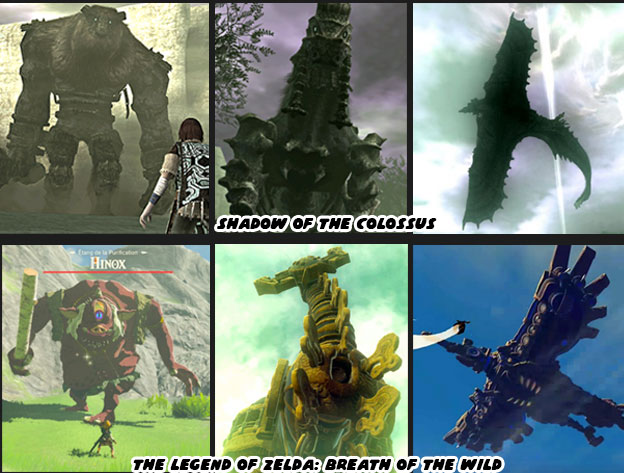
Ueda had created a universe filled with mythical creatures that appeared to be alive. He left enough clues on each level to let the origin of the creatures be explained. At some point the colossi might have been considered gods to the ancient civilization that built the temples. Prior to the colossi there was a single creature that inspired fear in the old tribes. Dormin was a dark, horned god that used to rule over the land. He was split into 16 pieces that each became a colossi. During the game it was revealed that Wander was slowly becoming possessed by Dormin as he defeated each of the colossi. On the last stage Wander underwent a transformation. Players could suddenly control Dormin against a group of tribal elders. This twist to the plot and game play was sublime. Players had no idea that they would end up becoming the creature that had been leading them on. Shadow of the Colossus redefined the giant monster genre and ended up influencing titles yet to come, not the least of which was Nintendo's award-winning game The Legend of Zelda: Breath of the Wild (2017). It turned out there were still other lessons that could be learned by playing with and against the creatures.


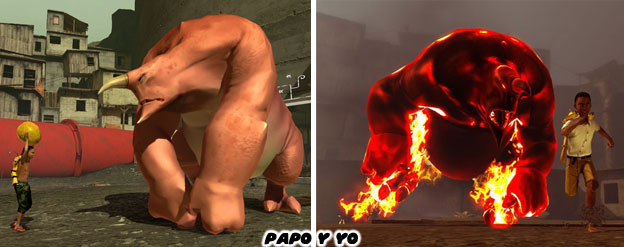
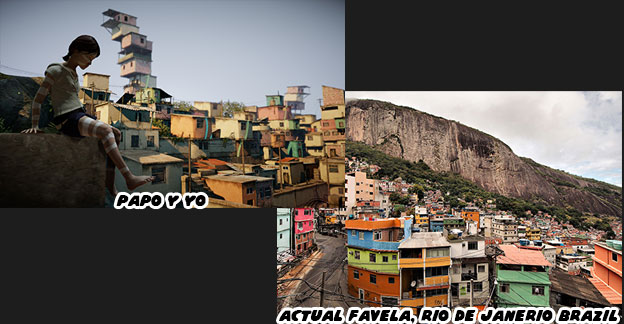
Vander Caballero created the indy hit Papo y Yo (2012). Minority developed an experience that captured the art of storytelling in gameplay as well as the biggest Triple-A studio. The game revolved around a unique relationship created between a monster and a little boy in a Brazillian favela (slum). The game turned the imagination of the young Quico as gameplay elements. Quico was searching for a way out of the favela while trying not to irritate the monster Papo. The game was actually an allegory for the relationship between the Vander and his alcoholic and abusive father. Quico could make walls turn to stairs and have building stretch as if the world were made of toy blocks and Silly Putty. Papo was available for some of the puzzles by triggering doors, traps or simply helping Quico reach higher places. The exploration and imaginative puzzles was only part of the reason that gamers wanted to find a way out of the favela. The sense of isolation that Ueda created in Shadow of the Colossus were mirrored in Papo y Yo. The favela was modern, it had color and personality but it also appeared like a prison. The walls were made up of the homes of people that seemed perpetually absent from the world. As far as the eye could see there were the walls, leaned onto the next, piled on top of each other. Despite the brilliant graffiti murals it was an oppressive site. In Shadow of the Colossus Wander would have to travel through the ruins of castles and temples that were even more imposing than the colossi that dwelled within. These design choices were part of the psychology of the games. The isolation created by these locations made Wander and Quico more sympathetic and their struggle more impressive.


Papo had a weakness, he enjoyed eating frogs but when he did he became a raging monster who did nothing but hurt and destroy. Papo could be pulled out of his rage by feeding him melons, but like sobriety to a person with a severe problem it was a constant struggle. The contrast between the friendly Papo and the flame-engulfed monster was a shock. Players learned to keep an eye on Papo while trying to figure out the next puzzle. The tension in the game was palpable. Players were tiptoeing around a ticking time bomb yet rather than stop playing they were compelled to help Quico escape. The emotional draw of the characters pulled audiences into the world. It was similar to the attraction behind Shadow of the Colossus. Wander needed the player to help him defeat the colossi and resurrect Mono. Quico needed to find a way out of his nightmare. Both games taught audiences to be brave and even defiant in the face of adversity. It also forced the players to think about their own mortality. The psychological elements from the giant monster myth were done equally well Papo y Yo. The isolated environment, the layers of detail that brought players into the world. The indestructible creature. When these things were combined they helped create a sense of primal fear. The fact that the game was created as a coping mechanism to help with those that came out of abusive relationships was superb design.


There was more to the giant monster genre than simply running from or battling against them. It was something that had been overlooked in the series thus far. A completely different contribution to gaming that could only be provided by the creatures themselves. Entirely new styles of gameplay had to be created so that the player could wreak havoc on an unsuspecting population. To say that the newfound power went directly to the heads of the players would not be far from the truth. In the next blog we shall look at the games that turned gamers into virtual gods.