In an earlier blog I mentioned the elements that I thought made for a great sequel. When movies were exceptionally made, told a riveting story, and had actors that made us believe in the world the director had created then it was possible to have an even more amazing sequel. I talked about how Aliens, Back to the Future II, The Empire Strikes Back, and Terminator 2 were awesome follow-up movies. They had raised the stakes, gave more important roles to the main characters, and even let the villains win to make a come back feel even greater. Great video games also made use of these lessons, God of War was no exception. Sony Santa Monica had raised the bar for an entire console generation. Other developers tried to copy the formula, or the play mechanics (Sonic Unleashed I’m looking at you), but it just didn’t work out. It was going to be all but impossible to top the game on the current Playstation 2 hardware. God of War came out in 2005, and most everyone believed that a sequel would be released on the Playstation 3, which would come out in 2006. Instead it was announced that God of War II would be released in 2007, and for the Playstation 2. Audiences couldn’t believe it. They thought that Sony was shooting themselves in the foot. Instead it turned out to be a very calculated risk. Since the PS2 was still a popular selling console, and it already had millions of units installed all around the world then it would make GoW II an instant best seller. Sony would be able to recoup a huge cost relatively quickly. Also the team at Sony Santa Monica was developing both GoW II, and GoW III simultaneously. The studio was learning the new hardware from scratch. The tricks that they had learned with the PS2 wouldn’t necessarily apply here. However they would be able to ensure that thematically the look, feel, and story of GoW III would be seamless between the platforms.
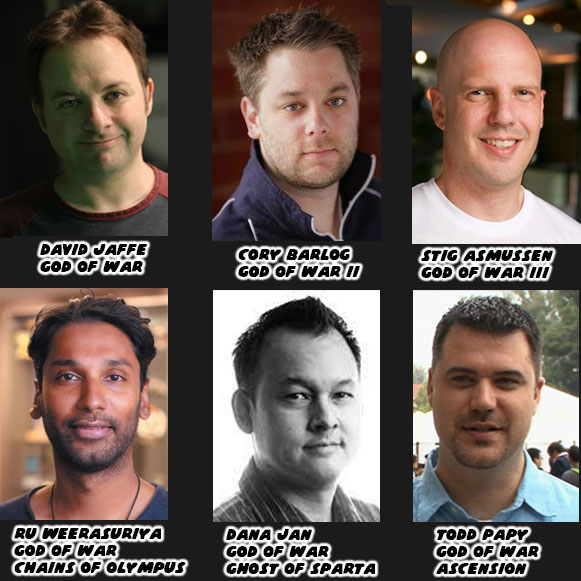
It took a lot of hard work from Sony Santa Monica, and although there had been different directors through the history of the franchise, they were able to make sure that the games felt like one connected story. Nothing felt out of place, nothing betrayed the spirit of the first, even as some events were retconned. When it came to this series I honestly felt that the first game in every chapter was perfect, and yet somehow the follow up was even better. To me that means God of War II was better than the original. I see the PSP games, and PS3 games through a similar lens. God of War III was great, but I think God of War Ascension, the second PS3 game, was even better. God of War Chains of Olympus was amazing, but God of War Ghost of Sparta was a step above perfection on the PSP. The reason why each follow up I consider better than the prior has to do with the team. In the first game the studio is breaking new ground, they are still getting a feel for the hardware, and software. They are still trying to figure out who the characters, and villains are. They go back, and forth refining the locations, villains, puzzles, and mechanics. By the time a sequel gets made the studio is filled with veterans. They know exactly where they are with the technology, characters, and game play. They are able to add new staff members that bring in more experience, and help raise the next game to even more amazing places. With God of War II we were able to hit all the notes that made the first game amazing, and then expand on everything tenfold.
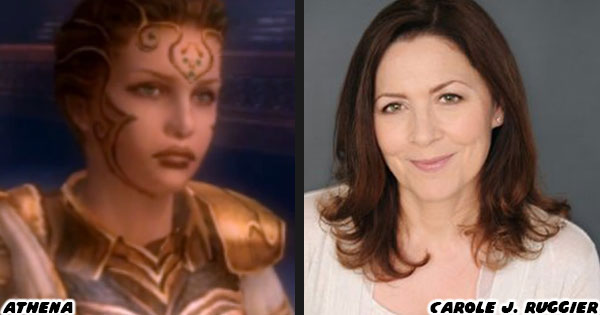
The game begins with the Spartan army laying siege to Rhodes. Conquering another city for the honor of Kratos, the new god of war. Athena appears in the flesh, she was simply a statue in the first game. Voiced by Carole J. Ruggier, the actress was fantastic throughout the series, and held her own with T.C. Carson, and Linda Hunt. She warns Kratos that the other gods will not tolerate his actions. He brushes her off, and leaps from Olympus to finish razing the city. As with all tragedies Kratos doesn’t even realize that he became the monster that Ares was at the start of the first game. Kratos even turns into a giant when he starts demolishing Rhodes. Just as Ares was a giant when he was attacking Athens. To try, and stop the mad god of war Athena strips Kratos of some of his power, and gives it to the Colossus of Rhodes. One of the fabled ancient wonders of the world. The Colossus comes to life, and begins advancing on the player. Audiences are given time to relearn the controls of the game, while the giant golden statue stalks us in the background. Even the human-sized Kratos is still too much for the army to deal with. He was as powerful at the start of this game, as when he was at the end of God of War. He even used the golden blades of Athena, instead of the Blades of Chaos, which he had earned at the conclusion of the first title. Right away we can tell that everything that made the original game memorable has been cranked up. The visuals, sound, animation, control, and effects were improved over the first. That in itself seemed impossible.
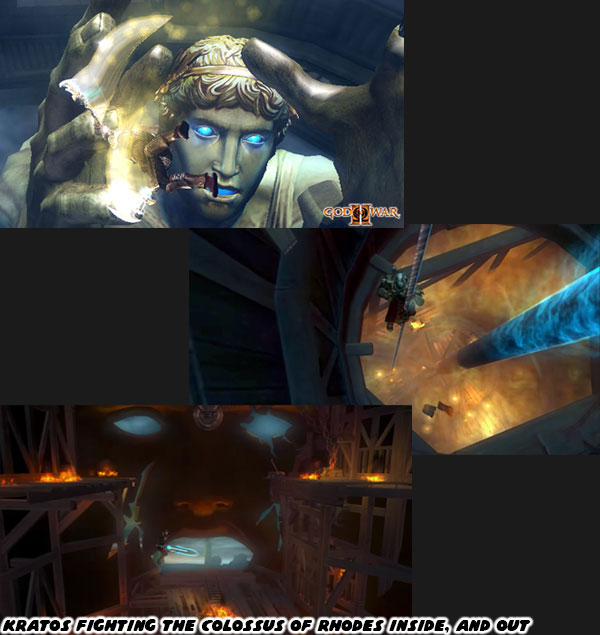
The game begins was a multi-stage encounter fighting the Colossus. Kratos is flung from one corner of the port village to the other. Zeus delivers the Blade of Olympus, the sword that he used to defeat the titans in the Great War. He tricks Kratos into using it so that his remaining power would be pulled into the weapon. We get a chance to fight the Colossus inside, and out. Battling inside a moving stage was something I’m sure the team had always wanted to do. The interior of the statue is a lattice of wood that is being engulfed in flames. Kratos not only has to defeat the waves of Rhodes defenders, but also has to take apart the superstructure while not falling into the flames. The game managed to raise the stakes over the iconic Hydra fight from the original. Where it went from here was anyones guess. I was certainly ready to go along for the ride. Kratos defeats the giant, and is boasting to the gods. But in his hubris he fails to see the hand of the Colossus falling on him. Without his godly powers to protect him he is flattened, and barely left alive. Zeus shows up, and finishes the job. Running him through with the Blade of Olympus. He says he does this to protect Olympus. Kratos is pulled into the underworld, but is saved by Gaia. The surviving titan gives Kratos some of her power, so that he may aid her, and the other titans. She hopes to gain revenge on the Olympians as much as Kratos does. Again, I had no idea where we were going from here, but I was 100% on board. I did not expect to see more mythical characters introduced, or that some loose ends would be tied up.
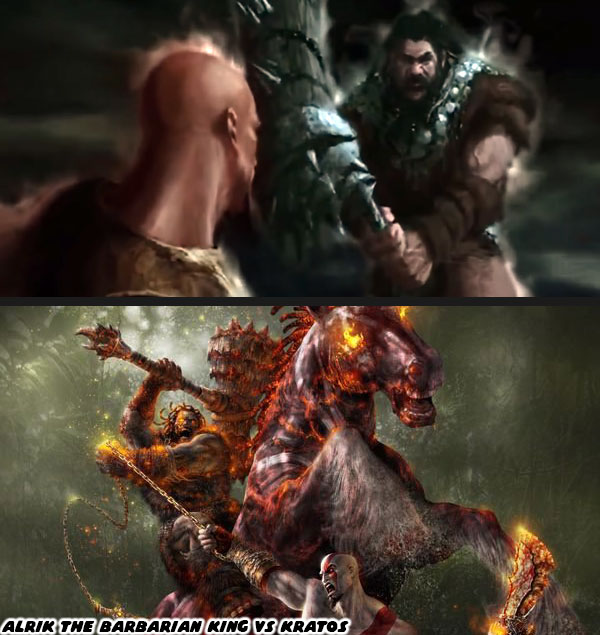
For example in the back story of the first game Kratos grows to be a legendary Spartan captain, but his men got wiped out by a barbarian horde. He offers his soul to Ares just as he is about to be killed by the Barbarian King Alrik. Kratos is gifted with the Blades of Chaos which he uses to decapitate the massive warrior. You have to wonder how mighty Alrik was to have bested the god of war in a one-on-one battle. Many fans questioned where the Barbarians came from, and who was this mysterious figure that had almost changed the course of history? Just as Kratos had fought his way out of Hades in the first game we get to see Alrik return from the underworld to get a rematch. His appearance gave me goosebumps, I recognized the fur-covered warrior right away. He was not only strong enough to break the grasp of death, he also was able to pull other souls out of the afterlife. Seeing the Ship Captain that Kratos managed to kill twice get summoned by Alrik was impressive, and at the same time comedy gold. It was not the only mythological match-up in the game. Kratos also fights Theseus, a king of Athens. He was a person that defeated the Minotaur in Crete, had captured the Marathonian Bull. He went on many adventures with Hercules, Jason, Orpheus, Euphemus, and other great legends. He was arguably the greatest hero in Greek mythology. This crossover made the mythology obsessive kid in me super excited. That was until Kratos then had to fight Perseus.
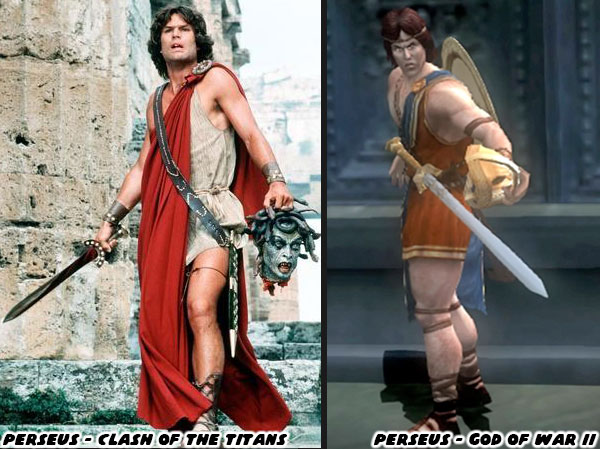
It seemed that the developers at Sony Santa Monica grew up with the same influences that I did. They must have been awed by the same films, and had kept them close to their hearts. The story of Perseus was told in the classic film Clash of the Titans. It was the movie that taught me about the titans, Medusa, and the various gods. I had talked earlier in the blog series how the stop motion work in the movie was done by Ray Harryhausen. He had worked on Jason, and the Argonauts, as well as The Golden Voyage of Sindbad. Not to mention dozens of other cult favorites. His work was as inspirational to me as any other artists living, or dead. Harryhausen brought the enormous Kraken to life, as well as the distance shots for the devil-like Calibos, and the tiny mechanical marvel Bubo who was Athena’s owl. What amazed me about GoW II was that the studio asked Harry Hamlin to reprise his role as Perseus some 25 years after he last played the part. I’m sure he was not about to turn down Sony for the project. Part of him must have been humbled knowing that an entire generation of kids never forgot the actor, or character. These kids were now writers, and directors in their own right. My brothers, and I were certainly giddy that Hamlin would be voicing one of our childhood heroes once more. I even told my mom about it, and she couldn’t believe that Generation-X never forgot the character. Of course the downside was that if he was going up against Kratos then it was not going to end well for him.
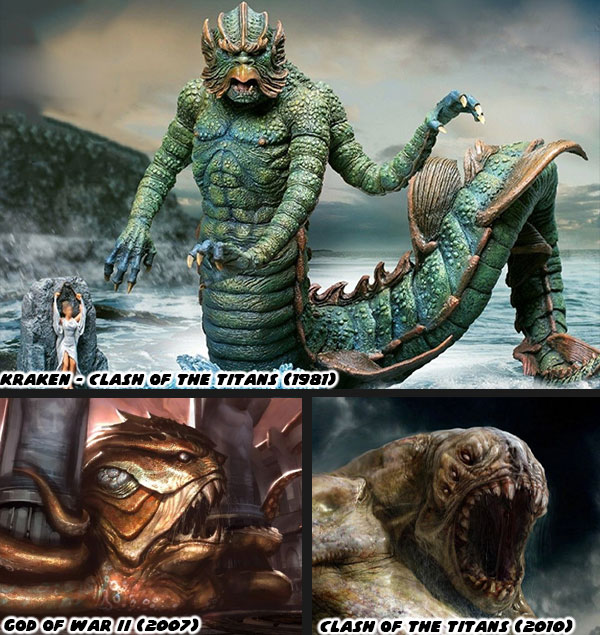
God of War was also creating an entirely new chapter in the mythology, and the way the gods were presented. In the era of the internet, cell phones, self driving cars, and other technological wonders Sony managed to take material that was thousands of years old, and make it accessible to the 21st century. The heroes of antiquity were vibrant, and moreover made cool once more. There weren’t many studios that could claim to bring history to life. Let alone influence global culture through their efforts. Proof of this was in the Hollywood remake of Clash of the Titans. The 2010 movie by Warner Bros. was undoubtedly nudged into production by the runaway success that Sony was having with God of War. The advances in special effects were light years above the work that went into the MGM classic. The monster designs in the new film were much more influenced by the types of characters featured in the Sony game, rather than the Harryhausen movies. Proof of this could be seen with the updated Kraken design. The original monster was terrifying on the big screen, at least it was to me as a kid. The Kraken featured in GoW II was much scarier, and could have easily influenced the look of the gigantic beast in the new movie.
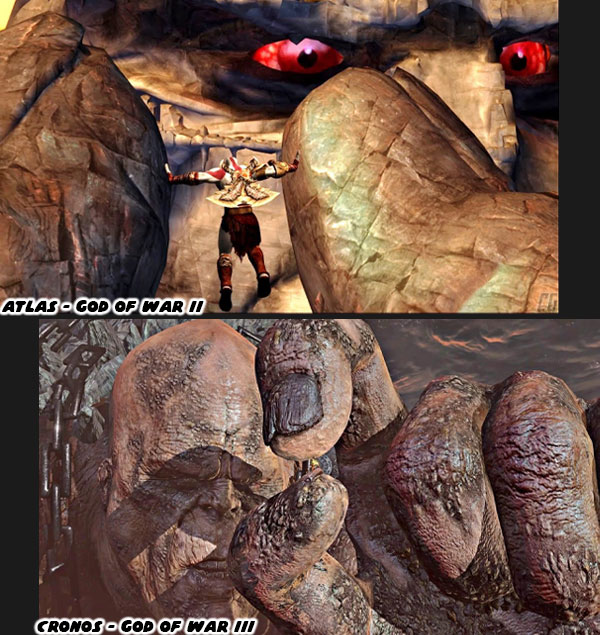
Going bigger, and better with every step of the series was something that David Jaffe helped push the team to do through SingleTrac, Incognito Entertainment, and Sony Santa Monica. The direction, casting, acting, and story were all rock solid. There was nowhere that Kratos could have gone to that I wasn’t eager to follow. There was no challenge that was impossible to beat for the Ghost of Sparta. My jaw dropped with the Cronos scene in the first game. Crossing the Desert of Lost Souls on the back of the titan leader was more amazing than anything I could have ever imagined. I had no idea that the sequel would have another scene to top it. Kratos was trying to cross the Great Chasm when he got into a fight with Icarus. As they fell through the world they ended up in a massive red abyss. I freaked out when I saw Atlas holding the world on his shoulders. Kratos landed on his brow, the head of the creature was as massive as an office building. Hollywood actor Michael Clarke Duncan voiced the four-armed titan. His deep baritone voice was perfect for the mountainous monster. Since Kratos had been stripped of his godly powers at the start of the game, he needed to be built back up again with new magics. A collection of Titans, and Primordials including Gaia, Cronos, Typhon, Prometheus, and Atlas had all leant Kratos a portion of their power through the different chapters of the game. They sought revenge against the Olympians as much as Kratos had. There was of course one final obstacle to beat. The Sisters of Fate were revealed to be the ones literally pulling the strings. In the game they lived in the Island of Creation, a place impossible for mortals to reach. In mythology the fates wove the threads of life. They knew the lives of every living being, including the heroes of old. When a person reached the end of their life they would cut the threads with magical scissors. In classic literature they looked like maidens working at a loom. Spinning threads, and overlapping encounters as they spun out destiny.
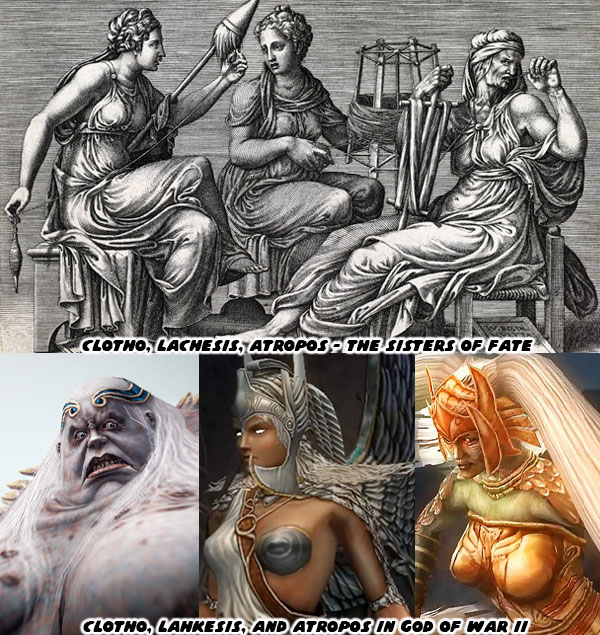
Sony Santa Monica had done a great job at interpreting the mythological characters, and made them appealing to modern audiences. The entire series had a certain aesthetic. The character designs were not quite realistic, nor were they cartoonish. They were instead something in-between. None of the characters, locations, or set designs were historically accurate. Instead studio artists incorporated elements that we would have identified as Greek, or Roman, but presented with the style of a comic book archetype. The three Sisters of Fate were made very unique, whereas their classic counterparts looked like regular women. Atropos was the oldest, she was the one that cut the threads. Her golden armor, and long scissor-like fingers a nod to her origin story. Lahkesis was the second oldest, and was responsible for determining how a person lived their life. This meant the sister looked the most human, and attractive in the game. Clotho was the youngest sister, at least in historical context. She was the one that spun the threads of fate. Instead of being a young maiden she was presented as a gigantic creature, with dozens of breasts. Like an enormous, obese silk worm. It was both a grotesque, and captivating monster design. Kratos defeats the sisters, and takes the power to rewind his thread, and return back in time to the moment where Zeus betrayed him.
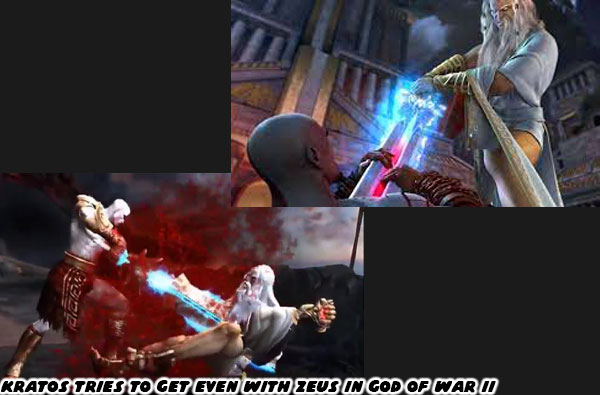
Kratos fights the king of the gods thanks to his newfound power. Zeus has a bunch of tricks at his command, and we have to fight him in multiple stages. From being a gigantic boss, to a more human-sized opponent. Well, Zeus remains tall in the game, well over seven feet in his human form. It is a well planned battle that sees the two trading blows, and neither really gaining the advantage. The game play in every boss encounter in the series is very well balanced, and the fights between Ares, and Zeus at the end of each respective game was the perfect kind of challenge. Kratos eventually gets the upper hand in the battle, he takes the Sword of Olympus, and tries to kill the father of the gods. Athena steps in and sacrifices herself. It was a moment that my brothers, and I did not anticipate. We literally gasped when the scene played out. Of course had we been paying more attention to the classic story structure we would have realized that she was the one destined to die. She had been with Kratos the longest time, had shown him mercy, and was trying to redeem him since the first game. Her death would have meant much more to audiences than Kratos simply getting his revenge.
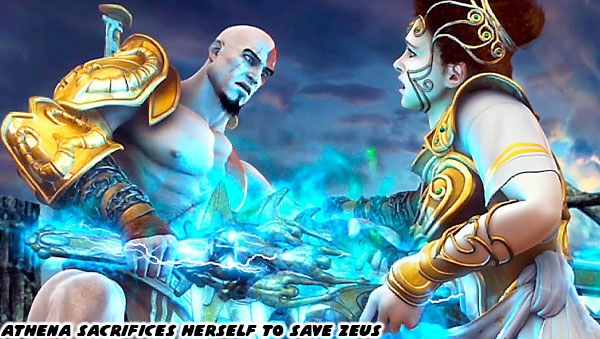
Zeus slips away, and runs back to Mount Olympus. Athena explains to Kratos that his obsession will destroy everything they have built. Kratos simply wants to kill his newly revealed father, but he doesn’t understand that Zeus is Olympus, if he dies then all of the gods die. With Athena passing, really the only god that he cares about, then he resolves that all of the gods must then indeed die. He returns back to the Sisters of Fate Loom Chamber, and goes further back in time. He uses the Blade of Olympus to pull the titans out of the great war, and bring them to his timeline. The game then ends with the titans, and Kratos climbing up Mount Olympus, a set up to the third, and assumed final chapter in the God of War series. It was a powerful ending, but one I didn’t necessarily appreciate. It was as if everything that happened in GoW II was nothing more than an ad to sell the Playstation 3, and the next game. That was how I felt about it. The previous 99.9% of the game was absolutely worth the experience. It had improved upon the original in every regard. The ending was a minor issue. Whether or not God of War III would be a worthy wrap up of the story was yet to be revealed. I was counting the days until I could get my hands on the game. If you played through GoW II what did you think? Did you think it was better than the first? Did you have a favorite encounter? Or was there something you wish had been explored in the story? Let me know in the comments section please. As always if you would like to sponsor me
please visit my Patreon page and consider donating each month, even as little as $1 would help make better blogs and even podcasts!