Hello friends, work is busy but here was something that I put together for the heck of it. It's been a while since I created an infographic and I hope this one might come in handy the next time you see skateboarding on TV.
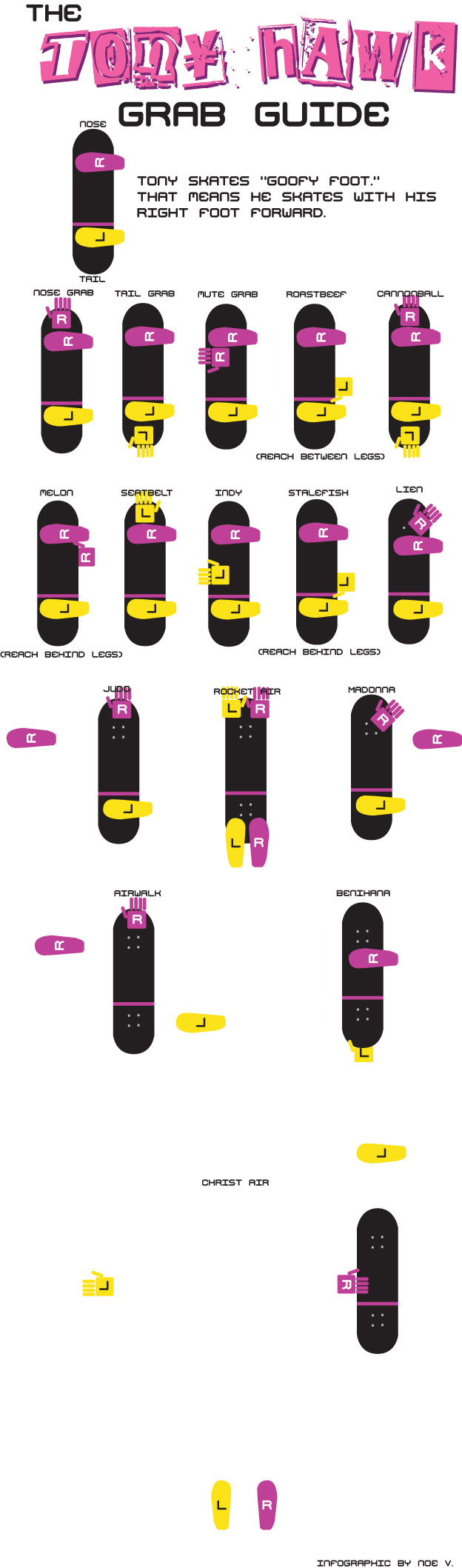
Hello friends, work is busy but here was something that I put together for the heck of it. It's been a while since I created an infographic and I hope this one might come in handy the next time you see skateboarding on TV.
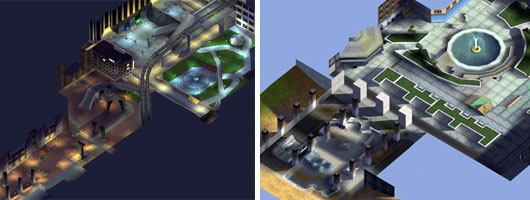
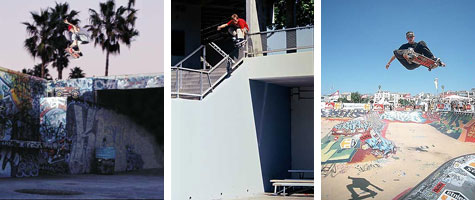
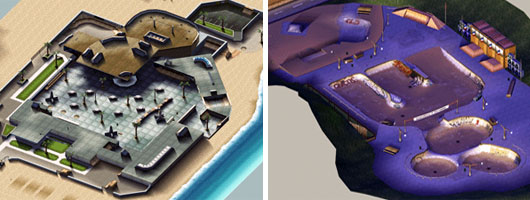
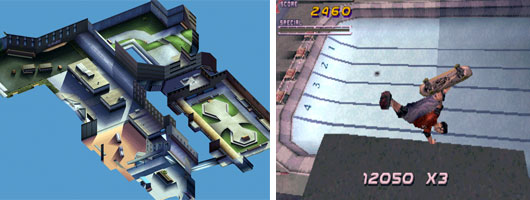
We have spent the last couple of blogs looking at what I would introduce, or change for a sequel to 720°. I’ve said the graphics, and game engine would get an overhaul. The core gameplay would remain the same, but with some new elements thrown in. The slalom contest would be retired, and in its place we would have street, and park contests. The ramp contest would return, and also be expanded to include random layouts, and locations in order to keep the experience fresh. One of the remaining contests would also be back. The downhill competition in the original 720° didn’t look, or play like any real downhill competition. It was far more fantastic, with super long wooden ramps to speed down. There were corners to clip, and places to jump that acted like shortcuts.
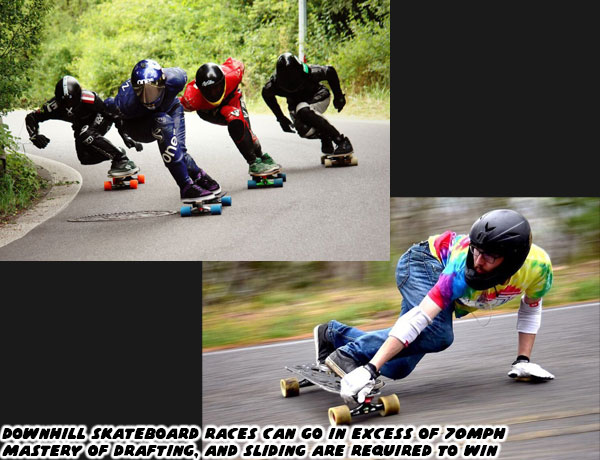
Actual downhill skateboard races are a thing of beauty. The technique, and strategy employed in downhill are unique to the sport. They require a different set of skills, just as park, street, and ramp contests require their own. Even the skateboards, and gear are unique for the races. The fastest tournaments require leather outfits, for aerodynamic, and safety reasons. As well as full face helmets. The decks are longer, and wider on average than most skateboards, with a concave that helps lock the feet in place. They also have wider trucks, and bigger wheels which help with both speed, stability, and stopping power. Skaters can control their speed through corners by sliding on their wheels, and hands. They wear gloves with plastic “pucks” on their palms to keep from being injured. Trying to recreate this would make for a fantastic skateboarding game, and something that I would absolutely love to direct, but it wouldn’t work for a 720° sequel.
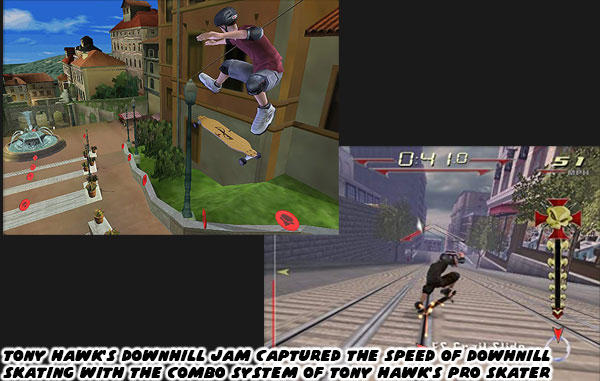
By the same token there aren’t too many games to look at for inspiration. Tony Hawk’s Downhill Jam by Toys for Bob was extremely fun. It featured skateboards that were accurate to the sport, and details like sliding, and even getting “speed wobbles” if you went too fast. The majority of the game play was focused on performing back-to-back tricks, grinds, aerials, and chasing combos, similar to the THPS series. In this regard it also wouldn’t be a good fit for a 720° sequel. So we have to figure out how to make it live up to the arcade spirit of the original. The stakes might seem mild in the Am downhill races, but as the player progresses through the game they would discover that the downhill portions are just as random, and exciting as any other event.
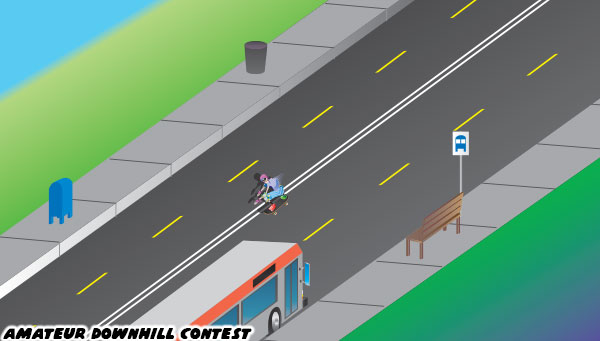
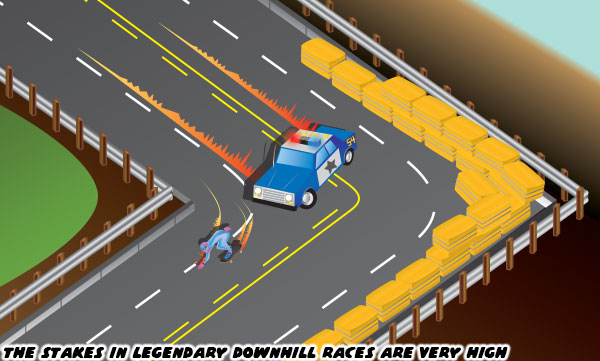
I would start the early downhill contests on the streets. It would still be an isometric POV. I would have the player race in a group of other skaters, but they would sort of fade so that the camera would focus on the main character. The illusion is that you are still racing against others, when really the races are a war of attrition. There are many obstacles on the way down that can take out contestants. Pressing the kick/pump button actually put the character in a tuck, helping them reach top speed. When the button isn’t being held down then skaters stands up, and slows down. If the player holds down the grab button on turns then they drop some speed, and slide through corners. If a player tries to take a turn at top speed without grabbing, then they slide wide, and crash out of bounds. There are several unique things about the downhill courses. Just like other contests they are randomly generated. A player never races down the same downhill course twice.
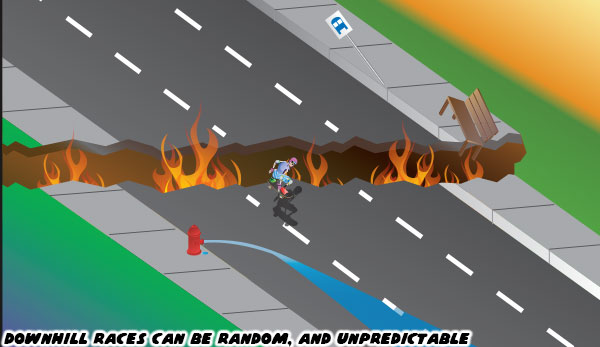
Some races take place in cities, you might end up avoiding traffic in both directions. You can ollie up a curb, and try to avoid rival skaters, and cars. But then you run the risk of crashing into a pedestrian, mailbox, or kid delivering newspapers. You might find yourself racing through a residential street, cutting through alleys, jumping over trash cans. Then there are courses that wind through mountains, where you might have to avoid a rock slide, a construction crew on the side of the road, making it a single-lane funnel into traffic. Falling off the side of some courses might end up with the player dropping into a chasm, or discovering a secret. By the time a player earns a legend ranking they have the gear, and ability to skate as fast as possible. This means the ability to slide through multiple curves in one motion, get back to top speed quickly, and chase down opponents. To help raise the stakes a cop car might appear to go after contestants. It might end up crashing into traffic, or smashing through a barrier, only to appear later on down the road. All of these things should bring back the hijinks of classic Atari games, as well as the exploration in Skate or Die. Downhill races should feel like the best parts of endless runner games, but with an actual finish line.
All of the contests I have talked about so far in this blog series are available for Am, Pro, and Legend events. The last contest for my 720° sequel is the final unlocked for Amateurs, and gets much harder for Pros, and Legends. The reason why will be explained in the next, entry of my series. I hope to see you back for that. Let me know what you think of my game idea so far. Would you play it? If you would like to sponsor me please visit my Patreon page and consider donating each month, even as little as $1 would help make better blogs and even podcasts!

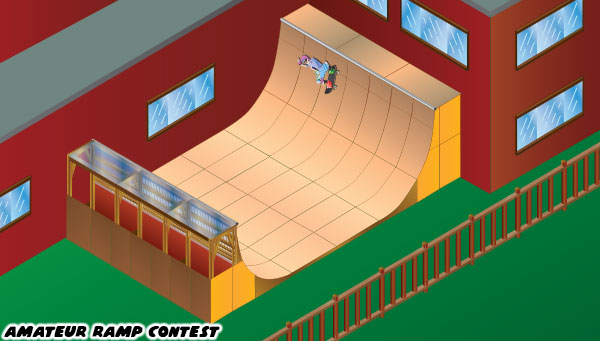
In the previous blogs I talked up how Skate City would be expanded, and feature objectives, and secrets. Also I talked a little bit about how the character can be visually customized, and how they would earn experience through the game. The character becomes better at performing tricks the more they go through the city, as well as compete. I said previously that the slalom contest would be replaced with street, and park contests. The other contests from 720° would return, but modified as well. At first glimpse fans of the original would think that the ramp contest was exactly the same as the first 720°. At least as an Amateur the first time you are invited to compete in ramp it is the original design.
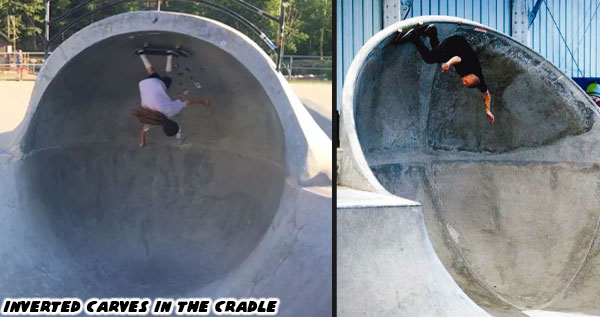
The vert engine underneath the game should be completely redone. Players can now pump the transitions in order to build speed. On vert skaters are going too fast to push with their back foot, so what they do is either drop, or raise their body weight on transitions in order to build speed. It’s similar to kicking your legs out, and bringing them back in while riding a swing. Pumping was a feature of the ramp, and high air contest in Skate or Die. Not many people realize that there was an animation in the original 720° that had the character pump the transitions as well. Being able to pump is essential not only for big airs, but also to defy gravity in skateparks. Very good skaters can exploit the lines in a park, and use them to go fast enough to get inverted in full pipes, and cradles. Being able to do these things consistently would translate to higher scores in competition.
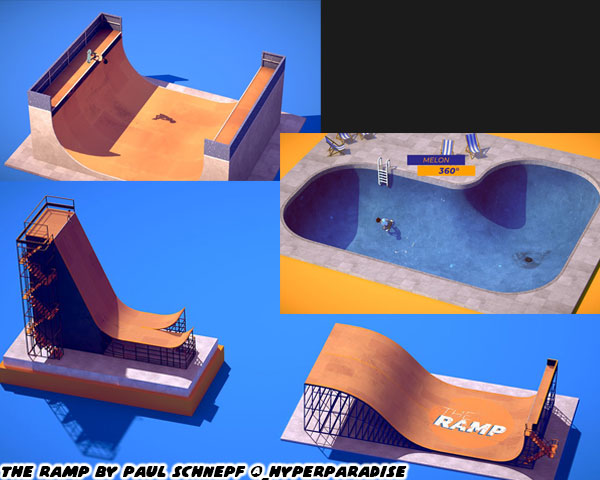
The best modern skate game to feature the pumping mechanic is the indy hit The Ramp by Paul Schnepf (@_hyperparadise). The Ramp is in an isometric view, just like 720°, and is very close to how I imagine my sequel would appear. It is an exceptional game, but I would still adjust the control, animation, and mechanics if it were to be the engine behind the 720° sequel. In The Ramp it is very easy to go off the side of the transition, especially the faster you go. The same is true for 720°. I would have the game engine “guide” players from flying off the ramp by nudging them to go straight up, and down if your character is right on the edge of the ramp. Yes the player can still shoot off the ramp if they want, but most would appreciate the nudge in the right direction so they don't lose a high score run.
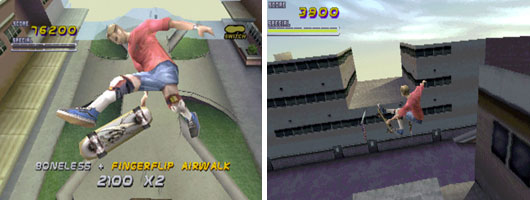
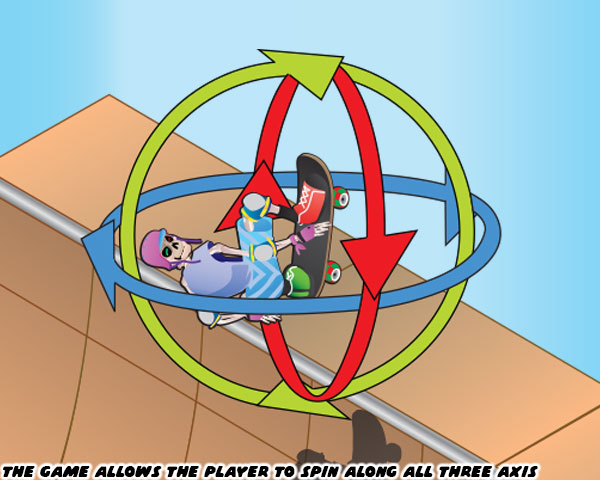
The other thing that I would add to the control scheme is the ability to rotate along all three axis (X, Y, Z). This was something that I had been pushing for Neversoft to do for years in the THPS series. The vast majority of skate games allow your character to rotate along one plane, this is the traditional frontside, or backside spin. Some games might have a special trick that a character can perform like a front flip, or a backflip. While the character is doing in this animation they cannot rotate on any other plane. A few skate games came close to allowing the full freedom of flipping, or rotating on more than one axis. Tony Hawk’s Downhill Jam, developed by Toys for Bob in 2006, allowed you to double tap a direction, and have the character flip along that axis. The animations were way over-the-top, which worked well in the context of the game. But 720° was closer to real vert tricks. Animations that looked too absurd would break the consistency of the engine.
The one game that got closest to performing these advanced tricks the way I imagine it was Grind Session by Shaba games. It debuted in March of 2000. After the original THPS, and before THPS2 was released. The game was very well done, it improved in many ways over the Neversoft hit. It introduced manuals, nose manuals, and no complies to the flatland trick library. It also allowed players to flip their board into a lip trick, which no game since has managed to accomplish. In the animation department players could string vert tricks back-to-back with seamless animation. In most skate games, including THPS 1+2, if you perform a grab trick, then another, the game engine competes the animation cycle for one trick before moving to the next one. In Grind Session the animation on the body position, hands, and feet would flow from trick to trick in one fluid motion. None of the animations would reset to the default position in between.
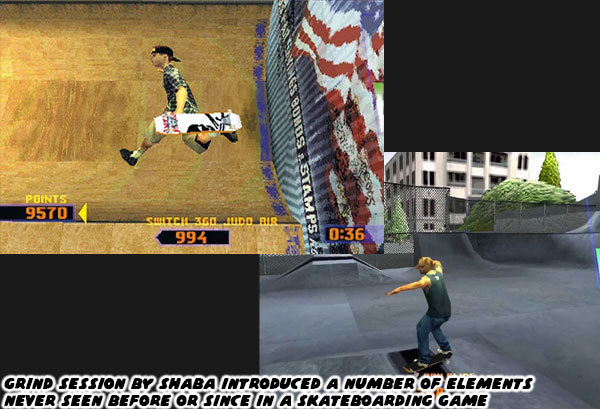
It was staggering how much Shaba was able to make certain skateboarding tricks work in a game format before Neversoft. I stopped calling it Grind Session, and started calling it THPS 1.5. I wasn’t the only one that saw value in what they did. The studio was bought up by Activision, and they helped port THPS3 to the Playstation, Tony Hawk’s Underground 2: Remix to the PSP, and Tony Hawk’s Project 8 to the PS2, and Xbox. Grind Session’s biggest contribution to skating engines was what they did with rotations. Some characters could perform a front flip, or back flip. The characters switched hands depending on if they were doing a front flip (Weddle grab), or back flip (Indy grab). So that they were accurate to the actual trick. While doing the flip you could actually rotate frontside or backside as well. This made the game that much more realistic, while not losing the ease of play.
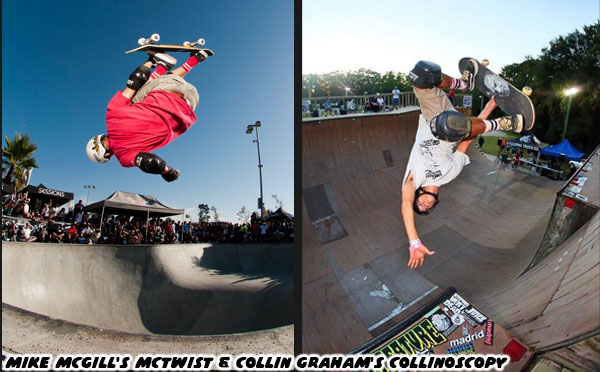
You may not think that inverted spins, and flips are really possible on skateboards, but they have existed since the late ‘70s. At first they were used on lip tricks. Moves like the Elguerial, Unit, Miller Flip, and Phillips 66 were inverts that required the skater to spin, flip, and push off the coping at the same time. Then there were the aerial inversions. Skaters at that time were having difficulty figuring out how to spin 540° without losing the board. Mike McGill saw Fred Blood, a roller skater, flip into his spins, and that’s how he got the idea for the McTwist, or an inverted 540°. If you broke down the trick into its basic elements it was a backside, front flip, Weddle grab 540°. Whereas a frontside, back flip, Indy grab 540° was known as a Rodeo Flip. Skaters have performed all manner of off-axis flips, and spins for decades. It should be possible to do them in the 720° sequel. They should not be easy to perform. Rotating the front flip, or back flip is slower than a frontside, or backside spin. So a Novice, or Am wouldn’t be able to land those tricks with any consistency. When a character has the stats of a Pro then they finally have the ability land them cleanly. When a character has the stats of a Legend then they can spin, and flip with almost any grab combination, and land them with more frequency.
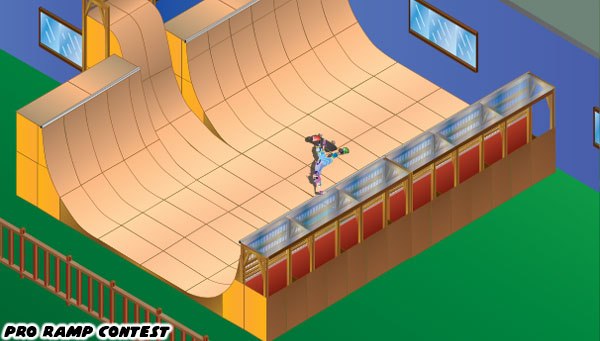
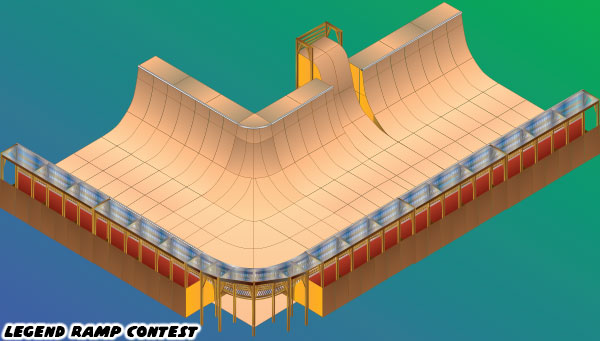
Ramp competitions are not necessarily all the same in my sequel. I mentioned that the size, and obstacles featured in street, and park contests depended on whether you were an Am, Pro, or Legend. Amateurs had the smallest courses, Pros had more space, and Legends had the biggest, and most complex courses. The same rules applied to ramp contests as well. The original 720° ramp was very simple, in my version I said it was designated for Ams. The Pro ramp has more transitions, perhaps a channel, or spine. Legend ramps are massive, they may have a hip, corner, or extension. Winning these contests require you to make full use of the ramp, while performing aerials, grinds, spin, and flip tricks.
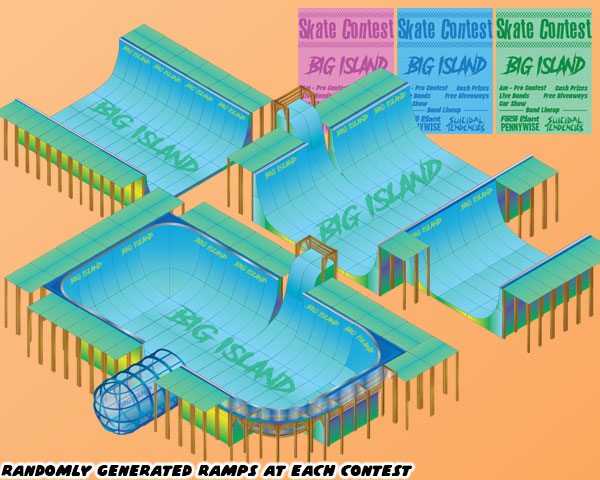
The biggest highlight of the 720° sequel is that contests are completely randomized. I don’t mean that you end up in an Am, Pro, or Legend contest randomly, but instead that the layout, transitions, rails, and roll-ins are randomly placed. You will never end up skating the same ramp twice. This applies to park, street, or other contests. Contests also take place in different towns, so the layout, and colors of the obstacles are unique compared to those featured in Skate City. Imagine a fictional contest taking place in the South Pacific called Big Island. The player gets a hint to the location from a colorful flyer while the stage loads, then they see the park. The ramps have colors, and stickers unique to it. Each time they go back to it the ramp is completely different, yet familiar at the same time. Every contest in the game observes the same rules. Imagine how you would feel if your favorite game changed a little bit each time you played it. The game, like the art of skateboarding, should never become stale.
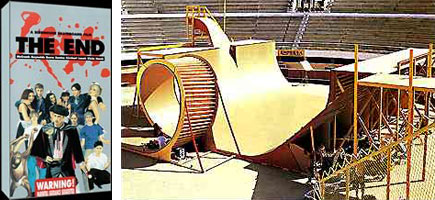
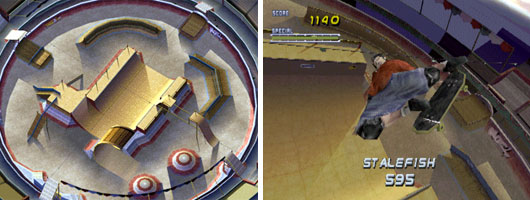
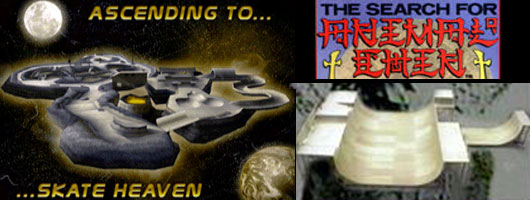
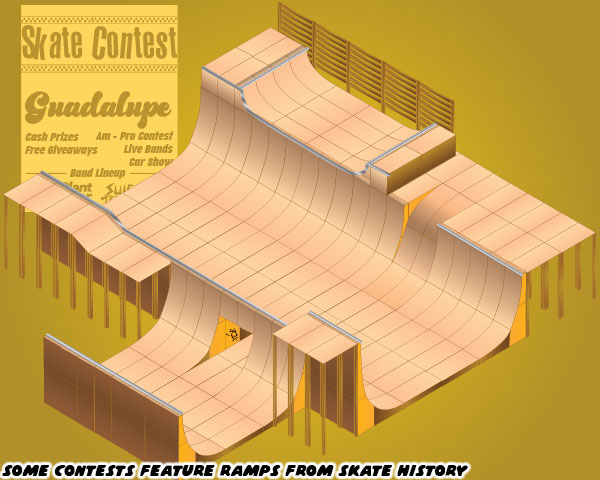
Every now, and then a ramp from skate history might pop up. For example, once, a long time ago there was a ramp in the town of Guadalupe, located between two junkyards. It was created by a legendary skater Won Ton “Animal” Chin. Long-time skate fans would recognize it from the Powell-Peralta video the Search for Animal Chin. New fans would just know that there are no random ramps that are as unique. There are a few of these ramps from the past that might have only been used for a contest, or two before being torn down by vandals, or even angry city councils. I’m on the fence as to whether or not you could save, and revisit those ramps whenever you want. Also I probably wouldn’t put in a build-a-park editor, as the game should still feel like an arcade experience.
Having the contest stages constantly evolve is possibly the most important thing the game would introduce to the genre. It goes far beyond waiting for DLC content, as the game creates its own new challenges. We certainly have the technology, and talent to make it happen. What I would do with the remaining 720° contests might be more exciting to audiences. I will talk about those in the next blog. I hope to see you back for those. Also, what do you think of my sequel idea so far? Would you play this game? If you would like to sponsor me please visit my Patreon page and consider donating each month, even as little as $1 would help make better blogs and even podcasts!
It turned out that the studio had put much more time into the game than just about any other title. I wasn’t aware of that until I started digging through its history. I found that there was an interview with the team in the March 1987 issue of Thrasher magazine. That issue also featured a full-color ad featuring pro skater Steve Caballero. Thrasher back then ran mostly black and white, with spot color in certain pages. It wasn’t as polished, or professional as Transworld Skateboarding magazine, but it was certainly respected by the most hardcore of skaters. It surprised me that they would be the people that published the story. Arcades were fairly mainstream at that point, and Thrasher was seen as more core or underground, but the game was loved by skaters, and non-skaters alike.
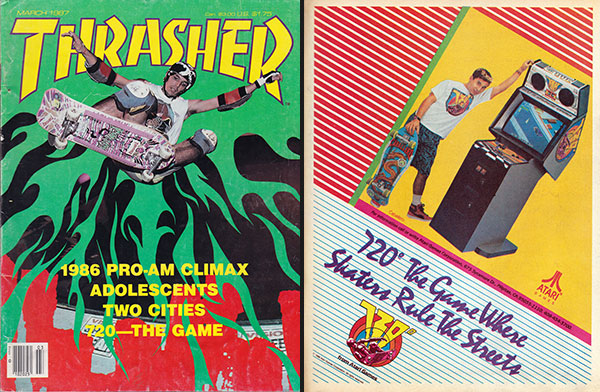
Just for perspective Atari was a California Bay Area company based in Milpitas. They were founded by Nolan Bushnell in 1972. This was the era when Silicon Valley was being paved. Steve Jobs, and Steve Wozniak worked at Atari for a short spell before founding Apple Computers in 1976. In the Thrasher article Rob Rowe was credited as an Atari Technician, and the man who came up with the idea for 720°. Rowe said he worked with Programmers John Salwitz, and Paul Kwinn, plus game designer Dave Ralston. The development of the game took 18 months of full-time involvement from the core team, according to Thrasher. It was released in December 1986.
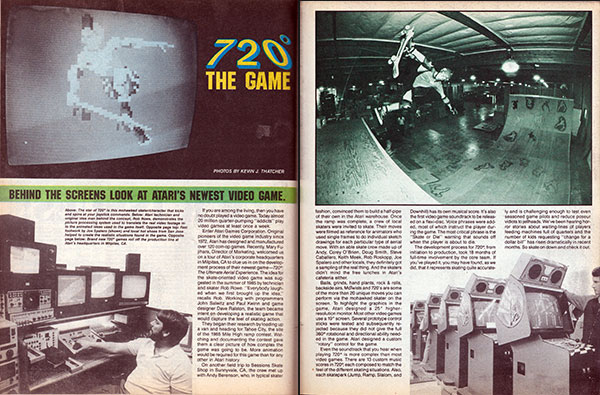
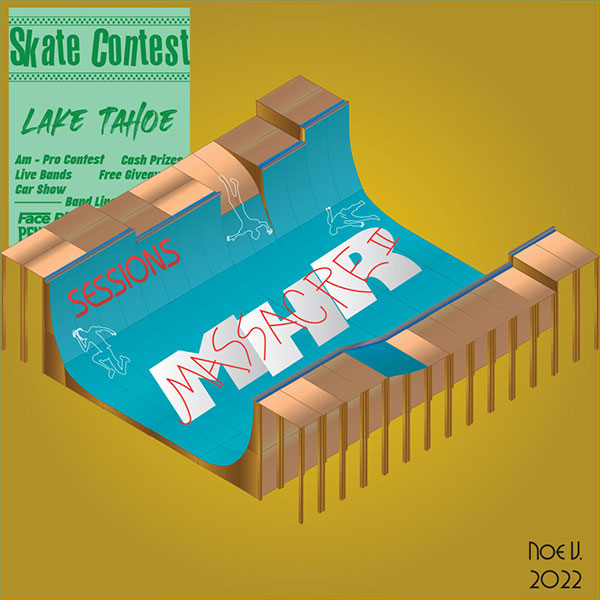
As any skater could tell you the animation was very spot on to actual skateboarding, and skate tricks from the mid-‘80s. It turned out the company had done a tremendous amount of research. The studio first recorded a Mile High halfpipe contest in Tahoe City, possibly the “Terror in Tahoe” contest from 1985 which resulted in the county tearing down the ramp afterward. Rowe, and his teammates learned they needed to do more research. While visiting the Sessions Skate Shop in Sunnyvale CA pro skater Andy Berenson convinced them to build a ramp in the Atari warehouse. He skated with other pros including Corey O’Brien, Doug Smith, Steve Caballero, Keith Meek, Rob Roskopp, Joe Spalero and others from the San Jose area. The list of credits includes animators Sam Comstock, Mark West, and Will Noble. Music by Hal Cannon, and Earl Vickers. Audio by Brad Fuller. General thanks to Dave Cook, Dennis Harper, Russell B. Dawe, and Jess Melchior. A number of these people had their initials appear as graffiti within the streets of Skate City.
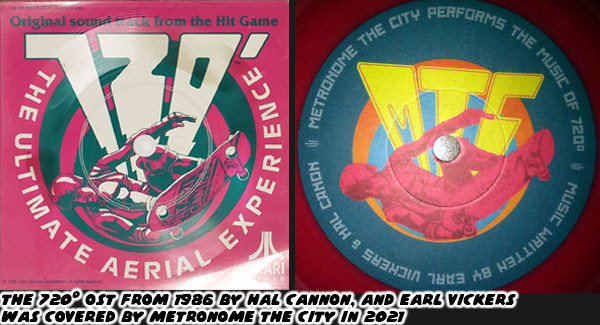
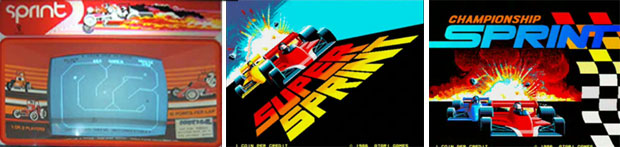
The team working on the game had to be massive (for the time) because of how ambitious the project was. In addition to the skaters being used for early rotoscoping efforts, the studio had to put together entirely new hardware. Atari designed a higher resolution 25"monitor for the game, most cabinets used 19" displays at that time. The hardware the game was programmed on was known as the Atari System 2. It was also used on Paperboy, Super Sprint, Championship Sprint, and A.P.B. The soundtrack was the biggest highlight in my opinion. With 13 custom tracks it was the first video game soundtrack released on flexi-disk. Years ago I managed to find an actual disk to add to my collection of gaming artifacts. Earl Vickers, and Hal Cannon composed many of the great tunes featured in the golden era of Atari. If you look at the initials that pop up on Atari arcade leaderboards they were listed as HAL, and EAR.

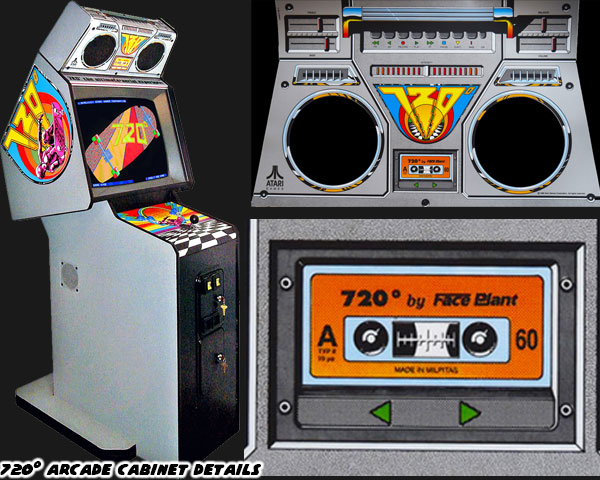
The music they laid out in 720° was arguably their best work. It was influenced by punk rock, which along with New Wave, was the default soundtrack of many skaters of the time. Atari let players know their efforts wouldn’t get lost in the mix. The company built that faux boombox with huge speakers atop the arcade cabinet, blasting players in the face with the high energy music. This helped pull you into the world they created. I can only imagine that this detail was taken from real life. The crew that skated the Atari ramp undoubtedly put a boombox up there during their sessions.
The game was a revelation. It was one of the hottest games in the arcade the holiday of 1986, going through the rest of ’87, and ’88. It was hitting at the peak of skate mania. With the Bones Brigade, and other skate teams were becoming household names. People like Tony Hawk, Steve Caballero, Neil Blender, Christian Hosoi, and Lance Mountain were becoming influential in the art, and mainstream communities as well. Audiences were dying for great skate video games. There was nothing that could touch 720° in the arcade for more than a decade. The home market was different. The NES version of was horrible, there was thankfully another game that was just as influential. Skate or Die by Electronic Arts was a certifiable hit on the PC, and later on the home consoles.
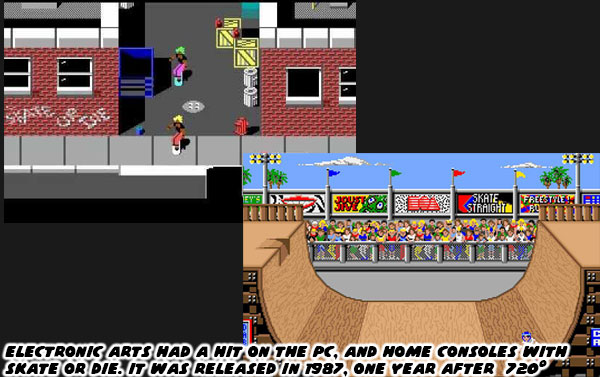
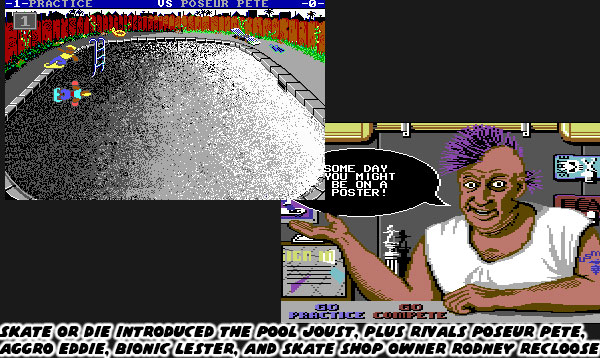
The team behind Skate or Die wasn’t as big as Atari’s, but they nonetheless hit the experience out of the park. Producer Don Traeger, Designers Michael Kosaka, Stephen Landrum, and David Bunch worked with programmer Stephen Landrum, artists Michael Kosaka, and Nancy Fong, as well as composer Rob Hubbard. They allowed players to explore different events, similar to 720°, but without a timer, or angry bees forcing the player to go from place to place. There was a ramp, race, and pool contest. They didn’t have as much realism in the graphics, and animation department as Atari’s hit, but they made up for it by providing completely different game play. For example the game created virtual rivals to challenge the player. Starting with Poseur Pete, and becoming harder through Aggro Eddie, and the ultimate rival Bionic Lester. These skaters would race you down alleys, and beat you senseless in a game of pool joust. The addition of events, names, and faces, especially the uncredited visage of Rodney Dangerfield helped add dimension to the game.
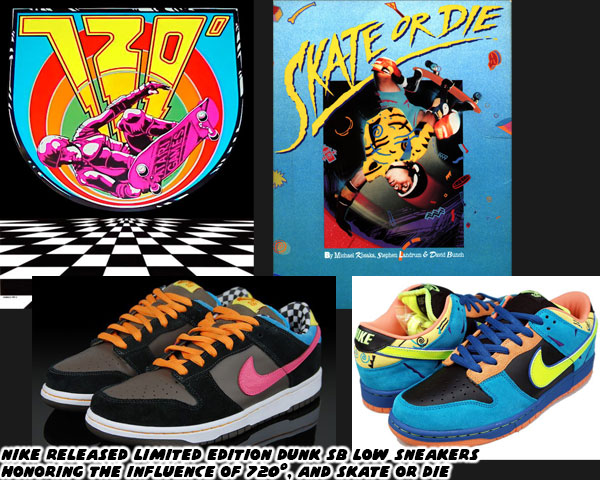
720° never received a sequel, but Skate or Die did. The sequel played like a typical NES adventure game, with the character skating instead of walking everywhere. The ramp portion was well done, but that was about the highlight of the title. Most people still hold the original Skate or Die in high regards. Its influence could be felt on a generation of game players. I know more than a few people that mistakenly thought 720° was called Skate or Die. Or that somehow Skate or Die was the sequel to 720°. The games had no relation, with the exception that the words “Skate or Die” are featured as a sound bite in 720°. Both games acted as cultural touchstones for the skate community. Some 30 years later as Nike was trying to establish themselves as players in the skate shoe market they released limited edition Nike DB Dunk Low’s in the colors featured in the game logos.
Skateboarding games would evolve greatly from the late ‘80s, but only a handful of them could be considered great. In the next blog I’m going to look at trilogy of arcade games that forever changed the landscape of action sport games. I hope to see you back for that. If you would like to sponsor me please visit my Patreon page and consider donating each month, even as little as $1 would help make better blogs and even podcasts!
But it was Hard Drivin’, and Race Drivin’ taught me how to drive. Asteroids, and Lunar Lander showed me how space was an endless adventure. It predated my love for all things cosmic. Gauntlet showed me that Dungeons and Dragons would actually be a great template for a video game. With that said however I always thought the skateboarding game 720° - the Ultimate Aerial Experience was possibly their most underrated gem. In my pantheon of arcade classics it was easily in the top 10, if not the top 5. It was hands-down the first game to get skateboarding right. Not only that, but it also reflected the era of ‘80s skating, and how far it had evolved from skating in the ‘70s. It was bold with its use of colors, music, and especially control. It was the first, and as far as I know, the only one with a joystick that’s fixed in a diagonal angle. Despite the greatness of the title, I thought the game was excessive in its difficulty.

Watching people chasing 720° high scores on YouTube confirmed to me that the game was just as hard as I remembered it. Every serious 720° arcade player on YouTube has a strategy in order to achieve their score. They don’t blindly start playing, and hope for the best. They share these details on arcade forums, but not necessarily on GameFAQs. This is essentially true of most arcade games. Unlike some home console games, you are rushed through the experience because you are almost always against the clock. A quarter only buys you a limited time, most games cannot be played perpetually. Those wouldn’t be appreciated by arcade owners.
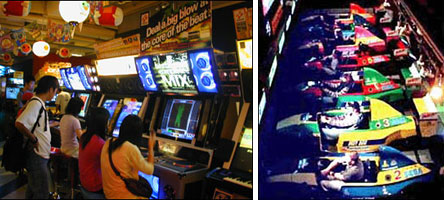
The best studios knew how to balance the experience of playing, with the challenge provided. In order to get a high score, and thus secure your local fame you have to exploit the game in some way. Whether it requires you going through stages in a certain order, unlocking an item, or simply having the determination to practice the same techniques over, and over until it becomes part of muscle memory. Chasing high scores means that you can’t really enjoy the experience. You are essentially tasked to challenge yourself to do better, rather than appreciate the game. The first time I remember truly enjoying 720° was more than a decade after it was released. I was working in a college computer lab, and installed MAME (arcade emulation software) on one of the computers. I used it to play all of my childhood favorites with unlimited credits.
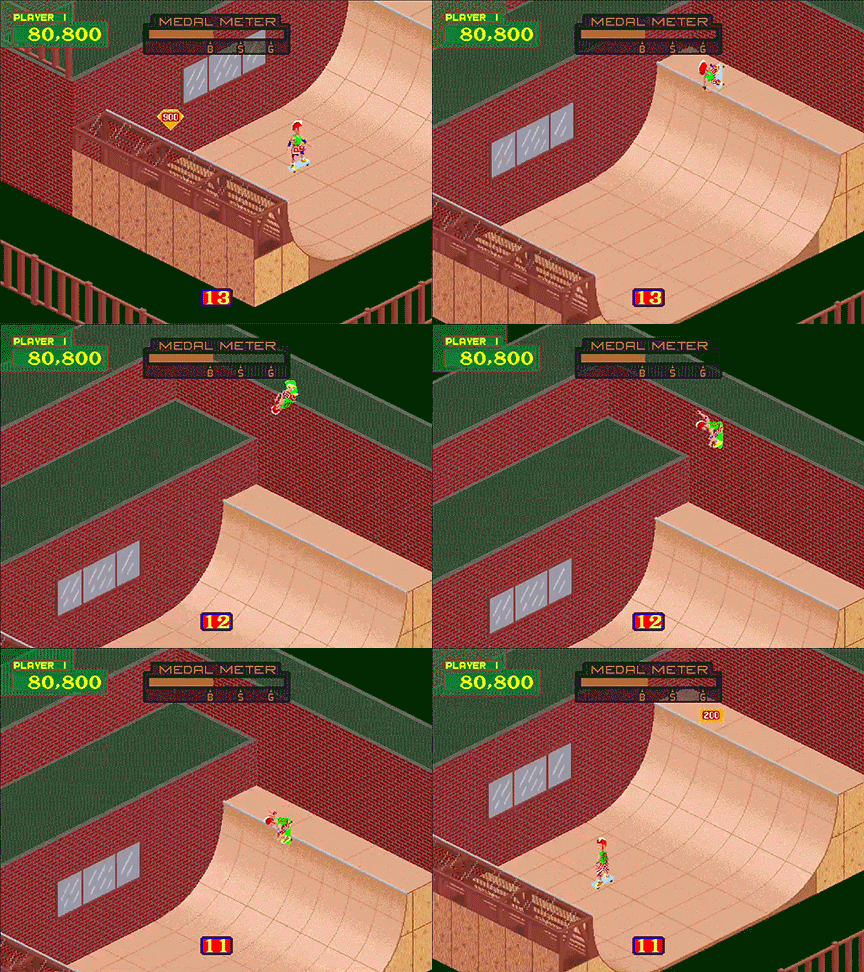
On one particular play through of 720° my character launched much higher than I had ever seen before, and he performed a McTwist. This was an inverted 540 spin° created by Bones Brigade alumni Mike McGill. I knew there were some basic vert tricks that could be performed on the halfpipe, but nothing as fantastic looking as the McTwist. Decades later I commented on the YouTube channels if there was footage of the McTwist that anybody had captured. Most players said they had seen it, however since it wasn’t worth too many points for high score runs then it was never recorded. That was when I decided that I wanted to get footage of this move because it was so cool looking, and not many had seen it. I couldn’t get MAME running on my home computer so I found that a lot of my favorite Atari games had been published in the Midway Classics collection. This was available to download for the Xbox One S. I remembered that I could screen grab, and record from the console so I paid a few bucks for the collection. It was well worth it, and in no time I found myself doing a deep dive on 720°, including capturing many of the moves, far more than I had even realized. I posted it on my Twitter, but probably should have put it on YouTube as well.

I discovered that nobody had put together a comprehensive list of moves on GameFAQs, or a strategy for the arcade game. There was one for the dismal NES version. I think part of the reason why was because many of the vert tricks would randomly pop out in the middle of a contest. Some tricks appeared depending on the speed, and angle that you approached the lip of the ramp. Some depended on what upgrades your character had, but none were guaranteed. I figured this must be the reason why nobody had ever written up a how-to for the arcade original. As a kid what really hurt me me about 720° (aside from wasting my quarters) was that it was built on an experience that no other game provided. The act of skateboarding is challenging, but at the same time rewarding. In order to separate gamers from their quarters Atari was cruel in their planning. They made it easy to skateboard, and perform tricks with the use of only two buttons. Anybody with a quarter could skate like a pro.
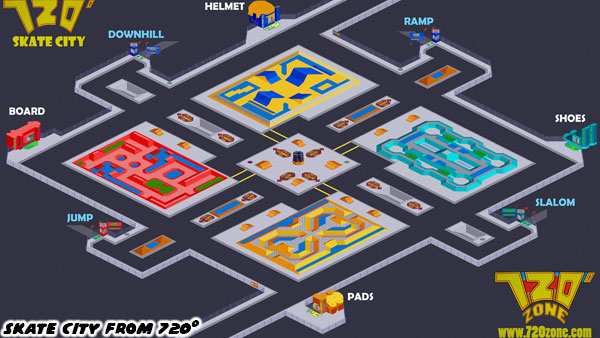
To really hook players Atari created the ultimate world to skate in. They introduced a place called Skate City. Every block its own brightly-colored skatepark, complete with gaps, ramps, and wedges. Massive speakers in the heart of the city provide endless skate-punk tunes. There are no signs prohibiting skateboarding, or skate stoppers bolted to any legs. This is the world that skaters wish they had. Skateboarding, as you know, is not a sport, it doesn’t have rules. Nobody can “win" at skateboarding, it never has a season, or championship, at least not in the traditional sense. It is an art form, a physical activity, and a culture. This culture comes in conflict with society many times in the real world. The act of skating is seen as destructive, just like graffiti art. It is not seen as creative expression in most cities. Atari’s version of Skate City is heaven to me now, as much as when I was a kid. Who wouldn’t want to explore this place? There are endless lines you can paint, nooks to find, and various spots to perform tricks on I needed to see every inch of the map. This was why I was willing to put quarter, after quarter into the machine.
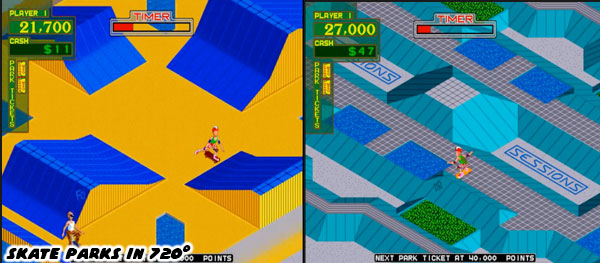
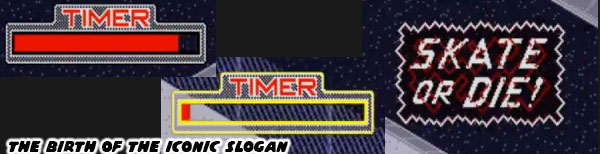
You can earn points while exploring skate city, but if you want your initials on the leaderboard you have to enter one of the four available contests. Atari made sure to encourage players not to waste time in the streets by putting a timer at the top of the screen. Once the timer runs out the game alerts you to “Skate or Die." While the slogan may have initially appeared on a sticker sold on the back pages of Thrasher magazine, it pretty much entered public consciousness thanks to the game. When the warning appears a swarm of angry bees start to chase the player. At first you can skate faster than them, but after a few seconds they begin to speed up, and even take shape like a cartoon syringe to sting players, and end the game. If you don’t have a ticket (many times I did not) there was no way to enter the contest, and escape the bees.
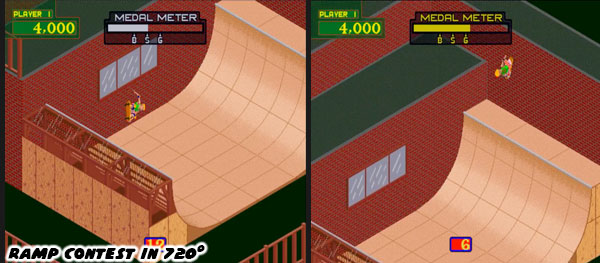
Players begin the game with a single ticket, and must perform tricks to earn more tickets to enter the four available contests. The contests themselves were a good cross-section of skateboarding events from the ‘80s, with a few liberties thrown in. The most popular contest, at least to me was the Ramp contest. It featured a halfpipe next to a brick building. Players could perform an assortment of moves on it, including every possible spin combination. Depending on how fast you rotated the joystick clockwise, or counter-clockwise your character could do a 180°, 360°, 540°, 720°, 900° spin, or more. No only that, with enough speed you could even leap onto the rooftop, and jump back in to earn outrageous points. The timer in each contest was constantly going down, meaning that in this event you only have a few seconds in which to earn enough points to score a medal; Bronze, Silver, Gold, or no medal at all. I’m certain that most people that played the game in the ‘80s wish they could have spent more time just trying out all the ramp tricks.
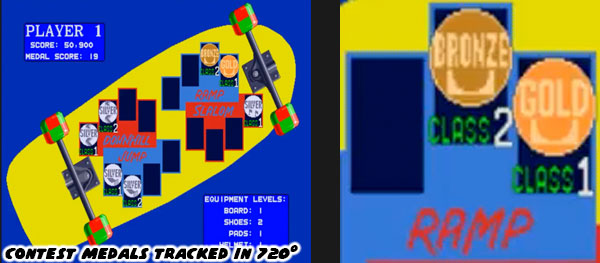
As the game advanced the contests required higher scores, or faster runs, in order to earn any medal. Several of the high score runs on YouTube don’t focus on medals, but rather what tricks score more points. It is possible in some events not to finish a course, but instead use the available time do as many tricks as possible. The ramp contest featured the most popular exploit in the game. Before dropping in it was possible to have your character bounce off the wall, and “grind" on the edge of the ramp earning an incredible bonus. Then you simply skate up each wall, and allow your character to slide down the ramp. While this kills the purpose of actually riding the ramp, and spinning, it rewards far more points, and guarantees a gold medal each time. The collection of medals are recorded on a skateboard deck, completing the theme of the experience.
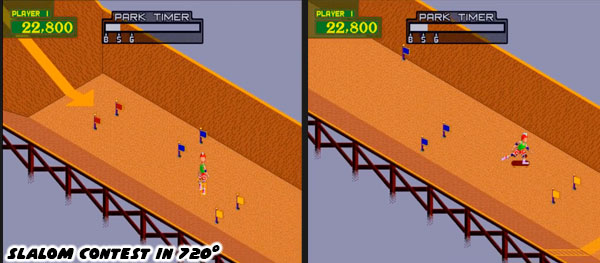
The other contests are pulled from traditional skateboard events. One of them is the slalom. In it players have to race down a wooden track, while moving in between flags as fast as possible. It is very easy to overshoot the flags, and end up sliding off course. Slalom was one of the more popular old school skateboard events going back to the early ‘70s.
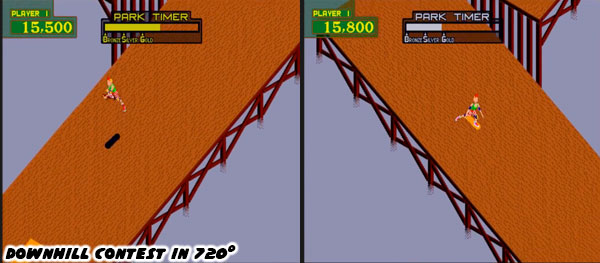
The other race in the game is downhill. Again this is sort of based on actual skateboard racing. However instead of racing on the street against a group of opponents it’s the player against the clock. Gamers have to navigate a steep wooden ramp, and try to get down as fast as possible. Players can clip corners, and jump into further sections of the ramp, rather than try to ride them down completely. Like the slalom it is very easy to go off the edge of the ramp because you miscalculate the turns or jumps.
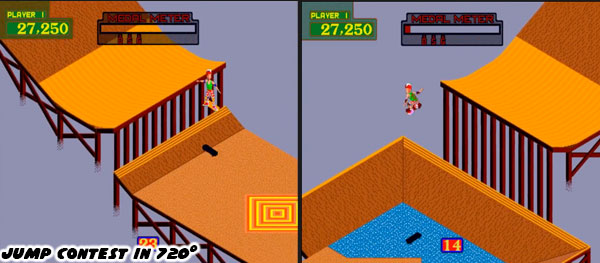
The fourth competition in the game is called Jump. It is the only event in the game that was not based on a traditional contest. Instead players have to navigate a steep ramp, similar to downhill, but with a ramp at the end of each platform. Players are rewarded for landing on a small multicolored target. Of all the contests this is by far the hardest to medal in. The target is not visible until you have already jumped. Making it very easy to overshoot completely. The game does give you a hint as to how far out to jump, and in which direction. A yellow diamond shape is painted on the run up ramp, if you line up right over the diamond you are guaranteed to at least be headed in the right direction. A large diamond means that the player has to jump, and spin out as far as possible. A medium-sized diamond means you don’t have to go as far. And a tiny diamond just means to let your character drop off the platform. Sometimes the diamond is pointing diagonally, which means you have to carve across the ramp just before your jump. Then there are double diamonds, which let you know if both are a jump, or if the first is a drop, and the second is a jump. Like I said it’s very difficult to score here, as there are no do-overs in the event.
The only way to get good at 720° is to play it over, and over. Which of course was what Atari, and the arcade owners were hoping for. As I said earlier there was a way for players to exploit a part of the game so that they could chase competition tickets, and high scores. The ramp glitch I described was one way. The other was by purchasing certain items. Contest money could be used to purchase a helmet, skateboard, shoes, or pads. Each one of those items helped increase the stats of the player. The shoes for example allowed the player to jump higher. The helmet allowed them to spin faster.
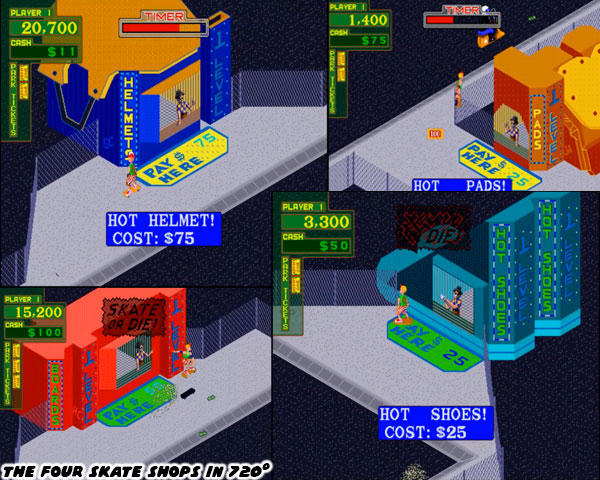
Pads could be used to recover faster from accidents. The board allowed you to go faster. There were three tiers of each item that you could buy before the store that sold them closed down. As a fun aside the stores themselves looked like a giant version of the item. The shoe shop looked like a giant pair of canvas sneakers. The helmet shop looked like a giant helmet, etc. You didn’t really have to purchase the Level 3 version of each item in order to maximize your score output. Many of the best players suggest to only get Level 1 or 2 of certain items, and in a specific order.
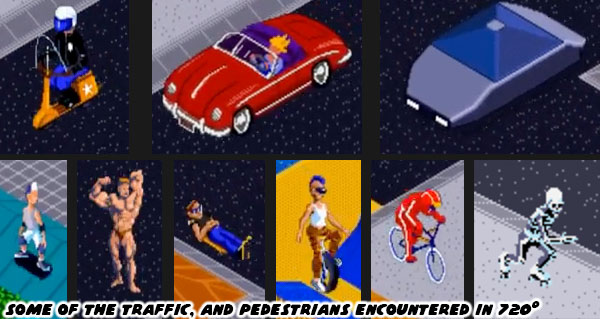
Of course navigating Skate City wasn’t without its risks. There were other skaters to compete with on the parks throughout the city, as well as various other pedestrians blocking the sidewalks. Rival skaters, kids on BMX bikes, punks on unicycles, bodybuilders, and even frisbee players could all knock over our skater. Yet a savvy player could actually time a boneless jump, and land on pedestrians instead. This was an interesting detail about the game. The character could not ollie, and would actually plant his foot in order to leap into the air, or go higher on a ramp. These tricks were known as boneless, no comply, or fast plant, depending on whether the player grabbed the board or not. Of all the pedestrians the one that stood out the most was a roller skating skeleton. At first glance you might think it’s a person in a skeleton suit, until you crash into him, and he collapses into a pile of bones.
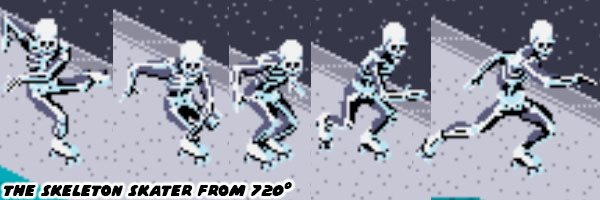
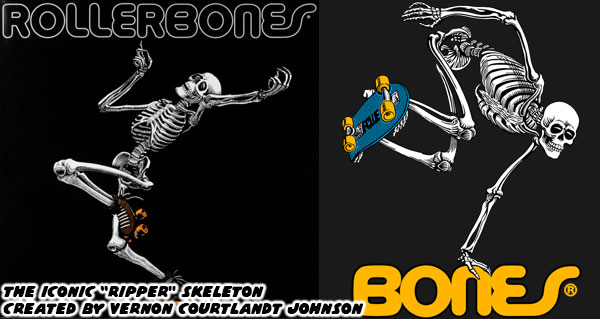
The character was undoubtedly based on the “Ripper" skeleton created by artist Vernon Courtlandt Johnson, who created a number of pieces for Powell Peralta skateboards. To me VCJ is a god, and easily one of the biggest influences on my art. I’ve mentioned this before on my blog. While many skaters may equate the Ripper with skateboarding, some of his earliest art was used on roller skates for Bones wheels. This very rare shout-out was used by Atari when they put the character in the game.
The more I played 720° in the arcade, years later on MAME, and decades later on the Xbox One S the more I appreciated it. As I pursued footage of the McTwist I began absorbing all sorts of details that had been lost to me previously. It made me dig in a little bit more into its history. I’d like to share a lot more on this game, and my other favorite skateboard games over the next few blogs. I hope to see you back for that. If you would like to sponsor me please visit my Patreon page and consider donating each month, even as little as $1 would help make better blogs and even podcasts!
