We cannot separate the over-sexualization of the female Street Fighter character designs from reality. Capcom has done a fine job of pandering to the mostly male demographic with the changes made to the female characters in the Street Fighter series. Yet to put all the blame squarely on Capcom would mean ignoring the society that we live in. Capcom creates characters that reflect society, the good and the bad aspects of it. If they are creating female characters and presenting them as objects of desire then they are following the trends. SNK does this, Sega does this, Namco does this, Microsoft does this, just about every studio that makes a fighting game is guilty of following the trend. Sex sells and when it comes to female athletes it is the most important thing to sell. The design behind Laura Matsuda, the new Brazilian fighter in Street Fighter V certainly caught onto the trends.
Women are paid less in general than men for the same amount of work in the business world. The divide becomes much more noticeable for female athletes. For example
Abby Wambach, forward for the USA Women's National Soccer Team makes far less than her male counterparts. She has an incredible record in league, international and World Cup play yet her annual earnings, including endorsements and sponsorships are less than even the big name retired male peers. Despite her accomplishments and abilities she is marginalized in the sports community. She does not turn up in much advertising, she does not get asked to appear in movies or television cameos. She doesn't even warrant an interview on the sports networks. At the same time retired NBA and NFL athletes have a steady stream of work in commercials and as commentators and are expected to make more than Wambach annually. As she retires chances are that she will fade away unlike the male athletes from the same generation. She was not the first to have this broad divide come to light. Women have to fight for respect at every turn. Earlier this year Sports Illustrated announced the Sportsperson of the year was tennis star Serena Williams. They took an online poll and people voted for the horse American Pharaoh to win the honor. Was it trollish behavior from the online crowd? Possibly. Was it sexist, racist or misogynist to pick a horse over a black woman? Quite possible as well. The news that people were
upset about the decision made headlines around the world. Women have to walk a fine line between being taken seriously as athletes and at the same time being marketable through attractiveness. This is especially noticeable in the fighting community. One of the first things that people noticed in the design of Laura were her looks, and aside from her breasts it was her hair that stuck out.
Laura Matsuda wore a half head of tight braids or cornrows. Most female fighters wore their hair in full braids during competition. This way it stayed out of their eyes. Unlike using a headband these braids couldn't easily fall apart even in a grapple. The half-head of braids was made popular in part by pro fighter Ronda Rousey. She would often wear her hair this way during media events and premiers. The hair itself can be seen as a part of the trend of having to be an attractive female athlete in order to be marketable. Do you remember the media outlets doing interviews on the stylists of any other fighter or boxer, male or female? We now know that
stylist Abraham Esparza helped create Rousey's trademark style only because the sports outlets decided this was important. Ronda still has to contend with the standards that society has on beauty. She still
has to deal with people calling her fat. Serena Williams and her sister have been called ugly and mannish because they were extremely muscular. By comparison the Russian
Maria Sharapova was easier to market, easier to build a brand around and feature as a mode because she fit the western ideal of beauty. She was blonde, thin and not as muscular as the Williams sisters. It did not matter if she was not as highly ranked a player or if she didn't have as many championships as either sister. Great looking fighters could be marketed. It didn't matter if Rousey had a judo record that earned a gold medal in the Pan American Games, a Silver in the World Championships and the Bronze in the Olympics. Or that her professional MMA career was 12-1, a prior women's champ for the UFC. The focus from many outlets was her appearance and
even her sexual appetite more than her in-ring ability.
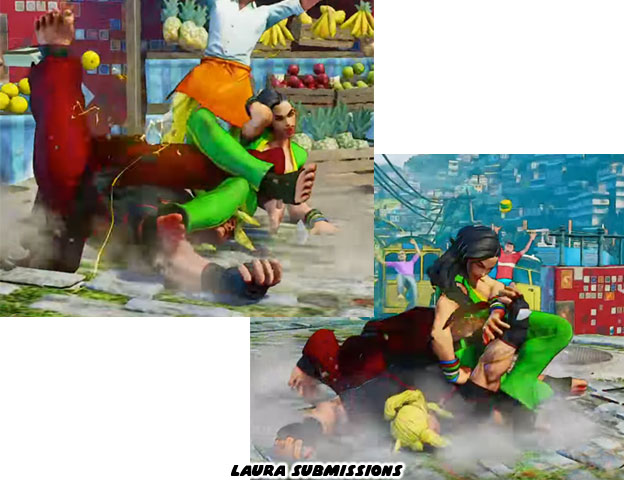
In Street Fighter V Laura Matsuda has a very attractive design however that is in contrast to her striking moves, traps and grappling takedowns. She has speed and power that almost put her on par with the bruiser Abel from Street Fighter IV. This might be a seen as a turn-off for some players. Even in the ring women have to be marketed as strong and sexy.
Michelle Waterson is nicknamed "the Karate Hottie" and the Japanese fighter Rin Nakai is advertised as
strength and beauty by the UFC. Is referring to women like this macho posturing? Is mixed martial arts is the most alpha-male of sports? Do men get intimidated by alpha-females in competition? If so do they believe that women belong in the ring as ring girls rather than fighters? Women walk the line and always have to look their best. Whether it's during training, a press conference or even weigh-in. They have to be made up and look presentable. Men do not have to deal with the double standard. They can be ugly or slovenly if they want. They can show up in torn pants with a 5 o'clock shadow to an interview and nobody cares. They can even act inappropriate to the reporter if they want to. Remember when Quentin "Rampage" Jackson
dry humped a female reporter on air? Or when he did the same
thing to a Japanese reporter overseas? Would you expect or even accept this behavior from a pro baseball or basketball player? Would female fighters be called sluts if they behaved in the same way? Or were male fighters somehow a part of a different crowd? Were they allowed to be as sexually dominant as they wanted because they were fulfilling some sort of contract with our primal desires?
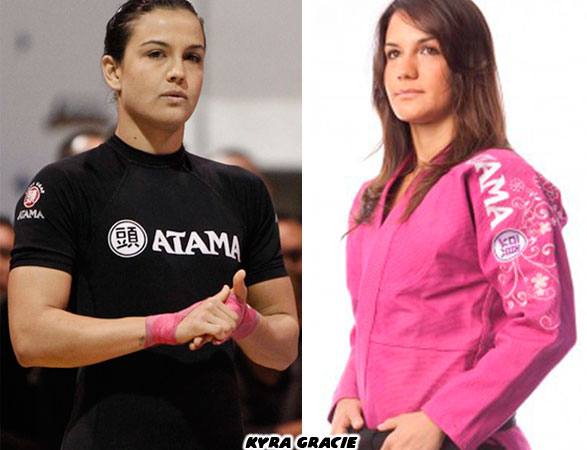
It is hard to be a professional female athlete in any discipline and much more for a fighter. Ronda is just one example of female fighters having to fit a certain mold, but let's look at somebody from Laura's part of the world and see if the same thing applies. Kyra Gracie, daughter of Rorion Gracie and a member of the legendary Gracie clan is a proud Brazilian. Like her family members she is expected to excel in jujitsu. It is not luck or genetic engineering that makes Kyra or her family members great. It is lots of hard work, practice and a system that has been refined by almost a century. The Gracie family was participating in international bouts and no-holds barred matches since the start of the 20th century. This was well before the term mixed martial arts was even coined. The Japanese champion
Mitsuyo "Count Kouma" Maeda helped introduce jujitsu to Brazil. He had a hand in teaching the Gracie family the art and exposed an entire nation to its effectiveness. Kyra represents a third-generation practitioner. She does very well in local and national tournaments. She fights in both gi, wearing the traditional uniform as well as non-gi contests where opponents wear tight-fitting rash guards. She had no plans on transitioning to MMA because the life-span of those fighters, and earning power, is much shorter. When it came to actual fighting Kyra did not sex up her uniform at all. Like other female fighters she wore something that was functional if not modest. Yet this did not mean that she was not presented as a sexual being to audiences.
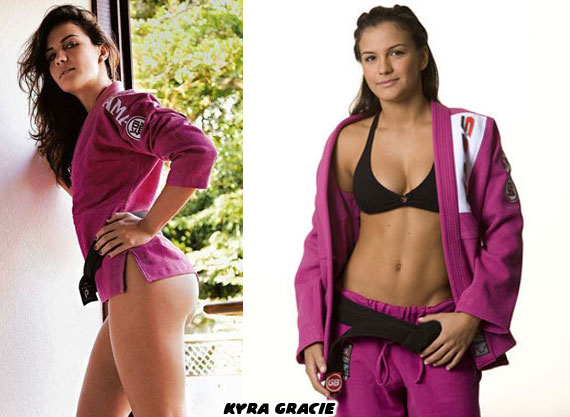
Kyra did some modeling outside of the ring to help make her more visible to non-MMA, non-jujitsu fans. By appearing in some very revealing shoots was she pandering to her fans? Certainly, but she was keenly aware of what she was doing. The Brazilian was using sex to sell her image, she was building her brand more so than she was building the Gracie brand. If large companies could exploit women in their advertising then what would happen if the women were in control of the image? Athletes like Rin Nakai, Ronda Rousey, Michelle Waterson and even the Williams sisters knew that they were not getting paid as well as their male counterparts. They also knew that their life in pro sports would not last forever. They needed to make as much money as they could, by using any avenue that they could. This is the sad truth of female athletes. Many female athletes have to do things that are not expected of male counterparts. Also, like the previously aforementioned sports figures, Kyra was doing these shoots of her own free will. She was not coerced into appearing topless, or pants-less in her pictures. She did this because she knew the images would sell and she would gain a lot of new followers. These followers would bring with them their money and make the sponsors happy. Did the sex do anything to diminish her presence in the ring? Nope! Also she did not actually fight with her boobs hanging out of her top.
Designers at every studio need to ask themselves if the characters they are creating go above and beyond the sexy tropes and stereotypes, or are they just reflecting what society expects a female fighter to be. SNK, Namco, Sega, Capcom, Midway and the other studios have created many fantastic female characters for over 25 years without resorting to pandering. They created female fighters that were empowered and attractive. Yet they also created many that were sexy for the sake of being sexy. This is something that drives me especially crazy about Capcom. At their best they can create characters that cross multiple genres, that appeal to a broad range of demographics. Yet in recent years they haven't quite been able to hit the mark that the previous teams did. The icons created in Street Fighter II, Street Fighter Alpha and even Street Fighter EX had a lot more staying power. They accomplished this without the use of 3D graphics, without overly-sexual female characters.
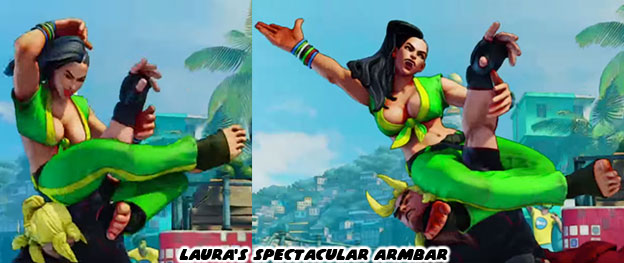
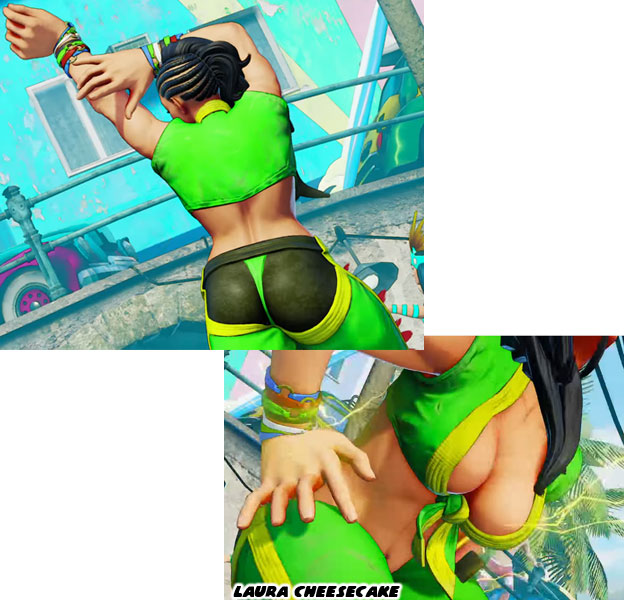
So how does Laura stack up? She has some of the most imaginative moves in recent memory. Her grapples and takedowns, which can be mixed up with solid strikes and combos are a refreshing addition to the franchise. They break up the monotony of Ryu's fireball attacks or the stiff power moves of Zangief. They are even somewhat believable to perform. What the character didn't need was the special attacks focused around electricity. I understand it was a nod to Blanka but are all Brazilians really doubling as car batteries? Not only that, her super moves have her bouncing around the screen like a pinball. The Street Fighter IV and V teams really enjoy breaking the 4th wall but now the moves are really starting to lose their charm. Purpose-wise she is a positive of a representation of Brazil. I could do without the feathered-costume samba dancers on her stage, or the giant world cup trophy in the background (instead of the Jesus statue atop Rio De Janeiro). We get it Capcom, this is Brazil, you don't have to be so ham-fisted about it. With that said Laura is doing much more for the people of South America than Blanka ever did. The pairing of rash guard shorts under her pants just to show off her butt was sophomoric, and her too revealing top was lazy design. Her color selection of green and yellow was however perfect, especially when combined with the black ankle sleeves for contrast. Bright primary colors were usually assigned to each character and green wasn't really assigned to anybody in Street Fighter V. The colors did the double duty of mirroring the colors from the Brazilian national flag.
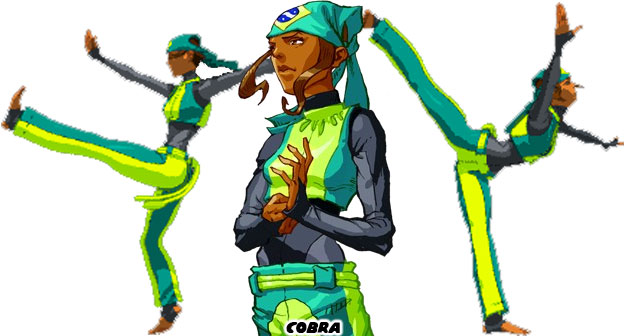
Laura was not the first minority character, or mixed ethnicity character to pull off this look. That honor would belong to Cobra from Spiritonin's Capoeira Fighter 3. Cobra was fast, flexible and very dangerous. She had some amazing strikes and brutal takedowns as well. She was a villain in the game yet at the same time fiercely proud of her nation. A good chunk of her costume, including the rash guard and ankle sleeves predates the look of Laura. Did I think Laura was derivative? No, I think it was coincidence in the design.
Do I think Laura works in the Street Fighter universe? I say yes. The game could always use more diversity with regards to ethnicity and diverse styles of fighting. I think characters like Laura belong especially when these are positive figures rather than stereotypical tropes. She certainly has more going for her than F.A.N.G. I could do less without the close ups on her butt or the gratuitous cleavage close ups during her intro or special animations. These don't do anything to make the game better or make audiences appreciate the character any more or less. She is very similar to Rashid in that she is a good design but does not actually achieve greatness. To be fair she is slightly more unique than Rashid for the move selection assigned to her and even for her creative hair style. Her moves, minus the electricity are more grounded and less fantastic than the sci-fi wind attacks of Rashid. I think that the character has much better design and purpose than her brother Sean, who was yet another "shotoclone" introduced in Street Fighter III.

Something that Capcom has to explain is why Laura is much lighter than her brother. I understand that they are siblings and sometimes there is a range in how dark or fair skinned a brother or sister can be. But this difference is very noticeable. It is okay to assume that they may be step-siblings but if they are truly brother and sister then why make her much lighter? I get the same feeling for Laura that I got for Vanessa Lewis. The studio is intentionally making her lighter just to appeal to the Asian market and of course Western ideal of beauty. Let's hope that is not the case. Laura is a good character and I hope to see her more in the future. I'd like to hear your take on this character and whether or not you think women fighters tend to be objectified more in games. As always if you enjoyed this blog and would like to sponsor me
please visit my Patreon page and consider donating each month, even as little as $1 would help make better blogs and even podcasts!