Showing posts with label cobra. Show all posts

Friday, December 15, 2023

My dream car lineup, the last five...

In the previous blog I talked about my favorite Italian exotic. My friend clued me into the only car that was on par with the F40 back in the day. There was an American aerospace engineer that wanted to build the greatest supercar of all time. The Vector W8 (1993) looked even more exotic than the Lamborghini. The engine itself was unique in how it was configured, the eight cylinders were not in a traditional V-formation, but rather a W shape. Hence its name. Also Vector did not consider itself an automobile manufacturer, they were an “Aeromotive” company. Their supercar had a number of technical features that wouldn’t be seen again in cars until almost 30 years later, including cameras, and an electric HUD. The small factory that made them was based in Wilmington CA, not far from where my mom used to work. I would beg her to drive around the building just for a glimpse at one. Sure enough one day we were fortunate to pass by when they had their gate open, and saw them assembling a car. Please read this amazing history of the Vector from Supercars.net. As well as when Car and Driver tested almost all of the functionality of the Vector in 1991. This was by far the most futuristic car I had ever seen, and still looks like the future that Cyberpunk promised us.

Between the GNX, Superbird, Ferrari F40, and Vector W8 you would think that my desire for fast cars was satiated. I still wanted a sporty head turner. Something in my garage that was unlike any other exotic. I had to be very careful with my selection. The McLaren F1 (1994) was considered to be the pinnacle of supercar design. In fact here’s the Road & Track article calling the F1 the World’s Greatest Car. It was certainly on my short list, but believe it or not it did not make the cut. Consider it to be number 11 on the list. It would be the first car I add if I expand my fictional garage.

I also considered a Shelby Cobra, and Fort GT40, the American cars that put the Europeans on notice back in the ‘60s. I would have loved the Dodge Viper GTS-R (1998), specifically the 2017 Special Edition. The Dodge V10 was already revolutionary, designed with the help of Carrol Shelby, the father of the Cobra, and GT40 programs. I wasn’t fond of the original Viper RT10 t-top. The hardtop looked much more brutal. The racing tuned version was the peak of performance. Here’s the Supercars writeup on the 2017 GTS-R. The thing was that I don’t think these models were street legal, I think they could only be used on the track. I could have gotten a street legal version of the Viper, but then again, I wanted a different kind of snake.

The next car in my garage would come from Japan. I got the same vibe for the Mitsuoka Orochi (2007) that I had from the Vector the very first time that I saw it. It was one of the featured cars, and one of my preferred rides in the Capcom game Auto Modellista from 2002. Here was a supercar way ahead of its time. The luxury exotic concept by Mitsuoka had been touring the car shows for years. It was supposed to have over 600hp, making it one of Japan’s true exotic supercars. The finished version had much less than that, but I would have the best tuners in the business replace the Toyota V6 motor with something much more powerful. More than the advertised performance numbers, it was the look that really sung to me. The Orochi was an eight-headed serpent from Japanese mythology. The car looked like a demon by design. The multiple headlights had thin snake-like lines drawn on them to convey that feeling. You can actually see one of these in the background of Avengers: Endgame. In the scene where Ronin (Hawkeye) is killing yakuza members in Japan, and the Black Widow comes to recruit him there is an Orochi behind them.

It wasn’t the only Japanese car that I would have in my personal top-10 garage. You might think based on the love that I have for performance cars that my other Japanese ride would be the Nissan Skyline R34 GT-R V-Spec II, Mitsubishi Lancer EVO, or Subaru Impreza WRX. Those are all fantastic cars, but I wanted something less intimidating. I wanted something small, and playful. My original choice was going to be the British Mini Cooper S (2000). I had always had a fondness for the little car from across the pond. When it was properly tuned it was as deceptively fast as the GNX. I wasn’t the only one that had the same feelings for the little car that could. Road and Track got to race one and fell in love. I would absolutely have added a properly sport tuned, and chassis-stiffened ride in my car, if it could fit 20 rides instead of 10 in my fictional garage.

So if I wasn’t going to put a Mini Cooper in my lineup, then what would fit into that tiny spot? I did consider a sport-tuned Subaru 360 from the 1960’s. Or even a Fiat 500 from the same era. They were all fun tiny cars, that could be made into sporty street racers. Ultimately I decided on the Mazda Carol 360 (1964). The millionth car made by Mazda was this micro mini. The look, stance, and shape are unlike anything else out there. The fact that it’s also a 4-seater like the original Mini makes it something functional for the whole family. Although I doubt that we can all fit comfortably in the little car I’d still love to have a tuned up version. The history of the tiny car is celebrated on Mazda’s site

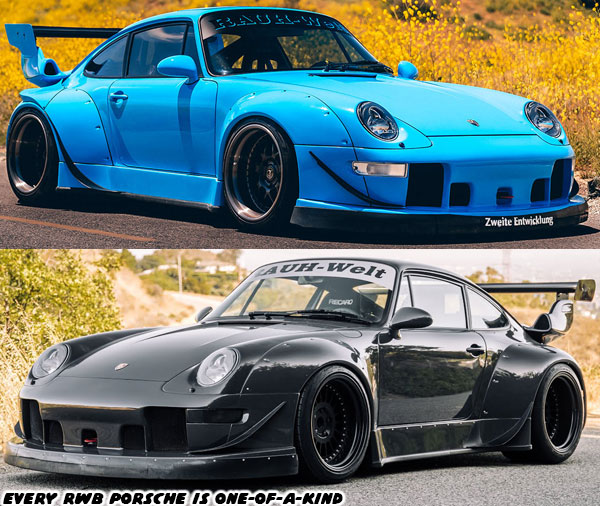
The ninth car in my lineup would be a Porsche. I can imagine many of you nodding in agreement. I have tons of American rides, but not a fine piece of German engineering. I’m split on a properly tuned up Porsche 911, or Porsche 930 circa 1989. Having a modified engine, suspension, wheels, and tires would only be the beginning. I would call on the Japanese body kit maestro Akira Nakai founder, and customizer RWB Rauh-Welt Begriff (Rough World Concept) to give the car the finishing touches. Mr. Nakai flies all around the world with a rolling toolbox, and installs the wide body kits himself. There is a two-year waiting list to get him for a project. You can find out about what he offers on the Rauh-Welt Begriff official website. I’ve seen countless videos of the man putting together a car. Watching him work is amazing. He’s like those hair stylists you read about that charge $700 for a haircut, and celebrities have to wait months for an appointment. When you watch him work you realize that he is on another level. He is completely absorbed in his work, an artist far more than just a tuner. Mr. Nakai seems to live on cigarettes, and Coca-Cola bottles while he cuts, assembles, and shapes the final body pieces during the installation process. This means that no two cars are alike, and in fact, he will only create one car per customer. Getting a unique Porsche RWB would definitely help make my car lineup stand out.

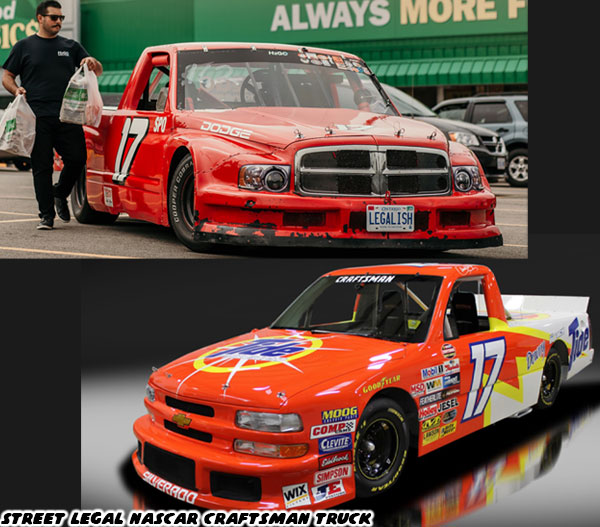
The final car in my garage would be completely custom build from the ground up. Number 10 in my dream list would be a street legal Craftsman NASCAR Truck. These are rare, but they actually exist. There are builders out there that make street legal race cars. I don’t mean they chop up an existing car, and race tune it. I mean they create a roll cage, frame, and engine from scratch. Then they wrap everything in sheet metal, or carbon fiber. These are no frills rides. No A/C, no radio, no sound deadening, no airbags, no side windows, or other amenities. You can read about the amazing Legalish truck repurposed by Richar Caetano, or even see video of Cleetus McFaland checking out Lord Cheyenne’s NASCAR Truck. I would absolutely love to get a truck of my own that defies logic. Something that could snap any other sports car in half. I'd use it to cruise down PCH.

So this what my dream garage would look like. I’d like to hear what your top-10 cars would be if money was no object. Tell me about it in the comments section. As always if you would like to sponsor me please visit my Patreon page and consider donating each month, even as little as $1 would help make better blogs and even podcasts!
follow the Street Writer on Patreon!

Monday, January 4, 2016

Laura, the new leading lady of Street Fighter V or more fanservice?

We cannot separate the over-sexualization of the female Street Fighter character designs from reality. Capcom has done a fine job of pandering to the mostly male demographic with the changes made to the female characters in the Street Fighter series. Yet to put all the blame squarely on Capcom would mean ignoring the society that we live in. Capcom creates characters that reflect society, the good and the bad aspects of it. If they are creating female characters and presenting them as objects of desire then they are following the trends. SNK does this, Sega does this, Namco does this, Microsoft does this, just about every studio that makes a fighting game is guilty of following the trend. Sex sells and when it comes to female athletes it is the most important thing to sell. The design behind Laura Matsuda, the new Brazilian fighter in Street Fighter V certainly caught onto the trends.

Women are paid less in general than men for the same amount of work in the business world. The divide becomes much more noticeable for female athletes. For example Abby Wambach, forward for the USA Women's National Soccer Team makes far less than her male counterparts. She has an incredible record in league, international and World Cup play yet her annual earnings, including endorsements and sponsorships are less than even the big name retired male peers. Despite her accomplishments and abilities she is marginalized in the sports community. She does not turn up in much advertising, she does not get asked to appear in movies or television cameos. She doesn't even warrant an interview on the sports networks. At the same time retired NBA and NFL athletes have a steady stream of work in commercials and as commentators and are expected to make more than Wambach annually. As she retires chances are that she will fade away unlike the male athletes from the same generation. She was not the first to have this broad divide come to light. Women have to fight for respect at every turn. Earlier this year Sports Illustrated announced the Sportsperson of the year was tennis star Serena Williams. They took an online poll and people voted for the horse American Pharaoh to win the honor. Was it trollish behavior from the online crowd? Possibly. Was it sexist, racist or misogynist to pick a horse over a black woman? Quite possible as well. The news that people were upset about the decision made headlines around the world. Women have to walk a fine line between being taken seriously as athletes and at the same time being marketable through attractiveness. This is especially noticeable in the fighting community. One of the first things that people noticed in the design of Laura were her looks, and aside from her breasts it was her hair that stuck out.


Laura Matsuda wore a half head of tight braids or cornrows. Most female fighters wore their hair in full braids during competition. This way it stayed out of their eyes. Unlike using a headband these braids couldn't easily fall apart even in a grapple. The half-head of braids was made popular in part by pro fighter Ronda Rousey. She would often wear her hair this way during media events and premiers. The hair itself can be seen as a part of the trend of having to be an attractive female athlete in order to be marketable. Do you remember the media outlets doing interviews on the stylists of any other fighter or boxer, male or female? We now know that stylist Abraham Esparza helped create Rousey's trademark style only because the sports outlets decided this was important. Ronda still has to contend with the standards that society has on beauty. She still has to deal with people calling her fat. Serena Williams and her sister have been called ugly and mannish because they were extremely muscular. By comparison the Russian Maria Sharapova was easier to market, easier to build a brand around and feature as a mode because she fit the western ideal of beauty. She was blonde, thin and not as muscular as the Williams sisters. It did not matter if she was not as highly ranked a player or if she didn't have as many championships as either sister. Great looking fighters could be marketed. It didn't matter if Rousey had a judo record that earned a gold medal in the Pan American Games, a Silver in the World Championships and the Bronze in the Olympics. Or that her professional MMA career was 12-1, a prior women's champ for the UFC. The focus from many outlets was her appearance and even her sexual appetite more than her in-ring ability.


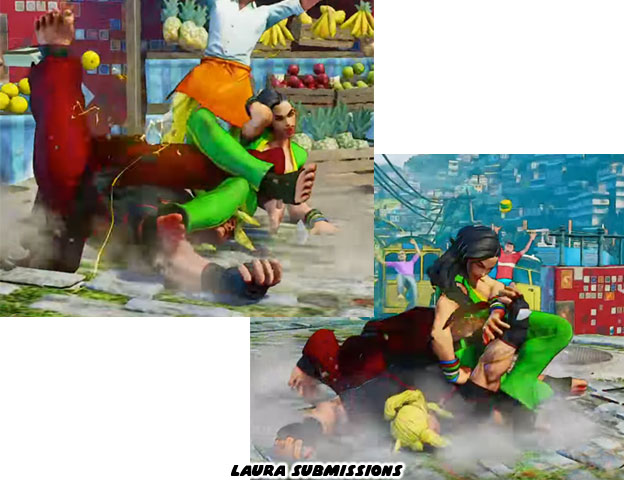
In Street Fighter V Laura Matsuda has a very attractive design however that is in contrast to her striking moves, traps and grappling takedowns. She has speed and power that almost put her on par with the bruiser Abel from Street Fighter IV. This might be a seen as a turn-off for some players. Even in the ring women have to be marketed as strong and sexy. Michelle Waterson is nicknamed "the Karate Hottie" and the Japanese fighter Rin Nakai is advertised as strength and beauty by the UFC. Is referring to women like this macho posturing? Is mixed martial arts is the most alpha-male of sports? Do men get intimidated by alpha-females in competition? If so do they believe that women belong in the ring as ring girls rather than fighters? Women walk the line and always have to look their best. Whether it's during training, a press conference or even weigh-in. They have to be made up and look presentable. Men do not have to deal with the double standard. They can be ugly or slovenly if they want. They can show up in torn pants with a 5 o'clock shadow to an interview and nobody cares. They can even act inappropriate to the reporter if they want to. Remember when Quentin "Rampage" Jackson dry humped a female reporter on air? Or when he did the same thing to a Japanese reporter overseas? Would you expect or even accept this behavior from a pro baseball or basketball player? Would female fighters be called sluts if they behaved in the same way? Or were male fighters somehow a part of a different crowd? Were they allowed to be as sexually dominant as they wanted because they were fulfilling some sort of contract with our primal desires?
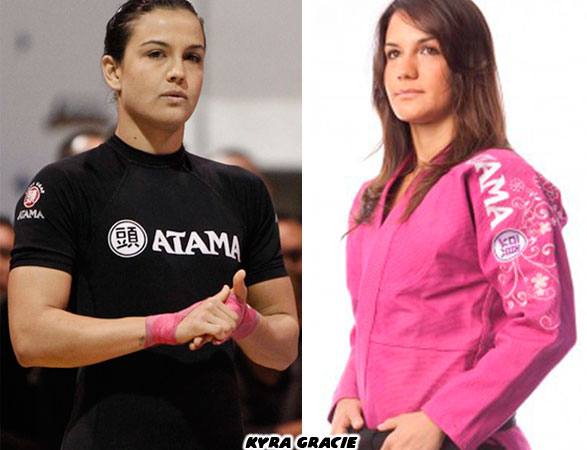

It is hard to be a professional female athlete in any discipline and much more for a fighter. Ronda is just one example of female fighters having to fit a certain mold, but let's look at somebody from Laura's part of the world and see if the same thing applies. Kyra Gracie, daughter of Rorion Gracie and a member of the legendary Gracie clan is a proud Brazilian. Like her family members she is expected to excel in jujitsu. It is not luck or genetic engineering that makes Kyra or her family members great. It is lots of hard work, practice and a system that has been refined by almost a century. The Gracie family was participating in international bouts and no-holds barred matches since the start of the 20th century. This was well before the term mixed martial arts was even coined. The Japanese champion Mitsuyo "Count Kouma" Maeda helped introduce jujitsu to Brazil. He had a hand in teaching the Gracie family the art and exposed an entire nation to its effectiveness. Kyra represents a third-generation practitioner. She does very well in local and national tournaments. She fights in both gi, wearing the traditional uniform as well as non-gi contests where opponents wear tight-fitting rash guards. She had no plans on transitioning to MMA because the life-span of those fighters, and earning power, is much shorter. When it came to actual fighting Kyra did not sex up her uniform at all. Like other female fighters she wore something that was functional if not modest. Yet this did not mean that she was not presented as a sexual being to audiences.
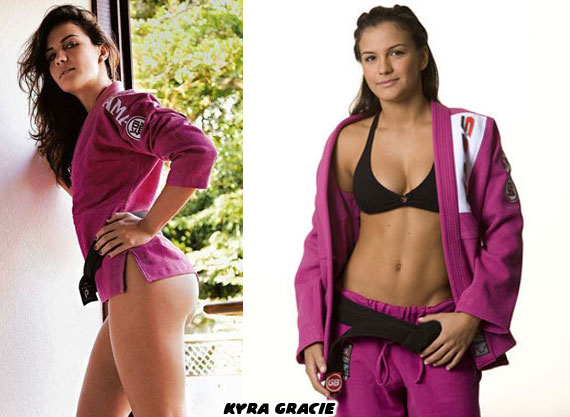
 

Kyra did some modeling outside of the ring to help make her more visible to non-MMA, non-jujitsu fans. By appearing in some very revealing shoots was she pandering to her fans? Certainly, but she was keenly aware of what she was doing. The Brazilian was using sex to sell her image, she was building her brand more so than she was building the Gracie brand. If large companies could exploit women in their advertising then what would happen if the women were in control of the image? Athletes like Rin Nakai, Ronda Rousey, Michelle Waterson and even the Williams sisters knew that they were not getting paid as well as their male counterparts. They also knew that their life in pro sports would not last forever. They needed to make as much money as they could, by using any avenue that they could. This is the sad truth of female athletes. Many female athletes have to do things that are not expected of male counterparts. Also, like the previously aforementioned sports figures, Kyra was doing these shoots of her own free will. She was not coerced into appearing topless, or pants-less in her pictures. She did this because she knew the images would sell and she would gain a lot of new followers. These followers would bring with them their money and make the sponsors happy. Did the sex do anything to diminish her presence in the ring? Nope! Also she did not actually fight with her boobs hanging out of her top.

Designers at every studio need to ask themselves if the characters they are creating go above and beyond the sexy tropes and stereotypes, or are they just reflecting what society expects a female fighter to be. SNK, Namco, Sega, Capcom, Midway and the other studios have created many fantastic female characters for over 25 years without resorting to pandering. They created female fighters that were empowered and attractive. Yet they also created many that were sexy for the sake of being sexy. This is something that drives me especially crazy about Capcom. At their best they can create characters that cross multiple genres, that appeal to a broad range of demographics. Yet in recent years they haven't quite been able to hit the mark that the previous teams did. The icons created in Street Fighter II, Street Fighter Alpha and even Street Fighter EX had a lot more staying power. They accomplished this without the use of 3D graphics, without overly-sexual female characters.
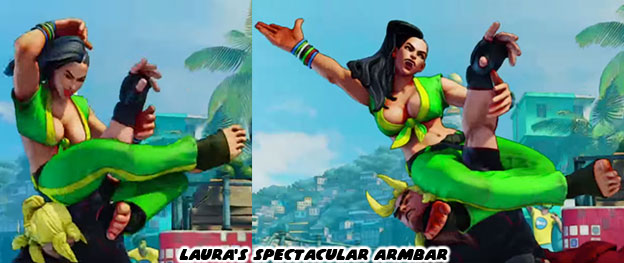

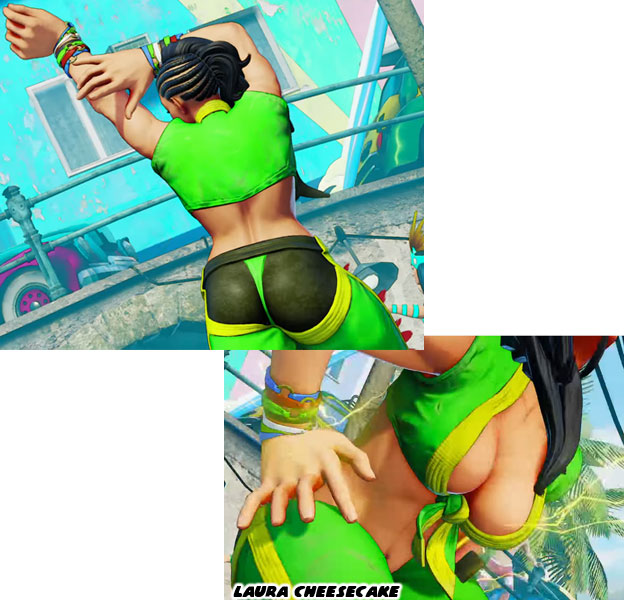
So how does Laura stack up? She has some of the most imaginative moves in recent memory. Her grapples and takedowns, which can be mixed up with solid strikes and combos are a refreshing addition to the franchise. They break up the monotony of Ryu's fireball attacks or the stiff power moves of Zangief. They are even somewhat believable to perform. What the character didn't need was the special attacks focused around electricity. I understand it was a nod to Blanka but are all Brazilians really doubling as car batteries? Not only that, her super moves have her bouncing around the screen like a pinball. The Street Fighter IV and V teams really enjoy breaking the 4th wall but now the moves are really starting to lose their charm. Purpose-wise she is a positive of a representation of Brazil. I could do without the feathered-costume samba dancers on her stage, or the giant world cup trophy in the background (instead of the Jesus statue atop Rio De Janeiro). We get it Capcom, this is Brazil, you don't have to be so ham-fisted about it. With that said Laura is doing much more for the people of South America than Blanka ever did. The pairing of rash guard shorts under her pants just to show off her butt was sophomoric, and her too revealing top was lazy design. Her color selection of green and yellow was however perfect, especially when combined with the black ankle sleeves for contrast. Bright primary colors were usually assigned to each character and green wasn't really assigned to anybody in Street Fighter V. The colors did the double duty of mirroring the colors from the Brazilian national flag.
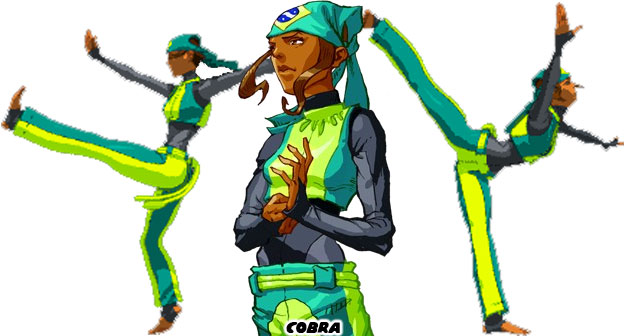


Laura was not the first minority character, or mixed ethnicity character to pull off this look. That honor would belong to Cobra from Spiritonin's Capoeira Fighter 3. Cobra was fast, flexible and very dangerous. She had some amazing strikes and brutal takedowns as well. She was a villain in the game yet at the same time fiercely proud of her nation. A good chunk of her costume, including the rash guard and ankle sleeves predates the look of Laura. Did I think Laura was derivative? No, I think it was coincidence in the design.

Do I think Laura works in the Street Fighter universe? I say yes. The game could always use more diversity with regards to ethnicity and diverse styles of fighting. I think characters like Laura belong especially when these are positive figures rather than stereotypical tropes. She certainly has more going for her than F.A.N.G. I could do less without the close ups on her butt or the gratuitous cleavage close ups during her intro or special animations. These don't do anything to make the game better or make audiences appreciate the character any more or less. She is very similar to Rashid in that she is a good design but does not actually achieve greatness. To be fair she is slightly more unique than Rashid for the move selection assigned to her and even for her creative hair style. Her moves, minus the electricity are more grounded and less fantastic than the sci-fi wind attacks of Rashid. I think that the character has much better design and purpose than her brother Sean, who was yet another "shotoclone" introduced in Street Fighter III.
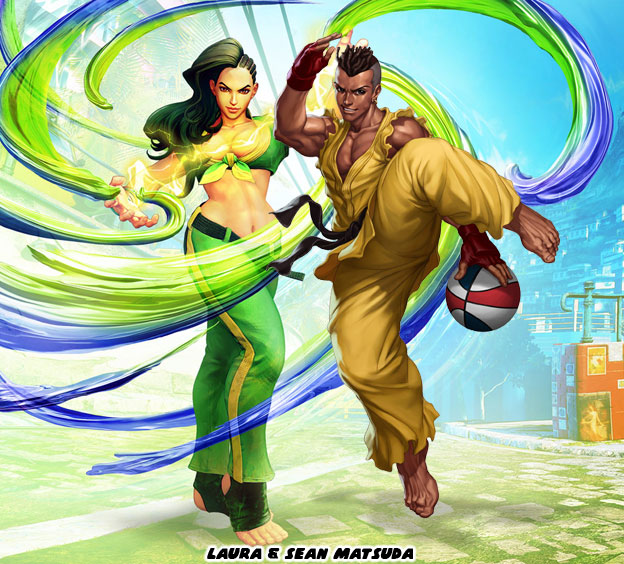
 

Something that Capcom has to explain is why Laura is much lighter than her brother. I understand that they are siblings and sometimes there is a range in how dark or fair skinned a brother or sister can be. But this difference is very noticeable. It is okay to assume that they may be step-siblings but if they are truly brother and sister then why make her much lighter? I get the same feeling for Laura that I got for Vanessa Lewis. The studio is intentionally making her lighter just to appeal to the Asian market and of course Western ideal of beauty. Let's hope that is not the case. Laura is a good character and I hope to see her more in the future. I'd like to hear your take on this character and whether or not you think women fighters tend to be objectified more in games. As always if you enjoyed this blog and would like to sponsor me please visit my Patreon page and consider donating each month, even as little as $1 would help make better blogs and even podcasts!

 follow the Street Writer on Patreon!

Monday, October 12, 2015

How fight culture became fighting game history, part 45

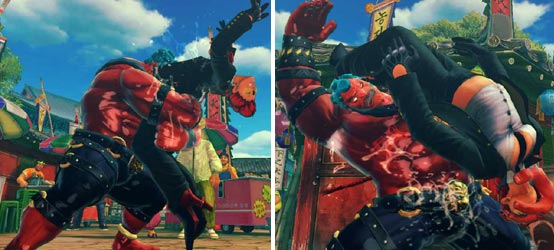
Minority characters had been incorporated into fighting games for over 30 years. Players were exposed to generic as well as recognizable figures in that time. Some of the best stayed with a series while others simply faded away. Earlier in this blog I had shown how some of the worst elements in fighting games were based on broad stereotypes and assumed truths about a culture thanks to limited exposure by the media. Asian and white characters seemed to have the best forethought and presentation while minority characters were usually pinned with a gimmick. For some the gimmick was the defining trait of the character. Look at Hakan from Street Fighter IV, the character was obsessed with oil for his style of fighting and nothing else. What would Turkish players make of him or his over-the-top version of yagli gures, the actual form of Turkish wrestling? For blacks it was usually sports or entertainment that they questioned. The challenge was for developers in Japan and the US to create iconic characters that would withstand the test of time. The idea that a minority character could ever take on a lead role had rarely been explored. The idea that a minority character could ever become a great villain was almost an absurd thought.


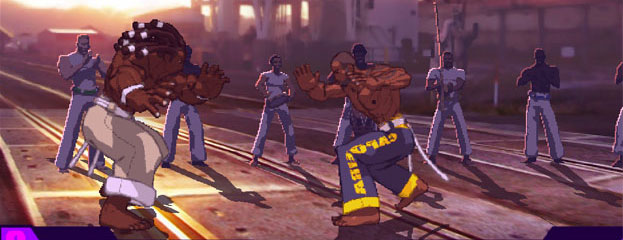
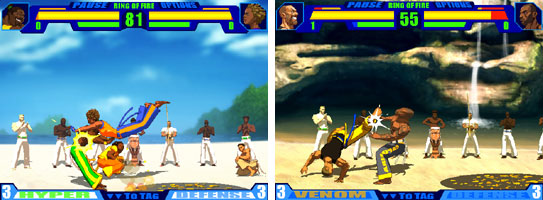
A previous blog had highlighted the Capoeira Fighter series by Spiritonin. The game was a love letter to the genre and presented within it many influences pulled from Street Fighter and Tekken. The game had actually been shaping the development of one of the main characters into a villain over the course of three titles. The Capoeira Fighter series originally did not feature a boss character and only the most basic of plots. By the third game each of the characters had a clearly defined goal from beginning to end. Players were allowed to choose from one of two outcomes. Not that players necessarily chose between a good or evil path, most paths actually had indifferent resolutions. However each variation hinted that either outcome was acceptable in canon. Moreover each path ran parallel with the rest of the cast so that all of the encounters in the game were possible.


Mestre Zumbi could be considered the most identifiable character in the game but he seemed to be a thorn in the side of the heroes. Imagine a fighting game that used the images of a villain as a selling point. It was rarely done by developers. The large muscular black man wore white pants and had thick braided hair. The contrast of dark and light elements on his costume helped him stand out from the cast. His massive frame and powerful moves let players know that this character was not one to be messed with. It turned out that the other masters in the game, Loka and Rochedo had a number of confrontations with Zumbi over the course of the series. The two masters were very consciences of their students and wanted them to learn the most positive aspects of Capoeira. Zumbi by contrast was jealous of the other Mestres and wanted to prove that he was simply the best fighter. He was willing to beat up all of the students and masters along the way to make his point. This made Zumbi very unpredictable and dangerous through the series. Loka and Rochedo accompanied their students where they could or sent elder students to keep an eye on the young ones whenever they traveled.


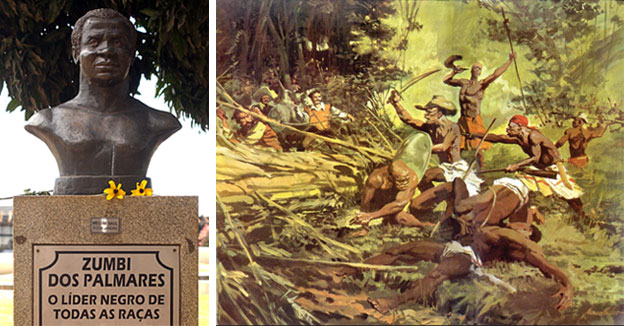
Zumbi was actually a well known name in Brazil. In the 17th century Zumbi dos Palmares had been born in the Quilombos, a settlement established by escaped slaves, prisoners, natives and refugees. There were a few settlements hidden on the east coast of Brazil just outside the jurisdiction of the Portuguese. Freedom fighters would try to help other slaves escape or stage insurrections from the Quilombos. Zumbi was an excellent fighter and a descendant of the Imbangala warriors of Angola. He became famous for his bravery as well as his military strategy. When his uncle Ganga Zumba was killed in battle he assumed the leadership of the warriors from the Palmares. A good number of their ranks were made up of exceptional capoeiristas, these fighters had proven the worth of the old African customs and helped spread the form through the Quilombos.


When the Portuguese raided his settlements they never managed to capture him. Slaves believed that he was blessed by the spirits, an immortal. Zumbi developed a sort of hero worship which was beginning to spread and became a concern to plantation owners and local governments. Eventually he was betrayed by a prisoner and his location was given to the authorities. As soon as they captured him they beheaded Zumbi and put the head on display in Recife, one of the largest cities in Brazil. The government hoped to break the will of the slaves. Afro-Brazilian pride did not die then and never would. The day that Zumbi dos Palmares was killed, November 20, would become celebrated as black awareness day in Brazil. The fact that Spiritonin gave the villain in their series the name of a hero was meant to be ironic. The characters in the game wondered to each other why the noble name was assumed by a madman.


The dangerous obsessions of Zumbi were revealed little by little over the course of Capoeira Fighter 3. Loka and Rochedo warned their students to watch out for him. There were rumors going around that Zumbi was beginning to practice some dangerous things. These were not solely forbidden fighting forms but also supernatural elements, perhaps the fictional Zumbi was trying to find out how to become "immortal" himself? Rochedo warned his student and confidant Saturno that Zumbi was "messing with things he doesn't understand." Not everyone in the game actually crossed paths with Zumbi. Scott Stoddard, designer of the series, made the plot believable in the sense that Zumbi would have only crossed paths with those he had previous dealings with. The heroic characters that were trying to stop the man would have fought him in his ultimate boss form. Otherwise characters that did fight him only saw him in his "regular" form. Many did not see him on the way to their own resolution.


Even his allies were becoming leery of Zumbi. Cobra, the daughter of crime lord Arcenio Rodrigues was obsessed with power, but not the same form of power that Zumbi was seeking out. She was partnered with him early in the game. When Zumbi revealed to Cobra the forces he had aligned himself then the players were given the choice to leave him for his understudy, the ponytail sporting and almost equally massive fighter named Maestro. Zumbi had ignored the traditions of capoeira and gave Maestro a nickname without having him go through a Batizado and earn if from the community. Maestro had originally appeared in Capoeira Fighter 2 under the alias Primo. He also had ties to the criminal underworld. Primo / Maestro was actually a parody of the villain Silverio from the film "Only the Strong." Maestro and Cobra seemed a perfect pairing and allowed Zumbi to fulfill his destiny within the game as a solitary figure.


Villains in fighting games rarely had partners. They were usually so powerful that they could take on one, two or even three fighters all by themselves. If anything they had minions, other dangerous men and women that would obey their orders. These people acted as sub-bosses. In Street Fighter II the Dictator had Sagat, the ex-pro boxer M. Bison and the Spanish assassin Balrog working for him. His "Generals" would keep the other World Warriors at bay. Only those powerful enough to go through his men deserved a chance to fight him as well. Of course Gouki broke all the rules and destroyed the Dictator at first sight, cementing his reputation in the universe. Capoeira Fighter 3 did not have the luxury of going through countless revisions so that players could be eased into the canon and history of Zumbi. Instead the entire transformation of Zumbi was done within game, and masterfully at that.


Cobra had told Zumbi that his rival Loka was taking his students on a world tour. When Zumbi learned of this it spurned him to chase after his sworn enemy. He was eager to show off the things he had learned. Cobra wondered aloud if the rumors were true, was Zumbi messing with Macumba? These were the ancient spiritual beliefs brought over from West Africa during the slave trade. Macumba was a sort of catch-all phrase for the Brazilians to describe magic. It was a force that could alter the fates or levy powerful curses on people. In his quest for absolute power Zumbi had submitted himself to the mysterious forces. The folly was whether or not he could hope to control such power or be bound in service to it. The next blog will explore the creation of this new villain. As always if you enjoyed this blog and would like to sponsor me please visit my Patreon page and consider donating each month, even as little as $1 would help make better blogs and even podcasts!
Friday, May 30, 2014

The Car Tangent, part 7...

You can read the history of Carroll Shelby on Wikipedia but it will never capture the full measure of the man. Chicken farmer, Air Force pilot, race car driver, team owner, designer, philanthropist. These were just some of the words that could describe his occupation at any point in time. Shelby was one of the rare Americans that went overseas to show and prove that he was a real driver. Driving for Aston Martin (yup, the James Bond cars), Mazerati and Donald Healey as in Austin-Healey in a series of events and winning the brutal 24 Hours at LeMans with British driver Roy Salvadori in 1959. That same year he had to retire from racing because of a long-running heart condition. Think about the millionaire race car drivers of the modern era and how well off they are now. Shelby would sometimes go from work on the farm to the racetrack, still in his overalls, and win. In endurance racing he would drive with a nitroglycerin pill slowly dissolving under his tongue. There was nothing soft about his approach to racing and he had the trophies to show for it.

Shelby made a name for himself as a team manager and designer however. He took some lightweight British AC Cobra bodies and somehow managed to fit in a Ford Racing V8. His power to weight ratio was absurd, more so than what DeLorean would attempt years later. His Cobras became the stuff of legends and a partnership between himself and Ford was struck. Shelby demanded nothing but the best from his vehicles as he did from his drivers. He knew the importance of having a winning reputation, especially when he began to post Ford cars against Ferrari, Aston Martin, Porsche and Maserati.


The reputation of the US auto industry was at stake more so than the Shelby name. When he felt his drivers were not playing their roles for the success of the team he was not afraid to voice his opinion. Or in some instances to chase chase after them with a hammer. Millions were being spent to develop US cars that could compete on the international stage. Shelby was a name that was recognized the world over and would become a focal point for the next half century. Perhaps the rest of the world did not find the appeal of the US sports cars. They were by and large still brutish and unrefined compared to the Italian and British automobiles. What couldn't be argued however were how they stacked up in races. Westerners suddenly found themselves not always lusting after Ferraris when they could have a sports car at a fraction of the price made in the US. The perception that Carroll Shelby gave American sports cars may have been his greatest contribution. Whether he was working for Ford, Dodge or Oldsmobile at the time he made sure that fans knew he was putting his name on a car that would live up to their expectations. Even the Mustang became more enviable when it was badged with a familiar Cobra logo. When he was not trying to get his own businesses off the ground he was sometimes hired as an adviser on supercar projects. Not all of his designs went into production but those that did became legendary.


Shelby had a hand in the evolution of the Dodge Viper. It came along at a great time too. The US had lost a lot of traction to Japan through the '80s and early '90s in terms of auto sales and public perception. Ford and Chevrolet were having a difficult time having their Mustang and Corvette lines hold up against Ferrari and Lamborghini in competition. The US GT class needed a booster shot and Dodge provided just that. From concept car to actual production car the Viper became a sort of second coming of the classic AC Cobra. The car was heavier than the Cobra so the power output had to be much higher as well. Dodge engineered a V10 engine that could be tuned to well over 600 horsepower, enough to elevate it to supercar status. Over the mid to late '90s several teams used the Viper to score victories over in multiple high profile races including the 24 Hours at LeMans.

It might seem obvious that the auto industry in every nation would have to continuously pour money into R&D and then test that technology on the racetrack before showing it off at an auto show but that wasn't always the case. When times were good the auto industry would pay executives huge bonuses and take it easy on developing new lines. When times were bad, often because another country had surpassed them, then the companies would have to play catch-up and spend money on development and marketing of new vehicles. In the end of the 20th century the US seemed to react to the auto trends rather than predict where they should be going. This meant that electric and hybrid technology were an afterthought rather than a plan of attack for the Big Three. The Viper was a success because Shelby was lending his insight to the project, but for every one success story there were a dozen failures waiting in the wings. The next blog will highlight the rise and fall of the concept muscle car. If you would like to sponsor me please visit my Patreon page and consider donating each month, even as little as $1 would help make better blogs and even podcasts!
follow the Street Writer on Patreon!