Showing posts with label concept cars. Show all posts

Wednesday, August 13, 2014

The Ridge Racer Legacy, part 28...

Great design is timeless. Great design changes the way that people look at the world. From a well designed set of silverware to a well designed office building. Great design is hard to ignore. It influences language, art, music and culture itself. I'm sure that the reader wishes that many of the weapons and vehicles they saw in movies were real. After all, who would not wish to own a Lightsaber from Star Wars, or a Light Cycle from Tron? The same rule applied to great design from video games.

Early on in this series I mentioned how influential artists like Scott Robertson and Daniel Simon were to films and gaming. Even cartoonists Dave "big" Deal, Ed "Newt" Newton and Japanese illustrator Yasuhiro Nakamura had a profound affect on the way vehicles were presented. The artists, animators and modelers that had worked at Namco were almost as influential, especially over the past 20 years. Many cars that they developed for the series were gorgeous. If I were a lottery winner there's no doubt that I would commission a speed shop to recreate a few cars for my collection. In Japan one company did live out the dream. The Yamasa featured as a Special Class car in Ridge Racer 2 for the PSP was a high performance version of the Soldat Raggio. It had the distinction of being the only Ridge Racer car to be produced in real life. The platform it was built from was actually an Acura NSX. It debuted to rave reviews at the 2006 Tokyo Auto Salon. The Auto Salon was an after market parts expo and showcase, not unlike the trade show event organized by SEMA in the US.


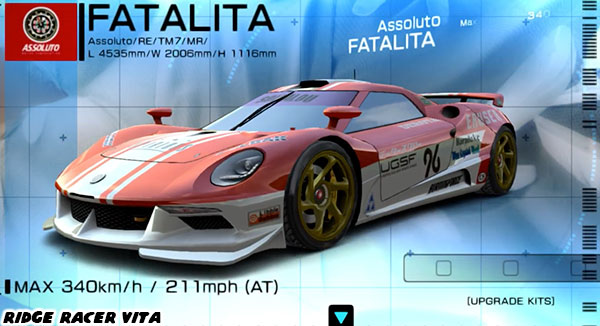
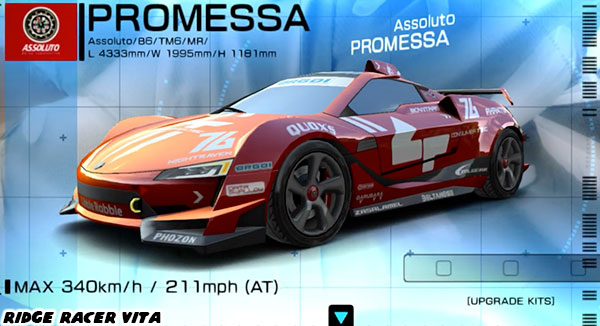
Pachislot manufacturer Yamasa picked up the bill for the recreation. They actually toured it around the country and raced it on occasion. The car actually performed better than the Acura it was built from. It gave credibility to the designs that Namco had been introducing to the genre. The cars did more than look good, they had functionality. They were well balanced, not just in the sense of symmetry but also for weight distribution which could help in the performance on a race track. The best designs in the series were not solely for the sake of eye candy. The artists updating the legacy cars in the series were dedicated gear heads. They wanted to introduce cars into the game that were aesthetically pleasing and could convince gamers that they would be real world screamers. Some of the designs were reminiscent of the best concept cars developed by the industry. In fact some of the designs predated the concept cars themselves. Such was the case for the Assoluto Promessa. The third generation Promessa debuted in Ridge Racer for the Vita in 2011. It predicted the radical "slingshot" design of the Toyota FT-1 Concept by two years.

Both cars were seamless with a minimal if nonexistent body and roof line. The cars also had curves and intakes that mimicked Formula-1 aerodynamics. Both cars were presented with highly tuned small engines. They could have great horsepower without being excessive on fuel consumption. Both cars also had radical ideas on feeding information to the driver. The FT-1 had its side view mirrors suspended from the doors via aerodynamic wings and had a heads-up display, like a fighter pilot, in front of the steering wheel. The Promessa had roof-mounted side view cameras shaped like tiny ailerons which fed the position information to a display, also in front of the driver.


When the Ft-1 was designed Toyota sent the specs and computer data to Polyphony Studios in Japan. The team that created the Gran Turismo series had created a game engine that was eerily good at predicting the performance of real and concept cars. Toyota would be able to put the FT-1 through the "shakedown" phase without risking a crash. A little known fact was that the engine in the FT-1 concept car that was shown at the car shows was a mock-up. There was a small electric motor from a golf cart that was used to move it around. Polyphony would be able to put in a real engine and see what the car was capable of with different gears and transmissions. While car fans may never see either concept car in person they could at the very least drive them in a favorite game. The FT-1 was made available as a free download in Gran Turismo 6 at the start of 2014. The Assoluto Promessa was featured in Ridge Racer 2 as well as in Ridge Racer Vita some years prior.

The designers at Namco never took the selection of cars in Ridge Racer too seriously. The enormous but agile cars from Danver mentioned in the previous blog were a testament to that. The designers wanted to remind audiences that just about anything was possible in their world. When it came to cars you could never judge performance by looks alone. The Angel 0 and Devil 13 cars represented the pinnacle of race engineering yet they sometimes had tiny dopplegangers in the series as well. The diminutive Scootacar from England was the inspiration for the Ecureuil in Ridge Racer Type 4. The petit car weighed next to nothing and had only one gear. Yet the setting of that gear was GO. It accelerated like the Angel and took corners like the Devil. The ability to keep audiences guessing as to what the next car would look like was something that the designers seemed to revel in. When players unlocked the Ecureuil I'm certain that many thought there must have been some sort of mistake. Surely nothing that small could stand a chance on the road. Once they tried it out there was no way they would doubt the creative capacity of the Ridge Racer team.


Namco learned early on that they would have to keep the series fresh by introducing it to mobile platforms. Sony always worked closely with the company to insure that the Playstation would always get at least one exclusive release. When the studio announced the PSP handheld and later Vita systems then audiences could guess that Ridge Racer was not far behind. Some of the most innovative periods of the series took place on handheld systems. The next blog will highlight these entries. If you would like to sponsor me please visit my Patreon page and consider donating each month, even as little as $1 would help make better blogs and even podcasts!
follow the Street Writer on Patreon!

Thursday, August 7, 2014

The Ridge Racer Legacy, part 24...

The fictional manufacturers in Ridge Racer were at war, but it was a battle without casualties or collateral damage. These companies were in a constant battle to release race cars that evolved as fast as technology allowed. Unbounded completely misunderstood that message. Ridge Racer 6 and 7 was a different type of conflict than Namco had been used to presenting. G.V.I. the Mishima Zaibatsu and the General Resources corporate sponsors reminded Ridge Racer fans that the biggest power players in Namco canon were not neutral parties. They were using the race to advertise their own agendas. Even on the track there was still good and evil personified. The Angel 0 and Devil 13 highlighted that understanding. The companies that manufactured the race cars would limit the fighting to the track. Every class of cars was a chance for one company to establish its dominance. Every release of a new model was a hotly anticipated arrival by racing fans. The best thing that a player could see, even more than the finish line, was the announcement screen that "You've got a new machine!"


Players were rewarded by their sponsors for certain achievements. Usually winning class categories and time attacks. Each manufacturer would deliver a newer, faster race car in a spectacular fashion. As it was the cast of cars was diverse and the tracks memorable and control spot on. Every new car was a chance to get a little better. Imagine the surprise that audiences would get in other genres. If in a fighting game, where there were a dozen or more well designed and balanced characters, then suddenly a new playable character is unveiled. Then another, then another as the game goes on. Each one with slightly different attributes and abilities. Each new fighter added didn't break the overall experience and only served to make the game better. This was what Ridge Racer felt like every time the transport vehicle showed up.


Cars were not delivered by the usual methods. They never drove in from the street for example. Nor were they met by paparazzo's at any unveiling. The delivery of a new machine was a sacred tradition reserved for only the most hardcore race fans.


Every new car arrived in style. Sometimes it arrived like a celebrity or dignitary to an important gala. They were met by a contingent of team members wearing their manufacturers livery.


The animations that played out for every new car was a chance for audiences to appreciate the scope of the world that Namco had developed. If a car arrived in the city at daytime players could make out busy roadways and planes departing and landing from the nearby airport.


Sometimes the manufactures would keep the release of a new car a secret from the world. They would deliver a single race car via cargo jet and unload inside of an airport hanger, far from the eyes of the public or the telephoto lens of a spy.


The latest creation would remain under wraps until the race itself. Sometimes a car would arrive at the local port under the cover of darkness. Only a wayward seagull would get to witness some of the best modeled cars ever featured in a game. The idea of secrecy was completely over the top and that was part of the charm that Ridge Racer had established.


The tradition of making a show out of new car deliveries was started in Ridge Racer Type 4. Manufacturers would reward the performance of drivers with newer and faster cars every few races. With 321 cars to unlock players looked forward to a visit from the sponsor truck. There was a manufacturers truck as well in Ridge Racer 6 and 7. It looked as futuristic as many of the rides.


Sometimes a manufacturer couldn't help themselves and had to unveil a new car in spectacular fashion. Rave City was reserved for those moments.


Every generation of vehicles was a legacy design but some were a step into the unknown. The most radical designs from the manufacturers were not delivered to the players by truck, helicopter or jet. When R&D was ready to unveil a top secret project then it was transported from deep within the bowels of the corporate headquarters via a hidden lift. Every manufacturer had a wild concept for what the future of racing would look like. Audiences would get a glimpse at the cars that would shape racing in the next century. Even better they would get a chance to pilot those cars and destroy their fastest lap times. What audiences didn't always realize was that reality was not far from fiction. If you would like to sponsor me please visit my Patreon page and consider donating each month, even as little as $1 would help make better blogs and even podcasts!
follow the Street Writer on Patreon!

Monday, June 9, 2014

The Car Tangent, part 13...

The popular social game Cartown is built around caricatured versions of real cars. Both production and race style cars are featured in the game for players to collect, customize, tune and race. The proportions used for the car models are a careful balance of Japanese and Western aesthetics. The large wheels and compact frames make them look like a marriage between Choro-Q and Pixar's Cars. The makes and models, all based on real-world rides are easy to make out despite all of the exaggerated scales. To add a sense of legitimacy the company that made Cartown even partnered up with the Car and Driver magazine.


The proportions on the Cartown models looked amazing. Players enjoyed the collecting and customizing aspect of the game but were eager to see how those vehicles would behave in a racing title as well. The closest non Choro-Q title to test the amazing little rides was a short lived racing MMO that never got past the Beta stage.

Scott Robertson, a teacher and master of design, had done a lot of work in the entertainment industry. He was tapped to create a series of cars for an action racing game. The cars would not be based on any actual production models but they would hint at contemporary muscle cars and exotics. They would have the exaggerated proportions featured in Cartown and would actually push the scale between the wheels and bodies even further. The plan from the developer was to sell collectible expansion cards that would allow players to upgrade their cars. Engines, wings, body kits, tires and bottles of nitrous would be randomly inserted into packs. The concept was good and the designs of the cars was rock solid but the game never got out of the beta-testing stages.


Real cars and even cartoon cars can be aesthetically pleasing, even to art critics. A great car can be likened to the ultimate symbol of form and function. Hundreds of patents in technology and thousands of individual components are brought together to work seamlessly as a machine designed for transportation. All of the elements are added up to become something more than the sum of their parts. The contours of certain cars, especially older Italian cars are not unlike classical sculptures. When combined with a bold paint job and polished chrome then they can appear like rolling works of art. Animated versions of these vehicles can have as much personality as any actor. The Pixar Cars film could attest to that.

Even fictional vehicles, like those designed by Mr. Robertson could hold their own against actual production models. The best designers in entertainment could be as influential to vehicle design as those working in the car industry. The work of top level designers could even rival, and in some areas exceed the wildest concept designs. The godfather of modern science fiction design Syd Mead proved that in the 1982 film TRON. His Light Cycles completely changed the way people thought about motocycles and vehicle design altogether.


Many years later a younger master of design named Daniel Simon came along and helped re-imagine the Light Cycle for Tron Legacy. All of the vehicles that were featured in the film were bold statements in design. Mr. Simon had accomplished the same visual spectacle that that Mr. Mead had given audiences a generation earlier. Designers like Robertson, Mead and Simon were not simply talented artists. They all had respect for their subject matter and a knowledge as to how the vehicles operated under the hood. They wanted to present vehicles that audiences would accept as functional in whatever time frame or universe they were set in. Mr. Simon in particular had actually worked for Volkswagen, Bugatti, Le Mans and Formula-1 race teams. He certainly had more credit than the person that Pontiac hired to redo the GTO in 1999. These professional designers would help shape every aspect of the entertainment industry. The next entry in this series will explore their contribution to gaming. If you would like to sponsor me please visit my Patreon page and consider donating each month, even as little as $1 would help make better blogs and even podcasts!
follow the Street Writer on Patreon!

Monday, June 2, 2014

The Car Tangent, part 8...

All bold ideas, relaunches and announcements for the car industry are previewed at an International Auto Show. The venues in Chicago, Tokyo, Geneva and Abu Dhabi get the biggest reveals and spark the imagination of millions through visits and reports. The concept cars are always a big draw. Some of the concept cars are outlandish. Sometimes having no noticeable door, windows or even wheels. Those cars are a way for a team of designers to come up with a glimpse into the far future. Where cars no longer run on fossil fuels but instead some sort of compact power source yet to be invented. Then there are the more practical concept designs. The cars that would more likely than not end up in production a few years down the line. They might be the ones that use LEDs in the displays, headlights and taillights rather than bulbs. Or they might offer some new shifting setup or wireless integration a decade before wifi catches on in homes. In some cases there are cars that split the idea between practical and pie-in-the-sky. Maybe someday these cars would come to pass and maybe they wouldn't, there was an even chance depending on the market and consumer trends.


The Viper was a fairly radical design for the early '90s but those that saw it had an immediate reaction. They could tell that there was tremendous potential with an actual production sports car. Dodge took the favorable public reaction and press coverage to heart and began unveiling their other concepts. The Viper as the star but it would have siblings that were more grounded. A less outlandish, and less powerful V6 version known as the Venom would appeal to budget minded speed junkies. A convertible roadster named the Copperhead also with a V6 but a bolder body shape would round out the trio. Favorable showings for these concept cars meant that they might actually make it to the street with just a few changes, mostly due to safety or emissions. The Venom and Copperhead were popular but Chrysler wanted to focus their budget on one supercar for Dodge and one radical design for Plymouth. The hot rod inspired Prowler was what Plymouth offered their richer customers. The Venom and Copperhead were wheeled back to one of the company warehouses once the go-ahead for the Viper and Prowler was given.

Visitors of the auto shows would show their approval, make comments to marketing teams and provide general feedback for the company. Car dealers, especially those that owned a fleet of dealerships would set up meetings with management and ask what the possibilities were of the cars actually getting produced. Every now and then millionaires and billionaires would touch base with the company executives and actually leave a blank check with them, letting them know that they were dead serious about buying the cars right off the assembly line and even buying the concept car for their own private collection. When the company was on the fence about a radical redesign they might invite the automotive press to a private unveiling before showing anything publicly. The receptions were often catered and featured the dignitaries that one would expect from a Formula-1 world championship. Sometimes they were held in an airport hangar or other venue far from competitor spies. By the end of the '90s the Dodge Viper was a certifiable hit and clearly showed that there was a strong interest in bringing the muscle cars back to the US consumer. Pontiac was considered the godfather of the movement and was eager to show that they too were developing something that would blow the minds of car fans as well. They invited a group of senior editors to the 1999 Detroit Auto Show for the unveiling of the GTO concept car. The reaction was less than stellar.


Aside from the "Orbit Orange" paint job from the classic 1969 GTO "Judge" there was little that made it look anything like a traditional GTO. The lines on the car, the stance, body style and overall shape were not legacy inspired at all. It certainly looked futuristic but not innovative like the Viper. The editors mentioned that the designer looked like the stereotypical nerd. Skinny and awkward with oversized glasses, somebody that you would expect to work at Microsoft rather than Plymouth. He wore a large racing jacket that seemed to hang on his lanky frame. When the car was unveiled the invited press could not wrap their heads around what they were looking at. They gathered that the designer did not know much about the history of cars but was an exceptional 3D modeler. They managed to get all of one question to the lead designer, to paraphrase they asked him what the connection was to the original GTO. He looked puzzled at the question. He responded that he wasn't aware that there was a GTO before his. The room fell dead silent and they say you could hear the eyes of the press roll to the back of their heads. An executive took the microphone and called off the press conference. The '99 concept GTO did the car show circuit as a radical design but not one planned for production after that day.

The difference between what Dodge did right and what Pontiac did wrong came down with who was leading the project. Carroll Shelby lent his insight as a race car driver, team owner and car designer. He knew production cars and super cars from around the world, what made most of them unique and what audiences were looking for. He may not have been a great illustrator but he certainly knew what worked. Pontiac went with an art school graduate, possibly from the top of his class. It did not matter that he seemed to know next to nothing about cars when asked to redesign an icon. Being a good designer had more to do than just being a good artist, knowing your subject and having insight also counted for a lot. Many artists outside of the industry have created modern interpretations of the GTO that would have undoubtedly won over the press more than the unveiled concept car.


There is a lot of give and take with concept cars. There can be a fine line between getting the concept right and missing the goal. In the next blog we will look at some other concept cars that made the cut and others that didn't. If you would like to sponsor me please visit my Patreon page and consider donating each month, even as little as $1 would help make better blogs and even podcasts!
follow the Street Writer on Patreon!

Friday, May 30, 2014

The Car Tangent, part 7...

You can read the history of Carroll Shelby on Wikipedia but it will never capture the full measure of the man. Chicken farmer, Air Force pilot, race car driver, team owner, designer, philanthropist. These were just some of the words that could describe his occupation at any point in time. Shelby was one of the rare Americans that went overseas to show and prove that he was a real driver. Driving for Aston Martin (yup, the James Bond cars), Mazerati and Donald Healey as in Austin-Healey in a series of events and winning the brutal 24 Hours at LeMans with British driver Roy Salvadori in 1959. That same year he had to retire from racing because of a long-running heart condition. Think about the millionaire race car drivers of the modern era and how well off they are now. Shelby would sometimes go from work on the farm to the racetrack, still in his overalls, and win. In endurance racing he would drive with a nitroglycerin pill slowly dissolving under his tongue. There was nothing soft about his approach to racing and he had the trophies to show for it.

Shelby made a name for himself as a team manager and designer however. He took some lightweight British AC Cobra bodies and somehow managed to fit in a Ford Racing V8. His power to weight ratio was absurd, more so than what DeLorean would attempt years later. His Cobras became the stuff of legends and a partnership between himself and Ford was struck. Shelby demanded nothing but the best from his vehicles as he did from his drivers. He knew the importance of having a winning reputation, especially when he began to post Ford cars against Ferrari, Aston Martin, Porsche and Maserati.


The reputation of the US auto industry was at stake more so than the Shelby name. When he felt his drivers were not playing their roles for the success of the team he was not afraid to voice his opinion. Or in some instances to chase chase after them with a hammer. Millions were being spent to develop US cars that could compete on the international stage. Shelby was a name that was recognized the world over and would become a focal point for the next half century. Perhaps the rest of the world did not find the appeal of the US sports cars. They were by and large still brutish and unrefined compared to the Italian and British automobiles. What couldn't be argued however were how they stacked up in races. Westerners suddenly found themselves not always lusting after Ferraris when they could have a sports car at a fraction of the price made in the US. The perception that Carroll Shelby gave American sports cars may have been his greatest contribution. Whether he was working for Ford, Dodge or Oldsmobile at the time he made sure that fans knew he was putting his name on a car that would live up to their expectations. Even the Mustang became more enviable when it was badged with a familiar Cobra logo. When he was not trying to get his own businesses off the ground he was sometimes hired as an adviser on supercar projects. Not all of his designs went into production but those that did became legendary.


Shelby had a hand in the evolution of the Dodge Viper. It came along at a great time too. The US had lost a lot of traction to Japan through the '80s and early '90s in terms of auto sales and public perception. Ford and Chevrolet were having a difficult time having their Mustang and Corvette lines hold up against Ferrari and Lamborghini in competition. The US GT class needed a booster shot and Dodge provided just that. From concept car to actual production car the Viper became a sort of second coming of the classic AC Cobra. The car was heavier than the Cobra so the power output had to be much higher as well. Dodge engineered a V10 engine that could be tuned to well over 600 horsepower, enough to elevate it to supercar status. Over the mid to late '90s several teams used the Viper to score victories over in multiple high profile races including the 24 Hours at LeMans.

It might seem obvious that the auto industry in every nation would have to continuously pour money into R&D and then test that technology on the racetrack before showing it off at an auto show but that wasn't always the case. When times were good the auto industry would pay executives huge bonuses and take it easy on developing new lines. When times were bad, often because another country had surpassed them, then the companies would have to play catch-up and spend money on development and marketing of new vehicles. In the end of the 20th century the US seemed to react to the auto trends rather than predict where they should be going. This meant that electric and hybrid technology were an afterthought rather than a plan of attack for the Big Three. The Viper was a success because Shelby was lending his insight to the project, but for every one success story there were a dozen failures waiting in the wings. The next blog will highlight the rise and fall of the concept muscle car. If you would like to sponsor me please visit my Patreon page and consider donating each month, even as little as $1 would help make better blogs and even podcasts!
follow the Street Writer on Patreon!