Showing posts with label akira. Show all posts

Tuesday, October 10, 2017

Hiding the master in plain sight, the genius of SNK's character design... part 5

SNK had exploded on the scene in the early ‘90s. The success of the Neo Geo console in the arcade, and the steady stream of fighting games made sure they would be around for the long haul. I had mentioned previously that the success to their school of design was based in hiding the masters of the martial arts in plain sight. A karate master didn’t have to be Japanese or wear a gi. This was demonstrated in the Art of Fighting (AoF); Robert Garcia was an Italian playboy that drove exotic cars, wore thousand-dollar shoes, tailored suits, and could go toe-to-toe with the ambassador of Kyokugenryu karate, his friend Ryo Sakazaki. King was a Muay Thai goddess but you would never have suspected it as she dressed like a high-class bartender. Shinkiro and the art team didn’t have a chance to create these plain-clothes masters for every new release but that didn’t stop them from experimenting. Before they found their groove they were as guilty as the other developers of following the trends. Boxers Michael Max, Axel Hawk and Micky Rogers were very generic designs. Pulled in part from real-world fighters Mike Tyson and George Foreman. All of that changed in 1994 when the studio released King of Fighters ’94 (KOF). From this point on it was almost mandated that the figures looked like cool manga characters instead of martial artists.


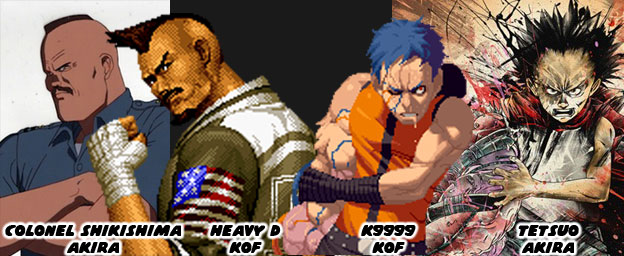
Manga and animé were very influential to the design of early fighting games. The team at Capcom were influenced by Buronson and Tetsuo Hara’s work on Hokuto No Ken / Fist of the North Star. The people at SNK were influenced by Katsuhiro Otomo’s science fiction masterpiece AKIRA. The people at SNK were so influenced by the book that it shaped the story of later KOF games. The entire plot revolving around clones and the paramilitary government organization N.E.S.T.S. was roughly pulled from the plot of AKIRA. Even the character K9999 from King of Fighters 2001 was eerily similar to Tetsuo, the antagonist in AKIRA. The likeness was so much so that publisher Kodansha took SNK to court and got them to remove any likeness of the character from future releases and official publications. I would argue that the imposing Heavy D, mohawk, square jaw and all was based on Colonel Shikishima from AKIRA as well. Thankfully SNK made him a dark-skinned character so the comparisons wouldn’t be as obvious. From that point forward the artists at SNK were taking very bold creative chances.
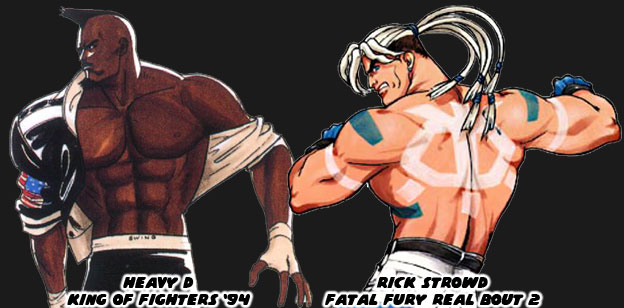
 

Heavy D started the trend of non-traditional boxers in the KOF universe. His street fashion, paired with his leather jacket and wild haircut made him look like an intimidating opponent. His was the type of look that audiences expected from SNK. It was their follow-up that was even more unique. One of the most unusual boxers in the SNK universe was Rick Strowd. He first appeared in Fatal Fury Real Bout 2 in 1998. I say he was unusual because of his appearance. He was as physically strong as any other character but that wasn’t unusual. He was actually a Native American character although he didn’t look like a typical one that we might have expected. Rick had pale skin, long white hair and bright paintings covering his body. His white pants and blue gloves were solid color choices, they matched the markings painted on his chest and back. He was not rooted in any actual native group, nor were his markings reflective of any tradition. The inverted skull painted on his back looked a bit too cartoonish for example. SNK was experimenting with different influences, different stylistic choices and different ways of presenting a traditional fighting art. They figured that they could shake things up by presenting a unique looking character and call him a Native. Their decision worked for the most part. From that point on the studio realized that boxing was not the only thing that American characters could represent.
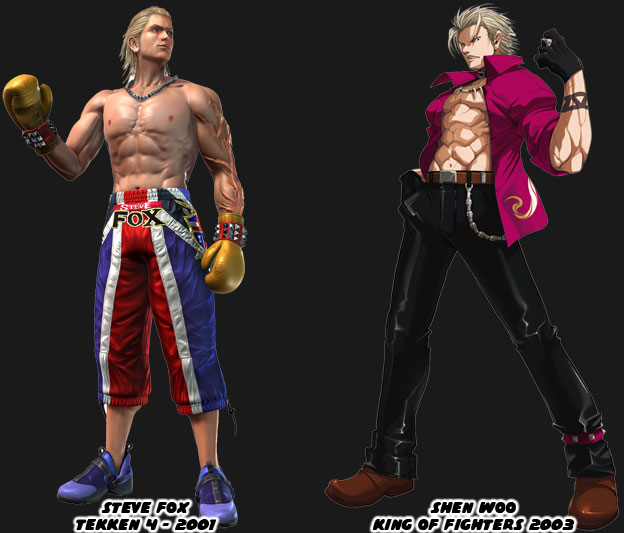
 

The other thing that the artists at SNK, and a few other Japanese studios, realized post Rick Strowd was that boxers did not all have to be big black guys. Two leaner blonde boxers made their marks after 2000. Namco introduced the fighting community to Steve Fox in Tekken 4. The British boxer had an athletic build and not too bulky. Most Tekken characters were nowhere near as swollen as the Capcom or SNK fighters. Fox had long slick blonde hair and most of his costumes in the series were street outfits. Even his “traditional” costume broke the mold. His boxing trunks were actually long training pants. His most unique element were the enormous scars covering his arm. He wasn’t sure how he got them or what their purpose was, making it an interesting side story for the character. Not to be outdone SNK dropped Shen Woo into KOF continuity in 2003. This blonde boxer was cut from the save cloth as Fox but his look and style were even more street. The Shanghai native was mostly a self-taught fighter, similar to Terry Bogard, and had gained a reputation as one of the most dangerous men in South China. Many of the tournament stars in the KOF series were young cool guys with street clothing so Woo fight right in. If the design had any failings it was that SNK had started relying on the street look too much. Prior to Woo the company had introduced a boxer that I would consider one of the best designs in the past 20 years. This character was named Rob Python from Buriki One.
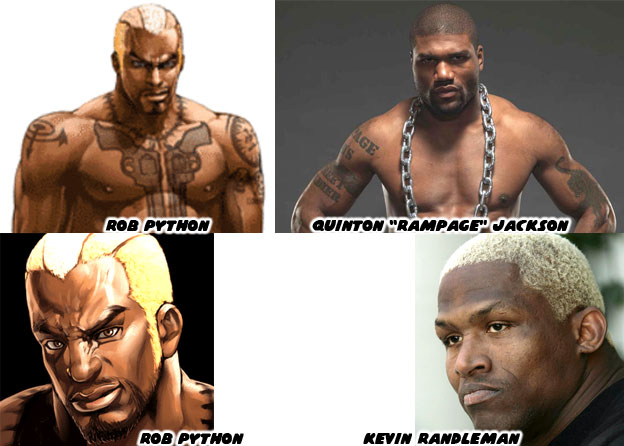
 

Python represented a break from tradition, he was reflective of the next-generation fighting black superstar. His look was inspired in part by actual MMA fighters Quinton “Rampage” Jackson and Kevin Randleman. They were wildly popular in Japanese tournaments. SNK knew that audiences had outgrown the clean-cut look of a young Tyson and the aging Foreman. They had been playing Neo Geo fighters for almost a decade and wanted new blood. The next boxer had to ooze personality and in the case of Python, he also had to ooze a sense of danger. He was among one of the most dangerous fighters in the Buriki One tournament and also the rival to Gai Tendo, the star of the game. Python was an understudy of Silber, whom I had mentioned previously on this series. Python’s tattoos were as much a part of his costume as his gloves or shorts were. No character before or after had ever looked as imposing. The enormous pair of Colt revolvers tattooed on his chest were meant to intimidate his opponents. It was assumed that he spent time in prison where he had learned of Silber. SNK, and in particular the talented artist Hiroaki, had changed the formula yet again. Python was not a fighting master hidden in plain sight, instead he was a killer masked as a boxer. It would take Capcom almost 17 years to reinvent the boxer by going full circle as well.
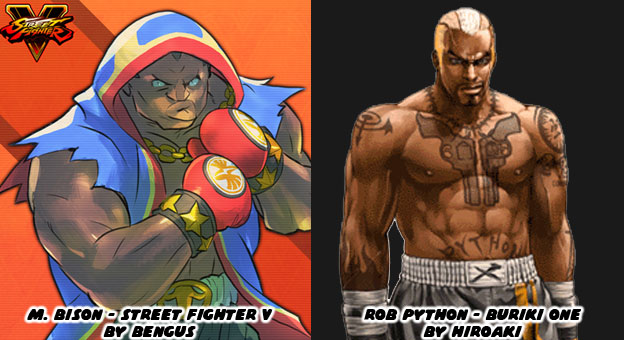
 

In 1991 M. Bison had pretty much set the standard that other boxers were compared against. There wasn’t a fighting game in the ‘90s that wasn’t compared to Street Fighter II. Every boxer was compared to Bison. His look had stagnated in the late ‘90s while SNK was committed to experimenting. Capcom finally conceded and created their own hidden master with Dudley in Street Fighter III (1997). The aristocratic boxer had a unique library of moves but long-time fans of Bison had a soft spot for tradition. Senior Capcom artist (and personal hero) Bengus was called in to work on the Street Fighter V (2016) designs. While he did not develop the original M. Bison, that was more likely AKIMAN and Shoei, Bengus was responsible for the new look. He wanted Bison to have the same big, brash personality but with an updated costume. The Capcom style of design was rooted in making traditional fighting archetypes. Their karate masters had to look like karate masters, their kung-fu masters had to look like kung-fu masters, and their boxers had to be boxers. Bengus went full-bore Americana with red white and blue trunks but then wrapped everything in a red, white and blue robe, with torn sleeves and gold jewelry to boot. The “Crazy Buffalo” now sported elements of the street, elements of real pro boxers and even cartoonish archetypes. He was still classic layered underneath modern accents.
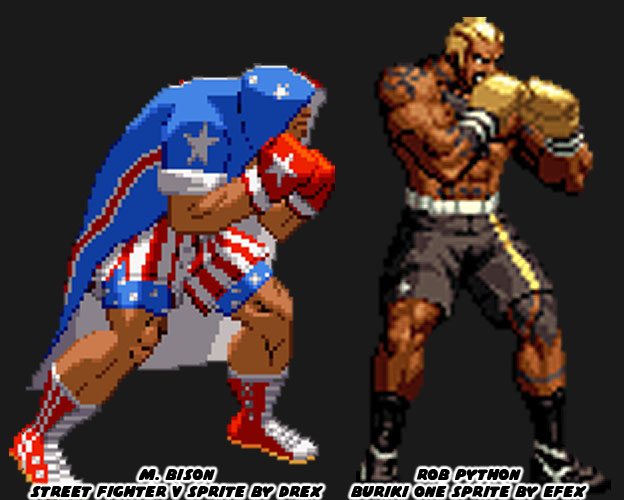
 

This was not to take anything away from Rob Python and all of the work that SNK had done with boxers over the past 25+ years. Their fighters had been among the most unique, most colorful and most diverse ever assembled. I honestly wish that they would revisit their Buriki One cast for the future installments of the KOF series. With that said they still managed to break new ground. One of their most stylish boxers debuted in 2000, right on the heels of Python. The new fighter was a mysterious special agent named Vanessa. She had taken up boxing when her lover was killed. Like King she was a master hidden in plain site. Her pants and suspenders were a nice touch under her sleeveless shirt and tie. The look was very chic. It wasn’t the first time than SNK had explored the dangerous femme. Vice and Mature, the valets for early KOF sponsor Rugal Bernstein were assassins in disguise. Vanessa was a hero using a similar fashion aesthetic. The trio predated and were more than likely the inspiration behind Crimson Viper in Street Fighter IV.


The most recent boxer in KOF canon was a mix of traditional and modern. Nelson debuted in the King of Fighters XIV, also released in 2016. He was a dark-skinned Brazilian and up-and-coming phenom. The young fighter was involved in a hit and run leaving the gym one night. He lost an arm and his girlfriend was put into a coma. A secretive sponsor paid for his cybernetic replacement arm and saw him enter the KOF tournament. SNK embraced his back story and and incorporated the tire tread motif on his boxing gloves and workout gear. His scars were very bright and spread across his face and torso, giving him the look of someone with the skin disease vitiligo. While I think there may have been too many color choices and design elements placed on the character he worked within the series. Like Vanessa he was a progressive character. His appearance might have appealed to people with disabilities or those recovering from amputations. I would like to see how SNK builds on their library moving forward. Speaking of which, some of the more recent entries in the KOF universe were also a mixed bag of design choices. We’ll look at these in the next blog. As always if you enjoyed this blog and would like to sponsor me please visit my Patreon page and consider donating each month, even as little as $1 would help make better blogs and even podcasts!
 follow the Street Writer on Patreon!

Monday, July 18, 2016

The Street Writer Podcast, Episode 6

 
Today we are going to look at the culture that inspired some of the most unique rivals. Japan created many of the the best fighting titles, this cannot be argued. Part of their success was due to being at the right place at the right time. The genre was relatively young in the mid '80s and every idea was fresh and unique. As soon as the developers figured out that a fighting game could be more than video boxing the world opened up. We can credit the various Japanese studios for many other "firsts." They were the first to place fighters from different martial arts schools against each other. They created a narrative for the main characters. They added a way to track health, the ability to perform special attacks and even the ability to destroy the environment on each stage. These details helped pull the audience into the experience. The character designers working on these titles were influenced by a number of sources. Many of the early fighting game heroes were based on movie characters or even popular real world fighters. Some were based on tough guy archetypes. In Japan one of the popular tropes was the young rebel, a sort of gang leader that talked with his fists.


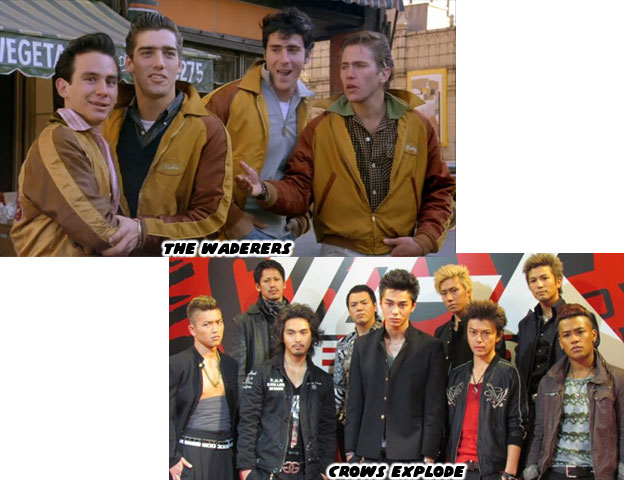
Movies about gangs, coming-of-age, fighting and violence are nothing new. The whole rebel identity is celebrated around the world, especially in pop culture. Cult movies like the Wanderers in the USA and modern films like Crows Explode in Japan capture a portion of the colorful and sometimes brutal side of life in a dysfunctional (rather than dystopian) society. The gang leader with a powerful sense of loyalty is someone to be admired. It doesn't matter if this is a novel, short story or comic book figure. There are actually many positive features with the rebels in these works of fiction. In the USA the leather clad motorcycle rebels from the '50s, the "greasers" were one such archetype. Often they were runaways, young enough to be in school they often rejected authority. They felt smothered by the establishment and wanted to be free to the run the streets. They lived hard, loved hard and fought hard. They were essentially the replacement for the open range "cowboy" from the previous century. Hollywood told their story and in the process they created icons like James Dean in film and The Fonz on TV. In Japan there was a variation of the heroic rebel as well. These figures were often modeled after high school delinquents.


In Japan there is a tremendous pressure to conform. Conform to family customs, societal expectations and especially to authority. Just because a kid is in school doesn't mean they can't get habitually in trouble. This is something that US inner-city schools know all too well. Troublemakers are sometimes perceived differently in Asian countries. In Japan people don't always associate a group of rebels with a gang, instead they lump them together as a more benign group of delinquents. In pop culture the leader of these gangs is known as a bancho. They are usually the toughest guy or the best fighter. They don't actually deviate much from from the look of typical high school kids. In fact they can often be found sporting crisp school uniforms, or gakuran. They might have a pompadour, or perhaps shaggy hair which shows a hint of nonconformity. These guys are magnets for trouble and of course the good girls girls who want nothing more than to fix a bad boy.


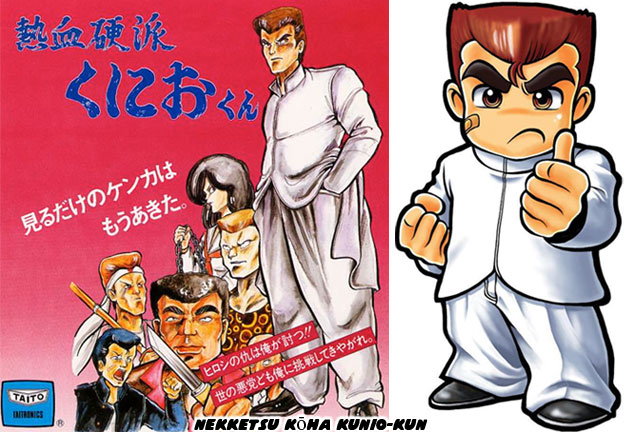
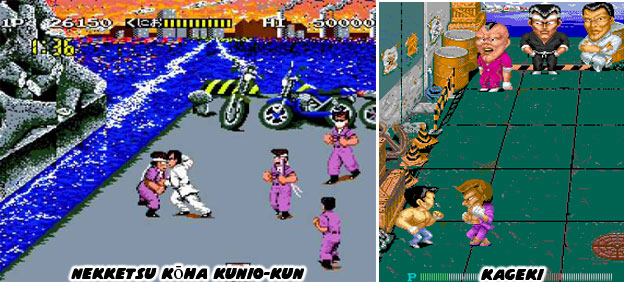
The first video game fighter to exploit this look was Kunio-kun. The game Nekketsu Kōha Kunio-kun, which translated to "Hot Blood Tough Guy Kunio." It was released by Technos in 1986. The character was named after Technos' former president Kunio Taki. It was developed by Yoshihisa Kishimoto, who many attribute the series, if not the entire genre to. This team could be considered the architects of the genre for certain, and the game could be considered the Godfather of the brawler genre. The arcade game was localized as Vigilante in the USA. The look of the hero and bad guys was changed from Japanese high school to more generic motorcycle gangs in order to make them appear more Western. People in the USA didn't really remember Renegade but they did remember the NES version based on the series.You might know it better as River City Ransom. The characters were there although they became shorter and more cartoonish in the process. Mr. Kishimoto went on to design Double Dragon for Technos. The title from 1987 became a huge hit and established the birth of a whole new genre.


Taito published a different sort of bancho fighting game in 1988. Kageki featured a heroic street boxer taking on every member of a local gang. Just about every gang and delinquent archetype from Japanese manga and cinema was represented here. The chubby low-level goon, a slacker, a chisel-jawed heavy, a weasel-like henchman, the dirty fighter, and of course the super-cool gang leader. These characters included the various motorcycle and car freaks that identified with the bosozoku or "violent speed tribes" in Japan. Remember that the seminal AKIRA, the manga first published in 1982 by Katsuhiro Otomo started with the futuristic bosozoku gang lead by Kaneda and his rival The Clowns. Being a delinquent was not only cool, it turned out that a group of them could save the world. Anyhow the various tough guys from pop culture all had to be defeated in Kageki. If a player scored a knockout their opponent would be dropped down a manhole. It was easily the coolest way of disposing a body in a video game.


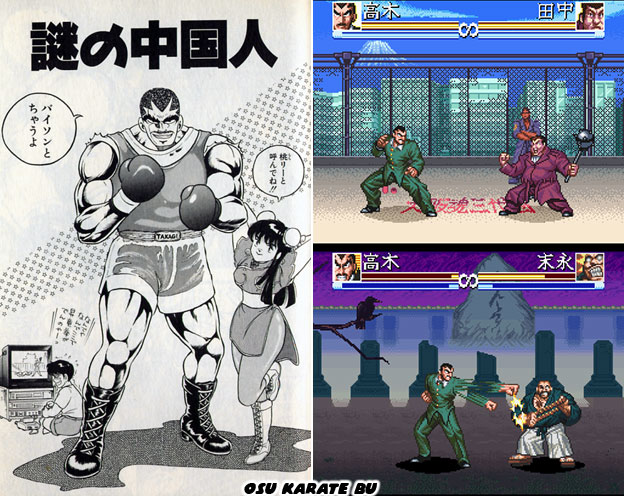
The bancho had a sort of peak in popularity in the mid to late '80s. One of the first breakout manga titles was Osu Karate Bu - "Karate Club" by Koji Takahashi. The series was first published in 1985 and ran through 1996. The story featured the mustached tough guy Takagi Yoshiyuki. He was the overseer of the various gangs that used to take part in his "club" which was really a front for organized no-holds-barred fighting tournaments. Think of it like a high school Fight Club where even mobsters and actual karate masters were allowed to compete. There was much more comedy and over-the-top fighters than the actual Fight Club movie of course. A young character named Matsushita Tadashi would become the most famous person in the series and end up being its narrator. When he started school he would get beat up all the time. He joined the karate club in the hopes that he would learn how to fight. He got even more beat up by the club members but over the years he grew stronger and learned how to fight back. The series hit a peak in 1994 when the manga was turned into a Super Famicom (Super Nintendo) fighting game by Culture Brain. During the rise of the fighting game genre Mr. Takahashi noticed that boxer M. Bison from Street Fighter II had an eery similar haircut to Takagi. He was sure to point it out when he created a parody cover in his comic.


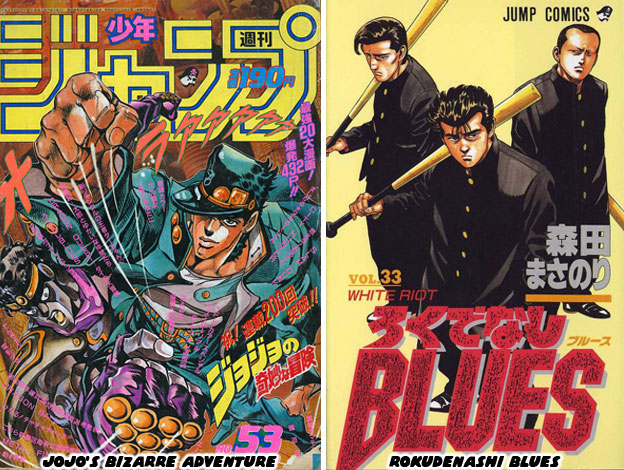
Young anti-heroes and the delinquents were made cool in AKIRA and Osu Karate Bu but those weren't the only series focused on outsider culture. Previously in manga, anime and live-action shows the heroes were straight-laced good guys. The outsider, the rebel of the group was still popular but was never meant to be a replacement for the main hero. All that changed when manga and anime began featuring more anti-heroes and more stories that weren't set on campy henshin or sentai characters like the Power Rangers. Possibly the hottest and strangest manga in the mid-'80s was JoJo's Bizarre Adventure. The series which began in 1986 revolved around Jotaro Kujo and his friends. Jotaro's uniform was a fashionable take on the gakuran, with a big gold chain punched through the collar, a decorated cap and multiple belts on designer slacks. When he and his friends battled they used supernatural abilities against all sorts of crazy-looking characters. The series by Hirohiko Araki was influenced by Western pop culture; character names included musical acts Chaka Khan, Ronnie James Dio, Cameo, ZZ Top, Mariah Carey, Iggy Pop and DEVO. And it featured characters and costumes inspired by international fashionistas. His hero and allies were far from the traditional bancho, the words that would best describe them would be colorful, flamboyant and eccentric. JoJo was on the extreme end of fantasy, yet there was another comic that was grounded in a more realistic world.


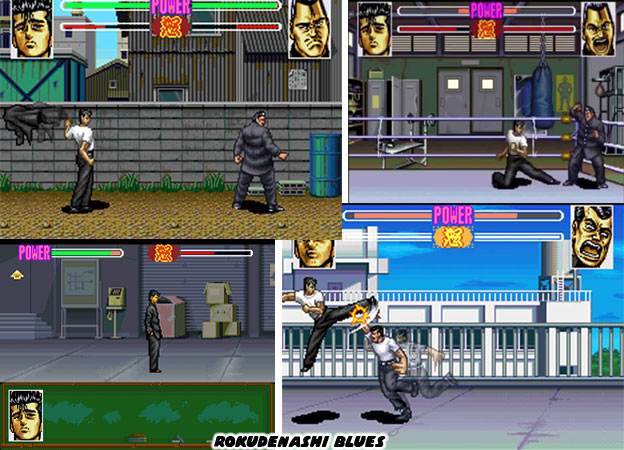
Rokudenashi Blues featured heavy hitter Taison Maeda. He was a scrappy boxer whose first name was reminiscent of Mike Tyson. Different spellings of course. Anyhow Rokudenashi Blues was as classic a bancho manga as there ever was. The series started in 1988 by Masanori Morita was a straightforward look at the life of delinquents trying to survive high school and of course the girls that loved them. There were many encounters with various gangs and other school troublemakers. The fights lasted several panels and the results of which would last for months. Unlike other manga where the heroes could be on the brink of death in one issue and then be perfectly fine the next Taison and his friends were left battered and bruised over the course of several story arcs. Jotaro and Taison were the types of heroes that school kids could identify with, making them very popular with young audiences. It only made sense that the bancho would turn up in fighting games a few years later as the audience began consuming different forms of entertainment. Osu Karate Bu found it's way to the Super Famicom in 1994 but so too did Rokudenashi Blues. Bandai developed and published the game. What made it unique was that the fights in the story mode happened the same order as the encounters did in the manga. This level of accuracy would be used in the Dragon Ball Z fighting games by Bandai as well.


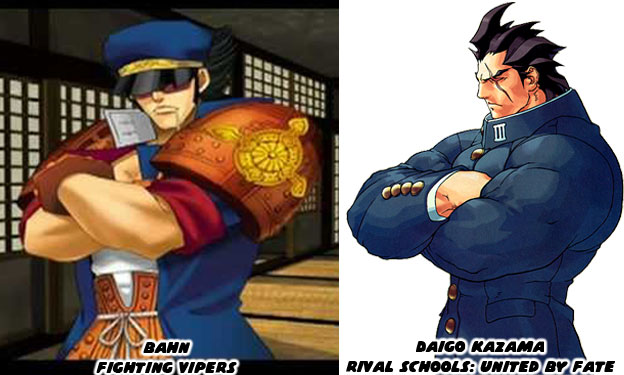
Fighting Vipers was a lesser-know Sega fighting game from 1995. It revolved around youth culture, with skateboarders, rock musicians and motorcycle thugs taking part in a tournament. The control and combo system were fairly easy to pick up and you could imagine that the game was meant to be the younger brother of Virtua Fighter, the more popular 3D fighter from the publisher. The main character in Fighting Vipers was 17-year-old Bahn. A large bruiser whose costume was modeled after Jotaro's. His costume was part gakuran and part samurai armor. He wasn't the only bancho to turn up in the genre. In 1997 Capcom released Rival Schools: United by Fate. That game was set entirely in a world where the top students, the most popular, or most delinquent from a half dozen schools also happened to be excellent fighters. I don't mean traditional fighters either, but more like young versions of the Street Fighter all-stars. A few characters wore traditional Japanese school uniforms but Daigo Kazama, the big brother of motorcycle rider Akira Kazama, was the leader of a gang and central to the plot of the game. He had been brainwashed and was going around attacking students and teachers alike. The other students had to figure out why and get to the bottom of the conspiracy. Daigo's long coat, spiky hair and nasty scar over his eye made him look like that baddest bancho there ever was.

The bancho was the hero that a new generation was following. They were the stars in the comics and cartoons and fans wanted to see them represented in fighting games. But the fighting game still had to do some evolving. The kung-fu films and comics of the late '70s and early '80s inspired the development of Street Fighter and the other first generation fighting games. The Japanese designers would try to create characters that had an international appeal, especially in the US where they could make lots of money in the arcade and home consoles. So they took influences from cult Western movies and mixed that look with the Japanese manga aesthetic. The results were characters with very strong looks. Karate fighters that wore the traditional gi, muay thai fighters in shorts, kung-fu masters in wushu clothes and literal street fighters that wore jeans and sneakers. This was what people expected to see. The bancho star wouldn't appear until later.


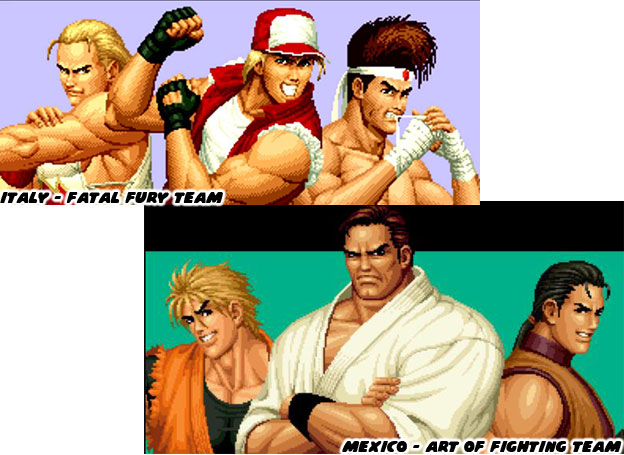
SNK was doing very well at telling the story through a fighting game. They had a gritty theme in the original Art of Fighting. You could almost imagine this game was based on a pulp '80s film. With its seedy villains, imaginative locations and twist ending. They also had the more animé friendly Fatal Fury, which also had a great story and over-the-top villains. By the mid-90s the studio knew that they had to come up with a radical new idea in order to compete against Capcom, Midway and the other studios that were red hot. That was when they decided to formalize the King of Fighters tournament in 1994 and create a game that united the various fighters. For fans of the first generation of fighters there would be both a team Fatal Fury and a team Art of Fighting. Each represented a nation, in this case Italy and Mexico respectively. SNK was not happy with the idea of Terry or Ryo being the solitary star of the game. They did not want fans to think the studio was telling them who were the better fighters, or who they should root for, they would let fans decide. To help make things interesting SNK went way back in their catalog of characters and brought back a few arcade pioneers.


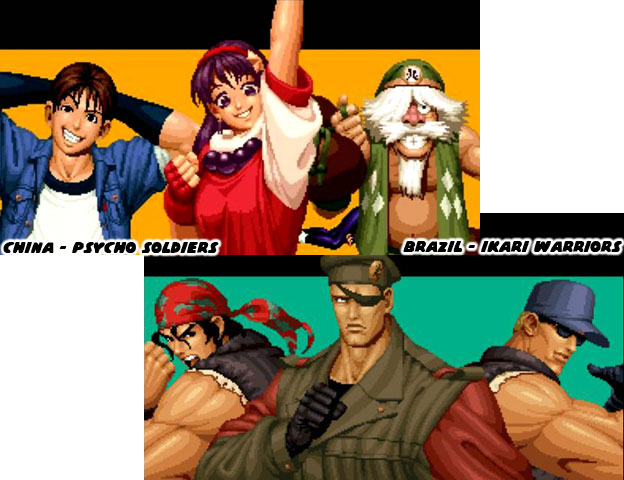
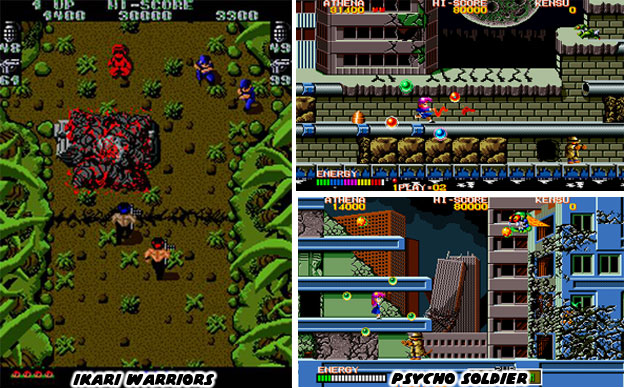
China was represented by a trio of Kung-Fu masters, the leader was a pink-haired Athena Asamiya. Her psychic powers lead to the state-sponsored team being known as the Psycho Soldiers. From Brazil there was a trio of mercenaries, two of the figures looked very familiar to arcade veterans yet the one with the eyepatch was new. It turned out that the guy with the blue baseball cap was Clark Still and the one with the red bandanna was Ralf Jones. The two were better known as the Ikari Warriors, an arcade title that shared the same name. It was one of the pioneering run-and-gun shooters in the arcade. The Ikari Warriors were a mix of Sylvester Stallone's Rambo and Arnold Schwarzenegger's Commando, they could topple any dictator with their nonstop barrage of weapons and combat skills. In the early game the characters wore a red headband or blue headband so players could tell them apart. The game was revolutionary because it featured an octagonal joystick that could be rotated to aim in different directions while running. Prior to that characters might have been able to shoot left, right or diagonally but the joystick had to be pointed in that direction as well. Gamers could suddenly strafe opponents while moving between cover. Seeing the mercs return as fighters was a welcome surprise. Perhaps they were the best brawlers in the KOF universe instead?


It turned out that the Chinese Athena and Sie Kensou had appeared previously as well. They were in a game called Psycho Soldier which didn't see much popularity in the US. It was a side-scrolling action title but instead of flying a spaceship as was the case with most side-scrollers this game had Athena and Sie using their psychic powers through the real world and underworld. The game was actually connected to a previous title called Athena. It was based on the Greek goddess and had players building her armor and fighting to reclaim Olympus. That game was an action platformer in the vein of Capcom's Black Tiger or Ghosts n' Goblins. The modern Athena was descended from the goddess. Both Ikari Warriors and Psycho Soldier were released in 1986 and both represented SNK's older and more cult-favorite titles. It was great that SNK was acknowledging their legacy and putting the various characters into one continuity. Yet something was missing. It was great to see the fighting game stars and other arcade stars introduced in a tag-team battle but the groups were found lacking. The studio needed to introduce a new team, or a couple of new teams that would represent the franchise and stand up to the stars from the other titles. These characters would have to become the next generation fighting icons. Once again the studio looked at pop culture for their inspiration. They had done what they could with classic movie heroes and villains and they needed to find something more contemporary. They found that the bancho was a hero they hadn't yet considered. An amazing rivalry would grow out of this character choice. We'll explore this story in the next entry. I hope to see you then! As always if you would like to sponsor me please visit my Patreon page and consider donating each month, even as little as $1 would help make bigger and better recordings and videos.

follow the Street Writer on Patreon!

Monday, May 12, 2014

Fighting Layer, return of the dragon, part 2...

A Chinese girl and a stylish American had been invited to the Fighting Layer tournament as well. They seemed like friendly rivals to Tesuo Kato and were both approximately the same age. Where or where have we seen these archetypes before? There was much more to Lan-Yinghua and Allen Snider than simply being revisionist versions of Chun-Li or Ken from Street Fighter. They actually had origins with the developers that went back a generation.


Karate and Kung-Fu were cornerstones of the Asian martial arts. Each style of fighting had countless schools within. What Capcom, ARIKA and the other developers did was create archetypes that symbolized the best fighters in each discipline. Ryu and Ken had come to symbolize karate for the Street Fighter series and Chun-Li was the embodiment of kung-fu. However in the planning stages of Street Fighter II it wasn't a given that Ryu or Ken would even be returning to the series. The studio knew that they had to have a karate representative in the game but the original design was very traditional and lacked the visual cues given to Ryu. The studio had been criticized for moving too far from the Street Fighter formula when they introduced Final Fight to arcade owners. In response they pulled back and tried to reinvent the fighting game by going very traditional with the early designs.

The downside to the prototypical Ryu and Chun-Li were that they were very generic designs. Both lacked a creative spark. The karate character was a 25-year-old stone faced fighter. Who would ever find him interesting? Ryu had the torn sleeves, red gloves and red headband that broke up the consistency of the all-white costume. Just a few changes gave him more visual flair. Tetsuo Kato was similar, with taped-up hands and a wood-block-print of blue ocean waves on his gi he could never be mistaken for a traditionalist. The original plans for Chun-Li were not much better. Her design was very dated and lackluster.


Akira "Akiman" Yasuda went back to the drawing board. Instead of going with a token girl fighter, as would be the problem for the majority of fighting games following SFII, he instead turned Chun-Li into a woman. To give her more presence she was imagined as an undercover cop. The costume she wore was a disguise for the Street Fighter tournament. The spiked weights, dark tights and wrestling boots broke up the visual consistency for the character like the red garnishes did for Ryu. There were many reasons why Chun-Li worked from a design standpoint as well as within the game. I wrote more about the importance of the character in the Female Equation blog from a few years back. The karate and kung-fu characters were revised countless times until they set the new standard.


Lan-Yinghua was a nod to the original concept for Chun-Li. She was young but also a seasoned fighter. Her costume was also pseudo-traditional. The nunchaku tied into her braids could testify to the designers having fun with the character. The Fighting Layer designs are not far removed from the Street Fighter II ones. Looking at the FL cast is like playing "what if?" with Street Fighter. The characters put into the Capcom series could have turned out like the ARIKA designs depending on what the producer was looking for. Akira Nishitani and his team had a specific vision for their new franchise. The new Chinese female lead would remind players of Chun-Li just as the new American would reflect Ken Masters.

Allen Snider had been introduced as a sort of friendly rival and understudy of Ken during Street Fighter EX. Ken was supposed to represent the best martial artist from the USA. His long blonde hair and bright red gi made him stand out from the crowd. His design cues said something about Western culture. The Japanese considered themselves more reserved by comparison so Ryu was slightly more traditional in appearance. Snider was created to be as flamboyant as Ken but without copying the same costumes worn by either he or Ryu. Snider was also an amalgamation of real life fighters that had influenced the Street Fighter developers. Enter the Dragon had influenced the creation of Street Fighter II, Mortal Kombat and even Fighting Layer. The real martial artists and actors found within also influenced the games themselves. Allen Snider was inspired by Chuck Norris and Bruce Lee. His hair and facial features were very similar, as was his desire to become a movie star. Lee and Norris battled in the 1972 film Way of the Dragon. That film came out a year before Enter the Dragon. The fight was memorable for many reasons but one of which was because the backdrop was the Roman Colosseum. That location would be recreated in Street Fighter Zero / Alpha many years later.


ARIKA demonstrated that they still had a fondness for the characters they had introduced in Street Fighter EX. Those characters met many of the same conventions as the original World Warriors and some had the same staying power as well. The inclusion of Allen Snider in the series meant to many SF fans that there was a chance that this game, and these characters, might fall within Street Fighter canon as well. A crossover was certainly not impossible. Of course there would be a lot of legal wrangling between ARIKA, Namco and Capcom if that day were ever to happen. What the game was lacking however was a strong female lead. Lan-Yinghua was not quite a Chun-Li tier character and the game needed someone more powerful. ARIKA reached back to their Street Fighter EX catalog and brought in Blair Dame. She, like Allen, was designed to balance out the SFII icons.

 Blair was the first mixed martial arts character in SF continuity. Her costume was revealing, as she was meant to represent the more sexual designs for female leads from the West. Her selection of strikes and grapples was pandering to male audiences but in a different way. Chun-Li had grace and style behind her attacks. Blair was a hard hitter by comparison, capable of throwing spinning backhands, knee strikes and drop kicks in rapid succession. She also had arm bars, ankle locks and take-downs which would make most MMA champions proud. Blair was created to balance out Chun-Li in Street Fighter EX, as such she had to be a woman and not a girl. Lan-Yinghua was a great character but she was more like Cammy than Chun-Li in scale and purpose.


When ARIKA designed Fighting Layer they included all of the control options that modern fighting game audiences had expected in the second or third revision of a game. They also included a robust cast that might have been included in an upgrade as well. Fighting Layer was not only an attempt at redoing the original plans for Street Fighter II but also for Super Street Fighter II. The parallels between Chun-Li and Blair, as well as Cammy and Lan were there but so were the other characters introduced in the game. The title was going to feature different traditional fighting styles but not make the practitioners appear strictly formal.

The three mid-sized fighters were pulled from other nations. The "cool" American guy, George Jensent had kickboxing type moves. He was an undercover officer trying to dig up information on the sponsor of the tournament. He was not far removed from the character that Bruce Lee played in Enter the Dragon. The roots of George's designs were based on C. Jack, the baseball bat-wielding supercop in Street Fighter EX. Both C. Jack and Jensent were designed to balance out Guile, the token US soldier in SFII. Hong Gillson was a prideful Korean and Taekwondo practitioner. He was looking to destroy Tetsuo in the tournament. Hong was the first TKD character in ARIKA and SF mythos, predating Juri Han by more than a decade. He could be likened to a striker like Dee Jay but without the obnoxious racial pandering of the character.


The third character, Shang Fenhuan, was a dangerous kung-fu master. He was taught the martial arts by a very secretive family that also ran the criminal underworld. He was trying to seek his path and was advised by a sage kung-fu elder that it would be found in the Sea of Japan, during the Fighting Layer tournament. Shang was lighting quick and had a very unconventional design. He could be likened to Fei Long, the Bruce Lee clone introduced in Super Street Fighter II. Shang could never be mistaken for yet another Lee wannabe.

Of course what would a fighting game lineup be without dedicated wrestlers? ARIKA did their homework and introduced three distinct characters into canon that represented different grappling arts. Jigjid Bartol represented the ancient Mongolian / Tuvan wrestling form known as Bökh. The form and rules of that school of grappling were said to have been the forefather of Japanese sumo wrestling. Jigjid was not a mountain of a man, like Zangief, but his lack of mass did not mean he lacked muscle. He was still fairly strong and his powerful attacks could shake the Earth. Jigjid entered the FL tournament to help lift an ancient curse. There were many strange occurrences plaguing the villagers in rural areas of Asia and both Jigjid and Lan-Yinghua were sent by their elders to investigate the cause of it. A secretive tournament on a private island in the Sea of Japan seemed to be the destination for all of these martial artists. A different type of wrestler, non-traditional and very flamboyant was also called to the competition. The gold spandex wearing Exodus represented the pageantry and spectacle of modern pro wrestling. Exodus wrestled in only the loosest concept of the word. He was an exceptionally dirty fighter. He could stab opponents with a fork he kept in his belt. He could also set opponents on fire and hit them with chairs or drop them through tables as well. He had come to represent what many had considered the worst aspects of modern pro wrestling.


There was a wrestler in the game however that subscribed to the classic catch-as-catch can school of wrestling. Clemence Kleiber was considered the greatest pro wrestler in the modern era. When he ran out of opponents he simply disappeared. Exodus declared himself the de facto champion. Critics would not accept his claim until he had proven himself by beating Kleiber in the ring. Exodus had to seek out the champ at his last known destination. The secretive Fighting Layer tournament. Kleiber was actually one of three sub-boss characters in the game and not initially a playable character. The bosses would be released by the game over the weeks that it had been played. Only after all of the sub bosses had been unlocked would the final boss become playable.

During the planning stages of Street Fighter II the developers wanted to include a pro wrestler in the lineup. Two different characters were sketched out. One looked very much like the popular Japanese wrestler Tiger Mask while the other had a more generic star mask. This character was dubbed "Maskuman" or Masked Man. These characters were in the lineup well before Zangief was ever finalized. They were meant to capture part of the showmanship of the wrestlers had during the formative years of the Capcom developers. The inclusion of Exodus and Clemence could have been a chance to revisit the original pro wrestler ideas from the company.


There were many other playable and hidden characters in the game. We shall look at them in the next blog. If you would like to sponsor me please visit my Patreon page and consider donating each month, even as little as $1 would help make better blogs and even podcasts!
follow the Street Writer on Patreon!