Friday, April 8, 2022

720° - the Ultimate Aerial Experience, a look at the original skateboard hit, part 1...

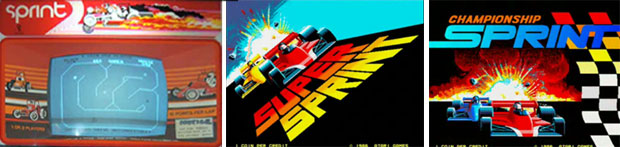
Believe it or not my most recent gaming, art, and history deep dive was triggered by GameFAQs. I was watching classic arcade videos on YouTube, specifically a lot of Atari games. Many of my favorite games in the arcade were from that studio. I can say with some certainty that I must have played 99% of every arcade title they released. Part of the blessing of being born into Generation-X was being a kid at the time where arcades were transitioning from pinball machines, to arcade cabinets. It gave me an appreciation for electromechanical (analog) titles, as much as digital ones. Most of my favorite Atari games had to do with racing. The free wheeling (literally the arcade steering wheel could spin freely) Super Sprint, and Championship taught me to go fast.

But it was Hard Drivin’, and Race Drivin’ taught me how to drive. Asteroids, and Lunar Lander showed me how space was an endless adventure. It predated my love for all things cosmic. Gauntlet showed me that Dungeons and Dragons would actually be a great template for a video game. With that said however I always thought the skateboarding game 720° - the Ultimate Aerial Experience was possibly their most underrated gem. In my pantheon of arcade classics it was easily in the top 10, if not the top 5. It was hands-down the first game to get skateboarding right. Not only that, but it also reflected the era of ‘80s skating, and how far it had evolved from skating in the ‘70s. It was bold with its use of colors, music, and especially control. It was the first, and as far as I know, the only one with a joystick that’s fixed in a diagonal angle. Despite the greatness of the title, I thought the game was excessive in its difficulty.

Watching people chasing 720° high scores on YouTube confirmed to me that the game was just as hard as I remembered it. Every serious 720° arcade player on YouTube has a strategy in order to achieve their score. They don’t blindly start playing, and hope for the best. They share these details on arcade forums, but not necessarily on GameFAQs. This is essentially true of most arcade games. Unlike some home console games, you are rushed through the experience because you are almost always against the clock. A quarter only buys you a limited time, most games cannot be played perpetually. Those wouldn’t be appreciated by arcade owners.
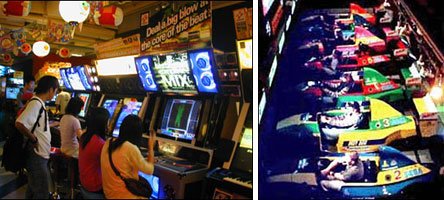
The best studios knew how to balance the experience of playing, with the challenge provided. In order to get a high score, and thus secure your local fame you have to exploit the game in some way. Whether it requires you going through stages in a certain order, unlocking an item, or simply having the determination to practice the same techniques over, and over until it becomes part of muscle memory. Chasing high scores means that you can’t really enjoy the experience. You are essentially tasked to challenge yourself to do better, rather than appreciate the game. The first time I remember truly enjoying 720° was more than a decade after it was released. I was working in a college computer lab, and installed MAME (arcade emulation software) on one of the computers. I used it to play all of my childhood favorites with unlimited credits.
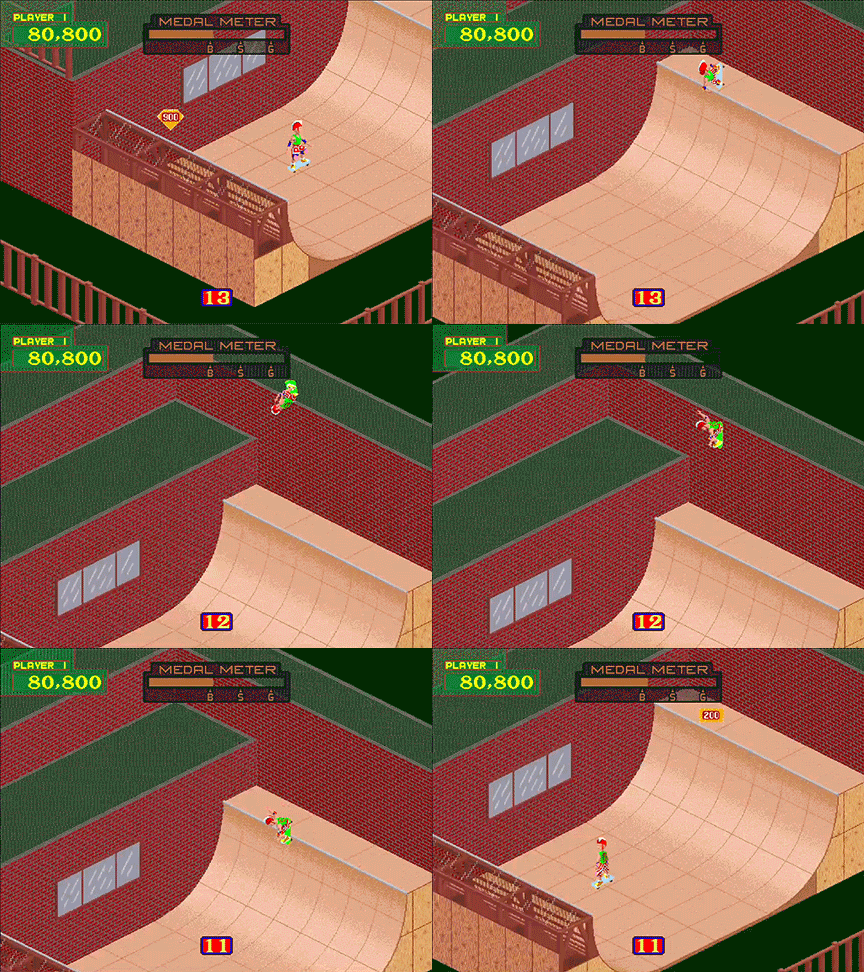
On one particular play through of 720° my character launched much higher than I had ever seen before, and he performed a McTwist. This was an inverted 540 spin° created by Bones Brigade alumni Mike McGill. I knew there were some basic vert tricks that could be performed on the halfpipe, but nothing as fantastic looking as the McTwist. Decades later I commented on the YouTube channels if there was footage of the McTwist that anybody had captured. Most players said they had seen it, however since it wasn’t worth too many points for high score runs then it was never recorded. That was when I decided that I wanted to get footage of this move because it was so cool looking, and not many had seen it. I couldn’t get MAME running on my home computer so I found that a lot of my favorite Atari games had been published in the Midway Classics collection. This was available to download for the Xbox One S. I remembered that I could screen grab, and record from the console so I paid a few bucks for the collection. It was well worth it, and in no time I found myself doing a deep dive on 720°, including capturing many of the moves, far more than I had even realized. I posted it on my Twitter, but probably should have put it on YouTube as well.

I discovered that nobody had put together a comprehensive list of moves on GameFAQs, or a strategy for the arcade game. There was one for the dismal NES version. I think part of the reason why was because many of the vert tricks would randomly pop out in the middle of a contest. Some tricks appeared depending on the speed, and angle that you approached the lip of the ramp. Some depended on what upgrades your character had, but none were guaranteed. I figured this must be the reason why nobody had ever written up a how-to for the arcade original. As a kid what really hurt me me about 720° (aside from wasting my quarters) was that it was built on an experience that no other game provided. The act of skateboarding is challenging, but at the same time rewarding. In order to separate gamers from their quarters Atari was cruel in their planning. They made it easy to skateboard, and perform tricks with the use of only two buttons. Anybody with a quarter could skate like a pro.
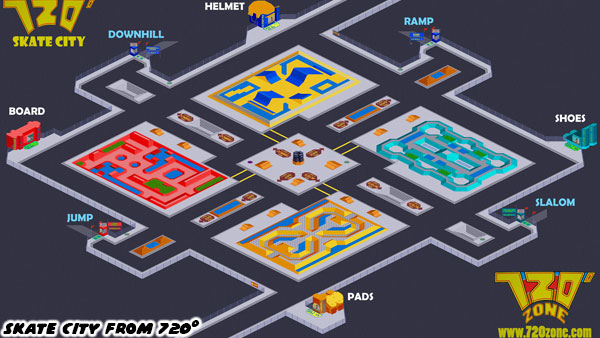
To really hook players Atari created the ultimate world to skate in. They introduced a place called Skate City. Every block its own brightly-colored skatepark, complete with gaps, ramps, and wedges. Massive speakers in the heart of the city provide endless skate-punk tunes. There are no signs prohibiting skateboarding, or skate stoppers bolted to any legs. This is the world that skaters wish they had. Skateboarding, as you know, is not a sport, it doesn’t have rules. Nobody can “win" at skateboarding, it never has a season, or championship, at least not in the traditional sense. It is an art form, a physical activity, and a culture. This culture comes in conflict with society many times in the real world. The act of skating is seen as destructive, just like graffiti art. It is not seen as creative expression in most cities. Atari’s version of Skate City is heaven to me now, as much as when I was a kid. Who wouldn’t want to explore this place? There are endless lines you can paint, nooks to find, and various spots to perform tricks on I needed to see every inch of the map. This was why I was willing to put quarter, after quarter into the machine.
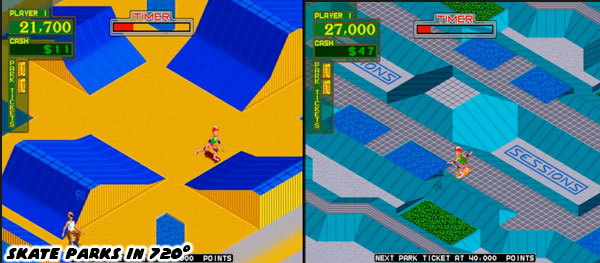
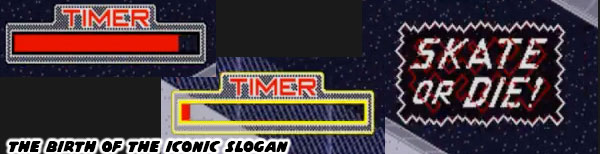
You can earn points while exploring skate city, but if you want your initials on the leaderboard you have to enter one of the four available contests. Atari made sure to encourage players not to waste time in the streets by putting a timer at the top of the screen. Once the timer runs out the game alerts you to “Skate or Die." While the slogan may have initially appeared on a sticker sold on the back pages of Thrasher magazine, it pretty much entered public consciousness thanks to the game. When the warning appears a swarm of angry bees start to chase the player. At first you can skate faster than them, but after a few seconds they begin to speed up, and even take shape like a cartoon syringe to sting players, and end the game. If you don’t have a ticket (many times I did not) there was no way to enter the contest, and escape the bees.
Players begin the game with a single ticket, and must perform tricks to earn more tickets to enter the four available contests. The contests themselves were a good cross-section of skateboarding events from the ‘80s, with a few liberties thrown in. The most popular contest, at least to me was the Ramp contest. It featured a halfpipe next to a brick building. Players could perform an assortment of moves on it, including every possible spin combination. Depending on how fast you rotated the joystick clockwise, or counter-clockwise your character could do a 180°, 360°, 540°, 720°, 900° spin, or more. No only that, with enough speed you could even leap onto the rooftop, and jump back in to earn outrageous points. The timer in each contest was constantly going down, meaning that in this event you only have a few seconds in which to earn enough points to score a medal; Bronze, Silver, Gold, or no medal at all. I’m certain that most people that played the game in the ‘80s wish they could have spent more time just trying out all the ramp tricks.
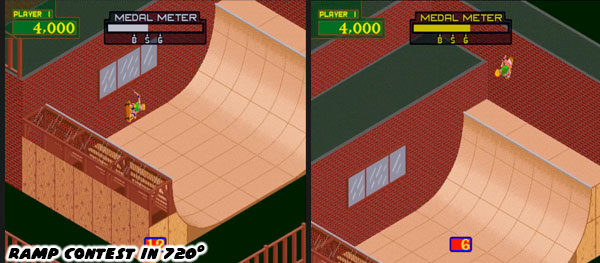
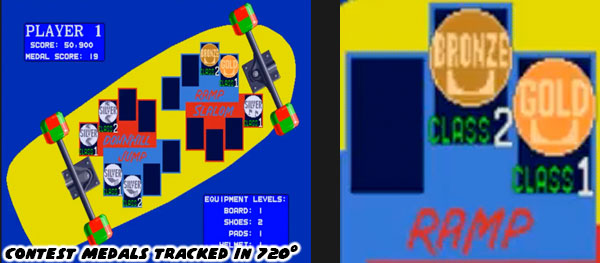
As the game advanced the contests required higher scores, or faster runs, in order to earn any medal. Several of the high score runs on YouTube don’t focus on medals, but rather what tricks score more points. It is possible in some events not to finish a course, but instead use the available time do as many tricks as possible. The ramp contest featured the most popular exploit in the game. Before dropping in it was possible to have your character bounce off the wall, and “grind" on the edge of the ramp earning an incredible bonus. Then you simply skate up each wall, and allow your character to slide down the ramp. While this kills the purpose of actually riding the ramp, and spinning, it rewards far more points, and guarantees a gold medal each time. The collection of medals are recorded on a skateboard deck, completing the theme of the experience.
The other contests are pulled from traditional skateboard events. One of them is the slalom. In it players have to race down a wooden track, while moving in between flags as fast as possible. It is very easy to overshoot the flags, and end up sliding off course. Slalom was one of the more popular old school skateboard events going back to the early ‘70s.
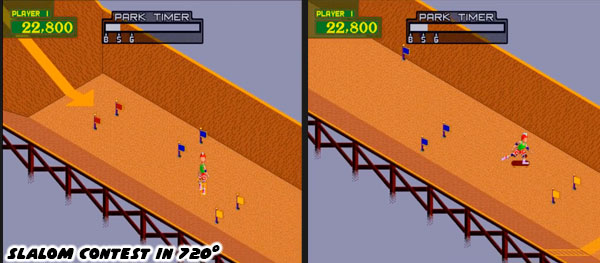
The other race in the game is downhill. Again this is sort of based on actual skateboard racing. However instead of racing on the street against a group of opponents it’s the player against the clock. Gamers have to navigate a steep wooden ramp, and try to get down as fast as possible. Players can clip corners, and jump into further sections of the ramp, rather than try to ride them down completely. Like the slalom it is very easy to go off the edge of the ramp because you miscalculate the turns or jumps.
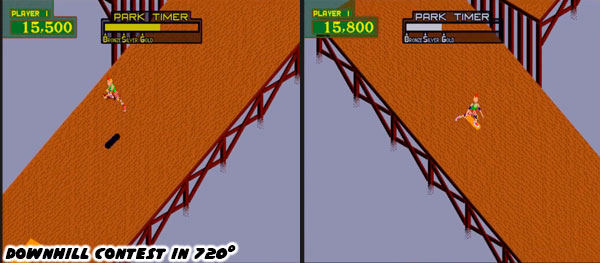
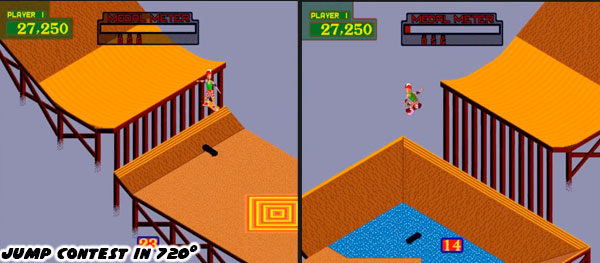
The fourth competition in the game is called Jump. It is the only event in the game that was not based on a traditional contest. Instead players have to navigate a steep ramp, similar to downhill, but with a ramp at the end of each platform. Players are rewarded for landing on a small multicolored target. Of all the contests this is by far the hardest to medal in. The target is not visible until you have already jumped. Making it very easy to overshoot completely. The game does give you a hint as to how far out to jump, and in which direction. A yellow diamond shape is painted on the run up ramp, if you line up right over the diamond you are guaranteed to at least be headed in the right direction. A large diamond means that the player has to jump, and spin out as far as possible. A medium-sized diamond means you don’t have to go as far. And a tiny diamond just means to let your character drop off the platform. Sometimes the diamond is pointing diagonally, which means you have to carve across the ramp just before your jump. Then there are double diamonds, which let you know if both are a jump, or if the first is a drop, and the second is a jump. Like I said it’s very difficult to score here, as there are no do-overs in the event.
The only way to get good at 720° is to play it over, and over. Which of course was what Atari, and the arcade owners were hoping for. As I said earlier there was a way for players to exploit a part of the game so that they could chase competition tickets, and high scores. The ramp glitch I described was one way. The other was by purchasing certain items. Contest money could be used to purchase a helmet, skateboard, shoes, or pads. Each one of those items helped increase the stats of the player. The shoes for example allowed the player to jump higher. The helmet allowed them to spin faster.
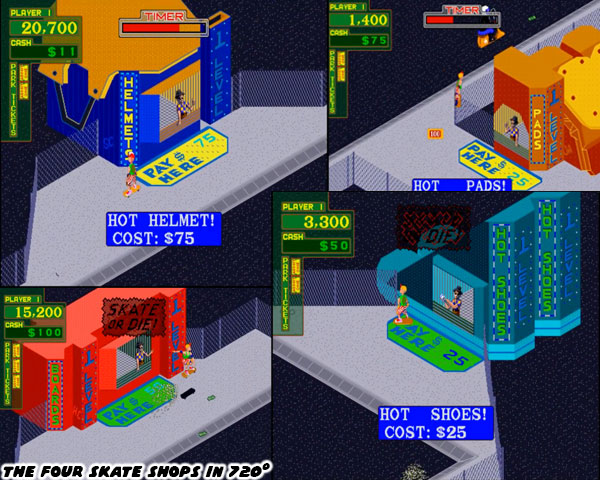
Pads could be used to recover faster from accidents. The board allowed you to go faster. There were three tiers of each item that you could buy before the store that sold them closed down. As a fun aside the stores themselves looked like a giant version of the item. The shoe shop looked like a giant pair of canvas sneakers. The helmet shop looked like a giant helmet, etc. You didn’t really have to purchase the Level 3 version of each item in order to maximize your score output. Many of the best players suggest to only get Level 1 or 2 of certain items, and in a specific order.
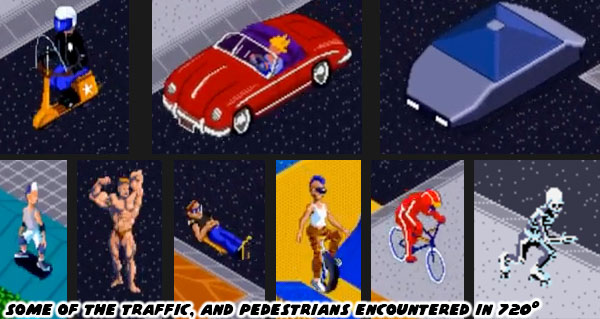
Of course navigating Skate City wasn’t without its risks. There were other skaters to compete with on the parks throughout the city, as well as various other pedestrians blocking the sidewalks. Rival skaters, kids on BMX bikes, punks on unicycles, bodybuilders, and even frisbee players could all knock over our skater. Yet a savvy player could actually time a boneless jump, and land on pedestrians instead. This was an interesting detail about the game. The character could not ollie, and would actually plant his foot in order to leap into the air, or go higher on a ramp. These tricks were known as boneless, no comply, or fast plant, depending on whether the player grabbed the board or not. Of all the pedestrians the one that stood out the most was a roller skating skeleton. At first glance you might think it’s a person in a skeleton suit, until you crash into him, and he collapses into a pile of bones.
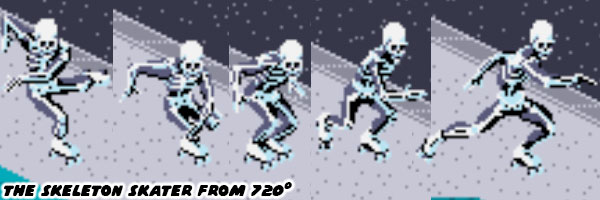
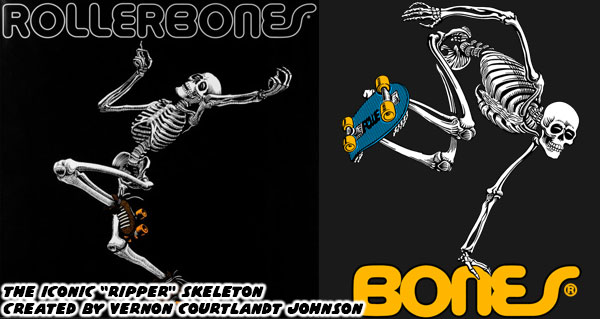
The character was undoubtedly based on the “Ripper" skeleton created by artist Vernon Courtlandt Johnson, who created a number of pieces for Powell Peralta skateboards. To me VCJ is a god, and easily one of the biggest influences on my art. I’ve mentioned this before on my blog. While many skaters may equate the Ripper with skateboarding, some of his earliest art was used on roller skates for Bones wheels. This very rare shout-out was used by Atari when they put the character in the game.
The more I played 720° in the arcade, years later on MAME, and decades later on the Xbox One S the more I appreciated it. As I pursued footage of the McTwist I began absorbing all sorts of details that had been lost to me previously. It made me dig in a little bit more into its history. I’d like to share a lot more on this game, and my other favorite skateboard games over the next few blogs. I hope to see you back for that. If you would like to sponsor me please visit my Patreon page and consider donating each month, even as little as $1 would help make better blogs and even podcasts!

follow the Street Writer on Patreon!

Friday, December 24, 2021

A story of robots, monsters, and rad rides

As the year winds down I get a bit nostalgic. I know a lot of my friends, and family members look back on the year, and think about how much has happened. Our family has recently had its share of losses. Not long ago our pet cat died, and a few days later a loving aunt passed. The winter season has not been kind to us in this regard. There have been good things to happen throughout the year. Projects completed, returning to orchestra playing, new business leads, building new friendships, these were just a sampling of the good things that have happened. Thankfully I’ve stayed employed, the family has stayed healthy. Things could have always been worse for us, or our loved ones, and I’m grateful for what we have.

With Christmas I’ve been thinking about some of my favorite toys, especially those I received for the holiday. I hope that you have fond memories of the toys you grew up with, and I wonder if there was something that you always wanted when you were a kid. I’m going to share a little bit about one of the toys I longed for. This story begins with Irma, our favorite aunt, and Tomy. Aunt Irma (RIP) was my mom’s younger sister, and easily the fun aunt. She had a great sense of humor, was highly creative (her Halloween decorations were legendary), and a good singer. My brothers and I always looked forward to her visits. Irma used to work at Human Resources at Tomy Toys.

Tomy was a Japanese company that was known for their games, puzzles, and toys. They didn’t necessarily have a lot of big name licensed products like the US companies Hasbro, and Mattel, but what Tomy did create was undeniably fun. They used to have a factory, and office building in Wilmington California. A small port town nestled in between some oil refineries. It was not far from where our family grew up. Irma got a big discount in the company store, and when she visited she would bring us various wind-up, and battery operated games. We still have many of the “Pocket Arcade” games that they created in the ‘70s, and early ’80s. These handheld games predated Mattel’s Electronic Football by years. I think the Tomy games were far more interesting than the early LED games of the era. They were tangible, had their own gameplay, rules, and control. The mechanized ones were usually wind up. Most didn’t need batteries. So we could take them anywhere to help pass the time.

Almost as awesome as the toys we were gifted from our aunt, were the catalogs from the company. We got a glimpse of what was coming out later that year, if not the following year. Many Gen-Xers had fond memories of the Toys R Us Christmas Catalog, or Sears catalog. Kids got to see every toy, video game, and bike that was available, or coming soon. My brothers, and I would take turns putting together our wish lists. We assumed it was just a matter of time before we won the lottery. As nice as those catalogs were, they were nothing compared to the trade magazine than Irma brought us each month. Playthings Magazine was our bible. Each issue was some 200+ pages in size. It was a way for the industry to share what they were working on with vendors. It took us behind the scenes, gave us in depth interviews, concept art, and reviews. Each magazine gave us a glimpse of what was coming out in the future, sometimes years in advance. These included entirely new toys, cartoons, and comic characters.

Imagine being in elementary school, and knowing more about toys, and cartoons than your classmates. Our friends were skeptical at first when we told them what was coming up. The thing was that since the industry was talking about things happening in the far future, there were lots of prototype details. Lines, and characters had name, and design changes before they came out. Classmates thought that we were just lucky with the predictions, until we brought the magazines to school, and gave them a glimpse at the future as well. They no longer doubted us when it came to news about toys, and cartoons. Many thought that with my love of toys, animation, and art, I would eventually get into toy design. I think about that timeline a lot. I hope that universe’s version of me is as happy as I’d hoped.

Tomy was on the cutting edge of electronic LED games, they made some of the first licensed arcade games, including Pac Man. Their Tomytronic 3D games were brilliant. Although quaint by today’s standards, imagine playing a game through a viewfinder, whose bright colors made it look like Tron graphics come to life. More important Tomy had a reputation in Japan, and the US for their toy robots. Going back to the ‘60s the company made very cute wind-up, battery-operated, and remote control robots. As tin gave way to plastic, and transistors found their way into manufacturing so too did the Tomy robots evolve over the decades.

Mom and dad bought us many of the smaller battery operated robots that they made. I have now passed a few to my kid. Aunt Irma would bring us the two most expensive robots that they made to play test on weekends. These being the Omnibot, and Omnibot 2000. The larger of the two remote control robots debuted in 1985, at the price of $600. Adjusted for inflation that robot would retail for over $1,500 in 2021. You can imagine that mom, and dad were stressed that three young boys would be taking turns playing with a robot that cost more than the monthly rent in our apartment. We promised our aunt to be extra careful, and you can bet that we were!

Of all the toys that came out in the ‘80s, I was the biggest fan of vehicles. Tomy made a few great cars, and trains, but they didn’t really capitalize on them. This was something that I don’t think toy designers often looked at when creating new properties. Yes, I enjoyed He-Man, the Transformers, and G.I. Joe. Those were character-driven franchises. When kids played with those figures they indeed took on the roles of those characters. I was happier imagining myself as the pilot, or driver of the various jets, tanks, and race cars.

I was most excited when a company made a vehicle that had some sort of neat gimmick, and wasn’t tied to an existing license. This meant I could imagine it in any scenario. I wasn't forced to play within the confines of their universe. Some of the designers working behind the scenes were becoming aware that there was a market for pushing vehicles to the forefront. A car could be the star, and not the driver. This was obvious going back to Speed Racer in 1966 (Mach GoGoGo in Japan). As cool as it was watching Speed / Go beat up bad guys, and race around the world, he would be nothing without the Mach 5. The state of the art race car could handle any course, and do all sorts of impossible things, including cut down trees, jump, and drive upside down with the aid of spiked tires. In 1982 Knight Rider introduced the world to Michael Knight, and his amazing car K.I.T.T. The self-driving car was fire-proof, bullet proof, and could also jump via “turbo boost,” The car was brilliant, and often helped Michael solve crimes. 

Between Mach 5, and K.I.T.T. the toy designers were beginning to realize that super cars could be a franchise all to themselves. Mattel had already cornered the market on toy cars thanks to their Hot Wheels line, but super cars was another story. So how do you sell kids on a vehicle as a star? It’s not like they could convince retailers that a vehicle-centric toy would sell, unless it was based on already popular car. The thing was famous cars were already attached to shows. The Batmobile, the Munsters Koach, and the Drag-u-la were associated the campy 1960’s TV shows. Toys, and model kits on those had already come, and gone in popularity. So where would the next big thing come from? In the early ‘80s no vehicle was more amazing than Bigfoot. This was a real truck, it could conquer any mud bog, pull a competition sled, and roll over cars. I had already talked about the mainstream success of Bigfoot in the early ‘80s.

Playskool got the license to create the Bigfoot monster truck toy in 1983. It was easily one of my  favorite birthday presents of all time. The toy was great at climbing, it had a forward, reverse, 2-wheel, and 4-wheel drive mode. When I played with it I imagined myself as the driver. I don’t think that anyone playing with the toy imagined that they were Bob Chandler, or Jim Kramer, the respective builder, and driver of Bigfoot. The same thing could be said of those that played with, as as K.I.T.T. Nobody missed having a Michael Knight figure because the car was the star. Playskool looked to build a “Muscle Machines” franchise around Bigfoot. They reached out to the wildest cars in the mud bog, and tractor pull circuits where Bigfoot was often featured. They signed licenses for the Orange Blossom Special II, and War Lord. These two stood out because they looked like street legal monsters, and not competition tractors. They fit right in with Bigfoot as plausible, albeit impossible rides. A cartoon show soon followed to help get Bigfoot on the minds of kids all over the country.

Many toy companies were also picking up on the 4x4, and monster truck trends. In 1980 Schaper toys (later Tyco) released the Stomper, a small battery powered 4x4. They also offered amazing play sets, and sleds for off road pulling action. To me these truck toys were as fun, if not more so, than the playlets for G.I. Joe, or He-Man. Galoob was known for their licensed toys such as the A-Team, Ghostbusters, and Aliens. They were keenly aware of vehicle toys, and developed the highly successful Micro Machines series. The toy that set my imagination on fire was a 1984 off roader was called The Animal. It was four wheel drive like other toys, however if the tires couldn’t get any grip while climbing then claws would automatically pop out from inside the tread to give it more traction. It was a radical concept in toy design. I never owned one, but knew some kids that had. I was envious, but it wouldn’t be the only Galoob toy I lusted after.

The Animal was the first in a series of beast-like rides from Galoob. The company added a combination tow wench, and spotlight called the Clench that could be pulled by the trucks. They also added smaller buoyant trucks called Swampers. A year later they added a bigger, and badder Animal called the Xtendor. This truck was modeled after a cabover diesel truck, like Optimus Prime. It also had a rocket launched on the tail, I’m not sure why it was weaponized considering that the vehicles didn’t have a story or military alignment assigned to them, but it was cool nonetheless. It offered the extending claws of the previous model, but if it needed extra help climbing the tail would stretch out, and lengthen the wheelbase. These automatic transforming mechanics elevated the toy above the competition.

The Animal was a hit, and showed the industry that kids loved these types of toys. The company released an off road buggy called the Flex. The tires seemed small, and extremely wide. When it needed climbing power the tires would shorten, and their treads would pop out, leaving gaps between the treads. The tires were shaped like rubber windmills, allowing even more grip than the set of claws that popped out of the Animal. These wheels seemed more adept for all-terrain play, making short work of grass, sand, shallow puddles, mud, or anything else that kids could throw at it. It made me wonder if this technology could be used on full sized cars. With Flex, and the Animal Galoob found themselves in a war with other companies building climbing rigs. Tyco, and Tomy liked touting that their vehicles could climb a steep grade, or wouldn’t slip under any condition. It was as if toy designers saw that nothing could stop real monster trucks, and they wondered if they could build monsters that could scale walls. Climbing further, and higher was the goal for their best toys.

Bigger wheels, expanding wheels, and low gear settings were revolutionary for the industry. The lessons they taught designers would be incorporated in toys, models, and remote control cars over the next few decades. The other way that manufacturers found that toy cars could climb was by putting multiple sets of wheels on them. Wheel counts jumped from four, to ten, to 16, and ultimately 32. Galoob set the bar impossibly high when they released the GIANT series. The Leader 16 featured 16 wheels, and could climb vertically with the aid of a rolling arm that was suspended in front. The rig wasn’t based on any real truck, although it had a cabover front. There was an even larger version called the Command 32 which featured the Leader 16 that connected to an eight wheel “GripIron” crane, and an eight wheel “TurboJet” Power Cab. The additional wheels, and engines meant that it could climb even greater obstacles. I was obsessed with the toy as a kid. Drawing it in my free time, hinting to my parents that it would make a great birthday, or Christmas present. I spent many days imagining how cool it would be to own one in real life. I never got one, and that was fine considering all the other wonderful toys that my parents got for my brothers, and I.

The idea of a multi-wheeled, all terrain vehicle stuck with me. I filled countless pages in my sketchbook of multi-wheeled giants. I remembered how Bigfoot 5, and 7 had 10-foot wheels that Bob Chandler had gotten from the Letourneau Land Train. Land trains were used by the military, and fossil fuel industry to cover expanses of land that were inaccessible to most vehicles. I have no doubt that the the Overlander from Gerry Anderson’s Terrahawks was inspired by the Letourneau land train. In the sci-fi series the Overlander was supposed to be massive, a rolling base of operations.

It was closer in scale to a space station, than a monster truck. I could only imagine how awe inspiring a real life version would be. Even more I wanted to see what a toy based on that would be like. In all fairness there was a six-wheeled science fiction toy that predated all of the ones I lusted after. The Milton Bradley Big Trak was a programmable vehicle from 1979. You could punch in commands for driving, turning, and distance using the keypad on the back. As nice as the design was I never could figure out the target audience. I wanted a toy sci-fi vehicle to play with, not to program.

The end of the climbing vehicle trend pretty much ended in 1991. Kenner was the company that had made the Star Wars toys of our youth. They were looking to do something else now that there were no new Star Wars films on the horizon. Return of the Jedi had come out in 1983, and the prequel movies wouldn’t come out until 1999. They needed to change with the times, or close down. Kenner was late to the party when released a vehicle called The Claw. To be fair It looked better, and moved much smoother than the 4x4’s of the ‘80s. The gimmick for this truck were tires that split, and extended to help it climb over rough terrain. The addition of teeth on the exposed treads, and ninja-star-like rims made it look wilder than the Animal. Of course by the time it came out I was almost out of high school. My tastes were changing. I still loved monster trucks, and always would, but video games seemed much more interesting, and engaging than traditional toys.

In the middle of the ’80s there was one multi-wheeled monster that Tomy made that gave the Leader 16 a run for its money. Tomy had launched a line of monster trucks called Monster Machines. The battery powered trucks were much different than my Bigfoot toy. Tomy was taking a shot at Galoob, and by my estimation created the best looking ride of that era. The Rad Rig / Mad Masher was a 16-wheeled, multi-engine, diesel truck capable of climbing over obstacles. Proportionally the wheels were larger than the Leader 16’s, making it look more like a real monster truck than a caterpillar. I was captivated by its design. Two sets of exposed, supercharged V8’s over the lead wheels, plus a massive spoiler on the rear made it look like something out of The Road Warrior. There were different colored versions. I only saw the red, and blue ones in stores. The yellow one may have been exclusive to the UK.

My sketches in school switched from the Leader 16 to the Rad Rig almost overnight. The scale, proportions, and design of it made it look much more realistic. Realism was something that tended to sell me on a toy design. Not to mention that Tomy had licensed the use of Goodyear, and STP so that the racing stickers on the truck made it feel more authentic. I lusted after the truck, but never managed to score one as a kid. Years later that I learned that there was a French auto sports promotion that had actually built a monster truck that was almost an exact copy of the Tomy icon. The Road Boss had one less engine, and set of wheels, but the proof was there that a Rad Rig could indeed exist. It made my love of the toy that much fonder. My brothers, and I never forgot about the toys we grew up with. A good portion of them I still have in my garage. Especially the ones I was gifted on Christmas. 

The toys that I wanted as a kid I kept an eye on as an adult. At least once a week I jump on eBay, and take a look at some rare items. Sometimes I spot a deal, but most of the time I look them up just for the sake of nostalgia. I don’t have room in my tiny apartment for toy collecting. So I often talk myself out of buying anything. The Rad Rig comes up often, but it’s usually incomplete, missing the cab, or some tires, or the stickers. A complete one that works does pop up from time to time. They are often the red model, the one that never spoke to me. A complete model, with the box is the rarest of the rare. As any toy hunter could tell you the value of a complete toy with the packaging could be astronomical. An old toy could fetch a lot, even if the box had been opened. You could imagine my shock when one of my grail toys had turned up in early December 2021. Not only was it complete, but it was in the box, with the instructions, and sticker sheet untouched. I told myself I didn’t really need it, but I had wanted it so badly growing up that pangs of that childhood frustration came bubbling to the surface. The seller wasn’t asking anything too outlandish either. I was just being a fiscally responsible adult, and didn’t go for the buy it now price. The seller offered $20 off the asking price just because I put it on my watch list. I couldn’t resist, and bought it. 

It got to me a few days later. I checked the contents, and sure enough everything was included in as close to mint condition as you would expect for a 36-year-old toy. I haven’t decided if I’m going to wrap it up, and then open it for Christmas, or even if I’m going to put the stickers on it. Just having it in my hands fills me with a sense of joy I haven’t had in a long time. I’d like to think that this was not an accident. I’m almost certain that Aunt Irma called in a favor from heaven so I could get that one Tomy toy I had always wanted. I hope this Christmas you get everything you want, and need. Tell me about a favorite toy you had always wanted, but never got. If you would like to sponsor me please visit my Patreon page and consider donating each month, even as little as $1 would help make better blogs and even podcasts!

follow the Street Writer on Patreon!

Thursday, August 5, 2021

A quick take on Luke, the new Street Fighter.

Another year goes by, and another new Street Fighter character is introduced to a lukewarm reception. This new character is named Luke, he was the mystery character added for the Summer 2021 Street Fighter V reveal. Takayuki Nakayama Director of Street Fighter V, and Shuhei Matsumoto the Producer of Street Fighter V showed off the inclusion or Oro. The elderly fighter that had originally appeared in Street Fighter III way back in 1997. Luke was a new face, and presented as the future of the series. I am thankful for Twitter because the hot takes on this character were very spot-on.

Many fans were unimpressed with the reveal. One of the first reactions came from @adam_rsfv who compared the new character to YouTube personality-turned-pro fighter Logan Paul. Logan, and his brother Jake have grated many people with their online antics. These include allegations of sexual assault, filming a dead body in a park, insulting the Japanese while on vacation, and acting like general nuisances. In a way they do reflect the culture of fame, and notoriety from the USA. You don’t have to be the best at what you do, you just have to be the best at promoting what you do. But those were far from being the only takes on the character reveal.

The fish-mash of design elements for the hair, tattoos, and costume of Luke were pointed out right away. @ryo_redcyclone said the character was piecemeal from other Street Fighters. It was easy to point out these influences. Like a villain in a daikaiju, or giant monster tv show.

Many lamented that there was another white boxer in the series. Luke follows on the heels of Ed, a white striker that had been introduced not long ago. The Street Fighter series was known for having a string of powerful Black fighters including Mike, M. Bison, and Dudley. Now in one game two white boxers had turned up. Some compared his look, and introduction to Steve Fox, the British boxer from the Tekken series. Katsuhiro Harada, producer, and director behind the Tekken series agreed with a fan reaction that this might be Steve’s younger brother.

All jokes aside the news of another white character designed to be the face of Street Fighter, the future of the franchise, was met with groans from many fans. Those that had been with the series a long while remember that Alex was supposed to be the face of a New Generation, starting with Street Fighter III. Then almost 15 years later the grappler Abel was designed to appeal to the west in Street Fighter IV. He was supposed to be the go-to character for Americans. Yet in each instance players passed him over to try other other new faces.

With one word to Capcom @KAINONAUT calls out the pattern, and like many minorities, is exhausted with the trend. With each legacy character returning to Street Fighter V players could see that the franchise was favoring the return, and the introduction of white, mostly blonde characters. It was hardly representative of the USA, and given the past four plus years of politics, and civil unrest, you would think Capcom could read the writing on the wall. This is why I am grateful for the internet, for Twitter, and players that are able to dig deep into the history of the series, and call out the company for making missteps when they have a chance to rise up, and produce something exceptional.

In a reply to Kai @mossy_dahlia reminds us of the greatness that could have been. King Cobra was a marvelous design, and the final design known as Rufus was the opposite. On the 30th Anniversary of Street Fighter I highlighted the 30 most important characters to me. Although he never appeared in a game I named King Cobra #1 When that character was turned into an obese white guy for the sake of being funny I knew the series, and director had lost their way. It didn’t make me boycott the series, but constantly call the studio out because I knew they could do better. Most people that read my blogs want to get to the heart of the character, what works, what doesn’t work with Luke? What should Capcom do?

First-off white boxers are nothing new in Street Fighter, or fighting games. Joe was featured in the original Street Fighter. What is concerning is that many of the newer boxers that end up in fighting games tend to be white, and blonde. Even if they come from Hong Kong like Shen Woo in the King of Fighters series. SNK, and Capcom have had their share of Black boxers in the KOF, and SF series. If I were to ask most of my friends to name champion boxers in any weight division I’m sure they could come up with many Black, Latino, and Asian-Pacific names. The white champions (especially blondes) would be few, and far between. Why then should fighting games go out of their way to cater to a certain demographic?

Capcom has demonstrated time, and time again that they are unwilling to take a risk. They want their lead character designs to be accepted by the west. This goes into the use of colors, tattoos, body markings, costumes, etc. If you look at several of the new characters, you’ll start to spot certain trends. Blonde female characters for example tend to get military alternate costumes, with goggles. For the new men the use of solid color tattoos, and patterns, turns up. It was on Necalli, Ed, and now prominent on Luke. The USA is a huge market for the studio. So if they look at pop culture, fight culture, wrestling, MMA, and the like they want to create a fighter that appeals to those fans. The Logan / Jake Paul comparisons for Luke are warranted. What Takayuki Nakayama, and Shuhei Matsumoto may not realize is that this type of fighting "personality" may be popular, but they are often reviled. They aren’t necessarily what the Street Fighter audience either wants, or what the game needs. In many cases fans are eager to try more unique characters.

I mentioned that Abel was designed to be the new face of the series in SF IV, but he was originally an androgynous little boy. The studio thought it would be too risky to have the skinny character in pigtails be able to judo flip larger opponents, so they turned him into a huge bruiser. To cover their bases the studio also created a female spy for the west. C. Viper took her inspiration from the western ideal of beauty, skinny with big lips, a bit like actress Angelina Jolie. When Capcom started trying out the SF IV cabinet in the US they were surprised that players were skipping over Abel, and C. Viper. The characters they designed for the market were failing. Yes they found some fans, but were largely not missed in SFV. There were many reasons why they didn’t work. I think Japanese interpretations of western trends was simply lost in translation. It turned out that when the studio created a character that more closely reflected a classic design, say Juri Han compared to Chun-Li, then the character was more widely accepted. I’m willing to bet that the little kid Abel would have been better remembered by audiences because he was out of the ordinary. Or then again, because he reflected smaller fighters like Ibuki, Makoto, and Sakura.

There is something that concerns me with Luke’s design. Again, it circles back to Japanese creators trying to interpret western tastes. We can tell he is supposed to be a patriotic character, somebody akin to Guile. Guile was a soldier that literally carried his nation on his sleeve. For Luke the stars, and stripes, in the form of tattoos, and even a haircut sends a similar, but not equal message. The use of solid color tattoos is something that I don’t think the people at Capcom considered. These types of tattoos have been more closely aligned with Far Right ideology in recent years. We saw police covered in patriotic tattoos, notably those of the Three Percent, a group identified by the Anti Defamation League as a far right militia movement. These officers have intimidated, and killed in the past. Many were fired, or forced to retire when they were outed as members of the group. The tattoos even turned up Patriots kicker Justin Rohrwasser.

In every instance people with Three Percent tattoos, and the like, all claim to be patriots. They claim not to subscribe to any racist ideology, but want to defend their country. It turns out that they want to defend their country from people that are not like them. Usually white, usually well off. Those that are minorities, gays, trans, Black Lives Matter supporters, Muslims, Liberals, Socialists, or immigrants are the enemy. They even go so far as to claim Anti-Fascists are the biggest threat to the American way of life. The irony in that logic cannot be understated. Guile had a design that could never be lumped into a hate group. He was intentionally designed to be over-the-top, like a GI Joe character that happened to be in a fighting game. He was fighting not for fame, but to get revenge for his fallen comrade, the soldier Charlie Nash. Luke seems to be in the game for himself, to be big, and famous. Sure it could be seen as being distinctly American, but there was more to this nation than a clone of the Paul brothers. I believe Luke doesn’t work because he has conflicting design elements. The sorts of elements that went into Ken for Street Fighter V.

More important I think Luke doesn’t work because Capcom does not know how to take a creative risk. When the studio says they are doing a deep dive, they often miss the elements that made their early generation characters work so well. They fall back on tropes, and stereotypes. Look at how Turkish oil wrestling was presented, or Mexican lucha libre with Hakan, and El Fuerte in SF IV. Fat people became used as joke characters in the series. Starting with Rufus, but spilling over into Birdie as well. The studio forgot that giant characters weren’t always stupid. Luke is designed to be modern, and edgy. He’s probably going to be as well remembered as Necalli in a few years. This is what drives me crazy about Capcom. Greatness is right in front of them, in many concept pieces for a character never used. For a throw-away design given to an existing character, as a costume. If only they would take a moment to listen, to trust their idea, and not what they think we really want. Lord knows I’ve tried to get through to them. I’ve applied to work at that company a half-dozen times. Even asked the producers to please read the blog. I’ll keep on pushing them to do better. I hope the community does too. If you would like to sponsor me please visit my Patreon page and consider donating each month, even as little as $1 would help make better blogs and even podcasts!

follow the Street Writer on Patreon!