


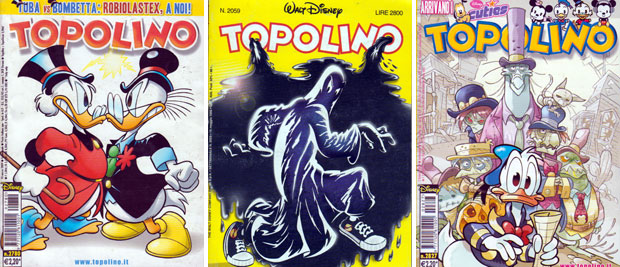
In keeping with the recent Disney themes this next series is going to take a look at the ways in which Europe approaches and develops the classic characters in popular media. To narrow down the scope of the series it would be focusing mostly on how Italy handled the Disney universe through Topolino magazine. Topolino was the name of Mickey Mouse in Italy. I had talked about the toys that came with the books in a previous blog. How Italy handles the Disney name and how they have been pushing to keep it relevant for several generations could teach many things to the parent company in the US.
The Italian word for comic book was fumetti, it literally translated to puff of smoke. This was in regards to how the word bubbles in comic books looked like clouds. Topolino was one of the rare western comics to be published in Italy’s pre WWII era. It had been in publication since 1932. Like most other Disney comic licenses the earliest issues were reprints and collections from the west. As demand for everything Mickey Mouse rose so too did the demand for more comics. Within a short amount of time local artists were emulating the Disney style and developing home grown stories to fill in the issues of Topolino.
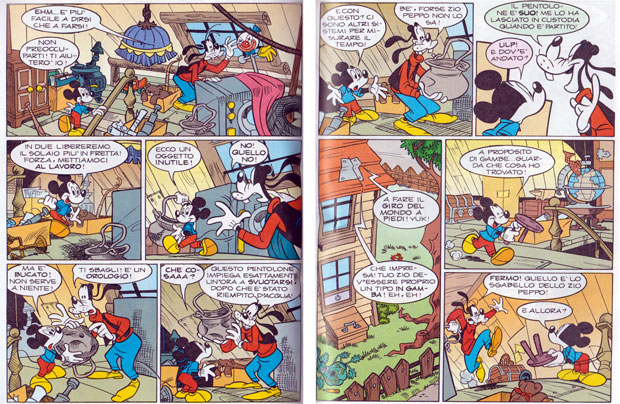
The artists and writers working on Topolino managed to incorporate the characters from the various Disney animated shorts just as well as characters that appeared in western comics originally. Through the issues they helped entertain and educate audiences on the library of Disney characters and how they interacted and related with each other. The same thing could not be said of many western Disney fans, especially those that were familiar with the cartoons and parks only.
Unless Disney fans in the USA were exposed to the classic comics and rare cartoon appearance then they might not know that the adventurous Moby Duck and the hapless Fethry Duck were part of canon. Or that Fethry was related to Donald Duck even! Their adventures and appearances did not end abruptly in fumetti as they did in the US in the 1970’s. To audiences in Italy the two ducks were every bit as involved in the universe as any of the more famous Disney mascots.
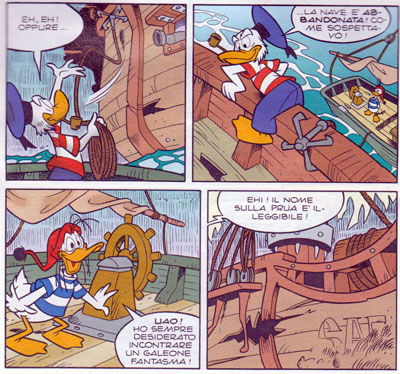
Topolino helped keep these minor characters relevant and developed their identity and appeal among readers. They did so by incorporating them in stories with the more recognizable characters but also by letting them to grow in their own adventures. The types of stories and adventures that the characters were featured in fumetti were becoming as memorable as those featured in the USA comics.
After more than half a century in publication the audience for Topolino had grown exponentially. It was diverse and not solely limited to children. Many Topolino fans were third and fourth generation readers and collectors. The publishers managed to appeal to every age by offering different things to their audience, from short gag comics to longer serials. Although labeled a fumetti Topolino was not considered a comic book as much as a magazine because of how much content was packed into the publication.
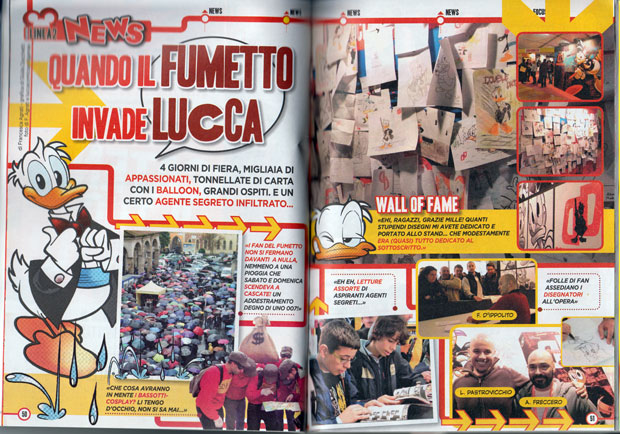
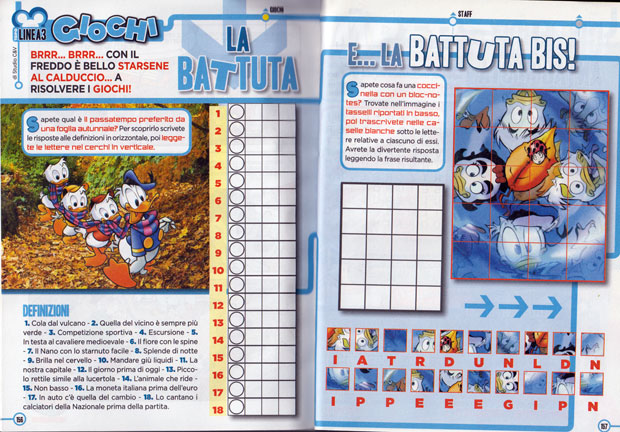
Each issue of Topolino was not only filled with comic stories but also interviews and articles on movies, music and events. There were news stories and interviews with popular celebrities. The issues also featured previews and reviews of toys, videogames and electronic gadgets. Puzzles and games were included to entertain younger readers.
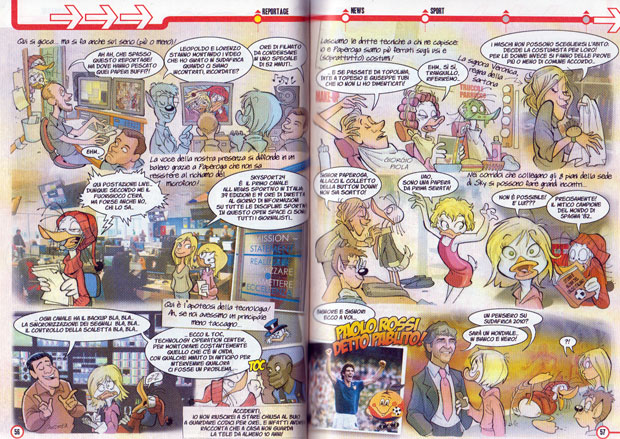
The extra content did not end with some puzzles. To help educate younger readers there was often a look at popular careers. For example a few characters from the comic would visit an actual television station and try to find out how the news was put together. Artists would incorporate photographs and create caricatures of real world people to interact with the cartoon icons. They would help explain their careers to audiences. These brief entries in the book gave many artists a chance to showcase their talents in ways that traditional comic formats did not always allow.
The biggest lesson that the fumetti could teach US comic publishers was in how the creators were granted artistic license. They could explore the Disney universe and present it in a diversity of formats. This liberty to explore and expand on the canon was rarely seen in the USA. Part of the reason was because in the USA comic books, and especially Disney comics, were meant to appeal to children. US comics had to be geared, developed and marketed to children. This limited the scope of stories and characters that could be created. Fumetti were open to all-ages and could be enjoyed by just about any reader. Similarly in Japan there were manga titles written for adults just as there are for teens and children. Countries like Italy, Brazil and Japan did not have a stigma attached to the medium. They also did not use the business model attached to the Disney comics that the US did.
Characters that had only made a few appearances in US comics had taken starring roles in fumetti. Entirely new characters and canon were explored without Disney fans and purists calling for a boycott to the changes.
For example if a writer for Topolino wanted to feature a young Scrooge McDuck in a flashback story about calcio (Italian for soccer) then they could do just that. He would be running around in a kilt playing against kids in shorts in a neighborhood yard. In the US it would be hard for fans of the Carl Barks canon to accept the visual changes to the character, or to see him cavorting with neighborhood children instead of being dressed shabbily and working towards his first dime.
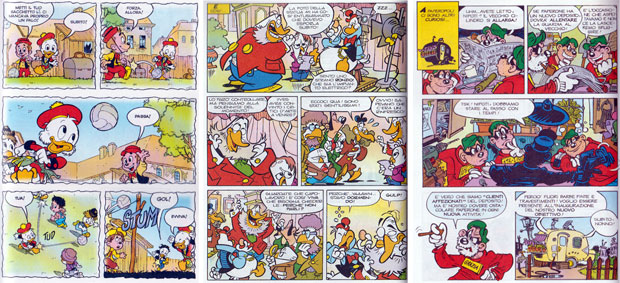
Each artist working in fumetti was free to explore a style of presentation and cartooning. Some artists had a distinct 2-dimensional style while others featured more convincing 3D forms and shapes. Some were great at the classic style of character art, making figures that looked exactly like those featured in USA comics from the 40’s and 50’s. Others had a more impressionistic stance, with flat and stylized versions if the icons that were definitely not based on the US model sheets.
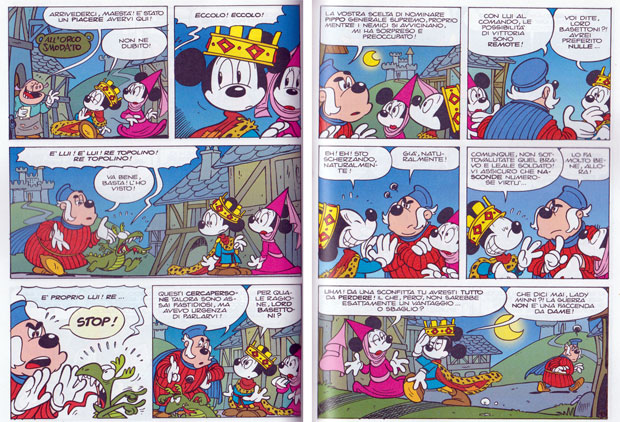
If Italy were to be ranked globally in the art of comic cartooning based on Topolino and its fumetti offshoots then they would arguably at the top with the US well behind them. The sole publisher of the Disney comic book license in the USA was Kaboom studios, the offshoot of Boom Studios. They had assumed sole ownership of the license from Gladstone and Gemstone publishing. Often times Kaboom and Boom were reprinting older Disney material from the US and Europe and only developing new material from recent Pixar films. The books from Kaboom were marketed mostly to kids but also to the older fans of the Disney Afternoon television series. Some of their best artists like James Silvani and Amy Mebberson were sometimes overlooked by the community simply because of the titles they were working on.
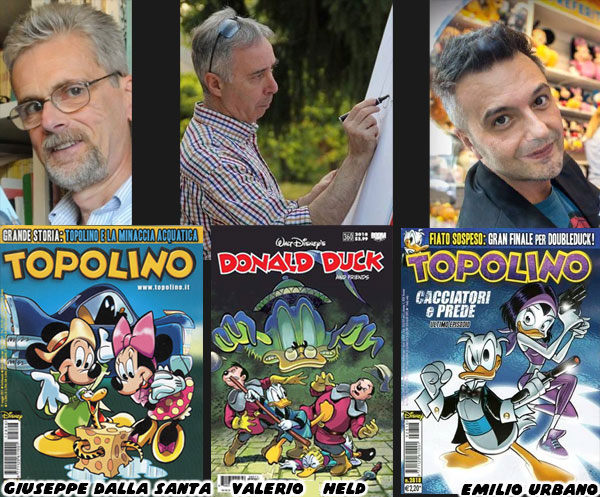
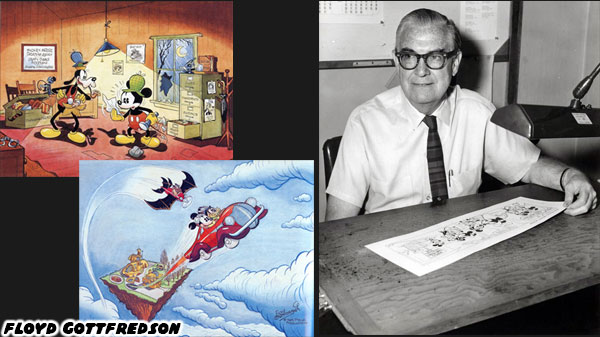
Of all the Italian artists, the one who has had the biggest influence on the Italian cartoon style and the one who was most emulated was Giorgio Cavazzano. He was and is very much considered a living legend among cartoonists, to be admired alongside such greats as Carl Barks and Don Rosa. Giorgio got his start in comics at the age of 14 by inking the pages of the original Italian legend Romano Scarpa. He was still in high demand as a cartoonist, only now his work also hung in museums. Many of the current Topolino artists and product designers still borrowed a lot from Mr. Cavazzano's style.
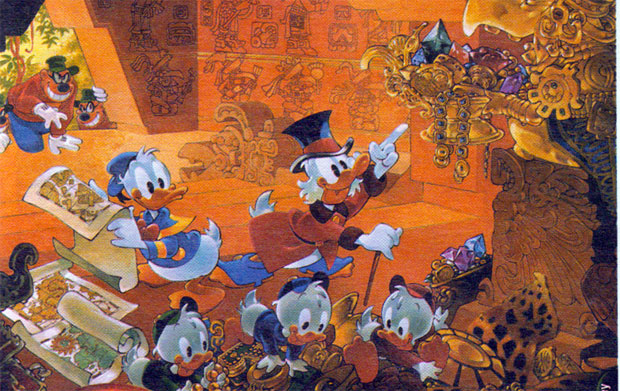
Subscribers of Topolino were treated to collectables and toys in many of the issues. Smaller collectables like puzzles, cards, stamps and coins would come packaged with the fumetti and larger toys would be distributed over several issues. The larger toys would have to be assembled by the readers, which for most young fans was a treat in and of itself.
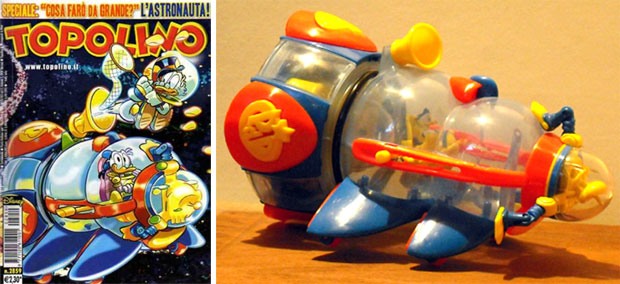
Many of the larger toys had some sort of battery activated feature. The space ship pictured above for example had working lights and sound effects. It could be separated into three components, a satellite rover, a ship and a command module.
These items or “gadgets” as they were known in Italy did not have to be part of a story. Many were just be based on any part of Disney history. The printed gadgets featured images from the Disney legacy, others were actual figures and models. Some were even crossover designs from multiple Disney sources such as Tron Mickey on a wind up light cycle or Donald Duck in Herbie the Love Bug.
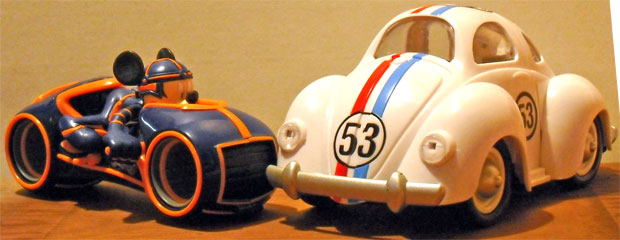
Disney followers in Italy had probably a greater breadth of knowledge of animated characters, comic book creations and classic films because of how often they were referenced in fumetti and via the gadgets.
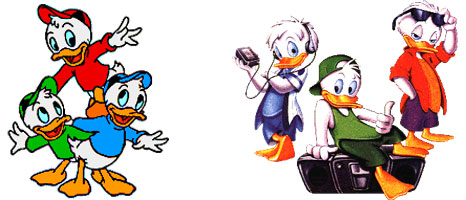
Italy helped introduce diverse timelines into Disney canon as well. Donald Duck may be seen as secondary to Mickey Mouse in the USA but in Italy he is every bit as important if not more so in the fumetti. Paperino, as Donald was known in Italy had several incarnations. One of the versions of the character, Paperino Paperotto followed the adventures of the young duck and his friends. Very little had ever been written or drawn in the USA on Donald’s childhood. Paperotto had a distinct visual style and even purpose in Disney canon. The character and his adventures were far more than a generic "Disney Babies” series. His hi-jinx stories were very sincere and the artists and writers worked hard to respect Disney continuity and as such they were accepted by fans.
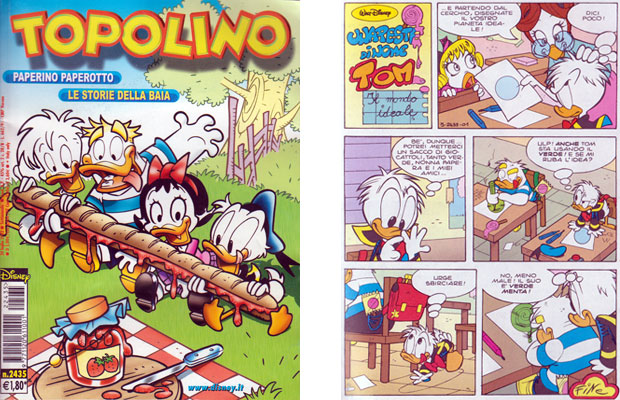
While these whimsical stories were meant for younger audiences they were balanced out by the more adventurous stories of Paperinik, the superhero alter ego of the adult Donald Duck.
Italian fans got tired of seeing Donald treated as a perpetual loser in the translated stories from the US. When the chance arose to create an original story they gave Paperino an alias that was far more heroic and adventurous than even Mickey Mouse. Paperinik was not unlike Batman in that the character relied on his guile and an array of gadgets to defeat a rogues gallery. Paperinik, the Duck Avenger in English-speaking countries and Papernika, the super alter ego of Daisy, had many colorful adventures over the years. The duo and other super-hero retellings of the icons had now been part of Disney comic canon for over 40 years.
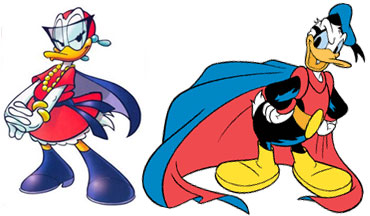
Both Paperino Paperotto and Paperinik demonstrated that the Italians were capable of taking classic characters into bold new directions and make them popular with the community. They also showed that the community would not be offended if changes to an iconic character were made, so long as the spirit of the original character were not compromised. Paperotto and Paperinik never crossed the line to make them anything other than Donald in a new form, the personality and temperament of Donald Duck still shown through the artistic facelift. The idea of remaking the Disney icons would be met by a collective groan from US cartoon fans.
With Christmas I’ve been thinking about some of my favorite toys, especially those I received for the holiday. I hope that you have fond memories of the toys you grew up with, and I wonder if there was something that you always wanted when you were a kid. I’m going to share a little bit about one of the toys I longed for. This story begins with Irma, our favorite aunt, and Tomy. Aunt Irma (RIP) was my mom’s younger sister, and easily the fun aunt. She had a great sense of humor, was highly creative (her Halloween decorations were legendary), and a good singer. My brothers and I always looked forward to her visits. Irma used to work at Human Resources at Tomy Toys.
Tomy was a Japanese company that was known for their games, puzzles, and toys. They didn’t necessarily have a lot of big name licensed products like the US companies Hasbro, and Mattel, but what Tomy did create was undeniably fun. They used to have a factory, and office building in Wilmington California. A small port town nestled in between some oil refineries. It was not far from where our family grew up. Irma got a big discount in the company store, and when she visited she would bring us various wind-up, and battery operated games. We still have many of the “Pocket Arcade” games that they created in the ‘70s, and early ’80s. These handheld games predated Mattel’s Electronic Football by years. I think the Tomy games were far more interesting than the early LED games of the era. They were tangible, had their own gameplay, rules, and control. The mechanized ones were usually wind up. Most didn’t need batteries. So we could take them anywhere to help pass the time.
Almost as awesome as the toys we were gifted from our aunt, were the catalogs from the company. We got a glimpse of what was coming out later that year, if not the following year. Many Gen-Xers had fond memories of the Toys R Us Christmas Catalog, or Sears catalog. Kids got to see every toy, video game, and bike that was available, or coming soon. My brothers, and I would take turns putting together our wish lists. We assumed it was just a matter of time before we won the lottery. As nice as those catalogs were, they were nothing compared to the trade magazine than Irma brought us each month. Playthings Magazine was our bible. Each issue was some 200+ pages in size. It was a way for the industry to share what they were working on with vendors. It took us behind the scenes, gave us in depth interviews, concept art, and reviews. Each magazine gave us a glimpse of what was coming out in the future, sometimes years in advance. These included entirely new toys, cartoons, and comic characters.
Imagine being in elementary school, and knowing more about toys, and cartoons than your classmates. Our friends were skeptical at first when we told them what was coming up. The thing was that since the industry was talking about things happening in the far future, there were lots of prototype details. Lines, and characters had name, and design changes before they came out. Classmates thought that we were just lucky with the predictions, until we brought the magazines to school, and gave them a glimpse at the future as well. They no longer doubted us when it came to news about toys, and cartoons. Many thought that with my love of toys, animation, and art, I would eventually get into toy design. I think about that timeline a lot. I hope that universe’s version of me is as happy as I’d hoped.
Tomy was on the cutting edge of electronic LED games, they made some of the first licensed arcade games, including Pac Man. Their Tomytronic 3D games were brilliant. Although quaint by today’s standards, imagine playing a game through a viewfinder, whose bright colors made it look like Tron graphics come to life. More important Tomy had a reputation in Japan, and the US for their toy robots. Going back to the ‘60s the company made very cute wind-up, battery-operated, and remote control robots. As tin gave way to plastic, and transistors found their way into manufacturing so too did the Tomy robots evolve over the decades.
Mom and dad bought us many of the smaller battery operated robots that they made. I have now passed a few to my kid. Aunt Irma would bring us the two most expensive robots that they made to play test on weekends. These being the Omnibot, and Omnibot 2000. The larger of the two remote control robots debuted in 1985, at the price of $600. Adjusted for inflation that robot would retail for over $1,500 in 2021. You can imagine that mom, and dad were stressed that three young boys would be taking turns playing with a robot that cost more than the monthly rent in our apartment. We promised our aunt to be extra careful, and you can bet that we were!
Of all the toys that came out in the ‘80s, I was the biggest fan of vehicles. Tomy made a few great cars, and trains, but they didn’t really capitalize on them. This was something that I don’t think toy designers often looked at when creating new properties. Yes, I enjoyed He-Man, the Transformers, and G.I. Joe. Those were character-driven franchises. When kids played with those figures they indeed took on the roles of those characters. I was happier imagining myself as the pilot, or driver of the various jets, tanks, and race cars.
I was most excited when a company made a vehicle that had some sort of neat gimmick, and wasn’t tied to an existing license. This meant I could imagine it in any scenario. I wasn't forced to play within the confines of their universe. Some of the designers working behind the scenes were becoming aware that there was a market for pushing vehicles to the forefront. A car could be the star, and not the driver. This was obvious going back to Speed Racer in 1966 (Mach GoGoGo in Japan). As cool as it was watching Speed / Go beat up bad guys, and race around the world, he would be nothing without the Mach 5. The state of the art race car could handle any course, and do all sorts of impossible things, including cut down trees, jump, and drive upside down with the aid of spiked tires. In 1982 Knight Rider introduced the world to Michael Knight, and his amazing car K.I.T.T. The self-driving car was fire-proof, bullet proof, and could also jump via “turbo boost,” The car was brilliant, and often helped Michael solve crimes.
Between Mach 5, and K.I.T.T. the toy designers were beginning to realize that super cars could be a franchise all to themselves. Mattel had already cornered the market on toy cars thanks to their Hot Wheels line, but super cars was another story. So how do you sell kids on a vehicle as a star? It’s not like they could convince retailers that a vehicle-centric toy would sell, unless it was based on already popular car. The thing was famous cars were already attached to shows. The Batmobile, the Munsters Koach, and the Drag-u-la were associated the campy 1960’s TV shows. Toys, and model kits on those had already come, and gone in popularity. So where would the next big thing come from? In the early ‘80s no vehicle was more amazing than Bigfoot. This was a real truck, it could conquer any mud bog, pull a competition sled, and roll over cars. I had already talked about the mainstream success of Bigfoot in the early ‘80s.
Playskool got the license to create the Bigfoot monster truck toy in 1983. It was easily one of my favorite birthday presents of all time. The toy was great at climbing, it had a forward, reverse, 2-wheel, and 4-wheel drive mode. When I played with it I imagined myself as the driver. I don’t think that anyone playing with the toy imagined that they were Bob Chandler, or Jim Kramer, the respective builder, and driver of Bigfoot. The same thing could be said of those that played with, as as K.I.T.T. Nobody missed having a Michael Knight figure because the car was the star. Playskool looked to build a “Muscle Machines” franchise around Bigfoot. They reached out to the wildest cars in the mud bog, and tractor pull circuits where Bigfoot was often featured. They signed licenses for the Orange Blossom Special II, and War Lord. These two stood out because they looked like street legal monsters, and not competition tractors. They fit right in with Bigfoot as plausible, albeit impossible rides. A cartoon show soon followed to help get Bigfoot on the minds of kids all over the country.
Many toy companies were also picking up on the 4x4, and monster truck trends. In 1980 Schaper toys (later Tyco) released the Stomper, a small battery powered 4x4. They also offered amazing play sets, and sleds for off road pulling action. To me these truck toys were as fun, if not more so, than the playlets for G.I. Joe, or He-Man. Galoob was known for their licensed toys such as the A-Team, Ghostbusters, and Aliens. They were keenly aware of vehicle toys, and developed the highly successful Micro Machines series. The toy that set my imagination on fire was a 1984 off roader was called The Animal. It was four wheel drive like other toys, however if the tires couldn’t get any grip while climbing then claws would automatically pop out from inside the tread to give it more traction. It was a radical concept in toy design. I never owned one, but knew some kids that had. I was envious, but it wouldn’t be the only Galoob toy I lusted after.
The Animal was the first in a series of beast-like rides from Galoob. The company added a combination tow wench, and spotlight called the Clench that could be pulled by the trucks. They also added smaller buoyant trucks called Swampers. A year later they added a bigger, and badder Animal called the Xtendor. This truck was modeled after a cabover diesel truck, like Optimus Prime. It also had a rocket launched on the tail, I’m not sure why it was weaponized considering that the vehicles didn’t have a story or military alignment assigned to them, but it was cool nonetheless. It offered the extending claws of the previous model, but if it needed extra help climbing the tail would stretch out, and lengthen the wheelbase. These automatic transforming mechanics elevated the toy above the competition.
The Animal was a hit, and showed the industry that kids loved these types of toys. The company released an off road buggy called the Flex. The tires seemed small, and extremely wide. When it needed climbing power the tires would shorten, and their treads would pop out, leaving gaps between the treads. The tires were shaped like rubber windmills, allowing even more grip than the set of claws that popped out of the Animal. These wheels seemed more adept for all-terrain play, making short work of grass, sand, shallow puddles, mud, or anything else that kids could throw at it. It made me wonder if this technology could be used on full sized cars. With Flex, and the Animal Galoob found themselves in a war with other companies building climbing rigs. Tyco, and Tomy liked touting that their vehicles could climb a steep grade, or wouldn’t slip under any condition. It was as if toy designers saw that nothing could stop real monster trucks, and they wondered if they could build monsters that could scale walls. Climbing further, and higher was the goal for their best toys.
Bigger wheels, expanding wheels, and low gear settings were revolutionary for the industry. The lessons they taught designers would be incorporated in toys, models, and remote control cars over the next few decades. The other way that manufacturers found that toy cars could climb was by putting multiple sets of wheels on them. Wheel counts jumped from four, to ten, to 16, and ultimately 32. Galoob set the bar impossibly high when they released the GIANT series. The Leader 16 featured 16 wheels, and could climb vertically with the aid of a rolling arm that was suspended in front. The rig wasn’t based on any real truck, although it had a cabover front. There was an even larger version called the Command 32 which featured the Leader 16 that connected to an eight wheel “GripIron” crane, and an eight wheel “TurboJet” Power Cab. The additional wheels, and engines meant that it could climb even greater obstacles. I was obsessed with the toy as a kid. Drawing it in my free time, hinting to my parents that it would make a great birthday, or Christmas present. I spent many days imagining how cool it would be to own one in real life. I never got one, and that was fine considering all the other wonderful toys that my parents got for my brothers, and I.
The idea of a multi-wheeled, all terrain vehicle stuck with me. I filled countless pages in my sketchbook of multi-wheeled giants. I remembered how Bigfoot 5, and 7 had 10-foot wheels that Bob Chandler had gotten from the Letourneau Land Train. Land trains were used by the military, and fossil fuel industry to cover expanses of land that were inaccessible to most vehicles. I have no doubt that the the Overlander from Gerry Anderson’s Terrahawks was inspired by the Letourneau land train. In the sci-fi series the Overlander was supposed to be massive, a rolling base of operations.
It was closer in scale to a space station, than a monster truck. I could only imagine how awe inspiring a real life version would be. Even more I wanted to see what a toy based on that would be like. In all fairness there was a six-wheeled science fiction toy that predated all of the ones I lusted after. The Milton Bradley Big Trak was a programmable vehicle from 1979. You could punch in commands for driving, turning, and distance using the keypad on the back. As nice as the design was I never could figure out the target audience. I wanted a toy sci-fi vehicle to play with, not to program.
The end of the climbing vehicle trend pretty much ended in 1991. Kenner was the company that had made the Star Wars toys of our youth. They were looking to do something else now that there were no new Star Wars films on the horizon. Return of the Jedi had come out in 1983, and the prequel movies wouldn’t come out until 1999. They needed to change with the times, or close down. Kenner was late to the party when released a vehicle called The Claw. To be fair It looked better, and moved much smoother than the 4x4’s of the ‘80s. The gimmick for this truck were tires that split, and extended to help it climb over rough terrain. The addition of teeth on the exposed treads, and ninja-star-like rims made it look wilder than the Animal. Of course by the time it came out I was almost out of high school. My tastes were changing. I still loved monster trucks, and always would, but video games seemed much more interesting, and engaging than traditional toys.
In the middle of the ’80s there was one multi-wheeled monster that Tomy made that gave the Leader 16 a run for its money. Tomy had launched a line of monster trucks called Monster Machines. The battery powered trucks were much different than my Bigfoot toy. Tomy was taking a shot at Galoob, and by my estimation created the best looking ride of that era. The Rad Rig / Mad Masher was a 16-wheeled, multi-engine, diesel truck capable of climbing over obstacles. Proportionally the wheels were larger than the Leader 16’s, making it look more like a real monster truck than a caterpillar. I was captivated by its design. Two sets of exposed, supercharged V8’s over the lead wheels, plus a massive spoiler on the rear made it look like something out of The Road Warrior. There were different colored versions. I only saw the red, and blue ones in stores. The yellow one may have been exclusive to the UK.
My sketches in school switched from the Leader 16 to the Rad Rig almost overnight. The scale, proportions, and design of it made it look much more realistic. Realism was something that tended to sell me on a toy design. Not to mention that Tomy had licensed the use of Goodyear, and STP so that the racing stickers on the truck made it feel more authentic. I lusted after the truck, but never managed to score one as a kid. Years later that I learned that there was a French auto sports promotion that had actually built a monster truck that was almost an exact copy of the Tomy icon. The Road Boss had one less engine, and set of wheels, but the proof was there that a Rad Rig could indeed exist. It made my love of the toy that much fonder. My brothers, and I never forgot about the toys we grew up with. A good portion of them I still have in my garage. Especially the ones I was gifted on Christmas.
The toys that I wanted as a kid I kept an eye on as an adult. At least once a week I jump on eBay, and take a look at some rare items. Sometimes I spot a deal, but most of the time I look them up just for the sake of nostalgia. I don’t have room in my tiny apartment for toy collecting. So I often talk myself out of buying anything. The Rad Rig comes up often, but it’s usually incomplete, missing the cab, or some tires, or the stickers. A complete one that works does pop up from time to time. They are often the red model, the one that never spoke to me. A complete model, with the box is the rarest of the rare. As any toy hunter could tell you the value of a complete toy with the packaging could be astronomical. An old toy could fetch a lot, even if the box had been opened. You could imagine my shock when one of my grail toys had turned up in early December 2021. Not only was it complete, but it was in the box, with the instructions, and sticker sheet untouched. I told myself I didn’t really need it, but I had wanted it so badly growing up that pangs of that childhood frustration came bubbling to the surface. The seller wasn’t asking anything too outlandish either. I was just being a fiscally responsible adult, and didn’t go for the buy it now price. The seller offered $20 off the asking price just because I put it on my watch list. I couldn’t resist, and bought it.
It got to me a few days later. I checked the contents, and sure enough everything was included in as close to mint condition as you would expect for a 36-year-old toy. I haven’t decided if I’m going to wrap it up, and then open it for Christmas, or even if I’m going to put the stickers on it. Just having it in my hands fills me with a sense of joy I haven’t had in a long time. I’d like to think that this was not an accident. I’m almost certain that Aunt Irma called in a favor from heaven so I could get that one Tomy toy I had always wanted. I hope this Christmas you get everything you want, and need. Tell me about a favorite toy you had always wanted, but never got. If you would like to sponsor me please visit my Patreon page and consider donating each month, even as little as $1 would help make better blogs and even podcasts!


