In the previous entry of this series I talked about some of my favorite comic book rivalries. I noted that some villains were evil mirror versions of the heroes, like the Abomination was to the Hulk, the Reverse Flash was to the Flash, or Bizarro was to Superman. That type of design worked well in many stories, and was a tool that young authors could use when fleshing out the antagonists for their own stories. I also mentioned that many of the greatest rivals were asymmetric in look, and ability. Such as the Joker to Batman, Doctor Doom to the Fantastic Four, or the Mandarin to Iron Man. I argued that these were the most interesting types of rivals. Creators that understood the format were able to build worlds that appealed to many readers throughout the years. Award-winning writers understood that the best characters represented something greater than themselves. For example the Hulk was a stand-in for rage, Superman stood for hope, and the Joker for chaos. When done well we could use that understanding across genres. I believed that the best storytellers could use those archetypes in entirely different languages. I have said that the best Superman arc, and best Hulk story of the past decade were featured in the works of the Japanese creator known as ONE.
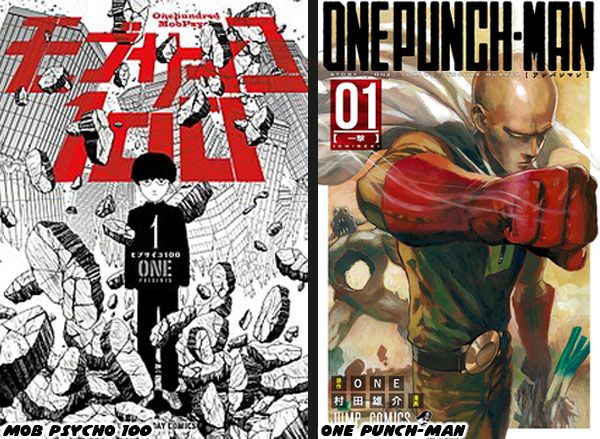
One Punch-Man was every bit a spoof as it was a love letter to the super hero genre. The main character was overpowered, not unlike Superman. The heart of the story was how the supporting characters would deal with world-ending threats before Superman, err, rather Saitama could deliver one of his trademark punches. This was essentially the same dynamic of the Justice League holding off a colossal enemy until Superman could show up. You would think that having a character that could defeat any opponent with a single punch would become boring after the first issue, but ONE managed to build a lot of tension by investing us in the street-level heroes. By comparison Shigeo "Mob" Kageyama wanted nothing more than to catch the eye of a girl he was crushing on, all while dealing with latent psychic powers. The heart of the Mob Psycho 100 story was how people would try to manipulate him, or exploit his powers. It was a cautionary tale dealing with bullying, self image, loss of control, and much more. Nothing could contain Mob when he was pushed to the breaking point. Similar to how Bruce Banner did his best to avoid conflict in the pages of the Marvel comics. When the Hulk was unleashed even the strongest villains found out that he was impossible to stop,. The Hulk had his own Lex Luthor, a human antagonist rather than a super-powered villain that functioned as a great rival for over 45 years.
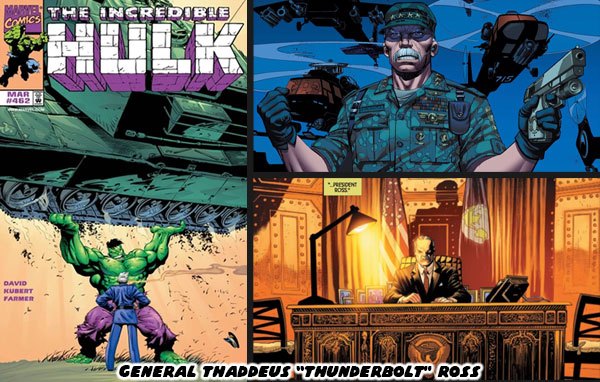
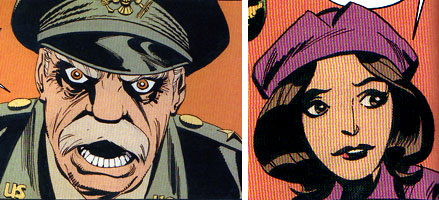
General Thaddeus “Thunderbolt” Ross hounded the Banner, and the Hulk. His crusade against the Green Goliath took him, and his battalions all over the world. He was a complex character, and doubly important because he was the father of Elizabeth “Betty” Ross, the love interest, and future wife of Dr. Bruce Banner. It had been argued that the Hulk was an allegory for war. General Ross represented the military industrial complex, the duo had a destructive relationship. He assumed that any problem could be solved if enough bombs were dropped on it. The opposite was true in the stories. It was impossible to beat the Hulk through perpetual escalation. The billions the government spent on military equipment did nothing but annoy the Jade Giant. He would only become stronger, cause more destruction, and collateral damage the further he was pursued. Thunderbolt’s single-minded obsession was comparable to Captain Ahab from the story Moby Dick. His mania would only lead to the estrangement from his daughter, a mental breakdown, and his eventual downfall. As for the Hulk, it turned out that peace, or rather leaving him alone was the best way to get him to revert to back into Banner.
This dynamic was critically important for the development of the series. Not every villain that the Hulk faced had to be a gamma-powered monster. His toughest battles were fought with his own human family members. At least this was the dynamic explored by all the great series writers except for one person. Jeph Loeb had written for films, television, and comic books for years. In an interview he mentioned that he had a wishlist of things he had always wanted to do in a comic book, and was looking for a character to apply it to. He wanted to see the Hulk stop holding back, to cut loose on the Marvel U, and see what he was really capable of. These included fourth wall breaks ala Deadpool. Things like punching the Watcher, beating up Thor with his own hammer, stealing the Silver Surfer’s board, etc. He knew that it wouldn’t work for the character that fans were already familiar with, so his idea was to assassinate the Abomination, and replace him with an even more powerful rival called the Red Hulk. This would allow him to check off the things on his wishlist without breaking the character that audiences were familiar with. After several issues it was revealed that the Red Hulk was actually General Ross. The editors at Marvel were on board, and the character became a part of continuity in 2008. To fans like myself if demonstrated a misunderstanding of Ross, and the dynamic of the Hulk comics up until that point.
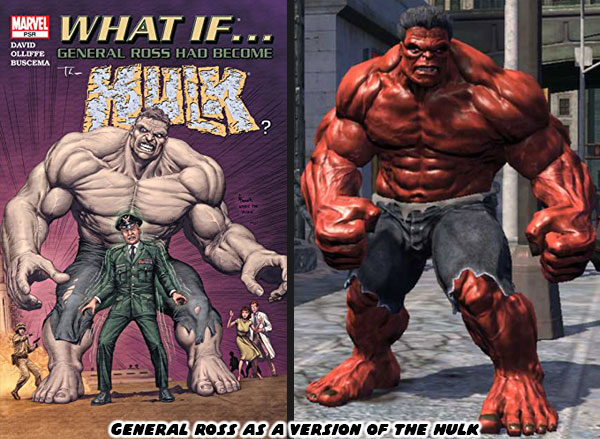
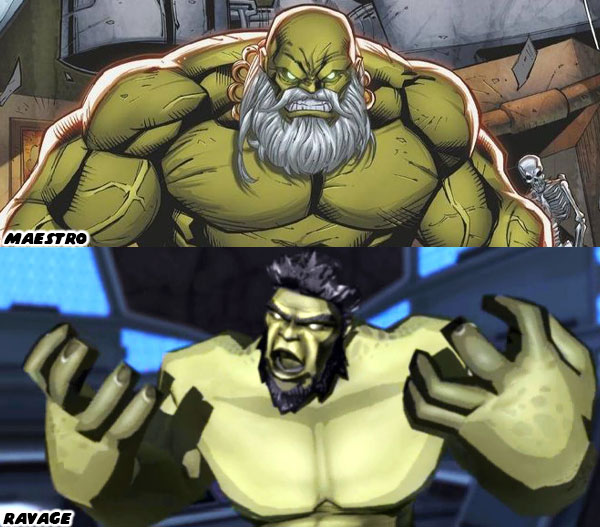
First off the idea of General Ross as the Hulk was explored in a What If? comic from 2004. In it he was gray, and not red. The important part of the story was that Ross saved Rick Jones during the gamma bomb field test, and received the gamma rays that transformed him into the Hulk instead of Banner. During his initial rampage he accidentally killed Betty. When he realized his mistake he transformed back into his human form. A distraught Banner snuck up behind him, and shot him in the head. Thus concluding the story. It made little to no sense for Loeb to add yet another strong guy into the Hulk books. There archetypes were already established through decades of adventures. In addition to the Abomination there were heavy hitters like the Absorbing Man, the Juggernaut, and the Wendigo. In fact when it came to parallel, or rather symmetrical villains there were two that had also been established previously. Professor Geoffrey Crawford was one of Banner’s university instructors. In an attempt to cure a terminal disease he ended up turning himself into Ravage. Yet unlike the Hulk he retained the intelligence of the nuclear scientist. Then there was a version of the Hulk from the far off future in which Banner’s personality had long since deteriorated, and all that was left was a tyrant known as the Maestro. Either one of these villains were overpowered compared to the rest of the Marvel universe. They could have potentially carried off Loeb’s wishlist. Yet I had a feeling that Jeph did not really understand how the powers worked in the Hulk books, how the psychology of the characters affected their mutations, or the roles of long-established foes.
I would argue that Jeph Loeb didn't really understand the heroes or villains from the Hulk books. He instead wanted to rewrite the cast to fit his own interpretation. In doing so it would cause a domino effect that would also turn Betty Ross into a Red She-Hulk, and make the Hulk have a couple of illegitimate offspring. It was the same misunderstanding of the characters that would lead writers to break up Peter Parker, and Mary Jane, and turn Spider-Man into a long suffering hero. This ended up disappointing a large number of fans. While there were many people that liked the Red Hulk, the role of General Ross was completely missed by Loeb, and his successors. I want you to think about it for a moment. Would this type of villain evolution work for the strongest characters in any other book? What if a writer that didn't understand the dynamics of Superman decided to give Lex Luthor all sorts of powers? What if this writer then started calling his creation Alpha Superman? How would fans react to this sudden change? Once the genie was out of the bottle Luthor would never go back to being a mere mortal. It didn't make much sense in this context. It certainly wouldn't have made for a more interesting villain. In fact I think the opposite happened with General Ross.
For almost a century comic book writers had to challenge themselves to create an engaging story. A story where normal humans posed legitimate threats to the most powerful heroes in their respective universes. These writers had to build the tension, and maintain the voices that readers were used to. They had to plot out story arcs that would keep audiences hooked month after month. A well written villain could be used over, and over without feeling tired or broken. New villains were sometimes given a gimmick that flew in the face of established history. This was just so writers that didn't understand the books could have a couple of cool moments pop up. This was what I think Jeph Loeb did with the Red Hulk. General Ross represented much more than a domineering father, or dogmatic soldier. War was all he understood. The concept of peace was foreign to him. He could not bear to let Banner and Betty enjoy their life together. His obsession with control, with Banner, and the Hulk was an illness. He was willing to sacrifice his own men in his pursuit. This made him the actual monster in the stories. A person like Ross would be diagnosed with
Ahab Syndrome, an actual condition where a person was consumed with revenge.
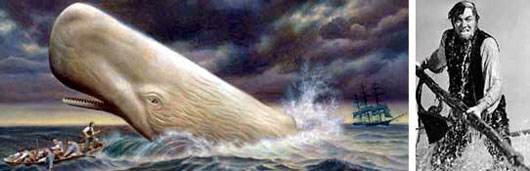
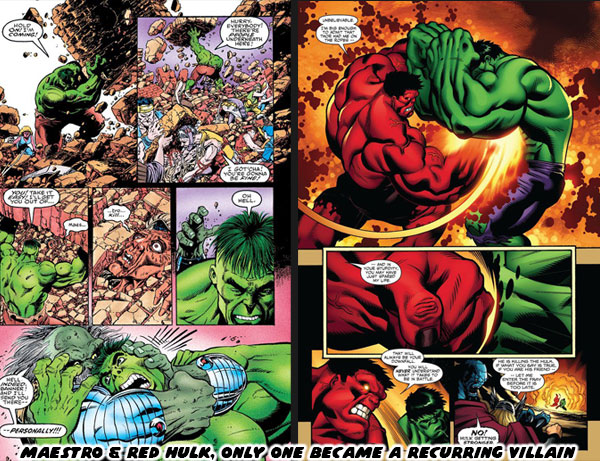
The introduction of the Red Hulk showed that Jeph Loeb completely misunderstood the dynamics of the Hulk. Mr. Loeb decided to rewrite the story of Moby Dick. In his version Captain Ahab would mysteriously get absurd powers. In fact the captain would beat up the whale at the start of the book, and then audiences would watch him go around the ocean beating up other sea monsters. The end of this story would somehow remain the same. The whale would take his revenge, and dispatch Ahab without much fanfare. Mr. Loeb ignored all the established heavy-hitters, and used the most basic type of symmetry to create the type of dumb strong guy that people assumed the Hulk was. The two Hulks would have a few fights, but they lacked the gravity of the battles against the Abomination, or Maestro. Audiences did not fear for the Hulk when this new monster popped up. In fact the Red Hulk would stop being used as a villain altogether. He would end up leading the government sponsored Thunderbolts on missions. You could imagine how absurd it would be if a symmetrical rival like the Reverse Flash, or Doomsday lead the Justice League after their debut. The Red Hulk was just another antihero added into a universe that had become saturated with cynical voices. Mr. Loeb did not create a rival that would withstand the test of time.
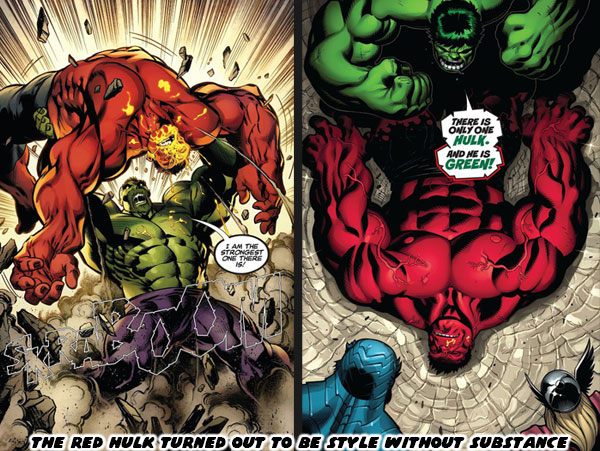
In my opinion Jeph Loeb did a disservice to the character, and continuity of the Hulk. Mr. Loeb lacked the nuance, and understanding that a creator like ONE had when it came to writing for overpowered heroes. The Marvel books would never be the same because of this. There were many rivalries that still meant something in the comics. I will talk about whom I consider to be the Hulk’s greatest rival in the next entry. Until then I want to read your take. Tell me about it on the comments section. As always if you would like to sponsor me
please visit my Patreon page and consider donating each month, even as little as $1 would help make better blogs and even podcasts!