Showing posts with label rockstar. Show all posts

Monday, February 26, 2024

Red Dead Revolver, the arcade game? - A 1UP classic from May 2, 2012

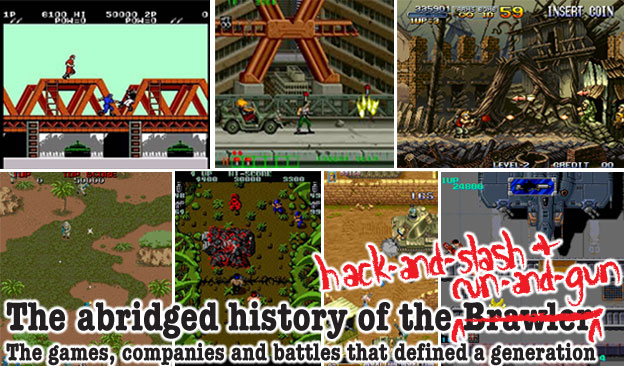
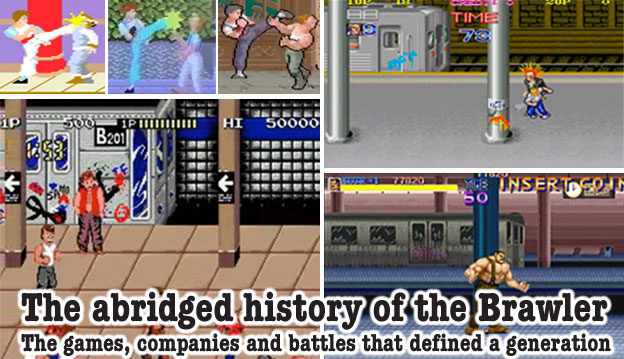
Friends, today we are going to take a look at a game that was and almost was. The title in question was one of my favorites, Red Dead Revolver. It was one of the games highlighted in one of my most popular blogs ever, the Great Western Shootout. It was also one of the titles featured on my Abridged History of the Brawler. I was following this game when Capcom had announced it back in 2002 and had kept tabs on it even when Rockstar San Diego took over duties and published it a few years later. Rockstar’s version was slightly different than the original design but it was great nonetheless. When a sequel was finally announced I held out hope that many of the characters and elements featured in the original might be preserved.

Red Dead Revolver was a rarity among high profile titles. That was because a large volume of material was documented during the development process and shared with media outlets. These included screenshots and video of pre-beta footage. Some of the ideas were interesting and others were laughable. The Japanese certainly had a unique take on the western mythos. Take a look at the oldest trailer from Capcom of Japan, circa 2002.


There were distinct visual elements that they were pursuing in the game. It was set to be an over-the-top western adventure. There was tremendous change to the layout, interface and heads-up display (HUD) from year to year. Capcom's next trailer from 2003 showed tremendous progress from year-to-year.

Not long after their E3 showing in 2003 Rockstar took over development of the game and would publish it in the USA while Capcom retained the rights to publish it in Japan. Here was Rockstar's first trailer from around 2004. It was obvious that the tone and feel of the game had changed considerably.

The second trailer that Rockstar released introduced the rest of the cast featured in the game. This was the first time that players got a chance to see characters other than Red Harlow running the main portions of the game.

In 2010 Rockstar would release a spiritual successor to the game. Red Dead Redemption had nothing in common with the original title, including locations or characters. That was until the expansion pack “Legends and Killers” was released. Fans of the original RDR could now play as some of the most iconic characters in multiplayer mode.

There was something that had always been a pet peeve of mine. Capcom had created a large number of assets that were not used in the final game. Perhaps it was for budgetary reasons or deadline issues but many assets were complete during the development of the title just never incorporated. Some of the changes made to the locations were necessary but the missing items could have shaped a better experience.
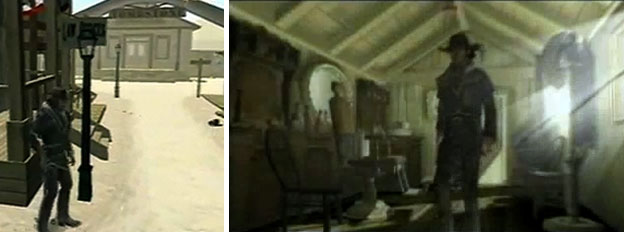
Before it was Brimstone that Red visited in between levels the town was named Tombstone. Perhaps Rockstar changed the name so that players would not think that this was set in any historical town. Other things, like the interior of the barber shop were complete in the Capcom build of the game. In the final release the barber shop was there but when players tried to access it a sign said it was closed. The items that players could buy to unlock levels or weapon upgrades from the barber shop were instead placed in different shops. Perhaps Rockstar did not want to hire another voice actor to play the role of the barber so they just closed a small part of Brimstone down.
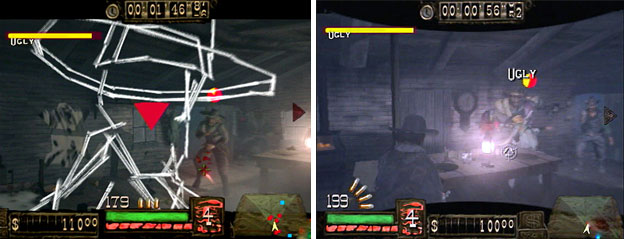
In another early build of the game the interior of the Harlow homestead was a playable level. It was fully decorated and the environment was entirely destructible. Players could shoot down pots and pans, break the glass on windows and even shoot holes through the walls. Moreover since the inside of the house was a confined space the camera might be blocked if the player backed into a wall. Capcom had solved this by outlining Red in a sort of see-through chalk form. This house and several other assets featured in the prototype builds did make it into the game but a shadow of their former selves. In RDR’s multiplayer mode the house sits empty and the figure is never outlined when backed into a wall.
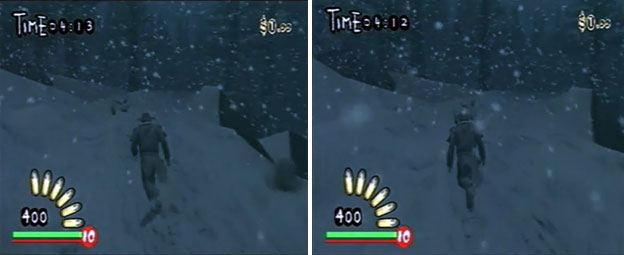
Based on the Capcom version of the game it would have been possible to visit the homestead at least two other times in the game. One of the more cinematic sequences featured a level, not far from Bear Mountain, at night and during a snowstorm. The house in the level was on fire, presumably a family was being attacked by outlaws and Red had to save them. This stage appeared amazing in concept. A version of this asset did make it into the final release as a multiplayer level. However this stage lacked any connection to the game or any dramatic tension. The ground was covered in snow but it never snowed in the actual game. There was a burned out remains of a cabin that players could use for cover but no hint as to what had happened on the mountain. It was a wasted opportunity for Rockstar to add more dramatic staging into the final build.
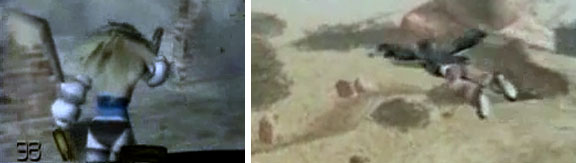
Many characters in the Capcom build of the game were revised or removed. The wild-haired girl in the Capcom prototype was turned into a saloon girl in the Rockstar version. There was a Native American character that had a winged suit and presumably his special ability was that of flight. Every character in the story mode and in multiplayer had a special attack. Some had special weapons they could activate or extended “Dead Eye” (bullet time) mode but the ability of flight would have been extraordinary. As amazing as the move was it would have fit into canon as there were characters that could teleport, spit fire and poison as well as do other supernatural things.
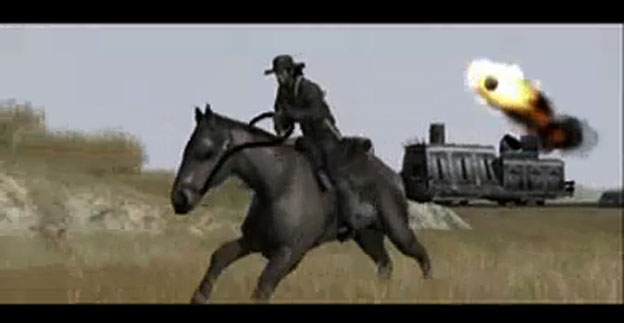
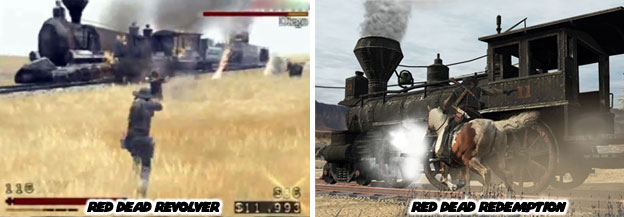
The final build of Red Dead Revolver earned a cult following because it preserved a large number of over-the-top elements, scenes and characters. The villain Colonel Darren had his arm shot off by the powerful Scorpion Revolver, the arm was replaced by a shoulder mounted cannon. General Diego travelled between Mexico and the US on a private armored train loaded with soldiers and artillery. These characters and scenes were far more fantastic than those in recent western films. Games like Red Dead Redemption and Gun tried to present the west with a realistic, dark and gritty atmosphere while the original RDR was more like the classic “Spaghetti Westerns” of Sergio Leone. In fact the soundtrack for the original RDR was based on music from multiple spaghetti westerns including Django, One Silver Dollar and A sky full of stars for a roof.

Fans of the series were left wondering how the game would have turned out if Capcom had finished the developing it, not to mention how they would have approached a sequel. The main characters, levels and assets used by Rockstar were designed and created by Capcom after all. The early success of the game was owed to Capcom as much as it was to Rockstar. In the early 2000’s Capcom wasn’t afraid to develop new IP. Devil May Cry, Crimson Tears, Shadow of Rome, Maximo and Viewtiful Joe were highly original titles that would have been considered a contemporary to RDR. After almost a decade after the original RDR was released people were still talking about it. Wikipedia and a few random gaming forums had perpetuated some myths about the franchise that should be addressed. In all my time searching for data and assets on the beta build I had never seen where Capcom was allegedly going to put zombies in the game. I was at the E3 back in 2002 and 2003 and saw nothing of the sort in the Capcom footage. Until somebody could show proof of zombies in a western game other than Red Dead Redemption or Darkwatch then this would remain nothing more than an urban legend.
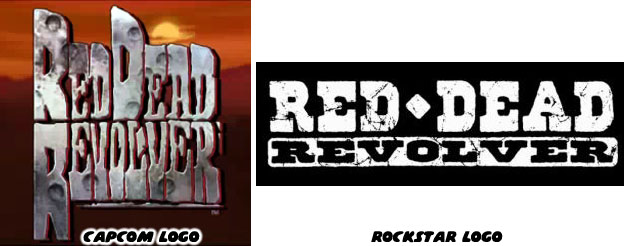
Now something did turn up online recently that would add a whole new chapter to the game that might have been. A few weeks back I was searching eBay for rare gaming items and I came across an arcade marquee. I don’t have many original arcade items, save for an occasional poster or flyer. I never imagined that I would be adding anything new to my collection. That was until somebody put a Red Dead Revolver marquee up for bid.
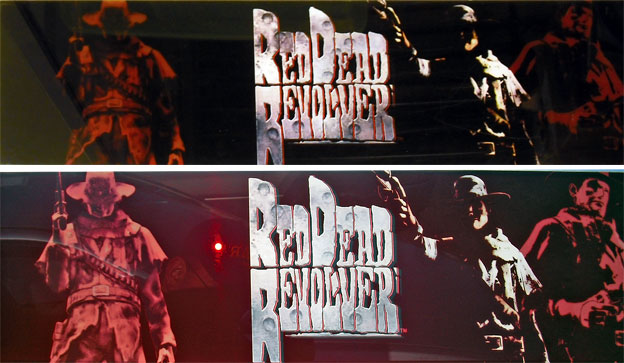
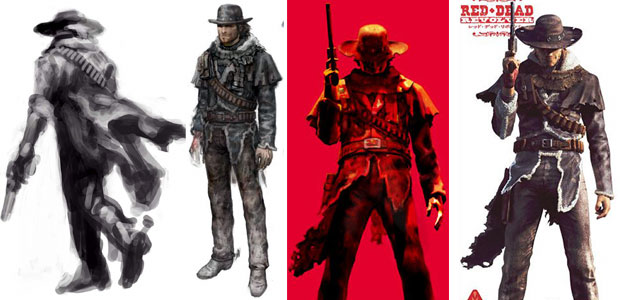
The characters and logo featured on the marquee were pre-Rockstar. I could tell right away because I had collected assets from the Capcom of Japan site and designer Akiman’s blog before Rockstar took over production. The figure of Red on the left side was from Akiman’s painting of the character while the CGI models pictured on the right were some of his very first 3D renderings also by Capcom. I put in a bid and won the marquee for a song.
The marquee gave me more questions than answers unfortunately. The printing on the marquee was top-notch, it made me believe that the assets came from Capcom themselves. The resolution used for the Akiman painting and original RDR logo was much higher than any asset I’d ever seen from a media outlet. I could see details in the marquee that weren’t as sharp as they were from Capcom’s own site. However nowhere on the marquee was Capcom’s logo listed. The RDR logo did sport a trademark sign but it would be curious that the developer was not credited. I was left wondering who created the marquee and what it was for. To the best of my knowledge Capcom did not intend RDR to be an arcade title. They haven't said anything on the Capcom-Unity site about this find. Perhaps in the earliest planning stages RDR might have been a multiplayer arcade title or a successor to their classic Gunsmoke game? Romstar published Gunsmoke for the US back in 1985, perhaps Rockstar was going to be a spiritual successor? Or perhaps Capcom was considering mocking up an arcade cabinet to show at the E3 in 2002 and then changed their minds and told the manufacturer to destroy it.
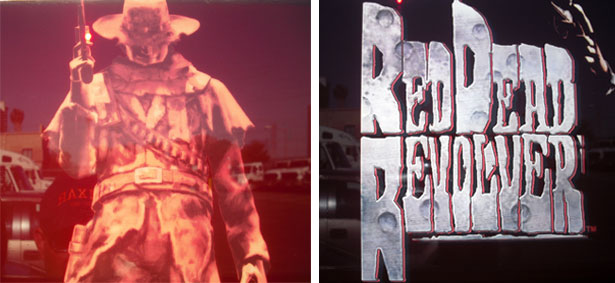
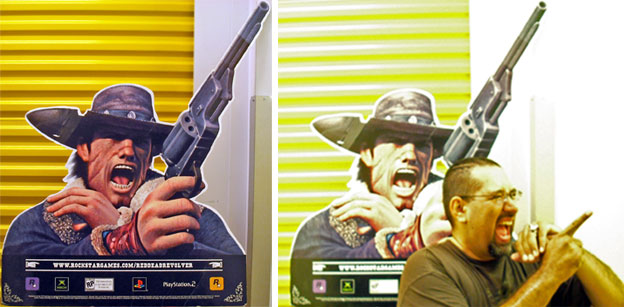
The thick acrylic sign was flawless. It was too well made to be a fan project and if it was a fan project from a US person then it should have used the US lettering and character art. If this was from a Japanese person then how did it end up in the US? I asked the seller on eBay what he could tell me about the sign. He said he had picked it up along with a bunch of other marquees from an arcade estate sale. Every other marquee he had was from a published arcade game. This was the only RDR marquee in the bunch. That’s all he knew about it. He could not offer a manufacturer or point of origin which was bad news for me but good news for my collection. The gem of my RDR set was previously a huge standee that I got from eBay as well.
There were other things that I’d like to add to my collection. Like the cool swag that Capcom of Japan gave to pre-orders. A leather keychain with the scorpion logo and a red bandana with a scorpion logo were some of the things they gave out. If any readers have a lead on the items then I’m listening. FYI in canon Red Harlow tied a red bandana around his hand to cover the scorpion logo burned into his palm. He got the scar as a young man after pulling his father’s revolver from a fire and shooting off the arm of Colonel Darren. This was yet another thing that made Red cooler than just about every other western videogame protagonist ever created. One of these days I’d like to unlock all of the assets on the disk and put together a comprehensive version of RDR just for my own amusement. Until that day take care and let me know if there were any videogame mysteries you wish had an answer to or share a special piece from your gaming collection and tell us about it.
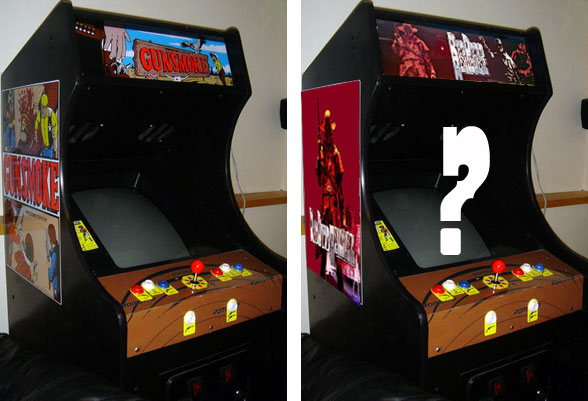
As always if you would like to sponsor me please visit my Patreon page and consider donating each month, even as little as $1 would help make better blogs and even podcasts!
follow the Street Writer on Patreon!

Wednesday, March 22, 2023

My favorite Games of All-Time #20: State of Emergency - Originally published on 1UP - March 31, 2006

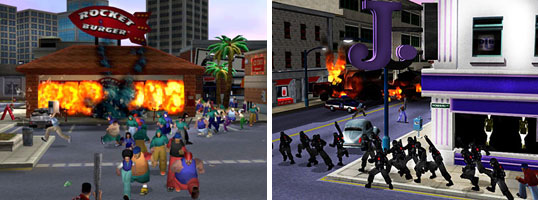
State of Emergency (SoE) by the now defunct Vis is my guilty pleasure. It is considered one of the shortest, lamest and easiest games ever published by Rockstar. In the all-time top games list of every magazine and website SoE is not even a footnote.

I rank State of Emergency higher in this list than any Zelda game, Shadow of the Colossus and God of War. I'm either insane or maybe I see something special in the game that most gamers overlook.

SoE first made news at the 2001 E3. Vis and Rockstar earned some respect for delivering up to several hundred people onscreen at the same time. Most PC developers said that the PS2 could never support that many characters at once.

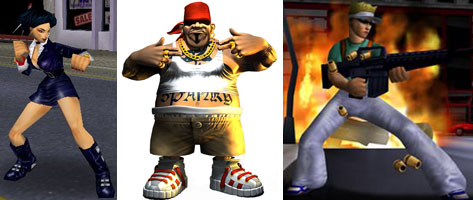
The game was memorable for the characters, mechanics and plot. You are one of several revolutionaries fighting against "the Corporation." There is an ex-cop, lawyer, hacker and escaped prisoner that you can use in your missions. Each character has their own special attacks, strengths and weaknesses. The most well known revolutionary is the chubby gangbanger Hector "Spanky" Solada.

SoE features tons of weapons including assault rifles and axes that players can use plus various missions to accomplish en route to toppling the Corporation. Adding to the running and gunning of the game are the crazed levels. The game is set in the middle of a riot. It is easy to get lost and even easier to evade authorities in the mass of people looting.

The Corporation runs a totalitarian regime in an undisclosed country. The artistic direction and visual clues help set the tone from beginning to end. The characters are highly stylized and a bit cartoonish, however it works in this game. The charm of State of Emergency lies in capturing the chaos of a revolution and turning less into a console game and more into an arcade experience.

That is assuming I can call a revolution charming. You can ask anyone in my family, I find chaos exciting. Riots, explosions wild police chases... I love that stuff. SoE is non-stop chaos and I can't get enough of it. My brother says I need to play more GTA if I'm about the running and gunning. I tell him that I don't want to mess around with a wanna-be game. If I want guns, explosions, gang wars, riots and mass chaos then I cut to the chase and play SoE. From the first level to the last SoE is all about the sensory overload. If I want high speed chases and better car physics than GTA I play Driver. This all goes back to my definition of a great game. Vis identified the element that makes action shooters work and multiplies that tenfold and then wraps it in the middle of a chaotic environment.

This is why I call SoE my dirty little secret. There are very few games that can chill me out when I have to blow off some steam, SoE might be the best at it. Blowing stuff up is fun in the game, it could be called the Katamari of chaos because nobody does it better. There is something visceral about SoE that transcends most game design.

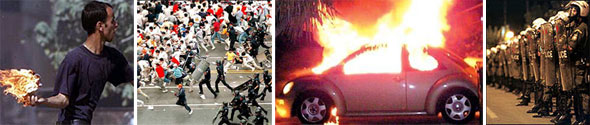
That visceral sensation is primal. The human psyche is tuned to either fight or flee when presented with images of a revolution, the rioting and chaos it brings out. We are reduced to our survival instincts in a mob mentality. As a group we can only be pushed so far by brutal regimes. We can tolerate only so much suffering and human rights violations before we begin rebelling. It is the struggle between freedom and power, the balance of order and chaos that goes back thousands of years. Whether you want to admit it or not, chaos it is as much a part of our humanity as order is.

The fight for freedom is a theme that keeps returning. Most recently in the game Getting Up and the movie V for Vendetta. No game before or since has captured that frenetic energy better than State of Emergency. For that reason alone it will stay on my top-20 favorite games forever and ever.

Viva La Revolucion!

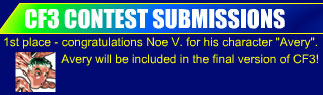
PS. My character Avery won the Capoeira Fighter 3 character contest.

I found out about it earlier this month, but the hosted site had been down for a while. It should be up if you visit. HOLY SMOKES, have a great weekend!!!

I’d like to hear your personal top-10, top-20, top fighting games, top sports games, or top games in any genre. Let me know in the comments section please. As always if you would like to sponsor me please visit my Patreon page and consider donating each month, even as little as $1 would help make better blogs and even podcasts!
follow the Street Writer on Patreon!
Blog, favorite games, arcade, 1up, reprint

Monday, June 6, 2016

The Abridged History of the Brawler, part 29


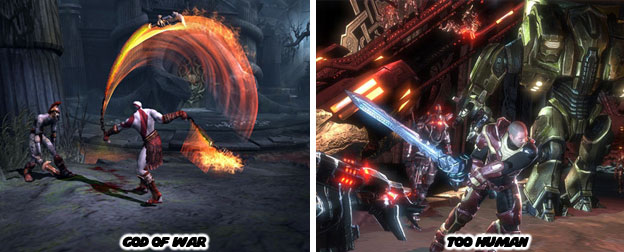
In 2005 Sony Santa Monica released the title God of War for the Playstation 2. The game was a phenomenal success. Earning accolades for the team and designer David Jaffe and his team made up of former Incog Inc. employees. The game was the culmination of the studio’s efforts and learning curve designing games outside of the mainstream. They first found success with Warhawk and Twisted Metal on the original Playstation. With the latter game they developed a dark cast that appealed to the maturing generation of game players. From War of the Monsters they learned combat systems and scaling combat between gigantic forces on the Playstation 2 hardware. From Downhill Domination they learned to create enormous environments and fantastic weather and particle effects. By the time Jaffe and company got to God of War they were well versed in hardware and software. What they did was develop an adventure which would be a response to the new breed of brawler from overseas.


The animations and control in God of War were amazing as Kratos, the hero, battled with unique weapons, the Blades of Chaos. The gameplay was not quite Dynasty Warriors and not quite Devil May Cry but somewhere in between. The hero was tough as nails, somebody that could have given Ken from Fist of the North Star a run for his money. In hand to hand or ranged combat the God of War lived up to his title. When Kratos was placed in breathtaking stages and puzzle environments that were as good as his dedicated fighting levels then the era of the single-player, Western produced, hack-and-slash had arrived.


Other western developers were eager to answer the challenge that Sony had laid out Unfortunately Microsoft’s Too Human by Silicon Knights failed to impress players or critics. The camera, control, story and gameplay were all lacking. Even worse, it misunderstood the brawling roots that inspired God of War. The one-against-the-world design of God of War was instead few-against-many within Too Human. The 2008 title seemed to be trying to cash in on a trend without fully understanding how Sony Santa Monica had gotten there.


The best games in any genre were not developed out of thin air. Nor were they the results of following a trend. Every great title pulled the influences from the team and shaped them into a gaming experience. Often times all the creative minds needed was a spark of an idea and off they went. Treasure for example found greatness was once they stopped working on licensed games for Konami. The industry would follow the trendsetters and find that time and technology shaped every game differently. Look at how far the brawler went from its humble origins. Instead of Kung-Fu Master I could have chosen to follow an even older genre, the Cowboy Western for example.


In 1982 Taito had released a game called Wild Western. It, like the early run-and-gun games was not far removed from the space shooter titles or shoot-em-ups. Yet US developer Exidy developed a game just two years later called Cheyenne which was a light gun game. Already the western genre had become broad based on the tastes and influences of designers. Players were just along for the ride.


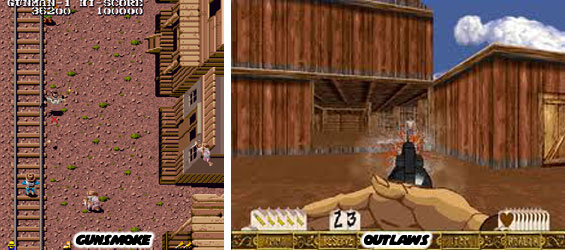
Capcom’s Gun Smoke from 1985 was not far removed from Commando. Players looked down on the hero from an overhead perspective as he cleaned up a western town. The important lesson here was that young players and future artists, designers and programmers were being influenced by these games, themes and heroes.


Outlaws was the first noteworthy FPS set in the wild west. The LucasArts title from 1997 predated Call of Juarez by years. It showed that a good story and emerging 3D technology could make for a great PC experience. The young developers that grew up on Japanese games were cutting their teeth programming PC titles like this.

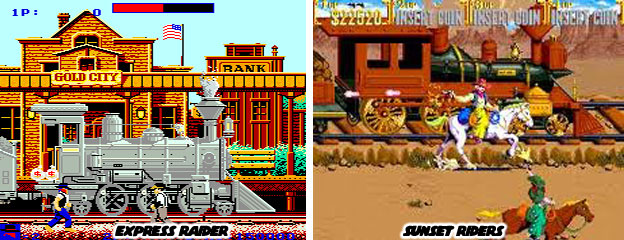
Next to Konami’s Iron Horse, Express Raider was the oldest western brawler. Nihoun Bussan developed the game and Data East published it in 1986. The game was a precursor to Bad Dudes and every other great side scrolling brawler that the studio produced. Players could fight opponents on top of a moving train and even shoot at lawmen from horseback. The game was ahead of its time. Allowing gamers to act as criminals a decade before GTA was even conceived.


I had already talked about Konami’s Sunset Riders from 1991 so there would be no need to bring up the brawling gem again. It undoubtedly left its mark on arcade visitors.

Capcom’s version of Red Dead Revolver was coming along with a slightly silly tone before Rockstar finished the project and made it more serious for its 2004 debut. The new millennia seemed to mark a changing of the guard. Designers from North America and Europe were now passing up Japan in terms of the scope and design of projects. Players could perform all of the things they had seen in a limited capacity in earlier Japanese cowboy games, including fighting on top of moving trains or shooting from horseback. This time they could do it in glorious 3D.


A few years later Rockstar developed a follow-up without the input from Capcom. The 2010 title Red Dead Redemption had shown how capable the US was at developing immersive playing experiences with a solid story, great controls and memorable designs as well.

What did Red Dead Redemption offer that none of the earlier console or arcade western titles could? It was the open world environment. Players were free to explore and interact with the world and make the game move along at their own pace. This sandbox environment would have meant nothing if players were unable to control the character easily. If they were not able to ride horses, have intuitive shoot outs or handle a surly stranger with the butt of a rifle, then players would have let the experience die. Rockstar had been building on the open game world through the Grand Theft Auto series and even The Warriors brawling games. They showed what was capable when players were allowed to experience a title at their own pace. As always if you enjoyed this blog and would like to sponsor me please visit my Patreon page and consider donating each month, even as little as $1 would help make better blogs and even podcasts!

follow the Street Writer on Patreon!

Monday, May 16, 2016

The Abridged History of the Brawler, part 20


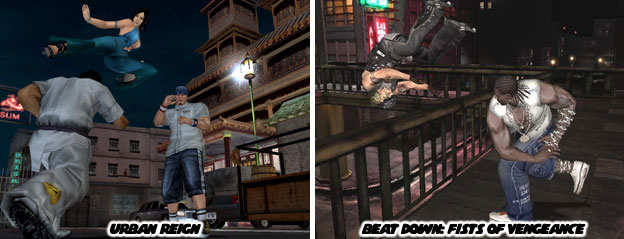
In 2005 games were becoming dark and brooding, they were following the trends from other studios as well as from cinema. The bright colors and over-the-top designs from brawlers in the early 90's seemed passé. In order to appeal to players the characters had to be dark and gritty. The universes they were set in also had to be dark and ugly. Hence the new Capcom brawler from that year, Beat Down: Fists of Vengeance, was one of the darker and more violent games they've ever produced.


Beat Down was designed to be an online brawling game, with a customization feature, complex story and various locations characters could visit. It was a brawler with RPG and MMO elements. However it did not capture the gamer's imagination. The characters looked like generic bruisers, an exercise in pop character design for an art college class. Guys and girls wearing leather and sporting tattoos seemed enough to make them tough characters. They lacked the archetypical traits that made the Final Fight cast so memorable. Capcom had rewritten the book on brawlers through the 90's and in the new decade had released a cast that lacked presence in a game that was average at best.


Capcom did not get off on the right foot while rival developer Namco faired slightly better. Urban Reign by Namco was their first 3D brawler and it was a good game. While Capcom was mastering 2D animation in their fighting games through the 90's Namco had been building a franchise in 3D technology. The programming experience that they had developed through the Tekken series was paying off for the publisher. The lessons they learned in arcade development was quickly translated for the Playstation platforms. They were among the first studios to have a version of Tekken available on the original Playstation and Playstation 2. With Urban Reign they saw potential for the Tekken engine beyond the traditional 1-on-1 fighting game. Specifically the Tekken 5 engine worked quite well for a brawling game for the PS2. It worked so well that it was also used in Death by Degrees the action game released the same year featuring Nina Williams, also from the Tekken fame.


Urban Reign featured a cast of distinct archetypes including a karate fighter, a street brawler and a female martial arts master. Visually they had greater diversity than the cast in Beat Down. The game was dark and gritty as well, but not as depressing as the world from Beat Down. From a gameplay POV the camera system drew far enough away for players to keep an eye on opponents as well as teammates and did not suffer from the blind spot problems from SpikeOut. The moves and control worked well within the 3D environments Players could set up special attacks and even perform double team attacks on multiple as well as single opponents with relative ease. Some of the double team attacks were spectacular, like the high risk moves from pro wrestling. Those familiar with the Tekken series could see where moves and animations were placed on the new models.


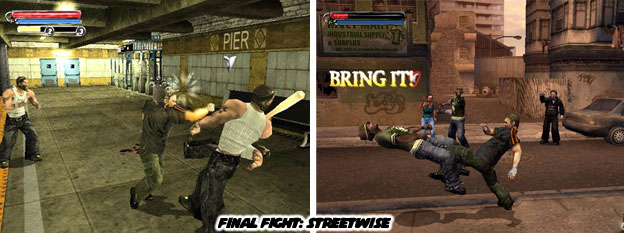
The game had a bonus feature in that any defeated character, including bosses, could be unlocked and played as in a fighting game format. Tekken characters were hidden in the game and could be unlocked for the fighting game portion as well. As well as it was done it faired only slightly better with gamers than Beat Down. The 3D brawling genre just could not gain momentum in arcades or home consoles. What Capcom did next would harm their reputation more than help it. Final Fight: Streetwise was a sequel to the arcade classic. It was the antithesis of everything that made the original brawler legendary. It was dark, ugly, slow, cumbersome and brooding. The controls lacked the simplicity and finesse of the original title, making it less accessible to gamers. Capcom's Production Studio 8, a US-based developer released the abysmal title in 2006, just a year after Beat Down failed to impress audiences.


The designs featured in the title were another exercise in character interpretation, possibly from some art college graduates not old enough to remember the original title. The new versions of the characters were as dark as the premise. A washed-up Cody was reunited with his (surprise!) brother to try and clean up the streets of Metro City from a new drug. The game was bad on all fronts and the attempts to make it visceral and adult just hurt the reputation of the arcade classic. Characters and situations like the infamous Weasel scene did nothing to help the genre or make it relevant to gamers. It was ugly, sloppy and classless design from the former masters of the genre. Thankfully Capcom would stop trying to reboot franchises and instead focus on releasing their actual brawling classics on the Playstation Network and Xbox Live Arcade in latter years.

There was one western studio that did manage to get the genre right, and also give players a compelling 3D experience without the problems suffered by previous brawlers. Rockstar released The Warriors in 2005. The game was based on the 1979 movie about a small gang trying to get past rival gangs through New York en route to their home turf on Coney Island. Rockstar managed to capture the spirit of the movie by recreating the details in the film and then expanded that universe through careful, period piece, interpretations. The game featured a more open ended sandbox-style gameplay than other brawlers. A modified version of the Grand Theft Auto III engine served as the backbone. There were no invisible walls, or camera problems that plagued earlier 3D fighting attempts. A brawler without a countdown clock, or facing nonsensical gigantic level bosses was a refreshing change of pace for gamers. The gang warfare highlighted in the Warriors brought back the energy and emotions that classic brawlers once pulled from gamers. It could appeal to fans of the GTA series without including all of the vehicle and mission hijinks featured in that game. Rockstar redefined the genre by ignoring convention and earned the praise of gamers and critics alike.


Five years later Rockstar released an Xbox Live Arcade version of the game that limited all of the play elements to the traditional format. The Warriors Street Brawl from 2010 used a fixed, side-scrolling camera, with 3D characters. The game did introduce a "store" to the genre where players could buy weapons and upgrades for their characters, but it failed to win over new fans. Street Brawl lacked the substance of the previous sandbox experience and if anything highlighted the deficiencies of the classic format with modern visuals. Without Sega, Capcom or Konami developing new brawlers after 2006 the genre would only be kept alive by independent studios. Many experiences faded away but at least one became an example of what still worked in the genre. Find out about the first major attempt at a brawling MMO as well as the little title that became a smash hit in the next blog. As always if you enjoyed this blog and would like to sponsor me please visit my Patreon page and consider donating each month, even as little as $1 would help make better blogs and even podcasts!

 follow the Street Writer on Patreon!

Friday, July 25, 2014

The Racing Tangent, part 1...

The West had not been sitting idly by letting the Japanese developers create all of the great racing experiences. Atari and Kee Games had been putting the first racing titles into arcades in the '70s. Of course Atari and Midway went on to publish and distribute some of the early Namco hits in the USA through the '80s. Atari though never stopped developing its own memorable titles. The single-screen Super Sprint series, which began in 1986, was one of the oldest arcade releases that had been adapted from black and white to color. It featured up to three human drivers and one computer-controlled car competing on a challenging and tight course. Players were rewarded for picking up wrenches on the race track, which they could use to upgrade the performance of their car in between races. It was one of the first games to offer that feature. Although it lacked the third person camera of Pole Position it was nonetheless a beloved series. The game was ported to multiple consoles and computers and got a follow up upgrade package for arcade owners. The company knew that sprite-based titles were on the way out and by the end of the decade they had released their first 3D title. Hard Drivin' from 1989 was an interesting hybrid of simulator and arcade racer. It was one of the first game to feature a clutch and even a key ignition. Players actually had to start their car before they could start playing and the car could even stall during the course. In Hard Drivin' players chose which path they wanted to drive on, either a road course or a stunt track with a full 360˚ loop. On the way players had to avoid oncoming cars and traffic. The game had very stiff force feedback steering and was one of the most authentic driving experiences ever created.


The studio followed up with Race Drivin' in 1990. The game had dramatically improved in the graphics department and the "Super Stunt Track" was a challenging course that few people could claim to have beaten. I practiced that course for a long while and could complete it and the follow-up race against the computer controlled rival "Helen Wheels." The game was completely unlike any of the Japanese-developed titles and that uniqueness drew me to it.. The company had a certifiable hit in the middle of the decade with San Francisco Rush in 1996. The game was ported to multiple consoles and was one of the first real 3D games to make the transition from arcade to home console. Its sequel Rush the Rock in 1997 was an even bigger hit. Proving that the US was in the running for memorable racing experiences. There was a trend that was developing from the West when it came to driving game. Developers did go through different racing genres and experiences, from sim to arcade. However the West seemed to infuse more action into their racers than the Japanese. It was as if decades of action movies and high speed pursuits and shootouts on TV shows had permanently changed the tastes of Western audiences. Going as far back as the Exidy game from 1976 named Death Race where players had to run over zombies in a graveyard. Of course I'm not a social studies major so it's just a random observation. Whatever the case studios in the US and the UK seemed to enjoy a bit more violence and action in their driving experiences. 

The original Playstation game Twisted Metal, released in 1995, pretty much set the bar for the vehicle combat sub-genre. There were vehicle combat games that came before and after and I might talk about those titles in some future blog. I want to focus on the non-weaponized racing experiences. There was another car-based hit from 1995 that was also on the Playstation. Destruction Derby was developed by Reflections and published by Psygnosis. The game was notable because it featured 3D cars that took damage and responded accordingly during the game. Too much damage to the body, frame or engine could result in overheating and slower performance. Of course too much damage would result in a complete breakdown. The game featured some spectacular crashes framed by a loud alternative rock soundtrack. By comparison the Japanese racing games featured pristine cars that no matter how much they slammed into each other or the course would take no damage. That school of design didn't change until Sega released Daytona USA in 1994. The stock cars would rarely finish a race intact. Fenders would be torn off, the door and trunk would be flapping in the wind. It was as if they were giving the West exactly the type of brutal racing that they wanted.


Reflections would go on to create the Driver and Stuntman series. Their work in 3D vehicle handling and damage was groundbreaking. In Stuntman audiences drove an entire host of vehicles that all responded accordingly. Cars could actually be tossed end over end and flipped upside down based on the severity of a crash. In many 3D games, especially those from Japan, it was all but impossible to turn cars over. To many developers an overturned car killed the game playing experience. These things may seem inconsequential today but were important for the evolution of the racing combat genre. Reflections may not be an important name to most audiences but they had predated the frenetic car chase physics in the Grand Theft Auto series by Rockstar / Take Two. The contribution by Reflections to the genre and the rise in high speed action racing wouldn't develop for another decade. Realism rather than reality helped make the impossible seem plausible in 3D games. Cars could take tremendous damage and keep on rolling. Audiences would actually turn out to see the carnage in these fictional worlds. The developer Stainless Software would release the cult PC/Mac hit Carmageddon in 1997. That game took everything that made Destruction Derby fun and threw in violence and gore by the bucketful. Carmageddon was set in a dystopian future, like Twisted Metal, where a tournament was held allowing race cars to earn points for killing other drivers as well as pedestrians. The cars were heavily armored but also very powerful. They could survive a fall off of a skyscraper and keep on running. If the players managed to land on a human or wipe out an entire row of them in the process they would earn "Style Points."


The content was so controversial that it was one of the games cited by the US Congress as the reason why video games needed to be censored. The gaming industry fought tooth and nail and developed a movie industry-like ratings system. Carmageddon went on to get a sequel which improved greatly in the 3D modeling arena. Drivers could smash through windows and their cars could fall apart and even split in half depending on how hard they crashed. Stainless lost the rights to publisher SCi. The following Carmageddon games were terrible and the series was pretty much over in the eyes of long-time fans. Almost 15 years later Stainless regained the rights and used Kickstarter to relaunch the franchise. This was celebrated in the community and considered a dark day for concerned parents everywhere. Aside from violence there was something else that the West looked for in videogames that wasn't exactly in tune with Japanese developers. The next blog will look at the shift in graphics once the world of gaming moved to 3D. If you would like to sponsor me please visit my Patreon page and consider donating each month, even as little as $1 would help make better blogs and even podcasts!
follow the Street Writer on Patreon!