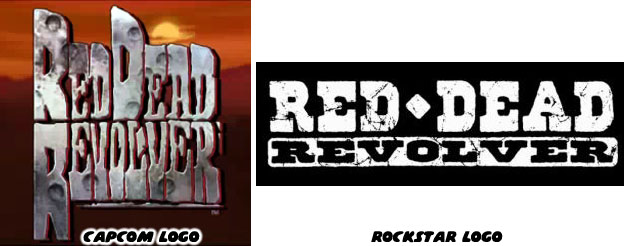
Friends, today we are going to take a look at a game that was and almost was. The title in question was one of my favorites, Red Dead Revolver. It was one of the games highlighted in one of my most popular blogs ever, the Great Western Shootout. It was also one of the titles featured on my Abridged History of the Brawler. I was following this game when Capcom had announced it back in 2002 and had kept tabs on it even when Rockstar San Diego took over duties and published it a few years later. Rockstar’s version was slightly different than the original design but it was great nonetheless. When a sequel was finally announced I held out hope that many of the characters and elements featured in the original might be preserved.
Red Dead Revolver was a rarity among high profile titles. That was because a large volume of material was documented during the development process and shared with media outlets. These included screenshots and video of pre-beta footage. Some of the ideas were interesting and others were laughable. The Japanese certainly had a unique take on the western mythos. Take a look at the oldest trailer from Capcom of Japan, circa 2002.
There were distinct visual elements that they were pursuing in the game. It was set to be an over-the-top western adventure. There was tremendous change to the layout, interface and heads-up display (HUD) from year to year. Capcom's next trailer from 2003 showed tremendous progress from year-to-year.
Not long after their E3 showing in 2003 Rockstar took over development of the game and would publish it in the USA while Capcom retained the rights to publish it in Japan. Here was Rockstar's first trailer from around 2004. It was obvious that the tone and feel of the game had changed considerably.
The second trailer that Rockstar released introduced the rest of the cast featured in the game. This was the first time that players got a chance to see characters other than Red Harlow running the main portions of the game.
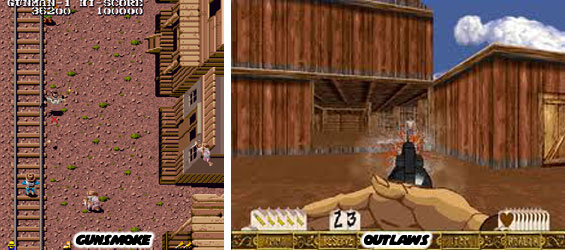
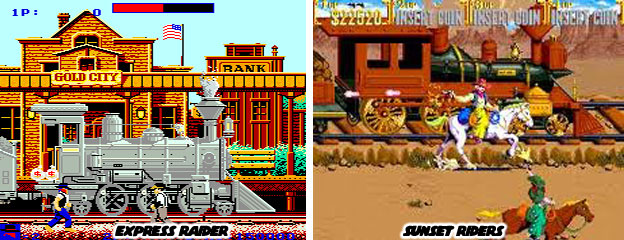
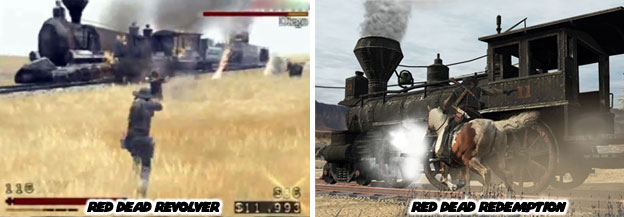
In 2010 Rockstar would release a spiritual successor to the game. Red Dead Redemption had nothing in common with the original title, including locations or characters. That was until the expansion pack “Legends and Killers” was released. Fans of the original RDR could now play as some of the most iconic characters in multiplayer mode.
There was something that had always been a pet peeve of mine. Capcom had created a large number of assets that were not used in the final game. Perhaps it was for budgetary reasons or deadline issues but many assets were complete during the development of the title just never incorporated. Some of the changes made to the locations were necessary but the missing items could have shaped a better experience.
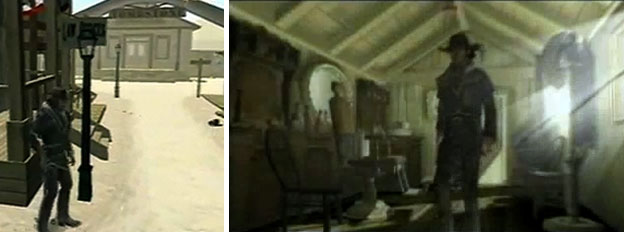
Before it was Brimstone that Red visited in between levels the town was named Tombstone. Perhaps Rockstar changed the name so that players would not think that this was set in any historical town. Other things, like the interior of the barber shop were complete in the Capcom build of the game. In the final release the barber shop was there but when players tried to access it a sign said it was closed. The items that players could buy to unlock levels or weapon upgrades from the barber shop were instead placed in different shops. Perhaps Rockstar did not want to hire another voice actor to play the role of the barber so they just closed a small part of Brimstone down.
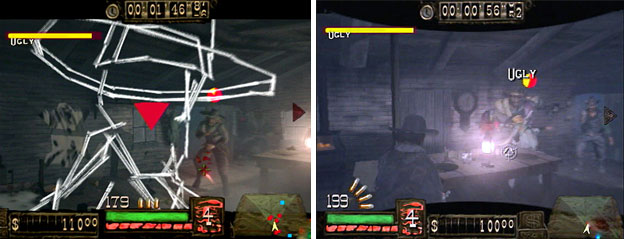
In another early build of the game the interior of the Harlow homestead was a playable level. It was fully decorated and the environment was entirely destructible. Players could shoot down pots and pans, break the glass on windows and even shoot holes through the walls. Moreover since the inside of the house was a confined space the camera might be blocked if the player backed into a wall. Capcom had solved this by outlining Red in a sort of see-through chalk form. This house and several other assets featured in the prototype builds did make it into the game but a shadow of their former selves. In RDR’s multiplayer mode the house sits empty and the figure is never outlined when backed into a wall.
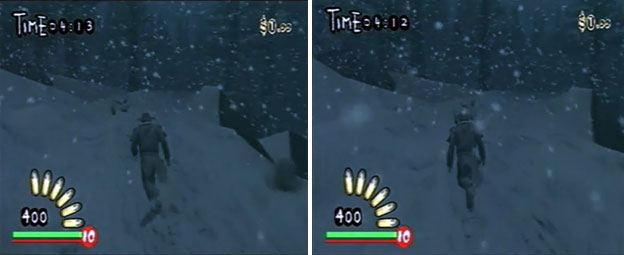
Based on the Capcom version of the game it would have been possible to visit the homestead at least two other times in the game. One of the more cinematic sequences featured a level, not far from Bear Mountain, at night and during a snowstorm. The house in the level was on fire, presumably a family was being attacked by outlaws and Red had to save them. This stage appeared amazing in concept. A version of this asset did make it into the final release as a multiplayer level. However this stage lacked any connection to the game or any dramatic tension. The ground was covered in snow but it never snowed in the actual game. There was a burned out remains of a cabin that players could use for cover but no hint as to what had happened on the mountain. It was a wasted opportunity for Rockstar to add more dramatic staging into the final build.
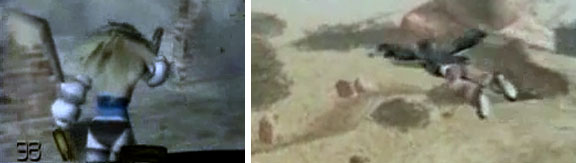
Many characters in the Capcom build of the game were revised or removed. The wild-haired girl in the Capcom prototype was turned into a saloon girl in the Rockstar version. There was a Native American character that had a winged suit and presumably his special ability was that of flight. Every character in the story mode and in multiplayer had a special attack. Some had special weapons they could activate or extended “Dead Eye” (bullet time) mode but the ability of flight would have been extraordinary. As amazing as the move was it would have fit into canon as there were characters that could teleport, spit fire and poison as well as do other supernatural things.
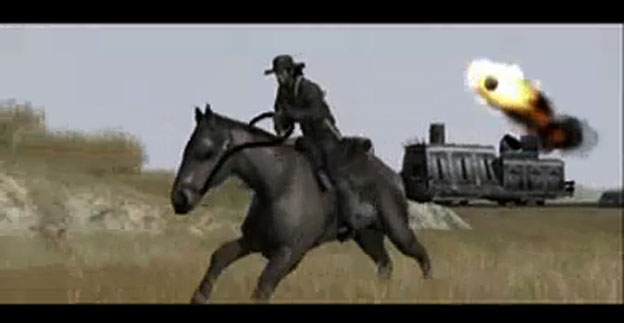
The final build of Red Dead Revolver earned a cult following because it preserved a large number of over-the-top elements, scenes and characters. The villain Colonel Darren had his arm shot off by the powerful Scorpion Revolver, the arm was replaced by a shoulder mounted cannon. General Diego travelled between Mexico and the US on a private armored train loaded with soldiers and artillery. These characters and scenes were far more fantastic than those in recent western films. Games like Red Dead Redemption and Gun tried to present the west with a realistic, dark and gritty atmosphere while the original RDR was more like the classic “Spaghetti Westerns” of Sergio Leone. In fact the soundtrack for the original RDR was based on music from multiple spaghetti westerns including Django, One Silver Dollar and A sky full of stars for a roof.
Fans of the series were left wondering how the game would have turned out if Capcom had finished the developing it, not to mention how they would have approached a sequel. The main characters, levels and assets used by Rockstar were designed and created by Capcom after all. The early success of the game was owed to Capcom as much as it was to Rockstar. In the early 2000’s Capcom wasn’t afraid to develop new IP. Devil May Cry, Crimson Tears, Shadow of Rome, Maximo and Viewtiful Joe were highly original titles that would have been considered a contemporary to RDR. After almost a decade after the original RDR was released people were still talking about it. Wikipedia and a few random gaming forums had perpetuated some myths about the franchise that should be addressed. In all my time searching for data and assets on the beta build I had never seen where Capcom was allegedly going to put zombies in the game. I was at the E3 back in 2002 and 2003 and saw nothing of the sort in the Capcom footage. Until somebody could show proof of zombies in a western game other than Red Dead Redemption or Darkwatch then this would remain nothing more than an urban legend.
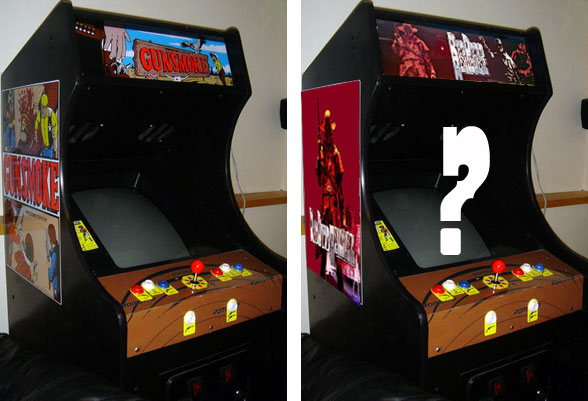
Now something did turn up online recently that would add a whole new chapter to the game that might have been. A few weeks back I was searching eBay for rare gaming items and I came across an arcade marquee. I don’t have many original arcade items, save for an occasional poster or flyer. I never imagined that I would be adding anything new to my collection. That was until somebody put a Red Dead Revolver marquee up for bid.
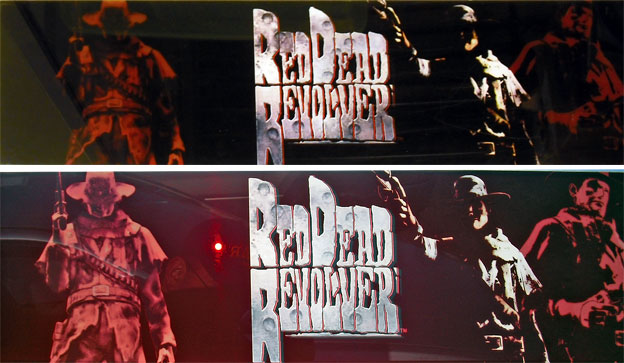
The characters and logo featured on the marquee were pre-Rockstar. I could tell right away because I had collected assets from the Capcom of Japan site and designer Akiman’s blog before Rockstar took over production. The figure of Red on the left side was from Akiman’s painting of the character while the CGI models pictured on the right were some of his very first 3D renderings also by Capcom. I put in a bid and won the marquee for a song.
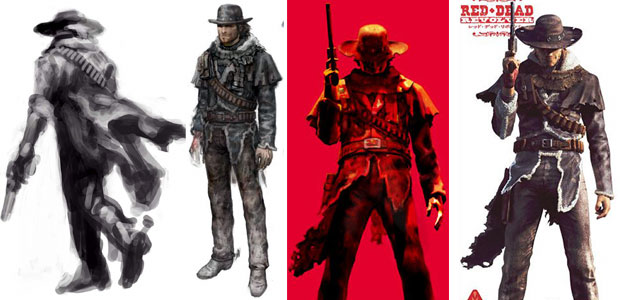
The marquee gave me more questions than answers unfortunately. The printing on the marquee was top-notch, it made me believe that the assets came from Capcom themselves. The resolution used for the Akiman painting and original RDR logo was much higher than any asset I’d ever seen from a media outlet. I could see details in the marquee that weren’t as sharp as they were from Capcom’s own site. However nowhere on the marquee was Capcom’s logo listed. The RDR logo did sport a trademark sign but it would be curious that the developer was not credited. I was left wondering who created the marquee and what it was for. To the best of my knowledge Capcom did not intend RDR to be an arcade title. They haven't said anything on the Capcom-Unity site about this find. Perhaps in the earliest planning stages RDR might have been a multiplayer arcade title or a successor to their classic Gunsmoke game? Romstar published Gunsmoke for the US back in 1985, perhaps Rockstar was going to be a spiritual successor? Or perhaps Capcom was considering mocking up an arcade cabinet to show at the E3 in 2002 and then changed their minds and told the manufacturer to destroy it.
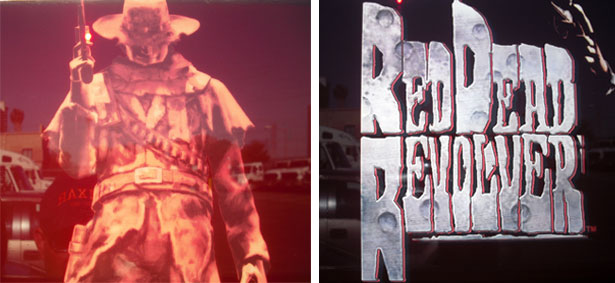
The thick acrylic sign was flawless. It was too well made to be a fan project and if it was a fan project from a US person then it should have used the US lettering and character art. If this was from a Japanese person then how did it end up in the US? I asked the seller on eBay what he could tell me about the sign. He said he had picked it up along with a bunch of other marquees from an arcade estate sale. Every other marquee he had was from a published arcade game. This was the only RDR marquee in the bunch. That’s all he knew about it. He could not offer a manufacturer or point of origin which was bad news for me but good news for my collection. The gem of my RDR set was previously a huge standee that I got from eBay as well.
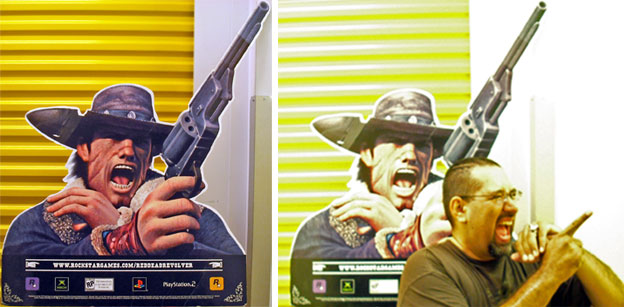
There were other things that I’d like to add to my collection. Like the cool swag that Capcom of Japan gave to pre-orders. A leather keychain with the scorpion logo and a red bandana with a scorpion logo were some of the things they gave out. If any readers have a lead on the items then I’m listening. FYI in canon Red Harlow tied a red bandana around his hand to cover the scorpion logo burned into his palm. He got the scar as a young man after pulling his father’s revolver from a fire and shooting off the arm of Colonel Darren. This was yet another thing that made Red cooler than just about every other western videogame protagonist ever created. One of these days I’d like to unlock all of the assets on the disk and put together a comprehensive version of RDR just for my own amusement. Until that day take care and let me know if there were any videogame mysteries you wish had an answer to or share a special piece from your gaming collection and tell us about it.