Showing posts with label crossover. Show all posts

Monday, February 12, 2024

The Street Fighter X Tekken Event Coverage! - A 1UP classic from March 2, 2012

Happy Friday amigos! I hope you have a great weekend planned. On my side I have a long day of work and orchestra rehearsal scheduled for tonight. Our first concert of the season is this Sunday. I'll see about getting some footage for you hopefully in the week ahead. I'd like to talk about the Street Fighter X Tekken event that went down in Los Angeles last night.

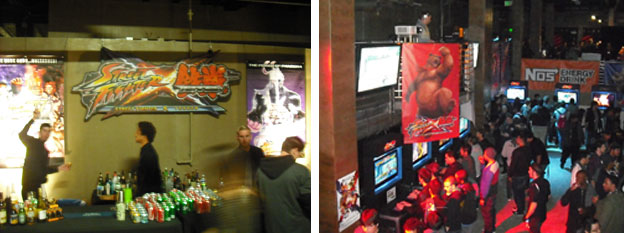
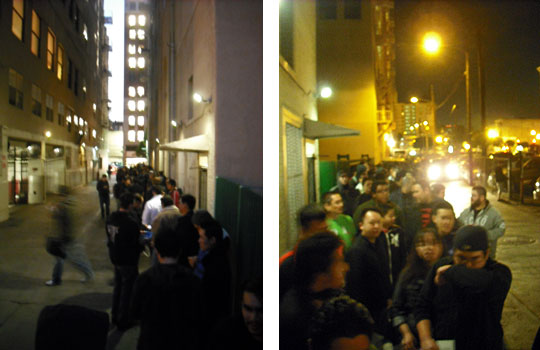
As with other Capcom release parties this one had a queue almost a block long at least two hours before the doors opened! If you ever think about going to a release party then make sure to get there early. I was fortunate because work was not too far from there and I could drive down and get in line relatively early. The people at Capcom were trying things slightly different and made sure that people understood it was 21 and over only. They, and the hosts at Majestic Halls did not want any trouble with minors crashing a party that was serving alcohol so they were going through the RSVP list and checking state issued ID's very carefully.

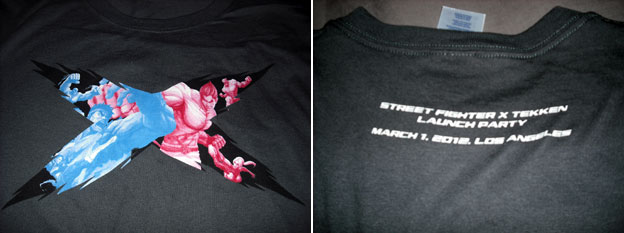
Once inside the building guests received a complimentary tee shirt. This shirt will undoubtedly be fetching a pretty penny on eBay very soon. Sorry but even though the shirt was too small for me does not mean I will be selling it.

Capcom has gotten quite experienced at hosting release parties. Every SF IV release, Marvel VS Capcom 3, Resident Evil and various Comic Cons would testify that they are a very community-oriented company. They had multiple cabinets set up for players to check out the final version of SF X TK. Plus they had free drinks, and a live DJ spinning at the show.

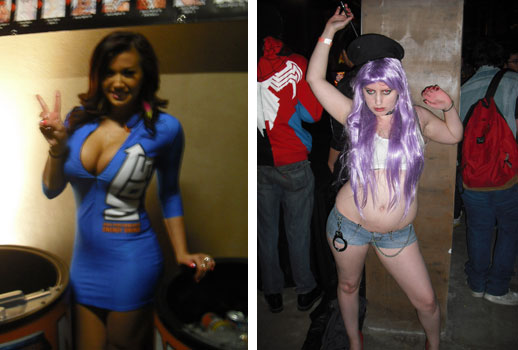
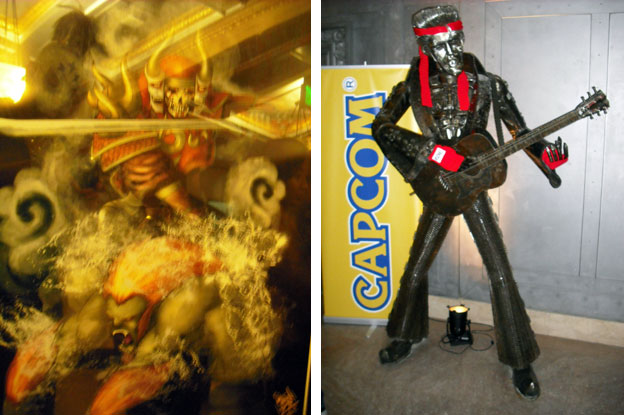
Attendees and sponsors were dressed up for the event.

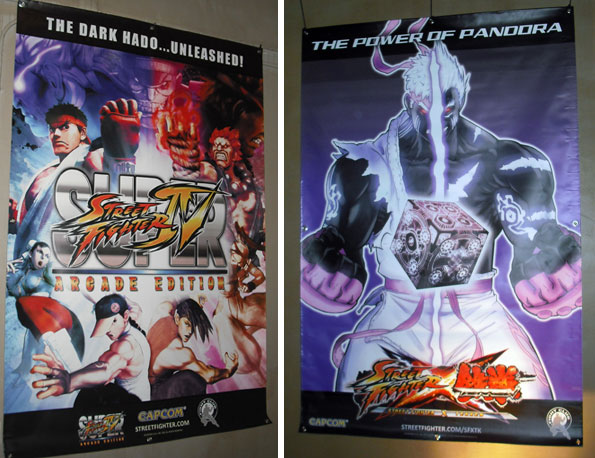
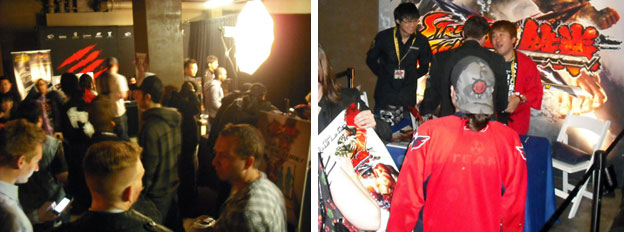
Capcom spared no expense posting gigantic banners and making guests feel welcome. Goodies were given away at the event and Producer Yoshinori Ono was signing posters for attendees.

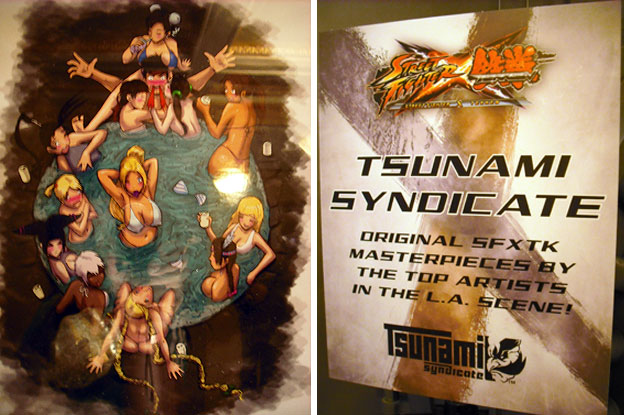
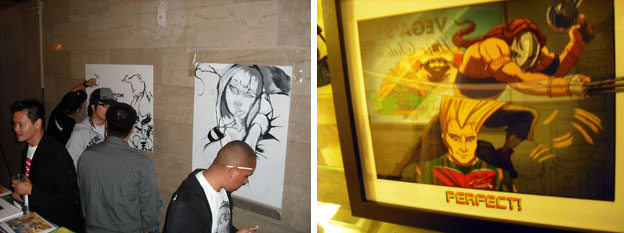
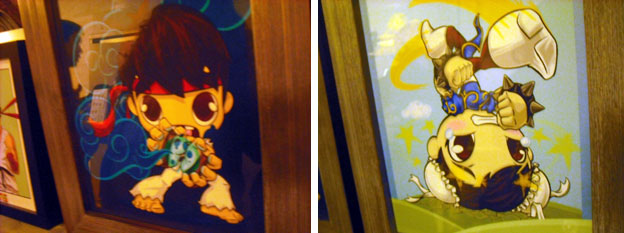
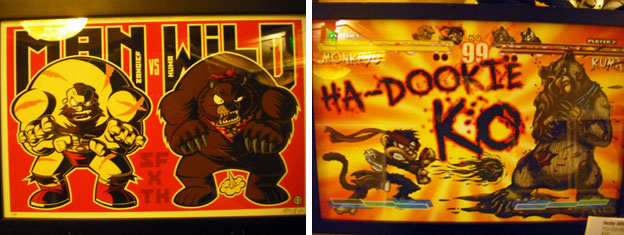
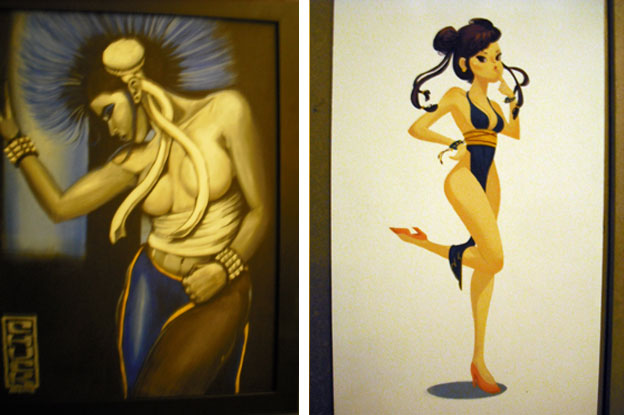
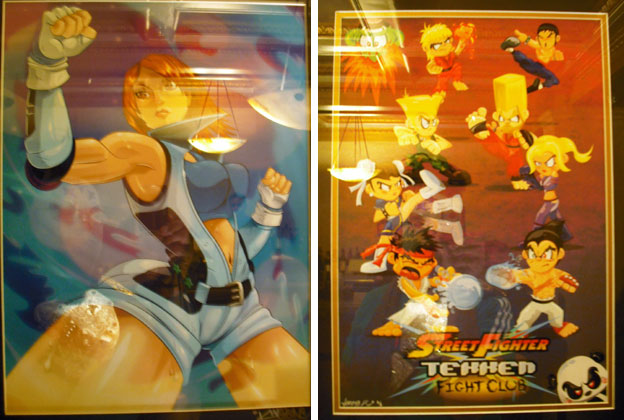
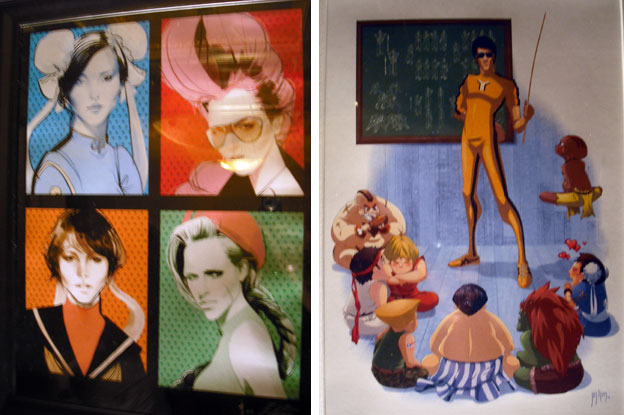
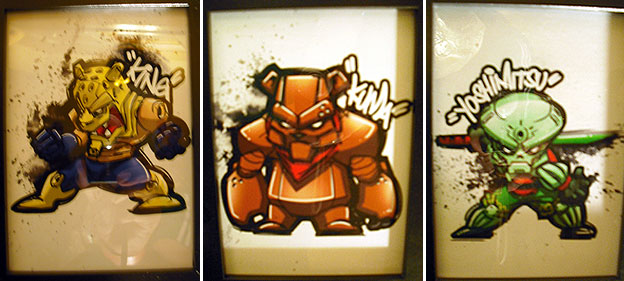
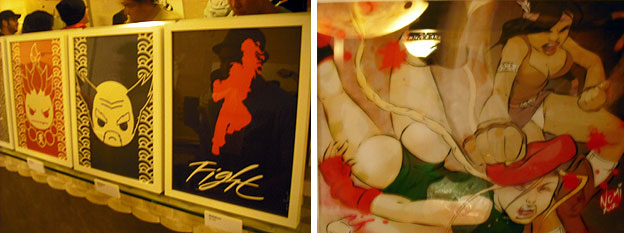
The coolest thing at the event was the art show presented by the Tsunami Syndicate. It was a collection of local artists putting forward original pieces and prints for sale of the SF and TK characters.

I would like to say thanks to Capcom, as always, for showing the community much love. They demonstrate time and time again how a publisher should reach out to the fanbase and make them feel like a part each and every release. The studio supports the local and national fighting tournament scenes, even when their games have to share the spotlight with other titles.There aren't many publishers that can claim to do the same thing. Cacpom, unlike several publishers that save their showings to the GDC or E3 make sure to appear at public events including PAX and the Comic Con.

Keeping tabs on community members on forums and sites outside of Capcom-Unity and Facebook makes the company seem more invested in the community than just about any other publisher. This type of reaching out will continue to earn the respect and admiration of the fans. Although I am not a fond of Mr. Ono's direction with the fighting titles I still wish the studio the best. Be sure to check out SF X TK this weekend and let me know what you think.

As always if you would like to sponsor me please visit my Patreon page and consider donating each month, even as little as $1 would help make better blogs and even podcasts!
follow the Street Writer on Patreon!

Friday, October 20, 2023

The Martial Myths; Capcom and SNK in manhua. A 1UP classic from Apr 4, 2012

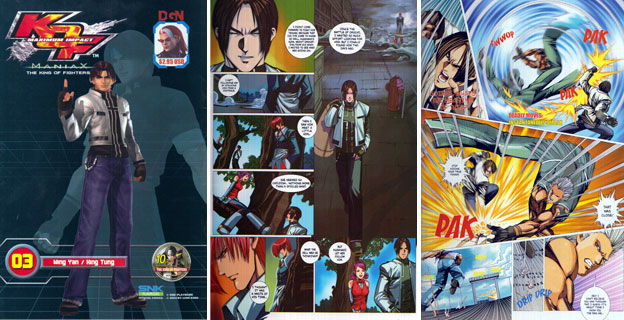
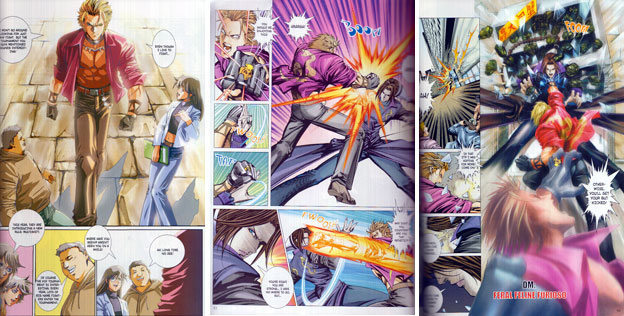
The oldest fighting game comics had been coming from Hong Kong. Many of the popular ones featuring Street Fighter or the King of Fighters series were available on this Chinese Manhua site. English adaptations of these books were rare. DrMaster Publishing (DGN) had the license and translated a number of Chinese and Korean manhua titles along with a few Japanese manga titles in the mid 2000's. However the company stopped distributing comics and seemed to simply vanish. Perhaps they were too ambitious with their titles and forgot to pay their bills? Some of the titles that they did bring over were the licensed fighting game comics from Hong Kong. Those that are interested in learning more about this style of comics should check out the following books.

The studio released an eight-part adaptation of the King of Fighters Maximum Impact series by Wing Yan and King Tung. This was based on the 3D KOF titles that SNK had developed. The game was somewhat popular and managed to get a sequel however fans were glad that the company returned to their 2D roots on subsequent releases. The manhua was notable for several reasons. Unlike the older Jade comics published in the USA these new books used high quality paper with digital colors, making them look every bit as good as US or Japanese comics.

DGN also published a series based on the King of Fighters 2003, also by Wing Yan and King Tung. The series was notable because it mixed the art styles. Some of the pages were colored in a Japanese animé style, with bright highlights and light filters. Other pages looked more like traditional manhua with thin inked lines denoting shadows and shapes instead of the thick inking of US comics. Other pages were digitally painted to make them completely unlike any other title.

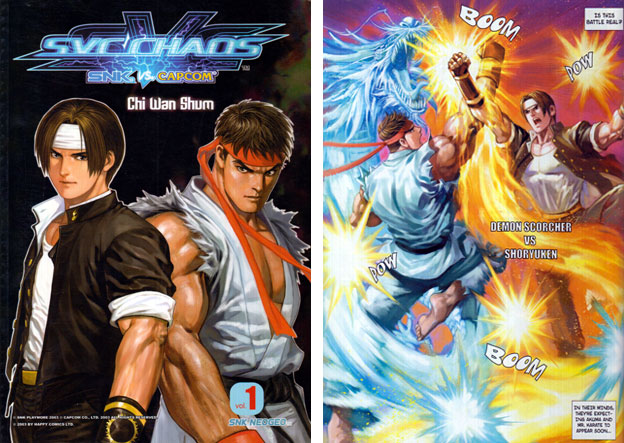
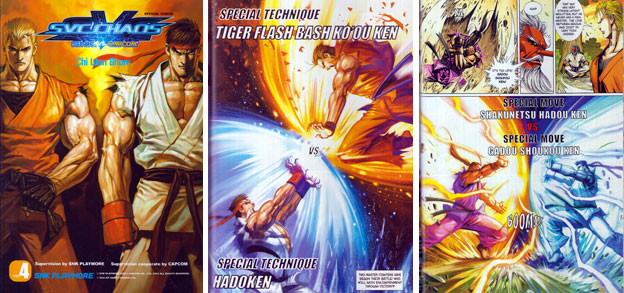
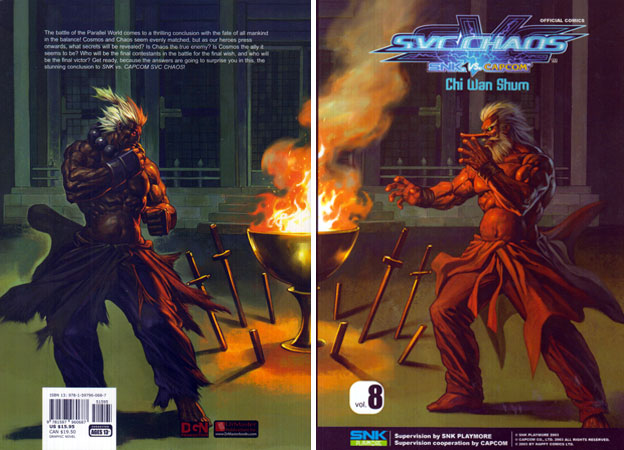
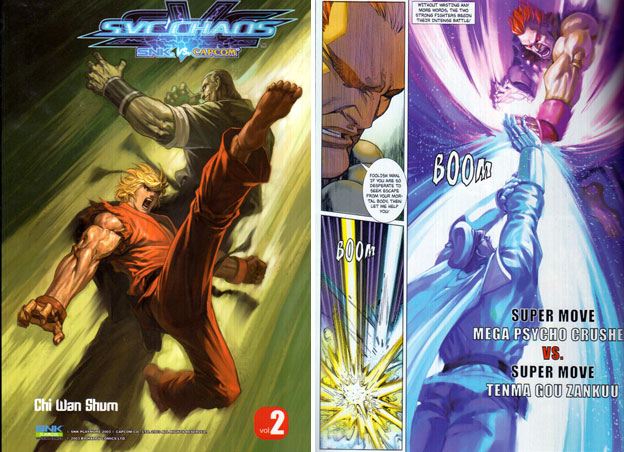
Street Fighter VS SNK Chaos (SVC Chaos) by Chi Wan Shum was highlighted earlier in this blog series for the number of panels swiped by the artist from other books. The title was actually a decently written attempt at bringing two completely different styles of game and character designs to readers in a convincing battle royale. This would not have been possible with some great interplay between series favorites and some fantastic painted panels by Wan Shum.

The premise for the book was a standard good versus evil in a fight to the death. Characters from Capcom and SNK universes were pulled into battle by some enigmatic young deities. The characters were scattered around a fictional city and forced to fight. It was a way for SNK to reinforce that Kyo Kusanagi was the poster boy for their fighting franchise rather than the older character Terry Bogard, who was co-developed by Street Fighter creator Takashi Nishiyama BTW. By comparison Ryu would retain his status as the most powerful fighter in the Street Fighter universe.

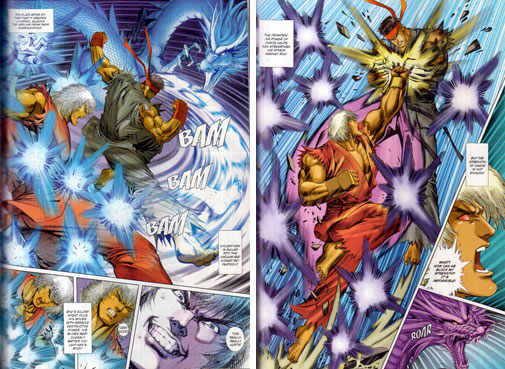
The manhua featured many different encounters between characters. In some cases there were variations of the main characters doing battle, like Evil Ryu versus Violent Ken. The series dealt with a great number of match-ups that only a true fan of both universes could have presented.

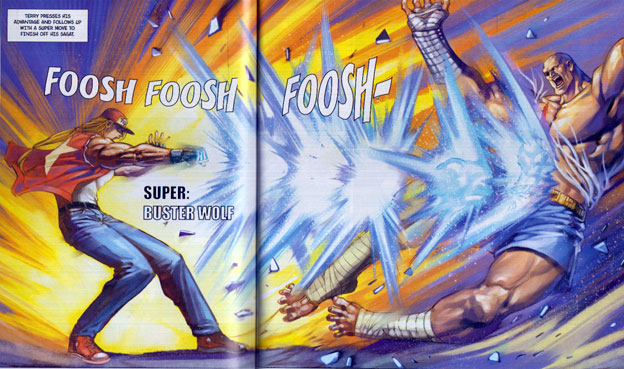
Terry versus Sagat? It was unlikely that an encounter in US comics due to licensing restrictions however the agreement that both SNK and Capcom had agreed with in Hong Kong must have been less costly to publishers.

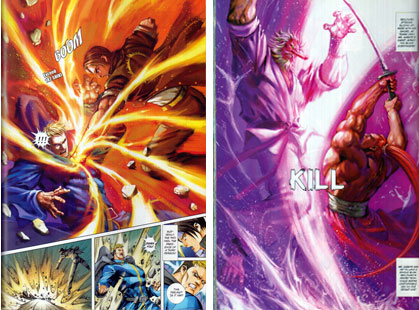
The series had some eye-catching painted panels.

The main villains in the series were Gouki and Mr. Karate, the respective fighting bosses of both universes.

The series was not all Capcom vs Capcom battles though. The SNK encounters were equally memorable. Chi Wan Shum tried to cram in every possible fanboy battle into the series. How about Ken versus Geese Howard, or Gouki vs Vega? Who were the most powerful fighters after all?

Fighting game collectors owe it to themselves to track down these books and see how the manhua differs from other comic formats. The ways in which manhua predated the Street Fighter myth was almost eerie. This relationship will be explored in the next entry. As always if you would like to sponsor me please visit my Patreon page and consider donating each month, even as little as $1 would help make better blogs and even podcasts!

follow the Street Writer on Patreon!

Monday, January 28, 2019

The Marvel Contest of Champions Legacy. part 3...


When fighting game fans think of Marvel fighting games they often go to the long-running series by Capcom. The first game in the series, X-Men vs Street Fighter debuted in 1996 and the most recent Marvel vs Capcom: Infinite debuted in 2017. Before the crossover titles Capcom had developed two unique fighting games that focused on a particular Marvel license. X-Men: Children of the Atom, a fighting game featuring heroes and villains from the X-Men comics debuted in 1995. That same year the studio also released Marvel Super Heroes, a fighting game inspired by the events in the Infinity War. The games featured highly stylized designs, high speed game play, brilliant animations, and a unique combo system. The Marvel Super Heroes title in particular allowed players to earn and use various Infinity Gems to give them a temporary power boost or special ability against their opponents. Of course at the end of the game Thanos would steal all six of the gems and use them against the player in true final boss fashion.


Marvel Contest of Champions (MCC) differed from the classic arcade fighters in a number of ways. In traditional arcade fighting games the battles only lasted a few seconds. Some of the more difficult battles in MCC could take several minutes to complete. Then there was the scale and scope of MCC. This was not just a game with one inevitable outcome. The Marvel multiverse and its inhabitants all depended on the player, known as the Summoner in the story. There were dozens of characters to unlock and play as, pulled from different realities. The game was also not a linear fighting game where you fought through a few characters, and wrapped up the story. There were tons of main quests and side quests to explore, each with their own special rules, and rewards. Players could earn experience for their champions, along with all sorts of collectible goods by "grinding" through the various missions. Players had to learn what items they should use to boost their characters stats and abilities before an encounter. This all added an additional level of strategy to each match. It was more like a fighting game-meets rpg-meets dungeon crawler.


A touch screen limited how complex most mobile games could really be, MCC was no exception to this rule. Most traditional fighting games used a six button layout, usually with a joystick or pad for directional inputs. The complex moves, and split-second timing from the Capcom games would be all but impossible to perform on a touch screen. Kabam simplified this, and inputs to simple taps. This didn't mean the game was simplistic. It still required learning the timing, and strategies for hundreds of potential encounters. Players had to learn when to activate certain counters, special attacks, and combinations. Otherwise they left themselves wide open to a counter attack. Players learned that certain characters worked well against one of the six classes; Cosmic, Mutant, Mystic, Skill, Science, and Tech. So just because you have a character with awesome powers, like Quake from Marvel's Agents of S.H.I.E.L.D, she didn't have the fighting prowess of Daredevil. In this way audiences learned to experiment and see which teams worked best for their style, and ability.


Best of all MCC draws equal parts from classic Marvel comics, and Marvel cinema. Both long time comic book fans and people new to the stories could be dropped right into the experience without missing a beat. In the Original Contest of Champions comic book the Grandmaster had organized the contest whereas in the Secret Wars it was the Beyonder. In the MCC the Collector was acting as the host of the tournament. The MCC took place in what was known as the Battlerealm. It was a nexus of different dimensions, and timelines that the Elders of the Universe had been shaping for their own entertainment. The idea of a dedicated arena was pulled from Secret Wars II in 1985. During that story Dr. Doom had temporarily gained the powers of the Beyonder. He hosted his tournament in what he called the Battleworld. The various locations released thus far in MCC did call out to specific locations that had been featured in over 40 years of Marvel comics. To help clarify the stakes and explain the new organizers Marvel released a 10-issue series titled Marvel Contest of Champions in 2015.


So how did Kabam hook new audiences without losing the veteran gamers? How did they strike a balance between easing players to a new game while still keeping it challenging. Of course the big question was how did they raise the stakes over any previous comic timeline? People that were just getting into fighting games, or mobile fighting games were probably familiar with the Avengers movies. Over the past 10 years Marvel had been building a cinematic empire that connected the various properties together. Almost every person today, young and old recognized Iron Man, Captain America, Black Widow, Hawkeye, and the Incredible Hulk thanks to these movies. They also knew the X-Men, and Spider-Man thanks to the films from other studios. What Kabam did was combine the live action licenses, including the characters that appeared on television, and placed them alongside their comic book counterparts. They managed to do all of this surprisingly well.


The contest organized by the Collector was simply one step in a much longer and more complex narrative. When Kabam released MCC only a few villains were revealed as organizers. Originally it was the Collector versus Kang the Conqueror, a time-travelling villain. They were battling over the ISO-Sphere, an item that allowed its owner to rewrite reality. This sphere was made up of ISO-8 crystals which champions earned in the game. All of this was explained in the comic. As the MCC series went on it changed organizers to include the Maestro. An evil version of the Hulk from the far future. In the "Future Imperfect" timeline he either killed or outlived all of the heroes and villains. The MCC also brought in the Grandmaster to act as an organizer. Of course what good was a contest if the Grandmaster could not participate, and show up his brother?


The ISO-Sphere was an all-powerful trophy, but long-time comic book fans were wondering if a different reality-changing item would appear in the series. Specifically one coveted by Thanos. The Infinity Gauntlet did exist in MCC, but not in the same way as the comic books, movies or even previous games had established. It took almost three years for Marvel Contest of Champions extend its version of the story, and the payoff was completely worth it. We shall explore this radical new world in the next blog. As always if you enjoyed this blog and would like to sponsor me please visit my Patreon page and consider donating each month, even as little as $1 would help make better blogs and even podcasts!

 follow the Street Writer on Patreon!

Friday, January 25, 2019

The Marvel Contest of Champions Legacy, part 2...


In the previous blog I talked about how Marvel's Secret Wars was as influential to the development of the Contest of Champions mobile game as any other Marvel story arc. It was not however what I believe to be the most influential crossover event in '80s comic book history. That title would belong to DC comics. Writer Marv Wolfman did not like the different versions of the DC universe characters occupying the same space. Unless you had been following the DC comics for a long time you didn't necessarily know that Superman and Superboy were two different characters occupying two different Earths. You simply assumed that before Clark Kent became Superman he was naturally Superboy. There was actually a long-standing legal battle around who owned the rights to Superboy. To compound things there were different dimensions and different timelines happening where Clark landed on Earth in the '20s or '30s and thus interacted with different historical characters. Superman had been given lots of nonsensical powers through the years, super ventriloquism, super face shifting, super hypnosis, etc. There were also dimensions where there was a super dog (Krypto), a super horse (Comet), and even super cat (Streaky). To try and make sense of it all, de-power Superman and others, and streamline the DC canon Wolfman, artists George Perez, John Byrne, and the editors at DC agreed on an ultimate crossover, the Crisis on Infinite Earths.


What set Crisis apart from every other comic book crossover at the time was the finality of the events. Whatever the outcome it would determine which characters remained in publication, which "Earth" was officially canon and who lived or died. Thus when Barry Allen, the Flash, passed away it was a sacrifice that meant something to an entire generation of readers. His protege' Wally West, the Kid Flash, would have to become the new Flash. Comic books were starting to "grow up" and writers like Wolfman and Alan Moore made sure to write some complex and mature material that forever changed the way comics would be presented. In the Crisis series a villain named the Anti-Monitor was collapsing dimensions in his wake. Each alternate timeline, or dimension was labeled with a number. This is where you might have heard things like Earth-1, Earth-2, Earth-Prime, etc. Imagine that in one Earth it was perpetually World War II, or that in a different Earth the Justice League was made up of criminals. It was a lot for fans to keep track of so DC needed to sort things out. Wolfman was using the gigantic Anti-Monitor as a sledgehammer to shatter each Earth. The fan-favorite characters that survived the onslaught managed to do so by traveling from Earth to Earth and joined all of the heroes for one final stand. If you are relatively new to comic books but have been to a movie theater in the past decade then this might sound like a familiar idea. Marvel had also created their own universe smasher and this one went by the name of Thanos.


The roots of Thanos and how he was worked into the mobile game Marvel Contest of Champions was inspired. In the previous blog I mentioned that the events in Secret Wars and the original Contest of Champions had a hand in shaping the development of the mobile game. But it went much deeper than that. Those comic runs from the early '80s focused mainly on the traditional Marvel heroes and villains, whereas DC had brought forward the idea of a battle royal across different dimensions, or the multiverse. In 2018 Sony Animated Pictures brought audiences the wonderful Spider-Man Into the Spider-verse. It helped introduce the concept of the multiverse to Marvel fans. Long time comic book readers knew that there were different Earths as well. Except they went by a different numbering system than DC. It was something that Alan Moore and Alan Davis made up. They called the traditional Marvel universe Earth-616, the events from other comics took place on other Earths, for example there were many different versions of Spider-Man. In one world we had Peter Parker, in another there was Penny Parker (Earth-14512) or Gwen Stacy (Earth-65).


There was a punk rock Spider-Man, the militant Hobart Brown from Earth-138. He wore sneakers and had spikes on his mask. There was Earth-8311 where all the Marvel heroes were cartoon animals, including the Goose Rider, Captain Americat, the Incredible Hulk Bunny and of course Peter Porker the Spectacular Spider Ham. These characters often appeared in one-shot comics or short run series, never to be seen again. Fans never forgot these characters and neither did the writers and editors at Marvel. They were waiting for just the right story to tell. Many of these alternate realities went into the Spider-Verse comic book run in 2014 and the Spider-Geddon follow up in 2019. The popularity of the original run gave Sony the inspiration to pursue an animated feature. Hopefully you have seen it because it is more than a great comic book film, or a great animated film, but because it is simply was a great film. MMC does feature the Peter Parker, Miles Morales and Gwen Stacy versions of Spider-Man but Marvel went much deeper than that.


There were many other alternate timelines in the Marvel U where heroes were not quite how you remembered them. There was the Fear Itself timeline, a crossover from 2011, where some heroes, and villains were given magical hammers. Similar to Mjolnir, Thor's hammer. Except the hammers possessed the bearer, and caused them to wreak havoc on the Earth. The mastermind behind this was Cul Borson, the evil elder brother of Odin. Then there was the Infinity Wars from 2018. This timeline had all sorts of weird twists. It was the dimension where Steve Rogers became the Soldier Supreme during WWII, and when Tony Stark was actually Tony Odinson. He created the enchanted Iron Hammer armor. These versions did make it into the mobile game Marvel Future Fight by Netmarble Games. Incorporating the idea of multiverse was really where the Contest of Champions shone.


The game from Kabam took cues from the live action films and television shows. Since the game took place during a nebulous period, far outside of whatever was currently happening in any one particular comic book it allowed characters from the past, future, and essentially any dimension to exist at the same time. For a Marvel fan this was the ultimate experience. Fans didn't have to worry about being locked into one canon, one continuity, one version of their beloved heroes and villains.  For example fans of the Hulk could actually take on the roles of at least three different versions of the Green Goliath. There was the classic green Hulk, the grey mob enforcer "Mr. Fixit" persona and even the evil future version known as The Maestro. Kabam had opened the floodgates for what it meant to be compete against other champions. The path that the company took and how they pulled the Marvel continuity into uncharted waters was nothing short of genius. We'll explore the adaptation process in the next blog. As always if you enjoyed this blog and would like to sponsor me please visit my Patreon page and consider donating each month, even as little as $1 would help make better blogs and even podcasts!

 follow the Street Writer on Patreon!

Wednesday, January 23, 2019

The Marvel Contest of Champions Legacy, part 1...


Thanks for hanging in there friends! The first blog of 2019 is to talk about an old fighting game, but not one from Capcom. In fact it's not one from any Japanese studio! This is a mobile game that is celebrating 4 years in business. That means it is a seasoned veteran by mobile standards. I don't talk very much about downloadable games on this site. In fact the last time that I did it was to talk about the Warhammer 40,000 game Freeblade. Without hyperbole I called it one of the best mobile games ever made. Freeblade was a great on rails shooter, but that was giant robots and monsters. The game I'm talking about today is an actual fighting game. Marvel Contest of Champions by Kabam is a fantastic game especially if you are a huge fan of the Marvel universe like me. I decided to write about the game thanks to the recently published book; Marvel Contest of Champions The Art of the Battlerelam by Paul Davies. The large hardcover by Titan Books, is the same publisher that brought us the gorgeous Spider-Man: Into the Spider-Verse: The Art of the Movie by Ramin Zahed. If you are a comic book fan then you owe it to yourself to get both books, like right now, before you even finish reading the rest of this blog.


When the Contest of Champions art book came it out and made me appreciate how far the comic, mobile, and fighting game genre has come in the past few years. I got my first preview of the game years ago in Anaheim during the D23 Convention, which is like the Comic Con for the various Disney properties. I was skeptical that any mobile game would do the Marvel universe justice. Comic book fans had been burned in the past by sloppy adaptations. I kept an eye on the game and as it grew and garnered hundreds of millions of players I learned it was no accident. As I was going through the book it made me realize that we should be celebrating the renaissance of comic book games, films, animated projects, and especially the creators bringing them to life. That's what got me to start writing again.

The game itself borrows a name from a three-run issue series from 1982. In it the series the Elders of the Universe, immortal aliens that specialized in a certain pursuit had a contest of sorts. Well, to be fair the Elders could die if they were gravely injured by another powerful being. In the comic book series the Marvel heroes and villains did battle as part of a cosmic game. En Dwi Gast, the Elder better known as The Grandmaster, challenged Death to a contest so he could win back the life of his brother Taneleer Tivan, the Elder known as the Collector. The two Elders were seen in the Marvel live action features, respectively played by Jeff Goldblum in Thor Ragnarok and Benicio del Toro in the Guardians of the Galaxy. Death accepted the challenge and each side chose warriors to battle. Comic books have always enjoyed a hierarchy of characters that existed beyond the limits of normal humans. These characters rarely popped up on Earth but instead inhabited the cosmos. Some of the most powerful figures could bend reality at will and even destroy entire galaxies if they wanted. Having these characters exist in Marvel canon allowed writers the freedom to do the impossible. They could capture entire rosters of heroes and raise the stakes over a traditional comic book story arc.


Movie fans might not realize it, but crossovers didn't happen as often as they did in the Avengers films. Crossover events used to be rare for big publishers like Marvel and also for rival publisher DC. For the most part the stars of the comic books had their own story arcs, relationships and adventures. They sometimes shared a city like New York. This was the base for Spider-Man, The Fantastic Four, Daredevil, and Dr. Strange. But these heroes didn't always cross paths. They each had to deal with their own problems and clean up their own part of the Big Apple. Often the enemies mirrored the heroes in their own way. The Fantastic Four would sometimes face a team of rivals, like the U-Foes or the Inhumans. Or it would take their combined efforts to stop one super-powered being like Dr. Doom. Daredevil would fight martial arts experts like Bullseye and Elektra, meanwhile Dr. Strange fought mystical opponents like Baron Mordo and Dormammu. The enemies were always at the appropriate level of challenge for the heroes. Despite his amazing abilities Spider-Man would be powerless against magic, but by the same token Dr. Strange would never be able to take a punch in a street fight. Some of the most unique figures in the Marvel universe have rarely appeared outside of the comics. When they did they were usually only recognized by fans of that particular character. For example I was happy to see the gamma-irradiated Leader and Madman in the Incredible Hulk video game. Their looks and abilities were unique but I could understand why some game players had no idea who they were.


The Hulk was famous for getting into fistfights with equally strong opponents but every so often he would sometimes pity his opponents and walk away. In some cases he would figure out their motive and actually outwit them. The relationships between the heroes and villains would change through the years. Even for those as timeless as the Leader or Madman. Like any great storytelling medium it was the growth of the character that kept audiences coming back. Sometimes the monthly issues would be a chance to develop a certain character, to see the world through their unique perspective. The X-Men, a team of mutants with special abilities debuted in 1963. It was a turbulent era in US history. The plight of the mutants in the Marvel universe paralleled the fight for civil rights in the US. While Spider-Man and The Fantastic Four were celebrated in New York, the mutants were feared and despised simply for being born different. It didn't matter when they fought for the safety and security of everyone. This lead to the radicalization of some mutants as well, showing two sides to the struggle. The X-Men had appeared in a number of brilliant multi-part story arcs, like The Dark Phoenix Saga (1980), Days of Future Past (1981), Mutant Massacre (1986), Fall of the Mutants (1988), Inferno (1989), Age of Apocalypse (1995). Many of these stories had now been adapted to animated and live action features.


The collective Marvel universe had very rarely crossed paths despite all of these story arcs. The Hulk would show up every now and then to take on a very strong mutant in the X-Men, and Ben Grimm (AKA The Thing) would help the friendly neighborhood Spider-Man deal with a crowd of bad guys. These crossovers were few and far between. A reason for this was because the writers and editors at Marvel needed to know months in advance how the stories would progress. They needed to hire artists, inkers and letterers to complete the panels before publishing. It would have broken continuity if a character appeared in one title when they were supposed to be dead in another. The three-issue Contest of Champions sparked the idea explored in the mobile game. A more influential battle royale could be attributed to the multi-part Marvel Super Heroes Secret Wars. The series from 1984 was actually created to help push a line of toys. Kids responded to crossovers, and the word secret during marketing tests. Thus the original arc had to fit in all of the big names and have them playing in the same sandbox in order to appeal to children. In the story an omniscient being known as the Beyonder summoned the great number of characters to fight for his entertainment. They didn't fight on Earth but instead on a makeshift dimension where anything went. Three decades later it was revisited during the 2015 run of the Secret Wars. This time however instead of featuring the characters from one Marvel universe, it expanded the scope to a multi-dimensional crossover. It featured the traditional heroes but also those from alternate dimensions, including the Ultimate (which inspired the live-action movies), 2099, Age of Apocalypse, House of M, and other arcs known to fans.


The stakes in the Secret Wars were pretty high. The Beyonder could shape reality to his will, drop teams of heroes and villains anywhere he wanted, and all of the cosmic forces seemed powerless to stop him. It was a scary opponent for our favorite heroes to face up to, but it was not the literal Earth-shattering event that would be most remembered. For comic book fans I would argue that the most influential crossover event in the '80s was not from Marvel but rather from DC Comics. We shall explore this series in the next blog entry. As always if you enjoyed this blog and would like to sponsor me please visit my Patreon page and consider donating each month, even as little as $1 would help make better blogs and even podcasts!
 follow the Street Writer on Patreon!