Showing posts with label spy. Show all posts

Monday, June 26, 2023

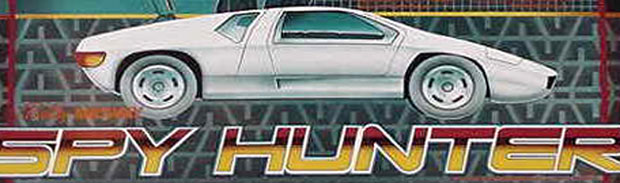
Spy Hunter, the original driving action shooter - Originally published on 1UP - March 26, 2009

If you were a serious gamer of the 80's then you know that Spy Hunter by Bally / Midway was possibly the best action driver the company has ever made. Released in 1983 the game has gone on to see countless releases on consoles, PC's and handheld systems. The arcade original is still possibly the best way the game should be played.

Spy Hunter broke the mold of the racing experience. It was a top-down driver, in the vein of the Sega's original Monaco GP but the similarities ended there. This game included weapons and a narrative. You were a spy making his way through hostile territory. Your car could gain special weapons to use against enemies, from smoke screens and oil slicks to machine guns and missiles. Each of these weapons would come in handy against certain enemies. Some opponents were heavily armored cars immune to bullets, they required drivers to shove them off the road, one of the harder enemies was a helicopter that could only be hit with missiles. The steering wheel found in most arcade racers had been replaced with something that looked more like a fighter plane control, with trigger and thumb buttons all used to fire the different weapons. The game also featured multi-path roads, some of which lead to rivers where the car would be switched out for a high-speed boat.
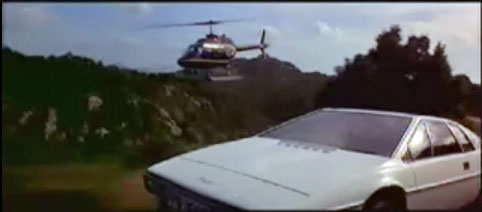
The entire experience was very reminiscent (read: lifted) from the famous Lotus Esprit chase in the 1977 James Bond film The Spy Who Loved Me. The sleek exotic car with hidden weapons and even the ability to turn into a submersible. I'm glad that the arcade experience focused on the car chase rather than the cheesy Roger Moore character. The game was very challenging. Very few people could get far enough into the game to try out all the weapons, let alone ever see the boat. All that experienced the game enjoyed the memorable theme, taken from the Peter Gunn television series. If you ask any arcade gamer about Spy Hunter then at the very least they should be able to hum the classic tune. A clever sense of nostalgia prompted Pontiac to create a commercial based on Spy Hunter.

Midway made sure the game was ported on multiple consoles and even followed up with a pinball release in 84. In 2001 they decided to relaunch the franchise and made an updated version of Spy Hunter for the Xbox and PS2. They added a more epic narrative and fleshed out the world of the G-6155 Interceptor. Creating a rival faction and a doomsday plot right out of a big budget motion picture to pull gamers through the experience. The release by developers Paradigm Entertainment was well-done. The classic elements featured in the original returned along with some updated elements. Rather than switch vehicles the new-and-improved Interceptor could transform on the fly and become a boat for river sections and turn into a motorcycle if it took too much damage. The pace was rapid and the game had a fun arcade quality to it.
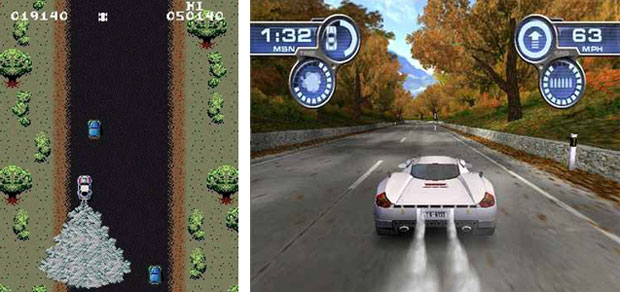
The sequels to the new Spy Hunter didn't sit well with critics. Angel Studios took over for Paradigm and made a decent game with 2003's Spy Hunter 2. The Interceptor could now transform into other vehicles and even featured "boss" battles against massive vehicles. However by the time Spy Hunter: Nowhere to Run came out the franchise went bust. The driver of the Interceptor, Alex Decker, was doing missions outside of the car in a loose GTA feel. The driving portions weren't as well made as the previous games. Players felt that the experience was lacking because Midway had broken up the game into two lacking experiences rather than one solid game. Most could tell that Midway wanted to turn the Spy Hunter game into a film franchise and were pushing the material into places that didn't suit it. The game worked when it was a car chase pulled from a spy film highlight. Not when it was trying to become the spy film itself.
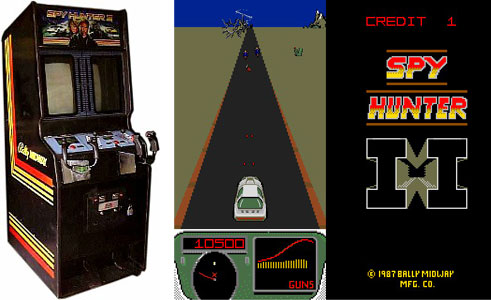
This wouldn't be the first time that Midway had failed the IP. The arcade sequel, Spy Hunter II in 1987, was a disjointed experience. In an attempt to bring in more arcade players on a single machine Bally / Midway fit two steering wheels onto a cabinet and split the screen in half. While this cabinet worked well in Max RPM, it doomed Spy Hunter II. The view was behind the car rather than above and the roads featured a number of blind turns and difficult opponents. For a drag racing game the narrow view was perfect, but not in an action game. The magic of the original Spy Hunter was replaced with something akin to Mad Max. In theory a partner spy in a yellow interceptor could help you on the other side. Rarely did I ever see one, let alone two people, playing this game in the arcade. Just as they failed the franchise in Nowhere to Run Midway was overly ambitious in Spy Hunter II.

Spy Hunter will always be remembered as a top down driving experience that had no peer. But was it the best overhead action driver ever made? Could that genre be done better in an isometric view as RC Pro Am showed? That was a topic for debate. Next week we'll look at two console games that tried to beat the legends. 

Did you ever play this arcade legend? Or did you play the home console versions? Let me know in the comments section please. As always if you would like to sponsor me please visit my Patreon page and consider donating each month, even as little as $1 would help make better blogs and even podcasts!
follow the Street Writer on Patreon!

Tuesday, June 28, 2022

Let's talk about A.K.I., the Dragon Lady of Street Fighter 6

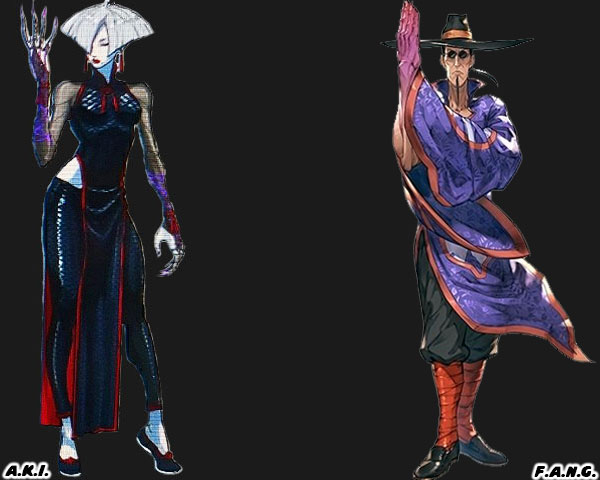
Today we are going to look at a new character slated for Street Fighter 6. A.K.I. is listed from China, and I mentioned previously on the Symmetry blog that she seems to be a new rival to Chun-Li. Maybe she is a leader of a Triad organization, maybe she's an assassin, or maybe she's just a fashion model mixed up in a fighting tournament. In my previous post I summed up their look this way. Both A.K.I, and Chun-Li hail from China, but they seem to be set as polar opposites. Chun-Li represents a classical fighting tradition. Her kicks are legendary in the series, as is her sense of duty to the police. A.K.I. by contrast looks like a villain right out of a comic book, or possibly action movie. She might be being set up as the ultimate rival. Her porcelain-white skin is eerie, making her appear almost supernatural. She wears flats like Chun-Li, but the similarities end there. Her costume is black, a sinister shade, and form fitting. She has pant leggings, and tulle-sleeves over her pale arms. She lacks the muscle definition of Chun-Li, but has claw-like jewelry. She's signaling that she is not a kicker, but a slasher. Just like Han, the villain from Bruce Lee's Enter the Dragon. I almost wonder if her claws have poison, similar to the nails of another Street Fighter villain.

When I look at A.K.I. I get the same feeling that I have from other Street Fighter 6 characters. Namely that she is an attempt to improve on an idea that was used in Street Fighter V. I think the moves of Jamie, and rivalry to Luke were originally going to apply to King Cobra. I also think that JP, was an attempt to redo the character of G. A.K.I. appears to be designed to replace the Shadowlaw general F.A.N.G. I know that I am not the only person in the fighting game community that has these same thoughts. Other people think that Manon is an attempt to redo the character of Abel. I’ve said that no good idea really dies, but perhaps some tropes need to be retired. I’m not sure what the abbreviation A.K.I. stands for, but in Japanese the name Aki can mean bright, brilliant, radiance. Aki itself is not a Chinese name. There were a lot of design elements behind F.A.N.G., but the character seemed like a giant troll. He was silly, goofy, and just plain stupid in the lineup. I think he reflected Yoshinori Ono’s sense of humor perfectly. Along with Rufus, and Hakan, these were gag characters that really didn’t belong in the series. The other reason the character didn’t work was because part of his design was based on the evil Chinese mastermind trope. When I look at A.K.I. there are hints of stereotypical elements to her look as well.

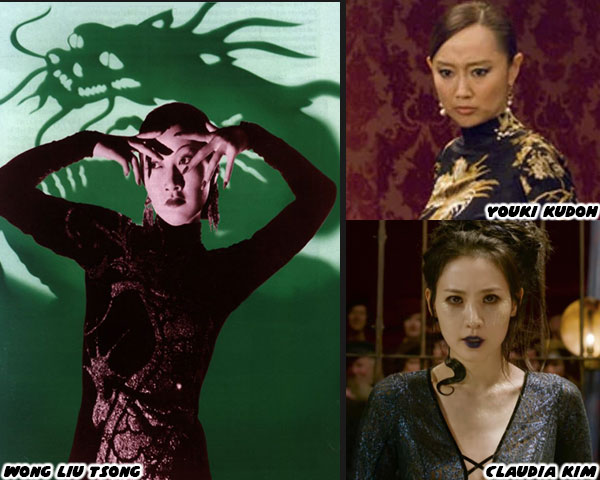
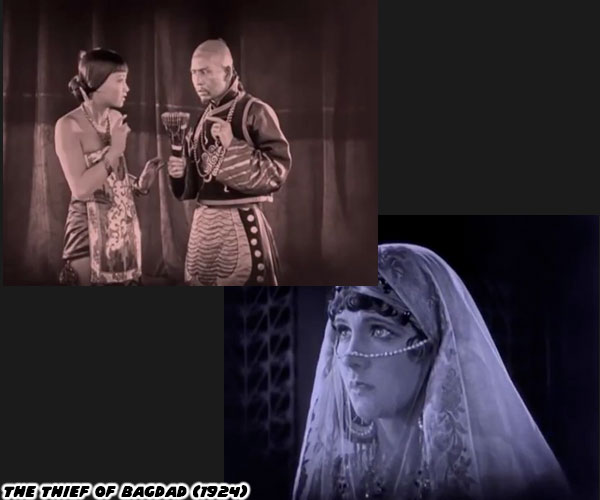
In a nutshell A.K.I. seems to be cut out of the Dragon Lady trope. There were several heavy-handed ethnic stereotypes created in the earliest days of Hollywood. One of the oldest was the dangerous “exotic” femme fatale, better known as the Dragon Lady. Wong Liu Tsong aka Anna May Wong was a gorgeous silent film star that fought for better roles all her life. She was a villain in the 1924 film the Thief of Baghdad, but went on to push for less stereotypical portrayals. The trend continued for decades. When they weren’t presented as dangerous assassins, like Rush Hour 3’s Jasmine played by Youki Kudoh, they were literally written as snakes. This was the case in Fantastic Beasts 2 Nagini played by Claudia Kim. Her character name was based on the Naga, which was a divine race of snake-human hybrids from South Asian mythology. Claudia was a Korean actress, but representing creatures from a completely different culture. The lack of ethnic understanding was something that the Harry Potter author JK Rowling had been criticized for in the past. Remember that she named the only Asian character in the Harry Potter series “Cho Chang”? The other characters Parvati Patil, and Padma Patil were South Asian.

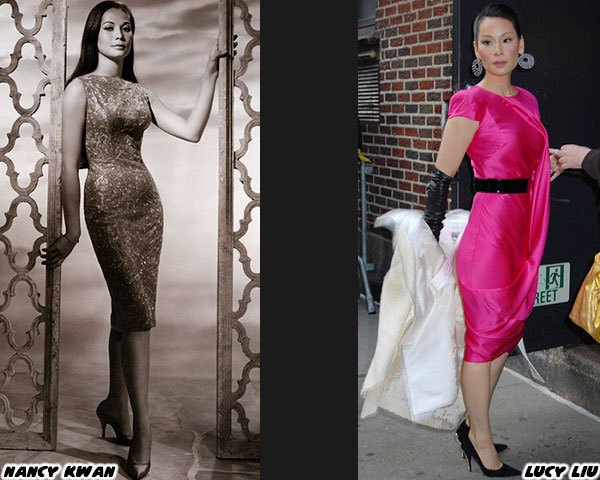
The Dragon Lady trope had multiple angles. These women could use their charm to spy, or seduce the heroes. They didn’t always have to be expert martial artists. In almost every regard an Asian female in a Hollywood movie was a fetish object. Anna May pushed for better roles, and many years later Nancy Kwan did the same for actresses in the ‘60s. Nancy’s break-out role was in the film The World of Suzie Wong, based on a novel of the same name. Instantly she became a sex object. Her dress in the film, a traditional cheongsam started being called the “Suzie Wong dress.” I’m almost certain that a bit of Chun-Li’s design, and international appeal comes from the seeds planted by Nancy Kwan. But as all things entertainment go, there was always a cycle. Decades after Nancy there was Lucy Liu, who was often cast as a cold-hearted Dragon Lady in film, and television. Lucy also pushed for better roles, and representation, but Hollywood was slow to change.

With A.K.I. I am reminded that the video game industry can also be slow to change. When she makes her debut in Street Fighter 6 it will be almost 100 years since Anna May Wong first appeared on screen. Maybe A.K.I. can rise above the Dragon Lady trope. She might actually be the surprise star of the game. Or she might be and ugly over-the-top character like F.A.N.G. Only time will tell. What do you think of this character? Are you eager to see a new rival to Chun-Li in the game? Someone that represents the Chinese underground? Or perhaps is a double agent in disguise? I want to find out more, that’s for certain. Let me know your thoughts in the comments section. As always if you would like to sponsor me please visit my Patreon page and consider donating each month, even as little as $1 would help make better blogs and even podcasts!
follow the Street Writer on Patreon!

Saturday, June 25, 2022

Cammy gets an entirely new look for Street Fighter 6, let's see how

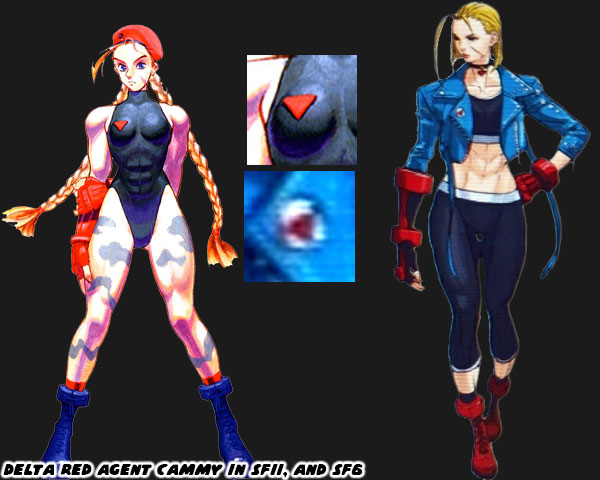
In the previous blog I mentioned that Street Fighter 6 Director Takayuki Nakayama, Producer Kazuhiro Tsuchiya, and Designer Yusuke Hashimoto had decided to redo the costumes of every returning character in the franchise. Some of the designs are obvious, but work in the context of the fighter, like Zangief having red pants, instead of red wrestling trunks. Even the ones that look the same, like Juri, and Rashid, are actually new fits. The changes to the cut, and color for their uniform that I think makes for better overall designs. However I cannot say the same for every returning character. The more casual designs I think hurt the impact of a classic fighter. This was the case with Ken, as his tee shirt, jacket, and boots seemed out of place from his previous red karate gi. I think the same argument could be made for Cammy White.

Cammy as you may know is a member of Delta Red. A super secret British military strike force. Despite her diminutive size, she is actually quite strong, and exceedingly fast. Her uniform consisted of a green leotard, red beret, red gauntlets, red socks, and combat boots. Also she wore camouflage paint on her legs. Like the other women in the cast she also had a unique hair style. Hers were two long blonde braids ran the length of her back. This was usually her outfit when she was on missions with her team. The new design of Cammy has her wearing something closer to modern street wear. She has what appears to be workout leggings, and a sports bra. Over which she wears a cropped blue jacket, with a long belt. She also has one full-arm gauntlet, and one red glove, with red combat boots. Her trademark hair has been cut short. Her somewhat military inspired look has pretty much been stripped away. The only connection to her training goes to a small Delta Red pin on her jacket. Many fighting game fans said there was little setting her apart from the more recent design of Sonya Blade in Mortal Kombat.

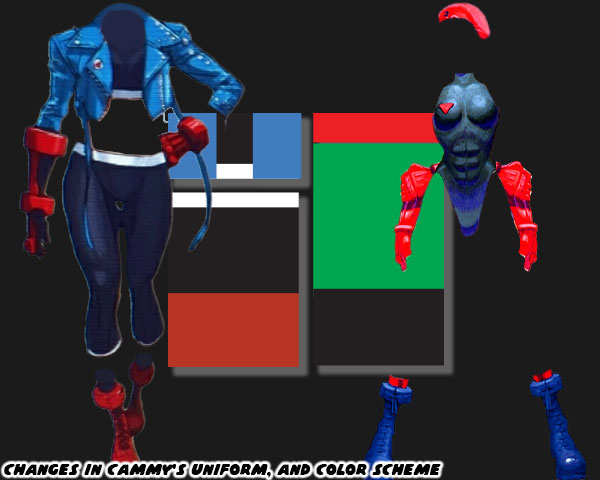
If you remove the character, and just look at the costume you’ll see a stark contrast in her design. I argue that color is one of the most important things you can assign any fighting game character. The ones that had solid colors, and a complimentary second color withstood the test of time. I said that this was a sort of happy mistake. Because game consoles in the ‘80s couldn’t have too many colors on the screen, then sprites were assigned bright primary colors so they could stand out from the backgrounds, and their opponents. This started a trend that at least Capcom stayed with through most of the ‘90s. The artists stayed with solid primary colors for each fighter even when they had hardware capable of presenting thousands of colors on screen at the same time. The original design for Cammy was no exception. She had a lime green associated with her uniform, this was a lighter shade than the green assigned to Blanka. Plus her red, and black accent colors were different than the rest of the Super SFII cast. Some of the returning characters in SF6 have perhaps a new accent color assigned to their outfits, while others have entirely new color pallets assigned to them. Cammy falls into the latter category.

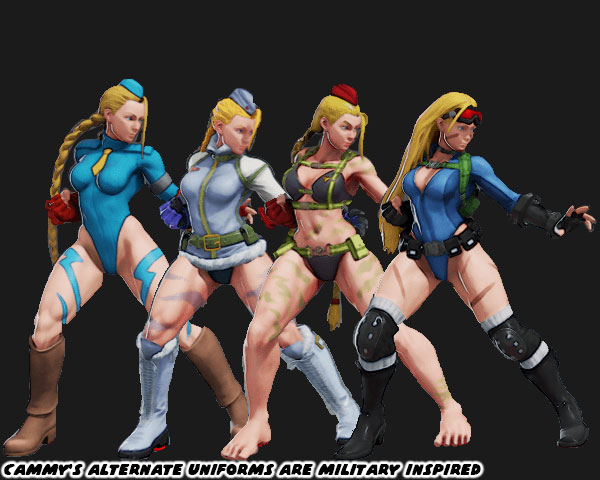
Cammy has had different variations of her uniform through Street Fighter Zero / Alpha, Street Fighter IV, and V. In every instance it was military inspired, even if it was a “sexy” version of spy gear. Without her long hair, red beret, and military look is she still Cammy? I think it’s fair to ask what the SF6 designers think defines the character? For that matter, what do you think makes Cammy unique? I think the changes they made were counter to the spirit of her original design, similar to their approach to Ken Masters. Also why were most of the blonde characters (Ed, Ken, and Cammy) all given jackets? Was Mr. Hashimoto even aware that he did this? I suppose as long as Cammy still plays in a similar fashion that she used to then she will be well received. I’d like to hear your thoughts on hew new look in the comments section. If you would like to sponsor me please visit my Patreon page and consider donating each month, even as little as $1 would help make better blogs and even podcasts!
follow the Street Writer on Patreon!

Tuesday, June 5, 2018

30 Years of Street Fighter, 30 Days of Characters; #26


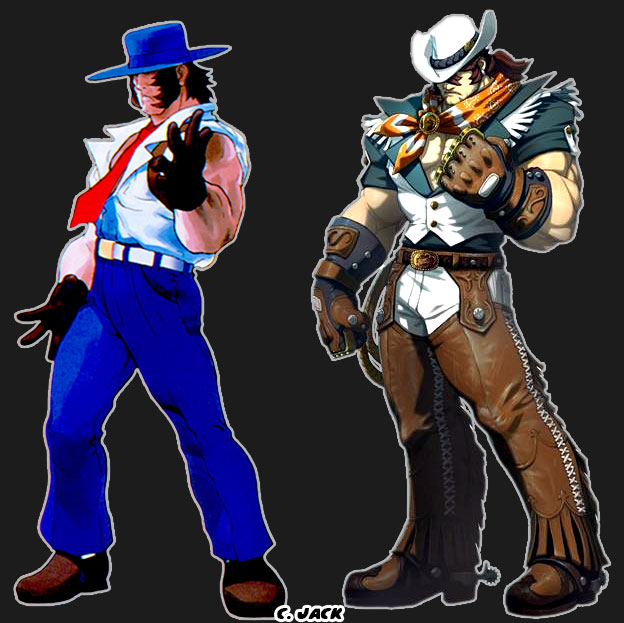
If there were a contest as to who was the coolest Street Fighter universe character ever the front runner might be Cracker Jack, aka C. Jack or simply Jack. The character made his debut in 1996 in Street Fighter EX. Jack was designed to be mysterious and interesting at the same time. The shirt and tie, and even hat were supposed to be reminiscent of Shadowlaw field agents. It was actually an old trope from comics and cartoons. Tough guys like mobsters and sometimes detectives wore the dark suit and tie. Except that Jack was not a bad guy. He was a bodyguard / double agent working for an organization fighting crime. Jack was like a super cop that played by his own rules. 


Jack fought with mostly punches in the series. He had an occasional grapple and body slam he could execute but he was a pure striker. He didn't have any fireball or other supernatural attacks to give him a ranged advantage but he did have something that none of the other characters had; a baseball bat. Jack could strike quickly and cut the distance between himself and his opponent. He really controlled the screen with the swing of his bat. He could strike away fireballs from a distance and smash the ribs of an opponent that wandered too close. This no-nonsense brawling that he had made him stand out from the traditional Street Fighter characters which were mostly based on martial arts.


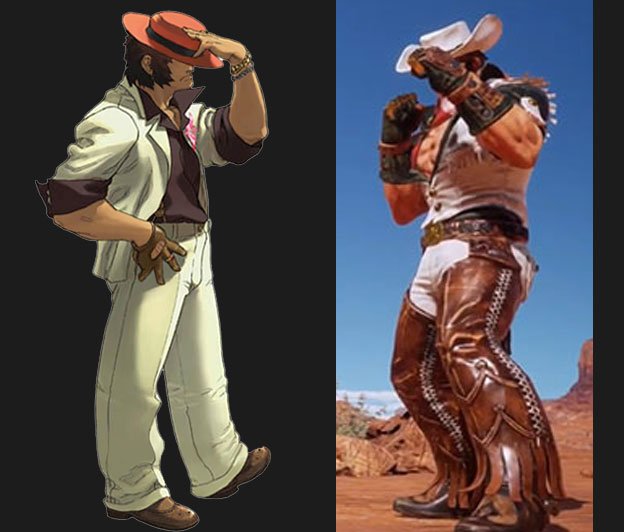
The team at ARIKA that designed the character kept him mysterious on purpose. They were vague on his affiliation, vague on his allies and even vague on his origin. They even made sure to make it difficult to see the face of the character. With his shaggy hair, sideburns and hat you could never get a clear look at his face. In canon the fighter went missing for years. He was found hiding out in the American Southwest. Whether is was to protect his former employer, on stakeout for a top secret mission or just to avoid his past was unknown. His transition from city brawler to fighting cowboy was one of the great redesigns in fighting game history. What do you think about non-traditional fighters in the Street Fighter universe? Would you like to see more of them? Please let me know in the comments. As always if you enjoyed this blog and would like to sponsor me please visit my Patreon page and consider donating each month, even as little as $1 would help make better blogs and even podcasts!
 follow the Street Writer on Patreon!