Showing posts with label gen. Show all posts

Wednesday, June 27, 2018

30 years of Street Fighter: 30 years of Characters #4

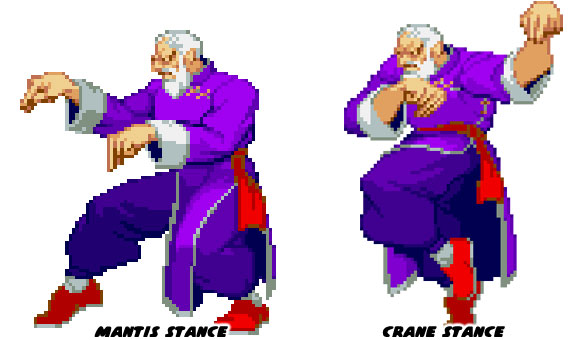
It's been 30 years of Street Fighter and nobody is talking about Gen. We have to give this grandmaster of kung-fu the attention he deserves. Gen is one of the original opponents in the series, the best fighter in China. He has popped up just a few more times since his debut. His return to the game, in Street Fighter Zero / Alpha 2 (1996), was easily his best appearance. Gen became the first character to offer players two completely different fighting styles, that of the mantis or crane. Players could alternate in between rounds their style by holding down different buttons. This meant completely different move sets, super moves and strategies. Imagine how unpredictable this made him in tournaments. Gen was a call back to the classic fighting archetypes that inspired the original Street Fighter line up. Remember how Dhalsim (#30 on my list) was based on the Yoga Master in the Master of the Flying Guillotine (1976)? Gen is a nod to the various white-haired masters from martial arts cinema, including Executioners from Shaolin (1977), Born Invincible (1978), Abbot of Shaolin (1979), and Fist of the White Lotus (1980). The ancient kung-fu techniques had been featured in cinema but rarely used in actual games until Gen. 


The legend of the white haired master went back to the earliest days of the martial arts in China. Gen was derived from a number of movie heroes and villains but even those characters were inspired by historical figures. The most likely root was Bak Mei, one of the founders of the Shaolin school. He was allegedly a survivor of the Shaolin massacre during the Qing Dynasty. He was one of the Five Elders, the survivors of an assassination attempt against the monks. They eventually rebuilt the school and preserved the early martial arts. This group also began developing new schools of fighting based on predatory animals like tigers and eagles. Gen was derived from those classic heroes. He had superhuman strength and speed despite his age and made us believe that these fabled masters might still be hiding in China. He represented the last living member of an ancient lineage. Hiding in plain site, wandering in the back alleys of the oldest corners of Shanghai. Where a centuries-old market had been paved over by a modern, indifferent world. Only a few clues remained of what was once there. A few crumbling signs, posters and ads, left to fall in disrepair in the shadows like the rest of ancient China.


Gen was symbolic of the mythical martial artists. He was just like the characters written about in wuxia, or classic hero stories. These were the ones that inspired revolutions. The handful of masters that led poor people to victory over corrupt regimes using only their fighting skills. These larger-than-life characters killed tigers with their bare hands, could run over rivers and along treetops. The people that were romanticized in stage plays and films. The kung-fu characters inspired people all around the world. Especially the developers working at Capcom in the '80s. His abilities were fantastic but sadly they were out of place. Gen was the last of his kind. A holdover from the 19th century, a person that had a connection to the original masters. His time was rapidly running out and he wanted to be killed in a fight and not by the ravages of age and disease. His legacy did carry through thanks to some talented students he trained. There may never be another character as important to the history of Street Fighter as Gen. For that we salute you on this anniversary and hope that your legacy will live on.v> If you would like to sponsor me please visit my Patreon page and consider donating each month, even as little as $1 would help make better blogs and even podcasts!
follow the Street Writer on Patreon!

Wednesday, August 23, 2017

How age and gender helped make the Street Fighter cast unique...

Working on the blogs about Ed in Street Fighter V and Allen Snider in the EX series I was reminded about how important legacy designs were to the creation of new fighting game characters. If you were a fan of fighting games, a budding designer or an artist looking for new ideas I wanted you to think about your favorite characters. Try to break them down and see what it was that you liked about them. Was it the moves and abilities they had? Was it their temperament and attitude? Did they have a unique costume or a unique look? Was it perhaps a combination of multiple elements? When exploring the details that went into making Ed I challenged the readers to try to do the same thing. Take any two favorite characters from the Street Fighter, or any fighting game series, and try to combine their design elements. Or take an existing character and try to make a young version of them, for bonus points try to change the sex or ethnicity of the character. How would they appear when compared to the rest of the cast? If a new character was done well then most people didn't notice these elements. For example Juri from Street Fighter IV was based very much on the elements that created Chun-Li. The costume, looks and moves of Juri and Chun-Li were very complimentary. This was no accident. Almost 10 years ago I wrote about the symmetry of Street Fighter.
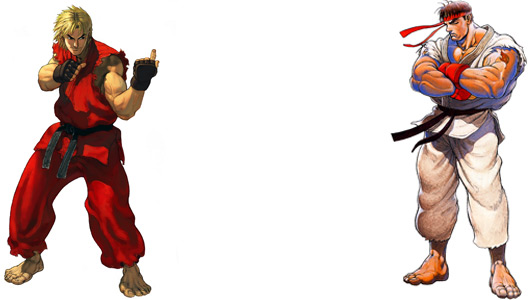
 

I said that one of the reasons Street Fighter II became an iconic game was because of how the characters were balanced. I'm not talking about how the fighting mechanics were balanced, but instead how each of the main characters had a sort of visual rival. It didn't matter if it was a friendly rival or an arch rival. Ken had Ryu, this was a literal balance, but Ryu also had Sagat, which was an asymmetrical balance. Having two main stars in the game created a trend that would be used by other studios. Ryo and Robert in the Art of Fighting, Akira and Jacky in Virtua Fighter, Haohmaru and Genjuro from Samurai Spirits were other examples of balanced main characters. There was something that the team at Capcom added to make the lineup more unique in the Street Fighter Zero / Alpha series. They weren't afraid to play with the roles and genders as well. Sakura was very much a girl version of Ryu. She had her own rival with Karen, who was like a girl version of Ken. These rules also applied to villains.
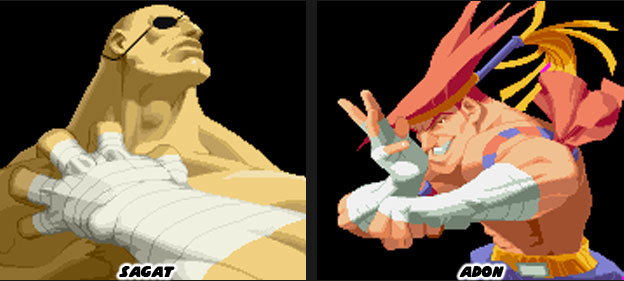
 

Having a younger rival was an excellent way to expand a character library. Sakura for example wanted to become a great fighter like the person she idolized. She trained very hard and even dressed a little bit like Ryu, with a similar headband. Then there were young rivals like Adon who wanted to dethrone their mentor. Ed was similar in this regard. People in Shadowlaw fought their way to the top. The four generals in the organization represented the most dangerous fighters in the universe. M. Bison the Boxer, Balrog the Claw Assassin and Sagat the Muay Thai champion were brutal opponents. Their boss Vega / the Dictator was absolutely ruthless. If Ed hoped to remain in their presence then he would have to surpass them. In his ending in Street Fighter V it is suggested that he might organize his own group to take over Shadowlaw. This wasn't the first time that a young character was created with the intent to replace and established fighter. In the early stages of Street Fighter III development the people at Capcom looked at only having Ken and Ryu return. They enjoyed the success of the World Warriors introduced in Street Fighter II. So they wanted to create a new cast with similar archetypes.
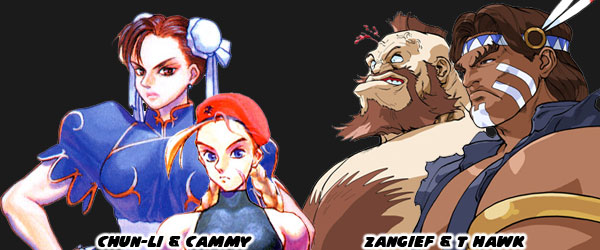
 

Two of the characters that were far along in the design process were Cammy and T. Hawk. They were going to be the updated version of Chun-Li and Zangief respectively. Plans for Street Fighter III were scrapped and these new figures were introduced in the upgrade called Super Street Fighter II: The New Challengers. The team at Capcom did a good job of recreating the archetypes without making these new characters look exactly the same as the veterans. Chun-Li was a special agent for Interpol. Her Chinese heritage was reflected in her costume. Cammy was a soldier working for Delta Red, her uniform looked more militaristic. Zangief was a powerful figure with some hard hitting slams. He was a Russian fighting for the pride of his homeland. T. Hawk was a native character, younger and bigger with equally powerful slams and protective of his reservation. By making the new fighters slightly younger it meant that they might be brought back in sequels, along with Ken and Ryu as older, more mature fighters. The thing about this school of design was that it worked almost as well when introducing older characters into the series.
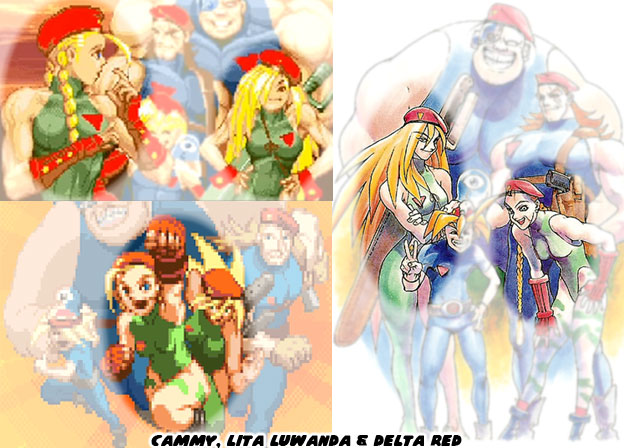
 

When planning out Cammy the studio wanted her team to be as unique. One of the members, Lita Luwanda, was a weapons expert. She also had long blonde hair, a green leotard and the trademark red beret. She could easily be mistaken for Cammy's older sister. The style of this character complimented the other fighters very well. She could have popped up instead of Cammy in a Street Fighter sequel and I think audiences would have enjoyed her and the massive sword she used. A designer could push the age of the character to the far end and still find a fit with the series. Gen and Oro were elderly fighters that worked well in their respective appearances in Street Fighter Zero and Street Fighter III. Gouken, the elder master of Ken and Ryu had been written about for years but had only appeared as recent as Street Fighter IV in 2008.
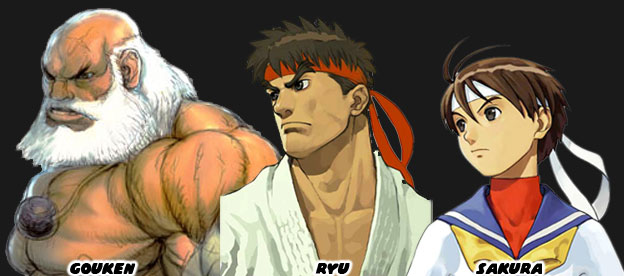
 

Gouken, Ryu and Sakura had a similar form of fighting but the differences between the three were very profound. If you are designing characters for a story, game or comic look carefully at how Capcom distinguished the trio. Gouken was at the peak of his abilities, every move that he had oozed power. He had techniques that were not yet known to Ryu or Sakura. He could perform the famous fireball attack with one hand, showing how much more advanced he was than the younger stars. Sakura was in the early stages of her abilities. She couldn't yet perform a proper hurricane kick so she would spin on her sneakers across the floor. Her fireball lacked the speed and range of the old master. Ryu was closer in terms of moves and abilities to Gouken than Sakura. Although the three had similar techniques, they all employed different strategies in the game. If you are thinking of designing your own fighters remember that characters can be from the same school but they should not all play the same. Gouken, Ryu and Sakura played as uniquely as they looked.
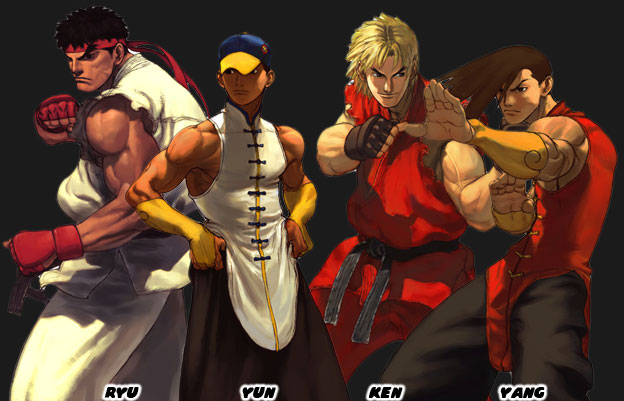
 

When development got started on an actual Street Fighter III Producer Tomoshi Sadamoto and Designers Yasuhiro Seto, Tomonori Ohmura and Obata Shinichiro were very mindful of the things that went into the creation of the original Street Fighter and Street Fighter II. They decided that only Ken and Ryu should return and there would be a new story and new main villain. The duo were joined by a new library of fighters and styles. Dubbed the "New Generation" these fighters were not necessarily based on previous characters but there were some similarities to them. The new heavyweight, Alex, was a hybrid fighter, with both strikes and grapples in his arsenal, similar to Adon and Birdie. Necro had stretchy limbs and electrical attacks, similar to Blanka and Dhalsim. Hugo was originally planned as the super-heavyweight, the Zangief of the game, but his sprites weren't ready until a few months after the game debuted. The two characters that were most similar were the brothers Yun and Yang. In design and temperament they were like a young Ken and Ryu. They even had a familiar red and white color scheme. If the developers made one mistake it was in having the moves of Yun and Yang be too similar, making them redundant. It took Capcom plenty of sequels to make the library of moves between Ken and Ryu unique. They forgot this while planning out Yun and Yang, and as such they didn’t take off as well as the studio had hoped.
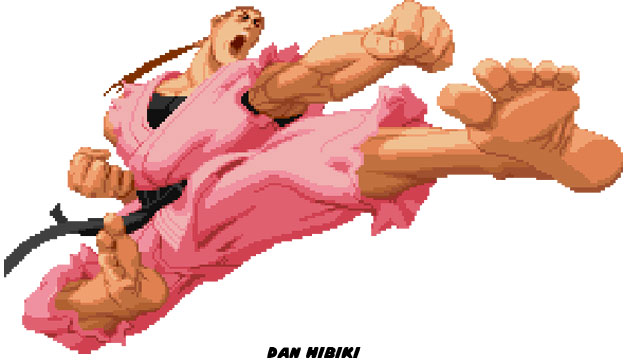
 

Capcom didn't always get the designs perfect the first time they were released but they quickly adapted. Well, at least they used to. For a long while every time they put a karate character in the game they played similarly to Ken and Ryu. Making fighters like Gouki, Sakura, Dan, Sean, Kairi, Allen Snider and Gouken were far more redundant than Yun & Yang. In fact this group of karate fighters were dubbed "Shotoclones" by the fighting game community. Yet the designers went back and challenged themselves to rethink the karate form. They incorporated the elements of an established character and then applied them to a younger fighter. Not only that, they considered changing the sex and ethnicity of the characters as well. They even gave these characters a unique form of karate. The final version of Street Fighter III, called 3rd Strike, Capcom expanded the library again. Of the new characters Makoto was a strong, young female, but she also had a new form of karate. She did not play like Ryu, and did not use the same strategies. Her attacks were amazing and they all worked well in the context of the series.
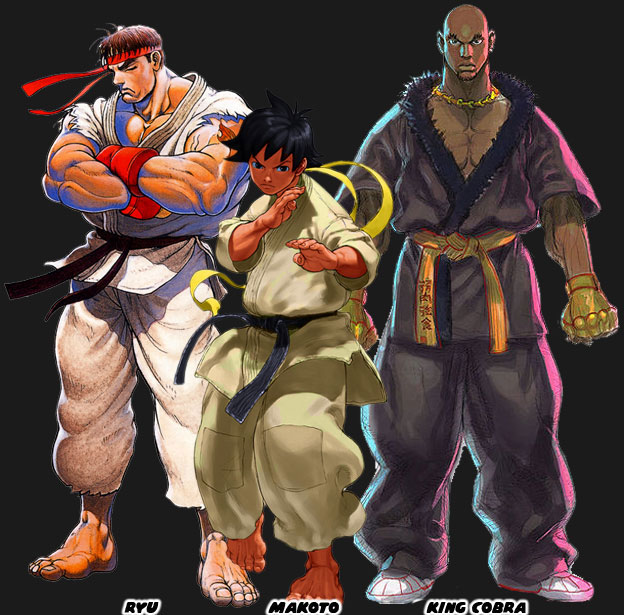
 

Capcom reminded us that no two styles, even from the same school, had to play the same. Makoto could never be considered another shotoclone. Even the unused design for the King / Black Cobra had a uniqe version of karate/kung-fu. These lessons had worked in previous games. No two giants had to play the same, like Zangief and T. Hawk. No two Muay Thai specialists had to fight the same, like Adon and Sagat. All of the archetypes were flexible. If you were a designer and couldn't think of where to take a character or style then think about how Capcom faced this challenge. If you were having a problem with your current design, think about making your fighter very young or extremely old. How would this affect the way they moved, animated or performed? If the design was found lacking think about changing the color the skin, or think about changing the gender of the character. Take a new approach to the archetype and you might end up with something great. Was there a character that you thought was well done? Could you spot the influences in their design? I'd like to read about it in the comments. As always if you enjoyed this blog and would like to sponsor me please visit my Patreon page and consider donating each month, even as little as $1 would help make better blogs and even podcasts!

 follow the Street Writer on Patreon!

Friday, July 31, 2015

How fight culture became fighting game history, part 14

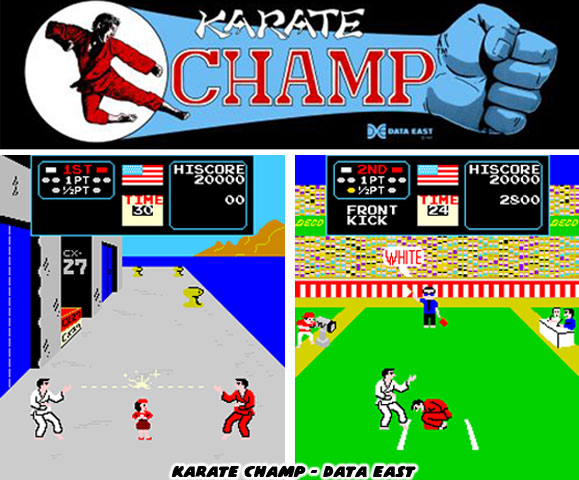
In fighting games (and in popular culture) karate would be considered a top-tier technique. The actual versions of karate featured in games were not necessarily rooted in one school. The looser the connection with an established style the better it was for developers to adapt into a game. In this way they could invent special attacks for the cast without fear from purists calling out the technique. Before characters could shoot fireballs from their hands karate was shown in a much more realistic light. In 1984 Technos released Karate Champ. It was one of the forefathers of the fighting game genre. The "plot" of the game was simple. The main character would travel from town to town and fight the best karate practitioners there. Players earned a full point or a half a point depending on the severity of their attack. The strikes in the game were based on actual karate moves, the points based on organized tournament rules. Players could punch, kick, jump and even block by entering commands on two joysticks. It was a clumsy control setup that would not be revisited by any other company. There was a "sub-plot" in the game as well. At each location there was a woman that was torn over which fighter she preferred. The winner of the tournament would get the girl. The girl-as-a-prize would be a trope that Anita Sarkeesian of Feminist Frequency would point out in many other genres.


Karate Champ was notable for using different backgrounds and locations to help tell a story. The main character went from dojo to dojo and even traveled around the world challenging opponents. While the main characters wore red or white it was due to limitations in the hardware. They were supposed to represent different fighters and even nationalities. This globe-trotting fighter was a Mas Oyama-type, a karate as the superior fighting form stand-in. Even the bonus stages were reflective of the demonstrations that Oyama would put on. He would break boards and even stones with his bare hands and his fights against bulls were legendary. But I'll go into greater detail on that in a future blog. In Karate Champ players could also break boards or even ceramic pots and bottles thrown at them. It was a little silly but made the fighter look like a badass. Karate Champ was mildly popular but the runaway hit from 1984 was a different type of fighting game. Irem released Kung-Fu Master, a game based loosely on Bruce Lee's final film "Game of Death." Kung-Fu Master predated Renegade (Technos, 1986) and Double Dragon (Technos, 1987) and could actually be considered the forefather of the brawler.


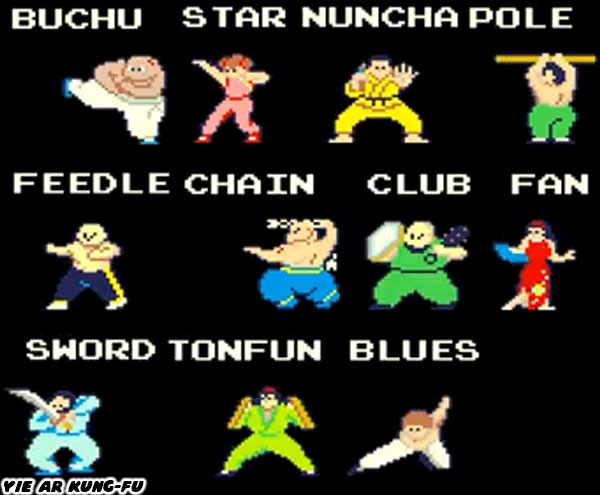
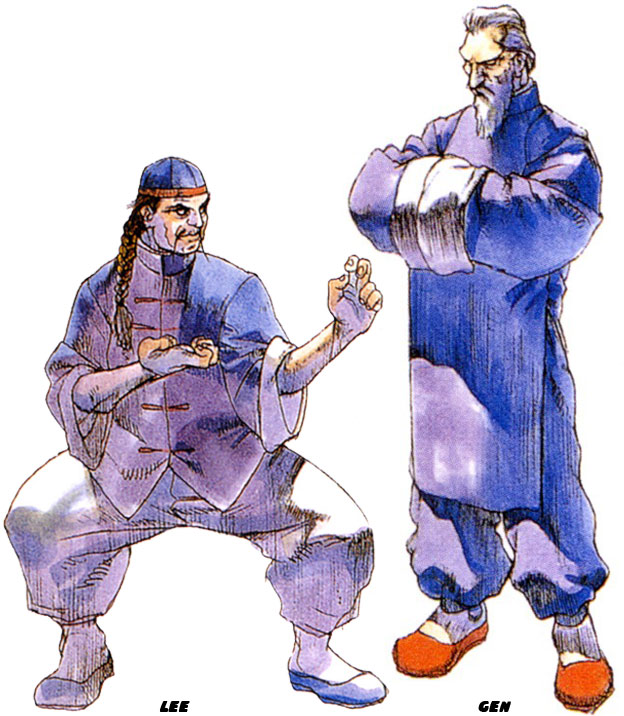
The first few kung-fu games created a framework that would be followed by the rest of the industry. Konami released Yie Ar Kung-Fu in 1985. It featured masters of different forms of kung-fu against a hero named Oolong. Some of the fighters used weapons while others user their hands and feet. It was notable for the traditional locations players visited as well as being the first fighting game that featured female opponents. Yie-Ar Kung was a fast-paced, very frenetic fighting game. There were no pauses in action, no chance for the player to breathe. The focus was less on realism and more on capturing the energy and slick choreography of kung-fu action films. The slow, calculated scoring system of Karate Champ was thrown out the window. Nonstop action would become the style of gameplay that Capcom and the other studios would try to build upon. Because of this the kung-fu master would become a trope in fighting games, especially Japanese fighting games. Lee and Gen appeared just two years after Yie Ar Kung-Fu. They kept the classical costumes with them. Capcom had unveiled a game engine capable of putting larger sprites with greater fidelity and more colors on the screen than Konami had done. This engine was used as the backbone for the original Street Fighter.


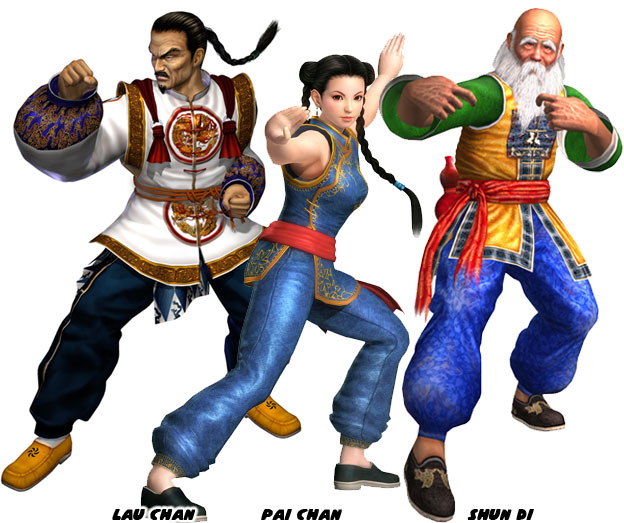
Kung-Fu masters were so well known globally that almost every fighting game had to make use of them. Three of the greatest fighters in Virtua Fighter tournament play and also in canon were Pai Chan, her father Lau Chan and family friend and "Drunken Master" Shun Di. Sega was one of the pioneers of 3D technology in arcade games and created what is generally regarded as the first 3D fighting game. Virtua Fighter was a hit from 1993. It had realistic graphics, lighting and quasi-realistic physics as well. These were things that audiences hadn't really seen before. The game was set in the modern world but many of the fighters were presented with classic uniforms, especially the Chinese ones. Pai and Lau were in the original game and Shun Di appeared in the sequel a year later.


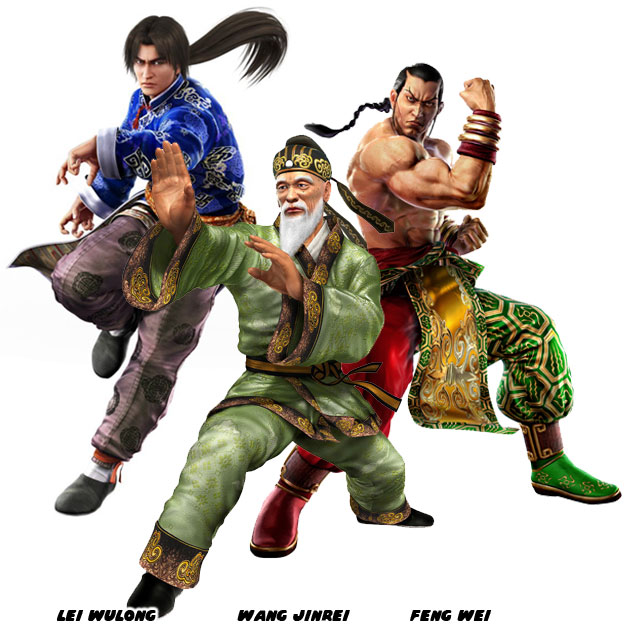
Not to be outdone Namco released their first 3D fighting game in 1994. The studio had a long standing rivalry with Sega. Anything one studio did the other studio tried to do better. It was seen in racing games, space shooters and especially fighting games. Tekken was the result of their work and audiences were split as to which 3D fighting game was better. The elderly kung-fu master Wang Jinrei appeared in the first Tekken. His understudy Lei Wulong, a "Super Cop" based on a Jackie Chan character, appeared in Tekken 2. A more classic villain Feng Wei debuted in Tekken 5. Again, despite being set in the modern world the characters were mostly stereotypes pulled from Hong Kong cinema.


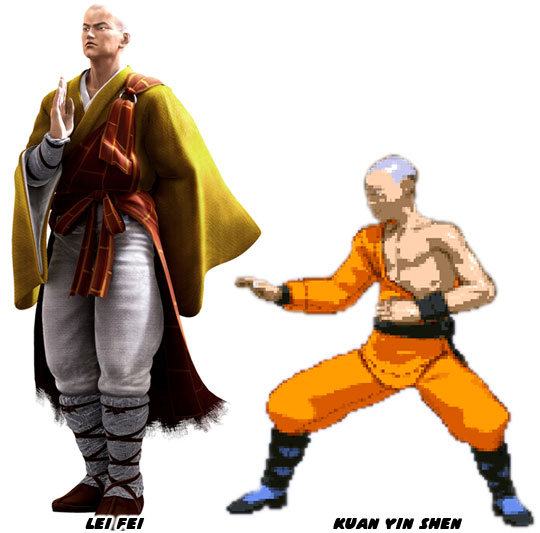
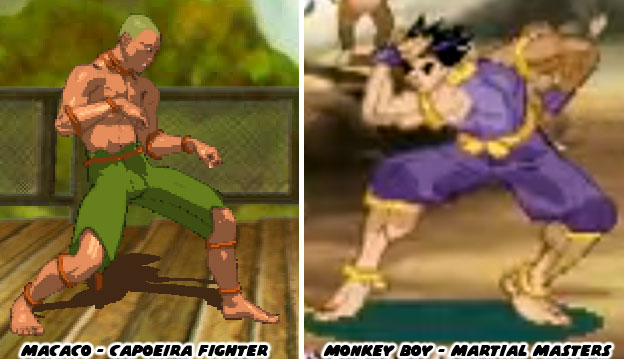
While Buddhist monks were credited for introducing kung-fu to China they have actually been grossly underrepresented in fighting games. Fans of the Mortal Kombat series might mention that Liu Kang and Kung Lao from the Mortal Kombat series were monks although they did not look or dress traditionally. The series was about as inaccurate as a fighting game could be when it came to representing actual fighting arts. The purpose of Mortal Kombat was to shock players with its ultra violent moves and fatalities. It was well done but it was fairly insensitive to Asian culture and traditions. In the history of fighting games were have been only two fighters based on actual Shaolin Monks. Lei Fei, appeared in Virtua Fighter 5 in 2001. There wouldn't be another monk worth mentioning until 2008. Kuan Yin Shen was the younger of the two and he appeared in Capoeira Fighter 3 by Spiritonin. The character was actually named on a Buddhist deity. Sega was a Japanese developer and Spiritonin was a US developer. The representation of traditional Shaolin kung-fu was indeed extremely rare around the world. But why was this? Perhaps religious undertones made the monks appear less intimidating in the games. It didn't matter if they studied the iron body techniques, could run on water or knew the death touch. In western circles a person in a robe just didn't seem as formidable as say a seven-foot cyclops that practiced Muay Thai. In Hong Kong cinema this was not the case, monks of different schools could be the subjects of action films. The classic Shaolin vs Lama highlights the fighting capacity of religious followers.


Popular culture dictated which styles appeared in a fighting game and even how the fighters themselves would be presented. Hong Kong cinema was the root of many kung-fu tropes. Some of which were based on historical figures but the vast majority were made up. The next blog will highlight how cinema influenced the evolution of the fighting game genre. I hope to see you back for that. As always if you enjoyed this blog and would like to sponsor me please visit my Patreon page and consider donating each month, even as little as $1 would help make better blogs and even podcasts!

Friday, July 3, 2015

How fight culture became fighting game history, part 2

The codified techniques of striking and grappling called wushu or gongfu (kung-fu) in China were drawn from countless schools and styles. The origins of some of the oldest systems were said to have been based on watching how creatures fight. Some styles were formed by monks and others by regular people. According to legend there was a man named Da Sheng Men that was schooled under the Di Tang method of fighting. He was imprisoned deep in the jungle for a crime he committed. The security was light on one side of the compound and heavy on the other. If a prisoner tried to escape on the heavy side they would get cut down by the guards. On the light side they could make a run through the jungle to freedom. Or so they thought. There were some vicious monkeys that lived in the woods and would tear an escapee to shreds. Da Sheng Men served out his short sentence but all the while studied the way the monkeys fought and incorporated it into his style. It became one of the forms of Monkey Kung Fu. This form looked amazing on film and was adapted a few times in gaming. Yet this particular form came into being at the end of the 19th century, many of the animal forms created by the Shaolin were a thousand years older.


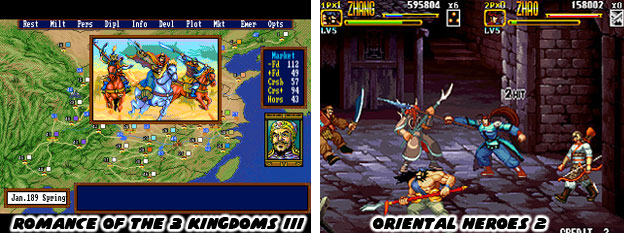
The known martial arts have existed since the earliest empires and just like those kingdoms they have experienced revolutions of their own. Art, science, religion and philosophy changed and evolved at the whim of the cultures and kings. The fighting arts survived the changes and have become immortalized in popular culture. One of the most storied celebrations of the amazing men and women of the martial arts coming from Luo Guanzhong's Romance of the Three Kingdoms. The events of the actual second century Han Dynasty in China were retold to audiences in the 14th century. Creative freedom and a great deal of historical fact made legends out military leaders and strategists. Warriors, heroes, criminals and soldiers have all been celebrated in other classic adventure stories. These fighters had never seemed more real than when they were presented in cinema. The end of the 20th century would signal the rise of a new form of entertainment. The average person would get to play as the legendary fighters in videogame form, marrying Eastern fables with Western technologies. Real and fictional battles could be experienced in any genre, from the role-playing series named after the Three Kingdoms to the action brawler Dynasty Warriors and Oriental Heroes.


This immersion in martial arts folklore gave audiences an entirely new experience. The martial arts would continue to change the face of popular culture. The sciences and philosophies of ancient Asia had to be explored in order to understand and appreciate the origins of the fantastic fighters. The roots of the Eastern Martial arts and philosophies were based in China. Even karate practitioners had to acknowledge that the origins of their systems were based in kung-fu. Mas Oyama, the main inspiration behind Ryu of Street Fighter fame, had defeated hundreds of men in his illustrious career but had known defeat only once. Early on in his karate career he decided to test out his style against a master of Taiji Quan. Taiji is a variation of the same Tai Chi you might see being practiced in a park. The Taiji master, reportedly named "Mr. Chen" was elderly and invited Oyama to a sparring match. Oyama thought that he would make quick work of him. Instead he discovered that no matter how hard he tried he could not land a single blow on the master. The elderly Chen used simple circular motions and smooth footsteps to evade the attacks. With tears in his eyes Oyama thanked the man for showing him that he still had room to grow as a martial artist. The life story of Mr Chen was lost to the pages of history, but the encounter was not. It helped perpetuate the myth of the ancient martial arts masters, characters like Gen in the Street Fighter series for example was one such person.


Gen was actually the first and only Street Fighter character to have two sets of fighting stances. Arcade players could switch between them in the middle of a match. Each stance also came with its own special and super moves. The character actually had a few strikes based on Tiger and Eagle Claw but his primary stances were Crane and Mantis. The early forms of Kung-Fu were inspired by the predatory animals in nature. These were considered noble fighting forms. Of course villains developed "evil" versions of Kung-Fu based on the poisonous animals like the scorpion and centipede as well.

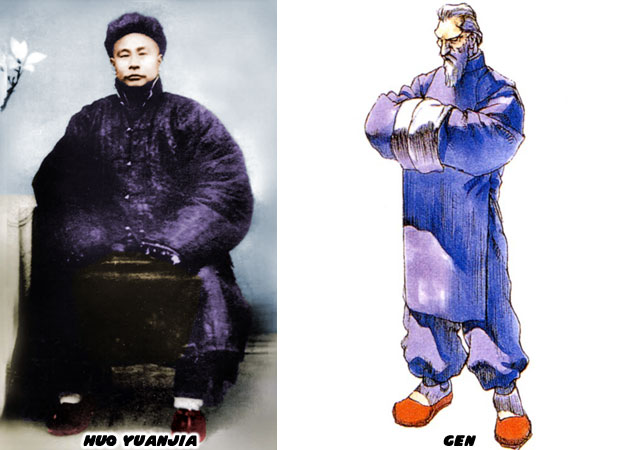
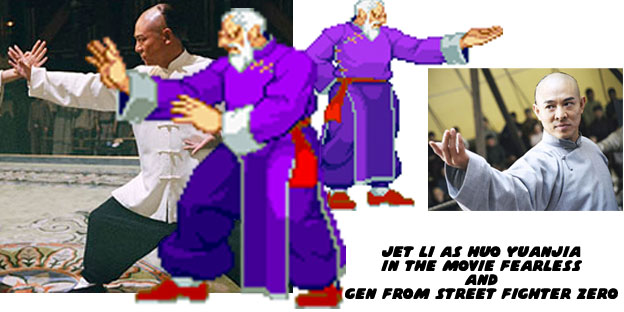
The character of Gen was inspired mainly by Huo YuanJia. Although they do not share many physical traits, it is the legend of the Kung-Fu master that bears the similarities. Huo was born in 1868. He was a sickly child who was kept away from the martial arts by his overprotective father. He proved that he was an amazingly gifted fighter when he defeated the older person that had beaten his brother in a match. From that point on he was allowed to study the martial arts. He had beaten the masters of various styles at a young age. He killed a man in one fight and put himself in exile.


It was similar to what Mas Oyama did when he was younger. Oyama was already an experienced karateka (karate practitioner) and had gotten in a bar fight. He killed the man that pulled a knife on him. Oyama knew that he had the ability to disarm the attacker but instead lashed out. This shame of not being able to control himself in a fight caused him to live like a hermit and become a stronger fighter mentally and physically. Both Huo and Oyama returned from their exile at the peak of their abilities. Of course the legend of Huo goes back almost a century earlier. Huo came out of "retirement" to face the foreign invaders. The Japanese and British had begun colonizing China. The nations would put on matches that surmounted to imperialist propaganda. Having boxers, judo experts and wrestlers take on all so-called kung-fu masters and beat them up in public matches. It was disheartening to the Chinese that their fighters and their arts seemed ineffective against the occupiers. They sorely needed an icon to rally around and Huo came along at the right time. He soundly beat the best fighters from abroad to demonstrate that the Chinese were not inferior people, nor were their fighting styles.


Huo became a national hero when he proved himself against the best Western and Japanese fighters. A fantastic retelling of his life story was done by Jet Li in the film Fearless. The question you may have is why is Gen depicted as an old man whereas Huo was young when he became an icon. Huo died at the age of 42. He suffered from health issues most of his life, including asthma and jaundice. Near the end he had contracted tuberculosis. His health deteriorated quickly and he died just a decade into the new century. The rate at which his health declined was questionable to many. Huo was fast becoming a symbol for national unity, which concerned the occupiers greatly. The Chinese suspected that the Japanese doctors that were treating him for his condition had poisoned him instead.
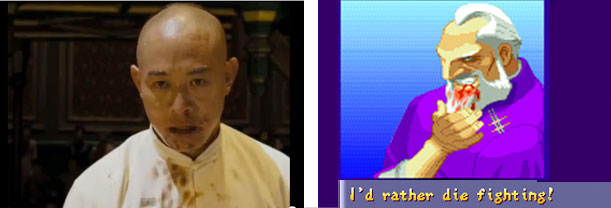
Gen was a symbolic character. He represented the legendary Kung-Fu masters from 18th and 19th century China. He was what would have happened if Huo had lived long enough to fight the greatest martial artists of the 20th century. Huo would have been elderly but still a dangerous man in the eyes of many. In Street Fighter canon Gen was not only considered a legitimate threat to Ryu but even the main villain Gouki. People suffering from tuberculosis sometimes cough up blood due to the deterioration that the disease has on their lungs. Gen could be seen suffering from this affliction in several endings in the Street Fighter Zero/Alpha series. He was such a proud man that he wanted to die fighting the best opponents in the series rather than to succumb to the disease.


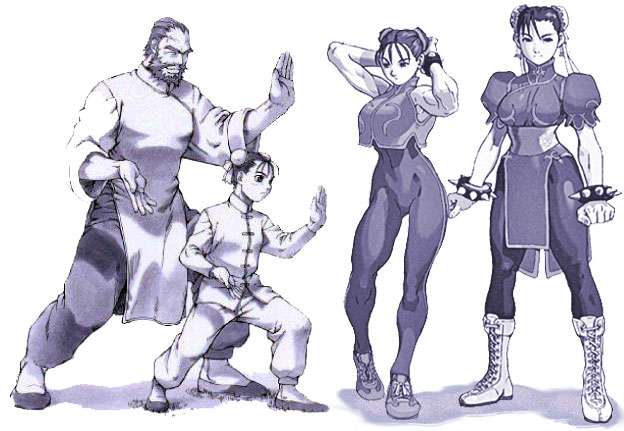
Eventually Gen died, whether by the hand of Gouki or not was never officially stated by Capcom. His secrets did not die with him. As an elderly man he helped mentor Yun and Yang. Each of the Chinese twins learned just enough of his fighting style to make them popular opponents in Street Fighter III. His greatest student however became an international darling. Gen was good friends with the father of Chun-Li. When her father was killed in the line of duty it was Gen that stepped in and continued training her. She became the best female martial arts master in the world but also became a great police officer and avenged the death of her father. Gen would turn up in manga and anime films to cement his status as one of the best fighters in the universe. We should be thankful that Capcom was able to incorporate a mythological Chinese hero in their martial arts fable.


Chun-Li was rooted in a myth that was even more important to the identity of the Chinese martial arts than Gen. The next blog will look at her origin. As always if you enjoyed this blog and would like to sponsor me please visit my Patreon page and consider donating each month, even as little as $1 would help make better blogs and even podcasts!