Showing posts with label feng wei. Show all posts

Monday, August 5, 2019

The new wave of Black fighting game protagonists

I am very excited following on the footsteps of EVO 2019. A lot of great tournament action went down and there were several great reveals by the game studios. I'm going to talk a little bit about a theme that went through two of the most recent announcements. Arc System Works has been cranking out some fantastic titles over the past few years, including Guilty Gear, BlazBlue, and Melty Blood. They teased that there would be a new character introduced into the world of Guilty Gear. He didn't have a name (as of August 5 as I write this) but he stood out from the crowd. He was a strong Black man with decidedly futuristic samurai armor. The crowd in Las Vegas, as well as online, went crazy by his reveal. It stood to reason because strong, positive Black characters and Japanese designers haven't always been on the same page.
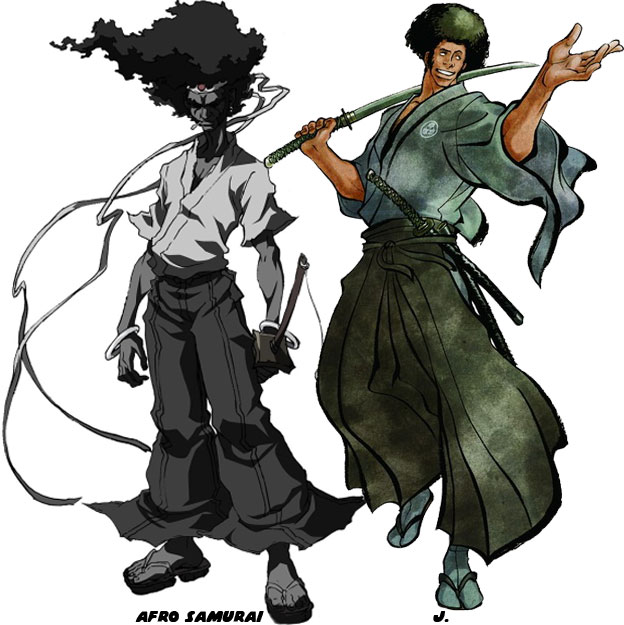


I was wondering if this new character might be based on Yasuke. The only black samurai in recorded history. I talked a little bit about this character while dissecting black stereotypes in fighting games. The animé character Afro Samurai, and Samurai Showdown character J were loosely inspired by this historical figure. Sadly, the black character in many fighting games often wore a large afro and a silly costume. The only alternate for the black characters seemed to be showing up as a boxer.

 
Representation went a long way in fighting game character designs and especially in the community. I have already argued that age and gender helped make the Street Fighter series unique. And I also argued that even body type, like fat characters, had a proper way to be introduced into the genre. Minority characters were something that I felt Capcom and the other studios could do better at presenting. I have a feeling that the growth of e-sports, especially the spectacle of of the EVO tournament has made Japan keenly aware as to how popular, and important, fighting games are to the western market. The impact of powerful minority characters is even more important to the minority community. Because of that it was wise of Arc System Works to include a new black character in Guilty Gear. But almost as important is Namco introducing a new character into the Tekken series.


The name Leroy Smith is a little too generic, almost too stereotypical for my tastes, but I think his inclusion serves many purposes. First let's talk about his look. The character is older and a master of the kung-fu arts. He is seen practicing with a classic wing-chun wooden dummy. He then takes on Marshall Law and Lei Wulong in his teaser trailer. Marshall is modeled after Bruce Lee and Lei after Jackie Chan. He defeats both soundly with his smooth minimal strikes.


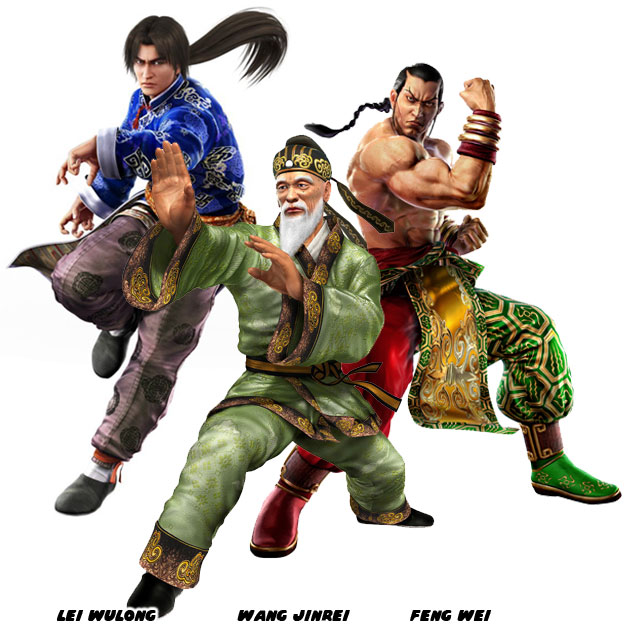
After this he takes on Feng Wei, a master of Chinese Kempo and probably the most pure wuxia villain in the Tekken series. He defeats Wei as well. His strikes and form are very reminiscent of Wang Jinrei, an elderly master of Xin Yi Quan. The character was a friend of Jinpachi Mishima, the founder of the Mishima Zaibatsu. Wang passed away in the series. Sadly for many fans of Tekken this also meant that his style of fighting went with him. I have a feeling that Leroy was introduced in part to bring back this classic form.


The appearance of Leroy might be strongly attributed to the character of Ezekiel from the Walking Dead television series. The older black character sported large dreadlocks and commanded respect in the series. He was often referred to as King Ezekiel in the graphic novel and television show. Negan, the main villain from the Walking Dead was introduced in Tekken 7. It's not hard to think that the designers appreciated the character of Ezekiel and wanted to include their own version without having to pay AMC or the actor to use his likeness. What if I were to tell you that the character of Leroy and his importance in the series, and with the fighting game community went much deeper than that?


The kids from Generation X grew up with heroes like Bruce Lee, Ron Van Clief, and Jim Kelly. The non-white heroes spoke to minority kids in every city and town from coast-to-coast. Finally there were heroes we could identify with. They did not play sidekick, or act subservient to any other character. That generation was raised on a steady diet of Shaw Bros kung-fu movies. When they got older that passion for the marital arts never faded. In fact the love of kung-fu built a cult following. The rap group Wu-Tang Clan out of New York were obsessed with classic martial arts films and even named their debut album after the iconic film The 36th Chamber of Shaolin aka Master Killer.


The group did more than pay lip service to the genre. They paid to have a collection of classic films get restored, dubbed, subtitled and transferred to DVD for an entirely new generation. Not only that but the defacto spokesman for the Wu-Tang Clan, the RZA, wrote, produced and starred in his own martial arts film. In the era where Hollywood wouldn't greenlight any classic style martial arts movies the RZA put up his own money and reputation to get the movie off the ground. He also appeared as a villain in the Protector 2, aka Tom Yun Goong 2, against Tony Jaa.


The RZA, and many more Hip Hop performers, including Lupe Fiasco were vocal about their love of fighting films and games. They were living proof that an entire generation was shaped by Asian culture. It was something that Capcom, Namco, Sega and the other Japanese developers seemed oblivious to. If you travel backwards through time you begin to see that kids in the inner-city had been clamoring for the Leroy Smith archetype for ages. The 1985 film the Last Dragon featured Tiamak Guarrello as Bruce Leroy Green. He was a mixed-race kid that modeled his life after Bruce Lee. The film was filled with an almost cringe-worthy fetishization of Chinese and Japanese culture. The villain was as over-the-top as any fighting game boss. Julius John Carry played Sho'nuff the Shogun of Harlem. I'm kind of surprised that none of the Japanese studios picked up on this earlier, considering how much they poached from US cinema.


To be completely honest, the first US-produced film that glorified inner-city gang fighting culture was the Warriors. Yes, there were earlier gang films that turned white protagonists into the anti-heroes. See James Dean in the 1955 film Rebel Without a Cause. What made the 1979 film the Warriors stand out was the idea of mixed race gangs. Each gang had their own look and costumes. Recreated faithfully by Rockstar in the 2005 game by the same name. The title gang was out of Coney Island. It was founded and run by a black man named Cleon. His lieutenant was a white guy named Swan.


In the story the largest gang in New York was the Gramercy Riffs. Their warlord was known as Cyrus. He was trying to unite all of the gangs so that they could take over the city. He was assassinated by Luther, the leader of The Rogues, a gang from Hells Kitchen. This triggers an inter-gang war where all of the gangs mistakenly go after the Warriors. The Riffs are controlled by the former lieutenant named Masai, who becomes the new warlord of New York. With his dark sunglasses, and no-nonsense attitude, he is as imposing a villain as ever there was one.


So here is where things lead back to Leroy and Tekken 7. In the official story of the game Leroy was caught in a gang conflict in New York 50 years ago and disappeared. He is returning as a martial arts master in order to seek revenge. There are two bits of trivia that I feel you should know. The Tekken series is set in the near-future. It's not hard to argue that the game is set at least 10 years from now. Also, the Warriors battled in 1979, exactly 40 years ago.


If a young man like Masai had lost his leader he might have escaped to become a better fighter. Let's assume he was 18 when the events of the Warriors happened. He would now be pushing 70. Technically he would still be the elderly kung-fu master but, still have enough gas in the tank to be a formidable fighter. I have a feeling that the developers with Tekken liked the surface appearance of Ezekiel, however wanted someone grounded in the era and experience of New York during its peak gang life. What they ended up with may be the most unique fighter in the past few years. At least Arc System Works and Namco are validating the colored community with the inclusion of these new characters. At best they are forever changing the landscape of Japanese fighting game designs. What do you think?


If you would like to sponsor me please visit my Patreon page and consider donating each month, even as little as $1 would help make better blogs and even podcasts!
follow the Street Writer on Patreon!

Friday, July 31, 2015

How fight culture became fighting game history, part 14

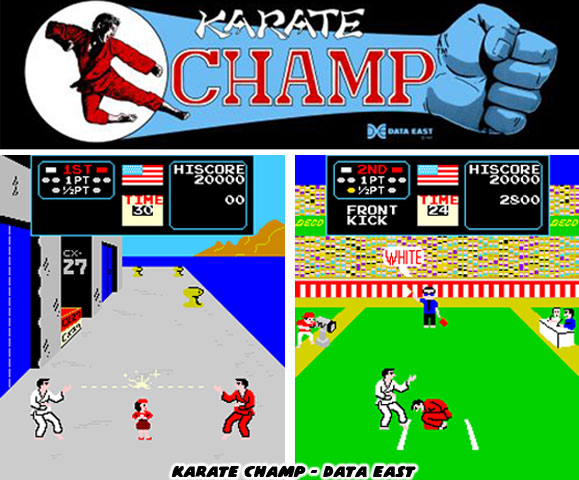
In fighting games (and in popular culture) karate would be considered a top-tier technique. The actual versions of karate featured in games were not necessarily rooted in one school. The looser the connection with an established style the better it was for developers to adapt into a game. In this way they could invent special attacks for the cast without fear from purists calling out the technique. Before characters could shoot fireballs from their hands karate was shown in a much more realistic light. In 1984 Technos released Karate Champ. It was one of the forefathers of the fighting game genre. The "plot" of the game was simple. The main character would travel from town to town and fight the best karate practitioners there. Players earned a full point or a half a point depending on the severity of their attack. The strikes in the game were based on actual karate moves, the points based on organized tournament rules. Players could punch, kick, jump and even block by entering commands on two joysticks. It was a clumsy control setup that would not be revisited by any other company. There was a "sub-plot" in the game as well. At each location there was a woman that was torn over which fighter she preferred. The winner of the tournament would get the girl. The girl-as-a-prize would be a trope that Anita Sarkeesian of Feminist Frequency would point out in many other genres.


Karate Champ was notable for using different backgrounds and locations to help tell a story. The main character went from dojo to dojo and even traveled around the world challenging opponents. While the main characters wore red or white it was due to limitations in the hardware. They were supposed to represent different fighters and even nationalities. This globe-trotting fighter was a Mas Oyama-type, a karate as the superior fighting form stand-in. Even the bonus stages were reflective of the demonstrations that Oyama would put on. He would break boards and even stones with his bare hands and his fights against bulls were legendary. But I'll go into greater detail on that in a future blog. In Karate Champ players could also break boards or even ceramic pots and bottles thrown at them. It was a little silly but made the fighter look like a badass. Karate Champ was mildly popular but the runaway hit from 1984 was a different type of fighting game. Irem released Kung-Fu Master, a game based loosely on Bruce Lee's final film "Game of Death." Kung-Fu Master predated Renegade (Technos, 1986) and Double Dragon (Technos, 1987) and could actually be considered the forefather of the brawler.


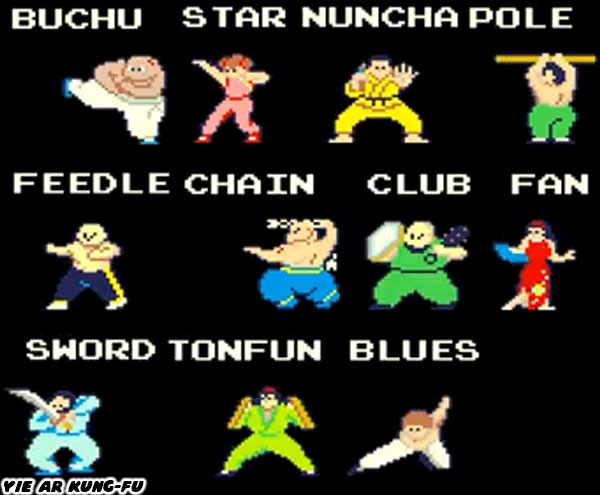
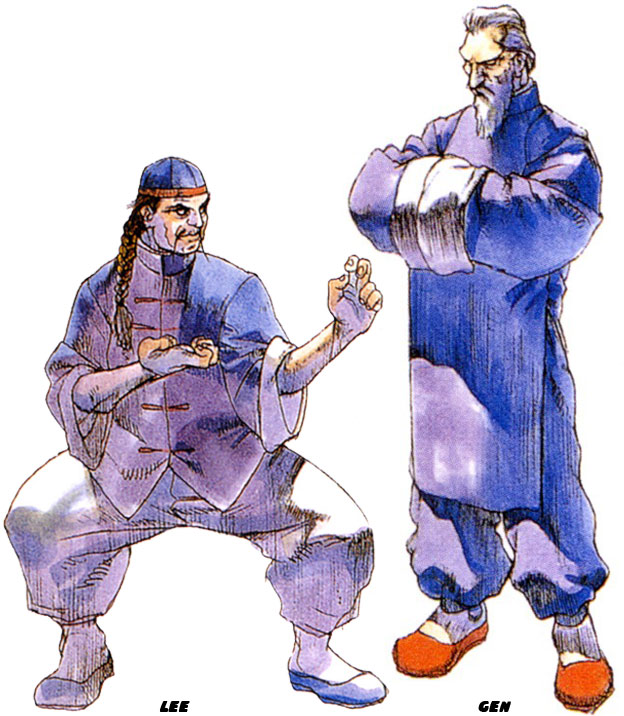
The first few kung-fu games created a framework that would be followed by the rest of the industry. Konami released Yie Ar Kung-Fu in 1985. It featured masters of different forms of kung-fu against a hero named Oolong. Some of the fighters used weapons while others user their hands and feet. It was notable for the traditional locations players visited as well as being the first fighting game that featured female opponents. Yie-Ar Kung was a fast-paced, very frenetic fighting game. There were no pauses in action, no chance for the player to breathe. The focus was less on realism and more on capturing the energy and slick choreography of kung-fu action films. The slow, calculated scoring system of Karate Champ was thrown out the window. Nonstop action would become the style of gameplay that Capcom and the other studios would try to build upon. Because of this the kung-fu master would become a trope in fighting games, especially Japanese fighting games. Lee and Gen appeared just two years after Yie Ar Kung-Fu. They kept the classical costumes with them. Capcom had unveiled a game engine capable of putting larger sprites with greater fidelity and more colors on the screen than Konami had done. This engine was used as the backbone for the original Street Fighter.


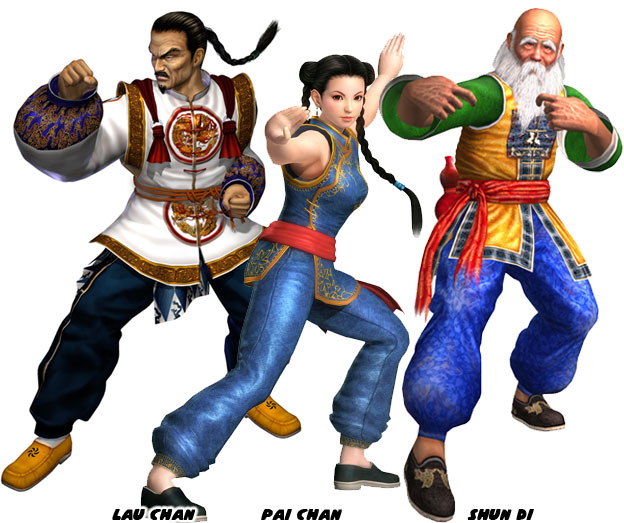
Kung-Fu masters were so well known globally that almost every fighting game had to make use of them. Three of the greatest fighters in Virtua Fighter tournament play and also in canon were Pai Chan, her father Lau Chan and family friend and "Drunken Master" Shun Di. Sega was one of the pioneers of 3D technology in arcade games and created what is generally regarded as the first 3D fighting game. Virtua Fighter was a hit from 1993. It had realistic graphics, lighting and quasi-realistic physics as well. These were things that audiences hadn't really seen before. The game was set in the modern world but many of the fighters were presented with classic uniforms, especially the Chinese ones. Pai and Lau were in the original game and Shun Di appeared in the sequel a year later.


Not to be outdone Namco released their first 3D fighting game in 1994. The studio had a long standing rivalry with Sega. Anything one studio did the other studio tried to do better. It was seen in racing games, space shooters and especially fighting games. Tekken was the result of their work and audiences were split as to which 3D fighting game was better. The elderly kung-fu master Wang Jinrei appeared in the first Tekken. His understudy Lei Wulong, a "Super Cop" based on a Jackie Chan character, appeared in Tekken 2. A more classic villain Feng Wei debuted in Tekken 5. Again, despite being set in the modern world the characters were mostly stereotypes pulled from Hong Kong cinema.


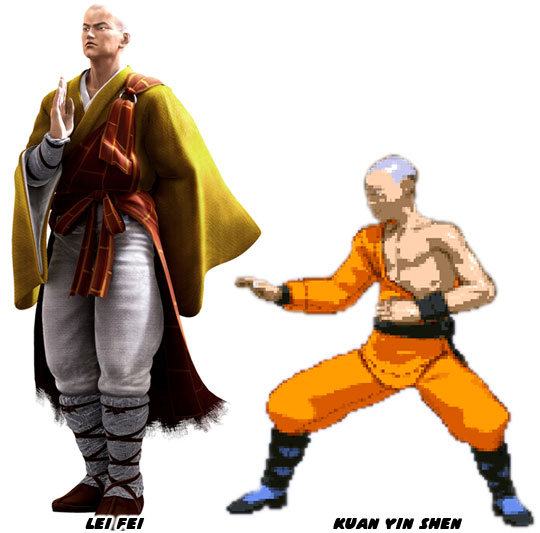
While Buddhist monks were credited for introducing kung-fu to China they have actually been grossly underrepresented in fighting games. Fans of the Mortal Kombat series might mention that Liu Kang and Kung Lao from the Mortal Kombat series were monks although they did not look or dress traditionally. The series was about as inaccurate as a fighting game could be when it came to representing actual fighting arts. The purpose of Mortal Kombat was to shock players with its ultra violent moves and fatalities. It was well done but it was fairly insensitive to Asian culture and traditions. In the history of fighting games were have been only two fighters based on actual Shaolin Monks. Lei Fei, appeared in Virtua Fighter 5 in 2001. There wouldn't be another monk worth mentioning until 2008. Kuan Yin Shen was the younger of the two and he appeared in Capoeira Fighter 3 by Spiritonin. The character was actually named on a Buddhist deity. Sega was a Japanese developer and Spiritonin was a US developer. The representation of traditional Shaolin kung-fu was indeed extremely rare around the world. But why was this? Perhaps religious undertones made the monks appear less intimidating in the games. It didn't matter if they studied the iron body techniques, could run on water or knew the death touch. In western circles a person in a robe just didn't seem as formidable as say a seven-foot cyclops that practiced Muay Thai. In Hong Kong cinema this was not the case, monks of different schools could be the subjects of action films. The classic Shaolin vs Lama highlights the fighting capacity of religious followers.


Popular culture dictated which styles appeared in a fighting game and even how the fighters themselves would be presented. Hong Kong cinema was the root of many kung-fu tropes. Some of which were based on historical figures but the vast majority were made up. The next blog will highlight how cinema influenced the evolution of the fighting game genre. I hope to see you back for that. As always if you enjoyed this blog and would like to sponsor me please visit my Patreon page and consider donating each month, even as little as $1 would help make better blogs and even podcasts!