Showing posts with label big daddy. Show all posts

Monday, May 22, 2023

Ed Roth, the original Rat Fink - Originally published on 1UP - March 5, 2009

Welcome back friends, I hope you are enjoying this series so far. Today I'll be talking about another of the hot rod art pioneers and one of my personal heroes "Big Daddy" Ed Roth. Big Daddy was one of the reasons I was inspired to write the entire series. Roth passed away a few years ago, and Von Dutch passed on a decade earlier. If you remember I mentioned that artist Dave Deal has passed away last year. A good number of artists in the automotive world were leaving us too soon. While their legacy was celebrated in the car circles it seemed that very few outside even knew or cared. I felt that their passing should be honored and remembered, especially on 1UP where sometimes the community isn't focused on this culture.

Ed Roth was a character and a half. Like Von Dutch he had his hands in everything within rod culture. Always the showman you could expect to see Roth show up at car shows sporting a suit with tails, a top hat and monocle. His custom rods were some of the first built specifically with the show circuit in mind. Not content with chopping and painting an older-model coupe, Roth and his friends created rolling works of hot rod art. The frames and engines sometimes chromed and polished themselves with a body sculpted by hand. Roth rarely bothered with a measuring tape while applying plaster of paris over a mock-up frame made of plywood in order to create his outlandish fiberglass bodies. Each of these rods were more innovative and mind bending than the last.
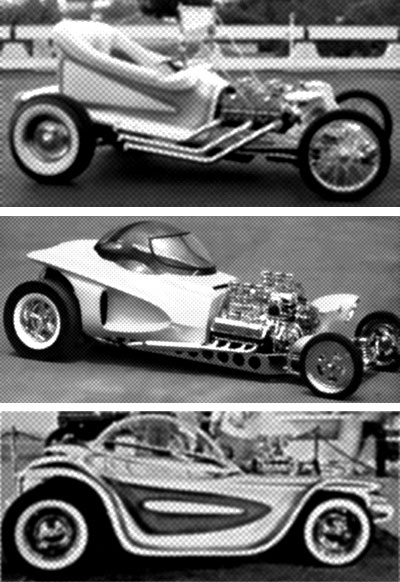
The "show rods" that Roth helped pioneer were part of a new rodding movement. Most of Roth's work were functional cars, no matter how outlandish they were they could at least move under their own power. Some show rods by other artists were non-functional and had to be pushed out. They were artistic statements extending beyond the traditional hot rod culture of converting old cars into racers. These artistic rods were made out of everything from a telephone booth to a tank, ultimately turning up everywhere in pop culture, from films and television shows to comics and cartoons. The hand-built cars from Roth, although not always the most popular in car circles during the 60's eventually became highly-sought collectors items. In recent years an original, restored Roth car, has earned over a million dollars at auction. One of the most interesting Roth stories of recent years was the discovery and restoration of his Orbitron. However show rods were not the only major influence Roth held over the culture. His biggest legacy was arguably from his airbrushed monster shirts.

In the early 60's Roth and his contemporaries would airbrush shirts for car clubs and fans at conventions. Roth worked alongside legendary art and car visionaries such as Dean Jeffries, Richard Ash, Stanley "Mouse" Miller, Ed "Newt" Newton and Gary Olsen. After drawing countless shirts the men started changing up their renderings to stave off boredom. What came from the experimentation were the caricatured cars and the cartoon-style hot rods that we've all seen associated with the genre. These would be the seemingly flexible cars with gigantic motors in the front and balloonish tires in the back, doing a "wheelie." Often-times a bug-eyed monstrous character would be driving these rods. In some cases the shirts featured only the monsters themselves. The majority of Roth's famous characters and rod designs were actually created by Ed "Newt" Newton. The monsters proved wildly popular with teens and created a phenomenon.

Youngsters, especially young boys and teenagers in So. Cal., were drawn to the gross-looking characters and their monster rods. They were looking for a symbol that skirted the sterilization that the Comics Code Authority placed on comic books. While the monsters were covered in warts or had razor sharp teeth and bug-eyes, at no point were they committing acts of sex or violence, hence they weren't in violation of the decency laws. Many say that the inspiration for the monsters was based on Basil Wolverton's Lena Hyena in the pages of the Li'l Abner comic. Lena Hyena worked so well for shock value that Newt and his boss would refine the style and make it their own. Eventually they produced trading cards and stickers with their monstrous creations.
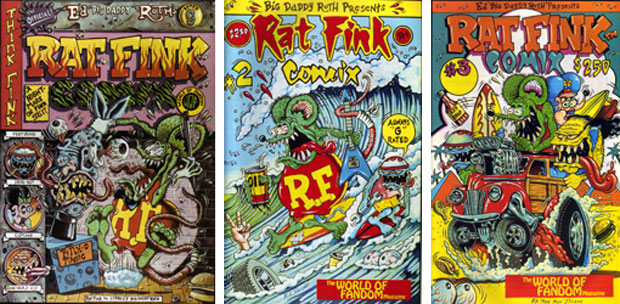
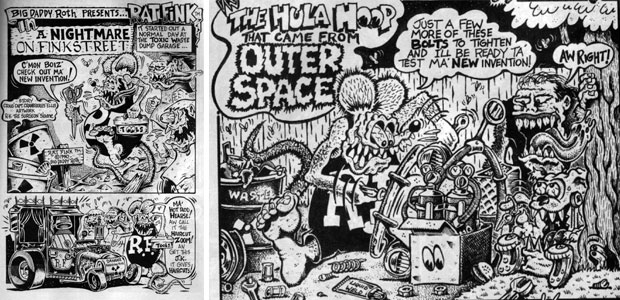
The covers of the Rat Fink comic books, published in the 90's, were not misleading, the adventures of Rat Fink, Cupcake, Drag Nut and the Junkyard Kid really were all G-rated. The adventures were nonsensical, stream-of-consciousness storytelling with some of the craziest black and white panels ever committed to print. As manic as they were the stories and situations were also filled with plenty of comedy and earnest good fun, they were never violent nor gory so could be picked up by anybody. The shocking characters were abhorred by parents which made the youngest members of the counter-culture identify with the monsters even more.
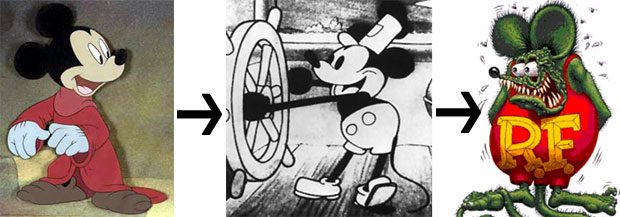
While many people think that Rat Fink was the antithesis of Mickey Mouse his origins are actually a sort of homage to Mickey. In an interview Roth was asked where the inspiration for the grotesque monsters came from. He explained that they were simply de-evolved cartoon characters. Roth produced an illustration of Mickey Mouse circa his Fantasia years. He mentioned that while we knew this was how Mickey looked, the character didn't always look like that. He then drew a version of the mouse from the earliest black and white films. Very rough but still recognizable. He then drew a rat monster and said if you go back far enough maybe Mickey's dad looked like that. He put the drawing away for the rest of the interview but returned to it soon after. He thought that this monster rat had something unique going for it and reproduced it on a shirt. Rat Fink was born from Roth's love of the Disney character, not as many believe an anti-commercialism rant against the mouse. It would be hypocritical to say that Roth was against the business since he sold tons of products with his characters and gladly signed deals with Revell to produce models based on his cars.
It is safe to say that a major influence on the underground comix scene from the late 60's was through Roth and Newt. The iconic "lowbrow" painter Robert Williams even spent time as an art director at the Roth studios. Williams was heralded as a pioneer of a new artistic movement alongside people like Robert Crumb and Bill Wray. Their odd comics and figures were definitely unlike anything produced by the mainstream comic book companies. This counter-culture art movement was more than a fad, like the rod culture itself, it would continue to grow and evolve until it found acceptance in the mainstream.
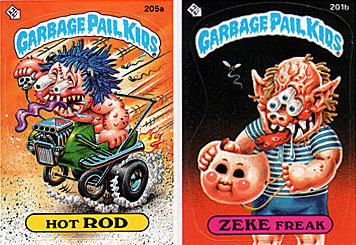
Decades later the gross art style that Roth made popular returned with the phenomenally successful Garbage Pail Kids trading cards. It seemed that no matter how far hot rod art was from popular consciousness it could not completely escape its pull. The monster characters and monster hot rods have now been part of American culture for at least 40 years. There is no sign of the culture slowing as it spreads across the globe and has strong following from places like Finland, South Africa and Japan. As for the man himself there are plenty of books about Roth and his influence plus a documentary film. If you are an artist and looking to learn the monster art style then look no further than this How to Draw book by Thom Taylor and the master Newt himself. But I'm not done talking about the art of rodding, tomorrow I'll talk about an artist that forever changed the world of hot rodding.
What do you think about the intersection of crazy looking cars, and grotesque monsters? Let me know in the comments section please. As always if you would like to sponsor me please visit my Patreon page and consider donating each month, even as little as $1 would help make better blogs and even podcasts!
follow the Street Writer on Patreon!

Wednesday, February 14, 2018

The Giant Monster Series, part 5...


The giant monster genre was a subsection of the monster genre. The tradition of scary beings went back to the earliest days of storytelling. Imagine primitive tribes sitting around a fire recounting the time they almost got eaten by a giant bat or snatched by a troll living under a bridge. Monsters were sometimes shape-shifters, they looked human from a distance but then up close they were something else. The bigger the monster, or god, the greater the chance for destruction. Gods and giant monsters were the roots of disease and natural disasters. Some demanded a blood sacrifice in order to be satiated. Smaller monsters could still be bloodthirsty, or demand a sacrifice. Their destruction was limited to a small group of people, a clan sometimes, they were just effective when used for a cautionary tale.


One of the classic monsters was the Cyclops. The one-eyed monster was the child of the god Zeus. The creature had a habit of eating trespassers on his island. He was blinded by Odysseus (Ulysses) and as punishment Zeus caused Odysseus and his crew to be lost at sea for a decade. Most lost their lives to various creatures, large, small and seductive. Homer the poet was credit for writing the Odyssey. The creatures he described represented a various state of being for the gods, or hubris for the lost Greek sailors. No matter how far they traveled, they could never outrun their past. The monsters in classic literature manifested our innermost fears. Another creature that reflected our psyche was the monster created by Dr. Frankenstein. The story by Mary Shelley was a cautionary tale about accepting responsibility for your actions. In the case of Dr. Frankenstein he was a reckless scientist. He succeeded in creating life from death but was horrified with the results. He abandoned his creature and without a master or guiding hand to temper his existence the creature terrorized a village. There were so many layers to the creature, ranging from pitiful to morbid. It made the creature both sympathetic and terrifying to behold. When the monster showed up in movies it created a template that would be copied by other studios and even game developers.


Bioshock by 2K was released in 2007 and had a monster not unlike Frankenstein's creature. The "Big Daddy" was a mutated man inside of a twisted diving suit. He was protective of his "daughters," mutated girls. Like the creature he was obscenely strong. He was relentless in his pursuit of the hero. The setting in the game made the encounters with Big Daddy much more intense. Audiences were trapped in the remains of an underwater city called Rapture. The hero couldn't simply run to the next town for help. The additional layer of isolation on top of a great antagonist made the series unforgettable. In the follow-up title, Bioshock Infinite by Irrational Games, the player was trapped aboard a floating city called Columbia. The game from 2013 replaced Big Daddy with a cybernetic automaton called the Handyman. Like Frankenstein's creature it was an unstoppable force with a tragic back story. Series director Ken Levine managed to turn both monsters into sympathetic creatures by the end of each game.

Great monster stories are about escapism. Whether the setting is Victorian England or Japan in the near-future, there has to be something for audiences to escape to or from. For video games it is not enough to run from the monsters, but to be able to fight them as well. When audiences were introduced to the Big Daddy or the Handyman they were grossly unprepared for the encounter. Early on in each game players had to learn how to hit and run from their opponents. As they gained experience then they earned new weapons and abilities. Eventually the game evened the playing field and audiences no longer had to fear the monsters. This formula has probably never been exploited more than in the Earth Defense Force series.


Earth Defense Force is a long-running series from publisher D3. The game has traded multiple developers since it debuted in 2003 but the core experience remains the same. You are the hero in the ultimate movie spectacle. Imagine a game recreating the biggest fights in Independence Day, Pacific Rim, Guardians of the Galaxy or Godzilla. In essence the jaw-dropping special-effects scenes that put people in movie theaters every summer. The story in each game is straightforward, you are a member of an elite force that is protecting the Earth from alien invaders. As aliens, in the form of giant bugs start popping up you fight them with small weapons but as you progress the tools get bigger and better. You move from machine gun, to rocket launcher, to tank and eventually science fiction weapons; power suits, laser rifles, rocket backpacks and much more. Your squad is under a constant barrage of enemy fire and giant monsters. It is a frenetic experience that ups the ante with every mission.

If you've never heard of the title there's probably a reason. The game has a cult-like following. Visually the graphics are amazing. The scale of the creatures you have to fight is off the chart. The alien spacecraft, giant bugs and monsters in the series are literally breathtaking. They are among the largest things ever presented in a game. Remember that this includes the enormous monsters in Mass Effect, Resistance, Lost Planet, Monster Hunter and the God of War series. From a game play standpoint there is a lot of action to be had and a ton of different ways to dispose of the various giant creatures you come across, including the ability to pilot a mecha or giant robot.


Despite the awesome visuals the game is lacking in depth. Like many of the summer movies the experience is about spectacle and nothing else. Films like Armageddon (1998), The Day After Tomorrow (2004) and San Andreas (2015) pile on the special effects and hope that audiences don't mind the lackluster script or poor acting. The EDF series is the gaming equivalent of those effect features. Small details that are addressed in AAA titles are overlooked in the series. Things like clipping (where 3D models intersect), animation and collision detection are not always right. But it doesn't seem to matter when the game hits you with wave after wave of giant robotic lizards and space ships that eclipse the horizon. No sooner are they destroyed than another batch arrives. You have no time to wonder how cities are rebuilt so quickly or why you are never fighting atop the remains of your enemies. The steady build up and immersive narrative of a Bioshock game is replaced with explosion after explosion. So was there a man versus giant monster game that captured the gravity of the situation better? Certainly! We will look at some examples in the next entry.

Sunday, May 10, 2015

Introducing Gigas, an original idea or more of the same? Let's take a look!

Fighting game fans were in for a shock when the fighters for Tekken 7 were unveiled. Familiar faces had returned along with a new young girl and handsome man which were part of the long-running Namco themes. What caught fans off guard was a massive bruiser that looked completely unlike anything featured previously in the series. The massive red humanoid, known only as Gigas, seemingly came out of nowhere and was poised to topple the most powerful fighters in the series.


Fans from the west were certain that the Japanese developers were catering to Western tastes. It seemed that many heroes and villains from Western video games, comics and movies were massive, muscle-bound monsters. It didn't take long for the comparisons between Gigas and his influences were being pointed out in online forums. An obvious similarity between Gigas and US designs could be seen with the Red Hulk, a villain from the popular Marvel Hulk comics and the mysterious Big Daddy from the BioShock series.


Yet there was several design cues that came from a different property also from the West. The Batman: Arkham series of games has featured several versions of the character known as Bane. The one featured specifically in Arkham Origins seemed the one directly responsible for the appearance of Gigas. There was the massive torso, large arms and tubes connected to the various major muscle groups on both characters. Yet there was much more to Bane than simply being a genetically-enhanced monster. When the character was introduced decades ago he was created to be the ultimate rival of the Batman. The man was a former prisoner-turned-assassin. He was subjected to various surgeries and treatments which enhanced his natural abilities. Batman was considered to be the supreme human physical specimen in DC comics. He was the perfect fighter and Bane was trained to match him in every mental and physical arena. The advantage that Bane had over Batman would be a drug called Venom which gave him a temporary increase in muscle mass, speed and dexterity. He used this to defeat Batman in unarmed combat and even break his back.


Sadly for Bane the writers and artists working at DC could not find a way to improve the character so they began changing his purpose as a worthy rival to the Bat. The character became over-reliant on Venom and in just about every subsequent appearance Batman would either cut off Bane's supply of Venom or cause him to overdose on it. Bane went from a cold, calculating villain to a musclebound stooge over a matter of years. The Joker would return to prominence as the main rival to Batman and Bane would be a supporting character in comic story arcs. The changes for the character were easy to see in animated form. When he first appeared in the Batman Animated Series he was very much rooted in his original comic book design. When he returned a few years later in the new Batman shows he would become more and more exaggerated and dark in his designs. One of his last designs made the character look more alien than human. Part of the reason for that was because the team of artists working on the character designs had previously worked on the Ben10 animated series. Ben10 if you may know was based on a kid that could change from a human into an alien host. The muscle on the new Bane were far larger than ever before, his strength increased tenfold and ability to withstand punishment increased. His skin had even been turned red. If these were not the roots of Gigas then I don't know what else to tell you.


The changes in the appearance of Bane were only part of the equation. Over the past few years many artists had been experimenting with how far they could push the designs of fan-favorite characters. The Joker had been a staple in the Batman comics for decades. His look had changed only slightly over the years but DC shook the community with a recent redesign. The character had cut off his own face and wore it as a mask to add a certain level of grotesque to his already macabre appearance. Many of the Batman villains received the same make-over. In order to give Bane a new look the artists working at DC and even at video game publisher Rocksteady had to push the envelope. As with any design the question remained; how far could the character be pushed and still retain the core elements? How would this character be identified by fans? It seemed that Bane could be made very grotesque and audiences would still recognize the character.


Yet even Bane was not an original idea. The man-becoming-a-monster was a staple of classical storytelling. It was not always a physical transformation to show a person becoming man, such as with Ahab in the story of Moby Dick. Other times a monster represented the mistakes of man, such as the creature created by Dr. Frankenstein. More than a century before Bane was created there was a character called Mr. Hyde. Robert Louis Stevenson (author of Treasure Island) wrote a novel on a scientist named Dr. Henry Jeckyll that used a chemical mixture to become a powerful monster known as Edward Hyde. The monster was more beast than man and terrorized the citizens of Victorian England. The characters of Jeckyll and Hyde would become synonymous with extreme personality changes and not necessarily physical changes.


The Hyde character would be revisited by Alan Moore in his graphic novel the League of Extraordinary Gentlemen. The story would be turned to film and Hyde would get yet another on-screen interpretation. In order to create a monster even more terrifying than Hyde the movie introduced Dante, a soldier that overdosed on the secret formula. The end result was an extremely grotesque and disproportionate man. He hardly looked human at all and could be considered one of the first 3D representations of the extreme comic book proportions that artists were placing on their figures. Yet to say that Hyde begat Bane begat Gigas in Tekken would be an insult to the Japanese designers.

Game designers in Japan as well as artists and illustrators had been creating monstrous characters for decades. They had been working on absurdly disproportionate muscled figures for as long, if not longer, than Western artists had. In fighting games there were many presidencies set by Japanese studios before Gigas had even been dreamed of. Capcom, SNK, Arc System works and various developers had been pushing the envelope on the "strong man" character trope. To help the characters stand out the artists often gave them large shoulders and thick arms while keeping their legs thin and heads small. This visual made many of the bruisers memorable.


The proportions featured on Gigas were not as extreme as they were on characters like Potemkin or Abubo but they were close. What Gigas had going in his favor was that he was one of the few Japanese characters designed in 3D with the exaggerated aesthetic. Because Bane had been presented in 3D previously most audiences simply assumed that the designers at Namco had simply poached the style. This was far from the truth. Both 2D and 3D fighting games from Japan had characters like Gigas for decades. Monsters and demons of the Gigas scale had already prepared audiences for what was to come. One of the first 3D monsters that predated Gigas was also from Japanese designers. Gandara appeared in Samurai Showdown / Samurai Spirits 64. The title from 1997 was not well received by audiences. It lacked polished control and featured crude graphics. Something that was well done however were the character designs, especially the demonic Gandara.


Gandara lacked the tubes and mad science theme of Bane, but was still bound in service. It was not technology but rather magic that kept Gandara enslaved. The tortured appearance was a bold artistic statement and made Gandara one of the most memorable fighting game designs of all time. Shifting the focus back on Gigas though we should note that Namco had actually set a precedence for massive fighters ever since the very first Tekken was released in 1994. The "strong" type fighter in the original game was a cyborg named Jack. The character looked like an army soldier, with a square blonde mohawk and a massive torso. As the series evolved so too did the designs for Jack. The skin would be replaced by metal and even hexagonal armor. Although the character developed a personality the Jack models would become disposable within the canon of the Tekken series. The character was bound in servitude to the Mishima Zaibatsu. The private military conglomerate run by Heihachi Mishima. Any version of Jack that demonstrated self consciousness would be destroyed by the company. It made Jack a likable cyborg especially as he became a pacifist. There was an earlier build of Jack that was also in the original Tekken tournament, known as P-Jack or Prototype Jack. This all-metal version of Jack wore sunglasses and was absolutely loyal to his programming. It made the character more dangerous in canon.


The robots of Tekken continuity were considered some of the strongest fighters in the series. The proportions of each version of Jack were similar to those of Gigas. But there was a missing-link of sorts. An MMA brute named Craig Marduk was introduced in Tekken 4. The seven-foot Australian was a champion fighter and an absolute genetic freak. He could out-muscle his opponents easily but was also a well-rounded technician in the ring. He was as close to being a Bane-type character minus the Venom. Marduk could go toe-to-toe with the Jack robots and just about any other character in the series. I would argue that Gigas was a mix in between Jack and Marduk. Whomever invented this fighter wanted the best of the physical abilities of Marduk but with the programmable loyalty of P-Jack. I believe Gigas is an entirely new weapon being developed by the Mishima Zaibatsu. The company has undoubtedly learned from their genetic experimentations. Many of the Tekken Tournaments are a front for the company. The plot of the games involve genetic manipulation, stolen DNA and cybernetic enhancements to soldiers and assassins. The characters Yoshimitsu, Anna and Nina Williams and Brian Fury have a mix of genetic manipulation if not all-out cybernetic enhancements. These figures were created to lead robots into battle, if not to act as a fail-safe in shutting down the machines. As impressive as Jack and P-Jack are they are far from being the biggest robot bruisers in the series. That honor would belong to NANCY-MI847J, a robot as large as a trailer truck.


Gigas could be deployed where the Robot NANCY would be a target to missile launchers. With the ability of some reasoning Gigas could also replace the faulty logic of the Jack models. It is the science-fiction that the Tekken series adheres to that I find most interesting. The teams working at Namco are intimately aware of how each game connects to a bigger storyline. They also know that the continuity of one series often marries into the canon of a different title. The Ridge Racer racing game, Tekken fighting game and Ace Combat fighter jet titles are all part of the same universe. The technology developed by one fictional conglomerate in the universe will turn up again and again and even become refined in different games. One of the more interesting features of Gigas is the helmet.


Cybernetic eyes and helmets had been featured in the design of the cyborg ninja Yoshimitsu. The multiple cameras where the eyes should be act almost like spider-eyes. They allow Yoshimitsu and in this case Gigas to have a greater view range than regular human eyes. The helmet worn by Gigas is a bit different than the ninja however. The hexagonal series of cameras are reminiscent of the COFFIN interface from the Ace Combat series. In the most advanced fighter jets in the series the pilot can see a full 360 degrees around the plane without ever having to turn their head. Cameras replace the open canopy of traditional fighter jets and feed the visuals directly to the mind of the pilot. In the case of Gigas he can see above, to the side and even almost all the way behind without having to turn his head. This makes the genetic creation impossible to sneak up on and even more dangerous in unarmed combat. Tekken is an amazing series from a design standpoint because it has humans fighting robots, but it doesn't end there. Monsters and even Angels and Devils could be seen as genetic anomalies rather than supernatural creatures thanks to the science in the series. I can't wait to see how Gigas develops and what his role will be in the greater scheme of things. What do you think about his design? If you would like to sponsor me please visit my Patreon page and consider donating each month, even as little as $1 would help make better blogs and even podcasts!
follow the Street Writer on Patreon!