Showing posts with label gigas. Show all posts

Saturday, July 25, 2015

Necalli, a first look and second take on the new Street Fighter V character...

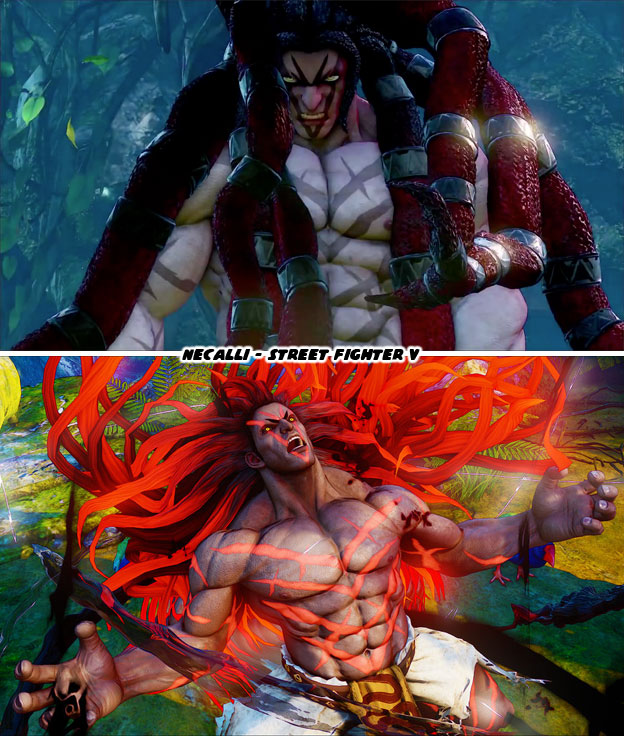
Okay friends let's talk a little bit about the new guy, Necalli, recently announced for Street Fighter V. I'll break this blog into my initial reaction, and them my thoughts as I saw him in action and then my early observations for his reveal. In case you haven't seen the character here he is in his two "modes."


Teenage me would have been all over that design. I mean he's got long dreads and tattoos! How cool is that? Then when he goes into Beast Mode his tattoos glow and his hair becomes big and red. That is crazy! Clearly this is going to be a popular character with guys that like rampaging all over opponents. When I first saw him I had two thoughts cross my mind and that you might not expect. The first was that this character was in response to Gigas, one of the new fighters in Tekken 7. Street Fighter producer Yoshinori Ono was friends with Tekken series producer Katsuhiro Harada. Was this a jab at the new fighter?
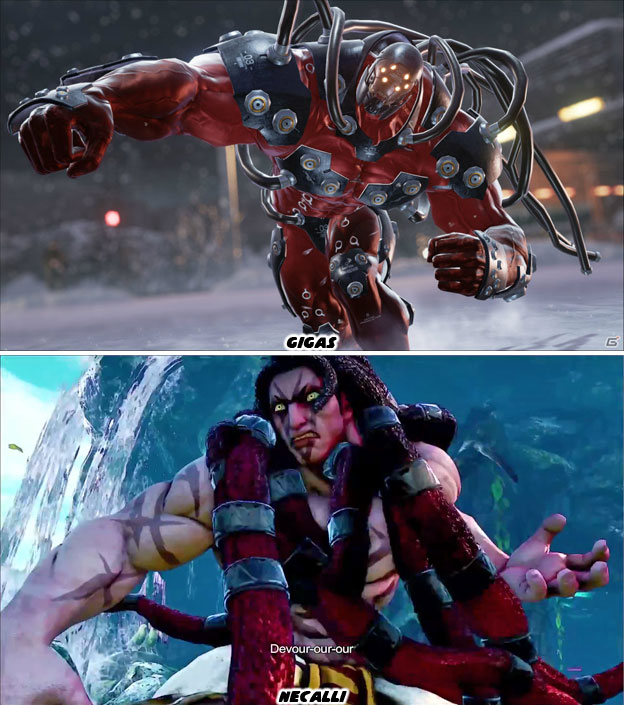
 

When I saw the hoses sticking out of Gigas all I could think was how distracting they were. The dreadlocks on Necalli seemed a little bit distracting as well. They were very thick and lumpy yet they bounced all over the place as he moved. The yellow eyes, red and black braids in Necalli's hair mirrored the color scheme of Gigas as well. Of course it could also be a coincidence.

The second thing I thought of was who this character was designed to appeal to. Was he designed for Japanese players? Young audiences? Older fans? Perhaps he was designed to appeal to players in the West. However I had a feeling he was designed to appeal to Chinese audiences.
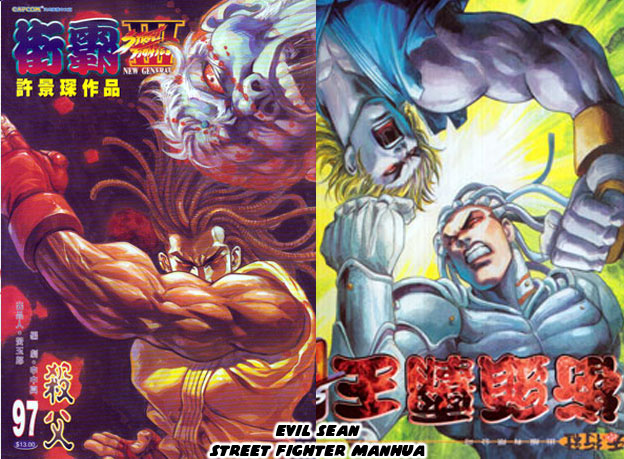
   

The reason I say this is because in Chinese manhua, comic books, the characters are often very over-the-top. They tended to combine many contrasting elements into the designs of a fighter, you know like, masks, tattoos, super powers, dreadlocks... Some of the more memorable designs from Japan and the US usually focused on a few defining elements. In China the characters can sometimes be overloaded with multiple cues. Such was the case for Sean from the Street Fighter series. The Chinese comics featuring the character took great artistic liberties with him. He was a sidekick character that looked similar to his game counterpart. He was young with short hair early on in the comics. Many issues later artists then made an "evil" version of the character that was slightly older with long braids. This version was decapitated and came back as a cyborg with metallic braids. I can't make this stuff up! I wondered if Necalli's various elements, the braids, the tattoos and transformation were combined in order to make him appealing to Chinese players.
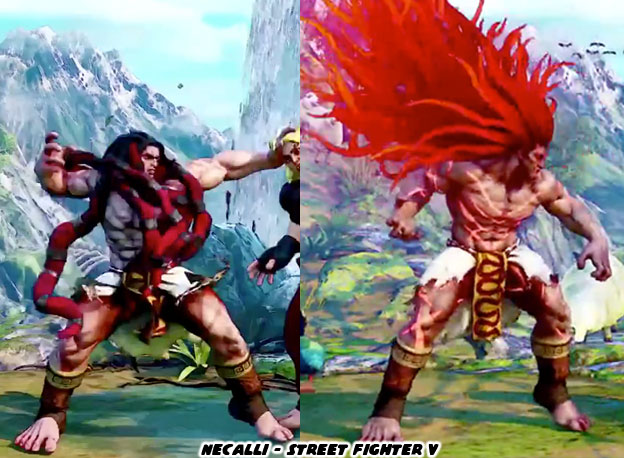
 

The next thing that I thought of after that was his costume and ability to transform. The tribal costume and hair color shift made me think of two distinct franchises. The first was the obvious one… Dragon Ball. The glowing red hair was very reminiscent of Gojita and the ability to manhandle opponents came from Broly. The colors on the clothing may also have been inspired by these fighters.
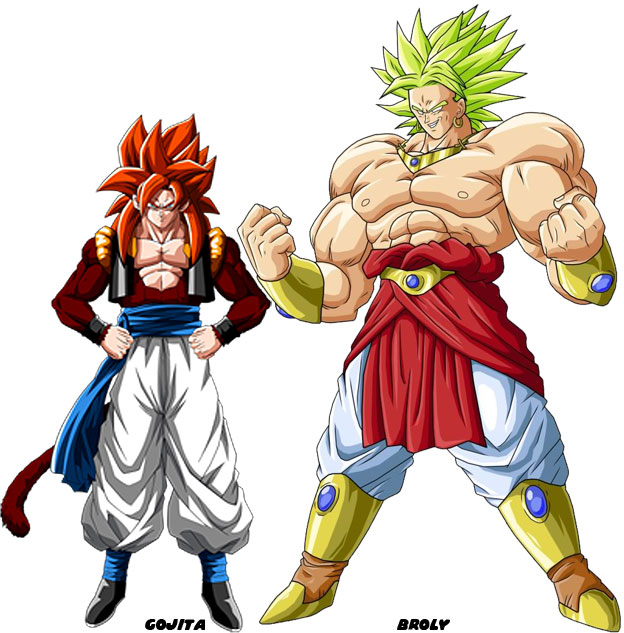
 

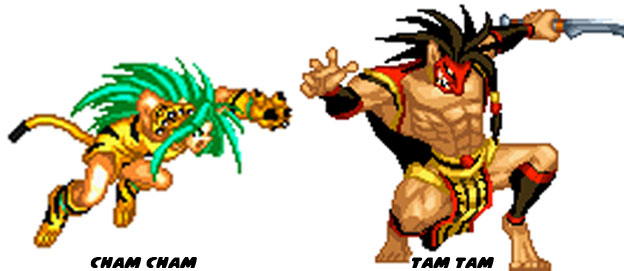
However the shredded clothing and leg bands were a staple for jungle fighters, for "noble savages" like Cham Cham and Tam Tam from the Samurai Spirits series. When I saw Necalli's hair I actually thought of Cham Cham. Characters from the jungle were often presented in a type of pre-Columbian native wear. Perhaps with a loin cloth or some sort of animal skin as the costume. The designers at SNK and Capcom didn't invent the trope. These images were as old as pulp comics in the US and stories from the "exotic" locations from around the world printed in Victorian newspapers. The Japanese were instrumental in making the jungle fighter uniquely animé.
   

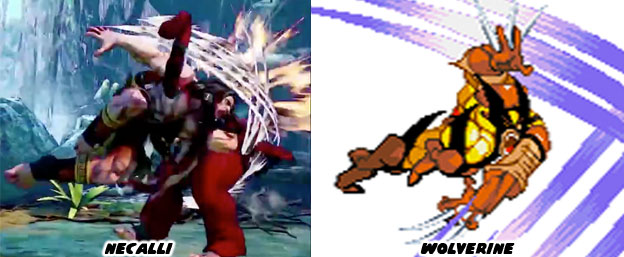
What I looked at next were the moves that Necalli was given. It consisted of mostly slashing attacks, stomps and throws. To make a crude comparison he slashed with the ferocity of Wolverine.
 

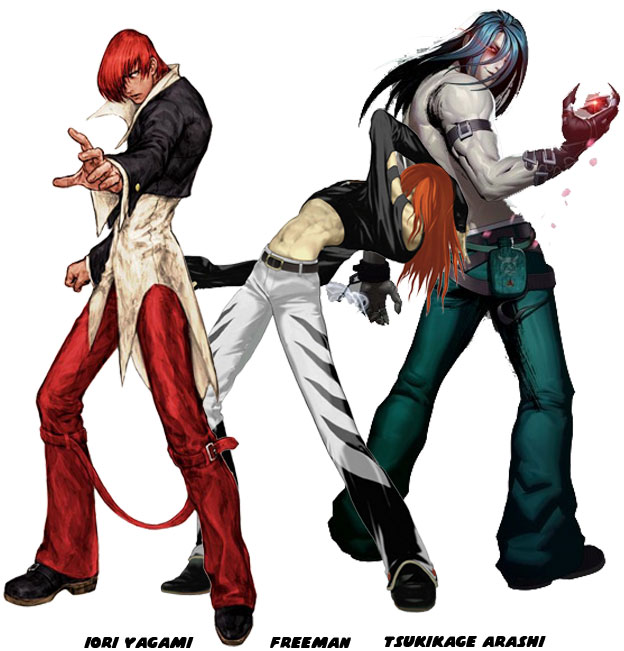
Anyone that has been playing fighting games for a few years could point at many other characters that slashed at opponents as well. Some were dressed in plain clothes such as Tiger from Martial Masters, some were dressed in regal uniforms such as Vold Ignitio from Fighting Layer. There were also those that were cool guys like Iori, Freeman and Tsukikage respectively from the King of Fighters, Garou: Mark of the Wolves and King of Combat. Each of these characters also slashed at opponents with their bare hands.
 

The template for the long haired slasher was older than Street Fighter itself. The hero Rei from Hokuto No Ken / Fist of the North Star, could cut his opponents to shreds using his fingers. The series debuted in 1983 and was highly influential on the artists at Capcom and their designs for Street Fighter, Final Fight, Street Fighter II and a few other arcade hits from many other studios.
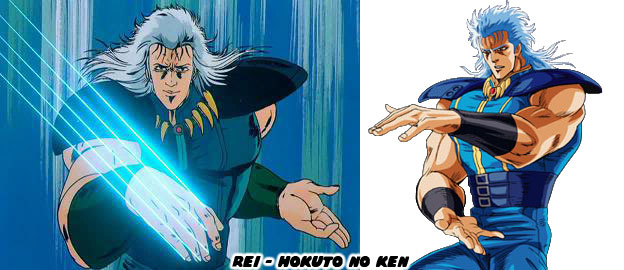
 

What concerned me about Necalli wasn't as much his design as it was his moves and how this character would effect the balance of the series. Necalli had a design that was very much boss-like. The fact that he could transform into a more powerful character with long flowing hair, glowing eyes and neon tattoos pretty much cemented the qualifications for a boss character, see Gill from Street Fighter III as an example. If he weren't a boss then he certainly was a sub-boss with those attributes.
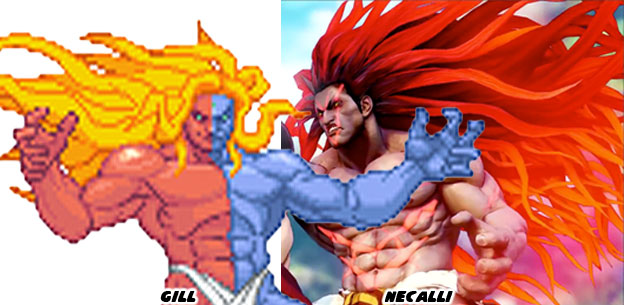
 

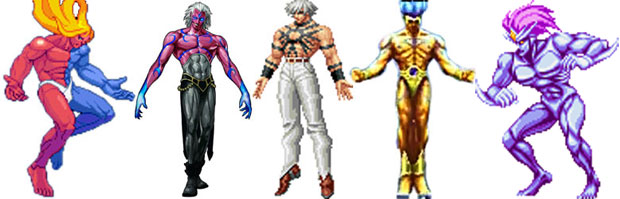
The thing was that we had seen the long haired, brightly colored, overpowered boss so many times in fighting games that it was starting to become predictable. In games from SNK, Capcom, Sega, Namco and various other studios there had been at least one boss character that fit the bill. He was humanoid but not necessarily a human. A demon or alien was the most popular type of long haired, omnipotent boss.
 

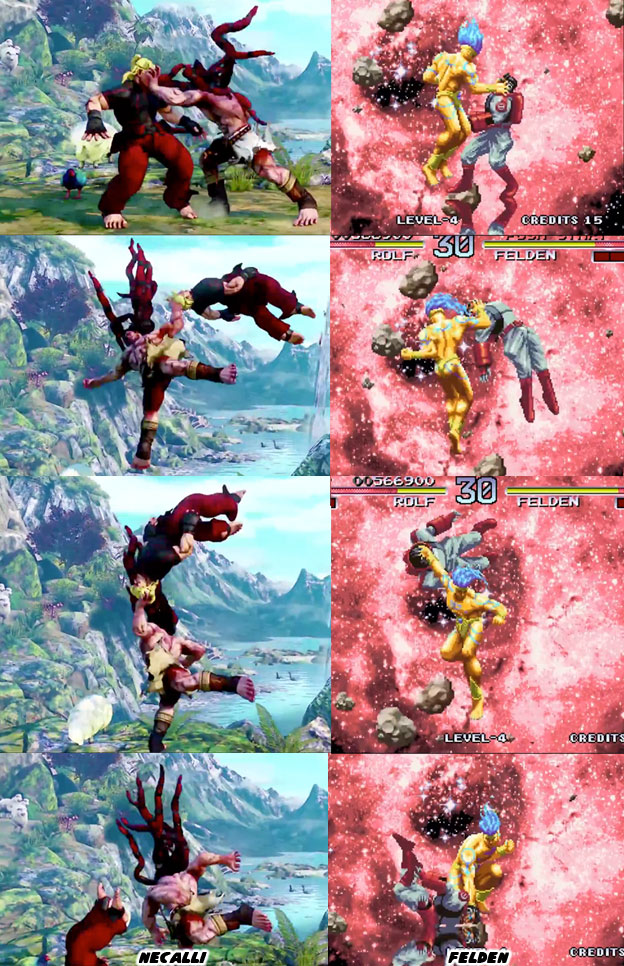
When you want to show how powerful the boss is then you have him manhandle his opponent with ease. With one hand if possible, and in the case of some bosses no hands are needed!
 

Even though Necalli is a playable character the idea that he can transform into a more powerful being concerned me greatly. Not because of what it did to the canon of the game but because what it did to the core mechanics of the game itself. A character with more than one style had been done before and done well, see the kung-fu master Gen. Players could with between his forms with the press of a button. But in Street Fighter IV and now V we have seen a shift in the game balance. One that requires the character to build a special meter in order to unlock the full potential of an attack or a library of moves.

It started with having to continuously pour oil on yourself for Hakan. Now we have Birdie that has to keep eating and drinking junk food in order to receive the benefits of a "V-Meter." It might be a "buff" or "armor" or some other bonus that the character earns once they fill the meter. I mean where does it end? Should Ryu be able to reach into his pocket and break some boards to get his armor started? Or should Chun-Li eat some dumplings to make her kicks more powerful? What if Akuma does 10 ShunGokuSatsu's in a row, will that allow him to become Shin Gouki?
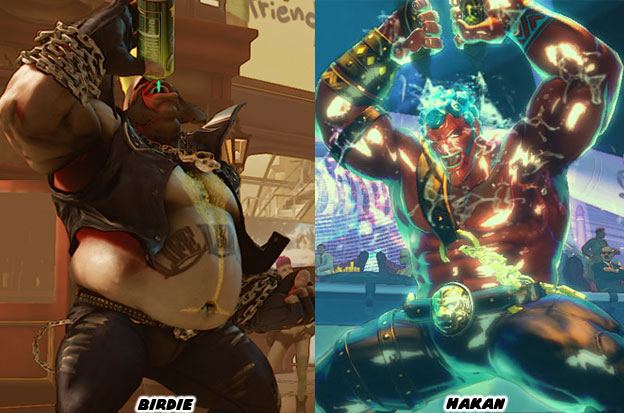

Will the game will suffer because players are forced to fill the special in order to play the character at their full potential? What if Necalli only had one form and full access to his abilities from the get-go? Would the character be more or less interesting? Would the game be more balanced?

I'd rather enjoy the game rather than focus on who can fill a special meter the fastest. Ultimately what concerns me is how the designers at Capcom are missing the lessons of the shows and titles that they are influenced by just so they can get a cool looking character in the game.
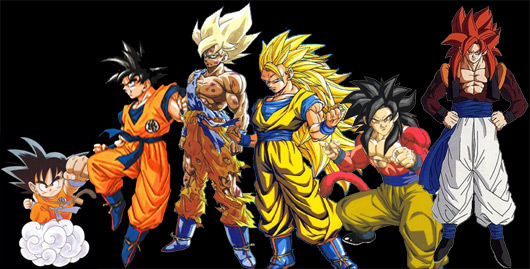
   

Dragon Ball was a highly influential series. It completely rethought the way that super-powered characters were supposed to fight. The fact that Son Goku could transform into a Super Saiyan was revolutionary. He was already a powerful character but then he could become 100 times more powerful. His hair would even turn to gold just to highlight how powerful he had become. This visual went on to influence every aspect of the entertainment industry. It was certainly not missed by the developers working on Sonic the Hedgehog.

But what many people forget was that it took a generation for Son Goku to grow up. There were many memorable adventures with his friends, and countless battles before he reached the point and was able to become Super. Once the proverbial super genie was let out of the bottle then it became a gimmick that was used again and again within the span of a few years.
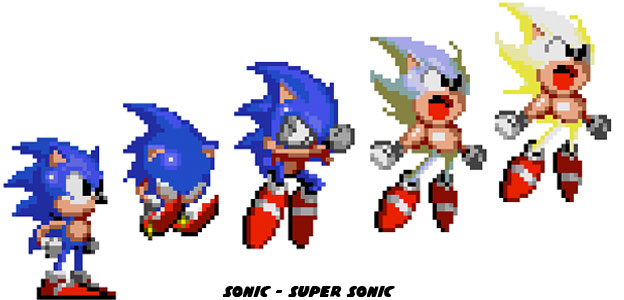
 

Once Son Goku could become Super, then his opponents had to become more powerful as well. It got to the point where Son Goku kept on evolving, his hair and costume becoming even more outlandish. Goku would outclass all of his robotic and alien opponents and soon could only fight gods. This formula became stale after a while. All of Son Goku's friends were so pitifully outclassed that there was little reason for them to be in the comics or cartoons. They either had to evolve or simply be written out of the plot. After 20+ plus years the creators went back to the drawing board and "rebooted" the franchise to the timeline where he could only turn Super Saiyan and even then it was barely enough to keep pace with his rivals. In doing so his supporting cast was able to return as well and join him on his adventures.
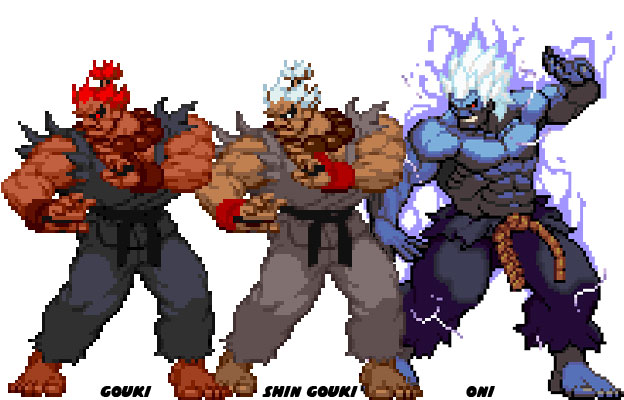
 

When I see what the team at Capcom is doing to Street Fighter I wonder if they missed the part where characters can only become so powerful before audiences begin to lose interest in them. Gouki was a fantastic character. He had the features of a lion. He was evil incarnate and had the attacks to prove it. But then came Shin Gouki, a more powerful incarnation. Audiences accepted the change, seeing it as a sort of Super Saiyan version of the character. Then there was Oni, and even more powerful version. I began to wonder what was the next transformation after that. Would he fuse with his back-from-the-dead brother to become Goukita? Would he become a god too?

Perhaps it would take another 20 years or another Necalli before the team realized that putting overpowered characters in a lineup was a flawed design approach. If they kept on that path then Ryu, Ken, Chun-Li and the rest would have to become boss-like characters as well or be replaced by Necalli-like figures. Or perhaps I was over-analyzing his introduction and Necalli was designed to be the extreme character, the Blanka or Dhalsim for this version of the game. The studio says they have at least three more new characters yet to debut, so we'll have to wait and see where Necalli fits in. I'd like to hear what audiences think of the characters revealed so far. As always if you enjoyed this blog and would like to sponsor me please visit my Patreon page and consider donating each month, even as little as $1 would help make better blogs and even podcasts!

Sunday, May 10, 2015

Introducing Gigas, an original idea or more of the same? Let's take a look!

Fighting game fans were in for a shock when the fighters for Tekken 7 were unveiled. Familiar faces had returned along with a new young girl and handsome man which were part of the long-running Namco themes. What caught fans off guard was a massive bruiser that looked completely unlike anything featured previously in the series. The massive red humanoid, known only as Gigas, seemingly came out of nowhere and was poised to topple the most powerful fighters in the series.


Fans from the west were certain that the Japanese developers were catering to Western tastes. It seemed that many heroes and villains from Western video games, comics and movies were massive, muscle-bound monsters. It didn't take long for the comparisons between Gigas and his influences were being pointed out in online forums. An obvious similarity between Gigas and US designs could be seen with the Red Hulk, a villain from the popular Marvel Hulk comics and the mysterious Big Daddy from the BioShock series.


Yet there was several design cues that came from a different property also from the West. The Batman: Arkham series of games has featured several versions of the character known as Bane. The one featured specifically in Arkham Origins seemed the one directly responsible for the appearance of Gigas. There was the massive torso, large arms and tubes connected to the various major muscle groups on both characters. Yet there was much more to Bane than simply being a genetically-enhanced monster. When the character was introduced decades ago he was created to be the ultimate rival of the Batman. The man was a former prisoner-turned-assassin. He was subjected to various surgeries and treatments which enhanced his natural abilities. Batman was considered to be the supreme human physical specimen in DC comics. He was the perfect fighter and Bane was trained to match him in every mental and physical arena. The advantage that Bane had over Batman would be a drug called Venom which gave him a temporary increase in muscle mass, speed and dexterity. He used this to defeat Batman in unarmed combat and even break his back.


Sadly for Bane the writers and artists working at DC could not find a way to improve the character so they began changing his purpose as a worthy rival to the Bat. The character became over-reliant on Venom and in just about every subsequent appearance Batman would either cut off Bane's supply of Venom or cause him to overdose on it. Bane went from a cold, calculating villain to a musclebound stooge over a matter of years. The Joker would return to prominence as the main rival to Batman and Bane would be a supporting character in comic story arcs. The changes for the character were easy to see in animated form. When he first appeared in the Batman Animated Series he was very much rooted in his original comic book design. When he returned a few years later in the new Batman shows he would become more and more exaggerated and dark in his designs. One of his last designs made the character look more alien than human. Part of the reason for that was because the team of artists working on the character designs had previously worked on the Ben10 animated series. Ben10 if you may know was based on a kid that could change from a human into an alien host. The muscle on the new Bane were far larger than ever before, his strength increased tenfold and ability to withstand punishment increased. His skin had even been turned red. If these were not the roots of Gigas then I don't know what else to tell you.


The changes in the appearance of Bane were only part of the equation. Over the past few years many artists had been experimenting with how far they could push the designs of fan-favorite characters. The Joker had been a staple in the Batman comics for decades. His look had changed only slightly over the years but DC shook the community with a recent redesign. The character had cut off his own face and wore it as a mask to add a certain level of grotesque to his already macabre appearance. Many of the Batman villains received the same make-over. In order to give Bane a new look the artists working at DC and even at video game publisher Rocksteady had to push the envelope. As with any design the question remained; how far could the character be pushed and still retain the core elements? How would this character be identified by fans? It seemed that Bane could be made very grotesque and audiences would still recognize the character.


Yet even Bane was not an original idea. The man-becoming-a-monster was a staple of classical storytelling. It was not always a physical transformation to show a person becoming man, such as with Ahab in the story of Moby Dick. Other times a monster represented the mistakes of man, such as the creature created by Dr. Frankenstein. More than a century before Bane was created there was a character called Mr. Hyde. Robert Louis Stevenson (author of Treasure Island) wrote a novel on a scientist named Dr. Henry Jeckyll that used a chemical mixture to become a powerful monster known as Edward Hyde. The monster was more beast than man and terrorized the citizens of Victorian England. The characters of Jeckyll and Hyde would become synonymous with extreme personality changes and not necessarily physical changes.


The Hyde character would be revisited by Alan Moore in his graphic novel the League of Extraordinary Gentlemen. The story would be turned to film and Hyde would get yet another on-screen interpretation. In order to create a monster even more terrifying than Hyde the movie introduced Dante, a soldier that overdosed on the secret formula. The end result was an extremely grotesque and disproportionate man. He hardly looked human at all and could be considered one of the first 3D representations of the extreme comic book proportions that artists were placing on their figures. Yet to say that Hyde begat Bane begat Gigas in Tekken would be an insult to the Japanese designers.

Game designers in Japan as well as artists and illustrators had been creating monstrous characters for decades. They had been working on absurdly disproportionate muscled figures for as long, if not longer, than Western artists had. In fighting games there were many presidencies set by Japanese studios before Gigas had even been dreamed of. Capcom, SNK, Arc System works and various developers had been pushing the envelope on the "strong man" character trope. To help the characters stand out the artists often gave them large shoulders and thick arms while keeping their legs thin and heads small. This visual made many of the bruisers memorable.


The proportions featured on Gigas were not as extreme as they were on characters like Potemkin or Abubo but they were close. What Gigas had going in his favor was that he was one of the few Japanese characters designed in 3D with the exaggerated aesthetic. Because Bane had been presented in 3D previously most audiences simply assumed that the designers at Namco had simply poached the style. This was far from the truth. Both 2D and 3D fighting games from Japan had characters like Gigas for decades. Monsters and demons of the Gigas scale had already prepared audiences for what was to come. One of the first 3D monsters that predated Gigas was also from Japanese designers. Gandara appeared in Samurai Showdown / Samurai Spirits 64. The title from 1997 was not well received by audiences. It lacked polished control and featured crude graphics. Something that was well done however were the character designs, especially the demonic Gandara.


Gandara lacked the tubes and mad science theme of Bane, but was still bound in service. It was not technology but rather magic that kept Gandara enslaved. The tortured appearance was a bold artistic statement and made Gandara one of the most memorable fighting game designs of all time. Shifting the focus back on Gigas though we should note that Namco had actually set a precedence for massive fighters ever since the very first Tekken was released in 1994. The "strong" type fighter in the original game was a cyborg named Jack. The character looked like an army soldier, with a square blonde mohawk and a massive torso. As the series evolved so too did the designs for Jack. The skin would be replaced by metal and even hexagonal armor. Although the character developed a personality the Jack models would become disposable within the canon of the Tekken series. The character was bound in servitude to the Mishima Zaibatsu. The private military conglomerate run by Heihachi Mishima. Any version of Jack that demonstrated self consciousness would be destroyed by the company. It made Jack a likable cyborg especially as he became a pacifist. There was an earlier build of Jack that was also in the original Tekken tournament, known as P-Jack or Prototype Jack. This all-metal version of Jack wore sunglasses and was absolutely loyal to his programming. It made the character more dangerous in canon.


The robots of Tekken continuity were considered some of the strongest fighters in the series. The proportions of each version of Jack were similar to those of Gigas. But there was a missing-link of sorts. An MMA brute named Craig Marduk was introduced in Tekken 4. The seven-foot Australian was a champion fighter and an absolute genetic freak. He could out-muscle his opponents easily but was also a well-rounded technician in the ring. He was as close to being a Bane-type character minus the Venom. Marduk could go toe-to-toe with the Jack robots and just about any other character in the series. I would argue that Gigas was a mix in between Jack and Marduk. Whomever invented this fighter wanted the best of the physical abilities of Marduk but with the programmable loyalty of P-Jack. I believe Gigas is an entirely new weapon being developed by the Mishima Zaibatsu. The company has undoubtedly learned from their genetic experimentations. Many of the Tekken Tournaments are a front for the company. The plot of the games involve genetic manipulation, stolen DNA and cybernetic enhancements to soldiers and assassins. The characters Yoshimitsu, Anna and Nina Williams and Brian Fury have a mix of genetic manipulation if not all-out cybernetic enhancements. These figures were created to lead robots into battle, if not to act as a fail-safe in shutting down the machines. As impressive as Jack and P-Jack are they are far from being the biggest robot bruisers in the series. That honor would belong to NANCY-MI847J, a robot as large as a trailer truck.


Gigas could be deployed where the Robot NANCY would be a target to missile launchers. With the ability of some reasoning Gigas could also replace the faulty logic of the Jack models. It is the science-fiction that the Tekken series adheres to that I find most interesting. The teams working at Namco are intimately aware of how each game connects to a bigger storyline. They also know that the continuity of one series often marries into the canon of a different title. The Ridge Racer racing game, Tekken fighting game and Ace Combat fighter jet titles are all part of the same universe. The technology developed by one fictional conglomerate in the universe will turn up again and again and even become refined in different games. One of the more interesting features of Gigas is the helmet.


Cybernetic eyes and helmets had been featured in the design of the cyborg ninja Yoshimitsu. The multiple cameras where the eyes should be act almost like spider-eyes. They allow Yoshimitsu and in this case Gigas to have a greater view range than regular human eyes. The helmet worn by Gigas is a bit different than the ninja however. The hexagonal series of cameras are reminiscent of the COFFIN interface from the Ace Combat series. In the most advanced fighter jets in the series the pilot can see a full 360 degrees around the plane without ever having to turn their head. Cameras replace the open canopy of traditional fighter jets and feed the visuals directly to the mind of the pilot. In the case of Gigas he can see above, to the side and even almost all the way behind without having to turn his head. This makes the genetic creation impossible to sneak up on and even more dangerous in unarmed combat. Tekken is an amazing series from a design standpoint because it has humans fighting robots, but it doesn't end there. Monsters and even Angels and Devils could be seen as genetic anomalies rather than supernatural creatures thanks to the science in the series. I can't wait to see how Gigas develops and what his role will be in the greater scheme of things. What do you think about his design? If you would like to sponsor me please visit my Patreon page and consider donating each month, even as little as $1 would help make better blogs and even podcasts!
follow the Street Writer on Patreon!