Wednesday, September 6, 2023

Street Fighter 6: A master class in game design, part 17

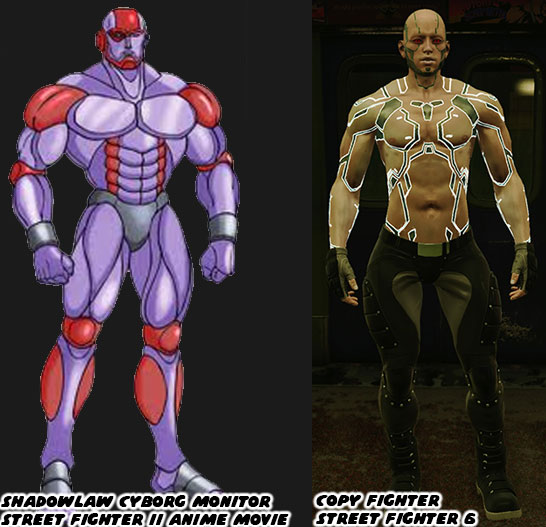
At the start of this series I talked about how the Street Fighter 6 developers were using the World Tour to ease a new generation of players into the many fighting game concepts. From random gang encounters, to part time jobs, to selective battles with pedestrians. Each of these things helped build muscle memory, teach range, reaction, counters, and using the Drive Meter. Each of these would make for better fighters, and a better SF experience. One of the more specific ways that the World Tour was prepping audiences for fights with the various masters was through the use of Copy Fighters. These were synthetic humans that popped up on occasion, similar to gangs. Yet unlike a gang member these androids were guaranteed to have many of the special attacks of an actual SF master. To be fair sometimes a random pedestrian or gang member would also have a move or two from a master, but the Copy Fighters had almost all their moves. They were nowhere near as strong as the actual master, like E. Honda, Ryu, or Guile for example, but they did know how to perform several of their combos, and special attack strings. Copy Fighters were sort of like random mini bosses to increase the challenge in the middle of the World Tour.

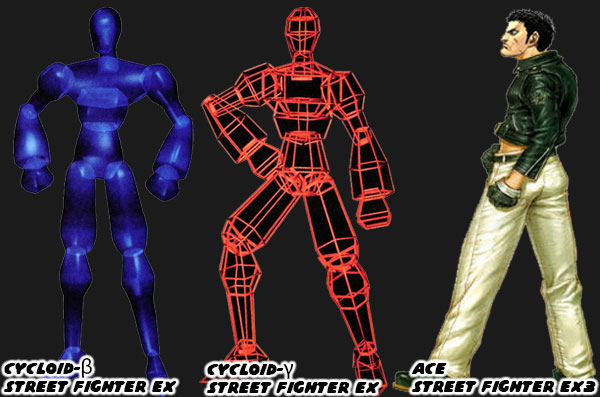
The idea of a cyborg that could copy the moves of the various fighters had been seen in other games, including Mortal Kombat. In the SF universe the first use of this was the Shadowlaw Cyborg Monitor. They were seen in the SFII anime movie, they were stealing the data, and copying the moves of the various masters. These cyborgs were actually playable on the Japanese Saturn, and Playstation consoles with Street Fighter II: The Interactive Movie. Audiences could take control of the cyborg after a prompt, and try to defeat Ryu in order to steal his moves. This sort of character would evolve in the Street Fighter EX series by ARIKA. There were two humanoid robots called Cycloids; Beta, and Gamma respectively. They each had special attacks from roughly half of the cast. Between the two they could perform all the special attacks from the masters. The evolved version of this character became ACE, and players could choose which moves he would be able to copy.

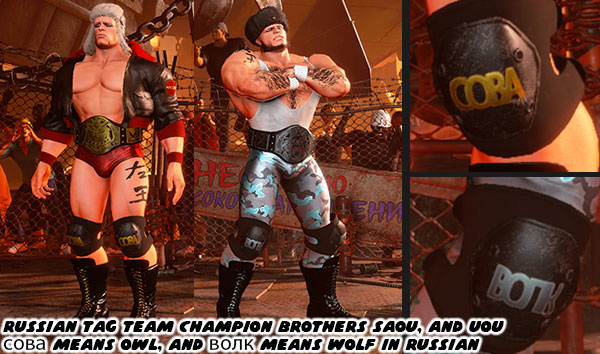
Copy Fighters, and Cycloids weren’t the only way to get a lighter version of a boss fight. Street Fighter 6 had understudies for several of the masters. They had the moves, range, and strategy of their masters. The only lacked the stamina, and more advanced combo attacks of the main SF roster. For example Zangief was established as a pro wrestler. Arguably he was the greatest pro wrestler in the entire SF universe. This didn’t mean he was the only one. The game introduced a pair of tag team wrestlers. They were Russian brothers named Saou, and Uou. One wore the championship belt with an owl mascot, and the other with a wolf. The two shared lessons from Zangief with the player. They could also be challenged for a match.

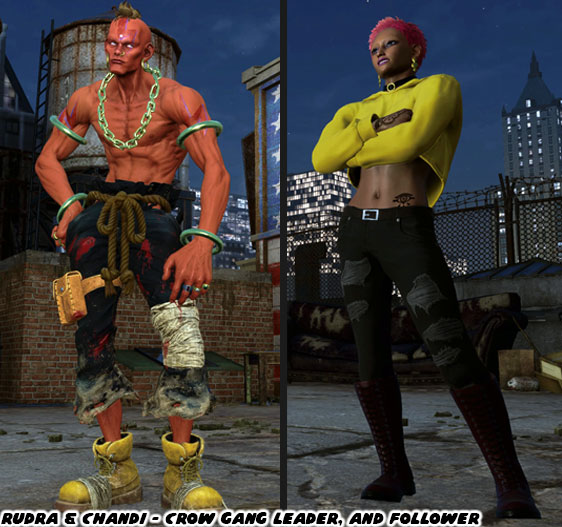
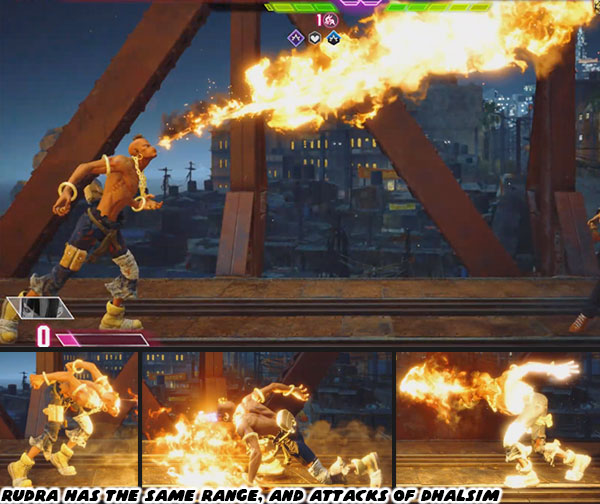
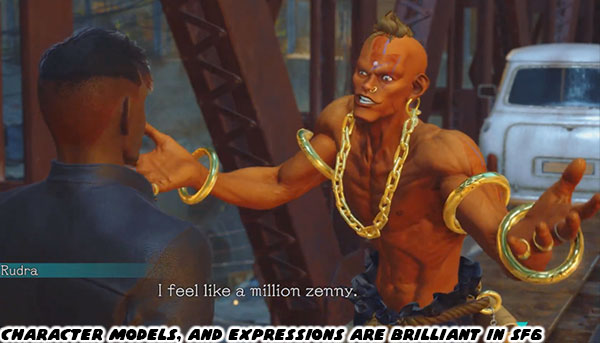
There were two other NPCs that were crucial to the story mode. Bosch, your friendly rival introduced in the story mode, had stolen money from the Mad Gear gang. In order to make amends you had to team up with Mad Gear, look for recruits, and fight against the Crows. The leader of the Crows was a punk named Rudra. It turned out that he was an understudy of Dhalsim, who had run away from the temple many years prior. He saw that kids were suffering, and being abandoned on the street. Instead of meditating about the problem he figured had a duty to act. So he would round them up, and teach them how to survive. Despite his punk looks he was a noble character in many regards. I think that was the reason why his abilities developed greatly with Dhalsim as his master. In typical SF6 design, nothing was put into the game by accident. The name Rudra actually had multiple meanings in Hindi, including he "who eradicates problems from their roots".

Rudra was joined at the hip by Chandi. The long-suffering Crows recruit that was doing everything in her power to get senpai to notice her. The writing, and personalities of the two characters came through clearly in the World Tour. Rudra was aloof, and disinterested in everything, but especially in society. Chandi was a sort of opposite. She had a bubbly personality, and earnestly believed in her leader. They easily had my favorite dynamic in the title. As with Rudra her name was important as well. Chandi or Chandika was a Hindu deity. She was a powerful form of Mahadevi (the supreme goddess) who manifested to destroy evil. Both of the characters may have been involved in gangs, but they had a noble purpose. This was opposed to the Mad Gear who just wanted to take back control of the streets, and the city.

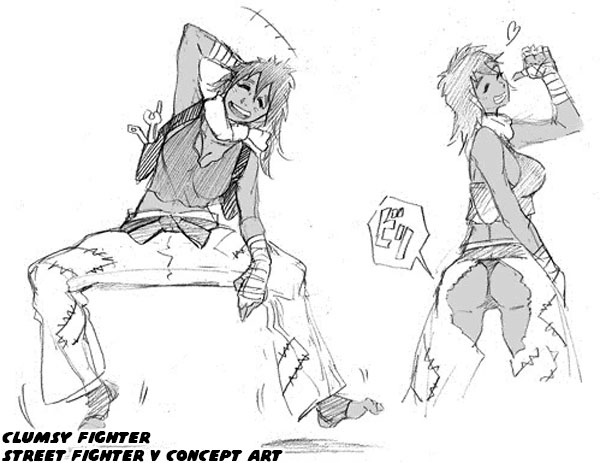
I believe that the roots for the characters had actually been planted many years earlier. During the planning stages of Street Fighter V one of the character concepts was called the Clumsy Fighter. She was a girl wearing torn clothing that managed to stumble her way through a fight. She carried a bag with wrenches, and other tools that she could use to her advantage. I could imagine the SF6 team, which also worked on SFV were going through their unused concepts, and being influenced by the tattered clothing, and carefree attitude of this girl. It was also possible that the idea of NPCs in SF6 throwing wrenches came from this concept character. Or it could have come from Pupa Salgueiro from the Rage of Dragons. That young lady also fought with a wrench in an earlier rival studio game.

If you were to tell me a few years ago that there would be a new stretchy-limbed Indian in SF6 then I would have scoffed at the idea. If you would have told me that the character was better developed, and presented than Dhalsim then I would have said it was impossible. Yet in the end I absolutely loved the character. I would go so far as to say I enjoyed his design more than all the new SF characters. To be fair Kimberly, and Marisa had some amazing personalities that shone through their animations. There were so many fantastic elements layered over the punk that it wasn’t fair that he would be an NPC opponent. For example take a look at the little details like his mohawk, and the paint on his head. At first glance it looked like the red stripe on Dhalsim’s forehead. However it was painted in a lightning bolt shape, falling over his left eye. This conjured up images of Ziggy Stardust the stage character created by rock icon David Bowie. He also wore a lot of jewelry. His nose, and ears were pierced with gold rings, he sported a gold chain, and large gold bands on his upper arm, and wrists, plus gold rings on his fingers. There hadn’t been this much flash on a punk since Birdie in SFZero.

Dhalsim was much more subtle in design, and personality. His necklace was made of rope, and his bracelets were metal, I wouldn’t even say they were silver. He was much more humble by comparison. To be fair Rudra was literally cut from the same cloth. His clothes were tattered, and torn. Athletic tape was holding his pants, and boots together. These were the modern equivalent of the rags that Dhalsim wore when he was doing his Prāyaścitta or penance. I could easily imagine Dhalsim being retired, and having Rudra return to fill that role in future sequels. I would frankly welcome that.

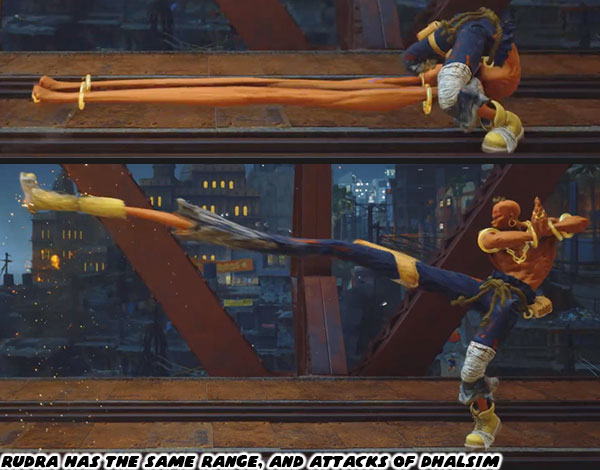
If I had one complaint about Dhalsim, or Rudra it would be with how their powers were represented. Previously it made sense that Dhalsim could only stretch his limbs on direct strikes. You could imagine that he could dislocate his joins, and throw a punch, or kick straight forward, and back. However in SFV, and SF6 he seems to be made completely out of rubber. He would contort himself in all sorts of positions, even while throwing simple attacks. There was no regard for his bone structure, muscles, or tendons. As if he were Plastic Man, or Mr. Fantastic from the comic books. The thing was that this type of character had already been done in SFIII. His name was Necro.

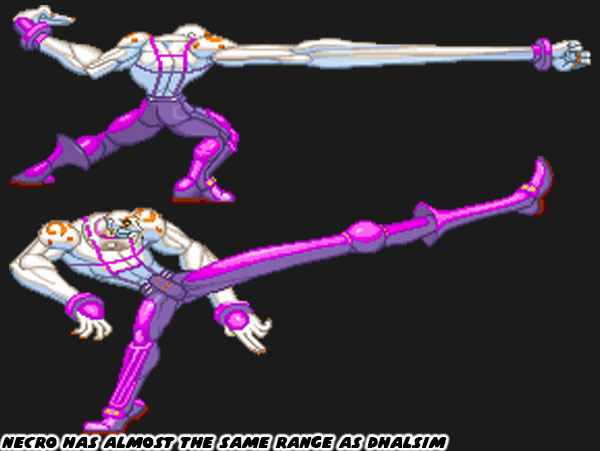
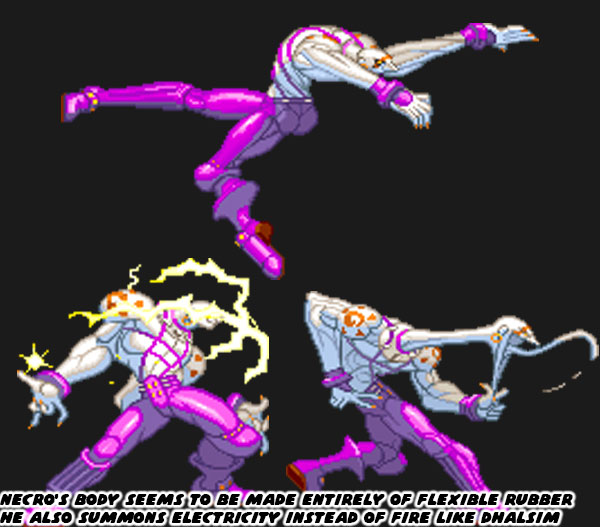
Street Fighter III Producer Tomoshi Sadamoto, and designers Yasuhiro Seto, Tomonori Ohmura, and Obata Shinichiro did their best to follow in the footsteps of the previous teams. Their goal was to create an entire new library of characters. They didn’t want to bring back any of the previous World Warriors, except for Ken, and Ryu. They wanted to explore new styles of fighting, and create new archetypes. Unfortunately for them people were looking for new characters that played exactly like old characters. They saw the stretchy Necro, and assumed he was the new Dhalsim. In a way he was. He had almost the same range, and his fire special attacks were replaced with electricity. But then if you dug deeper you realized this character did not employ the same strategies. His setups, his combos, and special attacks were uniquely his own.

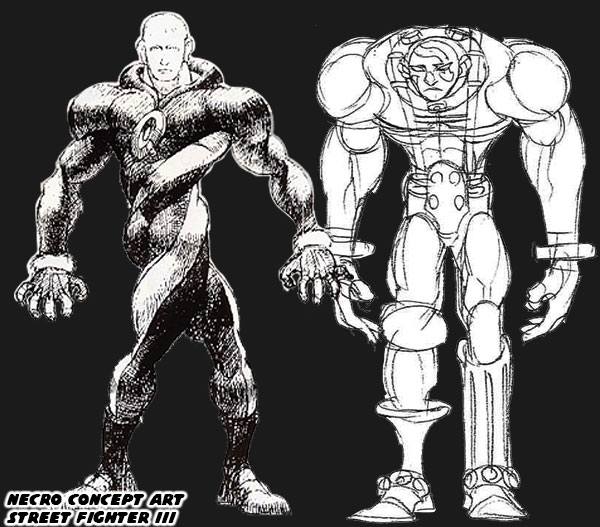
The other thing about Necro was that his skin, bones, muscles, and tissue were rubberized. He had been experimented on by Gill, and his Illuminati as part of the G-Project. They were trying to create the ultimate soldier, someone that was impossible to injure. Necro didn’t look quite human. His pupils were gone, his skin pigment was gone. The melanin was replaced instead by a light lavender. The fighter could stretch his face as if it was made of putty. He could twist his torso, arms, and legs past where they would normally break. He seemed impervious to any damage no matter how much he twisted himself up. Capcom shared the earliest designs for Necro in their arcade Secret Files. He was originally proposed to be an android.

Other synthetic lifeforms were created following the Necro experiments, including the shape-shifting characters Eleven, and Twelve. It made sense for Necro to be more flexible than humanly possible given that had been genetically modified. All of that stretching, and flexibility worked in the context of his origins. I don’t think those things should have been applied to Dhalsim in SF6. But that was a minor gripe in an otherwise fantastic game. Thanks to Copy Fighter, Saou, Uou, and Rudra audiences could get practice fighting light versions of the SF masters while in the middle of the story mode. Speaking of which. All of the time spent traveling the globe, and Metro City meant that you were going to compete as an amateur in the Metro City Fighting Tournament. It would be a test of whether or not you had mastered everything that had happened up until that point. We will look at the next chapter of creating this experience in the next blog. I hope to see you back for the next entry. If you are a long time fan of Final Fight, or Street Fighter then I would like to hear your impressions of SF6. If you have never played any game previously then tell me your experiences in the comments section please. As always if you would like to sponsor me please visit my Patreon page and consider donating each month, even as little as $1 would help make better blogs and even podcasts!
follow the Street Writer on Patreon!

Monday, September 4, 2023

Street Fighter 6: A master class in game design, part 16

Capcom had set the gold standard of lineups when they released Street Fighter II in 1991. I could argue that the greatest character they ever made was Chun-Li. It stood to reason that when they wanted to introduce a new female that they would use her as the template. Cammy was designed as the young upstart, and British special forces counterpart. In Street Fighter EX the characters Pullum Purna, and Blair Dame were inspired by Chun-Li as well. The most popular character post Street Fighter IV was Juri. She borrowed heavily from the design from Chun-Li as well. Street Fighter 6 Designer Yusuke Hashimoto was tasked to create another Asian female villain. Black was a color traditionally given to bad guys in pop culture. Red was an excellent accent color. Black hadn't really been assigned as one of the primary colors for any of the classic characters. The combination would be obvious go-to colors from the beginning. Mr. Hashimoto had to be aware of what the studio's contemporaries were working on. Whether the game came from Japan, China, or the US, he had to be conscious of how the genre had evolved over the past 30 years. Would it be possible to create A.K.I. in a vacuum? I think it was impossible. There would always be elements of some other character that could be pinned on any new one. Many in the fighting game community noticed that there were parallels with A.K.I. and those that came before. 

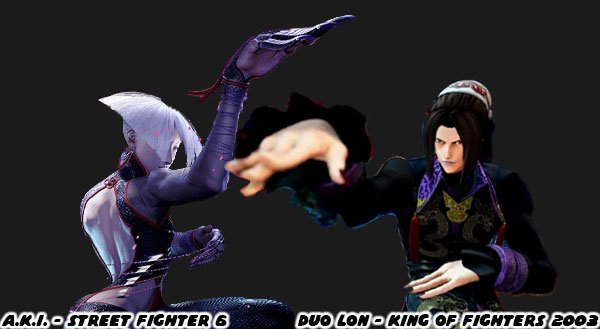
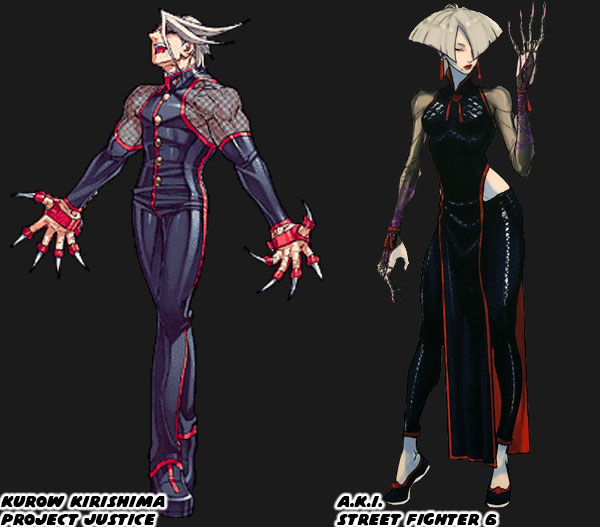
For example the Chinese kung-fu master with a unique hairstyle, that was wearing black, purple, and red, who also fought with a quick snake fist had been seen almost 20 years ago! Duo Lon made his debut in the King of Fighters 2003 in sprite form, and been revealed to be a 3D DLC character in KOF XV fall 2023. Just in time for A.K.I. to appear now that I think about it. Then there was an even earlier character who also eerily predated the look of A.K.I. The silver-haired, form-fitting costume, poison-claw-wearing Kurow Kirishima was created by Capcom in 2000. The ninja was the main villain from the game Project Justice. It was the sequel to the cult favorite Rival Schools. He was poisoning, and brainwashing students from different schools, and turning them against each other. If you've never heard of the series I want you to imagine Street Fighter featuring high school kids. It was one of the early 3D fighters the studio made, and has long been cited in fan polls for a reboot. I could imagine Kurow, and Kimberly having a heated rivalry. But I digress!

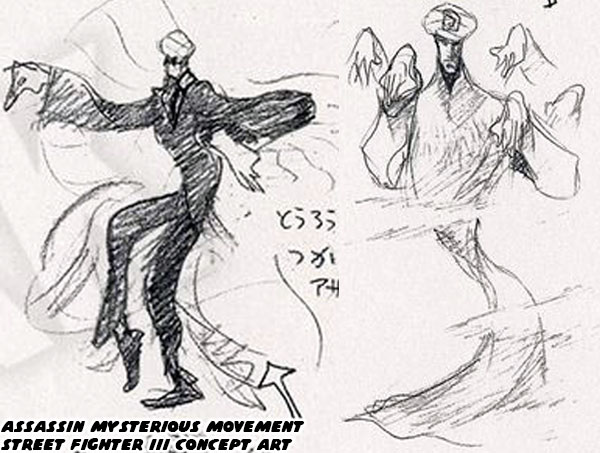
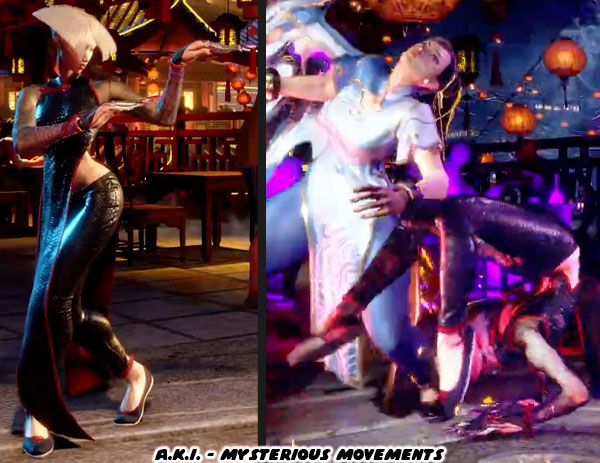
Fans were definitely onto something. The look, choice to be a villain, and move selection from Capcom seemed to mirror earlier antagonists. A.K.I.'s design could actually be traced back even earlier than Luo, or Kurow. In the previous blog I talked about the concept art from Street Fighter III. One of the designs proposed was a Mysterious Assassin. This was supposed to be an Indian character that had his own unique fighting style. The designs were from 1995-96. Many of the ideas were tossed, but there were a few solid ideas that would be revisited in the future. The Assassin was one such character that seemed to stick in the memories of the Capcom staff. In some cases these early concept figures included possible moves, and special attacks. For the Assassin the studio wanted him to have "mysterious movements". His hands would be obscured by long sleeves. His legs would be hidden under a long cloak, making it look like he could float.
  

While this character didn’t really go anywhere for SFIII I believe that many of these details were revisited in SFV. Specifically for the creation of F.A.N.G. The assassin with strange movements, that appeared to be able to float certainly fit the bill! By Street Fighter 6 the design elements were revised, and refined once more, and the character A.K.I. appeared. In 2022 I wrote that the design was giving off a dragon lady vibe. When the teaser for the character dropped during EVO 2023 my suspicions were confirmed. The longer move reveal trailer from just a couple of days ago showed that she had strange movements as well. She slashed with outstretched fingers, just like the Assassin concept art from many years prior. 

Eagle-eyed viewers noticed that several of A.K.I. moves were based on poisonous animals, she could slither along the ground like a snake, and even employ some kicks from the fantastic scorpion style of kung-fu. Hats off to the animation team, it must have been tremendous fun creating her attack library. The trailer gave us the best example of how to present hidden strikes. I want you to think about your favorite characters, and how they stand with their hands forward, or exposed to the game camera. If you threw a punch for a kick, then it would be easy to track on the screen. A.K.I was turned away from the opponent. This meant that several of her attacks were actually obscured from the game camera. A.K.I. could backhand, or hook kick opponents. Her torso hid which hand she used, and her dress covered which kick was being delivered as well. This mirrored how the Assassin concept fighter hid his attacks under a long cloak. The more difficult part for either F.A.N.G. or A.K.I. were creating lethal strikes that could be described as poisonous.

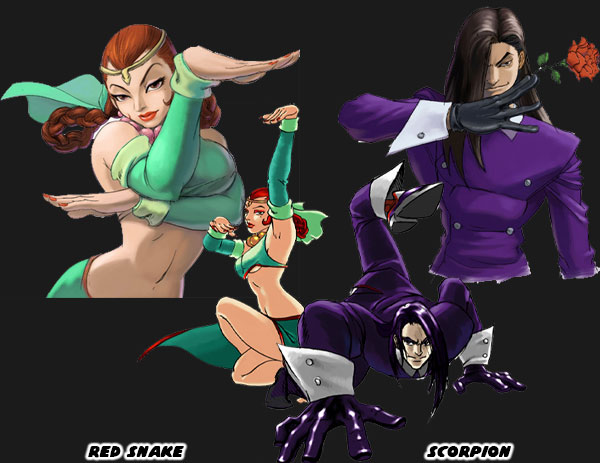
The turned stance was seen in several forms of actual Chinese wushu, and Shaolin kung-fu. The use of stealth, and sneaky moves was not a new thing in fighting games. One of the best, and rarest fighting games to use classic kung-fu forms was Martial Masters by IGS from 1999. The game featured a sexy fighter named Red Snake, she used the snake form, and a flirtatious ladies man known as the Scorpion.  I had written about the game from a Taiwan studio a few years ago, and how much they were influenced by the Capcom games from the mid-'90s. The characters in the game were inspired by a few classic kung-fu movies, not the least of which were the Once Upon a Time in China films featuring a young Jet Li playing the folk hero Wong Fei Hung. Martial arts cinema from Hong Kong, and Taiwan had a major hand in influencing the development of Street Fighter, and the entire fighting game genre. With regards to F.A.N.G., and A.K.I. there was actually a lot of precedence for having a "poison fist" fighting style. 

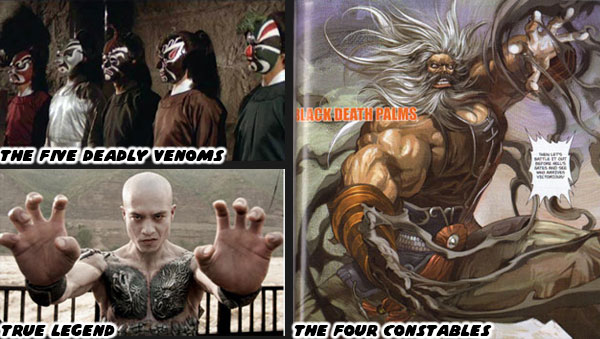
In cinema there was an all-star film from 1978 called The Five Deadly Venoms. In it the assassins were all trained in a particular deadly art; Centipede, Snake, Scorpion, Lizard, and Toad. One or several of these poison fists were referenced in many classic manhua, or comic books. The villains often mimicked the attacks of these dangerous creatures. Some of these techniques were so dangerous that even a single touch could kill. This was the case for Elder Guan from the Four Constables. His hands would turn dark when he summoned the Black Death Palms technique. A live action version of this power was seen with the character of Yuan in the 2010 film True Legend. There was no doubt that the people at Capcom were heavily influenced by these stories. The most powerful characters in myth could perform a dim mak, or death touch. The Shun Goku Satsu from Gouki / Akuma was probably the most popular death touch in modern culture. A.K.I. was a sort of nod to these mysterious, and often deadly techniques, but there was much more to her design.

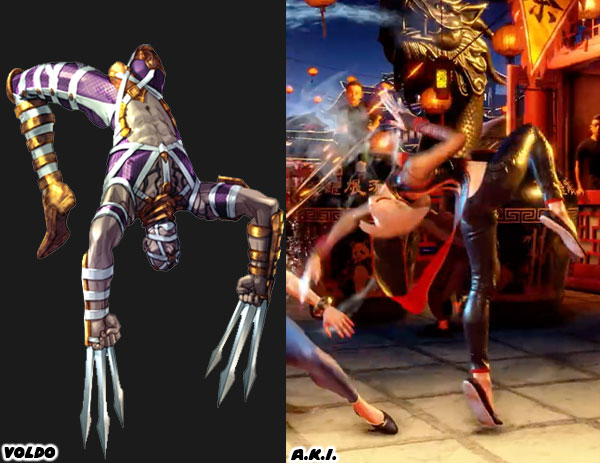
A.K.I. had to be an over-the-top villain in order to stand out from the rest of the Street Fighter lineup. She couldn't just be a kung-fu practitioner that happened to be mean. It wasn't enough that she had some sneaky moves either. Every part of her presentation had to be more outrageous than the traditional kung-fu characters like Chun-Li, or even Jamie. This meant that she had to have stances, and grapples that twisted, and contorted her body. She would fold herself in half before slashing, or drop flat to the ground before kicking. Not knowing where the next strike would come from would throw off opponents. The fighting game community had first seen these types of awkward angles, and strikes through the character of Voldo from Namco's 1995 hit Soul Edge. Voldo was an assassin, and could strike with his razor sharp katars from any position, including while laying on the ground.

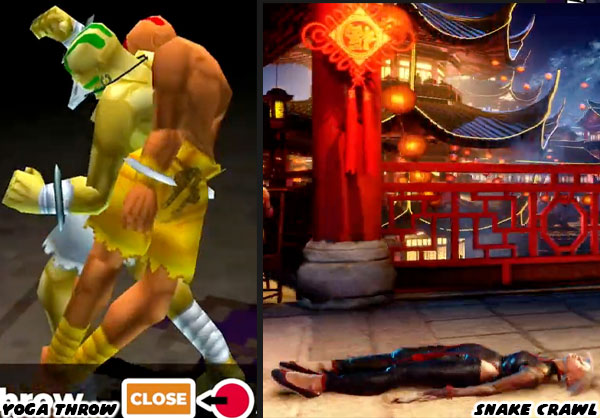
In the gameplay reveal trailer we could see A.K.I. slither on her back. It was unnerving seeing the character move like that. This snake crawl allowed her to get under ranged attacks, and close the gap on opponents. Previously the franchise did feature snake-like movement with at least one other character. In the Street Fighter EX series by ARIKA Dhalsim could perform a Yoga Throw. The setup for it was very unique. The Indian yogi would wind around his opponent like a serpent before grabbing their torso and flipping them on their head. It remained one of my favorite fighting game animations to this day. I'm certain that Street Fighter 6 animators were able to pick, and choose the best elements they could find from pop culture, from actual kung-fu, and even earlier games while fleshing out the moves of the new assassin.  

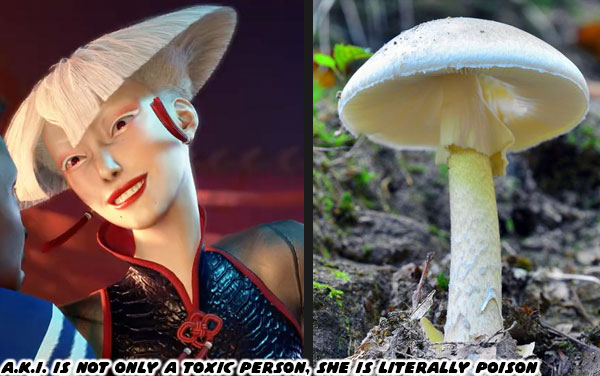
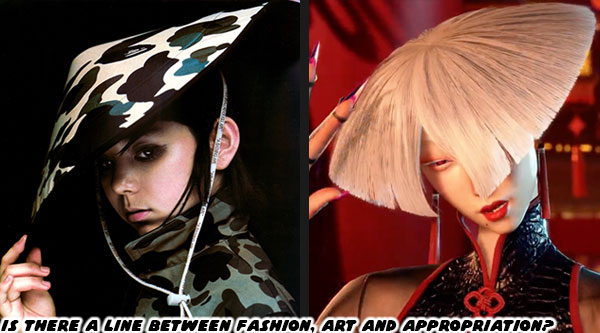
For the developers it also wasn't enough to have a character that fought, or moved like a snake. She had to look dangerous,and untrustworthy. From a visual perspective A.K.I. was figuratively, and literally a toxic person. The pale white skin was unnatural, as if she was drained of her blood. The cut of her hair was reminiscent of the amanita phalloides aka the death cap mushroom. As far as her costume went it could be argued that Street Fighter 6 Designer Yusuke Hashimoto was making a bold fashion statement. The use of modern tulle sleeves, and pants under a traditional cheongsam was only the beginning. His choice of costume, skin color, jewelry, and haircut were very avant-garde. Every detail added reflected the same fashion sense that he tapped into when creating the designs in the first two Bayonetta games. Had Juri, F.A.N.G., or Kurow never existed then I'm certain that A.K.I.'s introduction would have had a greater impact on the franchise. 

Capcom must have known that between Juri, and A.K.I. the toxic female Asian trope was becoming redundant. I'm not sure why they felt like they had to double-down on this route. The question remained. Was Capcom doing right with character representation? Could this simply be chalked up to an artistic choice, and not a jab at the Chinese villain trope? The studio had done much better with Dhalsim, Blanka, and Rashid in this title. However A.K.I seemed to be a step backwards, at least to me. Street Fighter 6 was doing a lot to address the mistakes in the past. To make up for ugly characters, and ugly design choices. To become more inclusive when it came to ideas of sex, and gender roles. There would be a lot of positive new changes, faces, and game design elements introduced into the franchise. One of the major shifts to the cast came with the addition of NPCs to help carry the story. We will look at how in the next blog. I hope to see you back for the next entry. If you are a long time fan of Final Fight, or Street Fighter then I would like to hear your impressions of SF6. If you have never played any game previously then tell me your experiences in the comments section please. As always if you would like to sponsor me please visit my Patreon page and consider donating each month, even as little as $1 would help make better blogs and even podcasts!
follow the Street Writer on Patreon!

Saturday, September 2, 2023

The Martial Myths; the lessons from manhua applied to Street Fighter. A 1UP classic from Apr 09, 2012

In the wuxia tradition there was always a price to be paid for using killing techniques in a battle. A person that attempted to use a powerful strike for evil purposes would receive a consequence. The most powerful techniques required a pure mind and heart, if a person struck with malicious intentions then it was unnatural, it caused damage to the internal organs and chi meridians. Chi was generated after all from nature and the elements, anything that manipulated chi outside of natural purposes had consequences. Those that continued down the dark paths of chi manipulation often did so at the cost of their soul.
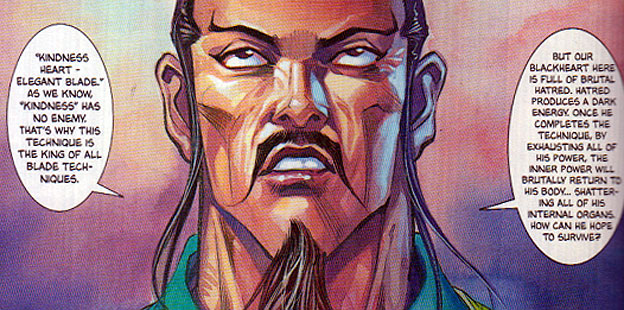
In the fighting stories there were always practitioners of the dark fighting arts. These were fighting styles meant to poison, cripple and kill opponents. In the case of Gouki he was studying a pure version of the assassin's fist and was using the strikes exactly as they were meant to be used. This took him off the path of a martial artist and turned him into a murderer. In many stories these techniques were cursed. Only the most villainous clans would have ever taught these techniques. To use them meant to turn away not only from society but from humanity as well.

The early practitioners of the dark arts in wuxia legends were said to have been masters of the poison styles of kung fu. The early fighting forms of Shaolin focused on “animal styles.” These were punches and strikes that tried to mimic the most dangerous predators in the animal kingdom. The tiger and eagle were just some of the styles that the monks helped to develop and preserve through the centuries. It made sense that man would try to study and emulate the creatures that depended on fighting for survival. It was not enough for the villains in stories however. They studied the poisonous animals including the scorpion, centipede and toad to develop their own killing techniques.
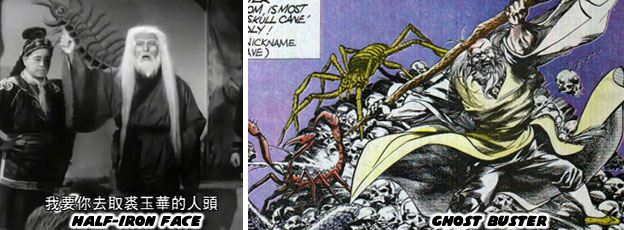
These evil masters were often major players in film and manhua. The evil master in the classic film the Furious Buddha's Palm was named Half-Iron Face. The icon on his banner was the centipede and he used its poison to kill opponents. When he wanted to torture them instead, like the heroine in the movie, he would implant a centipede into them and made it bite their heart whenever he played a drum. Talk about being an evil bastard! Of course it was completely over-the-top but entertained audiences that loved mixing superstition in with their action. This archetype was explored in various manhua like the poison master by the name of Ghost Buster in the Iron Marshal comic. He had developed ways of distributing poison through the air, weapons or in touches. In one instance he had poison dust hidden in the feathers of a bird, as it flew it poisoned the air around it. It was intercepted by the Iron Marshal before it had reached the emperor.
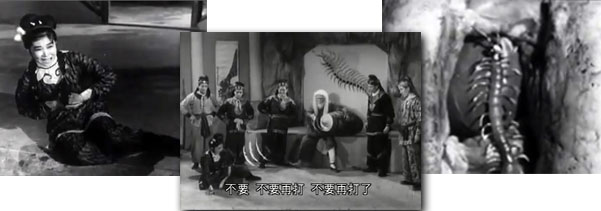
Poisons and poison techniques could be used to torture and brainwash opponents. The toxins that did not kill character would sometimes disfigure them in the wuxia legends. Many of these techniques had an antidote known only to the masters. A hero would have to defeat these people in order to learn the secret. In other instances if a hero were powerful enough he could use his chi to burn away the poison. The Iron Marshal for example used his chi to evaporate the poison dust carried by the bird without harming the bird itself. He then let the bird fly back as a warning to its master.
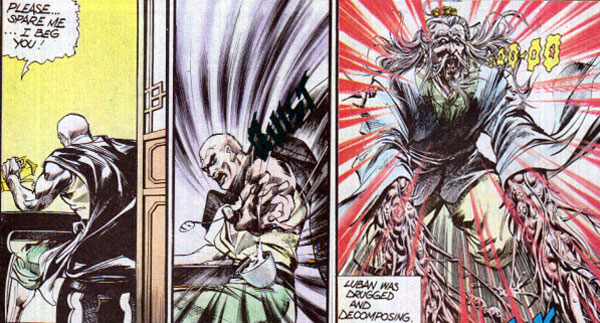
Chi could be used to control the natural elements, including air, water, fire and lightning. The most powerful characters tapped into this to deliver their fa jin attacks. The evil characters could send out poison attacks these ways. A hero could counter that attack and send it back provided they were strong enough.
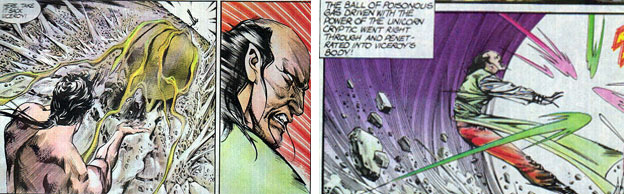
The Iron Marshal had a showdown with one particular villain that had tried to poison an entire court. Iron used his chi to gather the poison out of the air and delivered it back to the villain. This was an example of an evil or poisoned fireball attack. The villain had once started out as a good character, a court advisor that had turned against his emperor and subjects. A lust for power had turned a few characters in the series into villains. When they did that, when they were willing to kill countless innocent lives, they started becoming ugly or disfigured. The poison arts and evil fighting techniques corrupted even formerly noble men.

The Iron Marshal had a second major story arc that turned the mentor of both Iron and Duke into a villain. Tienway Champ had been secretly studying stolen martial arts and the dark arts as well. These philosophies and practices actually allowed him to return from the grave after he was assassinated by the Bloody Duke.
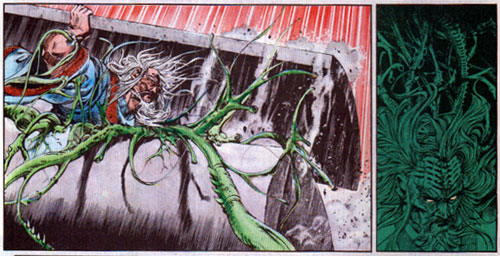
Tienway did not return from the dead to get revenge on the Bloody Duke, instead he returned so that he could get his hands on the Unicorn Sword and unlock the mysteries of the Unicorn Cryptic. These were a series of techniques that could have made him the most powerful martial artist in the world. This quest for absolute power was a mad obsession. The wuxia parable was showing how evil could corrupt the once great Tienway Champ.
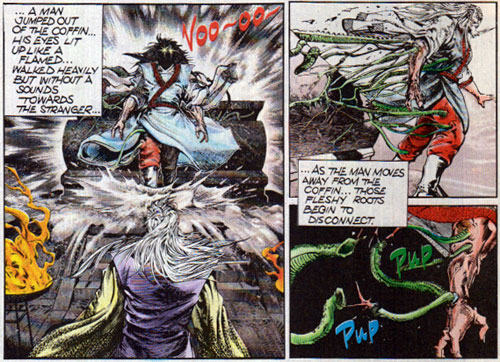
The techniques that Tienway had mastered had turned him into a monster. His lust for power and worship of the dark arts had caused him to be rejected by both heaven and hell, his body would not rest at peace and this explained his resurrection. Tienway had become a master of the "God Forbidden" techniques. A visage of the Buddha was shown with tears in his eyes. Demonstrating the pity and compassion felt for a person lost to the darkness. The figure of the Buddha as the all-powerful force returned again and again in the wuxia tradition. The Buddha represented righteousness. The martial arts techniques associated with the deity were said to destroy evil. The Buddha's Palm film and manhua titles were examples of the religious associations that the martial arts had, particularly when it came to expressing qigong and the battles between good and evil.
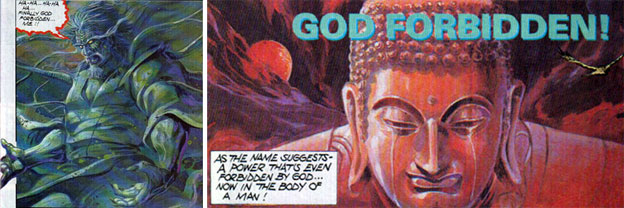
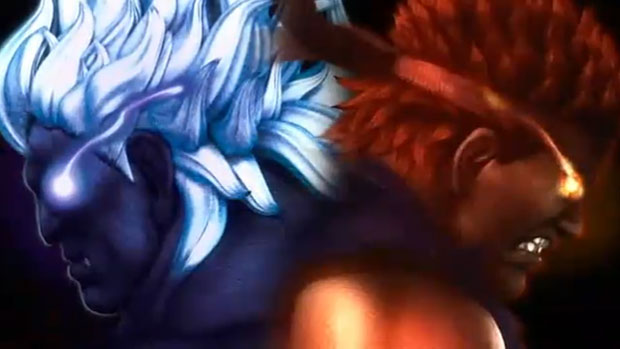
Characters that succumbed to the dark arts were very powerful in the stories, easily rivaling the most gifted masters. They were incredibly strong, fearless and seemed to not feel any pain. The trade off for all this power is the corruption of the physical form. Villains became grotesque creatures in these stories. They looked fearsome and animalistic. Gouki for example was designed with the features of a lion, a large head of spiky hair, a flat nose and sharp teeth to make him intimidating to players. In canon Ryu attempted to defeat Gouki with a well placed hadoken to the chest. What he discovered instead, and what was revealed to audiences, was how little of Gouki remained human at all. The Dark Hadou, the evil chi, had consumed Gouki and there was nothing left of the man on the inside. He became a physical manifestation of rage, a literal shell of skin over a core of evil energy.
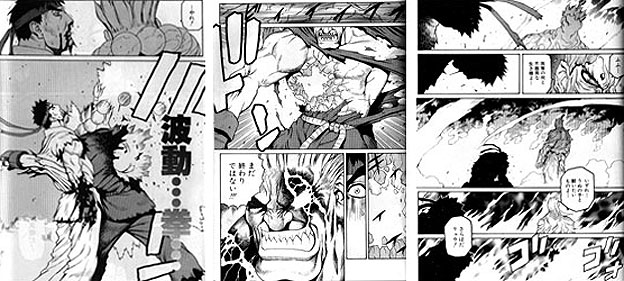
There was a duality to chi, same as the Force in the Star Wars mythos. The good and the bad, the light and the dark, were constantly seeking balance. No force was greater or lesser but both forces were constantly fighting. The dark chi sought to corrupt people who lusted for power while the good chi was meant to heal and grant power to those who are not ambitious. The forces of good must be ever vigilant to protect themselves and the community from the influence of evil. What this did was place the martial arts heroes in the role of the equalizer. Through the stories and adventures the hero discovered that every battle required an outcome and that even mercy had its limits. When it came to absolute evil there could not be a compromise. The hero was placed in a position where he had to use all of his techniques, including the lethal ones, to defeat the forces of evil. This did not turn the hero into a killer, but rather a force for justice. The person was trying to restore balance to nature.
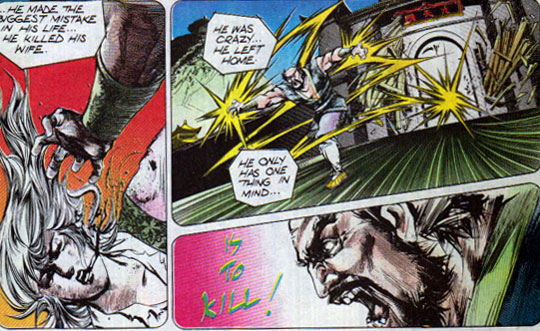
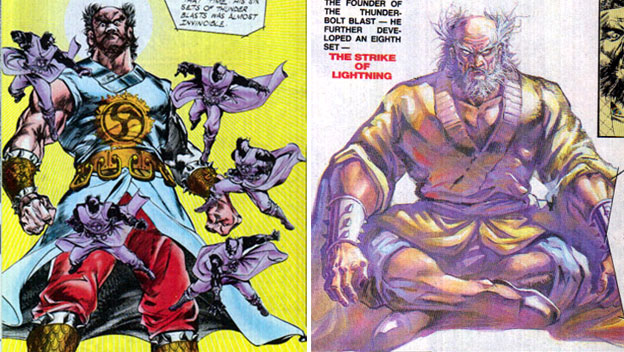
Near the end of the Iron Marshal story the origin of the Great Thor was revealed. Thor was a great martial arts master that had developed the Thunder techniques. Those techniques were stolen by by an assassin named Raving Eagle who was working for Tienway Champ. This assassin raped the wife of Thor and kidnapped his only son. When Thor returned from training and discovered what had happened he became filled with rage. Unable to deal with what had happened Thor accidentally killed his wife and went mad with revenge. Another martial arts master by the name of Immovable Creep offered to give Thor a reprieve from his torment because Thor had no way of knowing the identity of the assassin. Thor agreed and took the non-emotional formula which gave him amnesia for 30 years. During this period he trained the Iron Marshal and revealed onto him the techniques he had meant to show his son.
Western mythology had featured similar tragedies to the story of the Great Thor. The Greek hero Hercules was also a mighty warrior that let his pride and temper get the best of him. He ended up killing his own family in a fit of blind rage. To atone for his crime he was sent by the gods to perform a series of labors. A similar plot was explored in the God of War series as well. After Kratos killed his wife and daughter he was sent out on a series of missions by Athena to forgive his crimes.

The Great Thor had vowed never to teach anyone these secretive techniques after what happened to his family but fate intervened. The story showed the penitence of the Great Thor as he tried to help those on the side of good without quite knowing why he was doing it. When the memory of Thor was restored he vowed to atone for his sins and restore his family name. The opportunity presented itself later in the series. Thor went into battle with a clear mind. He knew that evil must be destroyed and did not hesitate when it came to performing his most lethal technique. The power of the Thunderbolt at close range destroyed Raving Eagle. The use of this technique was completely warranted unlike the Metsu Shoryuken that Ryu used on Sagat.
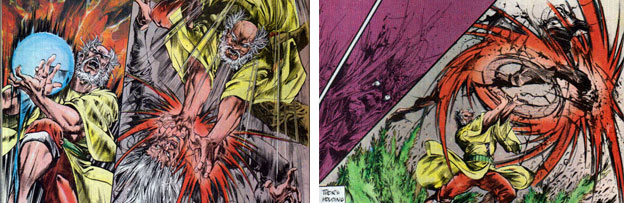
The heroic tradition dictated that a good character, no matter how lost, had a chance at redemption but the most evil and corrupt did not. Ryu learned from his over-reliance of lethal techniques and vowed to stay away from the dark had. He became a better fighter because of it. All characters in the classical tradition evolved. The young heroes particularly grew into maturation over the course of a story. The ways in which this evolution happened was almost universal between the manhua and manga editions.

The hero was hopelessly unprepared to fight the main villain early on in the stories. They had to develop his or her skills considerably. In wuxia stories the hero could often be aided by more than one master, especially after they have learned all of the techniques from the current mentor.
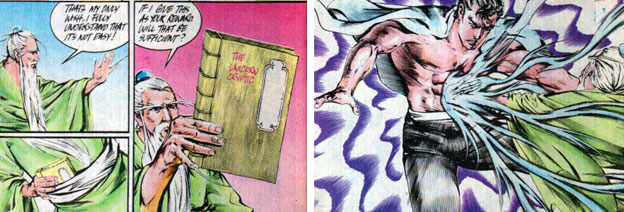
The Iron Marshal was actually aided by a martial arts genius and former emperor disguised as a peasant. This was after Iron was trained by Thor. The elderly man gave Iron a book with the secrets to the Unicorn Cryptic. This was the technique that Tienway had returned to steal. The techniques contained within the book could take over a century to master, even for somebody as gifted as Iron. What the emperor did was speed up the process by transferring his power and knowledge as chi into Iron. Doing this caused the emperor to age terribly but he was satisfied knowing that the powers were in the hands of a lawful person and capable warrior. With this newfound power the Iron Marshal could put an end to the strife caused by his former master.

Characters were often depicted as growing and maturing in manhua through physical changes to the character. The easiest way for an artist to do this was by changing the color of the practitioner's hair. This visual cue had been explored in western literature as well. In the biblical story of Moses the voice of God guided him. At each of these encounters his hair became progressively lighter until it went completely white. This physical change showed that something profound has happened to the character. In the bible story it was tremendous wisdom being passed down onto a leader. Those with white hair in the wuxia stories were also sage masters, yet capable fighters whose physical appearance beguiled their ability. Some characters grew exponentially in their levels of power through the stories and seem to age instantly. Such was the case for the former Emperor and the Great Thor.
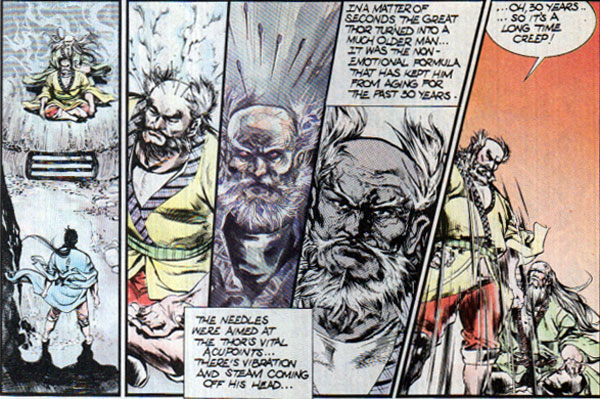
When the Iron Marshal first met the Great Thor he had dark hair and was enjoying his days living in seclusion. Thor was an incredibly powerful martial artist that did not look to be over 40. Yet in one issue Thor aged tremendously. In doing so also became a more powerful master. What caused this transformation was the lifting of the curse of amnesia he had placed on him. When this formula was undone by the Immovable Creep then Thor aged rapidly and his hair went stark white.
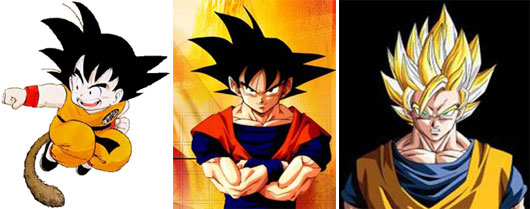
The usual visualizations of chi were placed on the character in the story. The Immovable Creep opened up all of the meridians on Thor using acupuncture needles, this release of chi was presented as steam. Remember that chi meant steam or breath in qigong. The release of energy and changing of hair color was also explored in manga and animé titles. None had made this more apparent than the Dragon Ball series. When the main character, Son Goku, went beyond his mortal power he became a "Super Sayan." At this point his hair went from jet black to golden yellow and energy flowed from him in crackling waves. This tradition of having an ultimate version of a person had begun in Eastern religions. Blogger Art-Eater created an extensive look at the relationships between the character design in Asura's Wrath and Buddhism. These observations also applied to the physical presentations of power, tenacity and wisdom in manhua and game design.
In Street Fighter Gouki was a master as well, yet he too had an ultimate or "true" version of his persona known as Shin Gouki. At this point Gouki's hair went from red to white. Any humanity that the character had was eliminated and he became nothing short of a living demon ready to destroy his opponents. Every fight for that version was a fight to the death. The "regular" version of Gouki knew when a fighter was no match for him and warned them to stay away. Shin Gouki would more likely kill a fighter that wandered too close than say anything. In the game he had more diverse and powerful attacks than Gouki. In order to challenge him in game the player had to meet certain criteria, like not losing any rounds and defeating multiple opponents with super attacks, thus proving that the player was also a fighting master. The Shin Gouki character was more aggressive and relentless than Gouki and only very good Street Fighter players could claim to have a winning record against him.
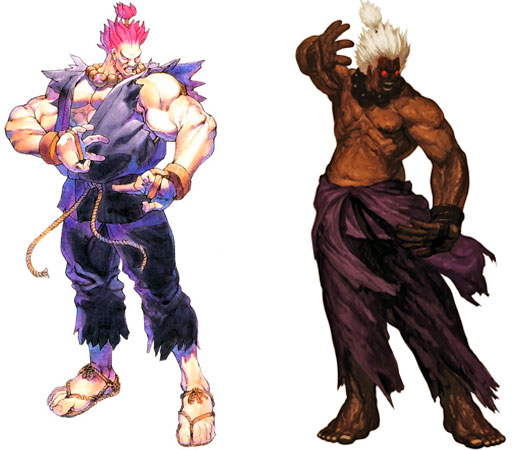
Super Street Fighter II was the first game to introduce a wuxia-type boss villain into canon. In the original game Ryu defeated Sagat. This was a variation of the Mas Oyama battle with Reiba. Sagat was not an evil person and had nothing to do with the death of Ryu's master. The boss character simply followed manga conventions by being large and powerful. In the sequel Ryu fought Vega (M. Bison in the USA) who was even more like a manga character. Vega was presented as a militaristic dictator, similar to a Hokuto no Ken-type villain. Gouki was actually meant to be the boss for SF III. The martial arts basis of the character, dark chi powers and revenge plot was pulled from wuxia storytelling. This combination of elements made him a very popular character. Instead of letting the developers introduce him in a proper SF III title he was placed into Super SF II as a hidden character. This inclusion and list of criteria to unlock him was inspired by the "Sheng Long" April Fool's joke.

Gouki was a formidable character that set the standard for all fighting game bosses. He had the perfect balance of move designs that made him believable and well rounded rather than cheap. The decision to give him animalistic features only added to his presence. The powers of the Dark Hadou were based in Buddhism but physically he was also inspired by the Nio, the fearsome guardians of Heaven and Hell in Eastern mythology. Gouki and even Mr. Karate from SNK's Art of Fighting / King of Fighters series were symbolically powerful characters rooted in spiritual beliefs. Those brave or foolish enough to fight these characters were willing to risk crossing over into the afterlife, or simply put, enter a fight to the death. Similarly Tienway Champ had returned from the dead more powerful than ever in the Iron Marshal story ready to take more souls on his quest for power.
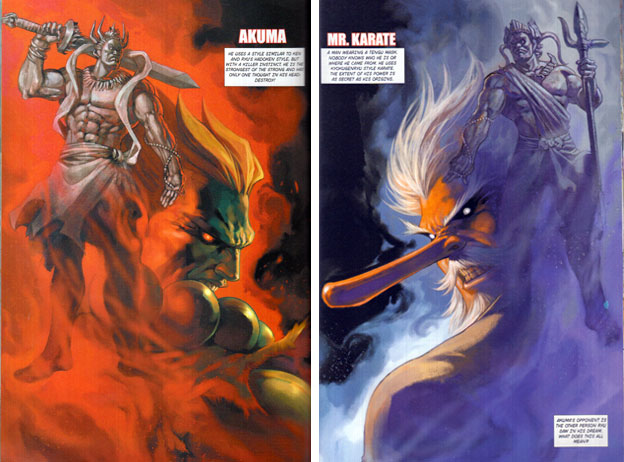
The hero in the wuxia tradition had to be able to rise up to the challenge, even the supernatural ones, and develop powers greater than the villains or die trying. At some point in the story the main character had to become aware of the powers they possessed and energy they could draw upon. The force of chi that flowed through the masters was almost limitless. If they could consciously tap into that energy then they had a chance against even the most powerful villains. In the qigong understanding almost everything in nature had chi. The wind for example was the chi of the Earth. Fire radiated heat as a form of chi and even water generated chi, but none of the elements had consciousness or perceptivity. Animals had perceptivity and chi but not “yi” a concept of right and wrong. Humans had all three and could learn to master them through the study of qigong. In martial arts fiction the hero was able to tap into this unseen energy and stage a spectacular comeback against even the most hardened opponent.

Qigong combined with the lessons handed down by the martial arts masters gave rise to the superhuman legends. The practitioners of Shaolin Quan, mentioned in the first blog of this series, demonstrated these amazing abilities by breaking stone with their bare hands and repelling spear tips with their throats. They had a fierce religious belief system and were known for defending villages during times of strife. The Shaolin fighting style was said to have really been created around 609 AD by a monk who used a broom to fight off invaders. At first the bandits thought he was crazy and laughed at him but when he proved that he was a capable fighter they ran away. His mastery of the staff was so impressive that other monks requested he teach them as well. It was said that he was a reincarnation of Kinna, the Fighting Buddha. Thus the Shaolin style was sometimes referred to as the Kinna Quan. These newly formed warrior monks with their devout origins were the template for the Jedi in the Star Wars films. They were also the biggest influences in latter wuxia comics and movies. The spiritual connection allowed the masters to fight even the most powerful forces of evil with their bare hands. These battles between good and evil were always the most spectacular in the manhua stories.
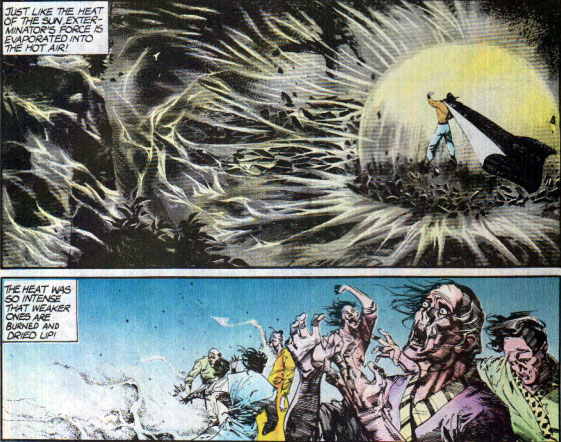
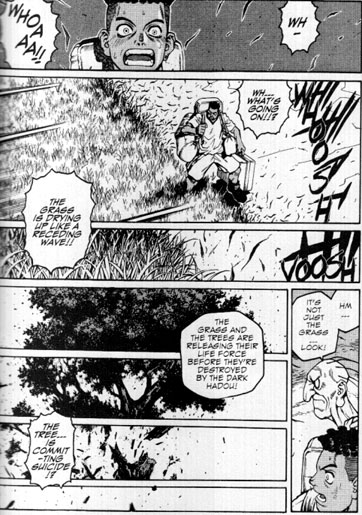
When the masters of good and dark chi battled they often caused collateral damage. They did not even have to physically touch a person in order to harm them. Only those that were strong in body and mind could divert the energy that these battles expelled. Regular people with no martial arts training would explode or burn up from the release of chi. Giant waves of chi were drawn in the manhua titles, flowing back and forth from hero to villain, upsetting nature and harming those in the way. Dark chi, or evil hadou could draw out the essence of living creatures and destroy it, this was visualized in the Ryu: Final manga as vegetation burned off by an unseen force.

These battles were always awe-inspiring in the comics and perfect for a fighting game. Street Fighter presented these chi battles as super moves, allowing gamers to play vicariously as the ultimate masters of the secret arts.
During the climactic battles between good and evil the hero often came to a realization. The techniques that they had learned during their travels were not enough to defeat the final opponent. It was at this point that the hero unleashed a new self-taught technique. This move often combined lessons from the previous masters as well as the latent chi energy that the hero could tap into. They did this in the heat of battle but with a calm and collected resolve.

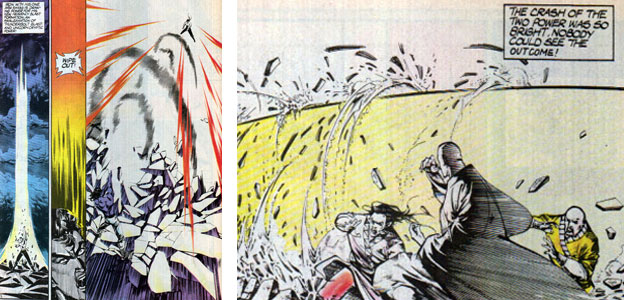
The final lesson of the wuxia narrative demonstrated was that the hero was most powerful when they were in control of their emotions. Their yin and yang chi, the earthly and heavenly energies could best be harnessed by an enlightened mind. The Iron Marshal for example developed a powerful chi blast called the "Wipe Out" which was a combination of the Thunderbolt techniques of the Great Thor and the power of Unicorn Cryptic. He did this in a calm and collected state while his opponent was furiously trying to kill him.
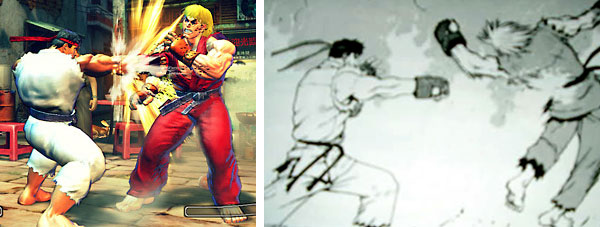
Ryu had done something similar in both the SF Zero and Ryu: Final manga. Before facing the final opponents he did not let his emotions get in the way and let the dark hadou take over, instead he fought Vega and later Gouki bringing all his abilities to the match with a calm resolve. The move invented for the character was the "Fist of the Wind". It was a direct punch that had the focus of a shoryuken with the lateral range of a hadoken. This strike allowed Ryu's punch to meet the opponent head on and transfer his power into a single point, destroying any chance for a counter. This move was placed into SF IV as a counter attack rather than a super move. Ryu was able to find the power required to defeat the boss characters by using all of his external and internal techniques. Ryu, as any great wuxia legend, was forged by the experience of facing different opponents and taking on new masters.
The heroes in martial arts fables were similar to the heroes in other genres. They were flawed characters but personable. They often rose from tragedy to become something extraordinary. They demonstrated the ways in which people should learn from their mistakes, especially during the most difficult parts of their lives. When called to sacrifice they do so without hesitation.

Players became fans of Ryu for the same reasons that audiences identified with Joe Yabuki in the manga Ashita no Joe some 20 years earlier. Joe was flawed and sometimes unsure of himself. He did not win all the fights but he never stopped striving and working hard to be the best. Through his dedication he was able to hold his own against formidable odds including the world champ. By extension Ryu and the Street Fighter cast also carried over the best qualities of earlier manga and manhua heroes. They had powers and abilities that were awe inspiring but placed on personable characters. The diversity of the cast; black, white, Asian, Hispanic and European reflected the audiences that were playing the game. This cast more so than any other cast in the history of fighting games had a deeper connection to the classical martial arts heroes and villains. It tapped into the subconscious associations that players had with fighting and heroic archetypes.
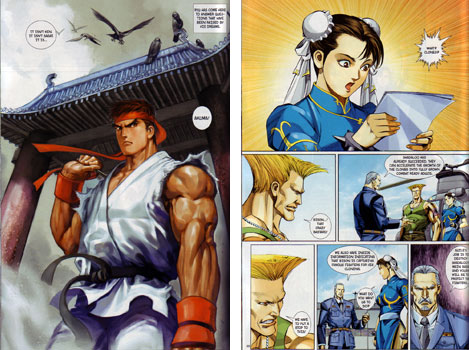
The developers at Capcom were placing the wuxia story in a modern context and making the masters not exclusively Asian. Audiences not only accepted this form of entertainment but willingly incorporated the art, language and designs into popular culture. A quarter century later these fans were still passionate about the Street Fighter series. They were producing art, music and their own games inspired by the legends. The heroes in the original game heroes came from somewhere. Their origins and inspirations should be emulated and celebrated equally. Those working at Capcom in the late 80's and early 90's had grown up in a culture that popularized the fighters of legend in the pages of comics, television and movie screens from the late 60's through the early 80's. They in turn created the legend of the virtual masters, new characters that videogame players could identify with and legends that they could spread onto the new generations. Perhaps centuries from now people might discuss the martial myth of Street Fighter in the same way that they refer to the heroes of the Water Margin, or Romance of the Three Kingdoms. A gamer could only hope. As always if you would like to sponsor me please visit my Patreon page and consider donating each month, even as little as $1 would help make better blogs and even podcasts!
follow the Street Writer on Patreon!

Friday, September 1, 2023

Street Fighter 6: A master class in game design, part 15

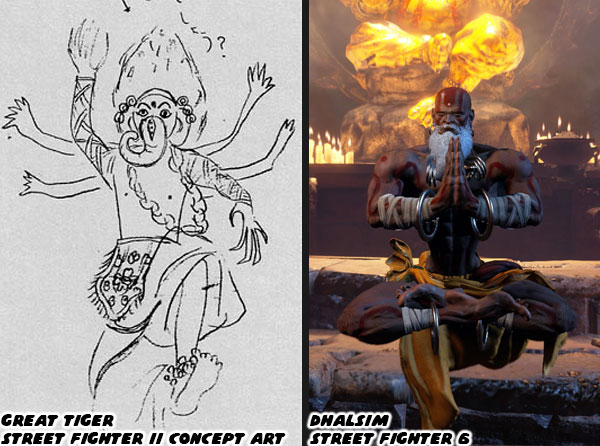
In the previous blog I talked about how Capcom was revising old character designs, and trying to make them more palatable to modern audiences. Every popular character was getting a redo. In the early stages of SFII Blanka had started off as an ugly Black brute in chains. He was turned into a green mutant, a wild man from the jungle. For SF6 this wild man was dressed in overalls. He was turned into a businessman starting up his own jungle tourism company. In the Street Fighter II concept art Dhalsim had started off as the Great Tiger, an Indian mystic wearing a Ganesh Balinese costume. He was turned into a stretchy limbed yoga master. Some of his more offensive costuming choices, specifically the child skull necklace was removed, and replaced with a necklace depicting the mudras. He would become a yogi, and instructor of yoga at a temple.

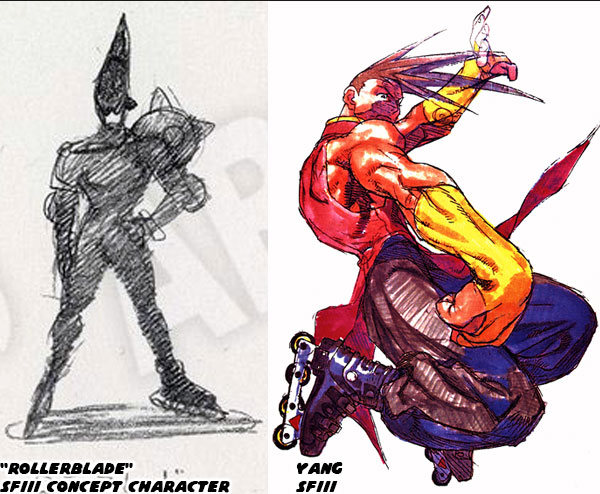
You would think that following the success of SFII the designers at Capcom would be more mindful of their international audience. For the most part the studio was able to create characters around a certain form of fighting. Whether they represented kung-fu, karate, wrestling, Muay Thai, or MMA. Those fighters had a look that reflected their style. The problem was when trying to create a design for a new fighter that didn’t represent a certain style. Blanka, and Dhalsim were examples of that. They fought in an unorthodox fashion, and thus had an unorthodox look to them. Before starting on a new game the designers would throw out all sorts of ideas, and see which ones stuck. For example one of the ideas for a SFIII character was simply titled “Rollerblade.” This character had some odd armor, and a helmet / hairstyle.

Designing an entire fighting style around a person that could inline skate didn’t go anywhere. Instead the studio took the skating, and made it a hobby for one of the kung-fu twins they were working on. The older of the two Yun, would be a skateboarder, inspired by Ken Lieu an actual skate legend. Yang was more than likely based on the Yasutoko Brothers, Takeshi, and Eito. Both of them were aggressive inline world champs. I would argue however that at least the spiky helmet in the concept sketch was turned into spiky hair for the younger twin. Not every design was as neutral. Some designs were right on the edge of offensive. What might have been meant as an homage to a certain archetype could be seen a stereotype to another person.

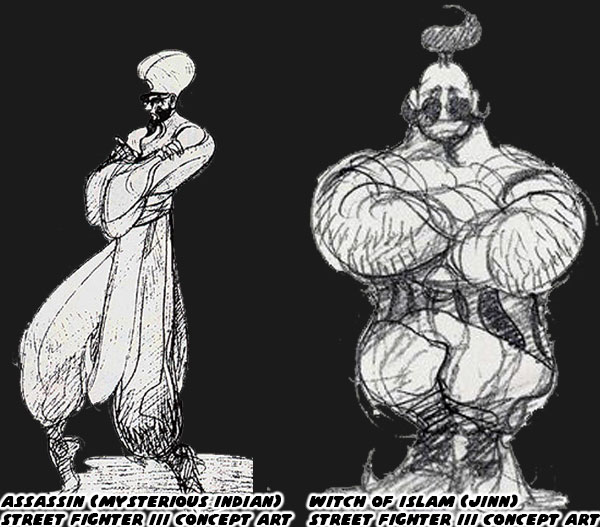
Let’s take a look at how the studio had been trying to incorporate a Middle Eastern character in the franchise for over 25 years. Some of the oldest drafts in Street Fighter III had a mysterious Indian assassin character. This fighter was dressed in classic Arabian fashion. I mean these costumes might have worked in a storybook, or Disney cartoon. That concept was fairly mild compared to the Witch of Islam. An enormous musclebound character that could be mistaken for a djinn, or genie. If you don’t think the design could be considered problematic then I wouldn’t know what to tell you. The Street Fighter 6 team didn't seem to be able to let some of their older designs go, no matter how far out of step they were with representation. 

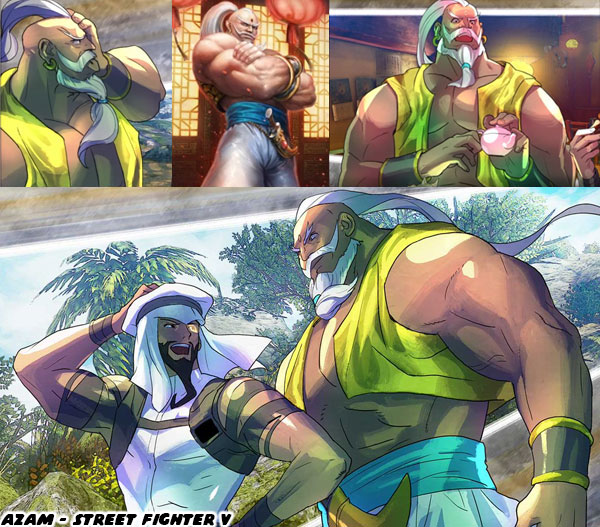
In Street Fighter V there was an NPC named Azam that was the attendant / bodyguard to Rashid. The duo represented a lost kingdom in the desert. Azam wore costuming that made sense in one of the classic tales of Sindbad. You could easily imagine the musclebound character in a fight with a cyclops, pirate, or sea monster. He looked nothing like a modern person from the Middle East. He was reminiscent of the Witch of Islam concept. Capcom thankfully thought better than making him a main character. The studio still had to develop somebody whose look spoke to Middle Eastern culture. I would argue that they leaned heavily into orientalism when presenting Rashid in Street Fighter V. The studio didn’t lighten their approach to Azam when updating him for SF6, Rashid was another story. 

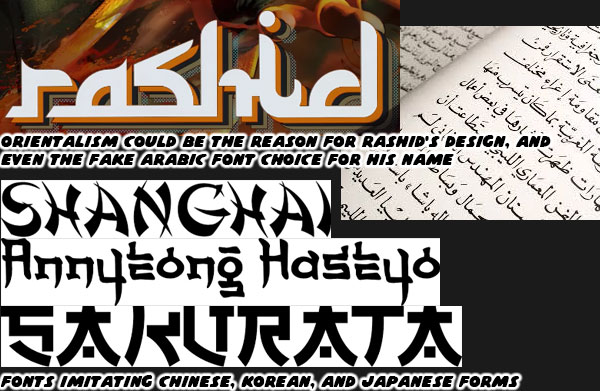
The developers didn’t second guess using a font that imitated the Arabic language, and script when announcing his return. It was a clever design choice, and I'm certain that Capcom had tremendous love, and respect for the people of the Middle East. This did not mean that some of their choices were not rooted in outdated ideas. Orientalism was the representation of Asia, especially the Middle East, in a stereotyped way that is regarded as embodying a colonialist attitude. This was something that had always been a part of character design from Japanese studios. I'm talking about magic, harems, genies, and inflatable characters! I created a series exploring the origins of these tropes. If you have some time please visit the following links; The Middle Eastern fighter, pt. 1, The Middle Eastern fighter, pt. 2, The Middle Eastern fighter, pt. 3, and The Middle Eastern fighter, pt. 4 (is where I talk about Rashid).

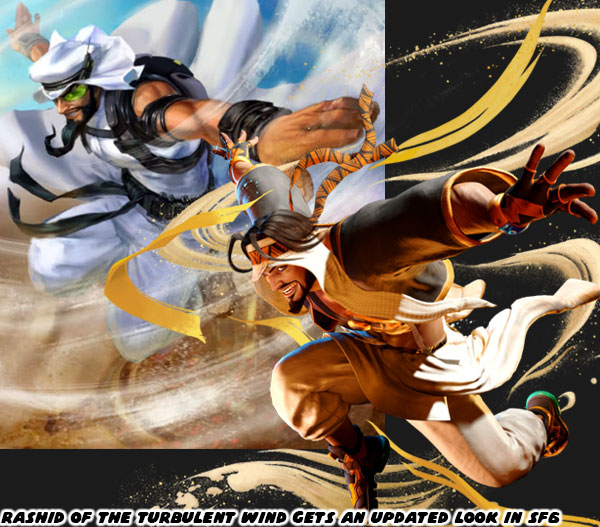
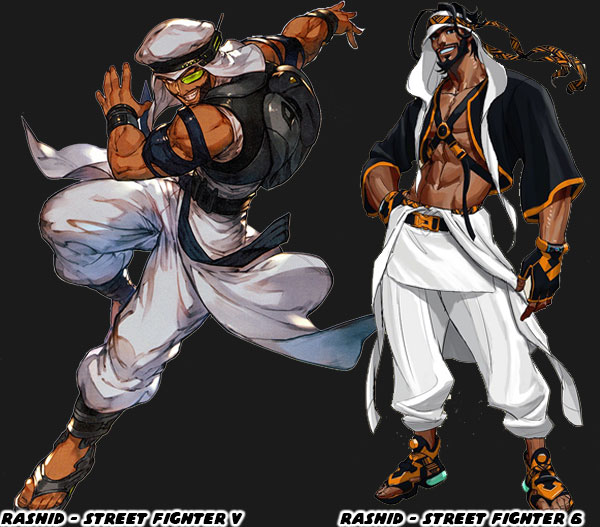
I would say that the newest version of Rashid was greatly improved over the previous. Let’s take a look at the differences between the designs in SFV, and SF6. One of the biggest problems I saw with the original look was the plain color scheme assigned to Rashid. Street Fighter II set a standard for character costumes, one of the reasons they worked was by sheer coincidence. The hardware that Capcom developed on was powerful for its time, but still had a limited sprite size, number of animations, and particularly limited palette of colors. The designers made sure that each character was given a strong primary color, and a complimentary second color. They would be easy to pick out of a crowd. If you think about Ken, and Ryu the colors that come to mind are red, and white. When you think of Chun-Li the color is blue. When I mention Blanka the color is green. You get the idea. For Rashid the color was primarily white, with a black belt. Something was lost when his costume was very similar to Ryu’s.

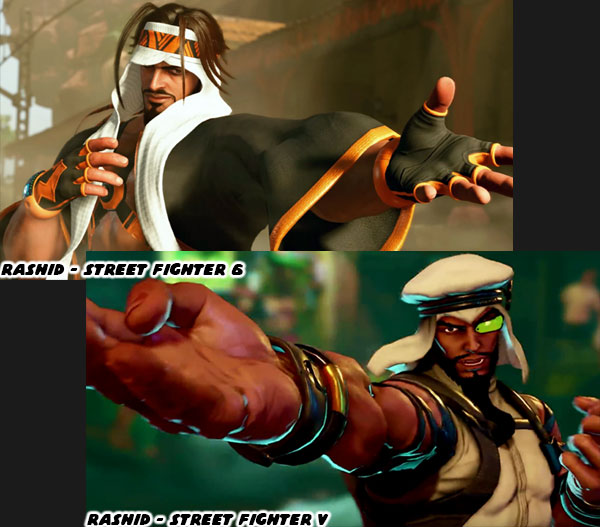
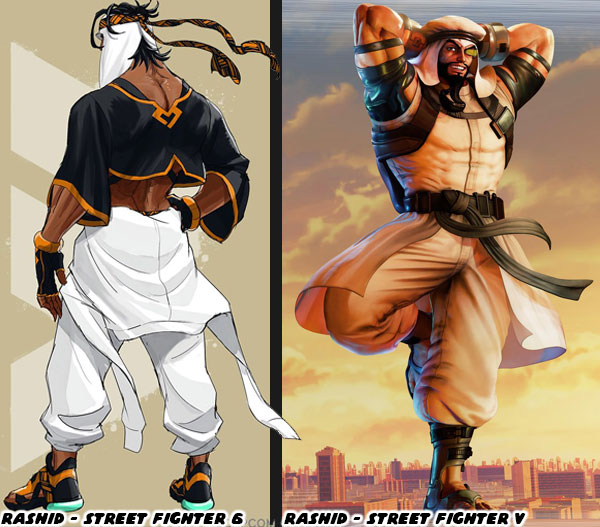
Designer Yusuke Hashimoto gave Rashid a makeover without losing too many elements from his original look. The first thing he did was expand the the secondary color black to cover the top half of his costume, and added orange as an accent color to separate him from Ryu. He also shortened the beard into something more realistic. He also did away with the overt technology the fighter relied on. Rashid was an expert at parkour, he was exceptionally quick, agile, and athletic. These things did not necessarily make him a dangerous fighter. He supplemented his strikes through technology. Hidden in his boots, and costume were tiny engines that created whirlwinds. In his original look he wore a large backpack to power these devices. The new costume got rid of these things.

His keffiyeh, the traditional headscarf was previously large, and puffy. This was swapped out to a visor head wrap with a long orange headband. His green viewfinder was ditched, as he was not a Sayan from Dragon Ball Z. His shoulders were now covered, there was no sign of the straps that had randomly criss crossed his arms. His smart devices were now integrated into his gloves. His sandals used to be plain looking, but were now stylized more like sneakers with electronics. Mr. Hashimoto pulled Rashid’s design into the 21st century, tried to leave the fairy tale elements out, while still making it unlike any traditional Arab costume. It followed the rules that went into the costumes of the other classic characters. After all Ryu, Chun-Li, and Guile’s costumes looked authentic, but only pulled a few cues from actual uniforms. His work should be studied in greater depth by anyone looking to create, or update a library of fighters.

Street Fighter 6 was evolving with the times, and pushing for a more diverse cast, without losing their unique eye. The Mysterious Assassin, and the Witch of Islam may have been the inspiration behind Rashid, and Azam, however they more directly influenced the creation of F.A.N.G. in SFV, and A.K.I. in SF6. We will look at how in the next blog. I hope to see you back for the next entry. If you are a long time fan of Final Fight, or Street Fighter then I would like to hear your impressions of SF6. If you have never played any game previously then tell me your experiences in the comments section please. As always if you would like to sponsor me please visit my Patreon page and consider donating each month, even as little as $1 would help make better blogs and even podcasts!
follow the Street Writer on Patreon!