Showing posts with label punk. Show all posts

Wednesday, September 6, 2023

Street Fighter 6: A master class in game design, part 17

At the start of this series I talked about how the Street Fighter 6 developers were using the World Tour to ease a new generation of players into the many fighting game concepts. From random gang encounters, to part time jobs, to selective battles with pedestrians. Each of these things helped build muscle memory, teach range, reaction, counters, and using the Drive Meter. Each of these would make for better fighters, and a better SF experience. One of the more specific ways that the World Tour was prepping audiences for fights with the various masters was through the use of Copy Fighters. These were synthetic humans that popped up on occasion, similar to gangs. Yet unlike a gang member these androids were guaranteed to have many of the special attacks of an actual SF master. To be fair sometimes a random pedestrian or gang member would also have a move or two from a master, but the Copy Fighters had almost all their moves. They were nowhere near as strong as the actual master, like E. Honda, Ryu, or Guile for example, but they did know how to perform several of their combos, and special attack strings. Copy Fighters were sort of like random mini bosses to increase the challenge in the middle of the World Tour.
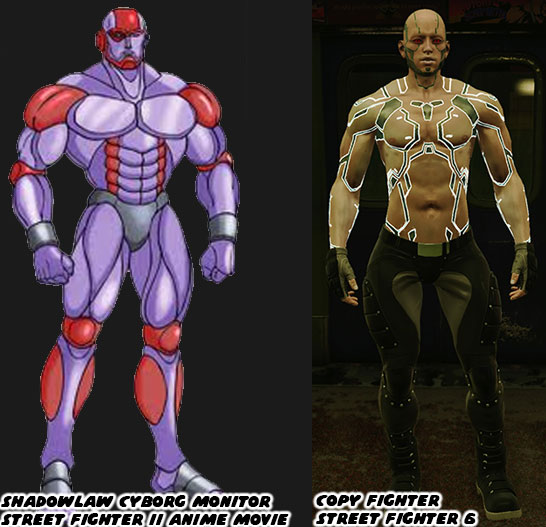
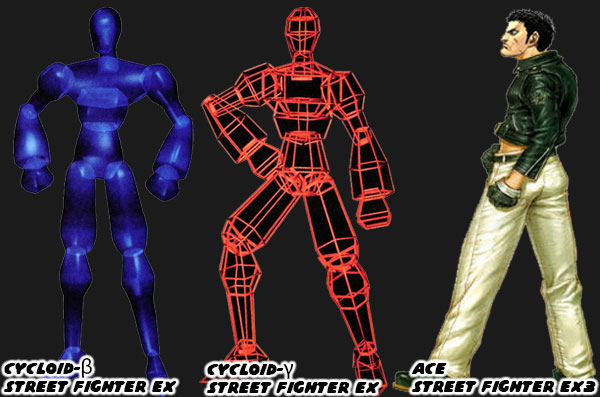
The idea of a cyborg that could copy the moves of the various fighters had been seen in other games, including Mortal Kombat. In the SF universe the first use of this was the Shadowlaw Cyborg Monitor. They were seen in the SFII anime movie, they were stealing the data, and copying the moves of the various masters. These cyborgs were actually playable on the Japanese Saturn, and Playstation consoles with Street Fighter II: The Interactive Movie. Audiences could take control of the cyborg after a prompt, and try to defeat Ryu in order to steal his moves. This sort of character would evolve in the Street Fighter EX series by ARIKA. There were two humanoid robots called Cycloids; Beta, and Gamma respectively. They each had special attacks from roughly half of the cast. Between the two they could perform all the special attacks from the masters. The evolved version of this character became ACE, and players could choose which moves he would be able to copy.
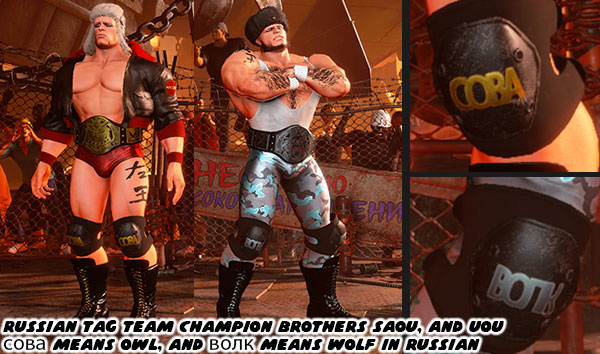
Copy Fighters, and Cycloids weren’t the only way to get a lighter version of a boss fight. Street Fighter 6 had understudies for several of the masters. They had the moves, range, and strategy of their masters. The only lacked the stamina, and more advanced combo attacks of the main SF roster. For example Zangief was established as a pro wrestler. Arguably he was the greatest pro wrestler in the entire SF universe. This didn’t mean he was the only one. The game introduced a pair of tag team wrestlers. They were Russian brothers named Saou, and Uou. One wore the championship belt with an owl mascot, and the other with a wolf. The two shared lessons from Zangief with the player. They could also be challenged for a match.
There were two other NPCs that were crucial to the story mode. Bosch, your friendly rival introduced in the story mode, had stolen money from the Mad Gear gang. In order to make amends you had to team up with Mad Gear, look for recruits, and fight against the Crows. The leader of the Crows was a punk named Rudra. It turned out that he was an understudy of Dhalsim, who had run away from the temple many years prior. He saw that kids were suffering, and being abandoned on the street. Instead of meditating about the problem he figured had a duty to act. So he would round them up, and teach them how to survive. Despite his punk looks he was a noble character in many regards. I think that was the reason why his abilities developed greatly with Dhalsim as his master. In typical SF6 design, nothing was put into the game by accident. The name Rudra actually had multiple meanings in Hindi, including he "who eradicates problems from their roots".
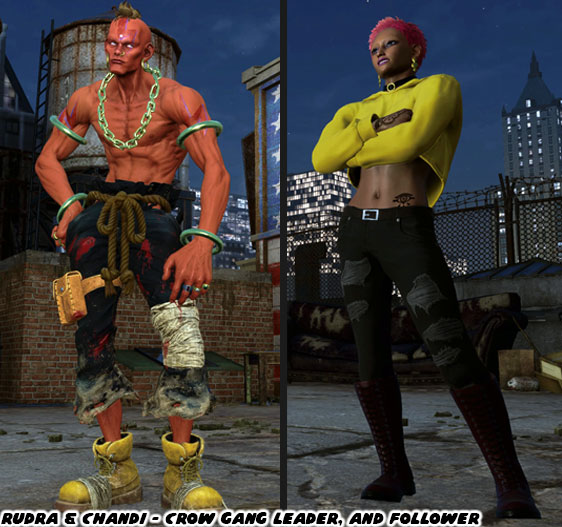
Rudra was joined at the hip by Chandi. The long-suffering Crows recruit that was doing everything in her power to get senpai to notice her. The writing, and personalities of the two characters came through clearly in the World Tour. Rudra was aloof, and disinterested in everything, but especially in society. Chandi was a sort of opposite. She had a bubbly personality, and earnestly believed in her leader. They easily had my favorite dynamic in the title. As with Rudra her name was important as well. Chandi or Chandika was a Hindu deity. She was a powerful form of Mahadevi (the supreme goddess) who manifested to destroy evil. Both of the characters may have been involved in gangs, but they had a noble purpose. This was opposed to the Mad Gear who just wanted to take back control of the streets, and the city.
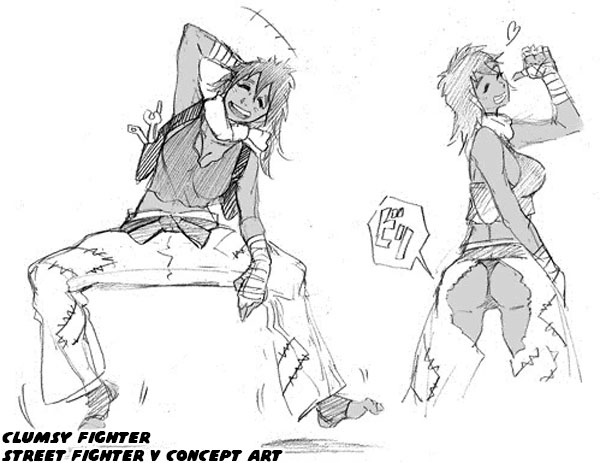
I believe that the roots for the characters had actually been planted many years earlier. During the planning stages of Street Fighter V one of the character concepts was called the Clumsy Fighter. She was a girl wearing torn clothing that managed to stumble her way through a fight. She carried a bag with wrenches, and other tools that she could use to her advantage. I could imagine the SF6 team, which also worked on SFV were going through their unused concepts, and being influenced by the tattered clothing, and carefree attitude of this girl. It was also possible that the idea of NPCs in SF6 throwing wrenches came from this concept character. Or it could have come from Pupa Salgueiro from the Rage of Dragons. That young lady also fought with a wrench in an earlier rival studio game.
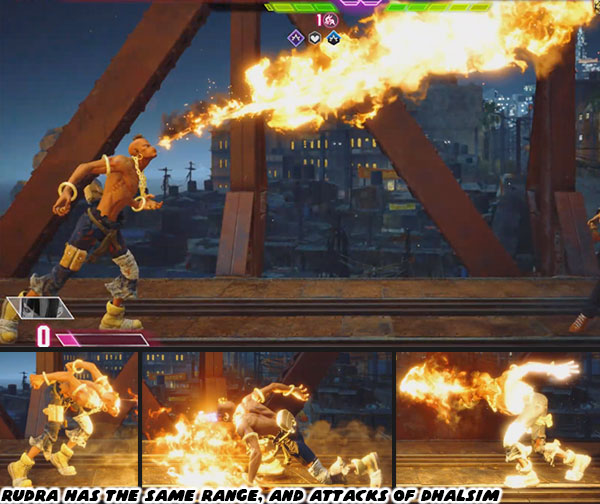
If you were to tell me a few years ago that there would be a new stretchy-limbed Indian in SF6 then I would have scoffed at the idea. If you would have told me that the character was better developed, and presented than Dhalsim then I would have said it was impossible. Yet in the end I absolutely loved the character. I would go so far as to say I enjoyed his design more than all the new SF characters. To be fair Kimberly, and Marisa had some amazing personalities that shone through their animations. There were so many fantastic elements layered over the punk that it wasn’t fair that he would be an NPC opponent. For example take a look at the little details like his mohawk, and the paint on his head. At first glance it looked like the red stripe on Dhalsim’s forehead. However it was painted in a lightning bolt shape, falling over his left eye. This conjured up images of Ziggy Stardust the stage character created by rock icon David Bowie. He also wore a lot of jewelry. His nose, and ears were pierced with gold rings, he sported a gold chain, and large gold bands on his upper arm, and wrists, plus gold rings on his fingers. There hadn’t been this much flash on a punk since Birdie in SFZero.
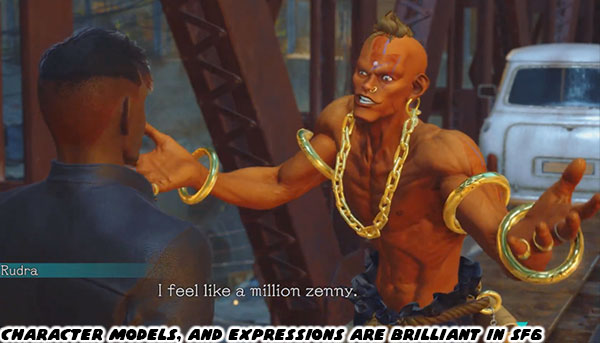
Dhalsim was much more subtle in design, and personality. His necklace was made of rope, and his bracelets were metal, I wouldn’t even say they were silver. He was much more humble by comparison. To be fair Rudra was literally cut from the same cloth. His clothes were tattered, and torn. Athletic tape was holding his pants, and boots together. These were the modern equivalent of the rags that Dhalsim wore when he was doing his Prāyaścitta or penance. I could easily imagine Dhalsim being retired, and having Rudra return to fill that role in future sequels. I would frankly welcome that.
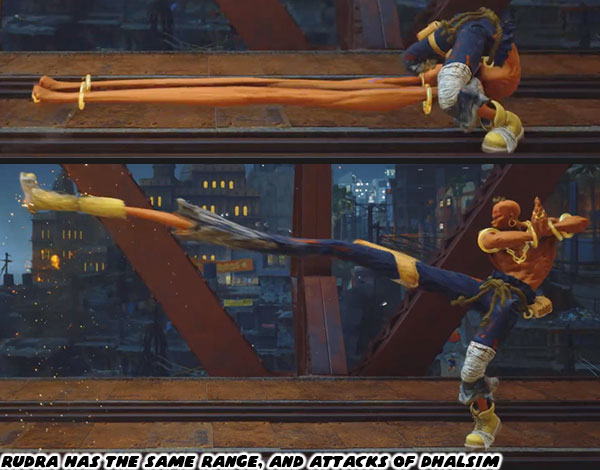
If I had one complaint about Dhalsim, or Rudra it would be with how their powers were represented. Previously it made sense that Dhalsim could only stretch his limbs on direct strikes. You could imagine that he could dislocate his joins, and throw a punch, or kick straight forward, and back. However in SFV, and SF6 he seems to be made completely out of rubber. He would contort himself in all sorts of positions, even while throwing simple attacks. There was no regard for his bone structure, muscles, or tendons. As if he were Plastic Man, or Mr. Fantastic from the comic books. The thing was that this type of character had already been done in SFIII. His name was Necro.
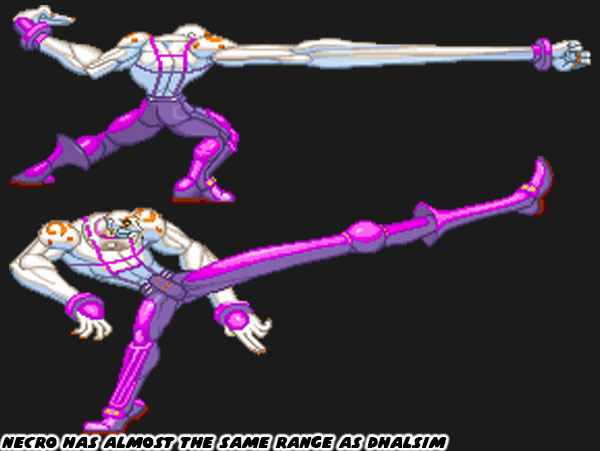
Street Fighter III Producer Tomoshi Sadamoto, and designers Yasuhiro Seto, Tomonori Ohmura, and Obata Shinichiro did their best to follow in the footsteps of the previous teams. Their goal was to create an entire new library of characters. They didn’t want to bring back any of the previous World Warriors, except for Ken, and Ryu. They wanted to explore new styles of fighting, and create new archetypes. Unfortunately for them people were looking for new characters that played exactly like old characters. They saw the stretchy Necro, and assumed he was the new Dhalsim. In a way he was. He had almost the same range, and his fire special attacks were replaced with electricity. But then if you dug deeper you realized this character did not employ the same strategies. His setups, his combos, and special attacks were uniquely his own.
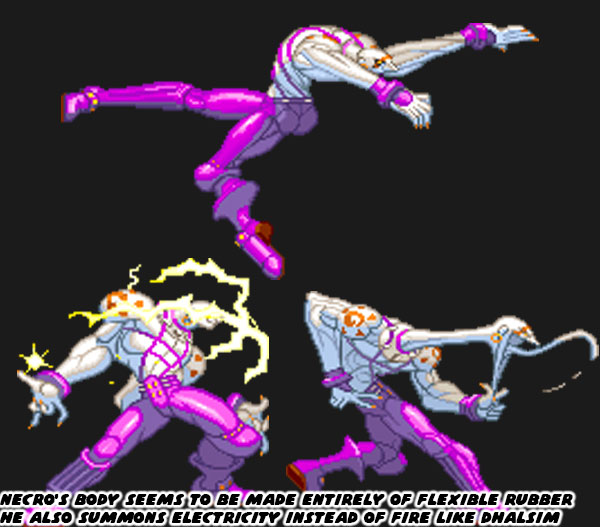
The other thing about Necro was that his skin, bones, muscles, and tissue were rubberized. He had been experimented on by Gill, and his Illuminati as part of the G-Project. They were trying to create the ultimate soldier, someone that was impossible to injure. Necro didn’t look quite human. His pupils were gone, his skin pigment was gone. The melanin was replaced instead by a light lavender. The fighter could stretch his face as if it was made of putty. He could twist his torso, arms, and legs past where they would normally break. He seemed impervious to any damage no matter how much he twisted himself up. Capcom shared the earliest designs for Necro in their arcade Secret Files. He was originally proposed to be an android.
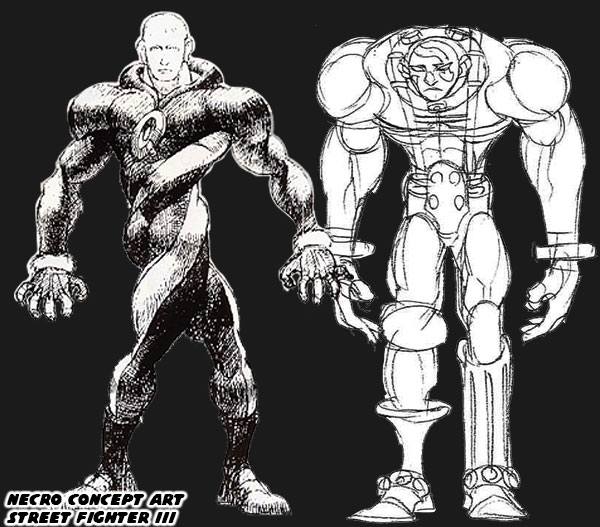
Other synthetic lifeforms were created following the Necro experiments, including the shape-shifting characters Eleven, and Twelve. It made sense for Necro to be more flexible than humanly possible given that had been genetically modified. All of that stretching, and flexibility worked in the context of his origins. I don’t think those things should have been applied to Dhalsim in SF6. But that was a minor gripe in an otherwise fantastic game. Thanks to Copy Fighter, Saou, Uou, and Rudra audiences could get practice fighting light versions of the SF masters while in the middle of the story mode. Speaking of which. All of the time spent traveling the globe, and Metro City meant that you were going to compete as an amateur in the Metro City Fighting Tournament. It would be a test of whether or not you had mastered everything that had happened up until that point. We will look at the next chapter of creating this experience in the next blog. I hope to see you back for the next entry. If you are a long time fan of Final Fight, or Street Fighter then I would like to hear your impressions of SF6. If you have never played any game previously then tell me your experiences in the comments section please. As always if you would like to sponsor me please visit my Patreon page and consider donating each month, even as little as $1 would help make better blogs and even podcasts!
follow the Street Writer on Patreon!

Friday, June 8, 2018

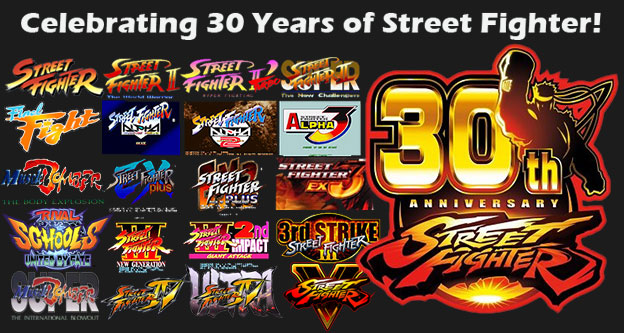
30 years of Street Fighter, 30 Days of Characters; #23


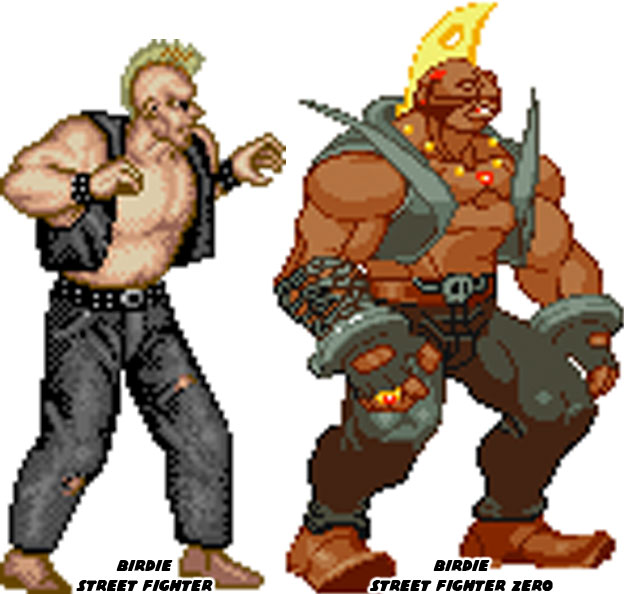
Today we celebrate Birdie, one of the original Street Fighter characters. He is one of the select few that appeared in 1987 and was brought back a few times as a playable character. Those old enough to remember the original game also recall that there were only two playable characters, Ken and Ryu. The duo traveled the globe and fought masters of various martial arts. Birdie was significant for a number of reasons. His size was one of them but aside from that he had a strong look. His mohawk haircut, leather vest, pants, and spiked bracelets let people know that he was a punk and not afraid of a fight. Also Birdie didn't represent any style of fighting, he was a legitimate street fighter. He swung his massive arms wildly and headbutted his opponents. There was nothing graceful about the character but he was very good at what he did.


Birdie wouldn't return again until 1995 with the debut of Street Fighter Zero / Alpha. When audiences saw him again he had a radical new look. Actually his look didn't change as much as the aesthetic. The legendary Bengus redrew all the characters and greatly exaggerated their proportions. Birdie was always a physically strong character, only now he appeared absolutely massive. His arms were now as thick as his legs. His mohawk, leather vest, and brown boots all returned. He had a few new accessories; jewelry, a tattoo, handcuffs and a chain all solidified his makeover. Of course the other thing that audiences noticed was his skin color. Birdie went from a white guy to a black guy in the span of eight years. The moves that he had in the original Street Fighter were preserved. He still relied on his club-like punches and headbutt. He could even use the chain on his arm as a makeshift lasso. The style wasn't pretty but it was very effective. 


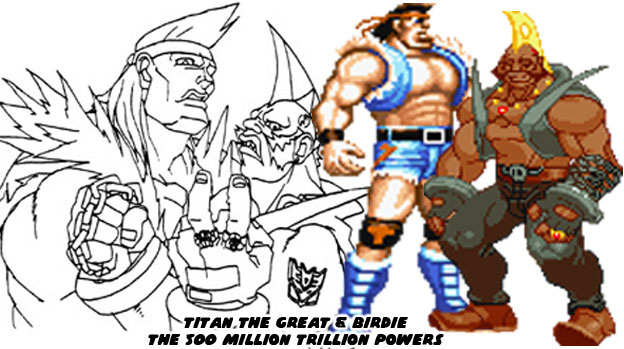
Despite his odd appearance Birdie was a sympathetic character. His friendship with Ryu was explored in the Street Fighter Zero manga. He also happens to be a character that bridges together the various continuities. Birdie helped connect the Street Fighter and Street Fighter II timelines in Street Fighter Zero. He also helped bring wrestlers into the fold as well. Mike "Macho" Haggar, the mayor of Metro City, was one of the stars of Final Fight (1989). Most people know that he also appeared as a pro wrestler in the Muscle Bomber / Saturday Night Slammasters series. In the game they mentioned that the giant Titanic Tim aka Titan the Great was the tag team partner of Birdie. This became canon when the official team art was released for Street Fighter Zero. Birdie was always a fun character to play as. Up close he could mangle opponents with his "Murderer Chain" and he could even leap across the screen for a surprise beating. I'm not fond of what the designers at Capcom did to him in Street Fighter V but I will nonetheless remember him for how unique he made the Street Fighter universe. As always if you enjoyed this blog and would like to sponsor me please visit my Patreon page and consider donating each month, even as little as $1 would help make better blogs and even podcasts!
 follow the Street Writer on Patreon!

Thursday, July 2, 2015

Representation Matters! Or, what happened to Birdie, part 3...


I'll get right to the punchline, fat characters were introduced into the recent crop of fighting games because they were funny to look at. For some reason Capcom producer Yoshinori Ono had decided to steer several characters into the absurd. When I saw what the team had done to Birdie in Street Fighter V I was deeply saddened. I thought to myself why would they do such a thing to such an original design. I could not think of a context where his transformation was justified. None of the other characters brought back had gotten fat. If the excuse was that punks got fat and lazy in their old age I would have to ague against that. Sure everybody may get out of shape as they get older but some in the punk rock community would argue that sentiment.


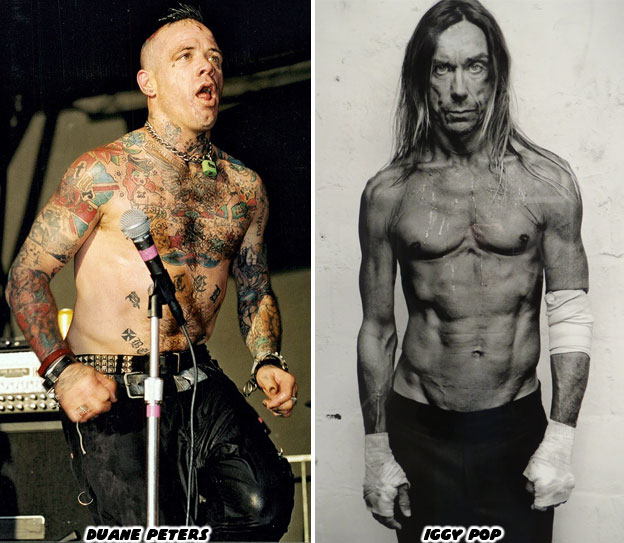
Singer, skateboarder Duane "The Master of Disaster" Peters was into the punk scene from a young age. He was as tough as any long-time punk and had lived a life that would have killed many other people. A veteran of the road he skates as hard as he ever did. He was also born in 1961, during the golden era of skateboarding in Southern California. But let's go even further back. The iconic Iggy Pop also works hard and rocks harder. He was born 1947 and was a catalyst of the punk movement. Iggy has a body better than most men half his age and also shows no sign of slowing down. So when everything about Birdie (up until) now says punk I don't think of fat bikers (which is really what he became). Instead I think of rockers like Iggy and Peters. Birdie should remain as timeless as the other Street Fighter characters. If the developers cannot meet the character with that basic understanding then maybe he shouldn't be in the game.

 So are you against fat characters in fighting games? 


No.

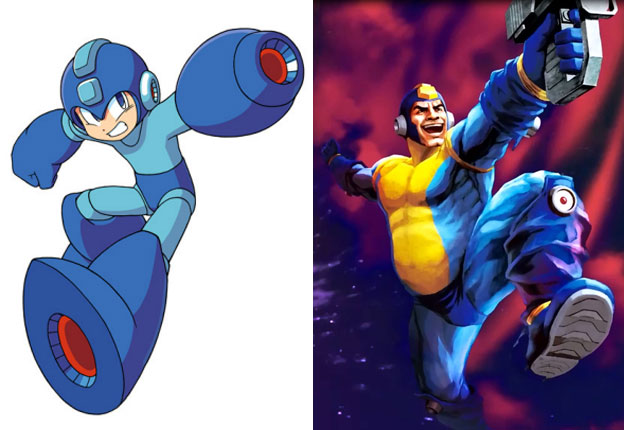
Let's make this perfectly clear. I am not against fat characters in fighting games. I am against silly gimmick characters in franchises that do not need them. Before Birdie got a makeover an even older, and more popular Capcom icon had gotten the same treatment. Mega Man was announced as a playable character for Street Fighter X Tekken. When most people thought of Mega Man they imagined a blue robot that looked like a kid wearing a blaster on his arm and a helmet on his head. What no one could have imagined was a fat guy with a laser pistol and some tights.


It was an absurd redo of a classic character, one that was based on the poorly designed NES box art from North America. It was more outlandish presentation than say the Bionic Commando as a morose ex-soldier in dreadlocks. Yet somehow somebody at Capcom not only thought this was a good idea, they pushed for it to get done. The artists, animators, programmers and developers all had to model and create this fat guy in a costume and balance him out against the rest of the Street Fighter and Tekken cast.  I would assume that it was the producer, Mr. Ono that made the call. Let's go back and look at his short list of questionable decisions in the fighting game arena. He was ultimately responsible for getting Hakan into Street Fighter IV and giving him the silly oiled up attacks. For having T. Hawk sit on opponents and make the Native "how" gesture. For turning El Fuerte from a traditional masked wrestler to a cooking obsessed parody. Of course there was the greatest misstep of all, the addition of Rufus to the Street Fighter universe.

 A-ha! I knew it, you do hate fat people in fighting games! 


Pay attention because I do not want to repeat myself. 

I do not hate fat people in fighting games. I love fat people in fighting games. I love to see diversity in body types, body shapes, skin color, age and ability more than anybody else I know. I love the fact that fat characters have been a part of fighting games since the earliest days. King Hippo in Nintendo's Punch-Out!! and Buchu from Konami's Yie Ar Kung-Fu were two of the earliest fat characters in the genre. The were swift, powerful, had great attacks and distinct looks. Hippo was a likable character and was paralleled in real life by people like super heavyweight boxer Eric "Butterbean" Esch. Capcom had even included fat people in their action games before Street Fighter II debuted.


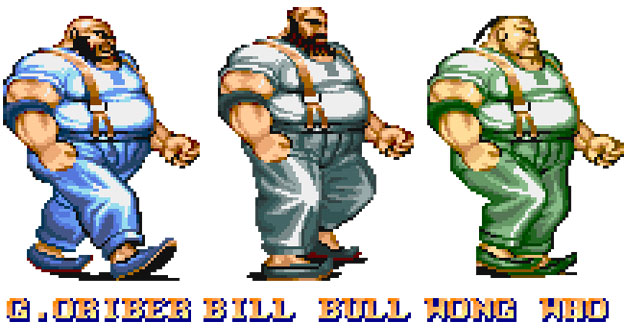
G. Oriber, Bill Bull and Wong Who were members of the Mad Gear Gang. They fought the heroes in Final Fight. The trio, like the rest of the gang, would get beaten up then return for more punishment later on in the stages. The three characters were heavy set but also very muscular. Being nothing more than pallet swaps (simple color changes) with a few cosmetic changes to the heads they were a quick way for the developers to make the cast of villains look numerous. These characters also showed a range of diversity. Oriber and Bull looked Western and Who was presumed to be Chinese. The archetypes were actually inspired by a heavy-set man that used to menace the local bars near Capcom's headquarters in Japan. This added an extra layer of dimension to the brawlers as I could imagine the Capcom employees had to sidestep this person after a night out on the town. I always thought that the fat characters worked well in the series and looked forward to their counterparts in the Final Fight sequels.

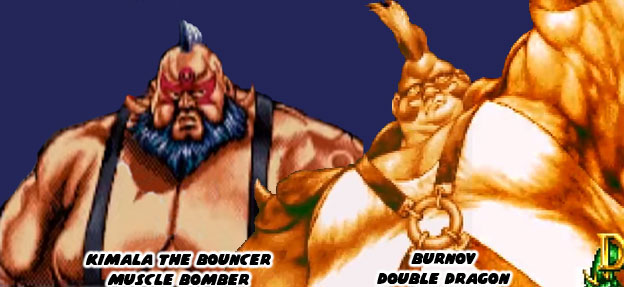
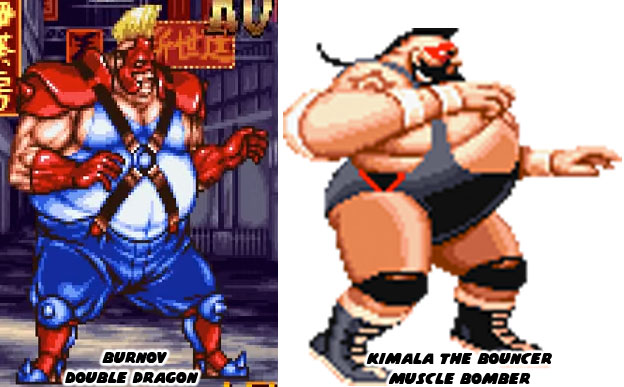
The tradition of adding respectable fat fighting game characters was actually observed by several studios and not solely Capcom. Two of the most massive fighters in a fighting game turned out to be eerily similar. Kimala the Bouncer from Capcom's Muscle Bomber / Saturday Night Slam Masters series (1993) and Burnov from SNK's Double Dragon (1995) fighting game were two of fattest game characters ever created. Their arms and legs were often wider than their entire opponents torsos. The two also happened to have Mohawk haircuts to add to their already imposing presence. There was nothing playful or silly about the fighters. They were there to brutalize opponents. Kimala was actually the BWA (Blood Wrestling Association) Heavyweight Champ. Burnov was a post-apocalyptic warlord, not far removed from the villains in Hokuto No Ken / the Fist of the North Star manga series.


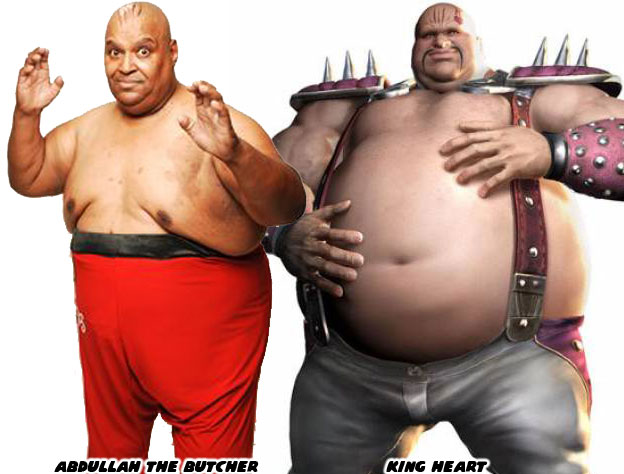
Speaking of which, Hokuto No Ken was a very influential manga series from the early '80s. It colored the development of many fighting games. One of the evil warlords from the comics was called King Heart. He was tall and fat, with deep scars on his forehead. He also had a distinct tattoo on the side of his head. It was a heart with a K for King, modeled after the classic Bicycle company playing cards. The heart tattoo placed on the head of Birdie as a nod to the character. Despite dying a gruesome death in the comics King Heart turned up in a few fighting games, including an arcade version.

Hokuto No Ken series creator Tetsuo Hara was actually a fan of the Street Fighter series and was called in to help with character designs for the wrestling game Muscle Bomber. He created a lineup that was in almost every way as unique as the original World Warriors from Street Fighter II. He modeled Kimala after the Sudanese (actually Canadian) wrestler Larry Robert Shreve, better known by his ring name Abdullah the Butcher. Abdullah was six feet tall and over 350 pounds. He had studied some karate and judo growing up. He found a living through pro wrestling. Abdullah had a very distinct look. He wore red pants with a sash and had curly-toed shoes, a costume that was supposed to bring up images of ancient Arabia. His most defining feature was his forehead. After years of blading (cutting himself to make the matches bloody) his head was left with very deep scars. Abdullah was never much of an athlete so his matches were often standing brawls where he would bring out illegal weapons, like a fork, which he would then use to stab opponents and bust them open so that they bled as well.


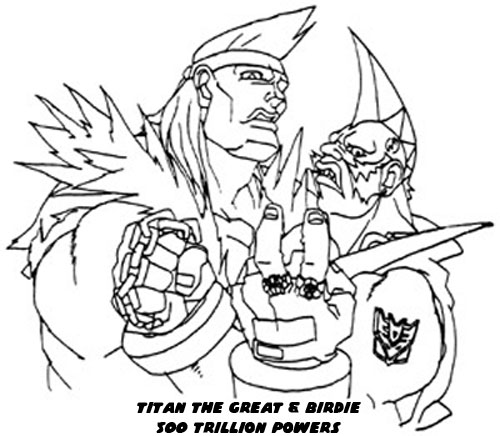
Tetsuo Hara did more than develop fighters, he helped create the backstory for Capcom's wrestling universe. Brutality was what the BWA was known for. The "good guys" wrestled in the CWA or Capcom Wrestling Association. The wrestlers would cross between promotions and have an all-out war trying to find out who was the best wrestler of all. I always admired Kimala as a character and also what Hara was trying to represent through him. The influence that he had on Street Fighter was immeasurable. The boots of Abdullah were paralleled in the curly-toed shoes worn by Birdie. But that was not the only thing that Hara had shaped for the character. Birdie was actually tag team partners with Titan the Great. Titan was the giant of the Muscle Bomber series. He was absolutely massive and just a centimeter or two shorter than Hugo Andore from Final Fight / Street Fighter. In the official character art between Titan and Birdie we could see that Optimus Prime and Megatron from the Transformers were characters on the rings of Birdie. Not only that but Birdie had a Decepticon tattoo on his shoulder. These were details that the people working on Street Fighter V had overlooked or simply did not know.


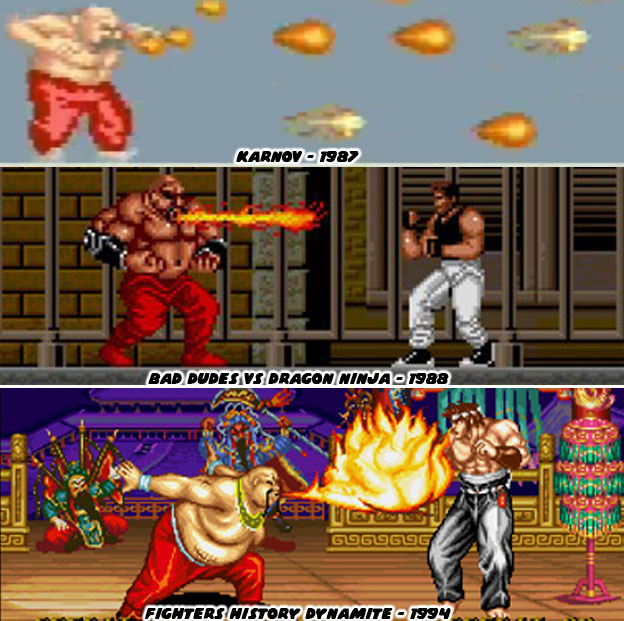
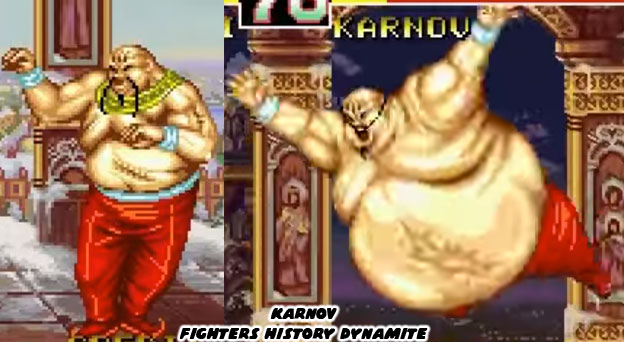
As an aside Abdulah had a hand in influence other fat characters in gaming. The wrestler had been at his craft through the '70s, often touring Japan. There was no doubt that Hara as well as other artists and developers were familiar with the character from his trips. The Middle Eastern look of the Butcher influenced the creation of one of the early console and arcade adventure heroes. Jinborov Karnovski aka Karnov was a fire breathing, ex-circus strongman from East Russia. His red pants, curly-toed boots and heavyweight frame were distinctly Abdullah's. If they were not then he was at least based on old Arabic folklore. The arcade game and NES adaptation of Karnov appeared in 1987. Data East was one of the forefathers of the fighting genre, they had created Karate Champ after all. Instead of focusing on one-on-one combat with fighters of different abilities they instead decided to wrap adventure games around these fighters. Karnov would face fantastic monsters on his journey, similar to a character like Sindbad, the pirate of Arabian legend. In addition to his strength Karnov also had the ability to breath fire. This was an important detail that would shape other characters and games.


A year after his debut Karnov appeared as the first level boss in the game Bad Dudes vs Dragon Ninja. This appearance meant that Karnov was a modern character but with ancient powers. His adventure was therefor not set in ancient times but instead in a part of the world where mythical creatures and demons existed. Karnov would fall off the radar for a few years. He would return in Fighters History Dynamite: Karnov's Revenge in 1994. Data East could not ignore the runaway success of Street Fighter II in the arcade and on home consoles. The publisher decided to create their own entry. The characters and controls in the original Fighters History were very similar to Street Fighter II. They were so similar in fact that Capcom took Data East to court for copyright infringement. Capcom lost the case and that precedence allowed other studios to create fighting games that also poached ideas from Capcom.


Here's the thing that I want all of my readers to pay attention to. In the original Karnov the character was heavy-set and each time he returned he became a bit fatter. This evolution of the character made sense in continuity. His ability to breathe fire, and his newfound ability to make himself a large balloon were based on ancient magic rather than martial techniques. It also made sense based on the origins of his look and powers. The costume that Abdullah the Butcher wore, the same costume of Karnov was based on ancient Arabia. In the classic story traditions of One Thousand and One Nights, Ali Baba and the Forty Thieves and the Seven Voyages of Sinbad there was a certain body type that kept turning up.

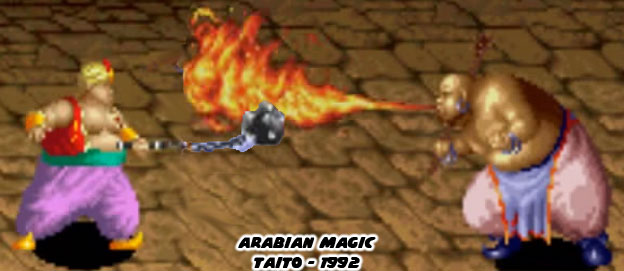
The fat characters were the strongest figures in the stories. Remember that thousands of years ago there were no such things as gyms or weight training programs. Big characters, fat characters, were universally understood as being the strong ones. Also fat characters could sometimes be seen as having status in society because they could afford to eat well. Fighters from these legends sometimes had magical properties. They had to have superhuman strength, be able to breath fire, and run across the sky in order to battle against the mythological characters. Sometimes these mythological characters could partner with them. Djinn or genie's could be summoned by the heroes. The would do this when they needed visit far off lands or destroy their enemies. These classic archetypes were actually featured in the game Arabian Magic by Taito in 1992.


Heroes and villains in Arabian Magic could actually be fat fighters. They were not silly and they did not have some sort of gimmick (like eating bananas and donuts) in order to make them more interesting. Abdullah the Butcher would probably have fit into one of the old stories and definitely would have worked in the games as well. This is where the genius of Hara came into play. Not only was he a huge fan of pro wrestling, he was also very familiar with the classic storytelling traditions. Kimala was influenced by Abdullah but he maintained some of the special abilities from myth. The character could spit poison (a trick used by the Graet Mutah) or breath fire as well. This was a tradition that SNK was familiar with. They used it when they created Burnov. The character could breathe fire and even engulf himself in flames and run over opponents. If you study the costume of Burnov you can see how it was a modernized version of the ancient Arabian costumes.


These fat characters were well designed and demonstrated that those body types could work in a fighting game as well. It turned out that characters like Kimala and Karnov were actually the exception instead of the rule. In the next blog we shall take an even closer look at fat characters in the fighting genre and see how the industry changed the purpose of those figures. I hope to see you in the next entry. Please leave any questions or comments if you'd like. As always if you enjoyed this blog and would like to sponsor me please visit my Patreon page and consider donating each month, even as little as $1 would help make better blogs and even podcasts!