Showing posts with label sonic the hedgehog. Show all posts

Monday, April 28, 2025

Sonic Superstars and beyond. Sega makes up for lost time, part 5...

In the previous blogs I looked at Sonic Superstars, and the things that the developers at Sonic Team, and Arzest did great. I also talked about the technical and design choices that I think really hurt the game. While I played through it I was reminded of all the wonderful things that I enjoyed in the franchise. It very much felt like a continuation of the elements that made Sonic Mania work so well. The art direction, level, and enemy design fit in the classic 2D style, even though the models were in 3D. The introduction of a new character named Trip, plus using individual Chaos Emeralds to change the game play was inspired. When I struggled with some boss encounters it showed that there were cracks on the facade. Trying some encounters over and over lent me to discover what type of gamer I was. In the end I had a favorable opinion of the game that gave me a lot of insight into myself. It allowed me to realize that the Sonic series was one of the rare titles that was globally appealing for a number of reasons. The first thing that drew me to the franchise was the character himself.

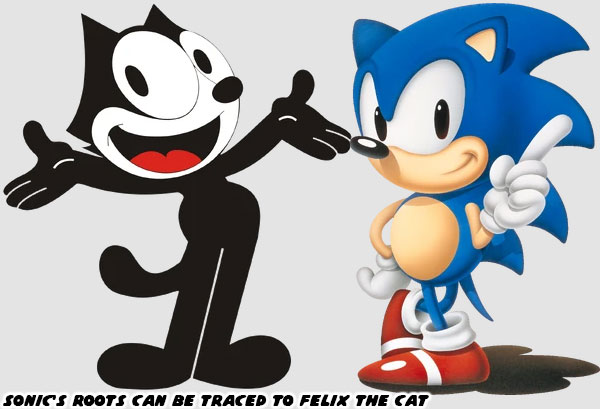
I stated previously that I loved the art, and design behind the hero, and his friends. I never cared much for Knuckles though, but that was besides the point. I was a huge fan of the mascot style of character art. The cartoon star that created the movement was Pat Sullivan, and Otto Mesmer’s Felix the Cat. He debuted in 1919, almost a decade before Oswald the Lucky Rabbit, and Mickey Mouse. The large head, big expressive eyes, and animal features set a template that would be copied for the next century. The early US cartoon stars like Donald Duck, Bugs Bunny, or Flip the Frog wouldn’t have made it big without Felix. Sonic the Hedgehog, Tails the Fox, Knuckles the Echidna, Mighty the Armadillo, and Ray the Flying Squirrel all followed in the footsteps of Felix the Cat. They were descended from one of the greatest cartoon traditions the world had ever seen.

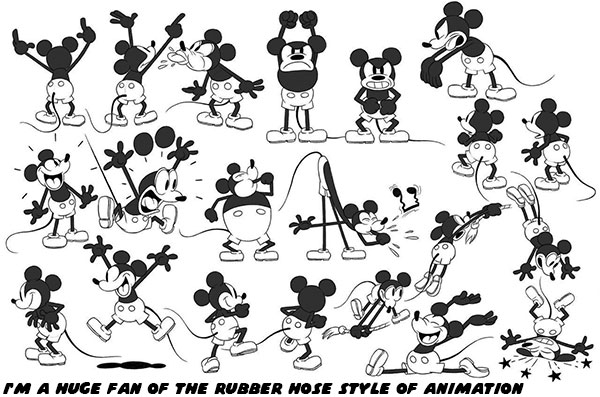
Although they were created by a Japanese team the Sonic art reflected my favorite form of American cartooning. The “rubber hose style of animation was the oldest form used in the US. The name was because the arms, and legs of these characters weren’t hinged as if they had bones. Instead they flexed like rubber hoses. Additionally the bodies on these characters were fluid. They could be pulled, stretched, and twisted like a rubber balloon. There was a sense of freedom in these cartoons that was liberating for artists. Although to be fair I was never good at drawing in a rubber hose format because my style was very rigid. It didn’t matter because I thought those early cartoon stars were so amazing. They could do the impossible, while still making their actions plausible. That tradition was rarely seen in modern cartoons, rare in video games, but not as rare in comic books.

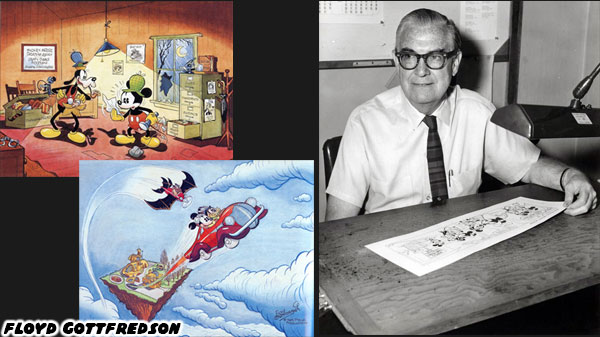
The Mickey Mouse comics illustrated by Floyd Gottfredson in the 1930’s set a standard for adventure storytelling featuring cartoon mascots. His comics kept the animated icon alive outside of the movie theater. Mickey would hang out with his friends in some stories, having fun with the other Disney stars. Then he travel the globe on an international mystery for longer arcs. A decade later Carl Barks raised the bar in the Donald Duck, and more important, the Scrooge McDuck comics. Comic books were the perfect format for expanding on the animated shorts. We could get to see the characters develop a personality. The writers, and artists presented a universe that was much deeper than could ever be shown in a cartoon. For the longest time I assumed that these stories were for children until I actually sat down and started reading the collected volumes. I was not only amazed by the art, but by the storytelling. It worked on multiple levels There was action for the kids, great character development for teens, and mystery for the adults. They truly were books for all-ages.

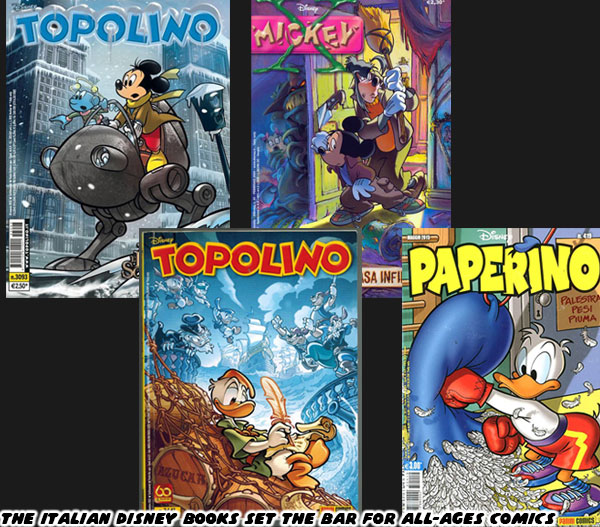
Comic books in the USA were mainly superhero titles. Often mature in tone, and not really created for all-ages. However overseas the Disney comics were still popular with families, and even adults. They were an institution in Italy, where the Mickey comics (Topolino) had been in publication for over 90 years. I believe that they were the greatest run of all-ages comics ever published. Multiple generations were raised on stories that were every bit as good as those created in the USA. I would argue that the elite Disney cartoonists cut their teeth drawing on the pages of Topolino. The best of these stories were serialized and translated to multiple languages. I did a deep-dive on the Italian comics many years ago. The reason that I brought them up was because they were critical to keeping the characters popular. More than that they were important to spread the cartooning art form. You could only do so much in an animated short but the comics allowed the characters to live, and grow. They did more for audiences than the parent company did in the parks, television, or movie screens.

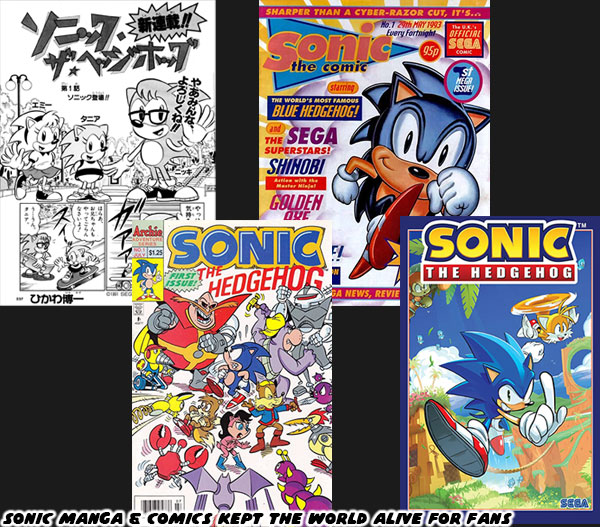
A similar thing could be argued for comics based on video games. Comic books could take a relatively short game, and give readers a cinematic experience. Udon was known for the Capcom books they published. Street Fighter, Mega Man, and Vampire / Darkstalkers were just some of the titles they released. Audiences got to follow the main, and side characters across a variety of story arcs. They allowed audiences to learn the dynamics between the stars, and any new faces introduced. As a fan of the mascot titles I was happy to see Sonic in publication. Granted not every editor, writer, or artist understood the games. This was especially true for many of the oldest issues. It seemed that the creators liked to make up stuff as they went along. The quality of the first comics didn’t matter to fans because they made the blue blur relevant. Whether in manga from Japan, or comics from the UK, and USA, Sonic had developed an international following. The most recent US comics from IDW were by far the best Sonic had ever appeared in print. The writing was amazing, and the stories stayed true to the games. Best of all the various artists captured the spirit of cartooning. They made young fans understand why the character appealed to older audiences, just as much as the Topolino comics helped kids understand why Mickey Mouse was beloved by their parents.

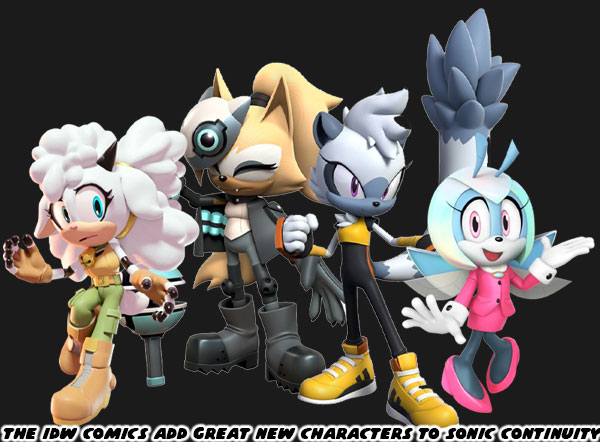
The creators at IDW were also able to expand the Sonic comic books to include new faces that were interesting in their own right. For example Lanolin the Sheep, Whisper the Wolf, Tangle the Lemur, and Jewel the Beetle were citizens-turned-freedom fighters. Their story arcs, and contributions in the comics made them very memorable. They were adventurers, sometimes with a tragic past, all rising to meet the challenge. They complimented all of the established heroes, and added their own unique dynamic to the stories. For long-time fans like myself I thought that these were characters that would be amazing to follow in a game. More than anything the Sonic comic books managed to remind audiences that the universe covered in the game series was far more expansive, and serious than we sometimes thought. Sonic Team managed to create a world that seemed straightforward, and easy to digest. Sonic was the good guy, and Eggman was the bad guy. He kidnapped animals to power his robots. It was up to Sonic to set them free. The formula hadn’t changed much in over 30 years, yet the stakes had always been incredibly high. Without Sonic, and his friends, then there was nothing preventing Eggman from conquering the world.

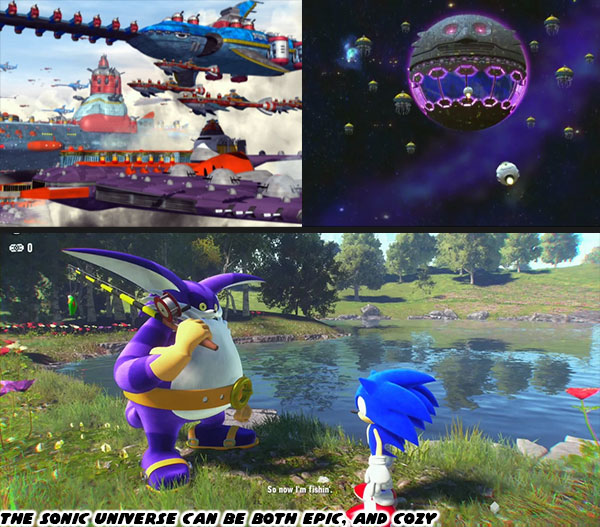
The threat that Dr. Eggman presented was epic in scope. He didn’t just raise an army of minions, he created an entire armada of war machines. He had a fleet of flying warships, giant robots, autonomous factories, laser satellites, and space stations with enough power to take over a planet. The fight had to be taken to Eggman to prevent him from ruling the world. There was nothing easy about the threats that Sonic, and his friends faced in every encounter. At the same time the designers at Sonic Team didn’t want to make the game feel heavy-handed. Yes the characters were fighting against impossible odds, but at this world was also a cozy place to live. The studio made sure to show audiences what Sonic was trying to protect. Sega wanted to remind us that this world was a beautiful place filled with loving characters. There were friends that wanted to enjoy a picnic with our hero, or perhaps do some fishing with him. These gentle characters were set against a backdrop that was quite serious. Being the protector of the innocent was the heart of several IDW story arcs.

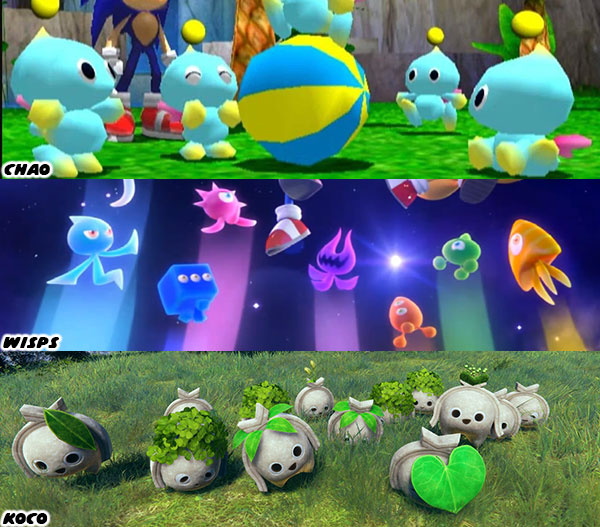
Sonic Team created different types of innocent creatures that Sonic, and his allies had to protect. In most games the animals trapped within the robots were the obvious ones. As the games evolved we were introduced to the Chao in Sonic Adventure, then the Wisps in Sonic Colors, and most recently the Koco in Sonic Frontiers. Those minor characters were adorable beyond description. However when you placed them within the context of the stories they were also tragic figures. Each of the characters had survived catastrophic trauma. An entire planet of Wisps were enslaved by Dr. Eggman for his cruel experiments. The Koco were the memories of the ancient aliens that brought the Chaos Emeralds to the planet. Sonic had to complete their memories, and reunite their ghosts so that they could have some closure. The Chao were the de-evolved descendants of those alien refugees. They were also nearly wiped out in a raid by the Echidnas a millennia ago. Even the cutest characters in the franchise were important to the story.

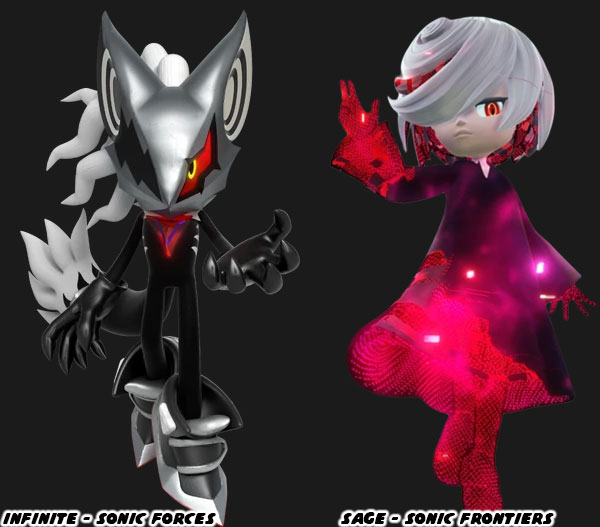
Felix the Cat started the tradition of cartoon mascots more than 100 years ago. Sonic the Hedgehog helped bring the art form to a new generation through video games. The creators at Sega, Sonic Team, and at IDW helped it evolve across multiple formats. Whether it was an animated short for social media, a live-action movie, or an award-winning comic book run. There was no doubt that cartoons were alive and well. The lore of the game series was already robust, and the comic books went much deeper than casual fans could have ever known. The characters they introduced in the past decade could still look cute, and universally appealing, but they had now grown to include shapeshifting assassins, psychic madmen, and even sentient AI. Heroes, and villains in the Sonic canon were colorful, memorable, and awe-inspiring. The games they were featured in evolved in unique ways. I’ll trace it out in the next blog. Until then I’d like to know if you have a favorite mascot character. Or if you even like cartoons at all. Tell me about it in the comments section. As always if you enjoyed this blog, and would like to sponsor me please visit my Patreon page and consider donating each month, even as little as $1 would help make better blogs and even podcasts!
follow the Street Writer on Patreon!

Monday, April 7, 2025

Making a Sonic Team fan, part 1...

Hello friends, and visitors! I hope the year is going well for you. I’ve been hard at work at my actual job. I’ve also been trying to make time for art. I’ve been stuck thinking about what to write about on the blog. Then it came to me. I could write a little bit about one of my favorite game series, and share some art at the same time! The thing about the games I want to talk about is that it also launched one of my favorite film franchises.

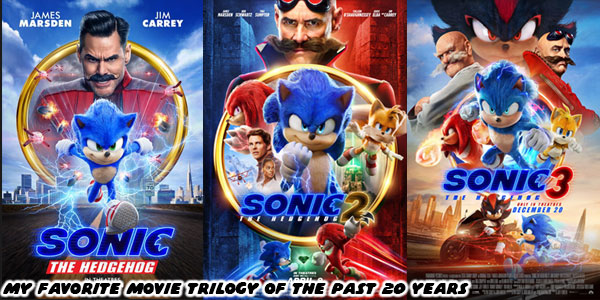
The Sonic the Hedgehog movies by Paramount have been great fun. I’m not going to lie however, I had zero faith in them when the trailer for the first movie dropped in 2019. Like many people the reaction to Ugly Sonic was harsh. Thankfully the studio listened to the outcry, pushed the release date back, and made drastic changes to the design of Sonic. It was one of the rare cases where the most vocal fans helped make sure that Hollywood would be kinder to the source material. By taking on writers, and animators familiar with the character the producers managed to create box office hits back-to-back-to-back. Each film in the trilogy had taken elements from the actual games by Sega, and managed to capture the emotional beats of all the main players. I really appreciated the attention to detail in each film. I know a purist might wish that the movies were entirely animated, and not set on Earth, but will all things considered the studios did very well making the characters accessible to the public.

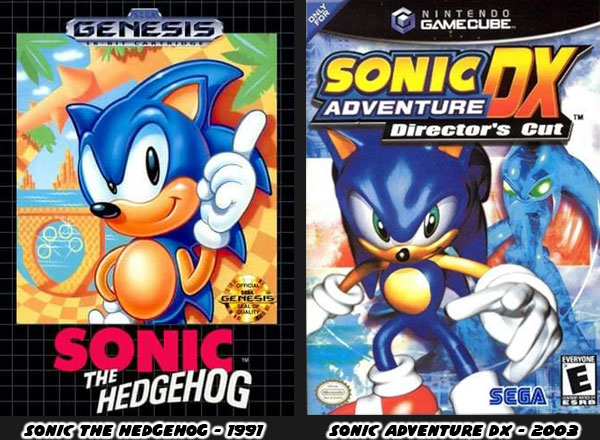
The other thing that I loved about the films was that I was able to bond with my kid over them. We were both big fans of the Sonic series. We must have owned just about every release across every platform, including many LCD games. My love for the character, and the franchise came with the debut of the very first game on the Sega Genesis way back in 1991. My kid’s first game was Sonic Adventure DX on the Nintendo GameCube in 2003. It seemed surreal that I had been a fan for 35 years, and my kid for more than 20. Being able to share a common love of a character had really brought us closer together. It made me appreciate that of all the movies we’d seen as a family, it was a video game movie that meant the most to us. It also made me think about how much I really enjoyed the games by the developers at Sonic Team working at Sega.

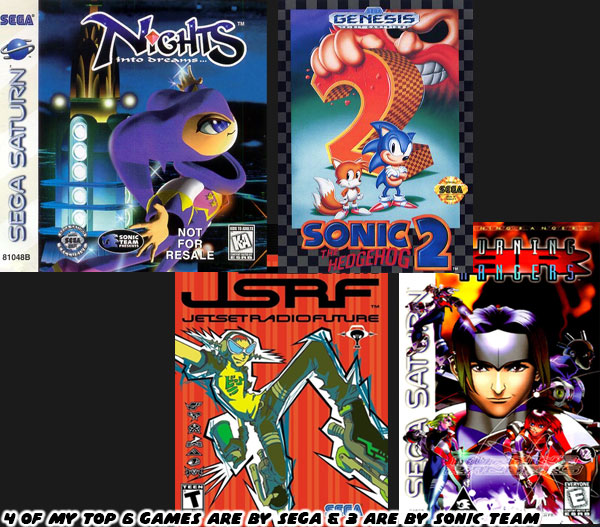
Like many of you I’ve had the conversation of favorite games with my family, and friends over the years. My brothers, and I grew up with the major consoles, going all the way back to the Atari 2600 circa 1980. We loved every console, and cherished every game we played. Long ago I had a thought experiment. If I were stuck on a deserted island, and could only bring one video game with me to play forever then which one would it be? Was it possible to rank them in order? I leaned to a very specific company, and very specific team. I published my list in 2006 on the old 1UP site. Sega was responsible for six of my top 20 favorite games of all-time. Of those games three of them were produced by Sonic Team. When I revised that list in 2023 the number of games from Sega went up to eight out of 20.

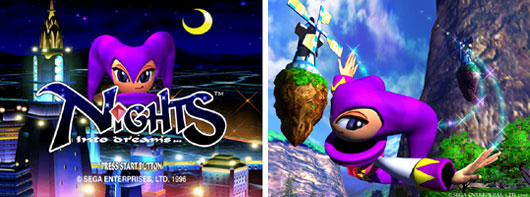
I ranked many Sega games high on the list my favorite game of all time was NiGHTS into dreams… which was from Sonic Team. I took my gaming seriously. I bought the original Xbox back in 2002 for the second title on my list Jet Set Radio Future. The Jet Set Radio series was by the Smilebit, and Hitmaker teams at Sega. The original Sonic the Hedgehog was revolutionary, and the even better Sonic the Hedgehog 2 ended up as #3 on my list. The third Sonic Team game that I ranked was Burning Rangers in the sixth spot.

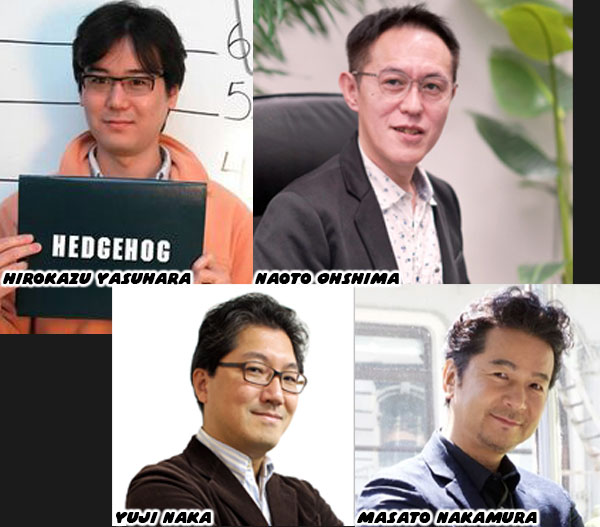
NiGHTS, Sonic, and the Burning Rangers were all radically different ideas that were each executed perfectly. The thing about the Sonic Team was that they were fantastic at creating experiences in different genres. It seemed that there was nothing that the senior members couldn’t do. The initial team was formed in 1990 from members of Sega's Consumer Development division aka the console people. This was opposed to people like Yu Suzuki and the AM groups working on arcade games. Sonic Team included programmer Yuji Naka, artist Naoto Ohshima, and level designer Hirokazu Yasuhara.

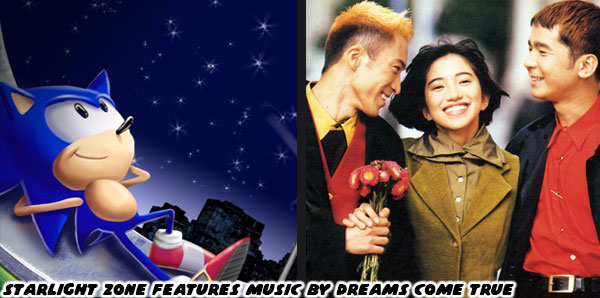
Music for the first two Sonic games came from composer Masato “Masa” Nakamura from the Japanese pop group Dreams Come True. Aside from the game play it was the music that really appealed to me in the early games. In fact after I beat the very first title I made it my mission to try and track down more music from his band. Thankfully the Los Angeles Metro Blue Line had also opened in 1990. It gave people from Long Beach a chance to travel to downtown LA for just over a dollar. When we were in high school my brothers, and friends would go at least once a month as a group to check out the sights. We discovered Little Tokyo, and made many repeat visits. We would rent Dragon Ball tapes just as they were released in Japan, collected toys, CD’s, and import games. All of the things that current generations take for granted used to be a series of adventures for us. One of the great things of the old Yaohan Plaza shopping complex in Downtown LA were the arcades. The building was multiple stories. There was an arcade featuring the latest games from Japan, and even a bowling alley with its own arcade as well. Sadly the majority of the shops closed down, and it was sold to a Korean conglomerate about a decade after we started visiting it.

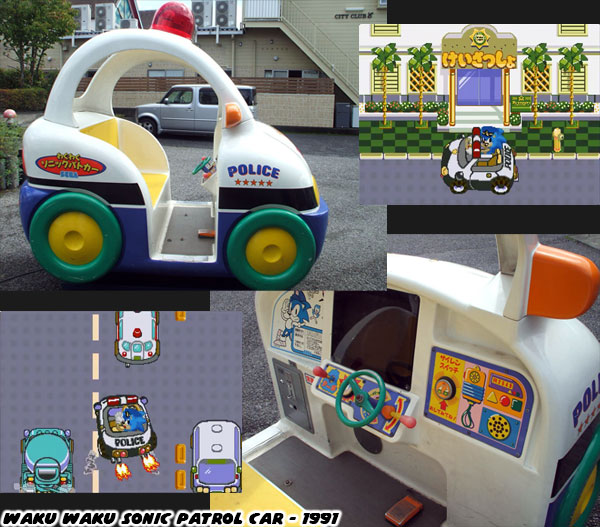
It was the “Arcade Japan” where I saw, and got a chance to play one of the rarest Sonic the Hedgehog games ever made. Waku Waku Sonic Patrol Car was a kiddie ride released in 1991, the same year that the console game debuted. I managed to cram my 6’ 7”, 320 lbs frame into the cabinet so I could play it. My brothers couldn’t believe that I managed to squeeze myself into the cabinet, but at the same time they knew how passionate I was about the series. While going into the various bookstores in Little Tokyo I finally found the music from Dreams Come True. I would buy at least one CD each trip, and ended up collecting every album, and almost every single from the group as well. It was also where I picked up a number of Capcom, and Sega games CDs which I still have in my collection.


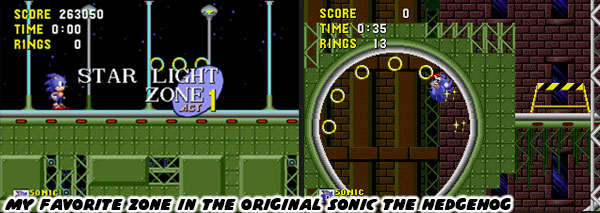
Each Zone in the Sonic titles had their own unique song. They were all catchy tunes. Little did I know that the best melodies would be featured in an album. The Star Light Zone song to me was the best. It framed the chill vibe of the stage, the groundbreaking parallax-scrolling stars in the background, and its unique fight against Dr. Eggman. I had just graduated high school, and was attending college when I finally heard the song it was based on. I remember I was walking to the bus stop, listening to my portable CD player when the familiar melody popped up. I lost my mind hearing the song with lyrics! 薬指の決心 = Kusuriyubi no kesshin = Determination of the ring finger from the album Million Kisses was the melody that Masa had composed for Sonic Team months before it appeared on the album.

I would also find out that the song Sweet, Sweet, Sweet aka Sweet Dreams from the album The Swinging Star was the inspiration for the ending song from Sonic the Hedgehog 2. For decades after I held the space-inspired stage from the original game, and the song in the highest of regards. While I enjoyed Sonic Adventure, and many other 2D and 3D games in the series, I felt that none of the releases ever captured the wonder of the Star Light Zone. That was at least until 2010 when Sonic Colors was released. The game took place on different planets all over the cosmos, but there was one section in particular that recaptured the magic for me.

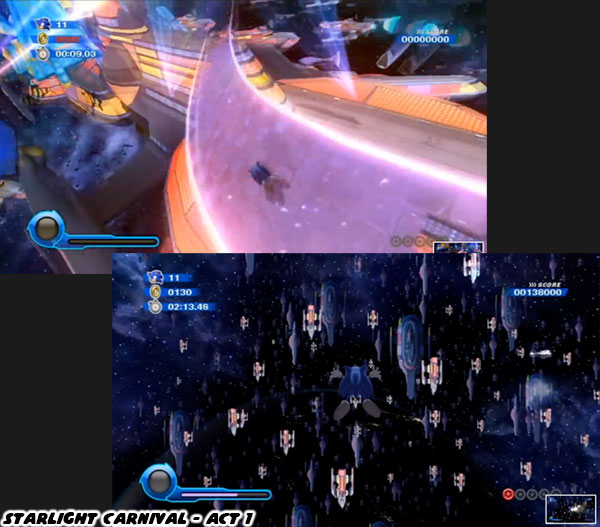
The Starlight Carnival, specifically Act 1 was arguably the greatest Sonic zone set in space. It was a parade, and fireworks show set in deep space. It was made up of hundreds of gigantic spaceships covered in lights, lasers, and glowing floats. It was like a cosmic version of the Disneyland’s Main Street Electrical Parade or Walt Disney World’s SpectroMagic for the people on the East Coast. Except that this parade went on for miles, and featured ships the size of skyscrapers. It was a spectacle as Sonic ran on a track made of energy, with countless ships as far as the eye could see, and even hundreds more popping in out of hyperspace. As a space nerd I was absolutely living for it.


The game play, and music featured in the Sonic Team games made me a lifelong fan. It wasn’t the only thing that kept me coming back. As an artist I couldn’t get enough of the world building that the studio was doing. It greatly influenced my work. I’m going to talk about that in the next blog. Did you have a favorite Sonic Team game? Did you like the movies, or music associated with the Sonic franchise? I’d like to hear about it in the comments section. As always if you enjoyed this blog, and would like to sponsor me please visit my Patreon page and consider donating each month, even as little as $1 would help make better blogs and even podcasts!
follow the Street Writer on Patreon!

Wednesday, December 11, 2024

Freeze frame, my poster collection, part 19…

I may have a lot of posters from cartoons, and comic books, but my biggest collection comes from video games. I have a few from Namco, and tons from Capcom. However I also have a decent collection from Sega.

A couple of the Shinobi, and Sonic silk screen prints I got from the Sega pop up booth during the San Diego Comic Con. The employees printed posters right in front of us, and zapped them with UV lights to get them dried, and rolled them up for us. It was a cool giveaway.

I have a few old posters from US game magazines. These were often the only ways to get some of your favorite games in poster form.

If you have ever played Sonic Adventure then you might remember the fictional Chao in Space movie posters around town. I was so happy to see Sega actually sell them. Now I just need to find some Soap shoes to frame them with.

Speaking of Sonic Adventure I still have a sticker sheet from the fantastic Dreamcast game.

Sonic Mania Plus was one of my favorite games of all-time. It was the only game in the series not made by Sonic Team that I absolutely loved.

Sega also dropped a cool glow in the dark poster celebrating the game. It took a few tries to get a picture of it in the dark. Thankfully I had a UV flashlight that helped me get the glow right.

My kid surprised me for my birthday one year, and got me this wonderful Sonic poster from an artist at a convention. She said keeping it hidden from me was the hardest part until my birthday rolled around. She also got me the Mighty, and Ray Missing posters, but I can't seem to find which box I stored them in. If I do track them down I will update this post.

She also got me the Mighty poster that was based on the same missing poster featured in the game. This was a limited run from the actual Sega store. It's very hard to find any collectables with Ray, and Mighty on them. I love that duo even more than Sonic and Tails.

NiGHTS Journey of Dreams was a tremendous disappointment for me. Especially considering that the original NiGHTS into dreams… was my favorite game of all time. I’ll never stop loving the character, and universe Sonic Team created. I can only hope that there might be a directors cut of the original NiGHTS in time for its 30th Anniversary.

Are there any favorite Sega games, or other studio games that you’ve collected poster for? I’d like to read about it in the comments section. As always if you would like to sponsor me please visit my Patreon page and consider donating each month, even as little as $1 would help make better blogs and even podcasts!
follow the Street Writer on Patreon!

Monday, May 1, 2023

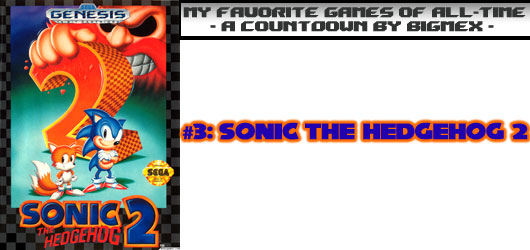
My favorite Games of All-Time #3: Sonic the Hedgehog 2 - Originally published on 1UP - August 11, 2006

Welcome back to the countdown. Sorry for the week off but as you can understand I've been a little busy catching up on work and everything. The focus is back on the list though! I wonder if I should shoot off some fireworks or something now that I have reached the final 3?

These are the games that define me, the games that I consider my favorite of all-time.

Number three is a lock. Sonic the Hedgehog 2 by Yuji Naka and Sonic Team. Yuji is the only man to make the list twice and both times in the top-10. He really put Sega on the map as far as console gaming goes. Yu Suzuki may be the undefeated Sega arcade champ but his work on home consoles falls short of Yuji's. Don't even tell me that Shenmue was better than anything Naka did because it would be a lie.
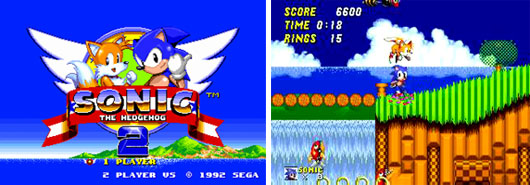
Sonic the Hedgehog 2 may be the greatest Sega platform game ever. Perhaps you think I have a bias against Nintendo, seeing as how Zelda, Link, Mario and Metroid don't make my list. Kid Ikarus almost did. To me Sonic was the Mario game reduced. That shouldn't make me a Nintendo hater.

Super Mario Bros. was fun for it's day, but each consecutive Mario game felt like the previous one. Levels were always stacked, plain, Mario went left to right and on occasion donned suits that game him special powers. Still, each world, each level felt like the last with minor changes to the color palette. We were growing up but it felt like Mario was not.

I don't believe the hype in Sonic as a character with 'tude meant for the jaded Nintendo gamers.
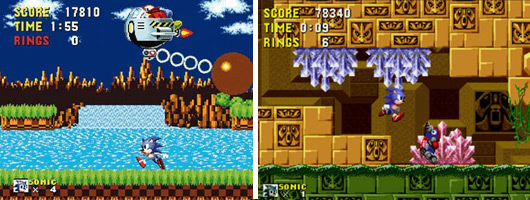
The Sonic games were boiled down into far more basic components than Mario. You only used one button in the series and it worked. It worked because Sonic had only basic attacks. It worked because the levels were organic and lent themselves to simple attacks. It worked because Sonic had a chance to open up and speed away from enemies instead of fighting.

For the first time that I could remember I was excited to run on levels because of minor changes in elevation and pitch. Think about it for a second. Previous to Sonic, most games were very two dimensional, every stage was literally a platform. There were no hills, dips, bumps or grades. Go diagonal while running? Never in a million years!

Sonic broke the mold and the blue hedgehog became less like Mario jumping up and down between platforms and more like an electric pinball whizzing here and there on a roller coaster track. Some said it was a gimmick, others called it disorienting sliding down tunnels and shooting across a level. I thought it was genius and platforming evolved.
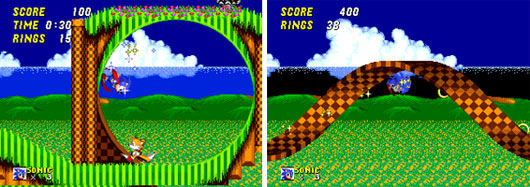
Sonic needed momentum to do loops and corkscrews, players sometimes had to get a running start before taking on a series of loops. The sense of running through a level with reckless abandon has yet to be topped.

Just as amazing as the level design was the second player that Sonic had. A little buddy, almost the tag-along little brother in "Tails." His twin tails could propel him forward to follow Sonic through the levels and help him from time to time. Tails could be controlled by a second player and this would come in handy when trying to collect rings during bonus rounds. It would be years before Luigi would join Mario in the middle of a game...

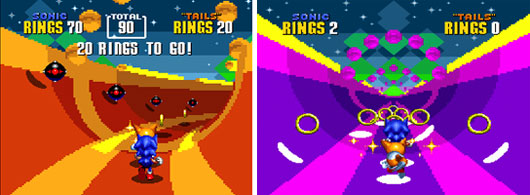
The game still had Sonic trying to defeat Eggman (Dr. Robotnik) but just like the previous title you also had to collect Chaos Emeralds. The original Sonic game had chaos emeralds stuck inside a perpetually rotating room, while disorienting, the level was actually quite cool. This time the emeralds were at the end of a long, pseudo 3D race track. Mixing side scrolling with 3D racing shattered the concepts of what could be done in a console game. Sonic could still run on walls and even flip himself 360 degrees on the track, Naka had broken the third dimension and there was never any going back.
Each level, each zone in the Sonic universe was unique. When I think of a Mario game, even the SNES versions, the levels are usually outdoors, indoors or underwater, again and again. The zones in Sonic looked completely different, at once a grassy hill and next an oil field or a floating airship. Each zone had its own music, tracks written by Dreams Come True, then a budding j-pop group and today considered one of the longest-running, most successful international music acts ever.

Some levels had multiple paths, hidden secrets, blast tunnels and trap doors. Credit where credit is due, learning to play each level became an art. Gamers with experience could not only beat levels quickly, they could also collect Chaos Emeralds and defeat most of the enemies in one fell swoop. Of course no two zones played exactly alike. Some required small steps and timed jumps, others flat out speed. Deconstruct the zones and see how logical this type of level design became. Naka introduced the world to a new way to game, sorry to say but Mario had become antiquated.
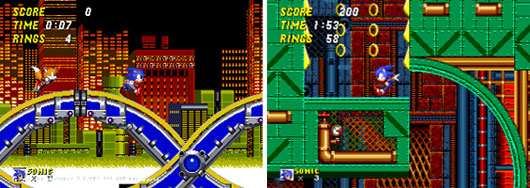
At no point did Naka's vision supersede the technical limitations of the 16-bit Sega Genesis. Things that would return in Sonic Adventure games on the Dreamcast and GameCube were pioneered in two dimensions. Sonic spanned the world chasing Eggman and collecting emeralds. When Eggman took flight so too did Sonic, on top of Tail's biplane the "Tornado." Eventually Sonic tracks Eggman to the "EggCarrier" flying fortress and even to a rocket that blasts into outer space toward the "Death Egg" (a clone of the Death Star from Star Wars). The Tornado, EggCarrier and space station all returned in the Adventure games. As did levels based in the desert, caves and high-tech factories.

This type of epic game was told within the span of a few levels on a few-megabyte cartridge and featuring things never before seen on a platformer. Themes of the levels and plot would return time and time again not only in the Sonic games but in other titles from the industry as well. Yuji had raised the bar in Sonic 2, the effects of which remain to this day.
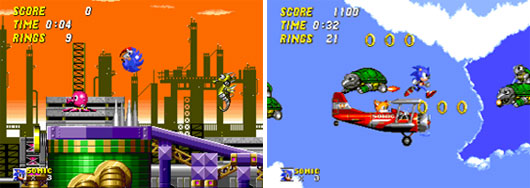
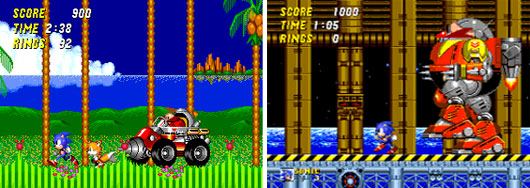
Sonic was never one to fight many bosses, just one, the Eggman. The rivalry spans decades but I think the best battles were in Sonic 2. Eggman would throw some type of mechanical device at Sonic and it was up to the gamer to figure out the timing and weakness and knock Eggman's contraption apart.

From buggies to tanks, drills and helicopters, Eggman threw everything he had at Sonic. In the Death Egg level we were treated to an epic boss battle. Eggman fought from inside a giant mechanical suit, complete with missile launcher and spike fists. The sprite of the robot was gigantic, taking up a third of the screen. For the time it was easily one of the largest sprites and boss characters ever. This "David versus Goliath" battle helped lend tremendous scope to an already epic game.
The characters, good and bad, were designed by Naoto Ohshima and Yasushi Yamaguchi. The designs were a mix between Japanese anime and Western cartoon. Simply timeless. The levels, plot and boss battles were usually an homage to classic Japanese and Western sci-fi. The closer you look into the levels and characters the more you'd see.

In the end it was one design that turned a great sequel into one of my favorite games of all-time... Super Sonic. You could beat the game without ever collecting one Chaos Emerald. Or you could go for broke and collect all of them. The reward for doing so was unlocking a supercharged Sonic. The ending of the game even changed to show off Sonic's new ability. Did I mention that Mario had become antiquated by then?

Upon collecting 50 rings, after gathering all of the Chaos Emeralds, in a level Sonic would turn "super" when he jumped. He was impervious to harm and able to fly through levels faster than ever before. The effects and animation associated with Super Sonic were brilliant. Super Sonic was without a doubt an homage to Dragon Ball Z, which at the time had the main character Son Goku evolve into a "Super Saiyan." This featured many of the same properties and looks that Sonic had inherited. A nod to the genius of Akira Toriyama aka "Dr. Slump," the creator of Dragon Ball Z.
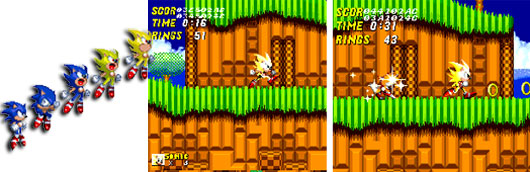
My brothers were there when I first turned into Super Sonic. The reaction was a unanimous "holy shit!"

I never looked back.

Sonic the Hedgehog 2 will remain one of my favorite games of all-time for ever and ever.

Sorry Mario.

I hope you get a chance to play it and hopefully become Super Sonic yourselves. Until next week take care and have a great weekend!

I’d like to hear your personal top-10, top-20, top fighting games, top sports games, or top games in any genre. Let me know in the comments section please. As always if you would like to sponsor me please visit my Patreon page and consider donating each month, even as little as $1 would help make better blogs and even podcasts!
follow the Street Writer on Patreon!