Showing posts with label shinobi. Show all posts

Wednesday, December 11, 2024

Freeze frame, my poster collection, part 19…

I may have a lot of posters from cartoons, and comic books, but my biggest collection comes from video games. I have a few from Namco, and tons from Capcom. However I also have a decent collection from Sega.

A couple of the silk screen prints I got from the Sega pop up booth during the San Diego Comic Con. The employees printed posters right in front of us, and zapped them with UV lights to get them dried, and rolled them up for us. It was a cool giveaway.

I have a few old posters from US game magazines. These were often the only ways to get some of your favorite games in poster form.

If you have ever played Sonic Adventure then you might remember the fictional Chao in Space movie posters around town. I was so happy to see Sega actually sell them. Now I just need to find some Soap shoes to frame them with.

Speaking of Sonic Adventure I still have a sticker sheet from the fantastic Dreamcast game.

Sonic Mania Plus was one of my favorite games of all-time. It was the only game in the series not made by Sonic Team that I absolutely loved.

Sega also dropped a cool glow in the dark poster celebrating the game. It took a few tries to get a picture of it in the dark. Thankfully I had a UV flashlight that helped me get the glow right.

My kid surprised me for my birthday one year, and got me this wonderful Sonic poster from an artist at a convention. She said keeping it hidden from me was the hardest part until my birthday rolled around. She also got me the Mighty, and Ray Missing posters, but I can't seem to find which box I stored them in. If I do track them down I will update this post.

NiGHTS Journey of Dreams was a tremendous disappointment for me. Especially considering that the original NiGHTS into dreams… was my favorite game of all time. I’ll never stop loving the character, and universe Sonic Team created. I can only hope that there might be a directors cut of the original NiGHTS in time for its 30th Anniversary.

Are there any favorite Sega games, or other studio games that you’ve collected poster for? I’d like to read about it in the comments section. As always if you would like to sponsor me please visit my Patreon page and consider donating each month, even as little as $1 would help make better blogs and even podcasts!
follow the Street Writer on Patreon!

Thursday, August 6, 2020

The Street Writer Podcast, Episode 14

Sega and Konami released two high profile comic book licensed games in the same year. How many of you got a chance to play either of the titles featured in this episode?


If you would like to sponsor me please visit my Patreon page and consider donating each month, even as little as $1 would help make better blogs and even podcasts!
follow the Street Writer on Patreon!

Wednesday, January 10, 2018

From Strider to Zeku, where did the lighting-quick ninja come from?

Think of this as a follow-up to Zeku, the new (old?) face in Street Fighter V. By all accounts Zeku is a ninja, a master spy, martial artist and assassin. Yet Zeku doesn't look like what the west considers a "traditional" ninja. He doesn't wear a black costume or throw ninja stars. He doesn't carry around a straight sword or cover his head. There have been other ninja characters in Street Fighter, going back to the original game from 1987. Geki (a non-playable character) was what we think of when we hear the word ninja. He wore a blue costume, fought with a claw hand weapon, threw shiruken or ninja stars at the opponent and could even disappear in a puff of smoke. Ten years later Capcom released Street Fighter III: New Generation and it introduced the world to Ibuki, a fledgling but insanely talented kunoichi or female ninja. Again, she more or less wore something that could pass as traditional garb.
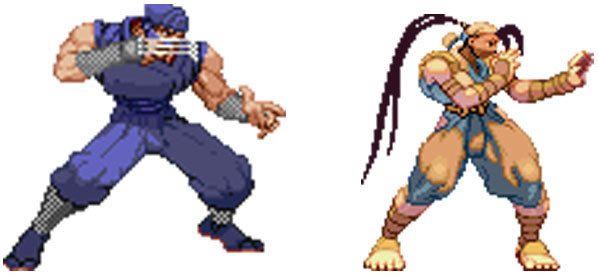


Zeku on the other hand was visually very unique, he had one foot in classical ninjitsu and one foot in the modern world. He wore designer suits yet could change into his fighting uniform in a flash. Zeku was created as the mentor to Guy, the ninja featured in Final Fight, a 1989 arcade hit. I had mentioned previously on this blog how the design of Zeku, credited to senior Capcom artist Bengus, was a nod to the anime heroes from the 1970's. His appearance, his style and even his aesthetic were rooted in the heroes that the Capcom creators had grown up with. But there was another layer of design and meaning with Zeku and with Guy. These were the templates that created the character Strider, a hero from a 1989 arcade hit of the same name. Strider was a revolutionary title. I can say with fair certainty that there was no game that looked even remotely close to it. Part of the reason for its unique look was because people outside of Capcom, a manga collective known as Moto Kikau established the world of Strider Hiryu. They set him and his organization up against a terrorist organization made up of martial artists, robots and cyborgs, lead by a shadowy villain known only as the Grandmaster.
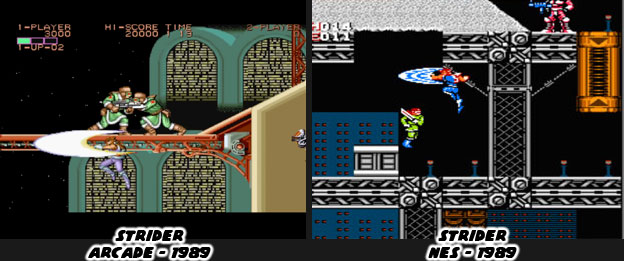


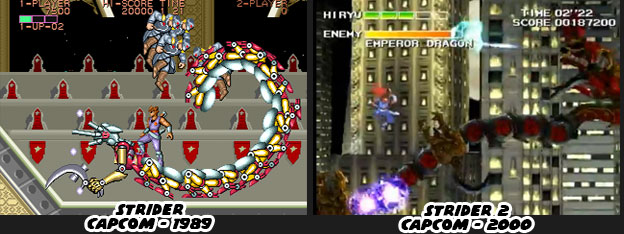
Strider was a cult-hit in the arcade and a smash on the consoles. It was one of the first arcade-perfect games to appear on the 16-bit Sega Genesis in 1990. The 8-bit Nintendo Entertainment System (NES) also had its own version of Strider. It came out a few months after the arcade game but was graphically inferior. The main character was the same, he still used a sword called the Cypher, fought bosses and traveled the globe. But because of the limited resources on the NES they had to focus less on graphics and expand on the game play. The stages were laid out more like you would expect on an 8-bit platform game, something like Contra or Rygar. Despite the small sprites and limited animations it was still a fun game to play. A big plus was that the story was expanded. It was much closer in details to the manga. Capcom had a lot of buzz from the community but didn't really capitalize on the game right away. A third-party developer, Tiertex Design Studios, made a sequel called Strider II aka Journey from Darkness: Strider Returns. The game was released on the PC and a few console systems but was lackluster in every regard. It rehashed the sprites from the Genesis game and did little to expand on the game play. An actual Strider 2 by Capcom would not debut until 2000. The new game was designed for the Sony Playstation. It was a mix of sprite and 3D backgrounds, making it one of the earliest 2.5D games ever created.
 

Strider had an iconic design. His costume was a blend of cyber-futuristic with classic touches. His costume down to his split-toe boots were something that you might have seen in a traditional manga or anime. Inspired by actual fighting uniforms it was blue rather than black. It turns out that for an assassin a dark color was easier to camouflage at night than absolute black. The costume was also functional, in that it allowed him a full range of motion. His character was about speed and stealth, these are things that would have been sacrificed with heavy armor, like that of a samurai. The biggest update to his design was the sword. It was replaced with a Cypher, a stealthy weapon he could strap to his back that functioned somewhere in between a lightsaber and a tonfa. Strider Hiryu was dangerous because of his fighting ability and his blinding speed. The high tech gadgets at his disposal were the frosting on the cake.
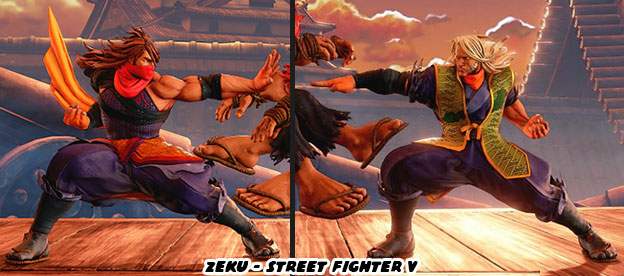
 

When we look at Zeku we are meant to think about Strider Hiryu. Obviously because his alternate costume is in-line with the other Strider uniforms. But we are also supposed to think of Strider because of the array of quick strikes and amazing acrobatics. Lightning speed is something that works extremely well for Ibuki in Street Fighter III (SF III) and Guy in Street Fighter Zero / Alpha (SFZ). The diversity of physical attributes and fighting styles is something that Street Fighter became known for. No matter how broad the size differences were the studio made an effort to keep the game balanced. The massive Hugo and tiny Ibuki were evenly matched in SF III because it was a contest of power versus speed. If a player had great technique then they could use either character well in the game. Yet where did this style of character come from? How did the Strider-like fighter evolve?
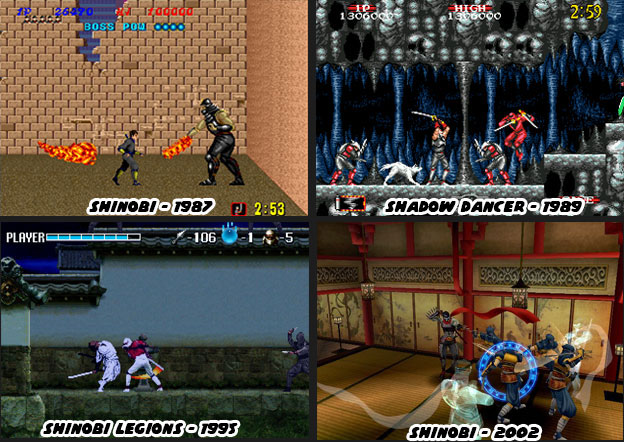


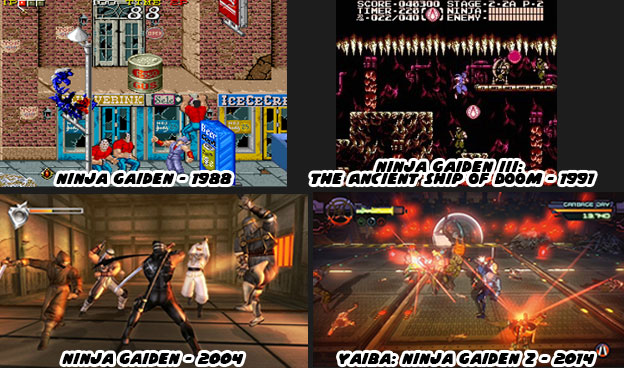
One of the early and popular ninja series in the arcade and consoles came from Sega. The Sega arcade game Shinobi from 1987 placed the ninja Joe Musashi in a modern setting, fighting a present-day cartel with his traditional weapons, the shiruken and a kodachi or short sword. However he could also use a handgun if he picked up a power-up. It was an interesting play mechanic, and influential to the development of the action platformer. Musashi was made all the more interesting with his ability to use ninja "magic." These were special attacks that allowed him to clear all of the enemies off of the screen or do tremendous damage to boss characters. Shinobi predated the other arcade hit Ninja Gaiden by a year. The aptly named Team Ninja, a group of developers from Techmo, introduced the world to a new hero. Ryu Hayabusa was their ninja-versus-modern crime lord archetype, the game was closer in game play to Double Dragon than Shinobi. Musashi and Hayabusa were names pulled from Japanese history but their video game personas became the new types of action stars. Each character appeared in a series of games for the consoles and handhelds over the next 20+ years, further expanding on the role of the ninja in pop culture. Shinobi and Ninja Gaiden predated Strider but I would argue that neither really were that influential to Capcom.
 

In 1985 (1986 in the US) Taito released Kage no densetsu, better known as the Legend of Kage. It was an action platformer the likes of which had never been seen before. The premise was straightforward, bad guys kidnap a princess and it's up to Kage (Shadow) to kill the bad guys and rescue the girl. The entire game was set centuries ago in Feudal Japan and it featured Kage, a young apprentice from the Iga school. He didn't resemble what we would consider to be a ninja but his clothing was accurate for the era. He fought costumed ninjas as well as other assassins and magic users on his quest. The game was notable because players would fight waves of opponents on a background that allowed players to scroll left, right up and down. Most games back then only advanced in one direction. Moreover the way the player moved and how he fought had never really been done before. Kage was insanely fast and when he jumped he leaped three or more times his height. This allowed him to jump onto tree branches and jump even higher into the canopy until he could fight his opponents above the treeline. These were the types of fights that had been romanticized in manga and cinema.
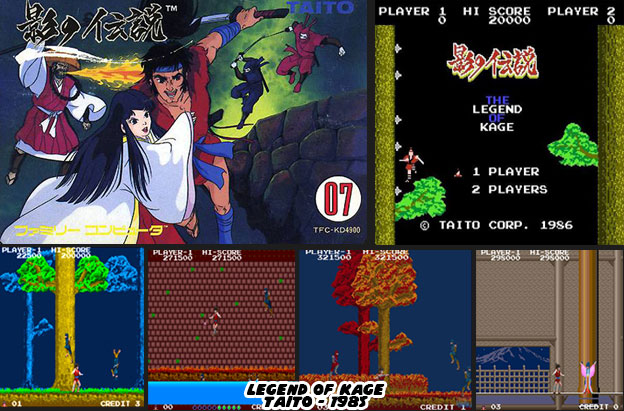
 

The game was also very violent for the time. Although there was no blood players could kill opponents with either a shiryuken or with a quick slash from the kodachi. There was none of this knocked out nonsense. Players would leap into the air, throw his stars in any direction while slashing in the opposite direction and any ninja that was in the line of fire would come crashing down head-first. This nonstop killing barrage was the core of every Strider encounter. Players would also block other shiryuken by spinning their blade around. An action video game with both offensive and defensive controls was very rare. The game also changed locations. Players tracked down the clan of the bad guys, through the forest, up a retaining wall and inside a labyrinthine castle where they would find the princess and make a harrowing rooftop getaway. When the intuitive fight and defensive controls were combined with the evolving stage design and non-stop fights it made for a cult hit.
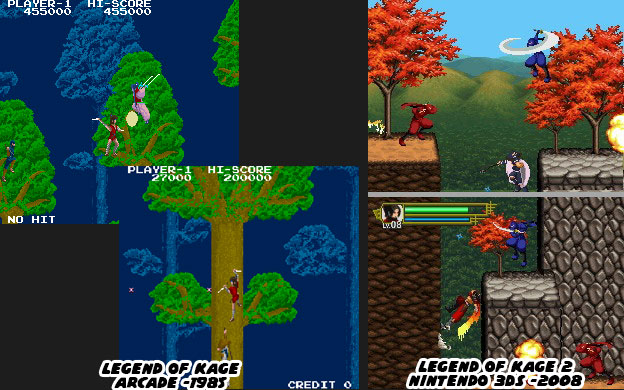


The Legend of Kage was arguably the most influential of the early ninja titles and colored the work of other game and animation studios. Yet even Kage came from somewhere. Ninjas had been a part of Japanese cinema for more than a century. Motion pictures started filming in Japan at the end of the 19th century and started playing at the start of the 20th. The early films were recordings of kabuki theater. Films with a plot came right after, bringing folklore heroes to life. One of the oldest ninja heroes in cinema was Jiraiya (Young Thunder) Gōketsu Monogatari. He appeared as he would have in story traditions, that was he didn't have the typical ninja mask or costume but something closer to everyday wear. He was a master of disguise, wily and charming, with the ability to shape-shift and cast all sorts of magic. He was like WuKong the Monkey King meets Robin Hood with the same amount of cultural significance in each nation. Films on Jiraiya went back to 1914 and turned up again and again over the next century. The way the character moved, his spell casting, his fighting became the standard for over-the-top ninja characters in film, anime and games including Strider and Naruto. In fact Capcom actually tried to make a game on the character post 2000.
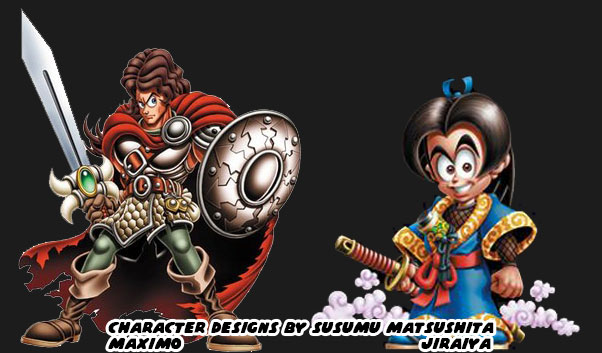
 

Capcom had just released Maximo: Ghosts to Glory, a sort of 3D successor to the classic Ghosts 'n Goblins arcade game. In the original 1985 game a knight in shining armor named Arthur had to save princess Prin-Prin aka Guinevere from a horde of demons. In the updated 2001 game the story was reset to feature Maximo who wore a costume that was more Roman or barbarian in origins. The game was developed by a Western team led by David Siller (Crash Bandicoot / Aero the Acrobat). It was a hit and Capcom wanted to do something similar from a Japanese point of view. Jiraiya Kenzan was an unreleased PS2 game that would have been released in 2002/2003. It featured the art and design of Susumu Matsushita, a Japanese artist who had created thousands of covers for Famitsu magazine and was known for his western-cartoon-style designs. It didn't hurt that he also happened to be the lead artist on Maximo. Sadly there was no Jiraiya game and no telling how it would have compared to Maximo. Would it have been a 3D version of Legend of Kage? Or would it have been more like Ninja Gaiden, Shinobi or Strider in 3D? We'll never know.
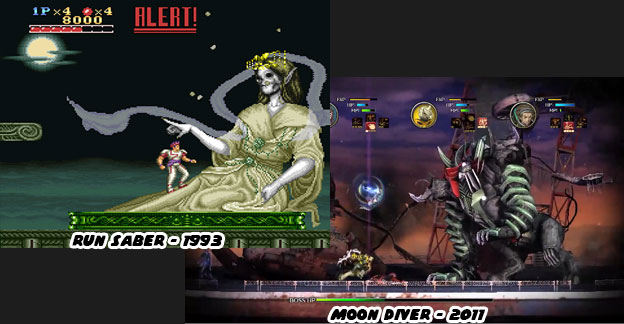


There was one person that I felt was overlooked for the evolution of the high-speed ninja gaming archetype. Kouichi Yotsui was the director on Capcom's Strider. He had difficulties working with the company, whether it was management or another senior person was unknown. He was one of the first directors to leave Capcom while it was in its prime. Mr. Yotsui had nothing to do with Strider 2 (2000) or Strider by Double Helix Games in 2014 but you don't appreciate how much his fingerprints were on the original game until you look at the other titles he released. He directed Run Saber for the Super Nintendo. It was developed by Horisoft and published by Atlus in 1993. That game looked and played very much like Strider for the SNES. This was important because Sega had the exclusive rights to a 16-bit console version of Strider. Run Saber expanded on the list of game play mechanics set up by Strider Hiryu. The new characters Allen or Sheena could perform all of the same basic attacks of Hiryu, they could also climb and run just the same. The duo now had a diving kick which allowed them to smash through opponents as they descended. Run Saber was also a multiplayer game, whereas Strider was a single player experience. Years later Mr. Yotsui directed Moon Diver. Developed by freeplus, and published by Square Enix in 2011, the game was another return to the classic Strider feel. It made me realize how little credit the man got when it came to the genre and the type of cinematic action he helped create.
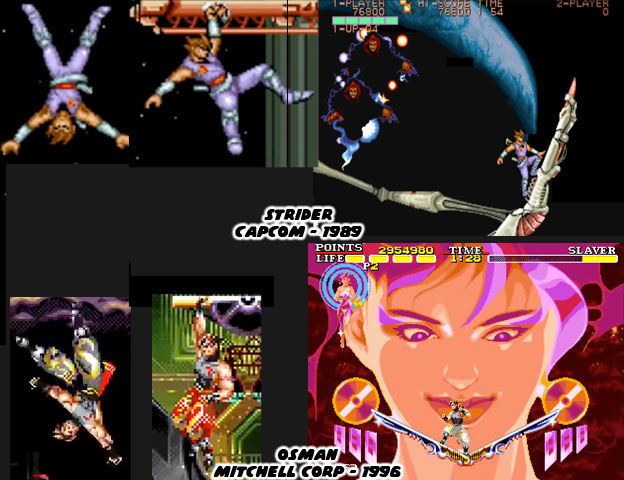


Mr. Yotsui's spiritual successor to Strider was another arcade game named Osman (Cannon-Dancer in Japan), published my Mitchell Corp in 1996. The game was beat-for-beat just like Strider. It was so similar in fact that the stage progression was almost identical. In Strider the setting was a futuristic Soviet Union, in Osman it was a futuristic Persian Gulf. The moves of the main character, Kirin, were identical to Strider Hiryu. He could fight, flip in the air, and climb. The lone assassin was a master of the "Secret Style" which allowed his punches and kicks to be as deadly as Strider's trademark Cypher sword. Kirin also had a new special "Fatal Attack" which was his screen-clearing move. He was on the hunt for Abdulla the Slaver, a female goddess-type character. She was the surrogate to the Grandmaster, the shadowy figure from Strider.
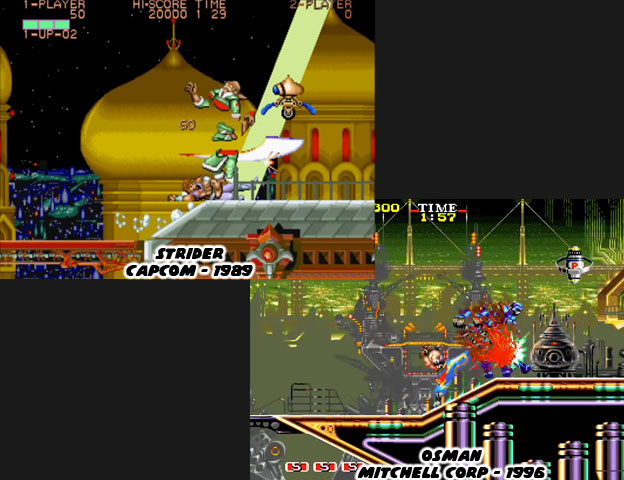
 

You begin to appreciate Mr. Yotsui's contribution to the genre and specifically the game play from Strider to Zeku when you look at the details in every game he's directed. In both Strider and Osman there was an emphasis on violence. Yes, graphic violence was in the manga, and had been a popular thing to do in post Hokuto No Ken / Fist of the North Star titles. But this was one of the first times graphic violence had been depicted in an arcade game. Strider killed opponents faster than any arcade hero previously. Bodies were getting sliced to pieces, or exploding in grotesque detail, but the sprites flickered so quickly that you couldn't really tell what was happening. Only when you go back and take a close look at the sprites and animations do you appreciate the frenetic deaths that Mr. Yotsui put into the game. In Osman the villains disintegrate in a flash of color and guts as Kirin strikes them down. If Zeku were based closer on the work of Mr. Yotsui then he would have had more lethal strikes. That or he would have been perfect for Mortal Kombat.
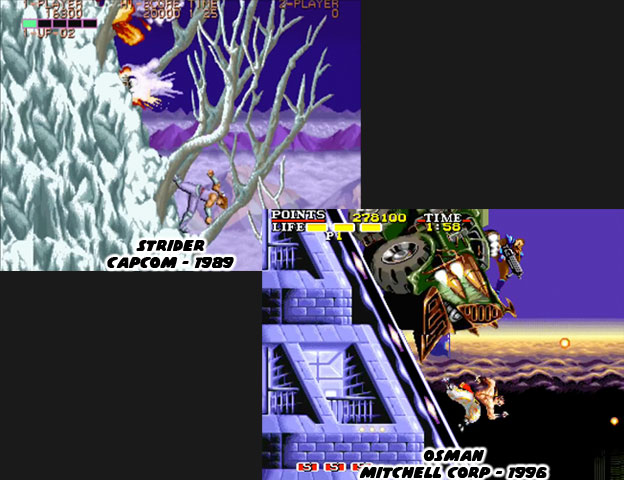


Kouchi Yotsui was a pioneer of cinematic action sequences in his games. I don't mean that he wanted to show the action in a CGI cut scene, or with a quick time sequence. Mr. Yotsui wanted players to experience what it would be like to do something incredible in game that would have been a highlight in an action movie. For example Strider ran down the side of a mountain while landmines exploded behind him. He ran faster and faster, gaining momentum then players made a blind leap before the cliff collapsed under them. This would have been an amazing shot in a Jackie Chan or Mission Impossible movie. In Osman a truck was chasing after Kirin down the side of a building. Again the character was running faster and faster until he could leap out of the way and let the truck smash into the roof of another building. These and many more amazing sequences (the gravity room, the airship, the satellite base) were what made the games unique. Nobody before or after Mr. Yotsui had produced games with the same over-the-top feel. He took the movie-style action of Legend of Kage and put it in a science fiction setting. If you play Zeku or are a big fan of the lighting-quick ninja fighters like Strider I want you to remember the work of Mr. Yotsui. He isn't credited as much as he should be and we should change that. As always if you enjoyed this blog and would like to sponsor me please visit my Patreon page and consider donating each month, even as little as $1 would help make better blogs and even podcasts!

 follow the Street Writer on Patreon!

Friday, May 27, 2016

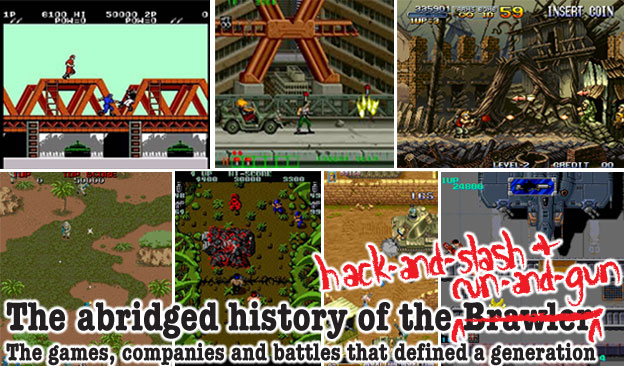
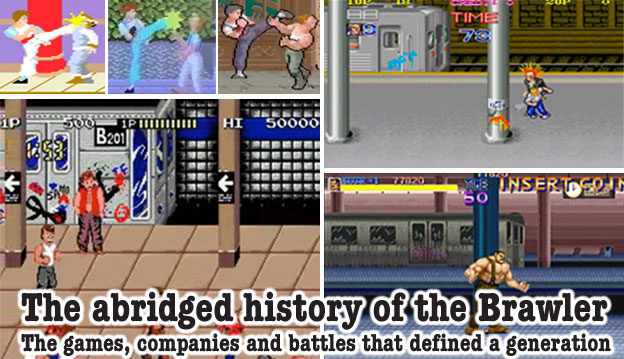
The Abridged History of the Brawler, part 25


The following games found a balance between the traditional side scrolling mechanics and the free-roaming brawler. They too featured wave after wave of opponents to battle but offered new ranged game mechanics to do so. Players no longer had to wait for an opponent to come to them, they could instead pace out the advancing bad guys with some well timed projectiles. We'll begin with the one that combined animé stylization with side scrolling action.


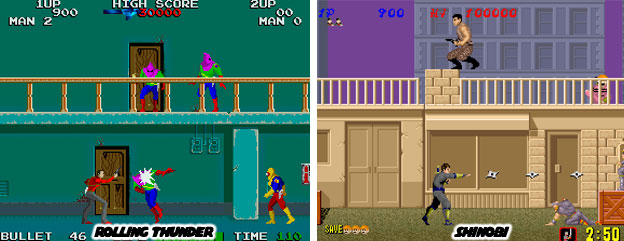
Namco's Rolling Thunder from 1986 was not a typical run-and-gun game. Instead players had to carefully track through an enemy compound while shooting or avoiding hooded sentries. Players could jump up or down to platforms and even sneak behind fences or inside of doors to evade captors. Although the game was still set in 2D, being able to interact with the environment gave players the illusion that there was height and depth to the levels as well. It also added a bit of a puzzle playing element to the shooting mechanic. Players did not have unlimited ammo so simply running and shooting was out of the question. Players could save up machine gun rounds between levels by shooting only when they had to. What the main character, the super spy named Albatross, lacked in this game was the ability to perform close range combat with the bad guys. That gameplay element would be introduced a year later by Sega.


The original Shinobi had very similar play mechanics to Rolling Thunder in that the character could jump to different levels and avoid enemies and strike from a distance. Joe Musashi used ninja stars to strike but could upgrade to a pistol. The game was unique for its use of a magic system which could wipe opponents off of the screen or do tremendous damage to a boss character. Both Shinobi and Rolling Thunder would stay popular with gamers and sequels would be released on arcade and home consoles.


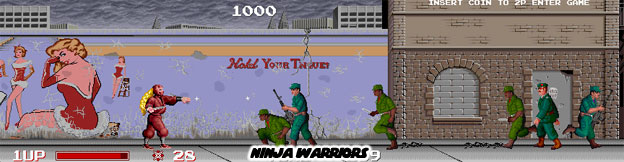
The ninja was beginning to develop a following in the US and by 1988 two major ninja games were released. The brawler Ninja Gaiden I had featured previously in this series. The second was the side scrolling action game the Ninja Warriors by Taito. As the game allowed two-players on screen fighting against opponents at the same time it could be considered a brawler. What made this game remarkable was that it was the second game that Tecmo released that was two monitors wide, the previous one was Tecmo Bowl from 1987. Ninja Warriors was a brutally hard game. Players had to have an absolute sense of range and timing in order to get very far into the game on one quarter The ranged ammunition, the ninja stars, were limited and there were no weapon upgrades. Players could wait for opponents to reach them and then cut them down with a short sword, but that also put them at risk of having opponents reach them from behind.


Visually the game was impressive. The levels were highly detailed and the sprites were large and well animated, I want to say that the moves were rotoscoped for how fluid the animation looked. On two displays it was like being the hero in a widescreen movie. However that sensation would be short lived. The Ninja Warriors was the first arcade game where I felt as if the ending were a hollow victory. I do not mean the poor translation in the credits either, the part that read: "A revorution broke out. And everything became to and end. The troubled country seemed to be finished by the death of the wicked machines. But the peace did not came."


Instead I refer to the defeat of the military dictator. He was a fat military character that was groveling and running with fear inside of his palace. He was impervious to ninja stars so players had to walk right up to him and cut him down with a knife attack. He went down with one stab, not very final boss-like at all, what came next would shock and sadden me. Some general, whose face was hidden in the darkness, pressed a red button, detonating a bomb hidden inside the robots, flattening the palace of the dictator. I was stunned. There would be no sequel, no chance to continue the adventure. The heroes were disposable. By extension the players felt the same way as well.


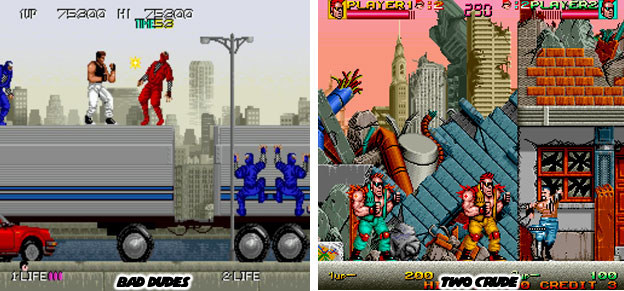
That same year another Japanese studio made players feel like real heroes. Bad Dudes vs. Dragon Ninja was released by Data East and had some of the best two-player side scrolling combat in any brawler. In fact when I did not mention this title early on in my brawler series my friend was upset. He was wondering how the "Double Dragon" of 2D side-scrollers could be left out. I told him that I would actually be saving this entry for when I spoke exclusively to the 2D brawlers that helped define the genre. What Bad Dudes did was more than define the genre. They set a standard for the Japanese pandering to young Western male gamers. President Ronnie, who happened to look a lot like the popular Ronald Reagan, was kidnapped by the Dragon Ninja clan. It was up to a duo of street fighters to save him. If that wasn't a premise for a low-budget 1980's action film then I don't know what was!


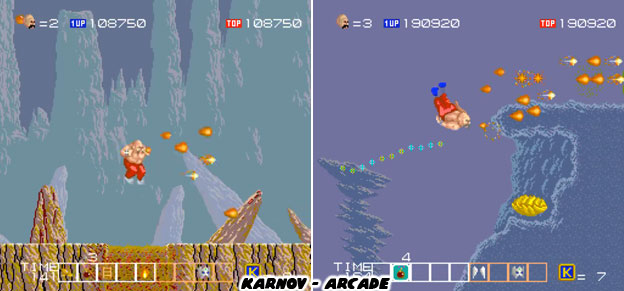
Bad Dudes was a better version of  Kung Fu Master and Vigilante. To show off the pedigree Data East even made Karnov, the first boss in the game. The famous strongman and fire breather was one of their earlier arcade stars. In Bad Dudes players fought waves of ninjas approaching from the sides, and could jump to different platforms to continue the adventure similar to Rolling Thunder or Shinobi's mechanics. Players could get knives or nunchaku's for weapons, however their best strikes were dished out with bare hands. The characters could charge up a punch by holding down the attack button and then release it once their character was glowing with energy. The force of the punch would actually send an invisible shockwave through the air, knocking down any ninja that was at least 2/3 of a screen or closer. This worked well on boss characters and large groups of opponents. Players could kick ninja stars out of the air, knock opponents off ledges and do all sorts of over-the-top moves.

The only game that could have possibly topped this game for action and impossible stunts was another one by Data East. Most brawling fans might think I was referring to Sly Spy, the 1989 title that gave Rolling Thunder a run for its money. The game even began with the secret agent jumping out of an airplane and shooting at terrorists while free falling over the White House! However like Shinobi and Rolling Thunder the game was a 1-player affair.


The title that tried to outdo the Bad Dudes was called Two Crude Dudes aka Crude Buster. The 1991 title had a completely different art style, one which did not settle with most fans of the original Bad Dudes. The characters were large, brightly colored, mohawk wearing bruisers, fighting to save a post apocalyptic New York. It was as if the Japanese were trying to make a game that looked like a comic book, complete with word balloons during strikes, only they had no idea how American comic heroes were supposed to look or act. The game allowed the Crude brothers to interact with the scenery. They could lift and throw cars at opponents, yank street signs out of the ground and swing them like clubs and even knock down buildings The game pandered to every insignificant detail the programmers knew about the USA. There was graffiti on the walls, a fallen Statue of Liberty and even a KISS knock-off boss in the first level. The problem was that the game might have been appealing to pop culture from 1981, rather than 1991.


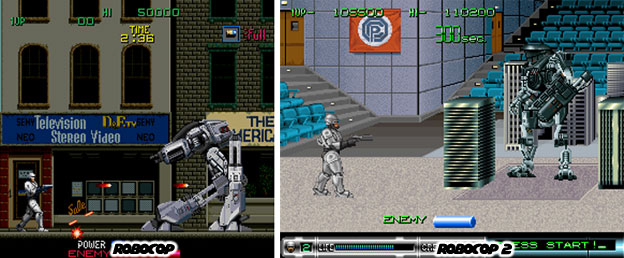
The other side-scrolling Data East games would fare better because they would be based on licenses. Before the company ruined their good name with the abysmal Captain America and the Avengers game they released Robocop. The 1988 title was based on the hit movie and featured locations, sound bites and villains right from the film. Players could shoot or punch opponents, they could even get different types of ammunition as well. The film and game based on it were so well made that Sega poached the concept in ESWAT a couple of years later.


Just as they had released a one-two punch with Bad Dudes and Two Crude in 88 and 91, so too did they follow up their run-n-gun attempt with Robocop 2. The sequel played out as you would expect, the publisher took some liberties with the characters and locations but followed the general direction of the movie including turning Cain into the nemesis. The game was actually more like a brawler as it provided 2-player action and free roaming levels. The game was notable for the limited use of depth in the game. If the two player-controlled Robocops came at the intersection of a street or an alley, they could actually shoot at opponents in the distance as well as those to the immediate left or right.


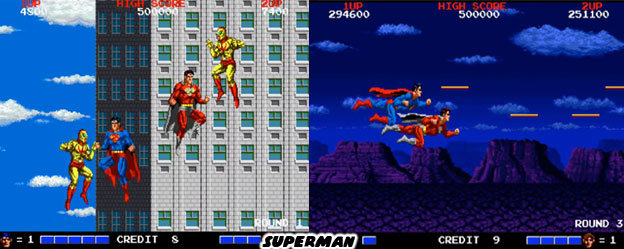
Licenses were hot for many of the arcade brawlers, one of the biggest licenses from 1988, Superman was again developed by Taito. Unfortunately this arcade game was very simplistic. It was a 2D brawler that had side scrolling levels where Superman could kick and punch his opponents as well as flying levels where he could shoot his heat vision and even energy punches at meteors and helicopters.


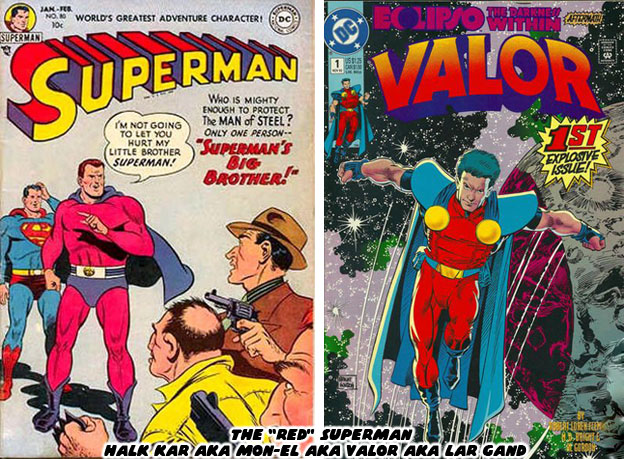
The reason I would consider this a brawler was because it was actually a 2-player game. The second person could play as "Red Superman." He was nothing more than a palette swap of the original character. Same powers, same strength, same everything. Which was a shame really. My brothers and I would pretend that he was actually Valor, an alien from the far future that had powers and abilities that were comparable to Superman. DC had actually featured Red Superman characters for some time, not including Shazam / Captain Marvel. The best part of the game was probably the soundtrack which was a digitized version of the classic John Williams soundtrack.


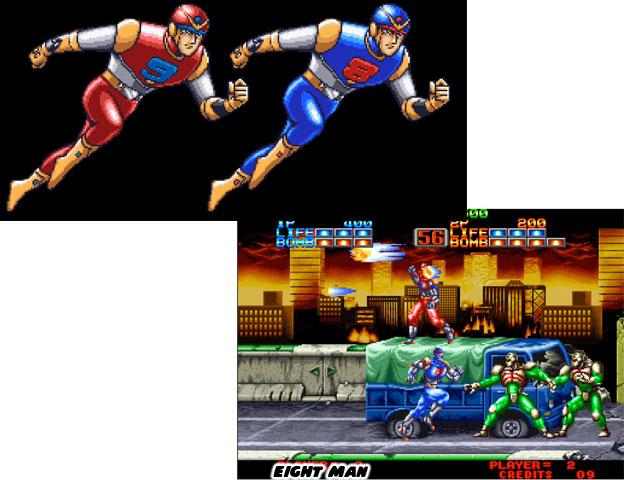
A slightly better 2D brawler based on a comic book appeared in 1991. SNK published Eightman, a game based on a classic manga and anime character. Eightman was a cyborg that could move super fast. He was defending humanity from rogue robots and cyborgs. The character was very influential and helped inspire cyborgs like Robocop and even some of the villains in Mega Man.


The game had a unique power up system which allowed Eightman to gain stronger attacks and even get screen-clearing moves. Player-2 in the game took control of Nineman, the red palette-swap version. The two fought in futuristic landscapes. On some stages of the game they ran quickly along the ground, racing cars and fighting other high speed villains. It was a great effect that was even better than the flying sequences in the Superman game.


Post 1991 the side scrolling brawler, run-and-gun and even hack-and-slash were not long for the arcades. The formats were kept alive on home consoles through the early 90's but trends were quickly shifting. The next blog will highlight the last great hurrah from the hack-and-slash brawlers. I hope to see you back for that. As always if you enjoyed this blog and would like to sponsor me please visit my Patreon page and consider donating each month, even as little as $1 would help make better blogs and even podcasts!

 follow the Street Writer on Patreon!

Wednesday, April 20, 2016

The Abridged History of the Brawler, part 9


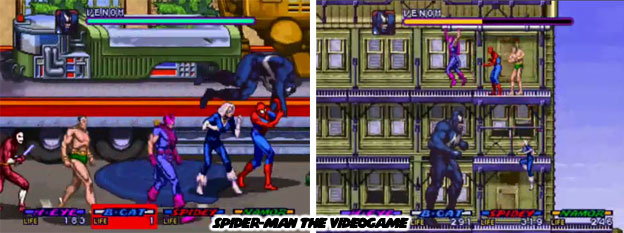
As 1991 was ending Sega was getting back aboard the arcade brawling bandwagon. Their last effort, Golden Axe, was met with favorable reviews. They studied the trends and were looking for a way to break the monopoly that Konami and Capcom were building. Sega was putting the finishing touches on their new arcade hardware, the System 32, which they felt was a powerful enough graphics engine to differentiate their next title from anything else out there. To show off their new processing power the first thing they did was secure a high profile license. They went to Marvel Comics and managed to get the license for Spider-Man. It was a surprise to me that Marvel would trust another Japanese developer following the debacle of Data East's Captain America game. What was even more surprising was that Sega had once gotten a cease and desist from Marvel because the original Shinobi featured a wall crawling ninja wearing red and blue tights at the end of Level 1 that looked an awful lot like Spider-Man.


Anyhow, the Sega game was a 4-player title featuring Spider-Man, the Black Cat, Namor the Submariner and Hawkeye. Unlike the hack job that was Captain America the developers seemed to have done research on the Marvel Universe and then went above and beyond in trying to recreate the western comic book format for arcades. The game was actually designed to reflect the pages of Marvel comics Characters would speak in word balloons, even during the fighting sequences. Level cinemas would play out in the panel per panel format. There was a certain gritty aesthetic to the visuals, as if it were a traditional 4-color traditional comic book come to life. The characters appeared to have been colored and even inked using traditional methods instead of strictly digitally. Proportionally there was something odd about the characters. They appeared as if a Japanese artist used to the manga format were trying their best to draw in the western style. The nuances of the poses, muscles and frames for the characters was slightly off compared to the actual Marvel model sheets. Not that it mattered, Sega released a game that was part brawler and part side-scrolling adventure.

The new graphics engine they created could scale the sprites with very little loss in fidelity. Sega used this to zoom out of action sequences and allow all four players to be seen climbing buildings, castles or going through caves independently. It was a groundbreaking gameplay and visual element


The game was fun if a bit hard. Unlike the Captain America game I didn’t mind putting quarters in this title. I’m not sure if it was a rare title but of all the arcades I visited in my youth I only saw two Spider-Man cabinets. Perhaps this lack of exposure was why the game was rarely mentioned in comic book to videogame comparisons.

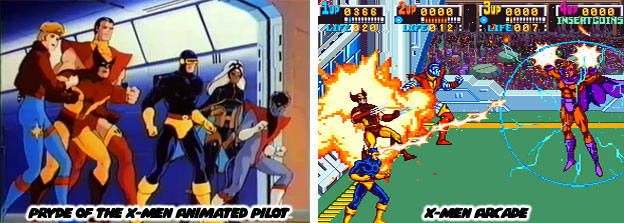
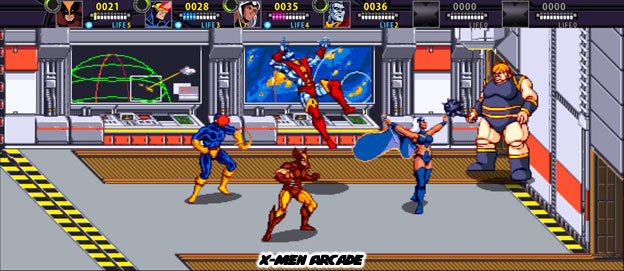
Konami had a higher profile release with the six-player X-Men arcade game. The deluxe version of the cabinet was pure excess but could actually be found at several arcades I frequented. It was two oversized screens wide and featured a dedicated joystick and buttons for the individual characters. The massive cabinet was about as big as three regular cabinets stacked side by side. The wraparound art featuring full color graphics from the Marvel artists themselves was a statement to the industry as much as to gamers. Konami had declared themselves the all-time king of the brawler (and of licenses too).


The game had a certain anime stylization rather than the comic format from Sega. This was because the 1992 brawler was based on an animated pilot from 1989. The Pryde of the X-Men was Marvel's first attempt at getting an X-Men animated series off the ground. It was produced by the Japanese Toei animation studios. That was the same studio that worked on other iconic shows from the 80’s including GI Joe, JEM and the Holograms and the Transformers.


My brothers and I loved the pilot episode and had wished that a series would have been made from it. The quality of the designs and animation were much better than the Fox Kids! series that appeared a few years later. But I digress…

The game itself pulled the locations and character designs right from the animated pilot. Each of the X-Men had a special, screen clearing attack based on their powers. For example, Storm could summon a series of whirlwinds and Nightcrawler could zap across the screen with his teleporting powers. Other powers, like Colossus' energy field were made up by the game designers, but this discrepancy was overlooked by most fans because the game was tremendous fun. It worked well with a single player but was best experienced when all six characters were on screen fighting off waves of robots, sentries and lizard men. The title was difficult as were the other Konami arcade brawlers and like those experiences the last level featured a battle royal against all of the previously defeated bosses.


Where Sega's hardware could render scalable sprites Konami's was capable of throwing sheer numbers on screen. Between the players and all the possible opponents there could be up to 16 large sprites on screen, fighting, shooting and performing vibrant special moves all without slowing down the game. It was an impressive feat that would have possibly been impossible on any other hardware.

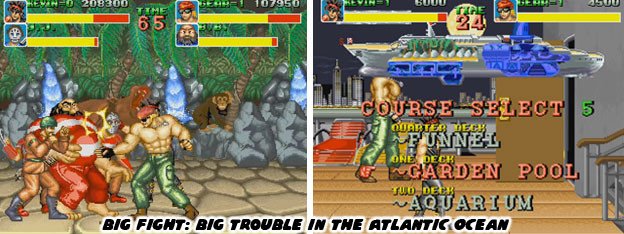
One studio that tried their hand at the brawler would disappear as fast as they came. Tatsumi released Big Fight: Big Trouble in the Atlantic Ocean in 1992. The game was rarely, if ever seen in the arcades. It borrowed a number of elements from the Capcom brawlers, not the least of which were it's character designs, especially the gang members. The game was unique for a number of reasons. It took place entirely inside of a gigantic cruise ship / floating city. Players could actually select the path they were going to take at the end of each stage. This was one of the few games that allowed players to explore different branches.


Something else that made the game unique was the story mode. If a player defeated a boss character then that boss could be selected as a playable character as well. The game was unique graphically for its use of parallax scrolling. Different layers of sprites moved at a different speed and it created the illusion of depth between the foreground and background. This was an important technique in the pre-3D era of game programming. Unfortunately the game was simply too ambitious to accomplish everything the studio wanted to. The control was lacking, the animation sloppy and the experience felt rushed. Tatsumi took their best shot and they should be remembered for pushing the genre forward.


Where Sega capped the end of 1991 with a big licensed title, Konami had given the genre another high-profile title in 1992. This buzz was important because there was a tremendous drop in the number of brawlers that year and a downward trend through the rest of the decade. I featured 18 games released in 1991 but only highlighted 8 for 1992. Those few numbers had not been seen since 1989. The brawler was a fun diversion but had fallen out of favor for most gamers. This was because Street Fighter II was released in 1991. The modern fighting game had arrived. The market changed overnight. Studios were busy answering the demand from audiences and arcade operators. Yet the brawler would not die, Konami, Capcom and now Sega would make sure of that. As always if you enjoyed this blog and would like to sponsor me please visit my Patreon page and consider donating each month, even as little as $1 would help make better blogs and even podcasts!

 follow the Street Writer on Patreon!