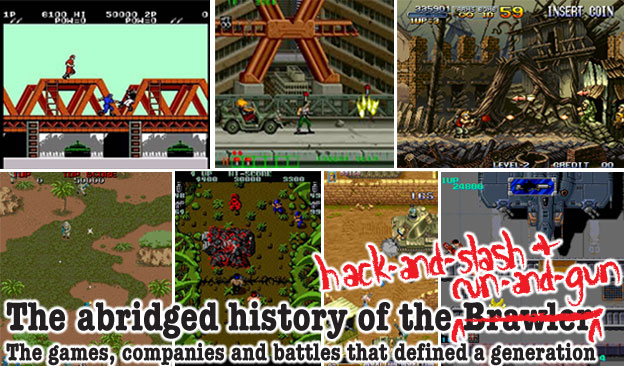
The following games found a balance between the traditional side scrolling mechanics and the free-roaming brawler. They too featured wave after wave of opponents to battle but offered new ranged game mechanics to do so. Players no longer had to wait for an opponent to come to them, they could instead pace out the advancing bad guys with some well timed projectiles. We'll begin with the one that combined animé stylization with side scrolling action.
Namco's Rolling Thunder from 1986 was not a typical run-and-gun game. Instead players had to carefully track through an enemy compound while shooting or avoiding hooded sentries. Players could jump up or down to platforms and even sneak behind fences or inside of doors to evade captors. Although the game was still set in 2D, being able to interact with the environment gave players the illusion that there was height and depth to the levels as well. It also added a bit of a puzzle playing element to the shooting mechanic. Players did not have unlimited ammo so simply running and shooting was out of the question. Players could save up machine gun rounds between levels by shooting only when they had to. What the main character, the super spy named Albatross, lacked in this game was the ability to perform close range combat with the bad guys. That gameplay element would be introduced a year later by Sega.
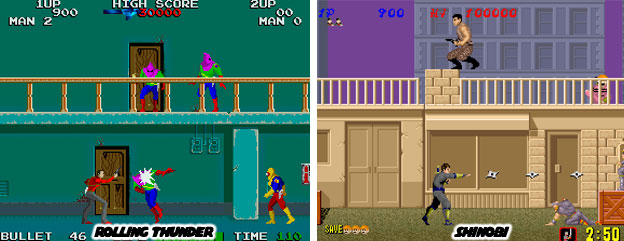
The original Shinobi had very similar play mechanics to Rolling Thunder in that the character could jump to different levels and avoid enemies and strike from a distance. Joe Musashi used ninja stars to strike but could upgrade to a pistol. The game was unique for its use of a magic system which could wipe opponents off of the screen or do tremendous damage to a boss character. Both Shinobi and Rolling Thunder would stay popular with gamers and sequels would be released on arcade and home consoles.
The ninja was beginning to develop a following in the US and by 1988 two major ninja games were released. The brawler Ninja Gaiden I had featured previously in this series. The second was the side scrolling action game the Ninja Warriors by Taito. As the game allowed two-players on screen fighting against opponents at the same time it could be considered a brawler. What made this game remarkable was that it was the second game that Tecmo released that was two monitors wide, the previous one was Tecmo Bowl from 1987. Ninja Warriors was a brutally hard game. Players had to have an absolute sense of range and timing in order to get very far into the game on one quarter The ranged ammunition, the ninja stars, were limited and there were no weapon upgrades. Players could wait for opponents to reach them and then cut them down with a short sword, but that also put them at risk of having opponents reach them from behind.
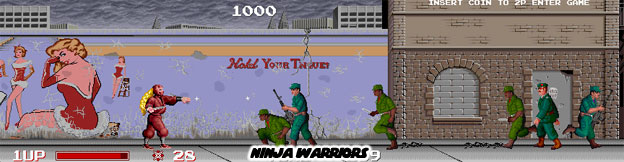
Visually the game was impressive. The levels were highly detailed and the sprites were large and well animated, I want to say that the moves were rotoscoped for how fluid the animation looked. On two displays it was like being the hero in a widescreen movie. However that sensation would be short lived. The Ninja Warriors was the first arcade game where I felt as if the ending were a hollow victory. I do not mean the poor translation in the credits either, the part that read: "A revorution broke out. And everything became to and end. The troubled country seemed to be finished by the death of the wicked machines. But the peace did not came."
Instead I refer to the defeat of the military dictator. He was a fat military character that was groveling and running with fear inside of his palace. He was impervious to ninja stars so players had to walk right up to him and cut him down with a knife attack. He went down with one stab, not very final boss-like at all, what came next would shock and sadden me. Some general, whose face was hidden in the darkness, pressed a red button, detonating a bomb hidden inside the robots, flattening the palace of the dictator. I was stunned. There would be no sequel, no chance to continue the adventure. The heroes were disposable. By extension the players felt the same way as well.
That same year another Japanese studio made players feel like real heroes. Bad Dudes vs. Dragon Ninja was released by Data East and had some of the best two-player side scrolling combat in any brawler. In fact when I did not mention this title early on in my brawler series my friend was upset. He was wondering how the "Double Dragon" of 2D side-scrollers could be left out. I told him that I would actually be saving this entry for when I spoke exclusively to the 2D brawlers that helped define the genre. What Bad Dudes did was more than define the genre. They set a standard for the Japanese pandering to young Western male gamers. President Ronnie, who happened to look a lot like the popular Ronald Reagan, was kidnapped by the Dragon Ninja clan. It was up to a duo of street fighters to save him. If that wasn't a premise for a low-budget 1980's action film then I don't know what was!
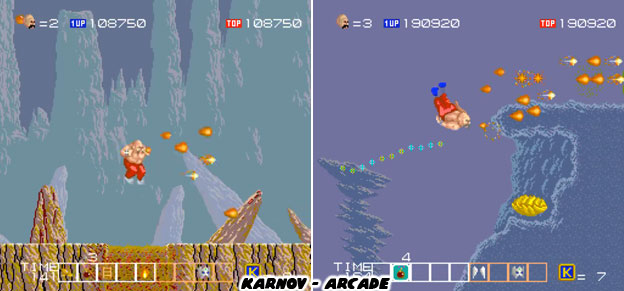
Bad Dudes was a better version of Kung Fu Master and Vigilante. To show off the pedigree Data East even made Karnov, the first boss in the game. The famous strongman and fire breather was one of their earlier arcade stars. In Bad Dudes players fought waves of ninjas approaching from the sides, and could jump to different platforms to continue the adventure similar to Rolling Thunder or Shinobi's mechanics. Players could get knives or nunchaku's for weapons, however their best strikes were dished out with bare hands. The characters could charge up a punch by holding down the attack button and then release it once their character was glowing with energy. The force of the punch would actually send an invisible shockwave through the air, knocking down any ninja that was at least 2/3 of a screen or closer. This worked well on boss characters and large groups of opponents. Players could kick ninja stars out of the air, knock opponents off ledges and do all sorts of over-the-top moves.
The only game that could have possibly topped this game for action and impossible stunts was another one by Data East. Most brawling fans might think I was referring to Sly Spy, the 1989 title that gave Rolling Thunder a run for its money. The game even began with the secret agent jumping out of an airplane and shooting at terrorists while free falling over the White House! However like Shinobi and Rolling Thunder the game was a 1-player affair.
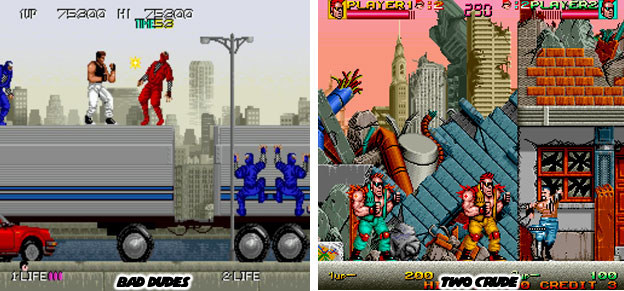
The title that tried to outdo the Bad Dudes was called Two Crude Dudes aka Crude Buster. The 1991 title had a completely different art style, one which did not settle with most fans of the original Bad Dudes. The characters were large, brightly colored, mohawk wearing bruisers, fighting to save a post apocalyptic New York. It was as if the Japanese were trying to make a game that looked like a comic book, complete with word balloons during strikes, only they had no idea how American comic heroes were supposed to look or act. The game allowed the Crude brothers to interact with the scenery. They could lift and throw cars at opponents, yank street signs out of the ground and swing them like clubs and even knock down buildings The game pandered to every insignificant detail the programmers knew about the USA. There was graffiti on the walls, a fallen Statue of Liberty and even a KISS knock-off boss in the first level. The problem was that the game might have been appealing to pop culture from 1981, rather than 1991.
The other side-scrolling Data East games would fare better because they would be based on licenses. Before the company ruined their good name with the abysmal Captain America and the Avengers game they released Robocop. The 1988 title was based on the hit movie and featured locations, sound bites and villains right from the film. Players could shoot or punch opponents, they could even get different types of ammunition as well. The film and game based on it were so well made that Sega poached the concept in ESWAT a couple of years later.
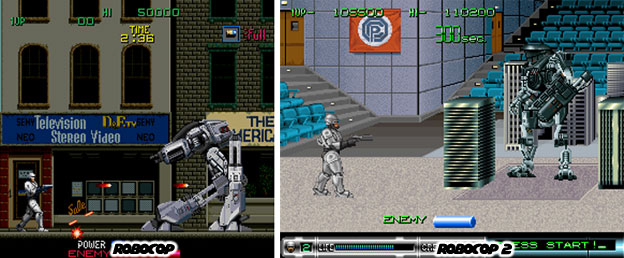
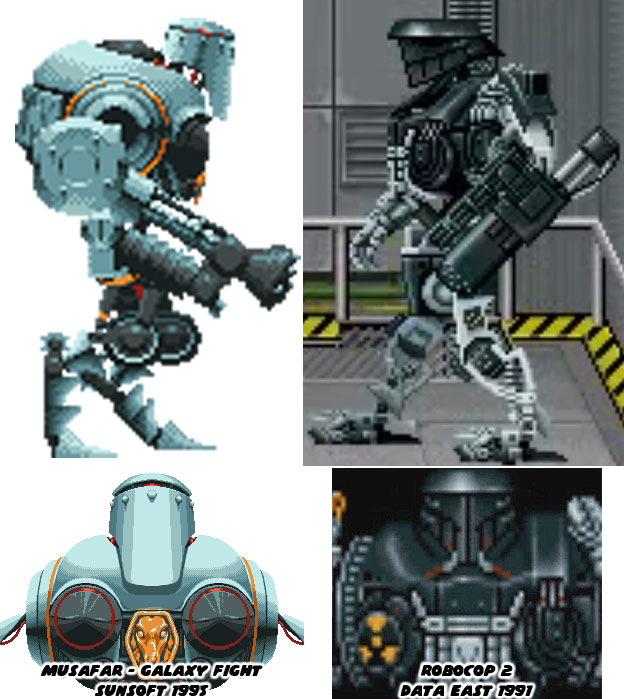
Just as they had released a one-two punch with Bad Dudes and Two Crude in 88 and 91, so too did they follow up their run-n-gun attempt with Robocop 2. The sequel played out as you would expect, the publisher took some liberties with the characters and locations but followed the general direction of the movie including turning Cain into the nemesis. The game was actually more like a brawler as it provided 2-player action and free roaming levels. The game was notable for the limited use of depth in the game. If the two player-controlled Robocops came at the intersection of a street or an alley, they could actually shoot at opponents in the distance as well as those to the immediate left or right.
Licenses were hot for many of the arcade brawlers, one of the biggest licenses from 1988, Superman was again developed by Taito. Unfortunately this arcade game was very simplistic. It was a 2D brawler that had side scrolling levels where Superman could kick and punch his opponents as well as flying levels where he could shoot his heat vision and even energy punches at meteors and helicopters.
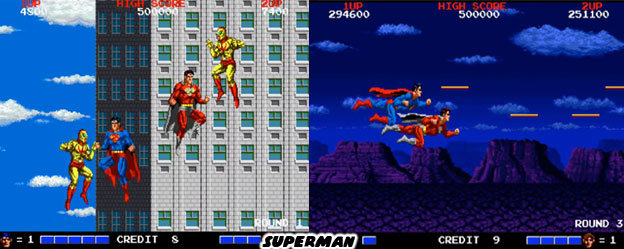
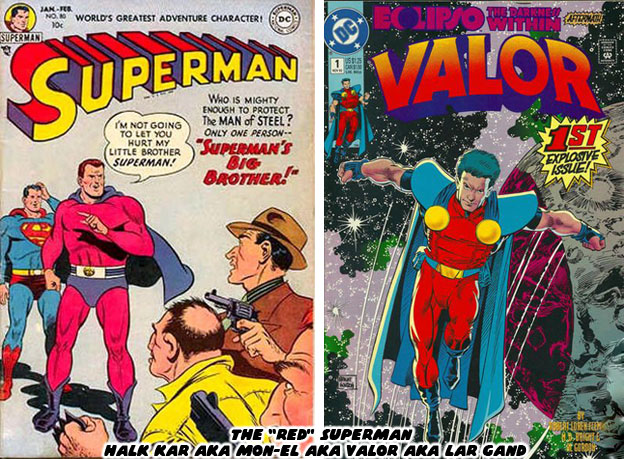
The reason I would consider this a brawler was because it was actually a 2-player game. The second person could play as "Red Superman." He was nothing more than a palette swap of the original character. Same powers, same strength, same everything. Which was a shame really. My brothers and I would pretend that he was actually Valor, an alien from the far future that had powers and abilities that were comparable to Superman. DC had actually featured Red Superman characters for some time, not including Shazam / Captain Marvel. The best part of the game was probably the soundtrack which was a digitized version of the classic John Williams soundtrack.
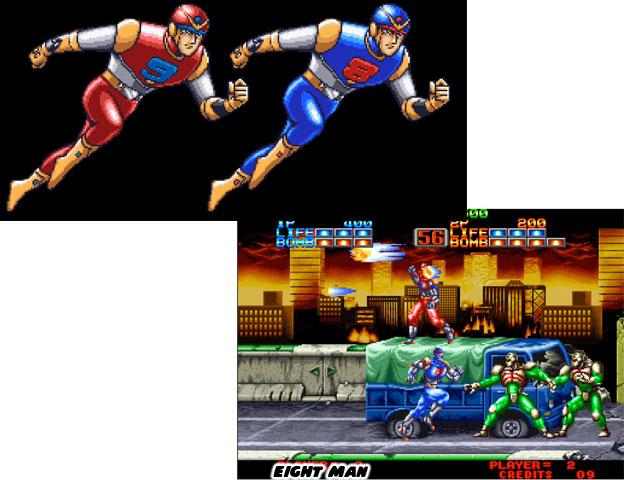
A slightly better 2D brawler based on a comic book appeared in 1991. SNK published Eightman, a game based on a classic manga and anime character. Eightman was a cyborg that could move super fast. He was defending humanity from rogue robots and cyborgs. The character was very influential and helped inspire cyborgs like Robocop and even some of the villains in Mega Man.
The game had a unique power up system which allowed Eightman to gain stronger attacks and even get screen-clearing moves. Player-2 in the game took control of Nineman, the red palette-swap version. The two fought in futuristic landscapes. On some stages of the game they ran quickly along the ground, racing cars and fighting other high speed villains. It was a great effect that was even better than the flying sequences in the Superman game.
Post 1991 the side scrolling brawler, run-and-gun and even hack-and-slash were not long for the arcades. The formats were kept alive on home consoles through the early 90's but trends were quickly shifting. The next blog will highlight the last great hurrah from the hack-and-slash brawlers. I hope to see you back for that. As always if you enjoyed this blog and would like to sponsor me please visit my Patreon page and consider donating each month, even as little as $1 would help make better blogs and even podcasts!