



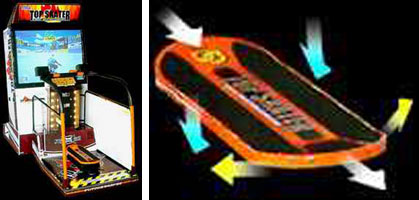
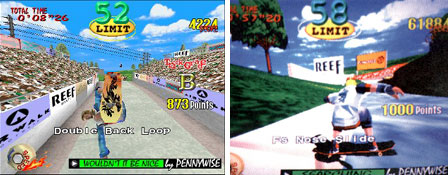
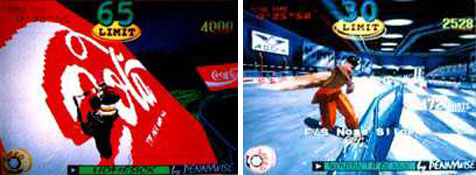
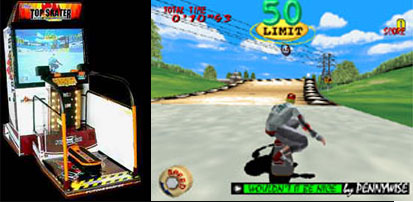
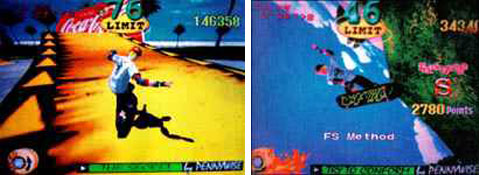
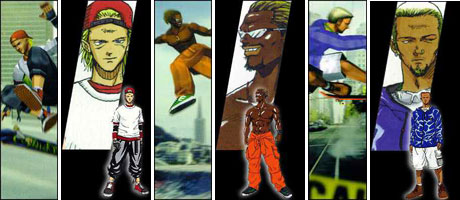
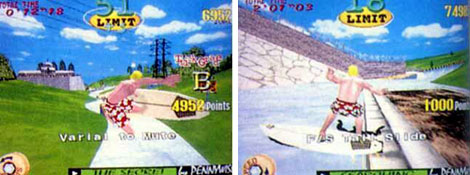
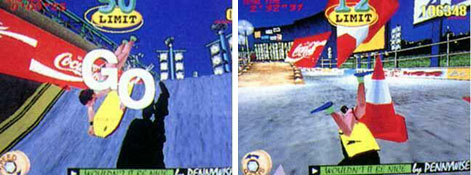
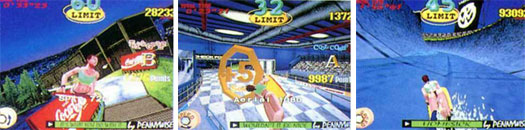
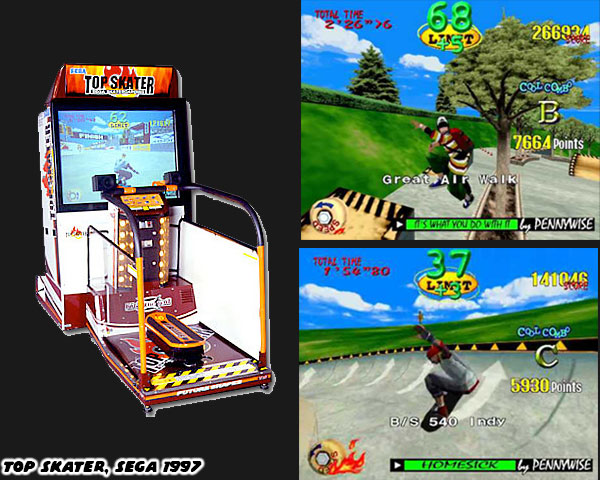
Director Kenji Kanno, and his team put together the only arcade skating game that was superior to 720° in every regard. First off the cabinet was enormous, with a display far bigger than most machines. The reason for this was because you stood on a plastic skateboard, the first of its kind, in order to control the characters. This put the players in the point of view of a pro going through a downhill skatepark. It was as close to simulating the experience as had ever been seen. The skateboard was not a clumsy set up. It was fairly intuitive to turn, ollie, and nollie off of the ramps. Sega was also showing off the advances in their 3D engines. Sprite-based graphics had fallen by the wayside. Polygons replaced pixels, blocky graphics at first, but little by little became more lifelike. Top Skater used the Model 2 engine, which was the backbone of their other hits including Daytona USA, Virtua Cop, Virtua Fighter 2, Virtual-On, and The House of the Dead. Top Skater featured fairly accurate skate tricks, both street flip tricks, grind tricks, and vert aerials. While staring at the giant screen it was possible to get a sense of vertigo as the characters flipped through the air.
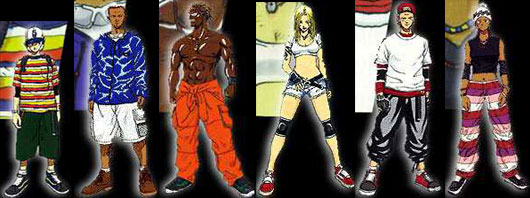
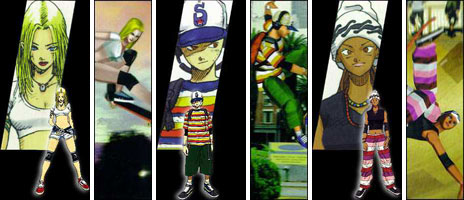
Speaking of characters, Sega created a library of skaters, male, and female from around the world. They even included hidden characters, that accurately reflected the culture. They wore the right style, and even shoes of the time. Each character actually had their own library of tricks. They even had their own stances, regular vs goofy. In addition to providing a great game experience the adherence to the actual culture won over lots of fans. The game featured an amazing soundtrack that I still listen to. A mix of songs from four different Pennywise albums would play. Pennywise was a Southern California punk band whose music was closely associated with the skate scene. The high energy music perfectly framed the experience that Sega was trying to capture. To be fair Director Kanno was exceptionally good at creating fast paced games with western soundtracks. His follow-up game Crazy Taxi was even more chaotic, and featured the music of the Offspring. Sadly Top Skater was never adapted for home consoles. Sega did create a spiritual successor in 2001 with a game called Air Trix.
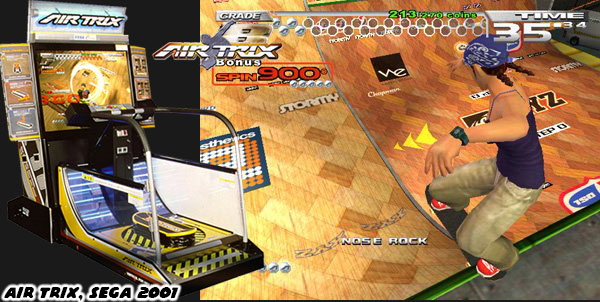
Air Trix was produced by Hisao Oguch, and Directed by Shinichi Fujii. The team at Hitmaker introduced an entirely new cast of skaters, and although the cabinet, and control were similar to Top Skater, the focus of the game was more of a vert simulation. It lacked the charm, and pace of Top Skater. Although the studio focused on getting characters wearing the right clothes, and shoes, it missed the magic of the earlier title. Mr. Kanno learned during the development process that Top Skater shouldn’t focus on racing with skateboards, because players would completely disregard performing tricks. At the same time he didn’t want players to solely focus on vert tricks, so the game nudged them in a general forward direction. Although it looked like you were going downhill, both tracks in the game were actually giant loops. Air Trix didn’t have a soundtrack, as players were expected to perform a series of back-to-back tricks on vert in a timed format. It was an exhausting experience, and although it was very accurate to vert skating, it wasn’t as fun to play as the earlier game. Sega went back to the drawing board, and took notes from their greatest action sports game.
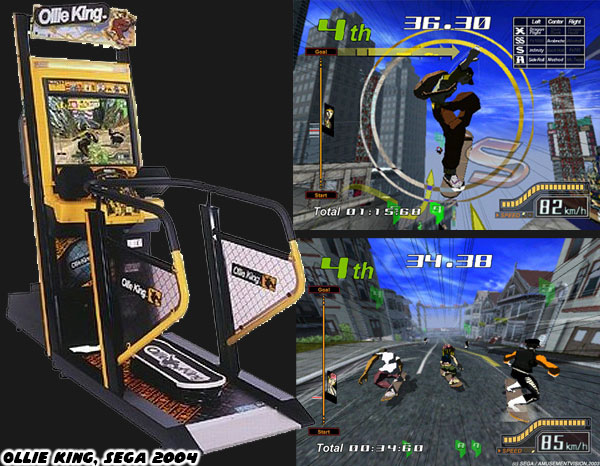
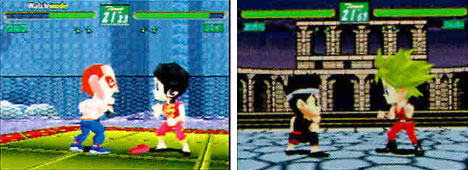
In 2003 the company released Ollie King. This game was directed by Masayoshi Kikuchi, and produced by Osamu Sato. A new development team from Amusement Vision got to work on it. The game also created their own cast of characters, each with accurate clothing, and gear. The soundtrack was created by Hideki Naganuma, who was known for his work on the Jet Set Radio series. In fact this game is considered to be part of the Jet Set universe, as the engine is cel-shaded, and features remixes of a couple Jet Set songs. Unfortunately the game came out during the sharp decline to arcade games in the US. Not to mention that the focus was more on downhill racing with some big air tricks thrown in. While it was very stylish, it didn’t seem heavily grounded in reality. It never received a home adaptation, and was relegated to the footnotes of skate history. Most of the people reading this know that Neversoft developed the undisputed champ of skateboarding games, the Tony Hawk’s Pro Skater series in 1999. They were heavily influenced by Top Skater, and would play it at a pizza shop not far from their studio. Tony himself also confirmed how influential is was during the development of the original. He would eventually get Activision to release a version that used a skateboard as a controller called Tony Hawk RIDE in 2009.
I’ve been playing skateboarding games since 1986, some bad, but many great. The release of Tony Hawk’s Pro Skater 1+2 by Vicarious Visions in 2020 was met with great success. The first two games helped shaped several generations of skaters, and gamers alike. The HD remake was absolutely brilliant, and I certainly enjoyed spending lots of time with it. I felt it was missing a few things that I enjoyed. I went back and replayed the original releases to see how the control, and game play changed between versions. It even got me playing rival games like Evolution Skateboarding, and Grind Session as well. There were some fantastic things in the earlier Playstation, and Playstation 2 games that weren’t really captured in the latest version. Credit where credit was due, Vicarious Visions should be proud of their work. They proved that a great game could withstand the test of time. It actually got me thinking about 720°. Now that I was playing through it on the Xbox One S, and enjoying the experience I wondered if we should revisit The Godfather of skate games. I started thinking of how I would approach a sequel, and what would it feature. If you’d like to read my process then please come back for the next entries. Did you have any favorite skateboard games? Did you start skating because of the Tony Hawk games, or other skate games? I’d like to know. If you would like to sponsor me please visit my Patreon page and consider donating each month, even as little as $1 would help make better blogs and even podcasts!

