Showing posts with label snes. Show all posts

Wednesday, October 1, 2025

Epic Review, Part 1 - A 1UP Classic from Dec. 20, 2010

This series is a look back at the Disney games that helped pave the road to Epic Mickey. This is an homage to the great and even the not-so-great titles that cluttered shelves and filled game store back rooms. Some of these games were filled with potential, some were sadly forgotten before their time. In order to appreciate Epic Mickey we have to understand how far gaming has come and how much Warren Spector and the people at Junction Point and Disney Interactive owe to the legacy titles. This blog will not trace every Disney videogame ever made, only the notable ones, the ones whose inclusion here helped shape genres and even the industry.

The first major player for Disney, one which wasn't regarded as another childish licensed game was was built around a popular Disney Afternoon series titled DuckTales. The afternoon series was successful for numerous reasons, not the least of which was a solid animation effort, memorable music, clever writing with stories and situations inspired the legendary Carl Bark's library. Capcom actually had a long and storied relationship working with Disney well past DuckTales but it was mainly the adventures of Scrooge McDuck which most gamers remember today.
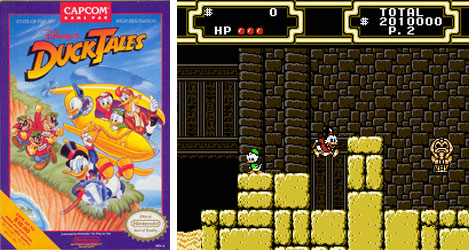
The Capcom game was based mainly on the full screen level designs featured in their other classic NES titles, including Trojan, Strider and Mega Man. DuckTales took the tried and true platform design and built a series of adventures that took Scrooge around the world. Each level was filled with appearances from the supporting cast, the nephews Huey, Dewey, Louie and the pilot Launchpad McQuack. The game introduced a new mechanic to the Capcom formula, something akin to the swing for the Bionic Commando or slide for Strider, Scrooge had a pogo-stick-like bounce attack using his cane. This ability to trounce opponents and traverse gaps in the stages gave diversity to the gameplay and allowed for many original level designs. This mechanic combined with some catchy and quirky songs made the game stand apart from the million other Mario-clones that had flooded the market by 1990. The game was so influential among gamers and Disney aficionados that Warren Spector has mentioned it in more than one interview. Capcom followed up with a sequel to DuckTales that was all but ignored.

The early 90's were a transition period for consoles. Minor upgrades to 8-bit money makers like Mega Man were not enough to satiate the "arcade quality" look and feel of the 16-bit generation. The graphics, sound, animation and design of subsequent games were leaps and bounds better than the best the NES had to offer. The most note worthy of the new titles, the "new" DuckTales, would feature Mickey Mouse in the Castle of Illusion. Sega would wrestle the quality label from Capcom by providing discerning players with a game whose design, animation and playability was up to the big mascot titles. With Castle of Illusion, Mickey would no longer play second string to Mario or the newcomer Sonic the Hedgehog. The expanded memory in 16-bit cartridges, more powerful graphics card and support for stereo sound meant that gamers would demand higher levels of detail and design in games. The fluid movement of Mickey through the levels was far ahead of the curve. This generation of Disney games inspired a generation of gamers, artists and animators.
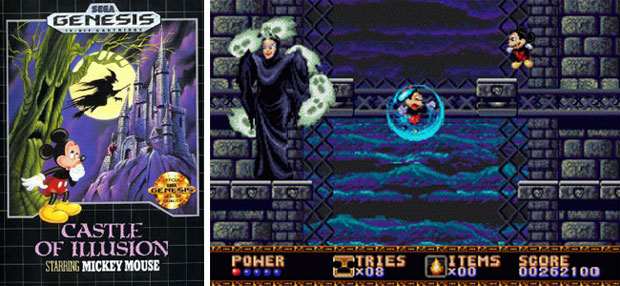
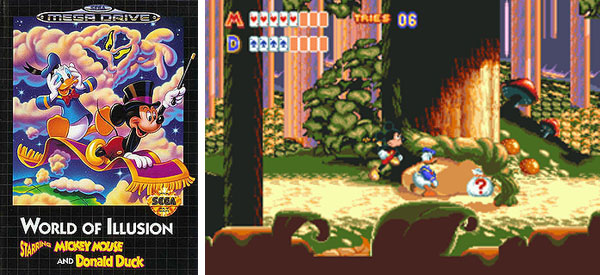
As great as Castle of Illusion was, it was surpassed in almost every regard by Sega's follow-up. Mickey Mouse was joined by Donald Duck in the World of Illusion. This title featured levels inspired by animated movies, larger characters, more frames of animation, new abilities and co-op gameplay. Gamers that had grown up on the animated adventures of the duo were left in awe by how fluid characters appeared in game. Mickey, Donald and the baddies had a familiar "stretch and squash" quality to their movement. It was more lifelike than the "stiff" animation that plagued the Mario character. It was assumed that some day consoles could present animated character indistinguishable from their television counterparts. Combining this animation with traditional 2-D level design meant that gamers could easily get into the gameplay. Between DuckTales and World of Illusion gamers were under the impression that Disney might be on the verge of conquering the consoles as they had animation. Unfortunately this momentum was short lived.
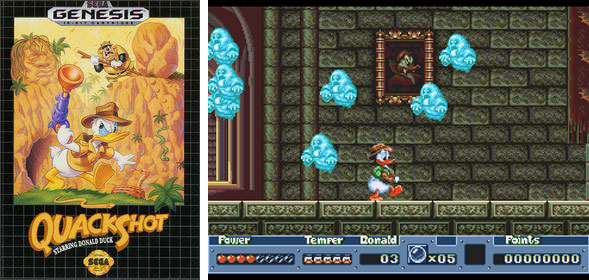
Donald Duck's solo effort, Quack Shot, also by Sega, felt rushed and lackluster. The premise was among the first in Disney history to change the look of the title character in order to fit the game plot. Gone were Donald's sailor blues and cap, they were replaced with a fedora, leather jacket and gun, very much in the Indiana Jones style. It was obvious that Donald had evolved into some sort of adventuring hero. Characters from DuckTales made cameos, including the nephews and Uncle Scrooge. Donald's trick gun could shoot different type of projectiles rather than bullets. Although the gun fired plungers, bubblegum or popcorn, it was a more intimidating act than most gamers were used to seeing. The magic cape and apple throwing from previous titles were far simpler and less menacing to young audiences. A rating concern aside, the lack of originality in level design, forgettable music and formulaic boss battles meant that Sega was simply going through the paces. Just like Capcom had done two years prior, Sega lost the magic within a generation.

The Disney titles suffered because gameplay marginally evolved between the 8-bit and 16-bit generations. Level design was based partially on gun mechanics, such as the ability to create barriers and build ladders. This gameplay element pushed Quack Shot along and allowed gamers to revisit levels and do more exploration after they had acquired different shot types. Unfortunately these were the same mechanics that Capcom had exploited years before in the Mega Man series. The lack of originality was beginning to show and the Disney name could no longer make up for average gameplay.
The things that Disney had going for it were the recognizable characters and top-quality animation. Clever themes, familiar characters and bold colors helped anchor the mascot characters with the gaming public. Unfortunately gamers would be more critical of Disney because they had begun to saturate the market with average titles. While there were significant gains between DuckTales and World of Illusion, Disney seemed to fall flat with the other titles in the 16-bit wars. One of the last notable attempts to make Disney's greatest icon connect with audiences was with Traveller's Tale's release of Mickey Mania. This title featured a new game engine and new team, one of the first Western-lead efforts, with Mickey Mouse in a starring role. The type of game was familiar, it was a platform title yet rather than put Mickey into a fictional world with loose ties to the Disney universe, this game placed Mickey in the middle of several animated shorts. Each level was a self-contained world based on the shorts, there was a lot of diversity, from Steamboat Willie to the Prince and the Pauper. The black and white as well as color worlds made for clever level design. The characters were far larger and more fluid than had even been presented in World of Illusions.
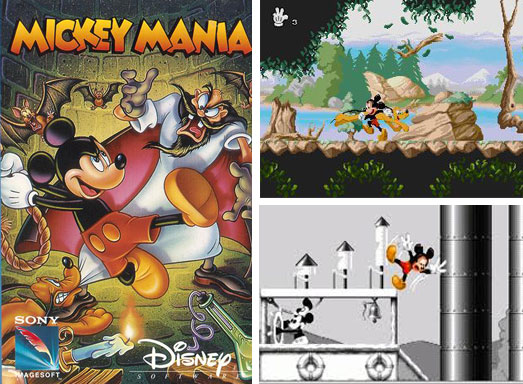
Mickey Mania was a solid effort to recapture the magic and awe that gamers first felt when playing Castle of Illusion. Even better, it served as a primer on the classic animated shorts that made Mickey popular with previous generations. Most gamers were not familiar with the library of Mickey films, possibly because there were only two shorts featuring the character produced between 1953 and 1990 (Mickey's Christmas Carol and the Prince and the Pauper). Prior to Epic Mickey this was the love letter to the character from the gaming community. Unfortunately Disney could not maintain the high level of quality and attention to detail. Many studios were beginning to match and surpass the quality of the best Disney games, especially with regards to animation.

There were two basic types of Disney games on the consoles. Those that were based on an existing movie or series and those that were based on a variation of a character. Disney was not alone in licensing or releasing classic films to the consoles. Lucasarts had a string of hits on the SNES with their Super Star Wars series. Disney was not as successful despite the memorable stories, and superior animation of titles like Pinocchio or the Jungle Book. Why did the latter Disney games fail to connect with audiences? In a word it was lack of evolution.
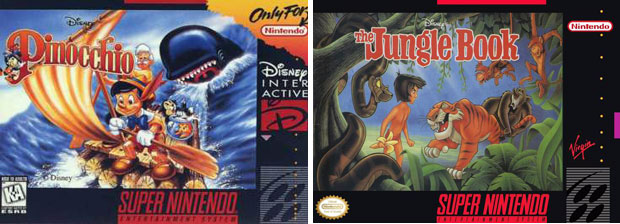
Lucasarts was busy exploiting the state-of-the-art Mode 7 capability of the SNES to achieve depth and the illusion of 3D perspective for many levels in the Star Wars series while Disney had kept everything in two dimensions. Disney had failed to push the characters into something other than a platform genre, which hadn't evolved greatly since the time of Mario or Sonic. Whether it was collecting badges as the Disney Afternoon character Bonkers or collecting fruit as Mogli from the Jungle Book, there was little to distinguish the jumping and collecting formula after the World of Illusion. For gamers there was little difference between the jumping and collecting in other titles on the SNES or Genesis, Vectorman, Rayman and the other characters that made their mark on the 16-bit generation were variations on a familiar theme. Relying on the same old formula had failed for most of their Disney Afternoon titles and not even their famous movie characters could help sell games.

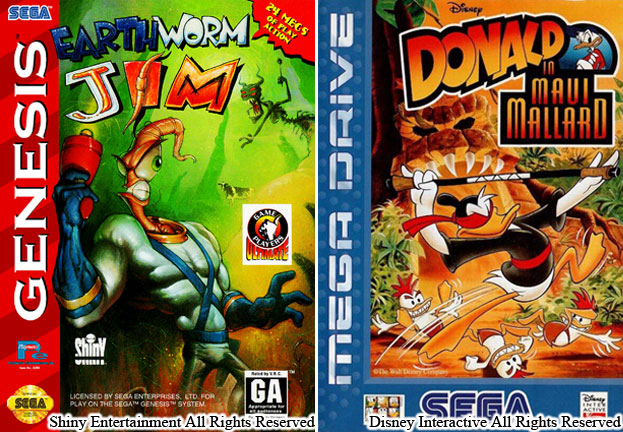
The alternate to titles based on shows or movies showed that Disney Interactive was willing to experiment and allow their characters to mature and feed into the tastes of the gaming public. Variations of iconic characters would be released to mixed reviews over the following decade. Donald seemed to lend himself more easily to the fighting-type adventurer that was popular among most gamers. The title Maui Mallard in Cold Shadow was a bold step by the House of Mouse. It was a very fresh take on the Duck persona. Maui Mallard, presented with a Hawaiian shirt and pistol was a thinly veiled Magnum P.I.. His alter-ego Cold Shadow was a blindfolded ninja that fought with a bo-staff. The game was far more mature than Quack Shot, but not insulting to the audience. It featured animation and design that were leagues ahead of World of Illusion, and moreover, were placed over two completely different styles of gameplay. Gamers could use the run and gun mechanics of Maui Mallard to clear a level or the up-close fighting of Cold Shadow.

The levels were refreshing takes on classic themes, the traditional jungle, underwater and volcano levels were combined with unique designs. Maui was tethered to a springy vine in the jungle and could be yanked about by the player. It was tricky navigating the jungle floor as Maui had to use his hands to climb across fallen bamboo poles. The underwater stages saw skeleton pirates and sea monsters fighting our hero while the volcano stage could be navigated by jumping from rocks or by swinging overhead using the ninja staff like a grappling hook. Maui Mallard was far from being the average Disney platformer. It stood out for its originality, in concept and execution it was one of the most notable but overlooked games in the 16-bit generation. Gamers had experienced many of the same features that made Maui Mallard very playable in a different title.
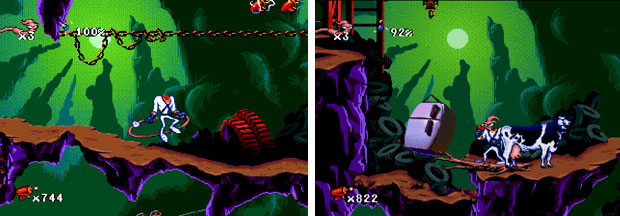
Earthworm Jim was an exceptional platformer. It combined run and gun gameplay with the leaping, climbing and swinging mechanics which were not good but great. Few games managed to capture perfect control and frame them within unique level designs. What made Earthworm Jim stand out from the peers was that it wrapped impeccable gameplay in a shockingly original, twisted, cartoon wrapping. Earthworm Jim was possibly the greatest traditionally animated 16-bit game of all-time. It stands to reason, Shiny founder David Perry cut his teeth as an animator for Disney's Aladdin game. The bold colors, warped designs and absurd amount of detail (and humor) that went into the game were imitated but rarely duplicated. Earthworm Jim represented a paradigm shift in platforming. It was an answer to the the unspoken reality. Specifically it acknowledged that gamers were getting older and more mature. The tastes that they had were changing. 
While fond of the Disney Afternoon from years prior, they were now tuning into the edgy Ren and Stimpy animation from Spümco. Cartoons were not solely for kids and neither should video games. Gamers acknowledged that many of the Disney games were well made and animated, but too simplistic. Earthworm Jim was a very demanding game that layered equal parts style over substance. Shiny made icons out of Jim and Princess What's-Her-Name overnight and Disney games had all but been forgotten. Maui Mallard was a response to the Earthworm Jim fan, two years after the fact. The peak of traditional 2D animation for gaming had been met. The next barrier would be 3D. Earthworm Jim would not remain king of the hill for long and Disney would not be ready to move into that position.

As always if you enjoyed this blog, and would like to sponsor me please visit my Patreon page and consider donating each month, even as little as $1 would help make better blogs and even podcasts!
follow the Street Writer on Patreon!

Monday, July 3, 2023

Rock and Roll, and Combat Cars Racing - Originally published on 1UP - March 30, 2009

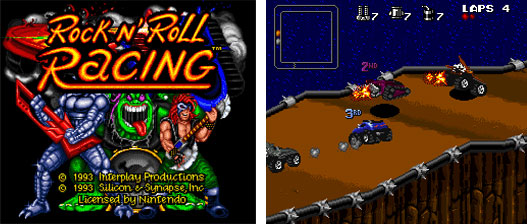
In the early 90's I was finishing high school and looking for new challenges in gaming. The arcade scene was still growing steadily but some of the best times I had were on the consoles. The Super Nintendo and Genesis split my time evenly. Two of the more memorable racers were in the combat genre, years before Twisted Metal was even announced. Rock and Roll Racing (RnRR) had a number of things going for it. The characters were a mashup between mutants and heavy metal gods. The cars they drove were equally intimidating, sports cars with monster truck tires or jet cockpits on tank treads. The game was established around an intergalactic competition so the rides could be as eccentric and intimidating as any science fiction movie. Tracks consisted of grades and jumps, not really explored in RC Pro Am or most other console racers. The mix of rock music, bright graphics and monstrous protagonists said this was a boys game. Even "the voice" of motor sports, Larry "Supermouth" Huffman lent his talents to this 1993 title by Silicon & Synapse, before they became Blizzard Ent.

Rock and Roll Racing was an isometric car combat game. Not quite as fast paced and frenetic as RC Pro Am but whose graphics and sound effect were absolutely top-notch. The digital covers of many rock standards made it stand out to many gamers.

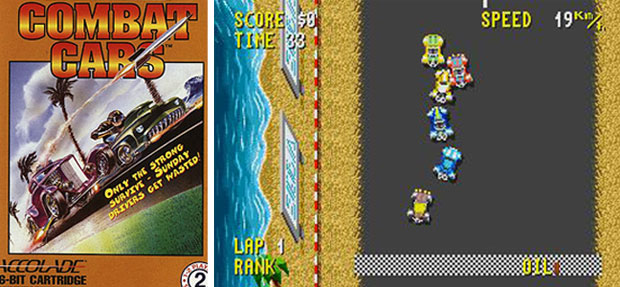
A year later the Genesis saw its own car combat game named, what else, Combat Cars. The game by Accolade seemed kind of dated. It was presented in the overhead view rather than isometric. The characters seemed like the usual assortment of ugly guys and mutants. The music was some odd type of electronica, rock music was out. There was no air of authenticity to this game, no connection to the racing world as there was with Rock and Roll Racing. That was with the exception of the cover art. Car art legend Ed "Newt" Newton was the person that designed the box art. That little detail was enough to get me to pick up the title.

These differences between this game and Rock and Roll Racing didn't amount to much as the game was very well made. The racing element in particular was very solid. In addition to being mindful of the track players had to line up shots and avoid opponents. The tracks were diverse, upgrade options numerous and the gameplay very fast paced. The design of the combat buggies even grew on me, more so than the three basic car types in RnRR. To many it was graphically inferior to Rock and Roll Racing but the play experience was anything but lacking. It was proof that a studio could create a fun experience with the overhead format. Make the player handle multiple elements in a racer and they will step up to the challenge. Provided that the balance is there, the controls are dialed in and the multiplayer mode isn't lacking. Combat Cars had all of the above.

Ten years earlier I would have never thought that a memorable overhead racer was possible, let alone on a console. Bally published a racing game, not one year after the amazing Spy Hunter, which almost killed the momentum of the overhead genre. I hope to see you back tomorrow to find out which game it was.

Were there any rare games that you enjoyed? Let me know in the comments section please. As always if you would like to sponsor me please visit my Patreon page and consider donating each month, even as little as $1 would help make better blogs and even podcasts!
follow the Street Writer on Patreon!

Wednesday, April 5, 2023

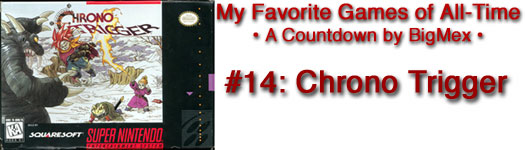
My favorite Games of All-Time #14: Chrono Trigger - Originally published on 1UP - May 19, 2006

Chrono Trigger (CT) is the final RPG on my list. I actually debated putting Mother, Secret of Mana or Final Fantasy Tactics in this place. There simply was no swaying me from the final decision though. I would be lying if I defined myself by a series of RPG games, they just aren't my favorite genre. I still have tremendous respect for them and that is why CT holds this spot. Although CT does not break my top-10 that is not to say it is not a great game and not worthy of admiration. Chrono Trigger is considered one of the best RPG's ever made and possibly the greatest game ever made. It is easy to defend either argument.

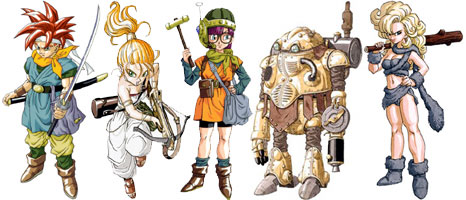
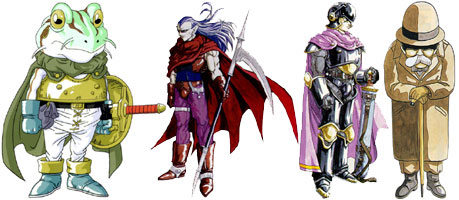
Chrono Trigger was loved by gamers and applauded by critics. CT represents the pinnacle of Squaresoft's RPG efforts. CT was produced by Final Fantasy's Hironobu Sakaguchi and directed by Dragon Quest's Yuji Horii. The character designs, which many believe to be the best styled in any RPG were done by "Dr. Slump" himself Akira Toriyama, better known as the creator of Dragon Ball Z. It has been a long time since anything so noteworthy had come out of Square. A collaboration of this magnitude may never be reached again.

Like all great games the story begins very simply. The main characters Crono, Lucca and Marle are your typical young adventurers from the kingdom of Guardia. What was not typical was the use of strong female characters and personable supporting adventurers. Characters did not exist in this game to fill out a token slot. They all had back sotry, they were designed to be atypical, charismatic plot-driven devices. People that played the game can often say who and why their favorite characters were in CT.

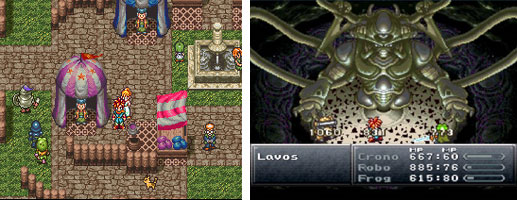
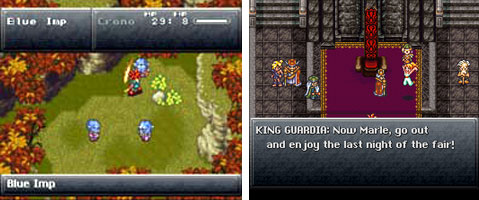
Sometimes the greatest direction of the game is the one that isn't even noticed. All great forms of entertainment move the viewer to new places. These are done so subtly that we never notice the inner-workings of the genius behind the scenes. Chrono Trigger is possibly the best example of a game where all of the components were perfectly crafted. The pairing of the main three character was no accident. As an errant message was delivered to a young man named Luke Skywalker in the first Star Wars movie. Crono, Lucca and Marle show up at the Millennia Fair at the same time at the beginning of the game. The plot quickly takes off when Marle accidentally gets teleported to the past and changes history. It is then up to Crono and Lucca to travel back and forward in time defeating enemies, adventuring with new friends and figuring out the mystery of Lavos, the alien parasite and would-be destroyer of the world.

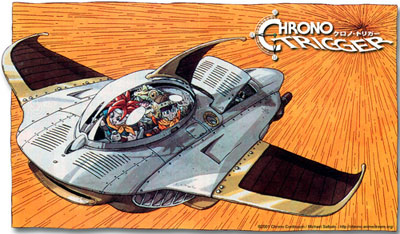
Chrono Trigger excels in the use of time travel as a plot device. I dare say that this game was better executed than the films Back to the Future or Bill and Ted's excellent adventure. No Delorean or telephone booth could rival the Epoch, a fantastic flying ship that allowed the characters to travel between time. Every choice the main character made in the past and every mission they took on effected the plot and even look of future levels.

The combat system was possibly the most unique element to the game. Characters could raise their levels of physical and magical attacks as in traditional RPG's. However players were encouraged to learn team attacks using their party. Characters like Robo the robot, Ayla the cavewoman and Frog the prince helped diversity the types, range and damage of the team moves. Different combinations of characters resulted in diverse and often incredible special effects (for the time) during combat. Robo for example had a special attack that was nothing short of a one-person rave complete with laser show and dance routine. Questing and exploration were key to unlocking paths and characters.

This open type questing and ability to travel through time was so well done that players used to traditional RPG games weren't braced for the ending. Rather for the possible endings that could be accomplished. Square is credited with inventing my favorite game device in recent years. The use of Game + data. Once a player had beaten the game, they could start a new adventure while keeping all of the stats from the previous game. Thus allowing them to explore the game further, unlock new paths and team members or just beat the tar our of Lavos as soon as the game started. The variables allowed for the player to get many different endings, some subtle and some major.

Critics argue that getting a player to connect emotionally with a character is the holy grail of game design. Supposedly it can only be done with next-generation graphics. I can say that fancy graphics have only cheapened the Square games. The more time wasted on pretty cinemas the less connected the gamer becomes with the character. I already said that the opera scene in Final Fantasy VI was one of the most powerful game moments ever. It was proof that the emotive experience is not limited by simple graphics. Think of Chrono Trigger as carrying the opera scene through the entire game. CT uses the same type of pacing, writing, detail and development but through a multiple path adventure. In essence Chrono Trigger becomes far more than the sum of its parts. This why it connected with me as a gamer more than any other RPG.

I hope that you are one of the lucky people that actually played this game. For those that didn't I wish that Square-Enix did not halt the progress on Chrono Resurrection. But there is always hope that one day we can all experience the adventure one more time...

Have a great weekend people!

I’d like to hear your personal top-10, top-20, top fighting games, top sports games, or top games in any genre. Let me know in the comments section please. As always if you would like to sponsor me please visit my Patreon page and consider donating each month, even as little as $1 would help make better blogs and even podcasts!
follow the Street Writer on Patreon!

Monday, March 5, 2018

The Giant Monster Series, part 13...


Godzilla is widely considered the king of all monsters. There were giant monster movies before Godzilla (1954) and of course hundreds after. But for many reasons we keep circling back to the atomic-fire breathing lizard. Part of the reason was because there was nothing like the monster. No force on Earth could stop it and even the most powerful military weapons of man could barely slow it down. You would think that a character this popular would be the perfect subject for a game. The hard part was figuring out what type of game could developers make around the character? Would it be a real-time strategy game where you line up the military forces and try to divert Godzilla away from a city? Or would it be an exploration adventure where you took on the role of a civilian trying to survive an attack? Of course most audiences wanted to be Godzilla and feel what it was like to have that type of power.

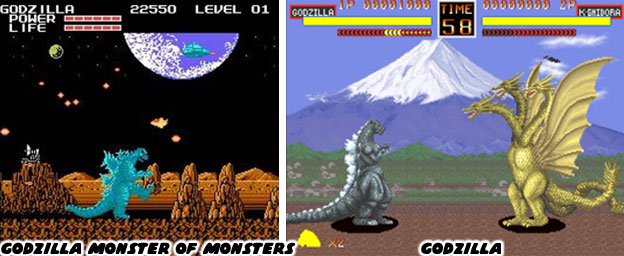
Godzilla Monster of Monsters for the Nintendo Entertainment System (NES) put gamers in charge of the title character. The title from 1988 was well received by fans. Just about every monster that had ever appeared in a Toho movie was featured in the game. Players took on the role of either Godzilla or Mothera as they fought wave after wave of aliens and other giant monsters en route to Planet X, the home of King Ghidorah. The game featured very large sprites with unique level visuals. If it had one failing it was that audiences couldn't appreciate the scale of the character as it was as big as human characters from other console games.


Godzilla console titles had limited game play. Most designers just followed the trends and put Godzilla in whatever was popular at the time. In the '80s many NES games were platformers, vs. Mario Bros, Bionic Commando, Rygar, Castlevania, etc. all had a character move left to right on screen and fight various bosses. As fighting games became more popular in the early '90s the Godzilla games evolved to follow suit. In the Super Famicom (Super Nintendo) versions of Godzilla: Battle Legends (1993), Super Godzilla (1993), and Godzilla: Monster War (1994) the game play was changed so that monster encounters played more like a modern fighting game. As fun as these games were they didn't really capture what it meant to play as the monster.

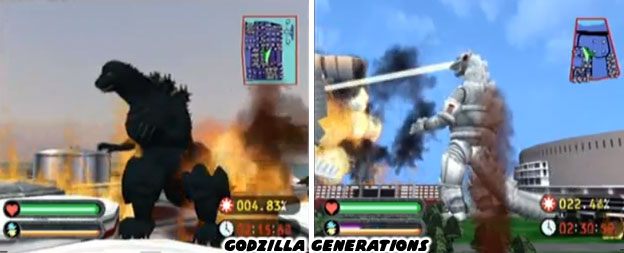
All of that changed in 1998 with the release of Godzilla Generations for the Sega Dreamcast. For the first time in a generation the awesome power of the monster was presented in 3D. The game revolved around Godzilla or one of a handful of monsters (including the abysmal USA Godzilla) destroying a city. Players could walk through skyscrapers, watch them break apart and come tumbling down. They could blow up refineries and even fight the G-Force military special units. There was little to the game play aside from destruction. It was a throw-back to the Epyx game Movie Monsters. For a little kid this was more than enough to make them happy but long-time players expected much more of an experience.


Godzilla Generations was the perfect example of why the character never became a gaming icon. It was difficult to make an enjoyable experience out of a creature that was famous for moving slowly, smashing cities and fighting other monsters. It didn't stop developers on both sides of the Pacific from trying to create a hit game with the license. We will explore these better attempts in the next blog. I hope to see you back for that.