Showing posts with label epic mickey. Show all posts

Wednesday, June 17, 2026

Bookmark This Page; Everything about Oswald the Lucky Rabbit, and Epic Mickey

Oswald the Lucky Rabbit is easily my favorite Disney cartoon character. If you want to learn everything about the character, and his appearances in animated, comics, and games then Bookmark This Page.

Oswald finds a new home, at his old home?

Retouching a photo, and checking out some Disney robots...

Oswald art for your walls - A 1UP classic from March 8, 2013

Freeze frame, my poster collection, part 17…

Freeze frame, my poster collection, part 18…

Epic Review, Part 1 - A 1UP Classic from Dec. 20, 2010

Epic Review, Part 2 - A 1UP Classic from Dec. 21, 2010

Epic Review, Part 3 - A 1UP Classic from Dec. 22, 2010

Epic Review, Final Part - A 1UP Classic from Dec. 23, 2010

The Epic Mickey 2 press junket. Touring the Magic Kingdom. - a 1UP classic from Oct 10, 2012

The Epic Mickey 2 the Power of Two Review - a 1UP classic from Nov 28, 2012

When a rare Oswald the Lucky Rabbit item turned up on bidding sites

Lightning strikes twice, a second rare Oswald item turns up on bidding sites! Disney characters help me break our of my art block The cancelled Oswald cartoon show, and the cameo in Disney Dreamlight Valley Skeletons, Disney, and Oswald break me out of my art block Some of my favorite Disney illustrations from 2026

Did you ever watch any of the classic Oswald shorts? Did you play Epic Mickey? What were your thoughts on the Lucky Rabbit? Tell me about it in the comments section. As always if you enjoyed this blog, and would like to sponsor me please visit my Patreon page and consider donating each month, even as little as $1 would help make better blogs and even podcasts!

follow the Street Writer on Patreon!

Friday, October 31, 2025

When Disney made the best ghost stories!

It’s that time of the year where ghouls and ghosts take over our streets. Since I had been on a Disney kick I was thinking fondly about the Haunted Mansion at Disneyland. I had talked about the attraction in the past and compared it to the God of War series. Specifically how the attraction, and game had richly themed environments. With that in mind I was wondering about how it was presented in game form.

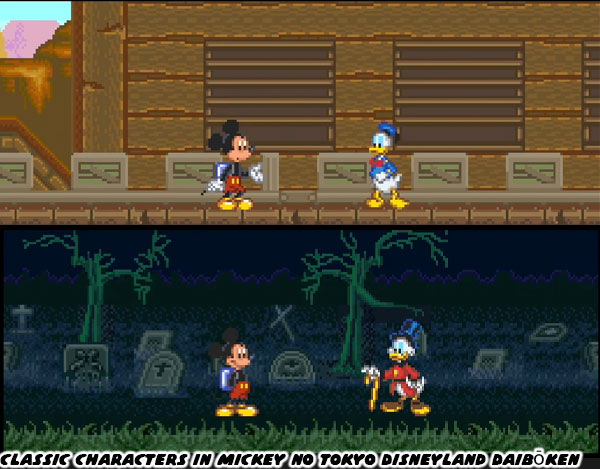
I discovered an old Disney game that had a dedicated Haunted Mansion stage. Mickey no Tokyo Disneyland Daibōken was a game published by Tomy for the Super Famicom (SFC) in 1994. The game featured Mickey and his friends at Tokyo Disneyland. Mickey was trying to get his friends together to practice for a concert. Each friend just so happened to be located in a different area of the park.

There were bad guy weasels trying to keep Mickey from his duties as he traveled around. Of course Mickey had to be able to fight against bad guys, but in a Disney game you couldn’t really be too violent. So Mickey was given two types of balloons that he could use on his adventure. The water balloon he could bounce off of, as well as throw at his enemies. Then there was a helium balloon that allowed him to float to higher platforms, of breeze over gaps. Parents wouldn’t be able to object to Mickey defending himself with balloons after all.

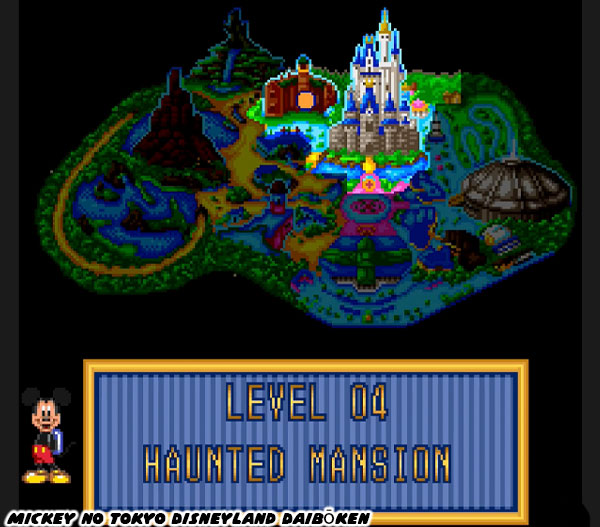
The big attraction at each land was the basis for each stage. It was neat seeing how things like Big Thunder Mountain, and the Pirates of the Caribbean were turned into platforming levels.

The fourth stage was set in the Haunted Mansion. That attraction was arguably the greatest dark ride ever created. It was layered with so much detail that it developed a cult following. Even I was not immune to its importance in theme park history. In fact I wrote about the Hatbox Ghost 10 years ago on this blog. You can read about the history of the Haunted Mansion on the Disney Family Museum page. The fact that the Japanese game was able to turn iconic scenes featured in the attraction into actual stages was mind blowing. The “stretching room” for example was amazing, it took advantage of the SFC’s fabled “Mode 7.”

The attraction did not have a definitive story, but was rather a collection of spooky vignettes. An official album tried to tie together the various scenes. However many things were added, or removed through its history. Each of these changes were embraced by the fans. Fan theories spread among the community, in the ‘80s these were discussed in fanzines, and would eventually make their way online. Even leftovers from a refurbishment got a legend all to themselves.

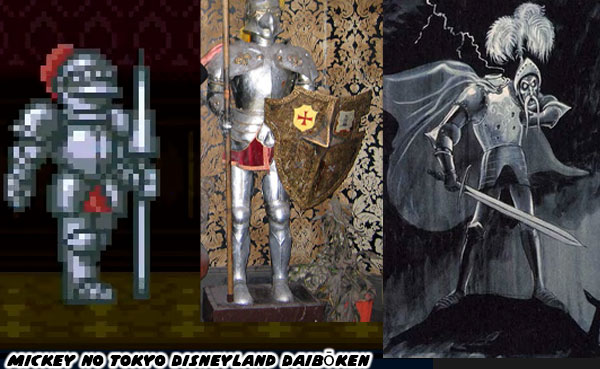
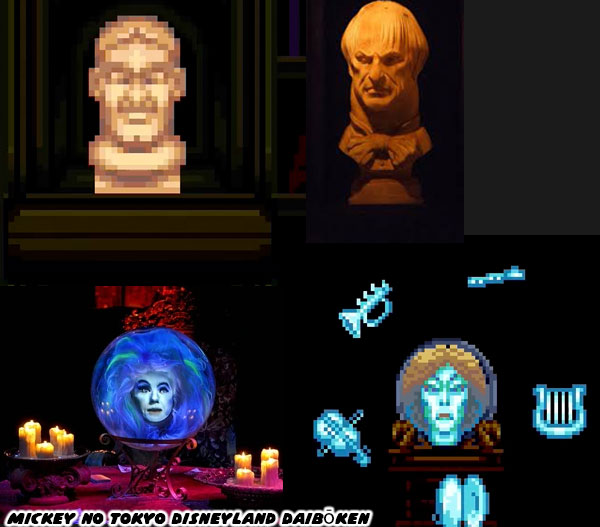
The game even featured animated suits of armor. This was a brilliant callback. In the early days of the attraction in the late 1960’s they actually had cast members wearing the armor, and pop out to scare riders. This was eventually turned into a stationary animatronic that rattled.

The busts that followed visitors in the foyer, and the head of Madame Leota in a floating crystal ball also appeared in the game. The developers at Tomy had certainly done their homework. The attraction was filled with 999 Happy Haunts. There was plenty to pull from, and many ghosts that people should expect to see in a game.

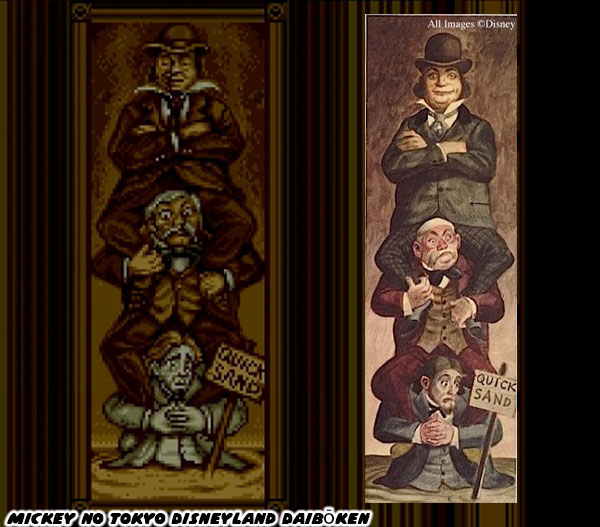
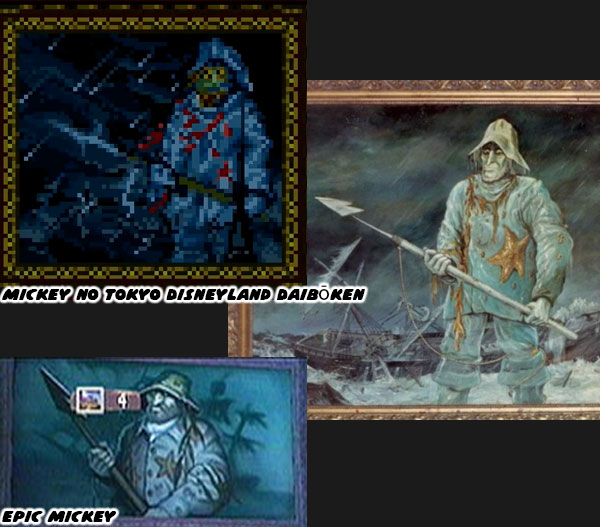
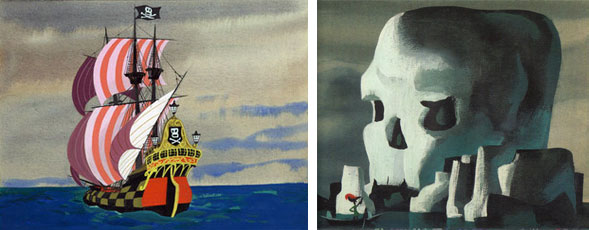
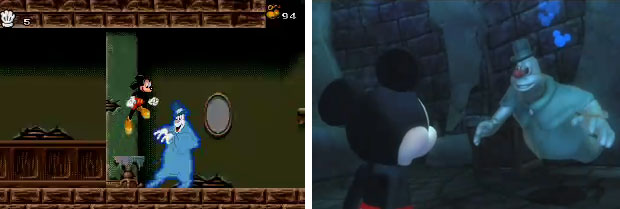
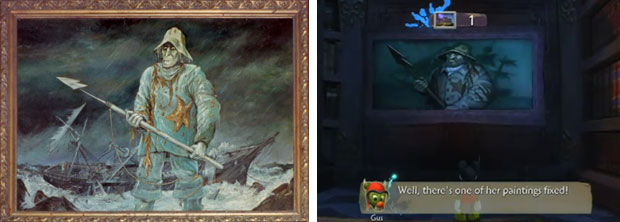
The deepest cuts in the game were the ghost portraits. Not every painting by Disney Animator / Imagineer Marc Davis was featured in the original attraction, or the follow ups in Florida or Tokyo. The ghostly fisherman was part of a pirate theme that had originally been pitched for the attraction. The mariner with the harpoon had appeared in both Mickey no Tokyo Disneyland Daibōken, as well as Epic Mickey.

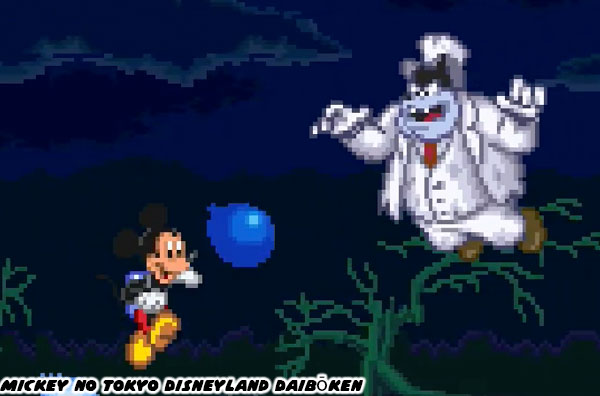
At the end of each stage there was a version of “Pegleg” Pete waiting to challenge Mickey. He wore a costume that was appropriate for the particular attraction. In Stage 4 Pete was waiting in the mansion graveyard. He was a pale blue color, and wore a pale victorian suit as many of the ghosts did in the attraction. He floated around the stage, and shot plasma balls at Mickey. As far as I know this was the first and only time this version of Pete had ever appeared in an officially licensed game.

In honor of this eerie version of Pete, and just in time for Halloween I decided to make an illustration of “Phantom Pete.” What do you think? Should Disney revisit platform gaming? Tell me about it in the comments section. As always if you enjoyed this blog, and would like to sponsor me please visit my Patreon page and consider donating each month, even as little as $1 would help make better blogs and even podcasts!
follow the Street Writer on Patreon!

Wednesday, October 8, 2025

Epic Review, Final Part - A 1UP Classic from Dec. 23, 2010

Audiences might credit Warren Spector with coming up entirely with Epic Mickey but it was actually a group of interns that sparked the idea of Mickey trapped in a twisted wasteland.
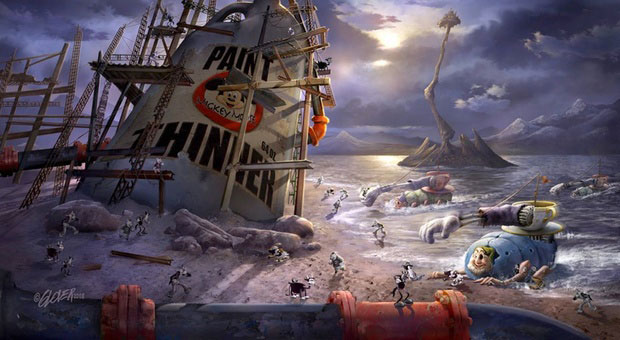
The concept pieces by Gary Glover and Fred Gambino set a tone for a dystopian world, which looked like a steampunk or post-apocalyptic wasteland with only a few, but prominent Disney set pieces scattered across the landscape.

The machinations featured in the concept pieces were combinations of the cartoon characters and theme park attractions. An amphibious Pete tank with tea cup turrets and cartoon arms reaching storming a beach and taking black and white cartoon characters. A gigantic paddlewheel ship / mechanical narwhal with enormous mechanical crab legs pulling the Spaceship Earth, the geodesic dome from Walt Disney World and water tower from Disney studios across an ocean.

Somewhere in the concept pieces the seeds of Epic Mickey were planted. Some elements translated well into game form, but far and wide the finished version of Epic Mickey had little to do with the concept art. Warren Spector was challenged to design a game that placed Mickey in an adventure, the likes of which had never been tried with the character. The Mouse would be trapped in a world, a twisted version of the one that inspired him, all for the sake of trying to get the character to resonate with modern gamers. But for many it seemed that the world in the final game was not as dark, mechanical or macabre as they would have wanted. What exactly did gamers and critics want? That would be tough to determine.

Metacritic gave Epic Mickey at a 73 out of 100 approval rating, whereas Disney's Guilty Party was rated at 78. This is not to say that Guilty Party was a bad game, but how was it possible so say that Epic Mickey was a worse game? Did it somehow lack the elements of play, control, animation, story or anything else that a Wii party game possessed? It could be endemic of a larger problem regarding ratings and genres, but I digress. I would like to challenge the critics of Epic Mickey, especially those that thought that Disney had made a better title this year. Show me where Epic Mickey was a worse game than anything else Disney released in 2010. Explain to audiences how this game was a letdown. The best I can do is take a guess at the design "flaws" that critics saw with the title.
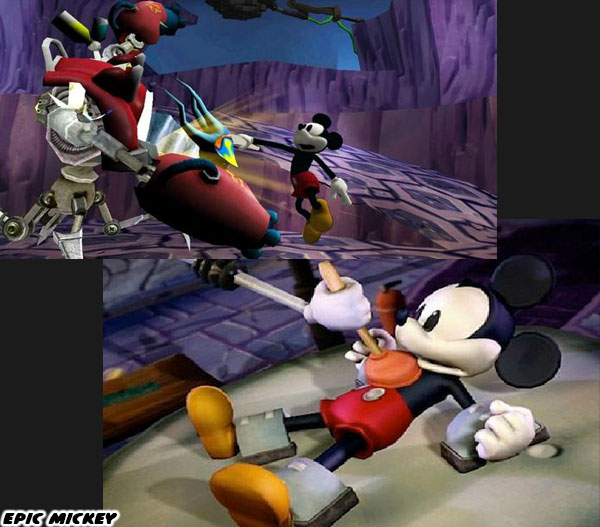
Did the game suffer because Junction Point did not create a sandbox environment out of the Wasteland? A wide-open area for Mickey to travel in, jump on and explore? If this were a complaint did the critics not wonder how much time and effort that would have taken? The levels in Epic Mickey were crammed with hundreds of layers of detail. Every corner of the lands had their own specific layout, textures, palettes, and atmosphere. Just as each “theme” part of the real Disneyland had its own personality, with unique signage, decorative elements and even trash cans. There were no repeated elements from theme area to theme area, so that Tomorrowland would feel like a glimpse into the future and Frontierland always had a classic western feel. So too did the individual levels in Epic Mickey bear many layers of uniqueness. Colors, textures, layouts featured in the title were based on the work of the legendary Imagineers, like Mary Blair, Rolly Crump which I mentioned in previous blogs. Even the legendary Marc Davis, whose concept work on the Haunted Mansion was set to tell a story of a vengeful sea captain returning from the dead. This painting was never actually featured in the original attraction but helped add atmosphere to the game.
It was highly unlikely that Wii media had the memory capacity to hold an entire open world like those found in Grand Theft Auto and still had maintained the absurd level of detail that the individual theme portions maintained, inside and out. Even if the discs could hold that much data for textures and modeling, it would have taken years for Junction Point and Disney Interactive to have modeled a fully scaled-out Wasteland. Additionally, the concept art that gamers flocked to clearly showed miles of empty areas and oceans separating the park elements. What would gamers have done with miles of nothing to see or do? Where there gameplay elements in designs like that? Were the lack of interactive elements and miles of space what turned some gamers off of Shadow of the Colossus? The Wasteland featured in Epic Mickey was actually designed with the elements featured in the concept art and then given a purpose. Whether critics acknowledged this or not was something else.
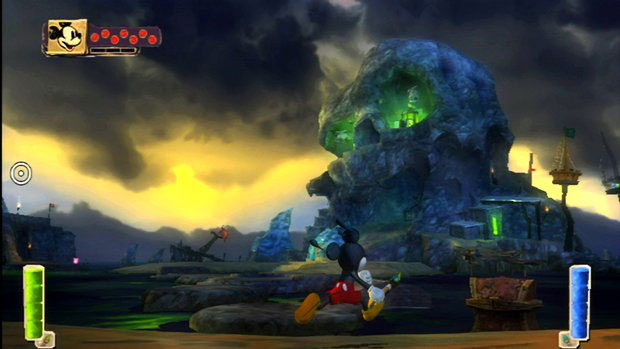
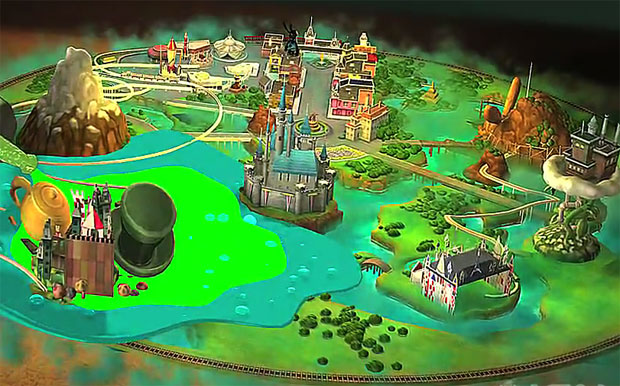
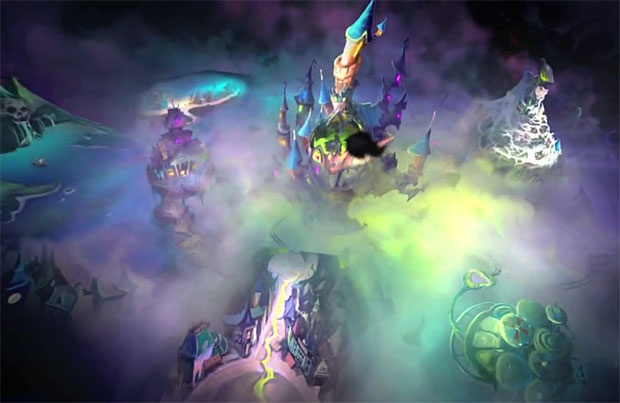
Oceans and rivers of paint thinner separated the various theme levels. In order to bypass the thinner and get from park to park Junction Point added the movie projectors. It created a mechanic to allow players to transverse the levels and layered a game-within-a-game play element. Once outside of the projects gamers were sometimes met with the same twisted scenery, oceans of thinner and bold colors that were featured in the concept art.

Many of these twisted landmarks did not solely exist for the sake of shock value, they were given a purpose. For example, rather than place the Matterhorn Mountain in the Wasteland, Junction Point created a “Mickey Junk Mountain.” It was a mountain that was built on decades of Mickey merchandising. Just about every record, book, puzzle, toy, toiletry, figure and game that featured the mouse was crammed into the walls, floors and background of the mountain peaks. Off in the distance there were ravines hidden behind swirling toxic clouds with the occasional set of mouse ears. If one bothered to look then they would have been reminded very clearly of the concept art.
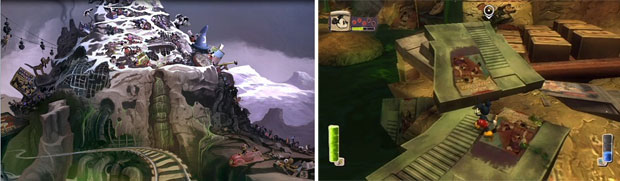
This mountain was used by Oswald to hide away the Mickey merchandising and keep the other citizens of the Wasteland slightly clueless about the mouse. Oswald did not want them to see how famous Mickey had become so he hid away as many products bearing the icon as he could. Not that it mattered because most everybody in the game knew who Mickey was and was delighted to meet him.

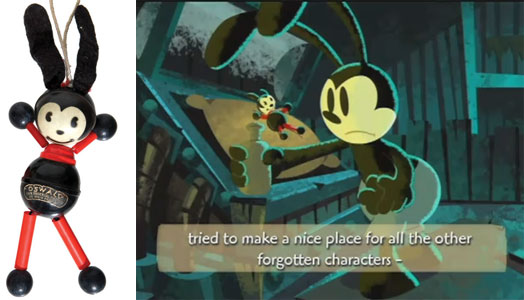
This bit of pettiness on the part of Oswald was tempered by the knowledge that he had been completely forgotten by the outside world. At the core of the mountain was Oswald’s lair. Inside he kept a solitary prized possession within a cabinet. Oswald took it out in a cut scene and polished the figure before putting it back. That small toy bearing his name was the only clue of the popularity that he had before Mickey came along. It was a tiny reminder of the Disney legacy that had been forgotten. Oswald’s purpose was in trying to keep the Wasteland going for the other forgotten characters and for himself to hold onto any memories he had left of the "good old days." Again, whether critics made the connection between Mickey Junk Mountain and the core made up of a single Oswald figure was something to be considered.
Other pieces of concept art made it into the game very much intact. Gamers might have paid more attention if the critics had bothered to find the connections between concept art and finished game design. Lonesome Manor in concept and the game were as complimentary as could be expected when converting 2d paintings into 3D models. The colors and overall shape of the model were very closely mirrored.

Another thing to consider was the preconceptions that gamers had about the Disney characters. This was the challenge of nostalgia versus expectations. Did critics ignore the gameplay just so they could complain about the lack of fanservice in the title? Where would these critics even assume that the only way a Disney game could work was through fanservice?

Kingdom Hearts may done wonders for the Disney name in gaming circles, however that popularity came at a price. Characters were dressed up in the costumes of the films the game was crossing into. It was original when the cast dressed up in (non-canon) Tron costumes, or in the black-and-white hues of the Steamboat Willie. Yet these visuals were done mainly for the sake of fanservice, appeasing fans by using cameos and crossover reference material as visual distractions. They supplemented the lack of actual gameplay by providing hefty doses of nostalgia. These nods to fan-favorite Disney films did nothing for the play mechanic. They were used solely for the sake of pushing along a plot.
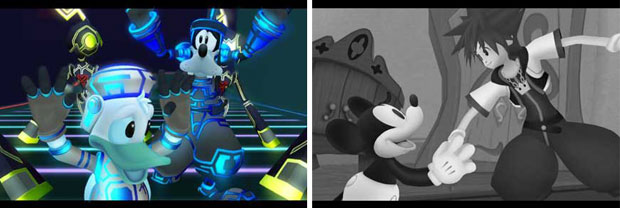
I challenge the harshest critics to review Epic Mickey on the gameplay elements rather than fanservice preconceptions. Rating down the game because Mickey was not in a particular costume did nothing to point out the actual failings of the game. Complaints about a certain detail from a concept piece did not make the character relevant. It did not answer the challenge laid out to Warren Spector and Junction Point. Mickey had to be presented as a personable character with a sincere story yet wrapped into an original gameplay experience. The best games after all should be played and not watched. Epic Mickey was a title that required intense audience participation. Unless a costume change was relevant to gameplay then it wouldn’t be in the game. The mouse did not change costumes or identities in Epic Mickey. He did not don a Tron, Pirate or Ghost costume in any portion of the title, yet that was not to say that those elements crucial to the Disney name were not featured. Epic Mickey presented fantastic battles in familiar, yet distorted locations, with nods to the park and film legacies.
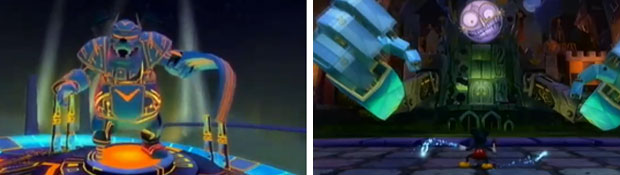
Whether it was fighting a gigantic Petetronic, part Pete and part Sark from Tron, above Space Mountain, or a possessed mechanical clock from it's a small world Epic Mickey maintained tons of originality and diversity to surprise even the most jaded gamers and visitors of the parks. Somehow these encounters and designs were glossed over by critics. Possibly because they not only supported but surpassed the concept designs.
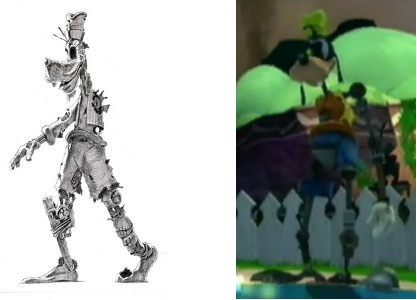
Other concept pieces showed macabre, mechanical versions of Mickey's friends. These disjointed and unfinished "animatronics" did make their way into the game. Goofy, for example, did only have one arm and was missing his large cartoon eyes, only a small green camera served as his vision. Did critics bring attention to these odd creatures? Did they acknowledge that the concept art and finished pieces were not far from each other? Or that Junction Point managed to capture the essence of the actual character even with unfinished robotics? How mickey interacted with the characters and helped solve their problems shaped the direction of the story.

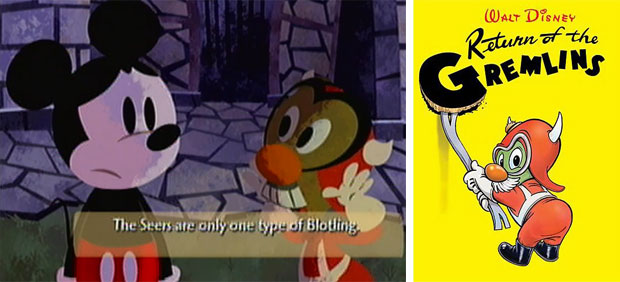
Mickey was given the ability to navigate the world in 2-dimension stages that gave a nod to the classic films and games that inspired the legacy. Those that did not grow up with the 8 and 16-bit titles got a sense as to how they used to play in the projector levels. The game served as an introduction to the original Disney animated shorts for an entirely new generation of gamers. Characters that had long been forgotten, like Oswald, got a chance to be reintroduced to audiences. Other forgotten characters, like Gus the Gremlin, were brought back in honor of the legacies that never got fully realized. When Mary Blair and co-designer Bill Justice were working on adapting the Gremlins from creator Roald Dahl’s (Charlie and the Chocolate Factory) stories, they never got to see an animated project take flight. Decades later Mr. Justice, suffering from Alzheimer’s disease, could not remember bringing the Gremlins to life or enjoy their part in Epic Mickey. Warren Spector was honoring his legacy as well as the other Imagineers that had left their mark on the company, some still with us and some that had passed on.
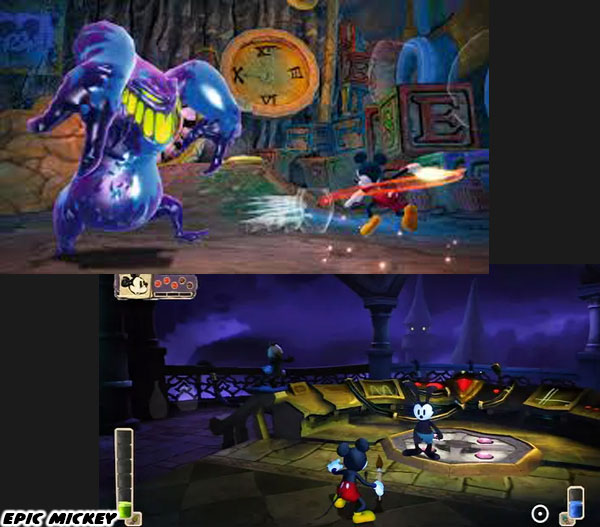
Players would be challenged working with the paint and thinner mechanic in 3D. This was the gameplay element that was actually bringing Mickey out of the 2D legacy and into a 3D gaming environment. Players could see how exploiting each mechanic made for a different experience. Gamers were given the option to assist or ignore the world that Mickey ruined. The outcome was the same; Mickey would escape the Wasteland, but the choices he made in doing so changed the way those left behind treated each other and how the world ultimately looked. These were the things highlighted in the series of clips played at the end of the game. Players could get all good, bad or mixed endings depending on the choices they made.
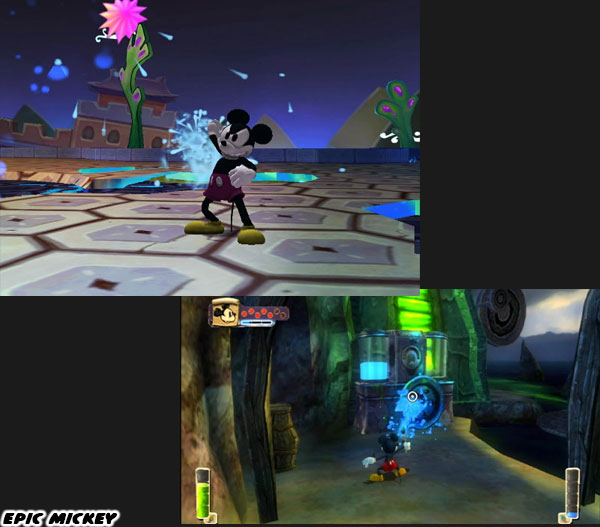
The harshest criticism and the biggest failing for Epic Mickey would probably have been the camera. There were a few places in the game where the camera made navigating platforms or aiming paint and thinner a chore. The camera forced a certain perspective on many outdoor environments and set a fixed side POV during the projector levels. In many instances the camera tried to focus the attention of the gamer in a certain direction. These were "look here" moments, a design cue used in many games by different directors. In shooting games there were set pieces, buildings exploding or planes crashing to draw the attention of the gamer, in an adventure title the player got a sense of scale when the camera panned back and then zoomed into the action. Some of these forced angles broke the illusion that the developers had worked hard to create, it was true of some portion of Epic Mickey, yet true of other adventure games including God of War or Shadow of the Colossus. Yet as bad as the camera was, it was not completely broken and it didn't break the game or experience. A press of the "C" button reset the camera position in all but a few locations. Those that complained most vocally about the camera problems should have mentioned that pressing a single button would have resolved many of the issues. Epic Mickey had gotten an unfair amount of negative criticism and bad word of mouth. These things have all but crippled sales in Europe. It would be a shame to see gamers not giving this title the benefit of the doubt because of bad reviews or harried reviewers. The game deserved far more attention than it has gotten and certainly second-look from the most biased critics.
The Disney name had been more of a miss than hit among gaming circles. It would be understandable if they released another flop and review scores were warranted. Yet as far back as the 8-bit era there have been titles like DuckTales to show that Disney could be synonymous with fun and original adventure gaming. It had been through the work of Capcom, which translated Disney Afternoon and movie franchises into titles. It was through Sega, that brought originality into the 16-bit generation with the Castle and World of Illusion. It was through Eurocom that created the last great 16-bit gems Maui Mallard and Mickey Mania, which acknowledged a love for the classic characters through superb animation while allowing changing tastes to influence game, character and level design. It was through UbiSoft that Disney first gained prominence in 3D with Goin' Quackers and PK: Out of the Shadows. It was through Konami that Disney learned that their characters could be icons in different genres with Disney Sports Soccer. And last it was through Square-Enix that Disney found success connecting classic characters to current gamers with Kingdom Hearts.
Epic Mickey was far more than the sum of its parts. It represented the culmination of almost 20 years of Disney videogame history, 55 years of theme park history and almost 90 years of animation and comic strip history. It represented a fundamental shift in the way Disney would be approaching their library of characters and how they would communicate with audiences. Animation was the legacy the company began but gaming was the medium that they could use to reconnect with fans. Epic Mickey was also more than a love letter to the characters or the parks. It captured the spirit of the mouse the same way that Steamboat Willie did generations ago. It expanded on the classic theme and allowed audiences to understand the character and give him a broader range of personality. This would not have been possible without advances in gaming technology, no movie or linear story could have done the adventure justice. No videogame saturated with fanservice would have been able to convey the same elements. Epic Mickey would not have been possible without an exceptional level of storytelling and guidance from a producer that was passionate about the source material. The plot was sublime, the characterizations impeccable, with generations of figures brought back from obscurity and made new to audiences. Some of the gameplay mechanics harkened back to the classic side-scrolling adventures while mixing them with build or destroy environmental abilities in 3D.
Epic Mickey was a fine game and a fun experience. It was an honest contender for game of the year in 2010. Unfortunately sales determine if Disney will continue to put this much effort into future titles. It is entirely possible that Disney will return to cheaply produced licensed titles thanks to the negative reviews on Epic Mickey. Gamers can go back to expecting little from the House of Mouse and be pleasantly surprised the next time a DuckTales or Castle of Illusion experience comes up (usually once every decade). Despite the massive ad campaign the gaming press will more likely be the determining factor for sales. They could disavow any responsibility for their overly-harsh reviews and back up critics as a matter of editorial integrity. If these critics failed to rate Epic Mickey on how much it actually accomplished, on how well it was made or how original the concept was then shame on them. If they failed to give the game a serious look and really take the title apart and review it without any preconceptions then the review scores are moot. Readers of this blog can play and tell me if it felt like an average-at-best experience or something more profound. I contend that it lived up to the epic title.

As always if you enjoyed this blog, and would like to sponsor me please visit my Patreon page and consider donating each month, even as little as $1 would help make better blogs and even podcasts!
follow the Street Writer on Patreon!

Monday, October 6, 2025

Epic Review, Part 3 - A 1UP Classic from Dec. 22, 2010

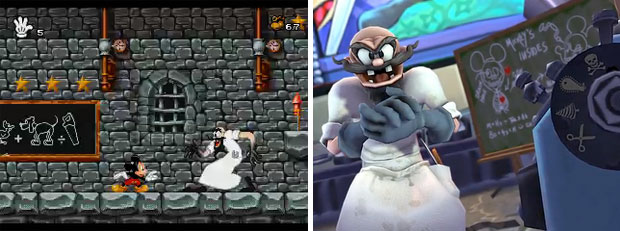
Yesterday I asked if Epic Mickey was the new Castle of Illusion or the new Magical Mirror? It Epic Mickey was to be compared to any game before it, then it would most accurately be described as the new Mickey Mania. It was a love letter to the character, the films and the legacy that made the mouse an international star. The early news described the main villain as one that had appeared once before in 1933. What most gaming sites and magazines failed to mention was that the Mad Doctor, level and all, had appeared in 1994's Mickey Mania as well. Right from the get-go it seemed as if gamers and the press had already begun forming their own opinions on the game before it was even finalized. Epic Mickey would be compartmentalized by the gaming press and handed down reviews based on concept art and ideology rather than content and design. This blog will try to unravel the details, mechanics and design that went into the game and explore the reasons why it was received with criticism by many media outlets.

As with most reviews we should talk about the story of Epic Mickey. This game was a character driven experience. It was not solely about Mickey, but by every character that he came across through the course of the opening cinema and the levels themselves. In order to make the story connect with gamers the character of Mickey Mouse had to be presented as a complex and flawed character. All of the cues that Warren Spector and the people at Junction Point used were from the Mickey films themselves. The earliest movies featured a character that was equal parts fun and feisty, not always friendly. His curiosity would get him into all sorts of adventures, some dangerous but most lighthearted.

Junction Point made sure to animate a version of the mouse that looked far more retro-inspired, more two-dimensional like a comic-strip character, than the 3D models featured in Kingdom Hearts or the DSN sport games. Junction Point even managed to keep Mickey’s ears in a constant 2D perspective like in the comic books, even when he turned his head. This helped take the mouse back to the elements that made him a hit. This look allowed Spector to show rather than tell audiences why early Mickey was an important character to animation and pop culture. He could be cheeky and selfish when he wanted to and did not always rely on his friends to round out his personality. In the early films Mickey conveyed many of the same qualities that Donald, Goofy and Pluto got credit for. He had a temper, a silly side and a sincere loyalty. The mannerisms, curiosity and fight of Epic Mickey were in stark contrast to the way the mouse was presented in Kingdom Hearts.

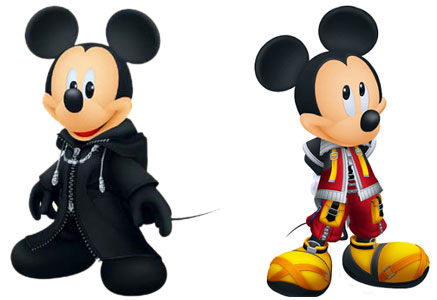
Square-Enix presented Mickey in the format that most audiences are familiar with. Perpetually a hero and always noble of heart, Mickey Mouse was everyone's friend. The difference was that KH gave him a fancy wardrobe with lots of zippers.

Unfortunately the version of "King Mickey" was also bland and uninspired. A character that was more saint than hero. Like many Disney characters that appeared in KH Mickey was added to help push a convoluted plot along. A hero that was perfect could not tell a story, there would be no dramatic expression they could convey, or genuine sense of loss or even joy. From a design standpoint a perfect Mickey could only exist as a deus ex machina, appearing at the end of an adventure to pull a character out of danger and then disappearing. The best characters, heroes and villains alike have traditionally had a flaw. Perhaps gamers never wondered why the main character in Kingdom Hearts, Sora, came from a broken home. It made for a more sympathetic character and one which was more complex than what gamers gives credit to.

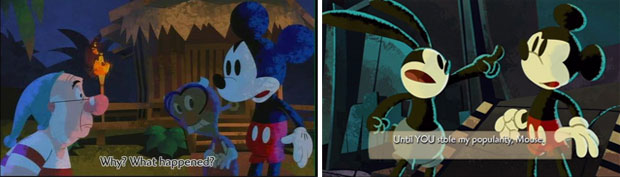
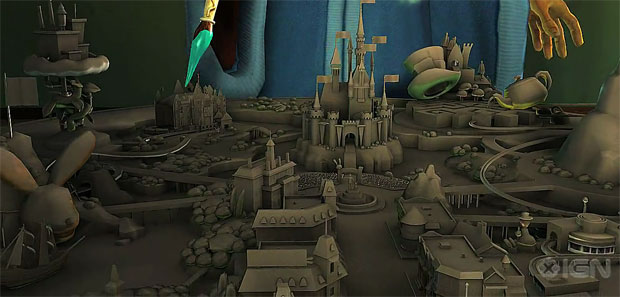
The mouse in Epic Mickey was anything but perfect. He was far more relatable to audiences because he didn't have all the answers to the story. He got caught up in a mistake he had made and forced gamers to help write the path out of his dilemma. The premise was simple; Mickey Mouse had gotten into the sorcerer Yensid's workshop and ended up spilling magic paint and thinner on a model city, a place for forgotten cartoon characters. The paint ended up creating an animated ink blot that Mickey tried to erase away. This mistake would grow and grow, eventually becoming the Phantom Blot, a villain that harassed Mickey in the old comic adventures. Mickey ran away from the scene when he heard Yensid returning. Yensid served as the narrator of the game. He was also featured in the film Fantasia for what was considered to be Mickey Mouse’s greatest role as the Sorcerer’s Apprentice.

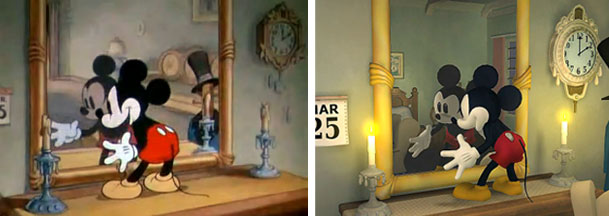
As the story goes years later Mickey Mouse grew in fame and popularity and completely forgot what he had done to the model city and the citizen therein. The Phantom Blot appeared from behind a magic mirror to pull Mickey into the "Wasteland" and trap him there. Gamers were dropped into the middle of the action. Mickey was strapped to an operating table by the Mad Doctor with a giant machine trying to pull the heart from him. Gamers immediately had to find out where they were and try to find a way out. The first thing was to get away from the giant machine by navigating a dark and twisted castle. Junction Point introduced a character to guide players, act as a traveling companion to Mickey and also serve as a moral compass. By extension he was also a moral compass to the game players, suggesting course of action that would be constructive or destructive.

Gus the Gremlin, from the lost Gremlin project would be the first of many lost characters that were brought back from the Disney archives specifically for the game. Gus served to teach players how to use paint and thinner from a magic paint brush and other game mechanics. The other characters introduced, like Horace Horsecollar and Clarabelle Cow, helped pull the gamers through the world and introduce layers of detail pulled from decades of Disney lore. These supporting characters created branching missions that ran parallel with the main plot of returning Mickey home. Each of these side quests could be explored or ignored, the choices of which would influence the ending movies in the game.

The in-game characters were all modeled in 3D, retro-inspired and cartoonish. Most were in black and white and maintained a familiar squash and stretch format of early animation. They harkened back to the time when Disney was growing by leaps and bounds and new characters were being introduced to the universe on a weekly basis. Sadly Mickey did not recognize most of his early colleagues when he met them. The lynchpin of these forgotten characters, the one that came before all of the others, and even before Mickey himself was Oswald the Lucky Rabbit. Oswald was very jealous of Mickey’s success which he believes should have been his own. The true heart of the game would revolve around Mickey trying to make amends with Oswald. To atone for the thinner accident and try to undo the damage he had caused.

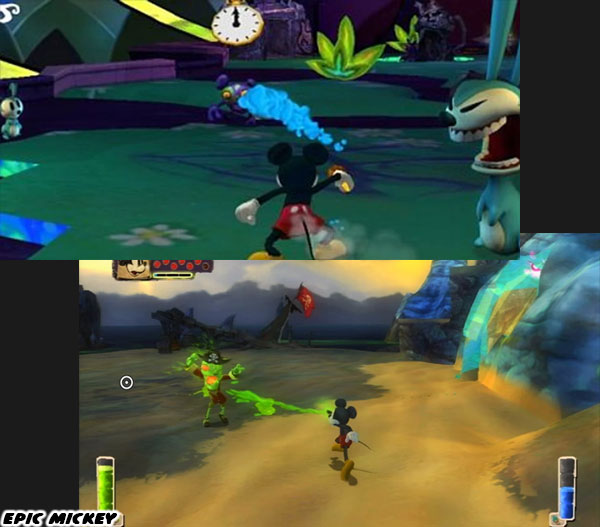
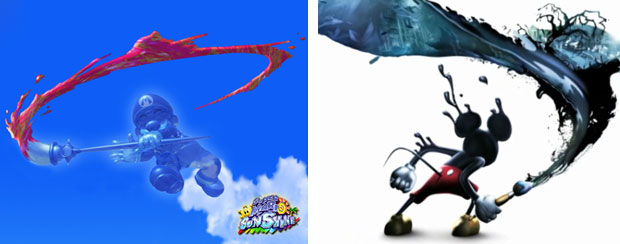
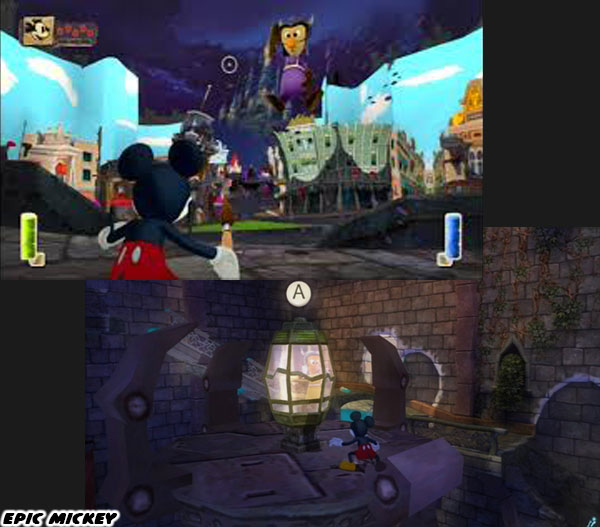
The cinema versions of these characters appeared as if they were illustrations from a children's book brought to life. They were animated superbly by Powerhouse Animation Studios Inc. the style of which helped bridge the Disney Comic and Animation traditions with those of its newer videogame one. The mechanics of using paint and thinner served as the focus of the gameplay elements. The paths and ending of the game changed depending on how gamers used paint or thinner to solve puzzles and defeat opponents. The more paint thinner gamers used to solve problems the more Mickey would drip floating ink and have his face blur, similar to the Phantom blot. Using a paintbrush kept Mickey in a mostly solid state. Thinner could be used to knock down the environment, make walls disappear and dissolve opponents. The mechanic of fixing or destroying the environment was first made popular in Super Mario Sunshine. The paint and thinner mechanic worked very much in the same way that Mario's water canon cleaned up Isle Delfino.

The levels and themes that made up the wasteland took full advantage of the play mechanics. It was the amount of detail that Junction Point put into the game that set it leagues apart from every other Disney game to-date. The world that Epic Mickey takes place in is the model for forgotten characters. We are constantly reminded that the world is an illusion by seeing false walls, painted alleyways and closed-off sections. Gamer might think that the model was based on the original Disneyland. They would only be partially right.

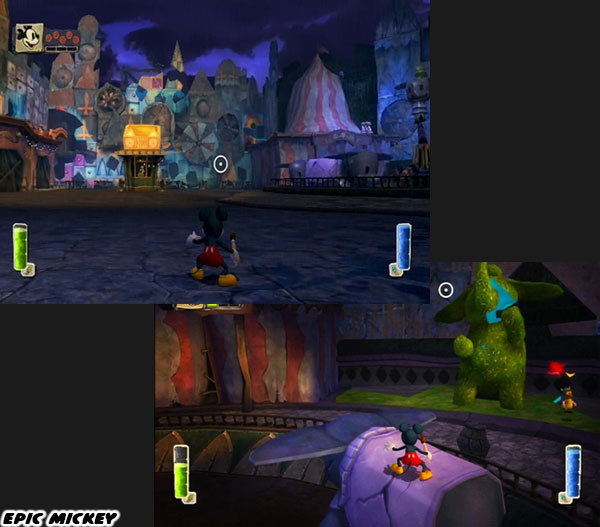
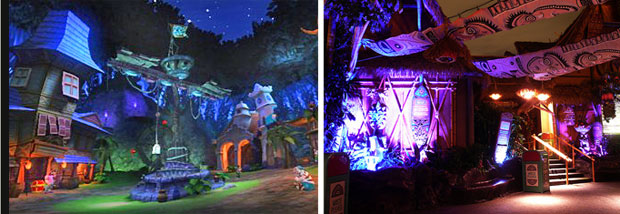
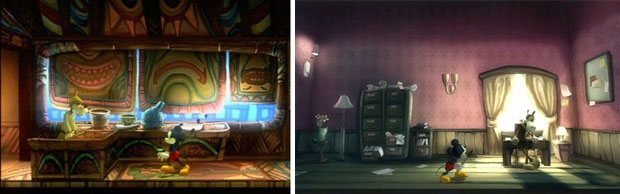
Each major level was broken into two basic components, a staging area, which introduced gamers to the theme of the level and the adventure stage itself which could be compared to one, or a combination of several, major rides in the actual parks. For example Bog Easy was the New Orleans type theme area with Lonesome Manor being the main attraction. In Disneyland that would be akin to Orleans Square being the home for the Haunted Mansion. Junction Point took many cues from the theme areas of the parks, including the rides, and amalgamated them into the stages. The tiki look, complimentary colors lush greenery and tropical atmosphere from Ventureland was inspired heavily from the Enchanted Tiki Room.

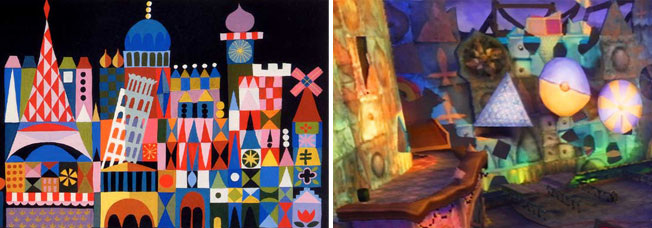
The kaleidoscope of color and patterns that made up Gremlin Village was undoubtedly based on “it’s a small world” featured in Fantasyland.

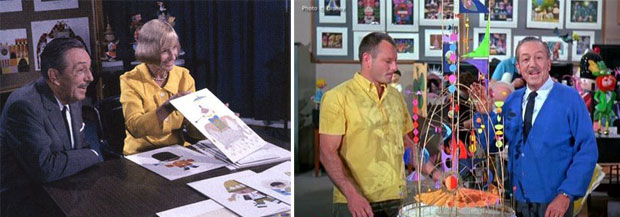
While Walt Disney gets credit for the parks, it was anything but a one man project. His best artists and designers, creators like Roland “Rolly” Crump and Mary Blair, moved from the animation studio to Disney’s World’s Fair projects (precursor to a lot of Disneyland tech) and became some of the most influential “Imagineers.” Their fingerprints are all over the parks, and by extension, all over Epic Mickey.

It was many of Crump’s designs which lent themselves perfectly to the look of Ventureland. Mary Blair was a genius of color and design, whe created the inspiration for it’s a small world. The design of Tortuga, Skull Island and the Jolly Roger preserved many of the elements from her original art for Peter Pan as well.

These cues were taken in a different direction by Junction Point and distorted into twisted relics of the designs and parks that Walt had envisioned. The thinner accident stripped away the wholesome elements of the parks and left gamers with a barren version of the areas.

The amount of work and detail that went into the levels was redoubled for the interior shots of several buildings. Junction Point exploited a lesson from classic cartooning here. There were no straight lines, no fixed angles in a cartoon world. Cabinets were rounded, edges kept soft and perspective a matter of layout rather than 3D modeling. The end result was yet another layer of detail that the studios could be proud of and gamers could explore again and again.

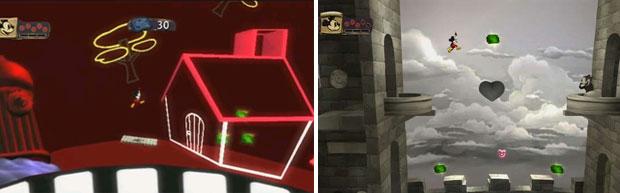
Each of these parks were connected via movie projectors. This gaming element was written in as a way for Mickey to cross the oceans of thinner separating the parks. He could jump into a classic cartoon playing on a projector screen and navigate to the next area. The cartoon levels were presented in a side-view-format, very much like all the early 2D Disney games. The stages preserved the music, characters and even visual style of the individual films. Players could collect movie reels and unlock bonus material in each of these levels.

Older gamers were reminded of the good times they had with Castle of Illusion or Mickey Mania. New gamers got a taste of how the good early Mouse games played in each of these film levels. Characters from the classic films turned up in many of the levels of those early titles and they were faithfully reproduced in 3D for modern audiences as well.

Navigating the Wasteland was not without its own perils. Using the paintbrush or thinner Mickey could either befriend or fight the inky monsters that answered to the Phantom Blot. Mickey could use a spin attack to knock back opponents or trigger level action with a shake of the Wiimote. He could also be assisted by pixie-like sparks that acted as paint or thinner guardians of the world. Junction Point's original minions called "Blotlings" were ink-based monsters, rough and unshapely. They helped balance out the polished cartoon citizens of the wasteland. These monsters also reinforced the story that Mickey's mistake caused not only the world to become misshapen but also the creatures that inhabited it.

The criticism behind the game was twofold, one was tangible, gamers and critics alike found fault with the camera, the other major complaint was more subjective, that Epic Mickey somehow did not live up to the concept. We shall explore these things tomorrow in the final part of this review.

As always if you enjoyed this blog, and would like to sponsor me please visit my Patreon page and consider donating each month, even as little as $1 would help make better blogs and even podcasts!
follow the Street Writer on Patreon!