Showing posts with label dreamcast. Show all posts

Monday, March 5, 2018

The Giant Monster Series, part 13...


Godzilla is widely considered the king of all monsters. There were giant monster movies before Godzilla (1954) and of course hundreds after. But for many reasons we keep circling back to the atomic-fire breathing lizard. Part of the reason was because there was nothing like the monster. No force on Earth could stop it and even the most powerful military weapons of man could barely slow it down. You would think that a character this popular would be the perfect subject for a game. The hard part was figuring out what type of game could developers make around the character? Would it be a real-time strategy game where you line up the military forces and try to divert Godzilla away from a city? Or would it be an exploration adventure where you took on the role of a civilian trying to survive an attack? Of course most audiences wanted to be Godzilla and feel what it was like to have that type of power.

Godzilla Monster of Monsters for the Nintendo Entertainment System (NES) put gamers in charge of the title character. The title from 1988 was well received by fans. Just about every monster that had ever appeared in a Toho movie was featured in the game. Players took on the role of either Godzilla or Mothera as they fought wave after wave of aliens and other giant monsters en route to Planet X, the home of King Ghidorah. The game featured very large sprites with unique level visuals. If it had one failing it was that audiences couldn't appreciate the scale of the character as it was as big as human characters from other console games.
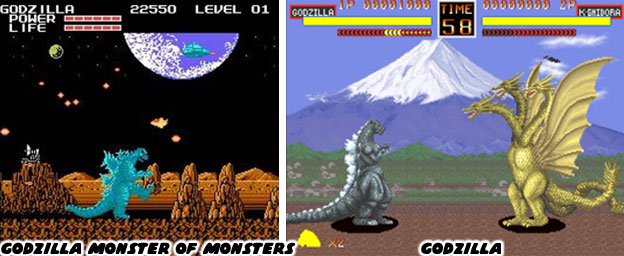

Godzilla console titles had limited game play. Most designers just followed the trends and put Godzilla in whatever was popular at the time. In the '80s many NES games were platformers, vs. Mario Bros, Bionic Commando, Rygar, Castlevania, etc. all had a character move left to right on screen and fight various bosses. As fighting games became more popular in the early '90s the Godzilla games evolved to follow suit. In the Super Famicom (Super Nintendo) versions of Godzilla: Battle Legends (1993), Super Godzilla (1993), and Godzilla: Monster War (1994) the game play was changed so that monster encounters played more like a modern fighting game. As fun as these games were they didn't really capture what it meant to play as the monster.

All of that changed in 1998 with the release of Godzilla Generations for the Sega Dreamcast. For the first time in a generation the awesome power of the monster was presented in 3D. The game revolved around Godzilla or one of a handful of monsters (including the abysmal USA Godzilla) destroying a city. Players could walk through skyscrapers, watch them break apart and come tumbling down. They could blow up refineries and even fight the G-Force military special units. There was little to the game play aside from destruction. It was a throw-back to the Epyx game Movie Monsters. For a little kid this was more than enough to make them happy but long-time players expected much more of an experience.
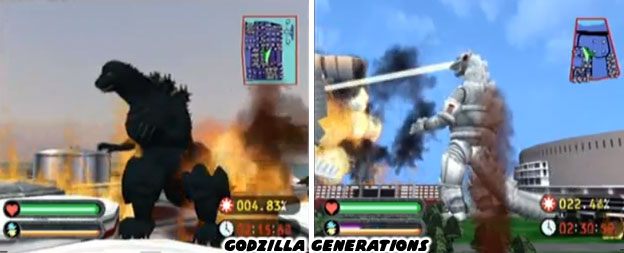

Godzilla Generations was the perfect example of why the character never became a gaming icon. It was difficult to make an enjoyable experience out of a creature that was famous for moving slowly, smashing cities and fighting other monsters. It didn't stop developers on both sides of the Pacific from trying to create a hit game with the license. We will explore these better attempts in the next blog. I hope to see you back for that.
Monday, February 12, 2018

The Giant Monster Series, part 4...


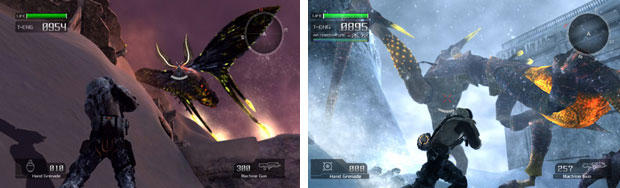
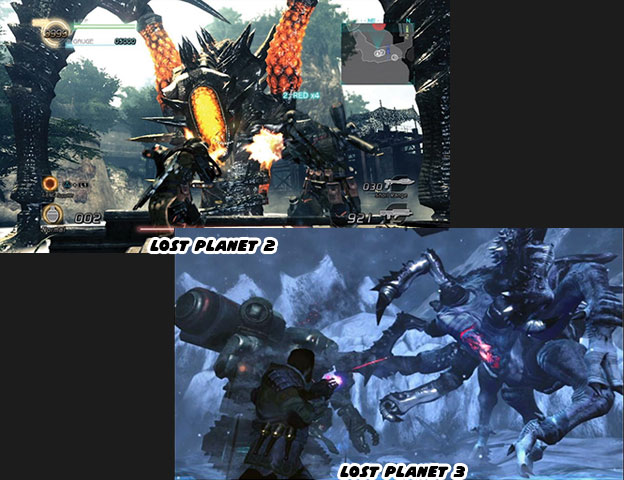
Capcom was creating memorable games featuring gigantic characters before the release of Asura's Wrath. As hardware got more powerful the developers were able to maximize the size and scale of opponents in their titles. Fans of science fiction shooters were sent to remote outposts in the series Lost Planet (2006). Players would come across alien lifeforms capable of swallowing entire trains whole. This was a departure from even the largest opponents in the Resident Evil series. The creatures in Lost Planet could easily snack on El Gigante and the Lake Monster from Resident Evil 4 (2005).


The Lost Planet series introduced many unique monsters to the genre with most of them being gigantic. To help immerse players in the experience the developers placed gamers in remote outposts on extreme climate planets. In the first Lost Planet players fought through the frozen wasteland of E.D.N. III. The harsh environment helped create an isolated feeling for the heroes. Something akin to the John Carpenter movie The Thing (1982). The limited visibility in a blizzard made it possible to have opponents appear out of nowhere and surprise the players. It made the encounters with giant aliens have much more of an impact. In the sequel the frozen wasteland gave way to jungles and desert environments, each of which could be extreme climates as well. The developers incorporated unique game play elements to allow players to navigate the environments and fight the monsters. Wading through the snow would have slowed down the game play tremendously but characters had grappling hooks which allowed them to jump over large patches of land.

Players were also equipped with machine guns that could mow down man and creature alike, and could pick up various types of explosive launchers. In addition to heavy weapons, players could control mechanized suits of armor and even large robots to combat the creatures. The most unique game play elements were based around the monsters themselves. The enormous Salamander was the size of a football field and players could actually get swallowed whole by the creature. Rather than die if eaten, as was the case for most other games, players could continue fighting the creature from within its digestive tract. It was a gross visual but something completely unique to the genre. Lost Planet was not the series that made Capcom a player in the giant monster genre.


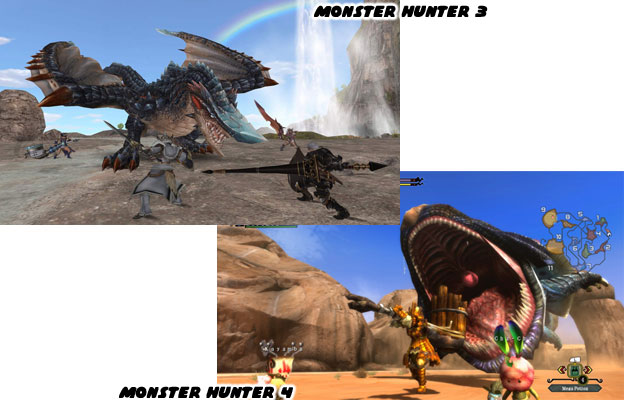
Monster Hunter, released in 2004, was one of Japan's all-time best selling titles. It had appeared on multiple platforms and introduced many an MMO player to real-time action combat. This was opposed to traditional MMO games which required gamers to point and click at their targets and let pre-rendered animations show whether or not they were hitting an opponent. In real-time combat players had to move, dodge and trap monsters just as they would have in an action game. The only difference being that the world was persistent and they could join thousands of other players online at any hour of the day. Like Lost Planet it too introduced unique elements to gamers. There were extreme changes in terrain, day and night and even weather effects to help immerse the players in the fantasy world. The creatures themselves were some of the largest ever created for an MMO or action title. They were a cross between mythological dragons and realistic dinosaurs. Each creature required a plan to defeat. Players could not go in swinging their weapon wildly and hope to take down the largest opponents. Gamers had to learn how to set traps ahead of time, lure monsters, how to regain health and recover from poison if bit. Even specific weapons and armor did more or less damage depending on the creature being fought. Cooperation was the most important element when dealing with the largest creatures but even the mid-sized monsters required a certain level of expertise.


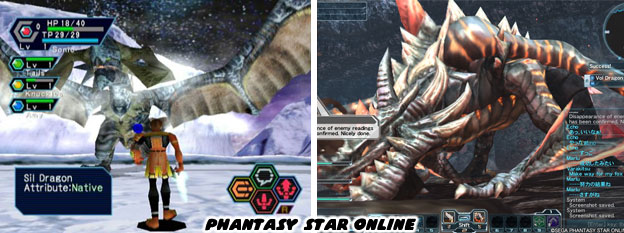
The Monster Hunter universe was set in a fantasy setting unlike the science fiction future of Lost Planet. The weapons in monster hunter had a limited range and were made from enchanted metals or the bones of defeated creatures. This type of game play appealed to different audiences than Lost Planet but that was not to say it could not work for a science fiction MMO. Sega had released an MMO based on their futuristic Phantasy Star Universe some years prior. Phantasy Star Online, released in 2000, had different classes of warriors with science fiction weapons and allowed players to explore regions of an alien planet in solo or group missions. The gameplay of PSO was closer to Monster Hunter than Lost Planet. Even though the characters had Star Wars-like weapons they had limited range so players were forced to get up close to the action for most of the battles. Some players referred to the gameplay as "hack and slash" like the medieval fantasy games.

PSO was originally released on the Sega Dreamcast. Despite the hardware limitations compared to the current consoles, the graphics were well rendered and several of the monsters were titanic in scale. The game eventually found its way to multiple platforms. The character classes and opponents becoming more imaginative as the series continued. The Phantasy Star Online and Phantasy Star Universe servers closed down in 2007 and 2012 respectively however PSO 2 began open beta in 2012 and would be released in 2013 around the world. Players were eager to see the increased scale of the alien monsters based on the new hardware that Sega was developing for.


Making a fun and memorable giant monster game took a lot more work than presenting enormous creatures on screen. Like Godzilla and King Kong, the best titles drew audiences into their world. Mass Effect, Resistance, Lost Planet and Monster Hunter all adhered to very specific themes. Players could talk about their favorite levels, locations and visuals from the worlds presented in those games. The studios did a great job placing players in unique worlds but there was much more to learn from cinema. The best films created an atmosphere by layering details that made the giant monsters even more terrifying. The sights of mass destruction, uselessness of conventional weapons and the sounds of people screaming in terror allowed audiences to suspend their disbelief and tap into their primal fear whenever the giant monster appeared on screen. The games mentioned thus far were very well made, however they did not always elicit the same emotional response from the great movie titles. We shall explore a couple of games that did in the next blog.