Showing posts with label outrunners. Show all posts

Friday, December 8, 2023

The racing fan that started a revolution - A 1UP classic from February 22, 2013

Sega has been featured many times on this blog for the various racing games they created. The company actually got into the arcade market before the video screens were integrated into the cabinets. In the early days of the arcade the electronic machines had mechanized components and moving parts, these were known as electro mechanical games. One of their first arcade racing hits was Moto Champ. The title from 1973 featured scale motorcycles on an illuminated track. The opponents moved via magnets under the game screen while the player controlled their own bike via a wire frame attached to some handlebars.

The mechanical games gave way to full video screens not long after. Developers that did not change with the times were forced to shut down. Sega would quickly change from mechanical to digital entertainment. Their first breakout racing game was Monaco Grand Prix in 1980. The game was set with a top down perspective, similar to what Atari had done in their Sprint racing games. It was memorable for the use of color as well as day and night transitions. Racers could only see the portion of the track illuminated by the car headlights, making for some very harrowing action. The game was difficult but rewarding. A year later they created a game that was featured in the film Wreck-it-Ralph. Sega Turbo from 1981 did not actually feature a racer named Turbo, nor did it involve any plot but it did set the template that would make the company famous. The game used a behind the racer POV and followed players through road courses, rewarding them with points as players passed opponents. The game was one of the first to use scaling sprites to create the effect that players were racing bast buildings and countrysides. A few years later Sega used that same technique on more powerful hardware. They created a new legacy with the 1986 game OutRun.
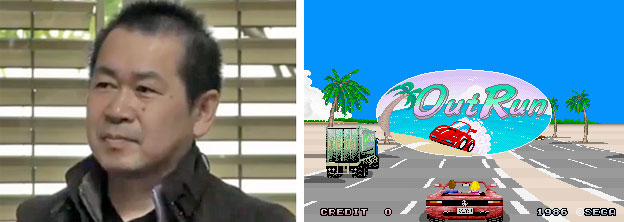
The brains behind the game was Yu Suzuki, the head of Sega's R&D unit AM2. His studio would develop an amazing streak of hits. The games could be seen as a celebration of his love of cars, especially the Ferrari. Suzuki, like so many other Japanese men grew up idolizing the racing cars from the West. They were celebrated on film and television, car enthusiast magazines sprung up and gave a nation cause to debate and discuss the ultimate driving machines. The auto industry in Japan had to increase their pace to help the nation recover from World War II. In order to do that the manufacturers had to try and replicate the things that made the Western companies successful and then improve upon them. They looked at the daily drivers from Europe and the USA and found ways to make small, economical cars for young families. They studied British and German sports cars and began developing contemporary models all their own. Both the family sedan and sports cars would be made more appealing if they could be made domestically and cost less than an import. To help raise their profile the large manufacturers began investing in racing R&D. Toyota formally entered professional motor sports in 1957 but it was Datsun (later renamed Nissan) that got the ball rolling in 1936. Other companies, including Mazda got noticed by building light but powerful engines. The companies began to change the local and international perception of Japanese made autos.

Mr. Suzuki's formative years were during the transition of Japan's auto industry from domestic to international powerhouse. He was around to read about the most innovative racers from Italy, Germany and Britain as they visited the Suzuka Racetrack during the Formula-1 season. He was able to see how well Japan was at recreating the sports cars and duplicating the success of the legendary designs and designers. Take Todd Green's racing Datsun for example. His VQ 35 Datsun roadster was originally created by the Japanese to be a less expensive answer to the Porsche racers. Mr. Green pushed the capabilities of the car and even design to challenge the legendary British AC Cobra.
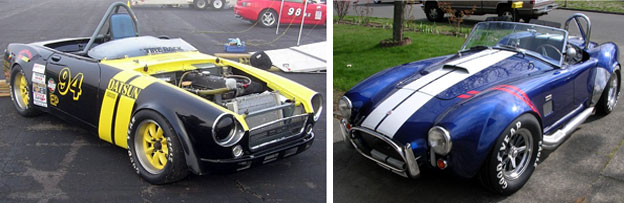
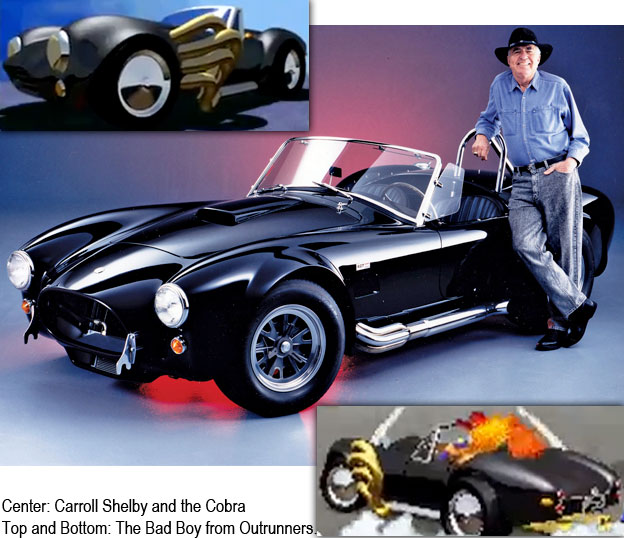
The Cobra was considered one of the ultimate sport cars. Texan Carroll Shelby (RIP) shoehorned a Ford racing engine into the light frame. The power-to-weight ratio that Shelby had unlocked in the Cobra and later Ford GT-40 went on to capture numerous racing victories and set plenty of speed records. The renamed Shelby Cobra was the envy of car fans around the world. Its styling and bold curves were copied numerous times. The Japanese did not have the Hot Rod revolution that changed car culture in US through the 50's and 60's, they however earn their own driving legacy. The Datsun VQ 35 was joined by the more famous Fairlady Z as cars that would shape post-war Japanese youths and turn them into car fans. Mr. Suzuki and the young designers at Sega were not immune to what car culture was doing to the nation. When Suzuki started he almost instantly began developing a legacy of racing games. OutRun was his most famous contribution but his team never stopped pushing the genre. A spiritual successor to OutRun appeared in 1993. Outrunners was actually developed by sister team AM1 and not by Suzuki. It featured a whole new slew of cars in addition to the trademark Ferrari Testarosa from the original game. The Bad Boy was added to give the Italian car a run for its money. Those that knew of Shelby recognized the inspiration behind the car. The blonde driver wearing a cowboy hat was a clever nod to the Texan.
AM2 did not always focus on realistic racing games, one of their most memorable entries, Power Drift was based on the silliness of go-cart racing. Another, Rad Mobile, demonstrated that storytelling elements could be incorporated through the race itself. The game had players driving in the dark and through the rain in a first person perspective, they actually had to turn on the windshield wipers and lights in order to see the track! The publisher had evolved quickly from the old electro mechanical cabinets they used to make. In fact they began pushing the technology for digital developers. They were among the first to move games away from 2D sprite based graphics to 3D polygons. You can learn how Sega Rally and Virtua Racing changed the genre on my older blogs. The studio had a unique take on the great American pastime of stock car racing with Daytona USA. By the time Super GT was released it could be considered the peak of Yu Suzuki's legacy.
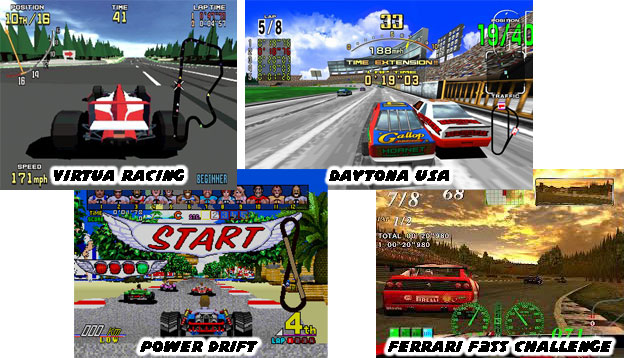
Yu had created a template that defined the arcade racer. The cars were always bright and colorful, they seemed to glide over the road and could be nuanced by drivers into impossibly fast power slides. The control for the majority of the Suzuki-produced racers was nuanced. It was the result of years and years of refinement to bridge the gap from realistic driving to stunt racing. Those that had played through the majority of the games knew that they could be difficult but rewarding as well. The road rockets raced on tracks that would be the envy of the Disney Imagineers. Nothing would have killed a Suzuki racer more than strict realism, his games were gorgeous spectacles. In fact if more tracks in the real world looked liked the ones featured in the Sega racers then there certainly would be no shortage of supporters. The level design of each track had more in common with theme park design and urban planning than driver safety. In some levels towering spires of crystal and steel were the eye-candy off in the distance while roller coasters wound around the track itself. As former 1UP boss guy John Davidson said the races in the Sega games took place on the most utopian day ever. The cities that hosted the races were more breathtaking than any real world city and set a standard that would be hard to top.

The goal of one recent Kickstarter campaign has been to recreate the feel of the Suzuki-produced gems for modern PC gamers. I think that the '90s Arcade Racer did the job well.

The Japanese contributions to the auto industry could not be disputed. From the daily driver to the record breaking racer there was nothing that the nation did not help improve upon. The people had also built a unique car culture over the past century. They embraced foreign cars, sub cultures and icons with sincerity while adding their own unique spin to everything. Manga and animé titles celebrated vehicles and shaped the entertainment industry. Video games did more than their fair share to help popularize driving. Sega went from pioneering electro mechanical games to actual video racing games. Unfortunately not everything that the Japanese did was embraced by the global, or even local community. Even the best laid plans could not save some ambitious games. The next blog will look at one of the most unique racing games ever produced.

Let me know in the comments section please. As always if you would like to sponsor me please visit my Patreon page and consider donating each month, even as little as $1 would help make better blogs and even podcasts!
follow the Street Writer on Patreon!

Friday, July 21, 2023

OutRun, the coast-to-coast legend - Originally published on 1UP - April 13, 2009

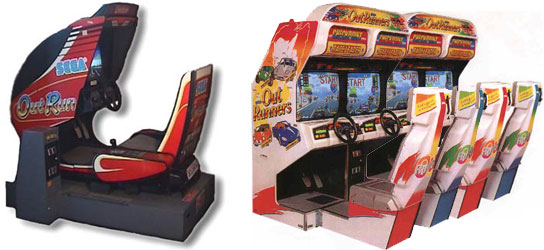
OutRun is an arcade legend, on par with the biggest names I've featured yet on the blog, and possibly the biggest title I'll be naming in the series. It was an easily accessible racing game not built for the sim community. It was an arcade racer through and through, whose bright graphics, multiple tracks and questionable physics appealed to everyone. My favorite version of the game was not the original title, but it's spiritual successor Outrunners.

Both games more or less played the same. You were driving a supercar in a trans-global race. This was one of the first racers to use gradations in the game rather than have tracks be completely flat. Drivers would take hills and not be able to see the path ahead, that level of uncertainty was exhilarating especially while doing well over 100 MPH. The drifting was subtle in OutRun but full out in Outrunners. Cars were large and cartoonish and unlike the other racing games of the time were not hung up on realism. It was the fantasy aspect that I think pulled most gamers to this title. If you were traveling top speed in OutRun and ran into a wall then the driver and passenger would get launched out of the car as it tumbled and land back inside by unseen forces. Unlike Pole Position where the slightest bump would cause your car to explode the racing featured in OutRun was more about the experience of driving and having a good time. Cars could jostle for position and trade paint without fear of game-ending explosions.

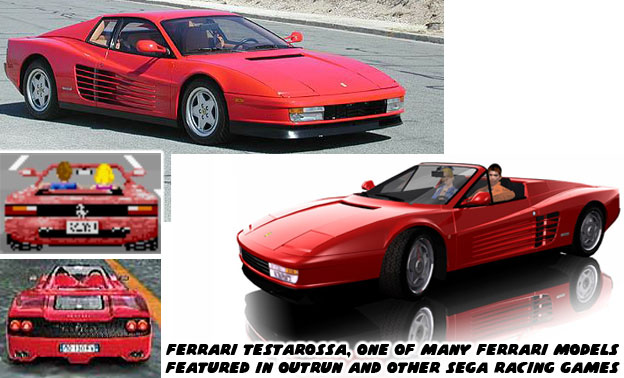
The timed courses were laid out with multiple paths. At the end of each checkpoint you were presented with a fork in the road. This opened up the racing experience in all sorts of ways. Players were no longer limited to replay the same tracks over and over as they could experiment and go for bigger scores and new experiences on each play through. Given a choice was a rare commodity in racing. The driving experience had become an unspoken narrative. Even though there was never a break in the action visual clues let us know which part of the world the stage was set in. Caricatured parts of New York, Paris and Egypt all popped up. It was a celebration of the international racing brotherhood. Yu Suzuki designed the original experience around the Ferrari Testarossa. It was an exotic car that lent itself to this type of experience. The name Ferrari alone conjures up images of excess, luxury and horsepower, it was made downright mythological by Suzuki. However as much as I liked cars I was never fond of Suzuki's obsession with the Ferrari. I felt that the world of cars was too big to be hung up on only one ride.

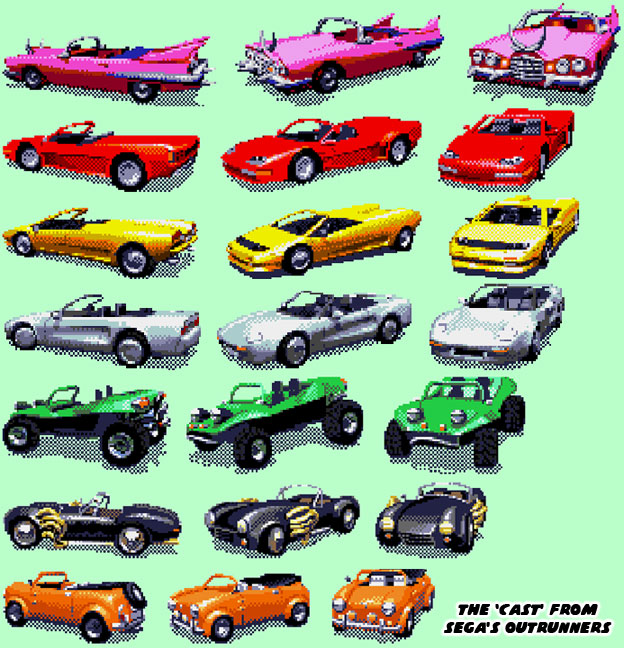
Outrunners was very much a second-coming of OutRun. The graphics of the '92 release were far superior to the original from '86. This game even featured the familiar Testarossa and her driver and passenger. Joining them were all sorts of other drivers and cars in the competition, each designed for a certain type of car fan. From an exotic Shelby Cobra-like car to a Volkswagen Beetle and even a big pink Cadillac. This game simply expanded on all of the things that made the original OutRun so much fun. However Outrunners was developed by Sega's AM1, not Suzuki's AM2. To many it could not compare to the original. Say what they will but I loved it.

Outrunners was beautiful. The cars each handled slightly differently, as would be expected. Discovering the nuances of each ride was what kept me coming back. As was the breakneck speed of the title. Sliding the car completely sideway through a series of stone archways, "threading the needle" in the most awesome sense of the word or dipping past the checkpoint just ahead of my brothers and friends as we played this in the arcade. This game was responsible for plenty of great memories in the 90's. The more that played on the linked cabinets the better. The details of a radio built into each cabinet was nice. Each station played an updated version of the classic OutRun music and players were free to switch stations on the fly. The titles would scroll by the LCD of the dashboard. How many arcade games ever went that extra mile?

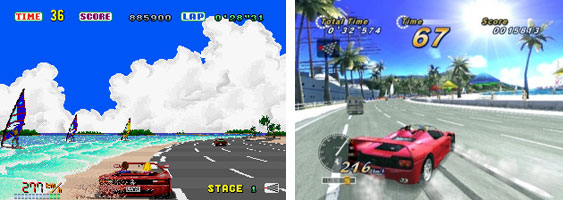
The official sequel wouldn't come out until 2003. By the time of OutRun 2 AM2 had grown by leaps and bounds, learning everything they could from their polygon legacy. It was a fun game that returned the series to its roots. All of the cars in the game were Ferraris and the graphics were stunning. I couldn't help but imagine that this was the type of experience that Suzuki had dreamed about giving arcade-goers a generation ago, now he finally had arcade machines and consoles with enough processing power to deliver it. As it turned out the Xbox title was not the last we would see of this classic racer. Sega is putting their finishing touches on OutRun Online Arcade. Fans around the world can't wait to relive all those great memories through the classic experience and even updated versions of their favorite OutRun songs.

While OutRun wasn't my favorite Sega racer ever it was still pretty damn good. There was a studio out there to make an arcade game that was every bit as memorable as the best Sega racers, including OutRun. However their name wasn't Namco and this studio was never known for making racers at all. Come back next time to see what I'm talking about.

Were you a fan of OutRun? If so I'd like to hear about it. Let me know in the comments section please. As always if you would like to sponsor me please visit my Patreon page and consider donating each month, even as little as $1 would help make better blogs and even podcasts!
follow the Street Writer on Patreon!

Thursday, June 12, 2014

The (Videogame) Car Tangent, part 2...

Game designers were often fans of the subjects they made games on. If they worked on a fighting game then chances are they also liked martial arts films, wrestling or boxing as well. If they worked on a space shooter then they probably liked science fiction movies and cartoons. Those that worked on racing games tended to love racing. The better the game was then chances were that the developers were also car fans. The racing game was a standard that all developers tried to master in the early days of the arcade. Those that did well with the genre tended to outlast their rivals. Sega was one of the first in the racing market, even developing electromechanical racing games before video arcade games really took off. They demonstrated that great racing games could take liberties with reality and make caricatures of tracks, scenery and vehicles and still become popular.


The developers at AM1, AM2 and AM3 at Sega each took turns pushing the genre to bold new heights. OutRunners, which was mentioned in the previous blog had demonstrated that even fictional cars could make for memorable main characters. I would take that concept one step further and argue that Sega was demonstrating the positive aspects of diversity in a videogame. The cars in OutRunners ran the gamut of design choices. From tiny to rotund, domestic and exotic, there was a car that represented the spectrum of the driving experience. Best of all was that each car had almost the same chance as winning the race as all the others.All too often in videogames the main character was a physically fit attractive male or female. Average looking or (heaven forbid) fat characters were avoided at all costs. Conventional thinking would have audiences believe that people did not want to play a videogame if the main character was an average looking shlub. In the case of racing games the main cars were often sporty and European. OutRunners broke the mold and gave the massive or under-powered cars a fair chance against the supercars. Sadly diversity was still an element lacking in games where humans were the main characters.

Well designed fictional or real cars could appear to have their own distinct personality. Who hadn't thought that the classic Volkswagen Beetle was not perpetually smiling or that ? When those cars were placed within imaginative games then they could really come into their own. The Choro-Q games by Atlus and other developers showed that cars could replace humans in an action-RPG. Gamers could be made to empathize with the tiny cars as the story progressed. Relationships were built with the other cars as players went on various missions. Players learned that their car was an important member of the community even though they primarily wanted to be a racer. Consider that these games were out way before the Pixar film had even been conceived! The racing element was not forgotten however and was actually quite challenging. Players learned that they had to compete against cars of their own class. There was no way and stock car was ready to race professionally after all. So players raised money by completing menial tasks and winning smaller events. Eventually they would work their way up to the big leagues. Every element of the cars could often be modified, from the paint schemes to the types of tires, body kits and engines that they used. In the Choro-Q universe it was akin to getting a makeover, or in extreme cases like getting a heart transplant.


The Choro-Q games had their own niche which they filled sublimely. They were like action oriented versions of Animal Crossing and Harvest Moon but for gearheads instead. Sadly they were overlooked when gaming editors were nominating the best racing titles of a generation. Sometimes cars were just a mode of transportation in a game and sometimes they shared the spotlight with the main characters. Some of the best cars in game history were never featured in a racing game.

The M12 LRV (Light Reconnaissance Vehicle) was better known to gamers as the Warthog. The first person shooter Halo had introduced all sorts of futuristic weapons to gaming, possibly none as awesome as the Warthog. It was a military vehicle designed for speed, one that could carry a few soldiers and run circles around tanks. Not many Hollywood films had been set with ground forces fighting on alien planets so the design was relatively new. The scope of all the designs featured in Halo was breathtaking in fact. Every piece of armor, every weapon, vehicle and location had tremendous forethought and execution. Those that assumed the best designers were working on films only had clearly not seen the work in most Triple-A blockbusters. The Warthog was akin to the Light Cycles in Tron. It not only looked great but it also looked very functional. It had four wheel drive and four wheel steering which would help it turn quickly despite its size. The large tires and dynamic suspension system could help it clear terrain that would have stopped normal vehicles and many off-road trucks. It had armor plating that followed the contours of the engine, protected the transmission and also provided clearance the rear mounted high caliber machine gun. It was nothing short of a perfect military atv and proof that game designers could make the transition to real-world production vehicles (if the military were interested).


Weaponized gaming vehicles had appeared appeared well before the Warthog. Many were more outlandish and a few became as iconic as any mascot character. The game Twisted Metal had a cast of vehicles as diverse as OutRunners. Actually to be fair the game had even more rides across the spectrum especially when they began inventing vehicle types and added in trucks, motorcycles and armored personnel carriers. Every vehicle was equipped with as much weaponry as the Interceptor from Spy Hunter except instead of taking down terrorists the drivers were trying to kill each other. This was all for the sake of a gruesome contest. The most memorable car in the series was an ice cream truck nicknamed Sweet Tooth. People often mistake the driver, a clown with a flaming head as Sweet Tooth but his name was actually Marcus "Needles" Kane. The psychopathic clown was a mass murderer and would lure victims out to the street with his truck. Normally when people think of ice cream trucks they think of soft colors and a catchy jingle playing on a loudspeaker. Sweet Tooth was armored, covered in rust and blood and could even transform into a robot. It was the stuff of nightmares and yet somehow gamers could never get enough of it. Twisted Metal was not the first vehicle combat game but it probably was the best.

The videogame industry evolved very rapidly from the '70s through the '80s. Graphics, controls, memory, storage and other issues were trial and error in the early days. The majority of titles were becoming more refined with studios splitting time between home consoles and arcade units. By the '90s cars could no longer be pinned to just one genre. Of course the most memorable car titles did involve racing of some sort. Through the arcade era no single studio could claim to have to have owned the racing genre better than Sega. Yet there was one studio that was perpetually challenging their status. The rivalry between Sega and Namco for arcade racing domination would become the stuff of legend. As patrons poured billions of dollars into the videogame industry both Sega and Namco were investing millions back into research and development. Some of the breakthrough technology in gaming came from a racing title. Color graphics, surround sound, analog versus digital steering and 3D modeling were technologies pioneered in many racing cabinets. No two studios did it better than Sega and Namco. The next blog will look at this rivalry and begin an entirely new chapter for this series. If you would like to sponsor me please visit my Patreon page and consider donating each month, even as little as $1 would help make better blogs and even podcasts!
follow the Street Writer on Patreon!

Wednesday, June 11, 2014

The (Videogame) Car Tangent, part 1...

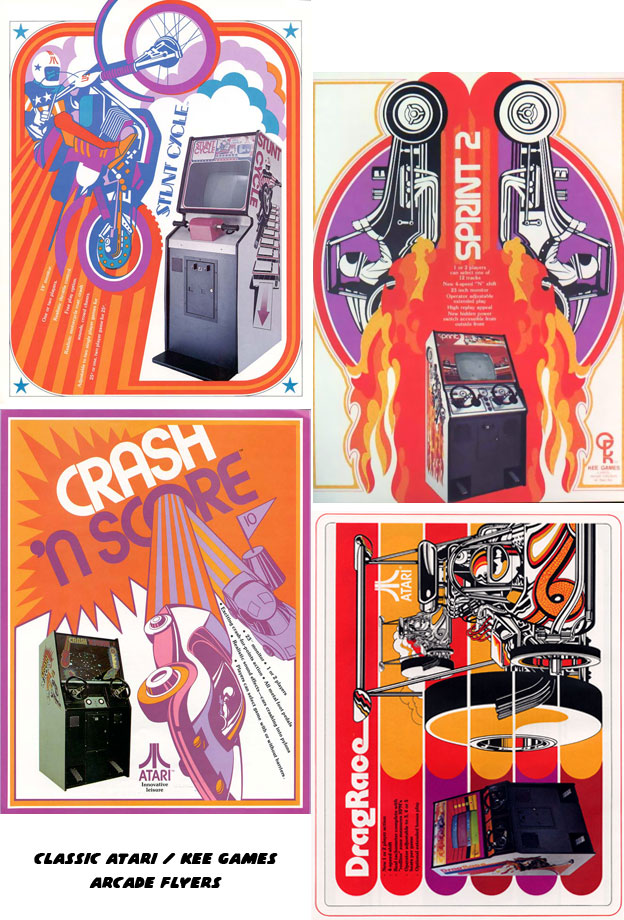
Some of my earliest memories of going into the arcade were seeing the brightly colored arcade cabinets. Atari seemed to have a new racing game every time I visited. The graphics and gameplay on the early titles were not very realistic. Cars and motorcycles were a few blocky pixels and gamers really had to use their imagination to fill in the blanks. It was the cabinet art that really spurred my imagination. The bold colors and stylish designs of late '70s graphic artists were striking. Many of the illustrations would undoubtedly go over well today as a retro tee shirt design.


Whether in the USA, Japan, England or Europe, there were countless racing fans working in the computer industry. Those that became successful with a program, application or platform went on to buy the fastest and flashiest cars that they could. In Silicon Valley the nicest cars either belonged to the venture capitalists that backed companies like Atari, Apple, Oracle or any number of upstarts in the San Francisco Bay Area. The nice cars sometimes belonged to the young engineers that were on the ground floor when the companies started trading publicly. These developers and designers were looking for ways to make computer games and arcade games more realistic. They were also looking to make games about the things they loved. Racing was therefor an early favorite for arcade developers in Japan and the US. One designer in particular had a strong passion for Ferrari super cars like the Testarossa. The man was Yu Suzuki and the company he worked for was Sega. One of his most successful titles was a racing game named OutRun. Released in 1986 the game featured a red convertible that looked strikingly like the Testarosa. It even included a familiar "Dancing Horse" logo on the rear which looked like the Ferrari badge. Sega would not have the rights to the Ferrari name for another decade. Not until Suzuki produced SCUD Race in 1996, which featured the Ferrari F-40 but also included rival super cars the McLaren F1, Porsche 911 and Dodge Viper. As much as Suzuki loved the Ferrari he knew that the rest of the world had also developed amazing supercars as well and they deserved to be in the game. Before SCUD Race the red convertible in the Sega racers was known simply as the "Speed Buster."


Throughout his career at Sega Mr. Suzuki constantly pushed his teams to break new ground on each and every title they created. As the leader of AM2, the Sega Amusement Machine Research and Development Team 2, he was tasked with helping develop hardware that was cutting edge and software that took full advantage of it. His work in 2D and 3D titles spans almost 30 years. Hits include Virtua Fighter, Shenmue, Virtua Cop and After Burner. The scope of his influence may never be fully appreciated by the game industry but his titles will certainly live on. Suzuki greatly improved from the development of Hang-On, a motorcycle racing game that was released a year prior to OutRun. The multiple branching paths that the Speed Buster could take, the complexity in the stages and animations had been bumped up considerably from what arcade players had seen just prior. Sega was always one of the most innovative arcade developers in the early days of the industry. They created one, if not the first arcade racer in color, Monaco GP in 1979. Atari by contrast had Sprint 2 (player) in 1976 and Sprint 1 in 1978 and both of which were in black and white and far more limited experiences. Sega was one of the trendsetters in a genre. Rather than trying to make the game player feel like they were controlling a driver in a racing game, they instead made the car the star. The driver and passenger in OutRun did have some memorable animations. Few could argue that the Speed Buster was not the true star of the game.


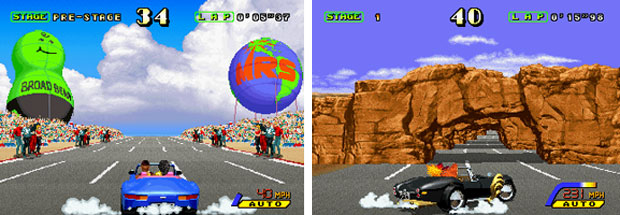
In 1993 the team at Sega AM1 produced OutRunners. It was a spiritual sequel to OutRun, the actual sequel produced by Suzuki would not appear until 2003. They expanded on the mechanics of the game, the graphics, courses and most notably the car selections. Each participating nation had a team of drivers, that varied from the silly to the serious. Again it was the cars that were the true stars of the game. Each car performed differently. No two handled quite the same and each had a distinct advantage and disadvantage, such as the ability to accelerate or recover from a crash faster than the other cars. The Speed Buster finally had a rival sports car in the virtual world, a bright yellow convertible named the Mad Power which resembled a Lamborghini Diablo. It was joined by other cars like the Bad Boy, Smooth Operator and Wild Chaser, which resembled the Shelby Cobra, Porsche 914 and Meyers Manx respectively. What Sega had demonstrated was that Suzuki was not the only car fanatic working at the studio. The developers understood and moreover appreciated the subtleties between the iconic cars from each nation. They were able to make amalgamations of popular vehicles without exactly settling on one brand. They were also demonstrating that some of the developers in the game industry were very good at trend spotting. The styling on several of the cars were not only good contemporary designs but also predicted the shape of sports cars and exotics yet to come. When developers realized that they did not have to lock cars into racing games then they went wild coming up with ideas. The next blog looks at the ways in which these cars began to shape gameplay. If you would like to sponsor me please visit my Patreon page and consider donating each month, even as little as $1 would help make better blogs and even podcasts!
follow the Street Writer on Patreon!