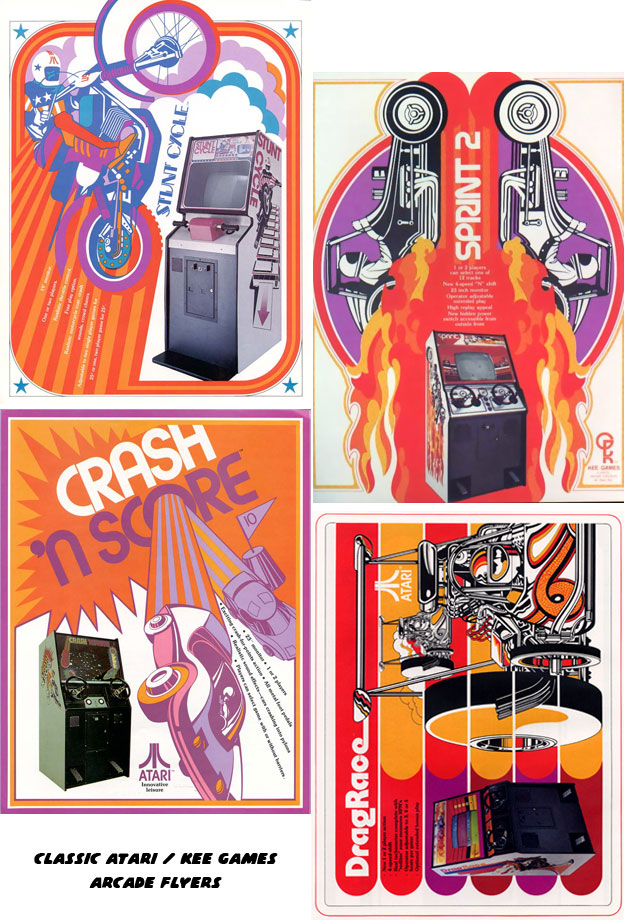
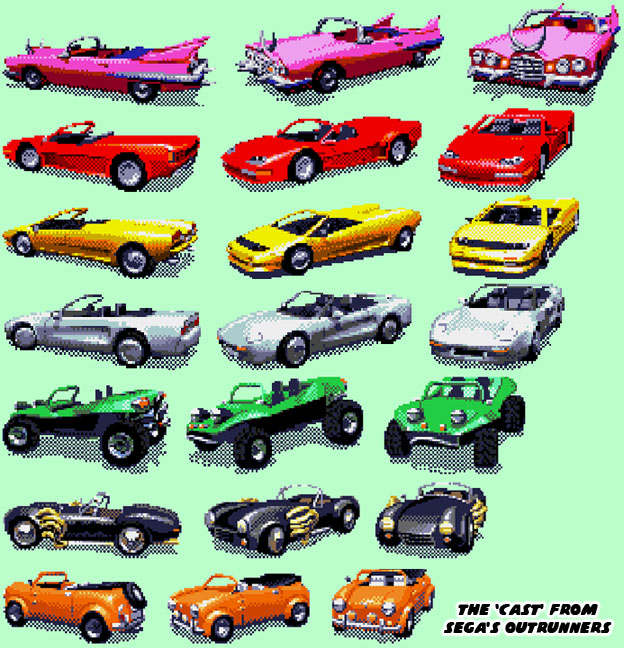
Kee Games and Atari had an interesting relationship while they were making some of the earliest racing games ever. The funny part being that in advertising they promoted themselves as rivals. One of Atari's most loved racing franchises was created under the Kee Games banner. The black and white game Sprint, released in 1976, was based on sprint car racing not Formula-1 as many now remember it.
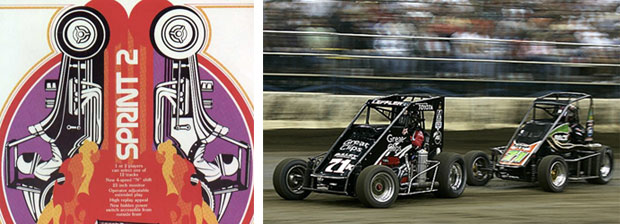
Kee Games used the familiar 4-speed shifter from Drag Race and Superbug on this game. The entire track was visible on one screen and players had to navigate a car around the track while avoiding their rivals and random oil slicks. Unlike Monaco or Pole Position Eventually making 2 and 8-player cabinets for the arcade. Their most memorable (or finger breaking) contribution to the arcade racer was in the loose steering mechanism. The Sprint games have never been about realism. These games were unabashed arcade racers. In order to win players had to spin their steering wheels with reckless disregard for their opponents safety and mash the gas pedal all the way down. There was no force feedback, there were no discernible physics to the cars as they didn't drift or slide around turns, they held hard and turned as fast as the steering wheel allowed. It was absurd but it was also a lot of fun.
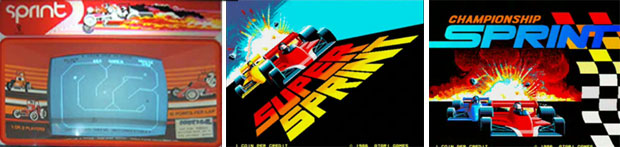
Kee Games was absorbed back into Atari. Their arcade gem was updated and polished into, possibly, the craziest and most demanding racing game ever. The sprint cars were replaced with cars that looked more like Formula-1 or the American equivalent, the Indy car. Indy cars. Super Sprint was born in 1986, and the updated Championship Sprint followed right after. The game itself kept the classic experience intact. The entire track fit on one screen with an almost isometric-view. The steering was super loose. Cars bumped and jockeyed for position on each and every lap.
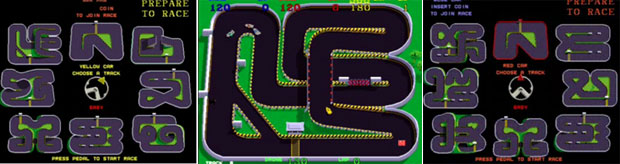
The tracks were possibly the most memorable element to the game. They were very imaginative and more akin to remote control car tracks than real Indy tracks. Some had shortcuts and jumps, all had oil slicks or tornadoes turn up to throw you off course. Wrenches that could be used to upgrade your car also popped up. The game had a very subtle difficulty curve. Players could dominate the computer opponents early on by skill alone. Along the way they could earn enough wrenches to upgrade their car in one of four categories including; turbo acceleration, traction and top speed. The thing was no matter how good of a driver you were it was only a matter of time before all of the rival cars had higher stats. Then you would have to begin pumping quarters into the machine to max out your stats and keep up with the rest. It was frenetic, it was difficult and it was damned addicting. By the mid-80's Atari and the rest of the publishers had figured out how to keep racers coming back.
Other isometric racers borrowing from the Super Sprint template would find similar success. Super Sprint set the bar very high on isometric racers. The racers featured on today's blog experimented with the formula and were hits or misses depending on your point of view. Danny Sullivan's Indy Heat by Leland was a revisionist take on Super Sprint. The tracks were hyper-detailed caricatures of real tracks and road courses from around North America, complete with crowds, pit crews and the atmosphere of real racing. Even my beloved Long Beach track was in the game. The cars could even take damage and begin smoking and burning as the race progressed, unlike the Super Sprint car which either exploded as it hit a wall or never really took damage. How could this game not be fun?
Despite the Indy name and look of the cars this was not a licensed Indy game as big money, and big egos, caused a number of team owners and drivers to start up a rival series. The Champ Car series was born from disputes with Indy organizers. Some of the most famous tracks went to one series after the split. Fans were keenly aware of this drama and while it didn't reflect in the quality of either Cart or Indy games it was an interesting footnote to history. As for this game it had a far steeper difficulty curve than Super Sprint. It was a shameless quarter waster where you could pump in quarters and maximize your car right off the bat. Not that it mattered because Danny Sullivan was a flawless racing driver and no matter how many turbos you bought and used he would always be right behind you.
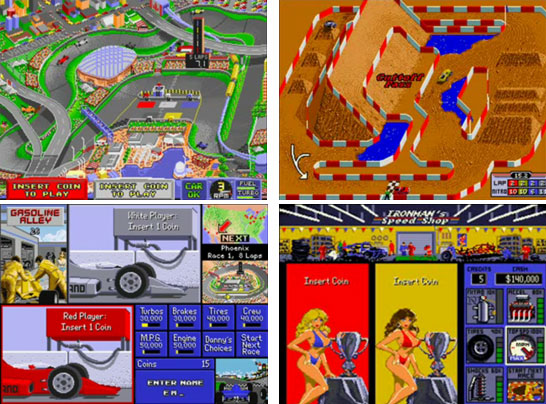
It was the over reliance of the turbo which eventually did in the isometric racer. The skill of driving had been replaced by the cure-all of instant speed. The publishers were exploiting the purchase of upgrades and turbos with real money in an attempt to maximize profits, plain and simple. The precursor to Indy Heat actually managed to remain closer to the Super Sprint, at least in spirit. Off Road featuring Ivan "Ironman" Stewart was the last fun isometric arcade racer. Despite the format it played very much like Super Sprint. The difficulty curve was subtle and a good driver could get relatively far into the game before falling behind opponents with superior machines.
The physics in the game were very "arcade" as trucks bounced all over the tracks and slid on the soil. This game was a refreshing change of pace from Super Sprint as the courses were very imaginative and challenging, even to experienced race fans. The entire stadium "off road" feel was captured and synthesized as a worthy successor to the Atari game. However this game, like Indy Heat was by Leland. They cut their teeth on this game and noticed how the turbo could be exploited by players to get further into the game than just driving and tuning the off road truck could. They must have thought that the system of allowing players to buy upgrades with quarters, and especially turbos, was a godsend to the arcade. They exploited that concept to a much greater degree in Indy Heat. Sadly that strategy backfired in the arcades that I frequented. Players would tolerate the subtle quarter gobbler of Off Road because it offered a refreshing experience in return. They all avoided Indy Heat like the plague. By the time Atari got back into the isometric racer the tastes of gamers, and the market itself had changed. The consoles were taking over and the arcade scene was dying. Badlands, released in 1990 was a lamentable driver that pretty much buried the legacy of Super Sprint.
Atari tried to revitalize the genre by adding weapons to the mix. Adding weapons wasn't the lamentable part of this game. Using doctored up levels and recycled controls and sounds from Super Sprint was what did it in. The lack of evolution did nothing to gain the confidence of older gamers. Badlands was an even bigger pariah in the arcades than Indy Heat. The idea of combining weapons with racing was not all that new. In fact it was a great idea that has turned the racer into an a whole new experience. Come back tomorrow to reminisce with a title most of you know and love.