I was having a conversation with my niece earlier this year about what my favorite car is. I said I don’t think I have a single favorite, but could come up with a handful of favorites. I asked what she liked, and she’s a huge fan of muscle cars, just like her dad. Specifically she loves the classic 1967 Camaro. Which is a super sexy muscle car. She likes GTO’s, Chargers, Chevelle’s, Mustangs, and the other classics as well. It got me thinking of making a blog post. I could spend the next dozen blogs writing about which cars I love, but instead I want to limit it. I want you to do the same thing. The rules for this thought experiment are simple. Let’s say you won the lottery, and could buy any car in the world, from any era. It could be bone stock, or it could be modified as long as it was street legal. This meant I couldn’t put a monster truck on the list. Although if I won the lottery then I totally would get one built. Also you can only choose 10 cars. None of this warehouse filled with cars like celebs have. These are 10 cars that you could cycle through to act almost as a daily driver. Do you have them in mind? To be honest I wouldn’t fit in most of the cars on my list. Maybe three are actually made for big people. The rest are made for people much smaller than me. Let’s start with one that would look good on me.
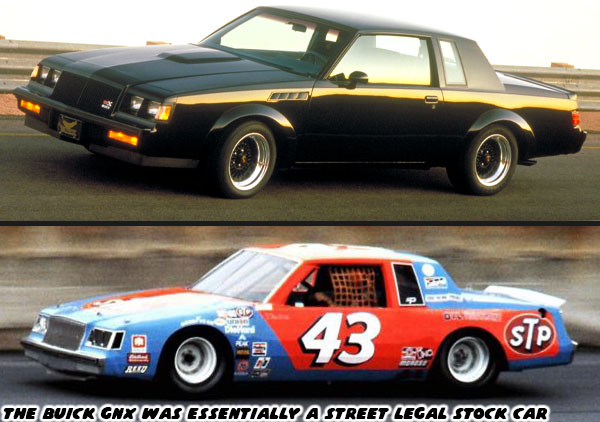
The Buick GNX (1987) is considered to be the last of the great muscle cars. It is the descendant of the grand national model of cars. We’re talking about the Oldsmobile, Fords, and Pontiacs that helped popularize NASCAR in the ‘70s. The Buick Regal T-Type was the base model, but the faster version was the Grand National. Then there was one with even more features, including twin turbos known as the GNX. As first glance it looks like something a grandpa would own in the ‘80s, and maybe drive it to church on Sundays. That is until you realize that it has supercar performance, and could destroy most sports cars on the road. Here’s
a breakdown, and comparison between a Grand National, and a GNX. Here’s
the Car and Driver review of the GNX from 1987. There was nothing else like it then, and could still beat most cars on the street today.
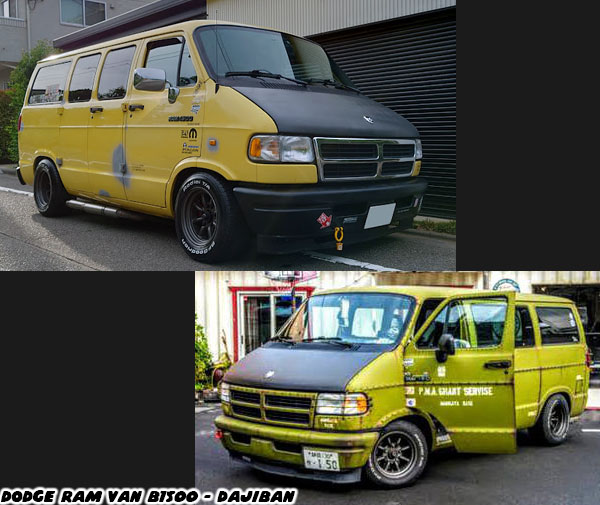
The first completely tuned up car I would buy after the GNX would be a Dodge Ram Van B1500 (1998). These are known as Dajiban in Japan, and they have a cult-like following in the tuning community. Similar to the GNX, it is a sleeper with fangs. To get you up to speed here
a Jalopnik article about Dodge van racing in Japan, and also a
Road & Track article about Dajiban racing. I used to own a ’97 Dodge Van so I know I could drive it comfortably. It belonged to my parents, my dad had it on sports tires years before the Japanese saw how brutal the stance was. Sadly we sold it, but I long to have a new one absolutely tuned up someday.
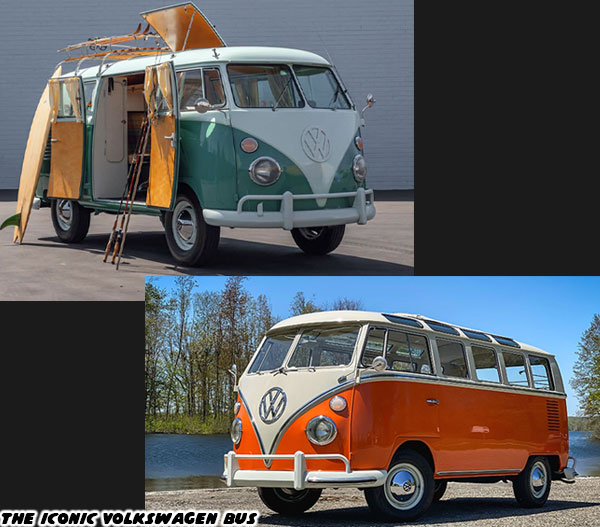
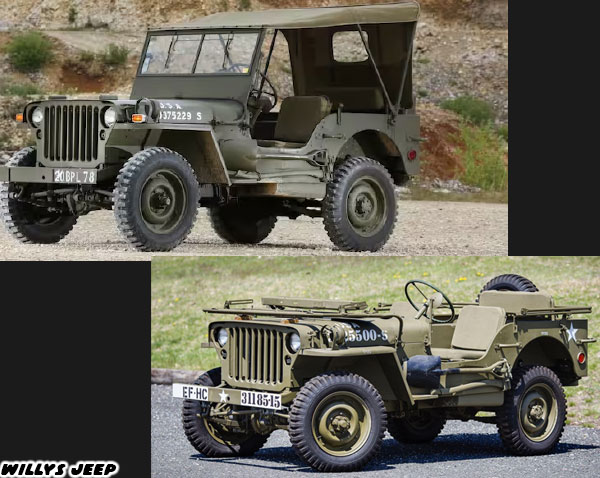
The next car in my garage would be a tough choice, at first I thought about getting a Volkswagen Bus. I’m sure my wife would love one, but I’ll let her make her own list. The VW Bus is far, and wide considered to be a classic Southern California ride after all. I would like to take my family camping, and nothing would make for a more suitable ride. Or would it? I’d like to not only drive to one of the many local campgrounds, but I don’t want to be stuck if the weather acts up. A VW Bus is a durable, but could also be a fickle ride. I’d like something that is tougher, and more reliable. Something with the rugged profile of a Willys MB (Jeep). This was
the off road car designed to replace mules for the Army in WWII. To this day there are companies that make reproduction parts for it, and help keep the 80-year-old 4x4’s running in perfect condition. Of course as cool as a Jeep is there is no way that I could take my family camping in one, that is if I could even fit behind the wheel.
There are plenty of modern campers that have 4x4 capability, but I do want something that has a classic look. Since money is no object then I could get a retro-looking bus, and have a modern diesel, or diesel-hybrid engine, transmission, and suspension put into it. That is why the third vehicle I would have in my garage would be a Volvo Laplander (1966).
Four Wheeler took a look at the military vehicle many years ago. The European 4x4 is as tough as they come. Newer versions are retrofitted for rally racing. I’d give this boxy-looking beast a complete makeover from the inside-out, and turn it into a reliable camper bus, with off road capability.

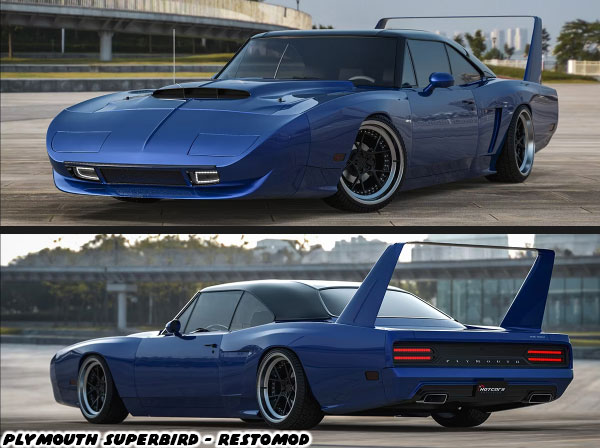
This isn’t the only retro car that I would love to have a restomod of. Restomod is a relatively new trend of car builders that goes beyond factory-accurate restorations. Instead of sticking with OEM parts they rebuild a car using modern engines, suspension, transmissions, parts, and technology. They have a classic, but updated look at the same time. Not everyone likes those rides, and I understand that some rides deserve to be accurately restored. There are so many possible classic muscle cars that I’d love to have in the garage. At the same time I don’t necessarily want them to all be stock. The GNX itself was already tuned up before it left the showroom floor. The biggest, most obnoxiously American muscle cars of all time were the Dodge Daytona, and Plymouth Superbird. Nothing screams ‘MURICA like a 20-foot-long, 200mph, boat with an enormous wing, room for four, and groceries in the trunk. That is why if I could only have one classic muscle car it would be one of those. Because of Richard Petty I’d lean towards a Plymouth Superbird (1970) restomod.
Hotcars featured a concept restored of the Plymouth Superbird. It just looks too good. Of course I’d have the brightest paint job on it that I could. Too much excess is never enough.
There are many supercars that I would love to own, but the list of exotics that have a special place in my heart is very small. Of all the Italian supercars there’s only one that I consider my absolute favorite. In the ‘80s many of my friends were all about the Lamborghini Countach, or the Ferrari Testarossa. I thought they were amazing-looking cars, but had been featured in so many movies, music videos, and television shows that I thought some of their exotic appeal had worn off. All of that changed when I was in high school. The Ferrari F40 (1991) was the car that completely rocked my world. It was as if Ferrari had turned one of their track cars into a street car. It looked so brutal that nothing else could compare. If you want to know what it feels like to drive one here’s when
Car and Driver tested the Ferrari F40. Sadly I’m certain there’s no way I could ever fit comfortably in this car. A guy can still dream right?
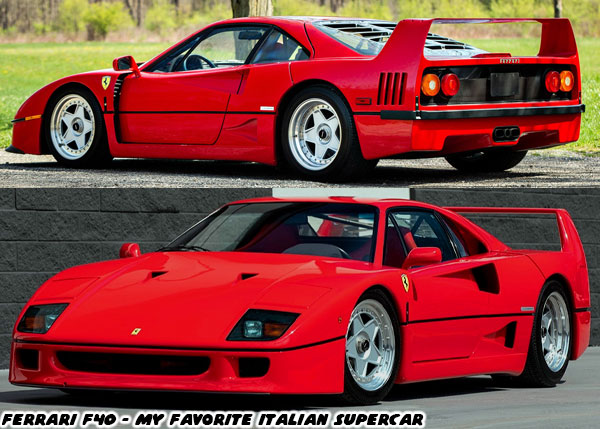
These are the first five cars in my dream garage. Do you have any of these in your lineup? We will look at the remaining five in the next blog. I’d like to hear what your top-10 cars would be if money was no object. Tell me about it in the comments section. As always if you would like to sponsor me
please visit my Patreon page and consider donating each month, even as little as $1 would help make better blogs and even podcasts!