A blog about my interests, mainly the history of fighting games. I also talk about animation, comic books, car culture, and art. Co-host of the Pink Monorail Podcast. Contributor to MiceChat, and Jim Hill Media. Former blogger on the old 1UP community site, and Capcom-Unity as well.
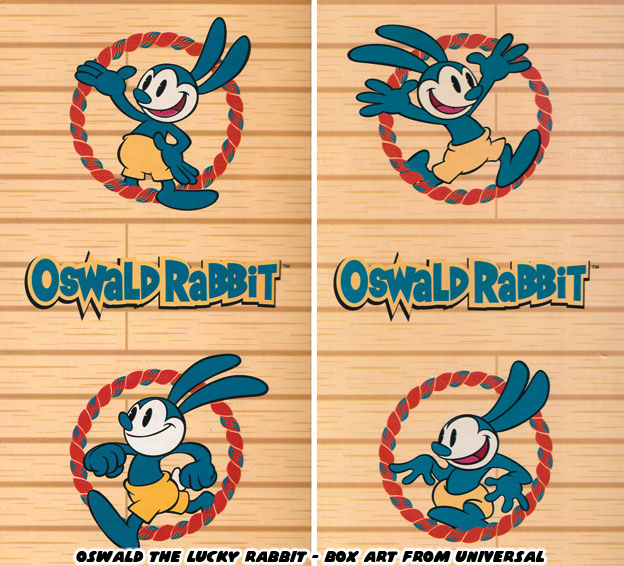
Hello friends, I hope that you are doing well. Today I want to talk about a question I didn’t have an answer for. As you may know I’m a huge fan of Oswald the Lucky Rabbit. I’ve done plenty of blogs about the character. No doubt I will write about him more in the future. What I didn’t know was when the character officially turned blue. I know that he was presented in an old rubber hose design, with blue fur, and yellow shorts when Universal Studios Osaka had his merchandise in their park. That was from around 2001-2004, just before the Disney company reacquired the rights. But was that really the first time the character was reimagined for audiences? I’ve been wondering if this new look was spearheaded by Japan, or the US.
I’ve also wondered how exactly this redesign came to be. After all, in the mid ‘90s Oswald was still brown in color, and looked like a traditional cartoon rabbit character. He had more or less stayed the same since his old comic book run from around 1937 until the mid 1990’s. There was a time stamp that showed one of his last media appearances from that era. In Brazil Woody Woodpecker was known as Pika Pau. “Coehlo Osvaldo” was brown in the game Férias Frustradas do Pica-Pau aka Woody Woodpeckers Frustrating Vacation. The title came out in October 1995 by Tectoy for the Sega Master System, and Sega Mega Drive. In it Oswald gave Woody a magic paintbrush. Mind you this was 15 years before the magic brush in Epic Mickey!
The next time Oswald appeared in an officially licensed game was in Woody Woodpecker Escape from Buzz Buzzard Park for the GameBoy Color. It was developed by Planet Interactive Development, and published by DreamCatcher Interactive (North America) on August 14, 2001. Oswald appears in Level 2 in his blue form. This time he wasn’t friendly with Woody, and would actually attack you with a drop kick.
A few years later Oswald got a cameo in a Japanese pachinko machine called CR Woody Woodpecker. Developed by Maruhon, and released in December 2004. In the game the blue Oswald made a short cameo on the game screen. In 2006 the sequel CR Woody Woodpecker 2 was released. Again the blue Oswald got a cameo on the video screen. What was interesting about this appearance was that it was the same year that Disney had gotten the rights back from Walter Lantz / Universal. This could possibly be the last piece of media featuring that version making it a rare collectors item. The blue Oswald was indeed in circulation between 2001-2004 just as I thought. The pieces were falling into place, however the pachinko machine made me realize the updated look lasted longer than I first suspected.
It turns out that the blue version had actually been proposed much earlier. Universal was looking at relaunching the Walter Lantz IP with a new Woody Woodpecker show in the mid 1990’s. This meant that the characters would be receiving a minor stylistic update, to make their look a little bit more contemporary. You can read the details on the New Woody Woodpecker show on the Walter Lantz Fandom page. Not only were Lantz’ biggest stars like Woody Woodpecker, and Chilly WIlly getting a refresh, but rare characters like Space Mouse, and Oswald the Lucky Rabbit were also getting a makeover. The show started development around 1997, with a few revisions made before production began. The new designs were posted by Daily Woody Woodpecker on Twitter. As these new versions were being finalized the comics, and games featuring the updated begun licensing.
Sadly we wouldn’t actually see Oswald, or a few other rare characters make it into the new cartoons. They would appear in Latin American comics, and the aforementioned games, and pachinko cabinets. As for Oswald’s earliest blue design, the oldest officially licensed item that I could find with him was a rectangular dish / tray from 1998. He was very loosely drawn, and didn’t have the standardized look used in the Universal Osaka merchandise. Altogether the blue Oswald lasted for about eight years. I began wondering if I could track down any US merchandise from this era, but I’ll probably stick to the Japanese items. Were there any rare cartoon characters that you want to see return? Perhaps in game form? Tell me in the comments section. As always if you enjoyed this blog, and would like to sponsor me please visit my Patreon page and consider donating each month, even as little as $1 would help make better blogs and even podcasts!
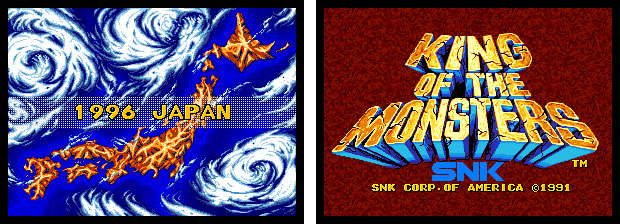
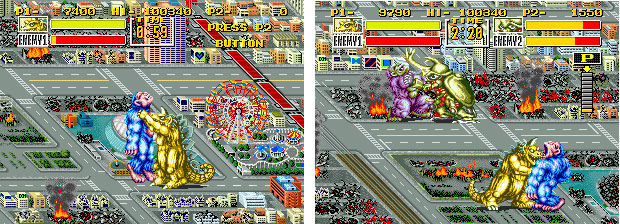
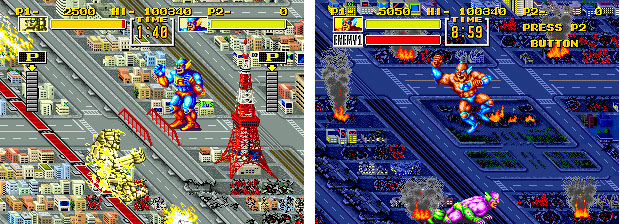
As much fun as I had with Rampage I felt that something was missing. The immersion offered by the PC game Movie Monster was absent. Granted, most arcade developers did not want to slow down the gameplay just for the sake of allowing a player to get settled in. Rampage was very transparent. It was an attempt to milk players of their quarters without a guarantee of a resolution for all their destruction. Making money was the purpose of all arcade games but the better ones had an outcome that offered more than a high score to audiences. In 1991 the SNK corporation released a title that I would consider one of the best giant monster games ever made but also one of the least known titles. The King of the Monsters was unique in that it was the first giant monster game to mix genres. It was both a rampage title, rewarding players by how much destruction they caused, but also a wrestling game.
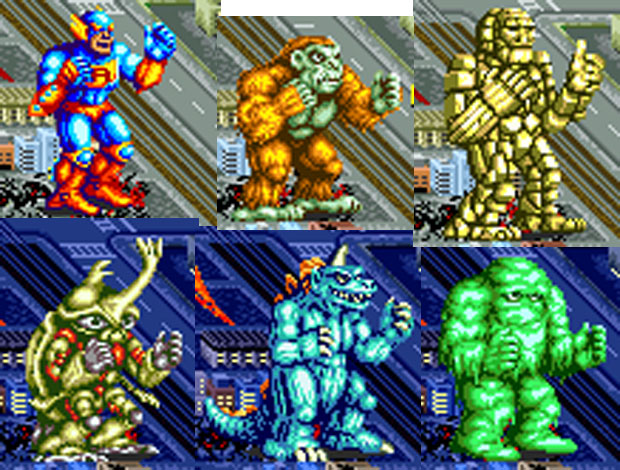
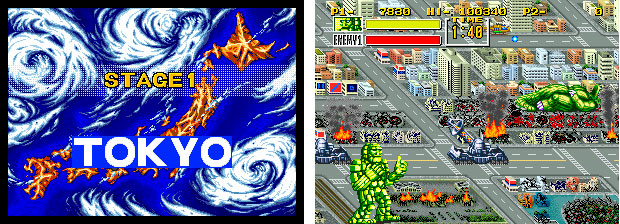
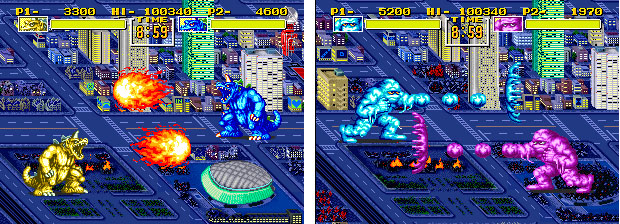
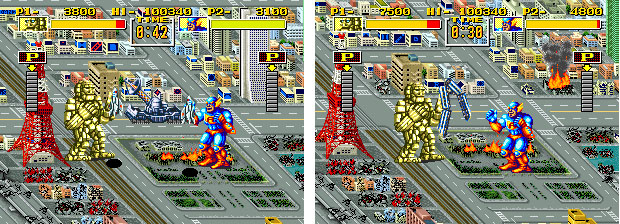
King of the Monsters was set in the near future, 1996 to be precise. Players could select from one of six unique monsters. The creatures were thinly veiled knock-offs of famous movie monsters. Geon, Woo, Poison Ghost, Rocky, Beetle Mania and Astro Guy were inspired by Godzilla, Kong Kong, Hedora, Daimajin, Megalon and Ultraman respectively. Each monster even had their own distinct roar. The characters were much larger in scale than those featured on just about every other game. They were as tall as a skyscraper and could flatten most roads, bridges and buildings in the game simply by walking over them.
The game offered several modes; player-versus-player, 2-players versus the computer or single player versus the computer. The entirety of the game took place in Japan. Six of the major cities, including Tokyo and Hiroshima were featured as stages. This was set up to be the ultimate giant monster smack down.
Players had an assortment of attacks. A basic punch or kick and a throw. If a player pressed a direction while grappling with an opponent then they could perform a slam or power move against them. Power moves included piledrivers, bear hugs and backbreakers. An opponent that fell to a power move also dropped a Power orb. Collecting 10 Power orbs allowed players to upgrade their special attack up one level. Players maxed out a special attack after two levels, or 20 orbs. If a player held down the attack buttons they could charge up for a special attack. The special attack was a ranged strike, capable of hitting the opponent from across the screen. Some special attacks were energy lasers, fireballs or electrical sparks.
Players could also grab items from the ground, like tanks and speeding bullet trains to throw at opponents. Even low flying military and jumbo jets could be snatched out of the sky and thrown.
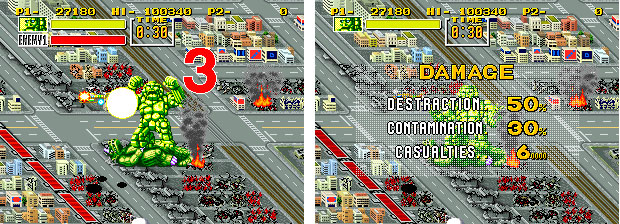
Players were rewarded by defeating opponents with a 3-count pin but also based on how much collateral damage they caused. Walking over buildings, throwing opponents through refineries and crushing vehicles all gave the player a bonus. One of my favorite mistranslations from any game was in the end level score. Players were rated on how much Distraction they caused rather than Destruction. This was King of the Monsters in a nutshell but there was far more to the game than that.
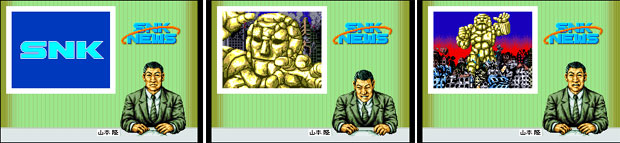
The game borrowed plenty of elements from the classic movies. Arcade games, especially fighting games, were not always known for giving players time to settle into their world. This was a rare exception. SNK managed to do that without interrupting the 3-minute matches. The developer mixed in all the important details through audio cues as the game progressed. On the introduction of the first and every third level a news reporter would break in and play up the calamity that the creatures were causing. Explosions could be heard in the background of each "broadcast." The panic in his voice was well performed, it helped put players in the scene. It was not hard to imagine that the news reporter was on the edge of the city, reporting from a safe distance.
Just about everything in the game had its own sound effect. As the monsters moved their titanic footsteps echoed on the tiny arcade cabinet speakers. The sounds of buildings turning to rubble, trees snapping and water splashing were present as the creatures moved through different terrain. Traffic could be heard as the tiny cars, no more than a few pixels in height, travelled through the streets. Some audio effects helped players learn when an object was just about to enter the stage. A horn blast signaled that a bullet train was going to pass through town. If a player were standing on the track then he could either derail the train or pull it off the tracks just as it passed. A jet roar signaled that a plane was nearby, a player that timed a jump could snatch the plane right out of the sky and then throw it.
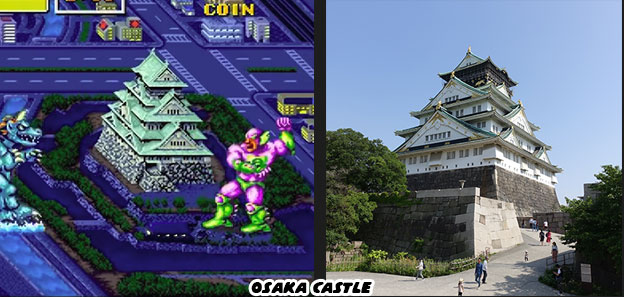
The amount of detail placed into each stage was absurd. Buildings had working neon signs and electronic billboards. Amusement park rides actually moved and famous landmarks from each town were crammed into the stages. The Tower of the Sun, the Tokyo Dome and the Himeji Castle helped put gamers in Osaka, Tokyo and Kobe respectively. Each of the landmarks could even be flattened for a major bonus. Although I had never been to Japan I recognized many of the locations from TV and movies. These were details that SNK put into their game that both Bally Midway and Epyx had overlooked.
It was one thing for the Western-produced titles to say the game was taking place in Tokyo or New York but another thing to show players the city. In the original Rampage the game told players they were in Chicago but the buildings looked similar to Denver. The silhouette in the background was different but nothing else really stood out. In Movie Monster players had to use some imagination to distinguish between the cities as well. I didn't mind using my imagination but it was much easier to get into the game when I had all the necessary elements. The more details a studio could present to fill in those gaps the less that a gamer had to suspend their disbelief. SNK eliminated any doubt that the monsters were fighting in their own towns. All of the landmarks were present on each stage, perfect to body slam an opponent on top of.
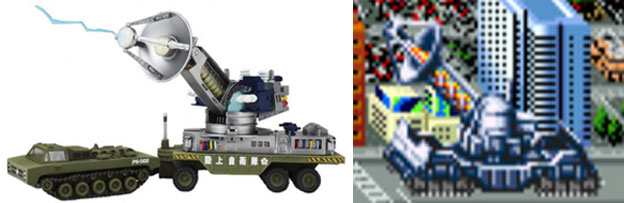
Each stage was cut off by electronic barriers. The barriers acted like the ropes in a wrestling ring. Players could throw opponents off the barriers and catch them with a clothesline. The mix of science fiction and military technology had been a staple in the movies. The Godzilla films were known for their use of sci-fi weapons. Tanks equipped with energy towers could shoot beams of electricity to help redirect the path of Godzilla. These "Maser Cannons" were used in several films. SNK put their own version in the game. Players could hear the sound of heavy tank treads before any of these vehicles had even entered the city. They caused considerable damage if players were hit with the waves of energy they projected. Players could pick up and throw the tanks at opponents before they even got a shot off though.
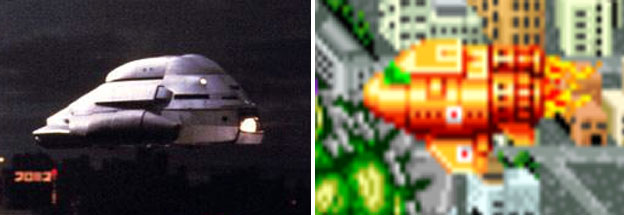
King of the Monsters even included a flying secret weapon to battle the monsters. The bright orange jet was based on the Super X. In the Godzilla films the Super X managed to put up a good battle against the giant lizard. In KOTM the jet could also turn the tide of battle. Thankfully the ships could also be snatched from the sky as well.
The game itself was one of the most challenging titles I had ever played. I was never any good at arcade wrestling games. I felt that the timing was tricky for those titles and the combat provided by fighting games was a little easier to get into. As a fan of giant monsters I was determined to see the ending of the game. The first time I played the game I spent a couple of bucks and only managed to get a few characters in. I made the mistake of running headlong into battle and punching and kicking as if it were a fighting game. Going toe-to-toe was a big mistake as the computer AI threw me all over the place. I thought that I should learn how to play the game first or I was going to waste my allowance on one title.
I realized that SNK gave players exactly 3 minutes per match and expected players to use every last second on the clock. Since opponents had to be pinned then I would first have to wear them down first. Even if I depleted all of my opponent's energy they would kick out two or more times, just like in a pro wrestling match. I learned to pin them near the electronic barriers. If they threw me off they might end up shocking themselves and buy me time to get up. I also learned that special attacks did a lot of damage even on fallen opponents so I had to power that up right away. I could have my character level up within the first two matches by applying the same power moves over and over, usually a backbreaker or bear hug. Once my character was fully powered I would spend the entirety of the match slowly whittling down my opponent. Kicking them while they were down, throwing every object I could in their direction and performing high risk moves when I saw an opening. I learned to catch my opponent off guard by throwing running clotheslines at them. The animation of the monsters' eyes bugging out when they were caught by the lariat was hilarious.
The computer was just as relentless as I was. A human player could be pinned even if they still had a little bit of energy left. I felt this was a little bit of a cheat by the SNK programmers. I would have to press all the buttons as fast as possible and shake the joystick in order to break the pin. A player could kick out of two pin attempts but no matter how much energy they had left over the computer would win the third pin automatically. Many a match was saved when my monster threw an opponent off just a fraction of a second from the 3 count. I would then quickly get up and cover my opponent with barely any time to spare. I eventually got so good at the game that I would eat up the clock on purpose. Going for as much collateral damage as possible and then pinning my opponent with 10 seconds or less remaining on the game clock. I knew I had mastered the game when I could beat it on one quarter. It took fierce concentration and some mad button presses though to get through all twelve stages. Players had to defeat all six monster twice before getting to the ending screens. I was rewarded with some incredibly high scores for my effort. I had the top spots on the leader board and was never knocked from #1. Part of the reason was because players that put in another quarter to continue had their score reset. Other players beat the game but nobody else came close to my record.
It was the ending of the game that completely blew my mind. SNK had incorporated the announcer that was following the monsters around into a short cinema. Digitized voices were not new to gaming but the length of the recording and the tone of the announcer caught my attention. He was reporting from a studio which monster was the victor and how he was devastating all of Tokyo. He warned that it would only be a matter of time before he attacked the radio station. Suddenly the screen began shaking he then began yelling for people to take cover. The urgency in his voice sounded sincere as pieces of the studio dropped from above. Then suddenly a large piece of stone collapsed and landed right on the announcer. Before he was crushed the TV signal cut out, leaving only static.
I was floored by the ending. I had never seen any game turn the tables on a player. I had no idea that all of the fighting would have ended in the death of the announcer. Although there was no blood the ending was still a bit of a shock. I was sold on the game when the credits immediately rolled and the theme to King of the Monsters "Cry of Lamentation" played. In typical Japanese programming style a bunch of nicknames rolled on the screen, those developers rarely used their actual names. All I could think about was what a great job they had done putting this together. Hamachi Papa, Mitsuzo and their coworkers had knocked the game out of the park.
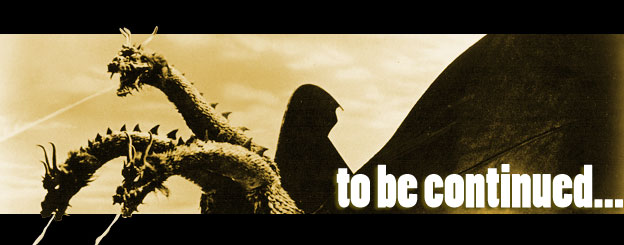
The theme had a slow and steady sound, the heaviness mirrored the last moments of the game. The music team at SNK had clearly been paying close attention to the giant monster genre. The Godzilla theme for example had a heavy, almost tragic sound. That heaviness made the character more sympathetic as the films progressed. Even though some people survived the encounter in the features, the devastation left behind remained. All of the memories I had from watching all the classic monster movies as a kid came flooding back. The very first time I beat King of the Monsters I had a newfound appreciation for the genre. I knew that I owed it to the team to make sure that the full credits would appear on my blog if I ever got around to talking about the game. As much as I enjoyed Rampage and Movie Monster there was so much more that the genre offered. SNK had made their mark and would follow up with a sequel just a year later. We shall explore the radical departure that was King of the Monsters 2 in the next blog.
In the previous blog I mentioned how the Japanese were crazy for all things Disney. The theme parks had done a great job instilling a sense of fun, imagination and quality when it came to Western cartoon characters. Outside the parks the Disney brand made its name in the arcade market. Not necessarily through games but rather through prizes in redemption machines. The library of Disney characters appeared in toy shelves and in many department stores but the younger fans would see plush figures, watches and other prizes in the popular claw-style arcade cabinets. Arcade machines could be found in many locations, making the figures easily accessible. Sega had the Disney license for decades and enjoyed the status that the partnership gave the company. In almost every arcade the Disney and Sega names were synonymous.
Universal knew that in order to make their brand and especially their park successful in Japan they needed to penetrate the arcade market as well. They released their own line of plush figures which could be found in the parks as well as in various prize machines but what they really needed was a marquee campaign. A partnership was formed with Taito (famous for Space Invaders) to create a line of products that could be found exclusively in prize machines. In order to catch up the rest of the world as to who Oswald was they decided that every plush figure featuring the character should come with a tag and description. Some of the figures even came boxed and a short introduction to the character was printed right on the box. On the various tags that came with the plush figures they made sure to highlight the fact that Walt Disney created the character in 1927. Universal knew that the Disney buffs in Japan would realize that this character predated Mickey Mouse.
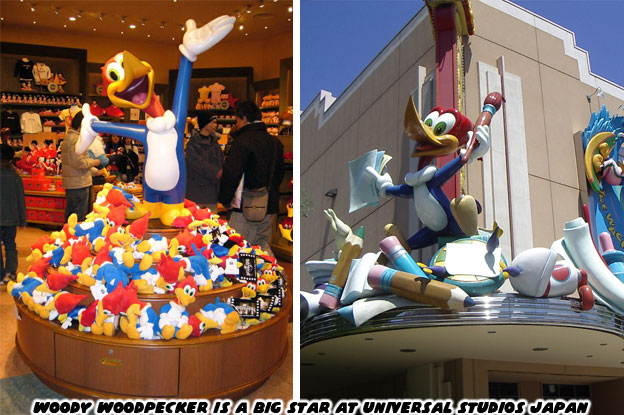
Not every plush was available via the prize machines. A dedicated line was also created to be sold exclusively in Universal Studios Japan. Of course Oswald would have to be weaned onto audiences. Woody Woodpecker was the big draw at the park and the first mascot character that most saw when they visited it. Like Mickey Mouse the character was timeless. The face of Woody and his fellow cartoon characters would be plastered all over the park and even the various buses and trams that took audiences to the resort and surrounding hotels. Certainly there were newer animated characters, those from the Shrek and Madagascar films, and even live action characters from Harry Potter but Woody came from the golden age of animation and was therefore more respected.
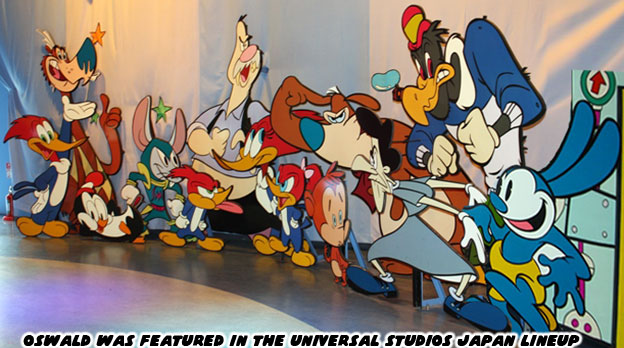
Since Oswald was much older than Woody and created by Walt Disney himself he was expected to be well received. The Japanese animation fans took great pride in learning their history and revered classic figures. The hunch at Universal was right. People were fascinated by the blue furred rabbit. His most recent makeover went over very well, especially when a standee was placed alongside the rest of the Walt Lantz characters in the park. Oswald was set next to Buzz Buzzard, he was opposite of where Woody was on a two-dimensional photo op. This was around the end of 2004. Of course the Oswald standee was removed almost a year later when the rights were transferred back to Disney.
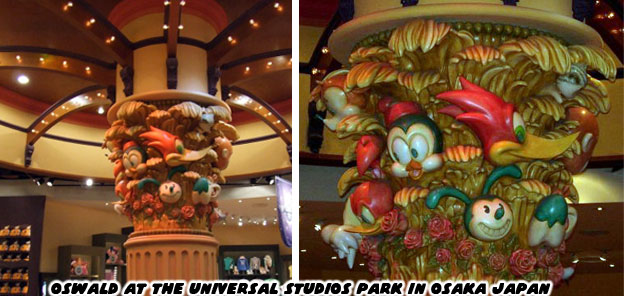
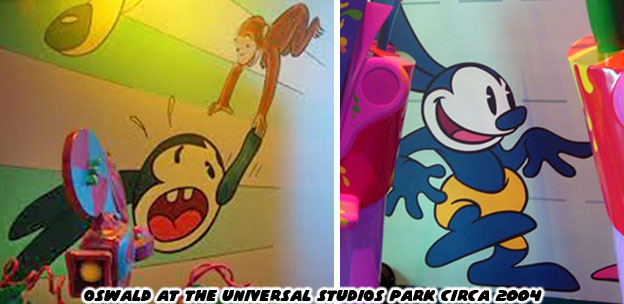
For the brief time that Oswald was in Universal Studios Japan the company made sure that he was integrated with the other icons. The sculptures in the studio store included a 3D facade of Oswald, this too was sadly removed a year later.
Oswald graphics were pasted around the park so that audiences would become familiar with the character. In one mural Curious George, another Universal license, was pulling on the rabbit's nose.
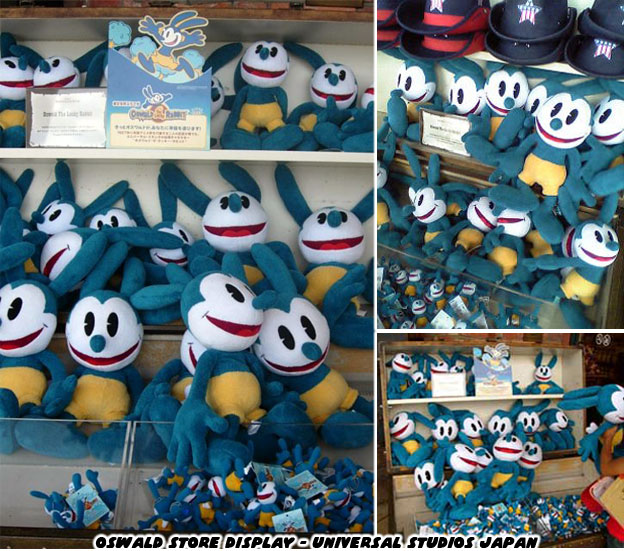
No trip to the studio store would be complete without Oswald plush figures. There were various sizes available for collectors from a small cell phone strap to an enormous pillow-sized doll. These figures could sometimes be found in the Taito prize machines. The larger plush dolls were rarer than the tiny ones.
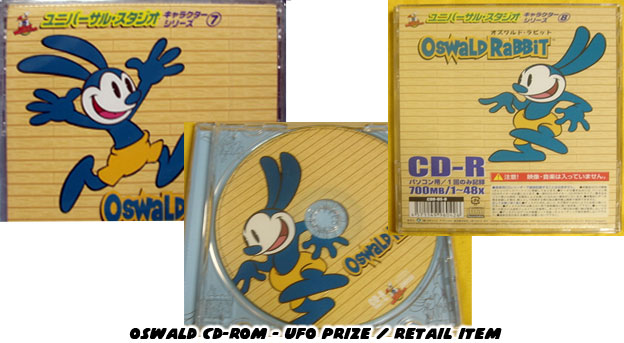
Not every prize offered in the machines was a plush. There were watches, inflatable figures and even a CD-ROM available as prizes. Taito handled the majority of the licensing and figure creation but there were a few other items bearing the character that also came out at the same time.
Oswald mania was gaining ground. Through 2005 many Japanese visitors were aware of the character. News of his appearance made its way to the USA. Fans were eager to see Oswald turn up in the US parks as well. No sooner did Taito and Universal reintroduce the Lucky Rabbit to audiences than he was traded back to Disney. This sudden change meant that vendors had to pull the plush figures from the shelves and scrub any hint that Oswald was ever a featured character at Universal. Once the arcade operators ran out of Oswald figures in their machines they were out of luck. Taito would have to restock them with some other licensed character. This shift created an overnight demand from serious collectors but for the majority of the world it was enough that Oswald was back in the public consciousness.
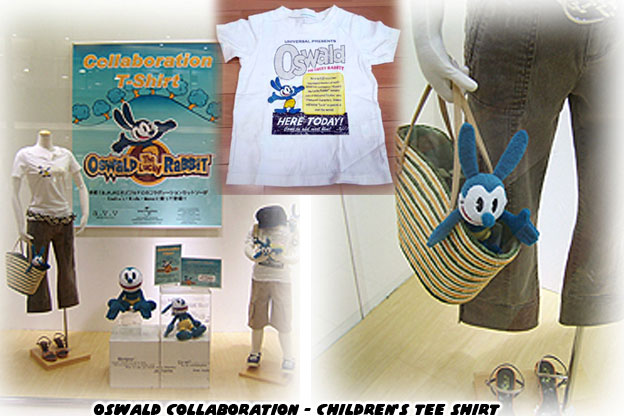
One of the most important things that helped bring Oswald back to the people had less to do with plush figures or prize machines and more with clothing. Tee shirt manufacturers were interested in this rare character and were eager to try and collaborate with either Universal or Disney and get some shirts out on the streets right away. The next blog will look at how the tee shirt manufacturers had a hand in helping shape the look of Oswald.
If you would like to sponsor me please visit my Patreon page and consider donating each month, even as little as $1 would help make better blogs and even podcasts!
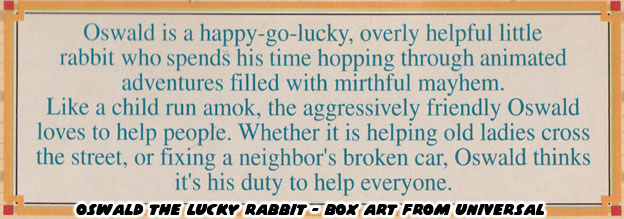
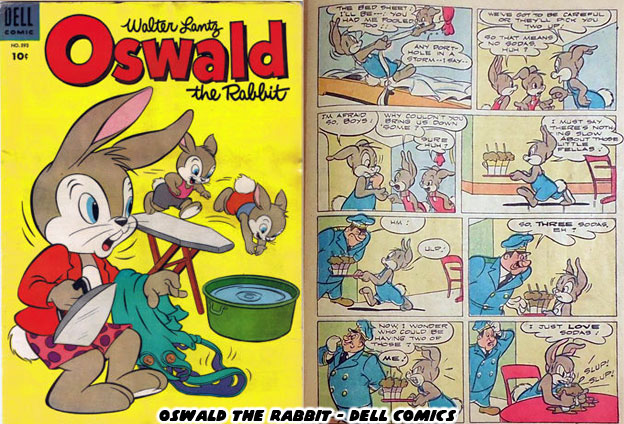
Oswald underwent a number of revisions since his introduction in 1927. He changed his look almost as often as he changed owners prior to World War II. The success of Woody Woodpecker and his friends meant that Walter Lantz could focus on running a mini animation empire. Toys, licenses and ancillary uses of his characters had to be carefully managed. The Lantz characters found popularity on the printed page just as they did on the silver screen. Oswald was one character that enjoyed a good run in comic books. He did not look or act anything at all like his old self while in the stories. Instead of enjoying a life of mischief and adventure he became a family friendly face. He was cast as the adopted father to young rabbits Floyd and Lloyd. His stories were very simplistic.
Any redeeming factors that Oswald may have had were lost in the formulaic plots of the comics. By contrast Mickey Mouse went on amazing journeys every week thanks to Floyd Gottfredson and his comic strip. In the comic book arena none could touch the stories by Carl Barks featuring Donald Duck and Scrooge McDuck. The Oswald comics were hopelessly bland by comparison to what Disney produced on a regular basis.
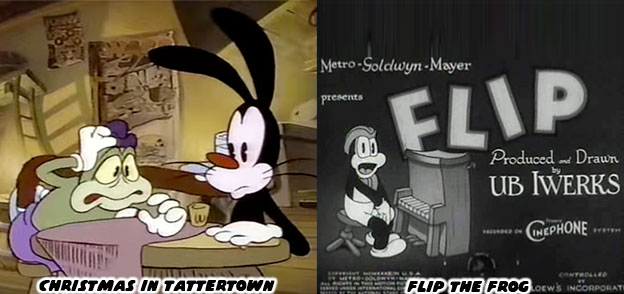
Post WWII there was little that kept Oswald in the minds and hearts of audiences. His last animated appearance was a cameo in the Woody Woodpecker Polka animated short. The 1951 cartoon featured a catchy song but not many fans realized that it was Oswald walking into the barn with a bunch of other Lantz mascots. The rabbit would not make another animated appearance for another 35+ years. The 1988 Ralph Bakshi animated film Christmas in Tattertown was a story set around a bunch of stuffed dolls and nursery rhyme characters come-to-life. About 3:05 minutes into the film there was a scene set inside a bar where a bunch of classic cartoon characters could be seen hanging out. You can hear Flip the Frog confess to Oswald "I could have been bigger than Mickey. I just didn't have the organization behind me."
Only die-hard animation buffs would have recognized the two characters seated together. Ub Iwerks left the Disney studios on bad terms in 1930. He felt he wasn't being fairly compensated, or credited for all of his contributions to the studio. He left and started his own animation studio where he created a character called Flip the Frog for MGM. He worked for several other studios over the decade but returned to Disney in 1940. He patched things up with Walt but one the condition of his return he stopped animating and became a special effects producer. Pioneering a number of revolutionary film, animation and even effects that would be used in many of the Disney live action films, the 1964 Worlds Fair and Disneyland certified Ub as a genius. Sadly his animated stars never quite lived up to the same reputation. Animation pioneer Ralph Bakshi and his friends never forgot and made sure that Flip and Oswald were framed together even if just for a moment. Sadly very few people outside of animation would have caught the gag. Most did not give the rabbit a second thought after that.
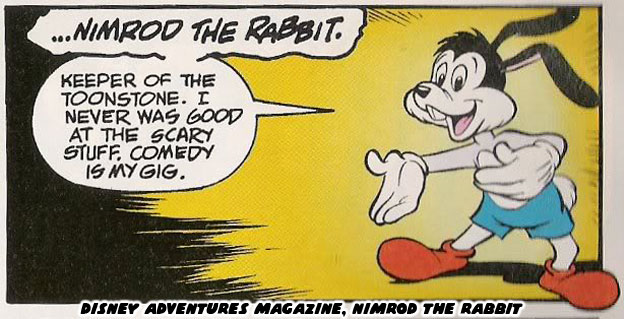
Disney Adventures Magazine did manage to feature one last nod to the character. In the late 1990's a cartoon police officer named Bonkers ran across an old carttoon legend known as Nimrod the Rabbit. Disney was still years away from getting back the rights to Oswald. This was just a way of having fun at the expense of the character. With the exception of reprints of the old Dell comics in Latin American countries and overseas through the '90s and '00s it was the last known original take on the character since the '60s. All of that changed in 2004 when Oswald the Lucky Rabbit suddenly turned up in Japan.
Universal Studios Japan was very similar to the other Universal parks in the USA. The studio had a library of film and animated characters used in rides, attractions and even restaurants. Although these characters were all based on older US icons the Japanese were nonetheless fascinated by them. The Japanese were great fans of western-style theme parks thanks to the success of Tokyo Disneyland. The Disney park had opened in 1983 and could be considered one of the most well run, well maintained and successful of all of the theme parks around the world. In 2001 Universal hoped to capture some of that market and opened its own park in Osaka Japan. The studio learned that they would have to incorporate some new Japanese licenses and make some changes to their merchandise in order to become more appealing to their audience. Unfortunately for them a few months after Universal Osaka debuted Disney opened up a second gate and called it Tokyo Disney Sea. Universal seemed outmaneuvered by the more popular Disney brand.
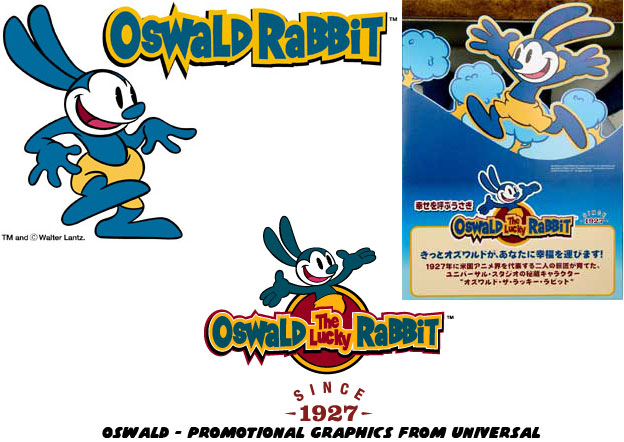
In 2004 Universal had found its ace. The company was already using the Walt Lantz characters in the park and stores. They discovered that they had the rights to Disney's first cartoon star as well. So they created a campaign to reintroduce him to park visitors and the rest of the nation. It was very important that wherever they could, especially on signage and item tags, they mentioned that Oswald was the first star created by Walt Disney. But in order to help sell the legend they had to give Oswald a makeover. They wanted to make sure that this character complimented Woody Woodpecker and friends but at the same time look a little older. They did away with the anthropomorphic rabbit. They replaced him with a much friendlier pie-eyed mascot. Oswald had a strong retro-look but was not tied into one specific period. They decided not to make the character black and white but instead an ocean blue with yellow shorts. This color combination ensured that the he would stand out from his contemporaries and certainly not be mistaken for Mickey!
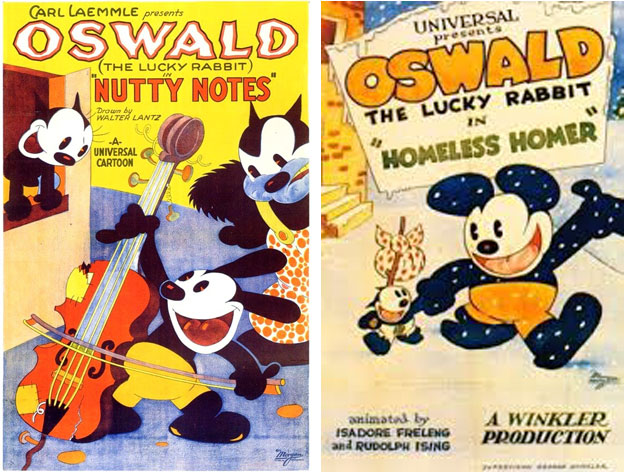
The origins for the Oswald redesign were rooted on two distinct things. The shape was based on the classic Ub Iwerks / Walter Lantz era of the character. The new look was slightly longer but overall timeless. The colors were based on at least two classic film posters, Nutty Notes and Homeless Homer, which each featured Oswald in yellow shorts.
Universal made a concession to a widely used Lantz design and featured Oswald wearing suspenders, or rather the single strap over his shoulder. These were from his days of wearing overalls in the latter cartoons and comics. To be fair many of Ub's original designs and advertising art featured Oswald wearing a strap as well. This look became standardized by Universal as part of the modern Oswald model sheet. The change hit so fast and so authoritative that it was adopted overnight by the companies still reprinting the old Dell comics.
There were still writers and artists creating new Oswald comics in Latin American countries. They also adopted the redesign and made sure that audiences knew that this was a return to a classic. Oswald mania was just beginning to take hold in Japan. The next blog will look at the ways in which Universal pushed the rabbit to the masses.
If you would like to sponsor me please visit my Patreon page and consider donating each month, even as little as $1 would help make better blogs and even podcasts!