As much fun as I had with Rampage I felt that something was missing. The immersion offered by the PC game Movie Monster was absent. Granted, most arcade developers did not want to slow down the gameplay just for the sake of allowing a player to get settled in. Rampage was very transparent. It was an attempt to milk players of their quarters without a guarantee of a resolution for all their destruction. Making money was the purpose of all arcade games but the better ones had an outcome that offered more than a high score to audiences. In 1991 the SNK corporation released a title that I would consider one of the best giant monster games ever made but also one of the least known titles. The King of the Monsters was unique in that it was the first giant monster game to mix genres. It was both a rampage title, rewarding players by how much destruction they caused, but also a wrestling game.
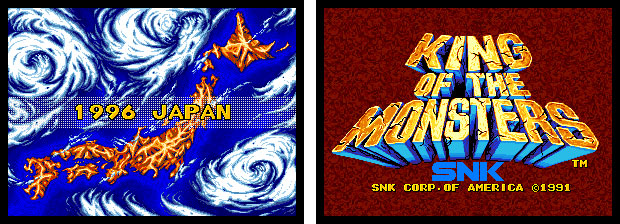
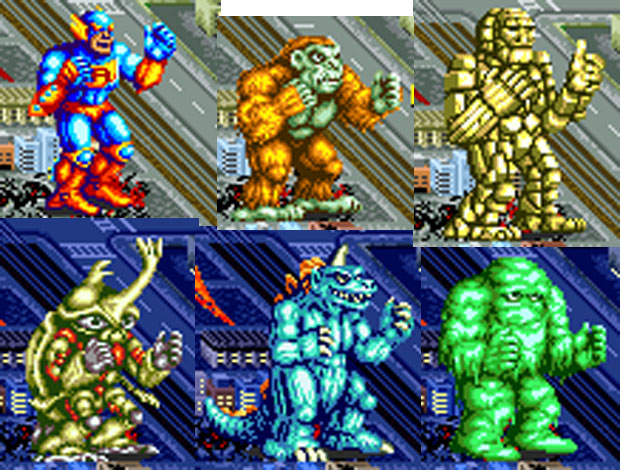
King of the Monsters was set in the near future, 1996 to be precise. Players could select from one of six unique monsters. The creatures were thinly veiled knock-offs of famous movie monsters. Geon, Woo, Poison Ghost, Rocky, Beetle Mania and Astro Guy were inspired by Godzilla, Kong Kong, Hedora, Daimajin, Megalon and Ultraman respectively. Each monster even had their own distinct roar. The characters were much larger in scale than those featured on just about every other game. They were as tall as a skyscraper and could flatten most roads, bridges and buildings in the game simply by walking over them.
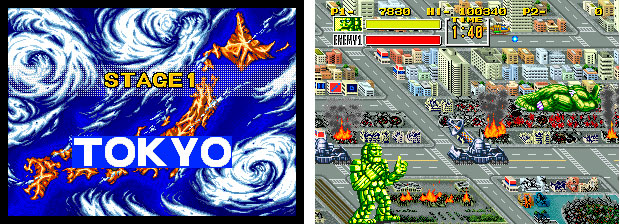
The game offered several modes; player-versus-player, 2-players versus the computer or single player versus the computer. The entirety of the game took place in Japan. Six of the major cities, including Tokyo and Hiroshima were featured as stages. This was set up to be the ultimate giant monster smack down.
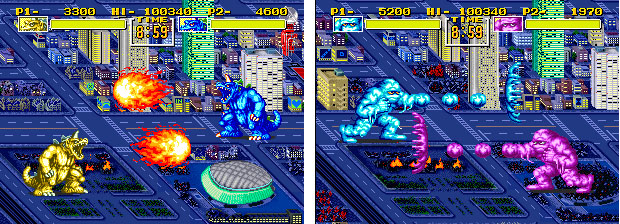
Players had an assortment of attacks. A basic punch or kick and a throw. If a player pressed a direction while grappling with an opponent then they could perform a slam or power move against them. Power moves included piledrivers, bear hugs and backbreakers. An opponent that fell to a power move also dropped a Power orb. Collecting 10 Power orbs allowed players to upgrade their special attack up one level. Players maxed out a special attack after two levels, or 20 orbs. If a player held down the attack buttons they could charge up for a special attack. The special attack was a ranged strike, capable of hitting the opponent from across the screen. Some special attacks were energy lasers, fireballs or electrical sparks.
Players could also grab items from the ground, like tanks and speeding bullet trains to throw at opponents. Even low flying military and jumbo jets could be snatched out of the sky and thrown.
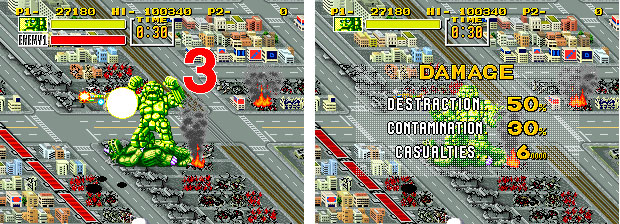
Players were rewarded by defeating opponents with a 3-count pin but also based on how much collateral damage they caused. Walking over buildings, throwing opponents through refineries and crushing vehicles all gave the player a bonus. One of my favorite mistranslations from any game was in the end level score. Players were rated on how much Distraction they caused rather than Destruction. This was King of the Monsters in a nutshell but there was far more to the game than that.
The game borrowed plenty of elements from the classic movies. Arcade games, especially fighting games, were not always known for giving players time to settle into their world. This was a rare exception. SNK managed to do that without interrupting the 3-minute matches. The developer mixed in all the important details through audio cues as the game progressed. On the introduction of the first and every third level a news reporter would break in and play up the calamity that the creatures were causing. Explosions could be heard in the background of each "broadcast." The panic in his voice was well performed, it helped put players in the scene. It was not hard to imagine that the news reporter was on the edge of the city, reporting from a safe distance.
Just about everything in the game had its own sound effect. As the monsters moved their titanic footsteps echoed on the tiny arcade cabinet speakers. The sounds of buildings turning to rubble, trees snapping and water splashing were present as the creatures moved through different terrain. Traffic could be heard as the tiny cars, no more than a few pixels in height, travelled through the streets. Some audio effects helped players learn when an object was just about to enter the stage. A horn blast signaled that a bullet train was going to pass through town. If a player were standing on the track then he could either derail the train or pull it off the tracks just as it passed. A jet roar signaled that a plane was nearby, a player that timed a jump could snatch the plane right out of the sky and then throw it.
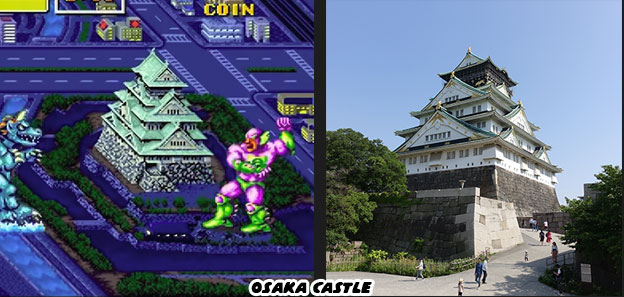
The amount of detail placed into each stage was absurd. Buildings had working neon signs and electronic billboards. Amusement park rides actually moved and famous landmarks from each town were crammed into the stages. The Tower of the Sun, the Tokyo Dome and the Himeji Castle helped put gamers in Osaka, Tokyo and Kobe respectively. Each of the landmarks could even be flattened for a major bonus. Although I had never been to Japan I recognized many of the locations from TV and movies. These were details that SNK put into their game that both Bally Midway and Epyx had overlooked.
It was one thing for the Western-produced titles to say the game was taking place in Tokyo or New York but another thing to show players the city. In the original Rampage the game told players they were in Chicago but the buildings looked similar to Denver. The silhouette in the background was different but nothing else really stood out. In Movie Monster players had to use some imagination to distinguish between the cities as well. I didn't mind using my imagination but it was much easier to get into the game when I had all the necessary elements. The more details a studio could present to fill in those gaps the less that a gamer had to suspend their disbelief. SNK eliminated any doubt that the monsters were fighting in their own towns. All of the landmarks were present on each stage, perfect to body slam an opponent on top of.
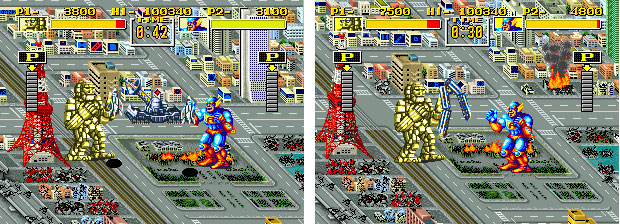
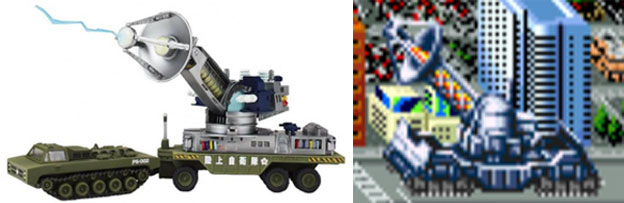
Each stage was cut off by electronic barriers. The barriers acted like the ropes in a wrestling ring. Players could throw opponents off the barriers and catch them with a clothesline. The mix of science fiction and military technology had been a staple in the movies. The Godzilla films were known for their use of sci-fi weapons. Tanks equipped with energy towers could shoot beams of electricity to help redirect the path of Godzilla. These "Maser Cannons" were used in several films. SNK put their own version in the game. Players could hear the sound of heavy tank treads before any of these vehicles had even entered the city. They caused considerable damage if players were hit with the waves of energy they projected. Players could pick up and throw the tanks at opponents before they even got a shot off though.
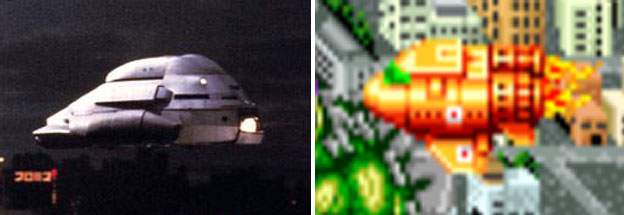
King of the Monsters even included a flying secret weapon to battle the monsters. The bright orange jet was based on the Super X. In the Godzilla films the Super X managed to put up a good battle against the giant lizard. In KOTM the jet could also turn the tide of battle. Thankfully the ships could also be snatched from the sky as well.
The game itself was one of the most challenging titles I had ever played. I was never any good at arcade wrestling games. I felt that the timing was tricky for those titles and the combat provided by fighting games was a little easier to get into. As a fan of giant monsters I was determined to see the ending of the game. The first time I played the game I spent a couple of bucks and only managed to get a few characters in. I made the mistake of running headlong into battle and punching and kicking as if it were a fighting game. Going toe-to-toe was a big mistake as the computer AI threw me all over the place. I thought that I should learn how to play the game first or I was going to waste my allowance on one title.
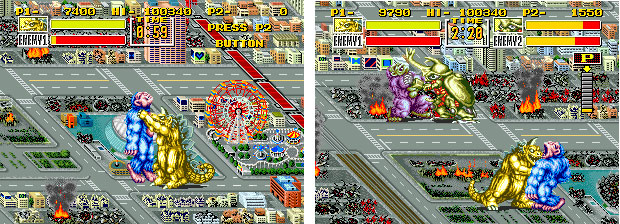
I realized that SNK gave players exactly 3 minutes per match and expected players to use every last second on the clock. Since opponents had to be pinned then I would first have to wear them down first. Even if I depleted all of my opponent's energy they would kick out two or more times, just like in a pro wrestling match. I learned to pin them near the electronic barriers. If they threw me off they might end up shocking themselves and buy me time to get up. I also learned that special attacks did a lot of damage even on fallen opponents so I had to power that up right away. I could have my character level up within the first two matches by applying the same power moves over and over, usually a backbreaker or bear hug. Once my character was fully powered I would spend the entirety of the match slowly whittling down my opponent. Kicking them while they were down, throwing every object I could in their direction and performing high risk moves when I saw an opening. I learned to catch my opponent off guard by throwing running clotheslines at them. The animation of the monsters' eyes bugging out when they were caught by the lariat was hilarious.
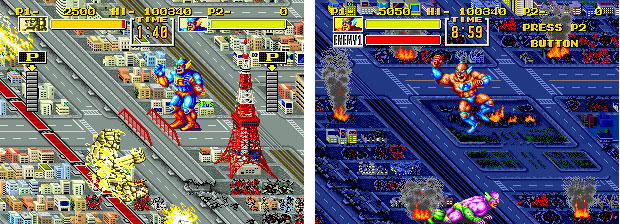
The computer was just as relentless as I was. A human player could be pinned even if they still had a little bit of energy left. I felt this was a little bit of a cheat by the SNK programmers. I would have to press all the buttons as fast as possible and shake the joystick in order to break the pin. A player could kick out of two pin attempts but no matter how much energy they had left over the computer would win the third pin automatically. Many a match was saved when my monster threw an opponent off just a fraction of a second from the 3 count. I would then quickly get up and cover my opponent with barely any time to spare. I eventually got so good at the game that I would eat up the clock on purpose. Going for as much collateral damage as possible and then pinning my opponent with 10 seconds or less remaining on the game clock. I knew I had mastered the game when I could beat it on one quarter. It took fierce concentration and some mad button presses though to get through all twelve stages. Players had to defeat all six monster twice before getting to the ending screens. I was rewarded with some incredibly high scores for my effort. I had the top spots on the leader board and was never knocked from #1. Part of the reason was because players that put in another quarter to continue had their score reset. Other players beat the game but nobody else came close to my record.
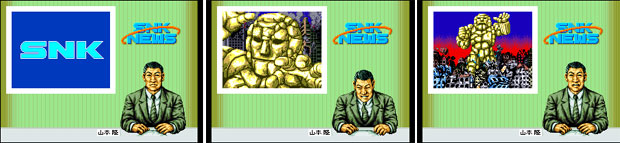
It was the ending of the game that completely blew my mind. SNK had incorporated the announcer that was following the monsters around into a short cinema. Digitized voices were not new to gaming but the length of the recording and the tone of the announcer caught my attention. He was reporting from a studio which monster was the victor and how he was devastating all of Tokyo. He warned that it would only be a matter of time before he attacked the radio station. Suddenly the screen began shaking he then began yelling for people to take cover. The urgency in his voice sounded sincere as pieces of the studio dropped from above. Then suddenly a large piece of stone collapsed and landed right on the announcer. Before he was crushed the TV signal cut out, leaving only static.
I was floored by the ending. I had never seen any game turn the tables on a player. I had no idea that all of the fighting would have ended in the death of the announcer. Although there was no blood the ending was still a bit of a shock. I was sold on the game when the credits immediately rolled and the theme to King of the Monsters "Cry of Lamentation" played. In typical Japanese programming style a bunch of nicknames rolled on the screen, those developers rarely used their actual names. All I could think about was what a great job they had done putting this together. Hamachi Papa, Mitsuzo and their coworkers had knocked the game out of the park.
The theme had a slow and steady sound, the heaviness mirrored the last moments of the game. The music team at SNK had clearly been paying close attention to the giant monster genre. The Godzilla theme for example had a heavy, almost tragic sound. That heaviness made the character more sympathetic as the films progressed. Even though some people survived the encounter in the features, the devastation left behind remained. All of the memories I had from watching all the classic monster movies as a kid came flooding back. The very first time I beat King of the Monsters I had a newfound appreciation for the genre. I knew that I owed it to the team to make sure that the full credits would appear on my blog if I ever got around to talking about the game. As much as I enjoyed Rampage and Movie Monster there was so much more that the genre offered. SNK had made their mark and would follow up with a sequel just a year later. We shall explore the radical departure that was King of the Monsters 2 in the next blog.