Showing posts with label universal studios japan. Show all posts

Wednesday, December 31, 2014

Oswald the Lucky Rabbit, a list of Taito products featuring the rabbit!


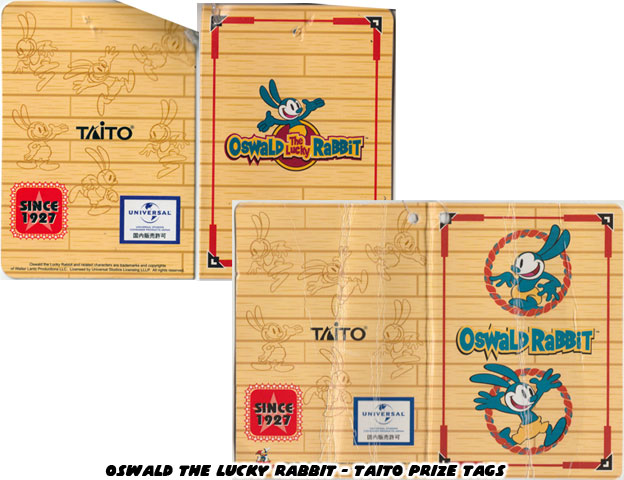
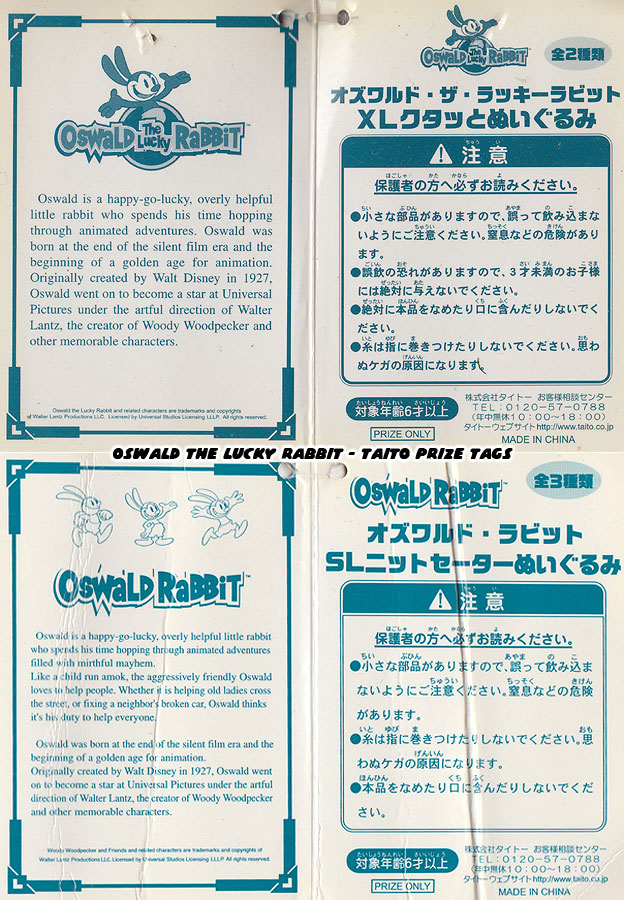
I had some pictures left over after my series on the evolution of Oswald the Lucky Rabbit and thought to share these with my fellow Oswald fans. In particular these are images of the various prizes created by Taito for Universal Studios in Japan. For the almost two years that the company had the rights to Oswald they created more unique and memorable Oswald merchandise than Disney did in the first few years since they got the character back. Let's take a look at the tags that were created for the various plush figures that had come out.


Universal wanted to educate their audience as to Oswald's origins. The Disney name carried a lot of weight in Japan. His films inspired Osamu Tezuka, the godfather of Manga. Presented was the character that predated Mickey and helped put Walt Disney on the map.


The tags sold the origin myth of Oswald very well while ignoring the fact that the studio stole the character and most of Walt's animators away from him. Taito designed many figures which would become prizes in their arcade machines. Oswald appeared in several formats.


The majority of the Oswald figures were plush but at least two were actually a soft vinyl, like a bean bag.


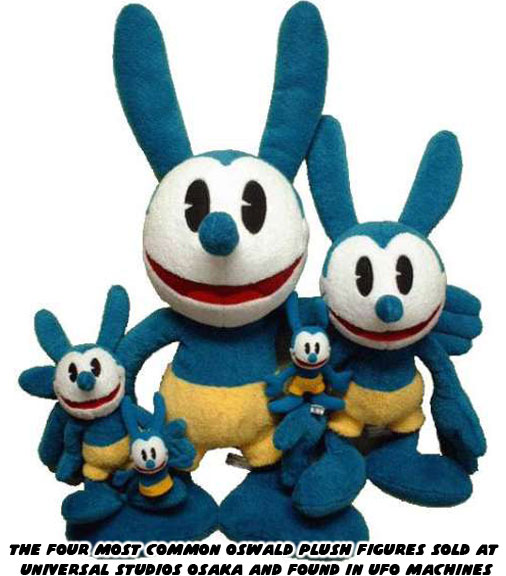
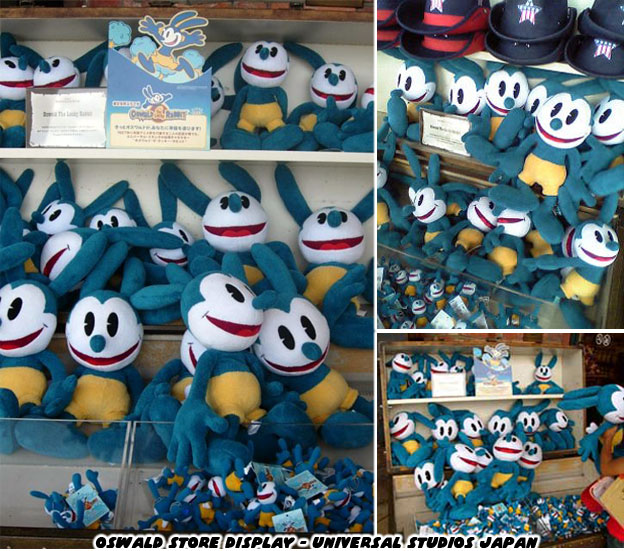
There was a set of Oswald figures that were sold exclusively in the Universal Japan park. They were small, medium and large plush figures with similar proportions and expressions.


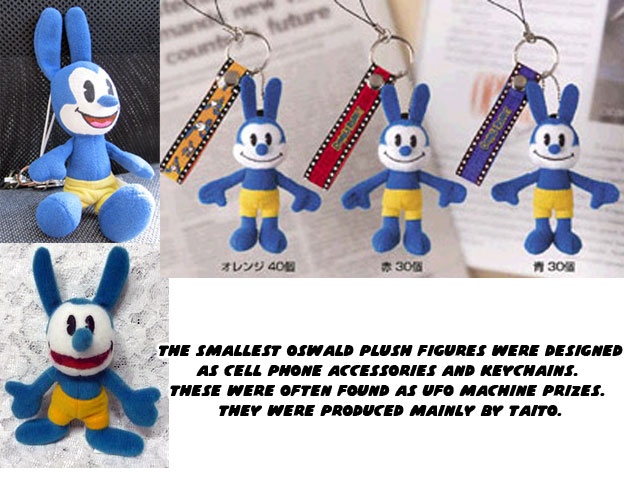
The smallest figures were designed as cell phone straps, it was and continues to be a popular trend in Japan to have mascot keychains and accessories.


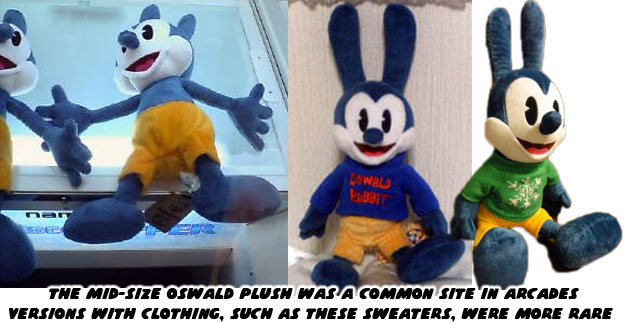
One of the more common Oswald figures seen outside of the theme park was a mid-size plush figure. The character was mainly seen shirtless. The earliest version of the character sometimes had a sweater with his name on it. There were at least four different sweater colors with this version. There was also one with a green "Christmas" sweater released during the winter.


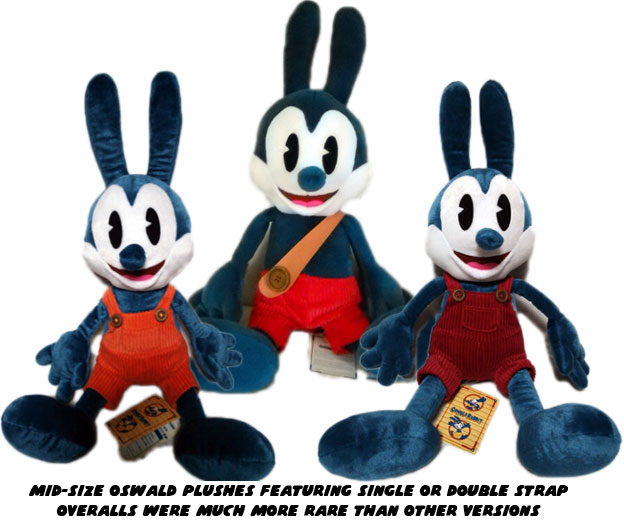
Oswald was often presented with a single overall strap over his shoulder. Several figures did have the character in full overalls. This was a nod to the early appearance of Oswald as a farm-type character in the comic books. These plush figures were more rare than the typical mid-size figures.


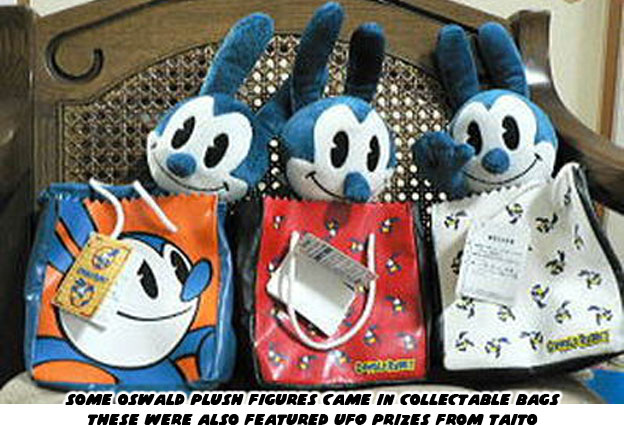
Some of the smaller mid-size figures came in collectible soft vinyl bags. Note that these figures had closed mouths, subtle differences like these made the figures desirable to fans.


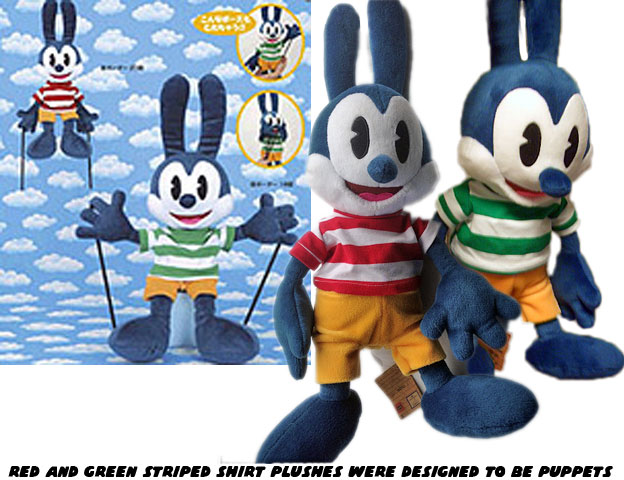
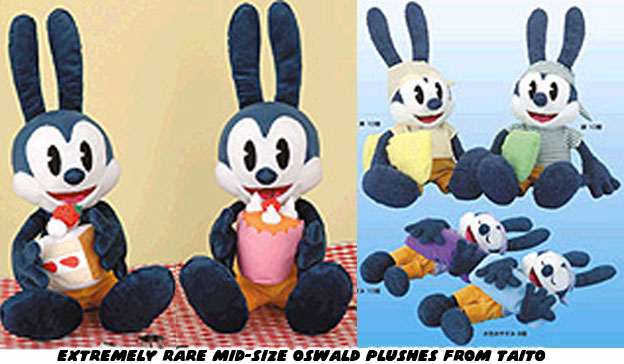
During the spring and summer there was a version of Oswald wearing a striped shirt. Taito had planned for this character to be used as a puppet. Unfortunately I do not know of any pictures with the character actually having the control arms.


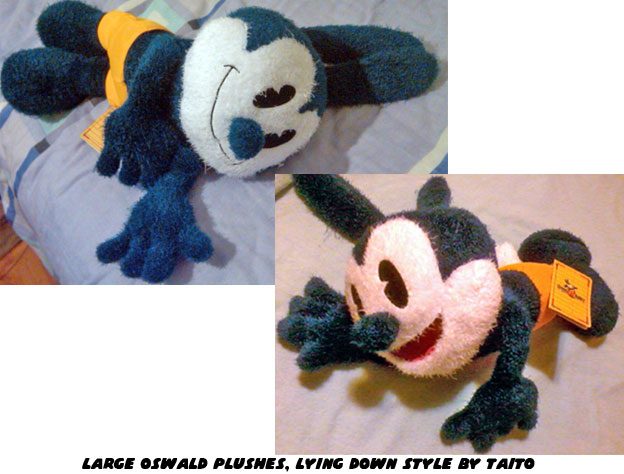
One of the largest figures made by the company was Oswald lying down. This plush figure was made with a soft material much fuzzier than the mid-size plush figures. There were two known versions of this figure made, one with an open mouth and one with a closed mouth.


Possibly the rarest of the mid-size plush figures were the cake and sleeping versions. A small plush cake was affixed to the hands of some characters. The others featured Oswald in a head scarf and nigh shirt while holding a pillow. At least two of the sleeping versions were presented with closed eyes.


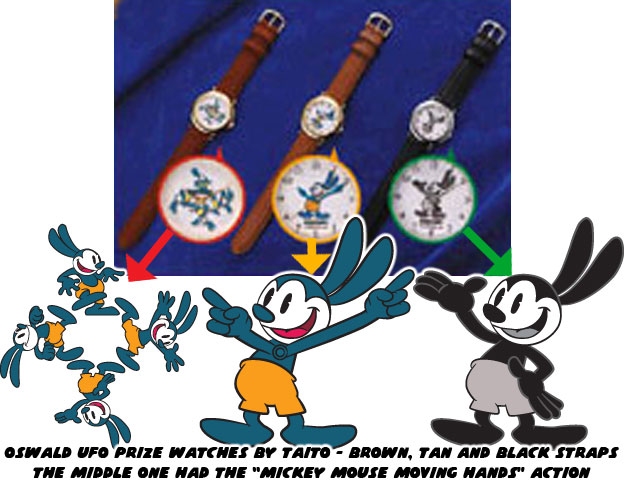
Not everything that Taito produced for Universal was a plush figure. Three of the most unique items from the company were watches. At least one of the watches had moving hands similar to the classic Ingersoll Mickey Mouse watch. This was the first Oswald watch to figure that type of movement. After Disney got the rights back Japanese watch maker Hirob created a variation of the moving hands action as well. Any of these watches are highly sought after collector pieces.


While the vast majority of everything that Taito and Universal produced had a blue fur Oswald wearing yellow shorts I did see at least one alternate colorway of the character. Many years ago when I purchased an Oswald plush from a Japanese arcade vendor I noticed that he had a picture of the same figure but in with gray fur and red shorts. Had I known that the Taito items would have disappeared overnight I certainly would have ordered the alternate color version. I used Photoshop to mock-up what the figure looked like in my memories. If I ever come across any other versions produced by Taito I'll be sure to share them on the blog. If you would like to sponsor me please visit my Patreon page and consider donating each month, even as little as $1 would help make better blogs and even podcasts!
follow the Street Writer on Patreon!

Monday, December 22, 2014

The evolution of Oswald the Lucky Rabbit, part 5...


In the previous blog I mentioned how the Japanese were crazy for all things Disney. The theme parks had done a great job instilling a sense of fun, imagination and quality when it came to Western cartoon characters. Outside the parks the Disney brand made its name in the arcade market. Not necessarily through games but rather through prizes in redemption machines. The library of Disney characters appeared in toy shelves and in many department stores but the younger fans would see plush figures, watches and other prizes in the popular claw-style arcade cabinets. Arcade machines could be found in many locations, making the figures easily accessible. Sega had the Disney license for decades and enjoyed the status that the partnership gave the company. In almost every arcade the Disney and Sega names were synonymous.


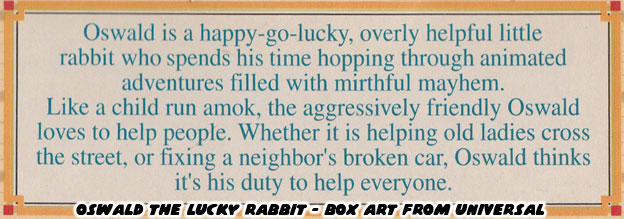
Universal knew that in order to make their brand and especially their park successful in Japan they needed to penetrate the arcade market as well. They released their own line of plush figures which could be found in the parks as well as in various prize machines but what they really needed was a marquee campaign. A partnership was formed with Taito (famous for Space Invaders) to create a line of products that could be found exclusively in prize machines. In order to catch up the rest of the world as to who Oswald was they decided that every plush figure featuring the character should come with a tag and description. Some of the figures even came boxed and a short introduction to the character was printed right on the box. On the various tags that came with the plush figures they made sure to highlight the fact that Walt Disney created the character in 1927. Universal knew that the Disney buffs in Japan would realize that this character predated Mickey Mouse.


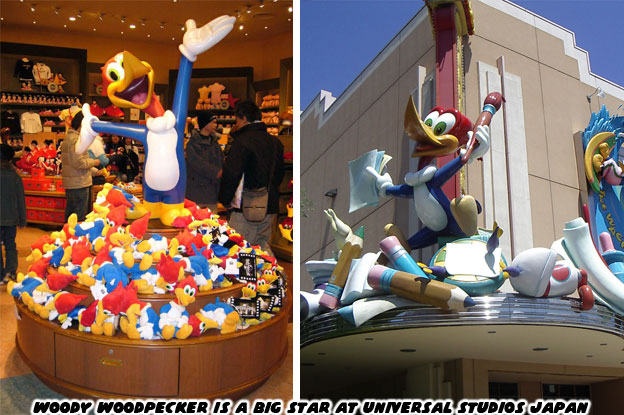
Not every plush was available via the prize machines. A dedicated line was also created to be sold exclusively in Universal Studios Japan. Of course Oswald would have to be weaned onto audiences. Woody Woodpecker was the big draw at the park and the first mascot character that most saw when they visited it. Like Mickey Mouse the character was timeless. The face of Woody and his fellow cartoon characters would be plastered all over the park and even the various buses and trams that took audiences to the resort and surrounding hotels. Certainly there were newer animated characters, those from the Shrek and Madagascar films, and even live action characters from Harry Potter but Woody came from the golden age of animation and was therefore more respected.


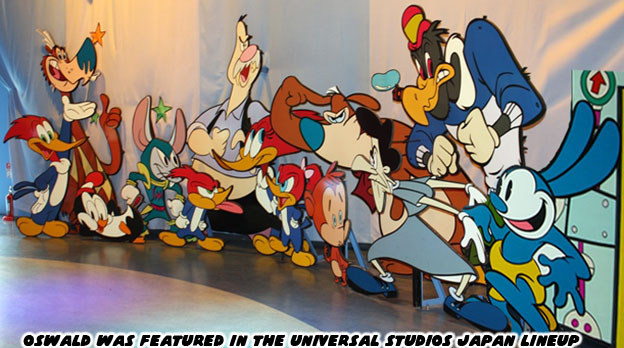
Since Oswald was much older than Woody and created by Walt Disney himself he was expected to be well received. The Japanese animation fans took great pride in learning their history and revered classic figures. The hunch at Universal was right. People were fascinated by the blue furred rabbit. His most recent makeover went over very well, especially when a standee was placed alongside the rest of the Walt Lantz characters in the park. Oswald was set next to Buzz Buzzard, he was opposite of where Woody was on a two-dimensional photo op. This was around the end of 2004. Of course the Oswald standee was removed almost a year later when the rights were transferred back to Disney.


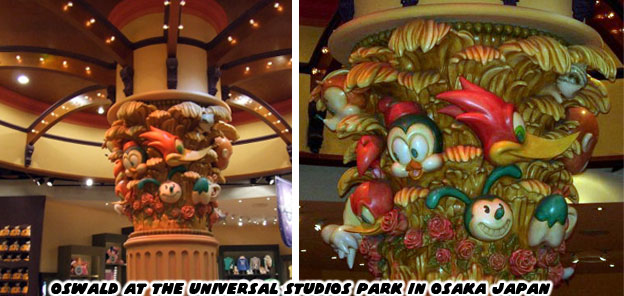
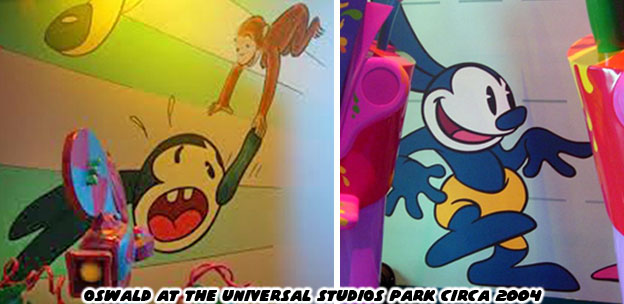
For the brief time that Oswald was in Universal Studios Japan the company made sure that he was integrated with the other icons. The sculptures in the studio store included a 3D facade of Oswald, this too was sadly removed a year later.


Oswald graphics were pasted around the park so that audiences would become familiar with the character. In one mural Curious George, another Universal license, was pulling on the rabbit's nose.


No trip to the studio store would be complete without Oswald plush figures. There were various sizes available for collectors from a small cell phone strap to an enormous pillow-sized doll. These figures could sometimes be found in the Taito prize machines. The larger plush dolls were rarer than the tiny ones.


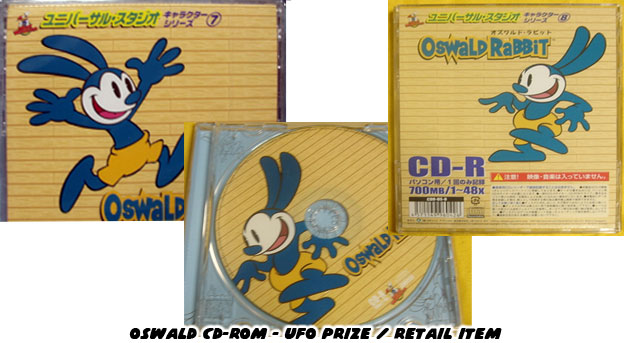
Not every prize offered in the machines was a plush. There were watches, inflatable figures and even a CD-ROM available as prizes. Taito handled the majority of the licensing and figure creation but there were a few other items bearing the character that also came out at the same time.


Oswald mania was gaining ground. Through 2005 many Japanese visitors were aware of the character. News of his appearance made its way to the USA. Fans were eager to see Oswald turn up in the US parks as well. No sooner did Taito and Universal reintroduce the Lucky Rabbit to audiences than he was traded back to Disney. This sudden change meant that vendors had to pull the plush figures from the shelves and scrub any hint that Oswald was ever a featured character at Universal. Once the arcade operators ran out of Oswald figures in their machines they were out of luck. Taito would have to restock them with some other licensed character. This shift created an overnight demand from serious collectors but for the majority of the world it was enough that Oswald was back in the public consciousness.


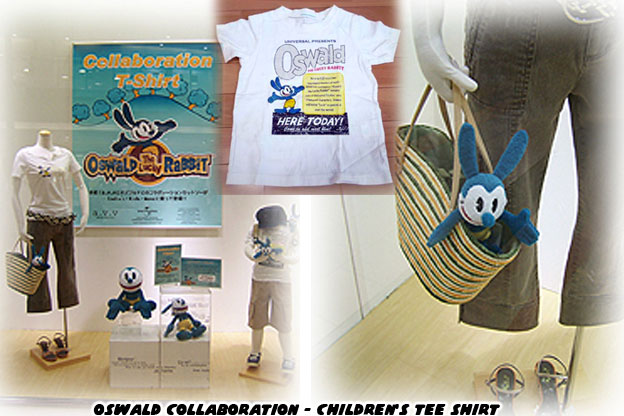
One of the most important things that helped bring Oswald back to the people had less to do with plush figures or prize machines and more with clothing. Tee shirt manufacturers were interested in this rare character and were eager to try and collaborate with either Universal or Disney and get some shirts out on the streets right away. The next blog will look at how the tee shirt manufacturers had a hand in helping shape the look of Oswald. If you would like to sponsor me please visit my Patreon page and consider donating each month, even as little as $1 would help make better blogs and even podcasts!
follow the Street Writer on Patreon!

Friday, December 19, 2014

The evolution of Oswald the Lucky Rabbit, part 4...


Oswald underwent a number of revisions since his introduction in 1927. He changed his look almost as often as he changed owners prior to World War II. The success of Woody Woodpecker and his friends meant that Walter Lantz could focus on running a mini animation empire. Toys, licenses and ancillary uses of his characters had to be carefully managed. The Lantz characters found popularity on the printed page just as they did on the silver screen. Oswald was one character that enjoyed a good run in comic books. He did not look or act anything at all like his old self while in the stories. Instead of enjoying a life of mischief and adventure he became a family friendly face. He was cast as the adopted father to young rabbits Floyd and Lloyd. His stories were very simplistic.
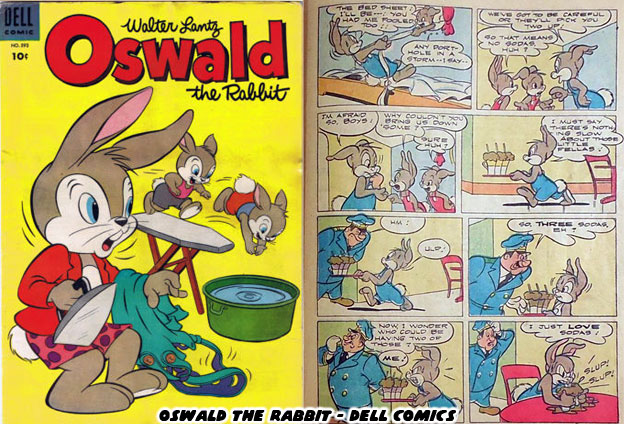


Any redeeming factors that Oswald may have had were lost in the formulaic plots of the comics. By contrast Mickey Mouse went on amazing journeys every week thanks to Floyd Gottfredson and his comic strip. In the comic book arena none could touch the stories by Carl Barks featuring Donald Duck and Scrooge McDuck. The Oswald comics were hopelessly bland by comparison to what Disney produced on a regular basis.

Post WWII there was little that kept Oswald in the minds and hearts of audiences. His last animated appearance was a cameo in the Woody Woodpecker Polka animated short. The 1951 cartoon featured a catchy song but not many fans realized that it was Oswald walking into the barn with a bunch of other Lantz mascots. The rabbit would not make another animated appearance for another 35+ years. The 1988 Ralph Bakshi animated film Christmas in Tattertown was a story set around a bunch of stuffed dolls and nursery rhyme characters come-to-life. About 3:05 minutes into the film there was a scene set inside a bar where a bunch of classic cartoon characters could be seen hanging out. You can hear Flip the Frog confess to Oswald "I could have been bigger than Mickey. I just didn't have the organization behind me."
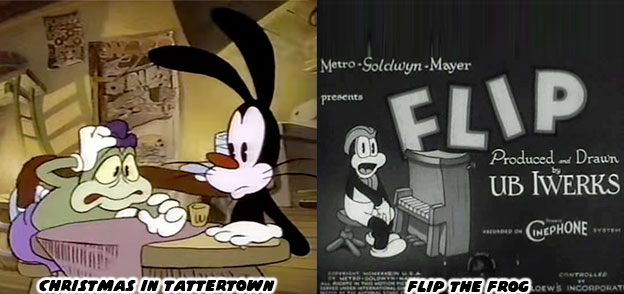


Only die-hard animation buffs would have recognized the two characters seated together. Ub Iwerks left the Disney studios on bad terms in 1930. He felt he wasn't being fairly compensated, or credited for all of his contributions to the studio. He left and started his own animation studio where he created a character called Flip the Frog for MGM. He worked for several other studios over the decade but returned to Disney in 1940. He patched things up with Walt but one the condition of his return he stopped animating and became a special effects producer. Pioneering a number of revolutionary film, animation and even effects that would be used in many of the Disney live action films, the 1964 Worlds Fair and Disneyland certified Ub as a genius. Sadly his animated stars never quite lived up to the same reputation. Animation pioneer Ralph Bakshi and his friends never forgot and made sure that Flip and Oswald were framed together even if just for a moment. Sadly very few people outside of animation would have caught the gag. Most did not give the rabbit a second thought after that.
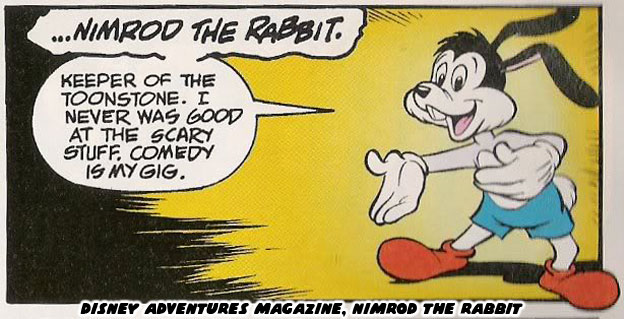


Disney Adventures Magazine did manage to feature one last nod to the character. In the late 1990's a cartoon police officer named Bonkers ran across an old carttoon legend known as Nimrod the Rabbit. Disney was still years away from getting back the rights to Oswald. This was just a way of having fun at the expense of the character. With the exception of reprints of the old Dell comics in Latin American countries and overseas through the '90s and '00s it was the last known original take on the character since the '60s. All of that changed in 2004 when Oswald the Lucky Rabbit suddenly turned up in Japan.

Universal Studios Japan was very similar to the other Universal parks in the USA. The studio had a library of film and animated characters used in rides, attractions and even restaurants. Although these characters were all based on older US icons the Japanese were nonetheless fascinated by them. The Japanese were great fans of western-style theme parks thanks to the success of Tokyo Disneyland. The Disney park had opened in 1983 and could be considered one of the most well run, well maintained and successful of all of the theme parks around the world. In 2001 Universal hoped to capture some of that market and opened its own park in Osaka Japan. The studio learned that they would have to incorporate some new Japanese licenses and make some changes to their merchandise in order to become more appealing to their audience. Unfortunately for them a few months after Universal Osaka debuted Disney opened up a second gate and called it Tokyo Disney Sea. Universal seemed outmaneuvered by the more popular Disney brand.
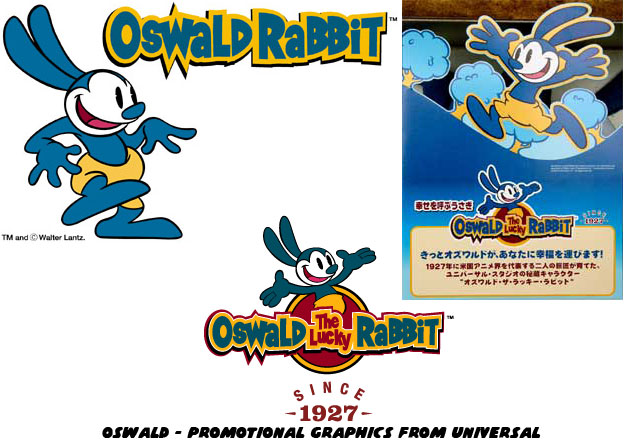


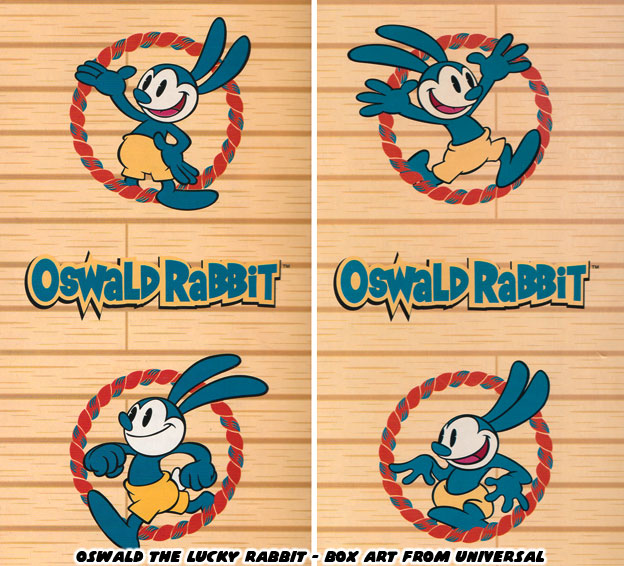
In 2004 Universal had found its ace. The company was already using the Walt Lantz characters in the park and stores. They discovered that they had the rights to Disney's first cartoon star as well. So they created a campaign to reintroduce him to park visitors and the rest of the nation. It was very important that wherever they could, especially on signage and item tags, they mentioned that Oswald was the first star created by Walt Disney. But in order to help sell the legend they had to give Oswald a makeover. They wanted to make sure that this character complimented Woody Woodpecker and friends but at the same time look a little older. They did away with the anthropomorphic rabbit. They replaced him with a much friendlier pie-eyed mascot. Oswald had a strong retro-look but was not tied into one specific period. They decided not to make the character black and white but instead an ocean blue with yellow shorts. This color combination ensured that the he would stand out from his contemporaries and certainly not be mistaken for Mickey!
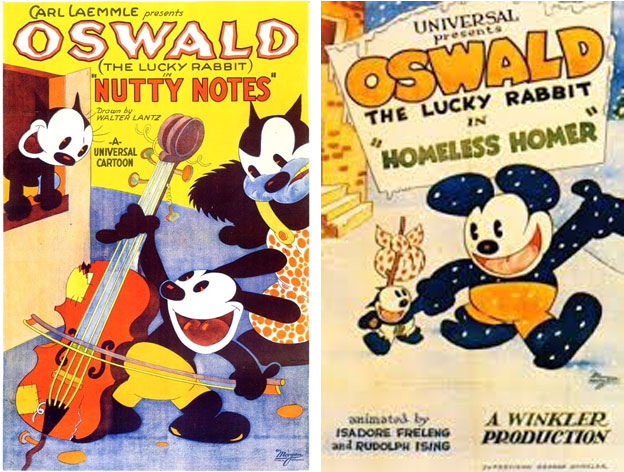


The origins for the Oswald redesign were rooted on two distinct things. The shape was based on the classic Ub Iwerks / Walter Lantz era of the character. The new look was slightly longer but overall timeless. The colors were based on at least two classic film posters, Nutty Notes and Homeless Homer, which each featured Oswald in yellow shorts.


Universal made a concession to a widely used Lantz design and featured Oswald wearing suspenders, or rather the single strap over his shoulder. These were from his days of wearing overalls in the latter cartoons and comics. To be fair many of Ub's original designs and advertising art featured Oswald wearing a strap as well. This look became standardized by Universal as part of the modern Oswald model sheet. The change hit so fast and so authoritative that it was adopted overnight by the companies still reprinting the old Dell comics.


There were still writers and artists creating new Oswald comics in Latin American countries. They also adopted the redesign and made sure that audiences knew that this was a return to a classic. Oswald mania was just beginning to take hold in Japan. The next blog will look at the ways in which Universal pushed the rabbit to the masses. If you would like to sponsor me please visit my Patreon page and consider donating each month, even as little as $1 would help make better blogs and even podcasts!
follow the Street Writer on Patreon!