Showing posts with label ub iwerks. Show all posts

Friday, December 19, 2014

The evolution of Oswald the Lucky Rabbit, part 4...


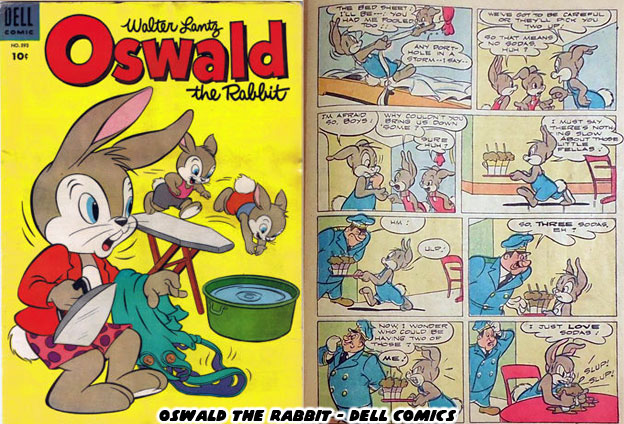
Oswald underwent a number of revisions since his introduction in 1927. He changed his look almost as often as he changed owners prior to World War II. The success of Woody Woodpecker and his friends meant that Walter Lantz could focus on running a mini animation empire. Toys, licenses and ancillary uses of his characters had to be carefully managed. The Lantz characters found popularity on the printed page just as they did on the silver screen. Oswald was one character that enjoyed a good run in comic books. He did not look or act anything at all like his old self while in the stories. Instead of enjoying a life of mischief and adventure he became a family friendly face. He was cast as the adopted father to young rabbits Floyd and Lloyd. His stories were very simplistic.


Any redeeming factors that Oswald may have had were lost in the formulaic plots of the comics. By contrast Mickey Mouse went on amazing journeys every week thanks to Floyd Gottfredson and his comic strip. In the comic book arena none could touch the stories by Carl Barks featuring Donald Duck and Scrooge McDuck. The Oswald comics were hopelessly bland by comparison to what Disney produced on a regular basis.

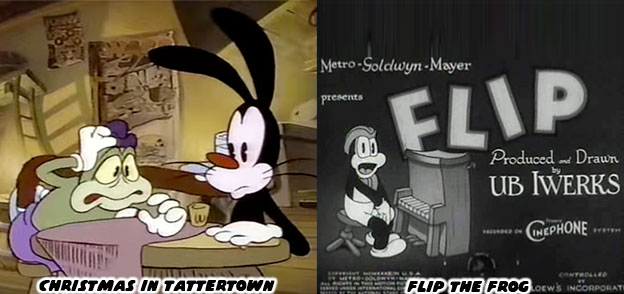
Post WWII there was little that kept Oswald in the minds and hearts of audiences. His last animated appearance was a cameo in the Woody Woodpecker Polka animated short. The 1951 cartoon featured a catchy song but not many fans realized that it was Oswald walking into the barn with a bunch of other Lantz mascots. The rabbit would not make another animated appearance for another 35+ years. The 1988 Ralph Bakshi animated film Christmas in Tattertown was a story set around a bunch of stuffed dolls and nursery rhyme characters come-to-life. About 3:05 minutes into the film there was a scene set inside a bar where a bunch of classic cartoon characters could be seen hanging out. You can hear Flip the Frog confess to Oswald "I could have been bigger than Mickey. I just didn't have the organization behind me."


Only die-hard animation buffs would have recognized the two characters seated together. Ub Iwerks left the Disney studios on bad terms in 1930. He felt he wasn't being fairly compensated, or credited for all of his contributions to the studio. He left and started his own animation studio where he created a character called Flip the Frog for MGM. He worked for several other studios over the decade but returned to Disney in 1940. He patched things up with Walt but one the condition of his return he stopped animating and became a special effects producer. Pioneering a number of revolutionary film, animation and even effects that would be used in many of the Disney live action films, the 1964 Worlds Fair and Disneyland certified Ub as a genius. Sadly his animated stars never quite lived up to the same reputation. Animation pioneer Ralph Bakshi and his friends never forgot and made sure that Flip and Oswald were framed together even if just for a moment. Sadly very few people outside of animation would have caught the gag. Most did not give the rabbit a second thought after that.


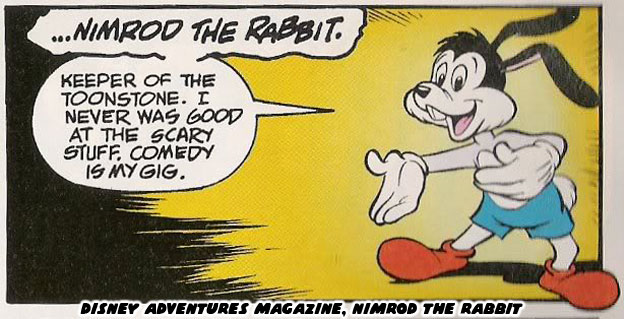
Disney Adventures Magazine did manage to feature one last nod to the character. In the late 1990's a cartoon police officer named Bonkers ran across an old carttoon legend known as Nimrod the Rabbit. Disney was still years away from getting back the rights to Oswald. This was just a way of having fun at the expense of the character. With the exception of reprints of the old Dell comics in Latin American countries and overseas through the '90s and '00s it was the last known original take on the character since the '60s. All of that changed in 2004 when Oswald the Lucky Rabbit suddenly turned up in Japan.

Universal Studios Japan was very similar to the other Universal parks in the USA. The studio had a library of film and animated characters used in rides, attractions and even restaurants. Although these characters were all based on older US icons the Japanese were nonetheless fascinated by them. The Japanese were great fans of western-style theme parks thanks to the success of Tokyo Disneyland. The Disney park had opened in 1983 and could be considered one of the most well run, well maintained and successful of all of the theme parks around the world. In 2001 Universal hoped to capture some of that market and opened its own park in Osaka Japan. The studio learned that they would have to incorporate some new Japanese licenses and make some changes to their merchandise in order to become more appealing to their audience. Unfortunately for them a few months after Universal Osaka debuted Disney opened up a second gate and called it Tokyo Disney Sea. Universal seemed outmaneuvered by the more popular Disney brand.


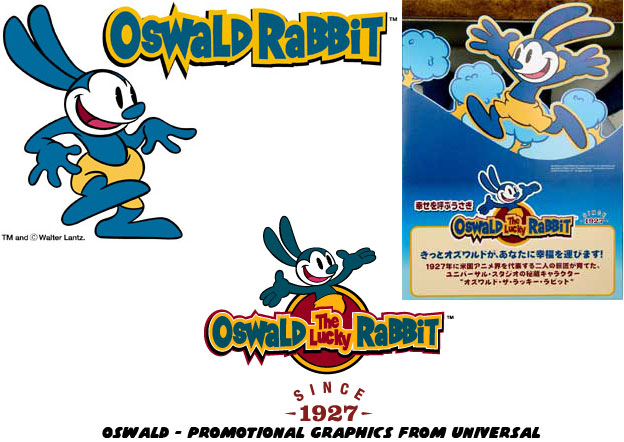
In 2004 Universal had found its ace. The company was already using the Walt Lantz characters in the park and stores. They discovered that they had the rights to Disney's first cartoon star as well. So they created a campaign to reintroduce him to park visitors and the rest of the nation. It was very important that wherever they could, especially on signage and item tags, they mentioned that Oswald was the first star created by Walt Disney. But in order to help sell the legend they had to give Oswald a makeover. They wanted to make sure that this character complimented Woody Woodpecker and friends but at the same time look a little older. They did away with the anthropomorphic rabbit. They replaced him with a much friendlier pie-eyed mascot. Oswald had a strong retro-look but was not tied into one specific period. They decided not to make the character black and white but instead an ocean blue with yellow shorts. This color combination ensured that the he would stand out from his contemporaries and certainly not be mistaken for Mickey!


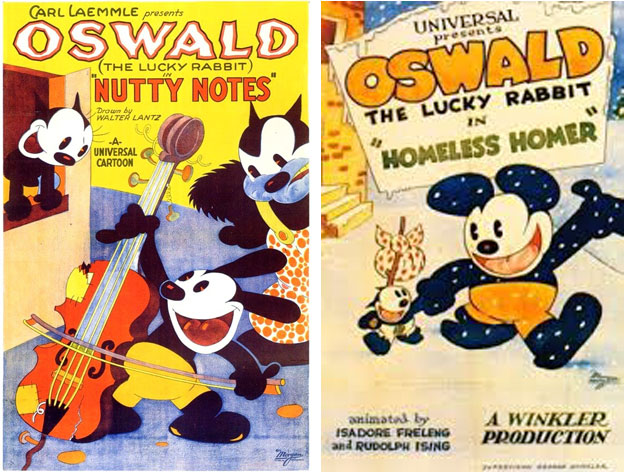
The origins for the Oswald redesign were rooted on two distinct things. The shape was based on the classic Ub Iwerks / Walter Lantz era of the character. The new look was slightly longer but overall timeless. The colors were based on at least two classic film posters, Nutty Notes and Homeless Homer, which each featured Oswald in yellow shorts.


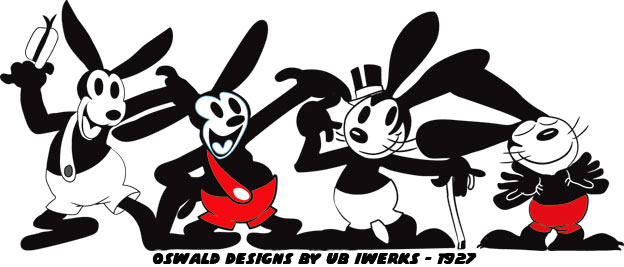
Universal made a concession to a widely used Lantz design and featured Oswald wearing suspenders, or rather the single strap over his shoulder. These were from his days of wearing overalls in the latter cartoons and comics. To be fair many of Ub's original designs and advertising art featured Oswald wearing a strap as well. This look became standardized by Universal as part of the modern Oswald model sheet. The change hit so fast and so authoritative that it was adopted overnight by the companies still reprinting the old Dell comics.


There were still writers and artists creating new Oswald comics in Latin American countries. They also adopted the redesign and made sure that audiences knew that this was a return to a classic. Oswald mania was just beginning to take hold in Japan. The next blog will look at the ways in which Universal pushed the rabbit to the masses. If you would like to sponsor me please visit my Patreon page and consider donating each month, even as little as $1 would help make better blogs and even podcasts!
follow the Street Writer on Patreon!

Monday, December 15, 2014

The evolution of Oswald the Lucky Rabbit, part 2...


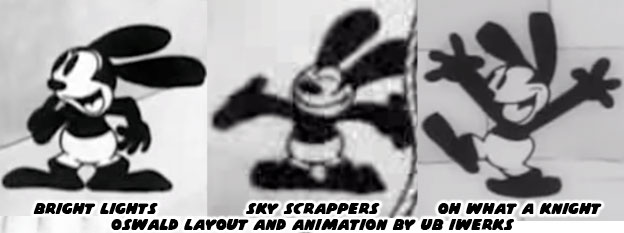
Many Disney fans are familiar with Oswald the Lucky Rabbit these days but not long ago he was an obscure trivia answer. The most recognizable version of Oswald the Rabbit was actually created by Ub Iwerks. His proportions, scale and size were standardized within a year.


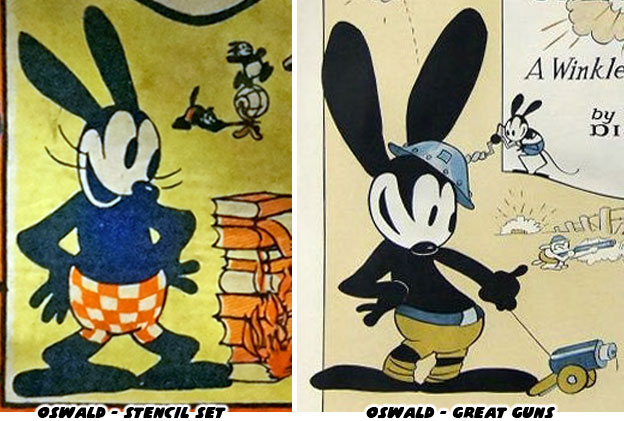
What the current-generation of Disney fans might not realize was how much Oswald changed in the span of a few years. In the original poster art and designs for Oswald Ub had planned a taller, lankier character. His head was more egg-shaped and often featured whiskers on his face and claws on his feet.


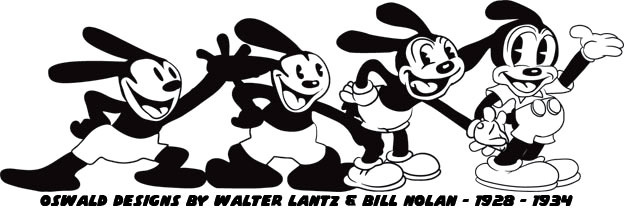
Oswald was visualized as having suspenders in some early pieces. These elements were paired down and Oswald became shorter and rounder in the process. The whiskers eventually went away. By the end of 1927 and the start of 1928 the look that most fans are familiar with finally took shape. Yet it was also about then that Disney had lost the rights to the character. Lantz took over and spared no time in remaking the character.


The post-Disney Oswald cartoons were notable for the lack of consistency. The quality of the animation suffered greatly. Animator Bill Nolan had worked for Disney and was one of the artists that left. He was a very prolific artist as well and was capable of producing almost as many frames of art as Ub Iwerks. Yet the one thing he lacked was the visual consistency of Ub. The lines for Oswald were sloppy, his movement lacked fluidity. Nolan was nowhere near the draftsman that Ub was. Nolan worked with Walter Lantz and helped redesign Oswald over the years. The shape of the head and eyes changed again. The costume did as well. The runaway success of Mickey Mouse meant that all of the following characters had to poach many of Mickey's design elements. Oswald soon found himself wearing shoes and sporting a shirt and even buttons on his shorts.


Despite the visual makeover fans were not flocking to Oswald as they once were. The cartoons lacked the creative spark that Disney had. They also lacked the quality and consistency that Ub offered. Oswald spoke in the Universal films but his voice changed from picture to picture because different animators took turns recording the character. Even Pinto Colving (the eventual voice for Goofy) did some voice work for the character. Oswald was losing ground to Mickey Mouse and his friends. Lantz would continue changing the character to try and fit the times. All of the lessons that Ub discovered while creating a cartoon rabbit would have to be relearned by Waner Bros. a decade later when they created a character called Bugs Bunny.


Realistic animal shapes did not lend themselves easily to animation. The artists had to take a lot of liberties in order to make the characters work in the medium of film. Luckily for Warner Bros. some of the animators working on Bugs had first cut their teeth animating Oswald. These artists learned very quickly not get too used to one school of design. Lantz was not finished changing the look of Oswald. In the next blog we will look at how far the character had changed from his first appearance. If you would like to sponsor me please visit my Patreon page and consider donating each month, even as little as $1 would help make better blogs and even podcasts!
follow the Street Writer on Patreon!

Friday, December 12, 2014

The evolution of Oswald the Lucky Rabbit, part 1...


Do you have a favorite comic book or cartoon character that you have stayed with even though they changed over the years? In some cases the change was due to a storyline. Those that follow Marvel's X-Men characters are fluent with the number of lineup and costume changes they have had. Some characters became injured or grossly disfigured and had to undergo a visual makeover by the artist over a stretch of issues. Many fans can pinpoint a favorite iteration of Wolverine or Storm for example. Some attribute a specific look to a certain artist. Some characters change simply because the popular aesthetic changes over time as well. For example the comic book characters of the 1970s were not drawn the same as those from today. Fans could still make out Wolverine and Storm but they looked different simply because of the aesthetic of the era. Even the most famous cartoon characters are not immune to change. The "rubber hose" animation from the silent film era was refined over half a century until animators learned how to create the illusion of weight and mass on a two-dimensional object. The purpose of this series is to see how my favorite Disney cartoon character changed over the years and yet managed to return to his original aesthetic. Before we talk about the changes we have to learn what made the character worth remembering.

Oswald the Lucky Rabbit was the forefather to Mickey Mouse. Many Disney fans could tell you the origin of the character and many of the things that made him memorable. Oswald, like his more famous successor, spoke to the every-man. He wasn't born into money but was instead a hard working character. This was an important detail because while a handful of Americans were making obscene riches during the Gilded Age, there were also many living on the edge of ruin. The Wall Market crash of 1929 destroyed the economy and with it the hopes of many Americans. Those people were looking for a reason to smile during the turbulent era. Oswald and later Mickey Mouse were those reasons.
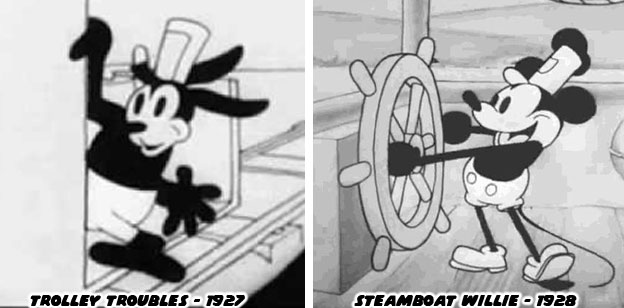


The two characters worked for a living but were content even when unemployed. That happy-go-lucky attitude was a big draw. In the first case Oswald operated a Trolley. A year later Mickey Mouse was featured as a steam ship pilot. Oswald's first completed cartoon was not Trolley Troubles but it was the first one shown to audiences. Just as in the same way Mickey's first cartoon was not Steamboat Willie but it was the first shown to audiences. During that time the look of Oswald had not been set. It did not matter what the character looked like because there were many memorable scenes in that film that kept audiences coming back. There was tremendous comedic timing from the rabbit that was showcased in the following cartoons. He could defy physics, swim through the air, pull his leg off, break into small pieces and put himself back together again. Many were gags pioneered by animator Ub Iwerks, Walt Disney and the staff at the fledgling Laugh-O-Gram animation studio.
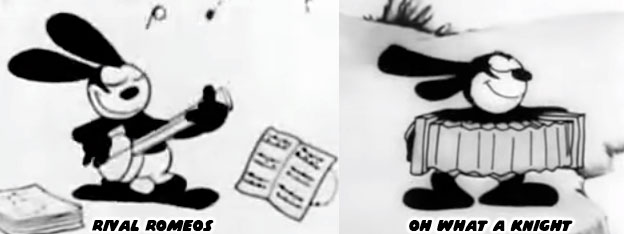
 

Where Oswald really shone was when he was romancing a girl. In some instances it was a female rabbit while in other shorts it was Ortensia the cat. It was as if there was nothing that was impossible for Oswald. He was truly a great leading man especially when he was trying to win the affections of his co-star. In addition to being an every-man Oswald was a bit of a musician. In a couple of his earliest appearances he could be seen trying to woo his girlfriend with a musical number. Unfortunately for the rabbit sound synchronization in animation had not yet become available to Walt Disney. Audiences had to use their imagination and guess that the sound of the theater organist was also a banjo or accordion.
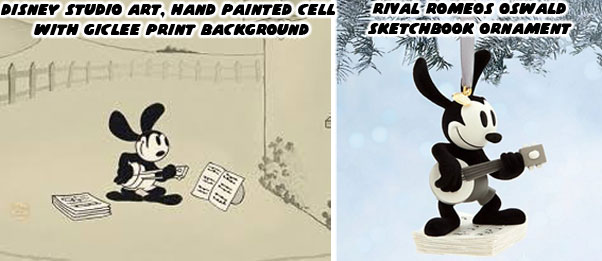
 

 It had been well over 80 years since Oswald had been seen playing a stringed instrument in Rival Romeos yet somebody at Disney had been doing their homework. One of the first collectable pieces of art that the studio produced after getting the rights back from Universal was a hand painted cell that rekindled that scene. A few short years later the company released a brilliant Christmas ornament celebrating the same scene. Yet it was not all smiles and music that made Oswald an important character. Oswald was absolutely the template for Mickey Mouse. Every detail that made Mickey a household name was pulled from Oswald. Both characters had a broad range of emotions. Both were playful but also prone to getting upset. In fact they were willing to get into fights if the situation called for it. This gave both dimension and made it easier for audiences to identify with them. It would be something that the Disney and Universal would get away from as Oswald and Mickey Mouse grew in popularity.
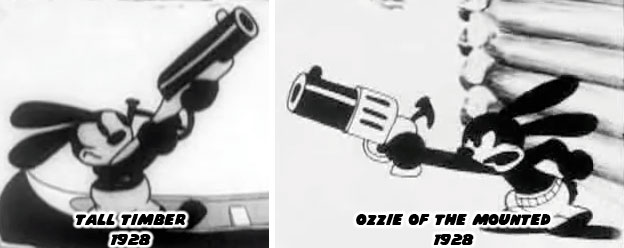


 The personality of Mickey Mouse would be stripped away little by little. His temper would be assigned to Donald Duck. His silly side would be given to Goofy and his loyalty to Pluto. By the '60s Mickey was devoid of any real range of emotions. He had become the face of the company and a family-friendly one that that. Oswald would become a mascot devoid of any real personality as the years went on. His traits would not really be transferred onto other characters created by the Lantz animation studio. Well, to be honest some of the silliness is reflected in the characteristics of the early Woody Woodpecker cartoons. The studios wanted audiences to forget that Oswald, Donald and even Mickey pulled guns in a cartoon. Yet that ability for the character to do something drastic also made them memorable. The characters did not fight for the sake of violence, if they did it was in self defense, usually when standing up to bullies. Nor did they resort to a firearm unless the situation, or the gag, called for it. Unfortunately for Walt he did not have Oswald long enough to see him develop into a real icon. As many Disney fans know Walt lost the rights to Oswald. Universal took the rabbit and even a great chunk of Walt's animators out from under him. His senior man Ub Iwerks stayed with him and helped Disney finish the remaining shorts that they were contractually obliged to produce.
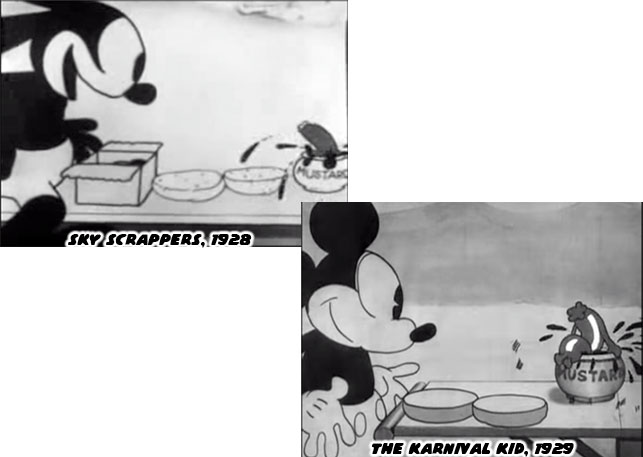


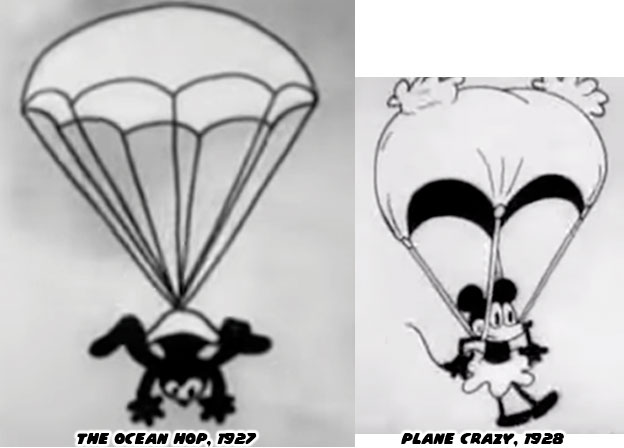
Something that Ub and Walt did was try and improve on the gags they were using in their final Oswald shorts. They began using some of the same set-ups for the early Mickey Mouse cartoons, which they were creating in secret. During this time Ub was creating hundreds of frames of art each and every day. At his peak he as pulling out 700 drawings a day, enough for a cartoon every two weeks. Ub understood the mechanics of animation, of perspective and timing. He was a natural at the art form and a master draftsman. He created many memorable gags for the early Oswald shorts as well. Some of the better ones he was willing to reuse for Mickey Mouse.


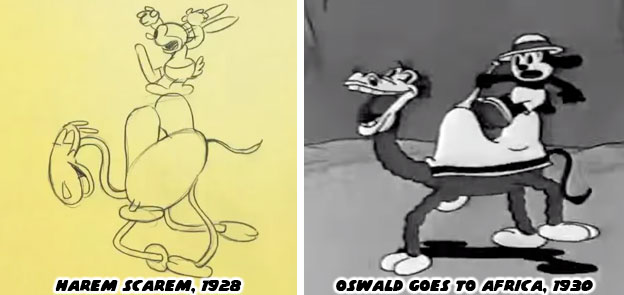
Some of the gags that the former Laugh-O-Gram animators had planned out for Oswald while he was at Disney eventually found their way into the later Walter Lantz animated films. One of the rarest Oswald films, Harem Scarem was lost to time. No known print exists but a few sketches from Ub do which the Disney Archive was kind enough to showcase at a D23 fan event. One of the visual gags had Oswald losing his balance while raiding atop a camel. A few years after Harem Scarem Universal released a sound film featuring Oswald called Oswald Goes to Africa. The gag had changed slightly to make use of sound but it was reminiscent of Ub's original designs.


Walter Lantz worked for Universal and was starting up his own animation studio. He had some of the animators that worked with Disney previously and were familiar with the rabbit. What he needed was a mascot to build his studio around. He won the rights to Oswald in a card game against Universal producer Carl Lammle. He stayed with the studio and produced the majority of Oswald's animated adventures in the following years. What he also did was give the character a radical makeover. We will explore this more in the next blog. If you would like to sponsor me please visit my Patreon page and consider donating each month, even as little as $1 would help make better blogs and even podcasts!
follow the Street Writer on Patreon!