Showing posts with label chompoo. Show all posts

Thursday, September 28, 2017

Hiding the master in plain sight, the genius of SNK's character design...part 2

Fatal Fury introduced audiences to the SNK school of fighting game design. Audiences could now choose between traditional masters like Joe Higashi, street fighters like Terry Bogard, or a hybrid fighter like Andy Bogard. By contrast the Capcom school of design was rooted closer to featuring only martial arts archetypes. The fighters all wore costumes that looked classic, they each represented a certain school of fighting. Almost none of the characters in Street Fighter II wore street clothing, whereas many of those in Fatal Fury did. This boiled down to the people that were developing the games. Takashi Nishiyama and Hiroshi Matsumoto put literal street fighters in the original Street Fighter. People like Mike, Joe and Birdie fought in their everyday clothing. These things carried over into Fatal Fury’s cast. It was Yoshiki Okamoto, Akira Nishitani and Akira Yasuda that decided to focus on archetypes for Street Fighter II. SNK boss Eikichi Kawasaki wanted his fighting games to be the biggest and the best, his new title, developed by Mr. Matsumoto was the most ambitious.


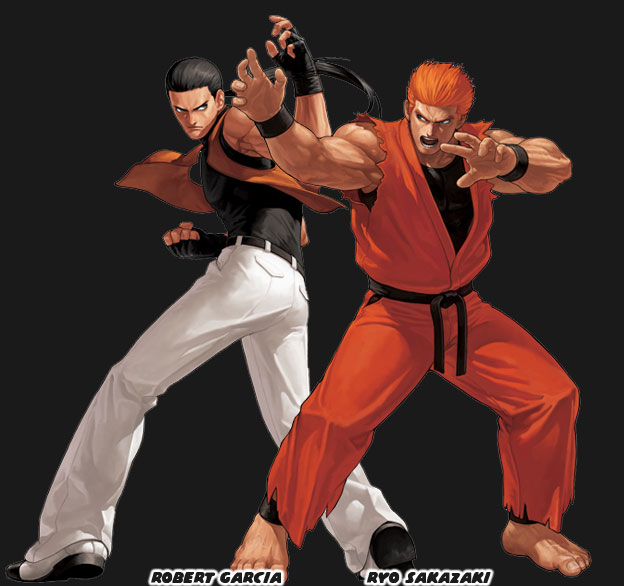
Mr. Matsumoto wanted The Art of Fighting (AoF) to be more cinematic, to look and feel like an action movie. To be more visceral than any game before it. Like Street Smart and Fatal Fury there was a mix of the traditional martial arts master and the street fighter as playable characters. The fictional Kyokugenryu Karate style was placed on both Robert Garcia and Ryo Sakazaki. The two were evolved from the Ken and Ryu template respectively. This new game was really pushing the power of the Neo Geo console. It featured more color, more detail and sprites bigger than the competition’s. Not to mention that it had graphics that zoomed in and out of the action. These sprites could also reveal damage. Characters bruised and their clothing tore from round to round. There was even a slight RPG element as characters could grow and evolve thanks to the lessons learned in the bonus stages. The genius of this game came in the planning stages. If SNK wanted to dethrone Capcom as the best fighting game developer then they had to offer the best experience. Although Fatal Fury and the Art of Fighting looked and played differently they were part of the same shared universe. This meant that at some point there would be a crossover game featuring a massive library of established characters.
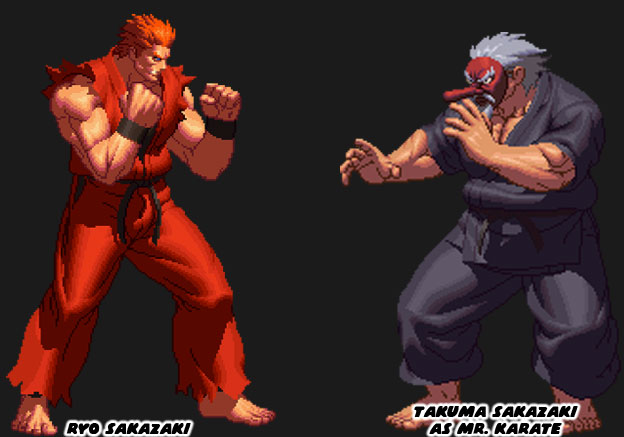
 

The entire cinematic feel of AoF was not lost on audiences. The figures in the game had more realistic proportions and looked less cartoonish than their rivals. It was much easier to get pulled into this world as bits and pieces of the story were revealed in between every stage. Yuri Sakazaki, the young sister of Ryo had been kidnapped. It was up to Ryo and Robert to find and save her. Every person that the duo faced had been hired or bribed by Mr. Big, a South Town mob boss. Each encounter brought them one step closer to the truth. At the end of the journey Ryo found out that the kidnapper was a martial arts master known as Mr. Karate. At the climax of the game Yuri stopped her brother from killing Mr. Karate. She cried out that man was their father. This was an exceptional plot twist and something that set up a sequel. It turned out that both Mr. Big and Mr. Karate answered to Geese Howard. Now that Yuri was safe there would be a reckoning between the Sakazaki family and Howard. Imagine how confident Geese must have been in his abilities by also starting a war with the Bogard brothers at around the same time. Story points aside the AoF game is one of the perfect examples of the SNK school of design. I’ll begin with one of the best masters hidden in plain sight.
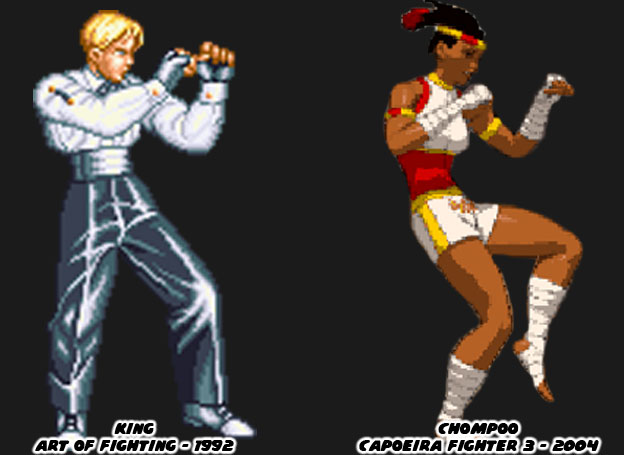
 

A while back I talked about how the traditional Muay Thai master ended up in fighting games. I called Chompoo the first notable female Muay Thai master in a fighting game. This angered a lot of SNK fans because the character King predated her by more than 20 years. In context I was talking about actual Thai fighters that dressed in the traditional fighting uniforms. Chompoo had the shorts, taped up hands and feet and even headdress. I was not talking about characters that knew Thai boxing. With that said let’s actually look at the elements that went into making King and why she had a fantastic design. First off she wore a suit, close to that of a bartender in a high class restaurant. She had the familiar stance, hands up for striking and moving on the balls of her feet. If you had asked any other designer to create a female Muay Thai master you probably would have ended up with someone that looked more like the character by Saeed Jalabi. Saeed hit all of the traditional notes perfectly. The shorts, headdress and even wrapped cords of older, classical forms of the Thai boxing arts. Any audience member could look at the design and know instantly this was some sort of fighter. Even if the gamer was not familiar with the fighting arts they could still tell a few things about her. The athletic frame, toned muscles, wrapped hands and feet were meant for striking. This was not a ceremonial costume but one for competition.
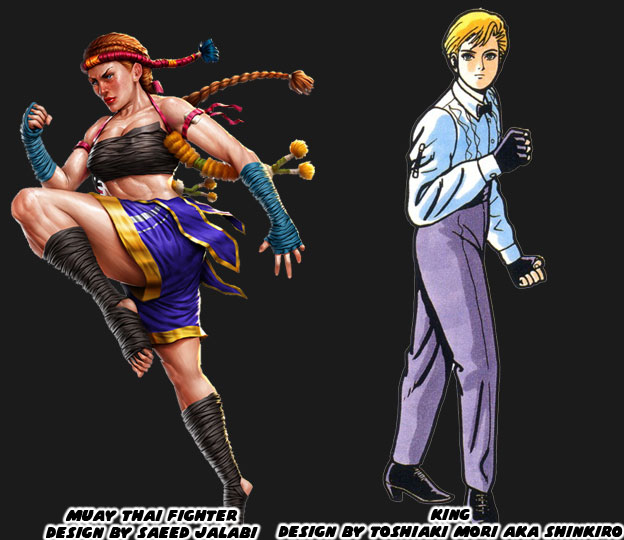
 

By contrast look at the design that Toshiaki Mori came up with. The SNK designer would become one of the most influential artists of all time. Most people would recognize him by his pen name, Shinkiro. He didn’t approach his designs the way one would have expected. What made his work so great was how down-to-Earth every figure was. When he was helping create the costumes for the AoF cast he knew to make each character fit the story. As Robert and Ryo made their way through South Town the people they fought reflected a certain part of the city. The thugs looked like biker gang members, those in the military wore fatigues. Having a half-naked Muay Thai fighter in a classy restaurant would not have made any sense. But what about one dressed like a bartender? The uniform was central to the character. Modern martial arts movies featured characters that wore deceptive clothing. One the first examples was the tuxedo that Robert Baker wore when he fought Bruce Lee in Fist of Fury (1972). Bruce Lee helped bring classic wuxia or Chinese hero stories into the modern era. The same thing was true of the suit that Benny Urquidez wore when he fought Jackie Chan in Wheels on Meals (1984).
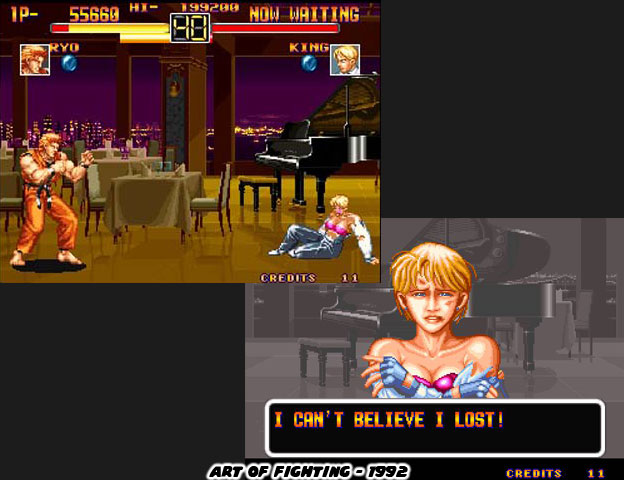
 

The suit was deceptive but that was only one layer of Shinkiro’s design. King looked like an effeminate man, or perhaps a boy. Audiences had been conditioned to expect 99% of the people they fought to be men. Up until that point Fan from Yie Ar Kung-Fu was the only female opponent in a fighting game and Chun-Li from Street Fighter II was the only playable female character. Audiences expected a female martial artists to be wearing a traditional dress. That whole idea was turned upside down if players tore the blouse off of King with a special attack. That was when it was revealed that she was wearing a bra underneath. That violent act made the game feel far more mature than any other title. This sort of turn was something that you would expect in a movie and certainly not in a game. SNK hid the reveal right until the end, going so far as to name the character King instead of Queen. In doing so it made the design very memorable. This master of the fighting arts was hiding in plain sight. She would be the perfect example as to what set SNK apart from the competition.
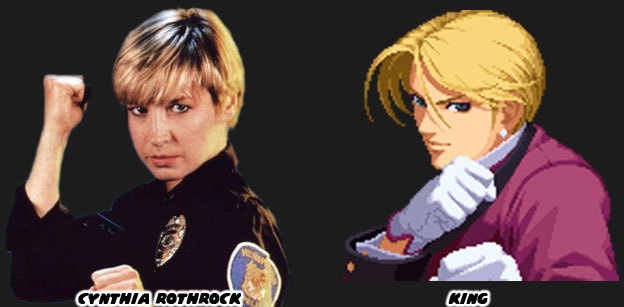
 

If you have been reading my blogs for a while then you know that I like to dig into the influences behind the various characters. For King the most obvious comparison would be with the martial arts star Cynthia Rothrock. Since 1985 Cynthia had been featured in a string of movies, mostly produced overseas. Women hadn’t really been considered for leading roles in most Western-produced martial arts films. There have been exceptions of course in other action films such as the Black Widow from the Avengers films, Furiosa from Mad Max or Gazelle from the Kingsmen. Those characters were almost always in a supporting role and not the stars of the film. In Hong Kong however women could be the stars of the film. This was a tradition going back to 1928. Heroes came in all shapes (see the chubby Sammo Hung), sizes, and colors even. When Cynthia couldn’t land a role in a US film she was almost always guaranteed to find a spot in Hong Kong. The same thing was true for Ron Van Clief. As a black martial artist, and Army veteran he faced tremendous racism in the USA but was a welcome star in Hong Kong cinema.
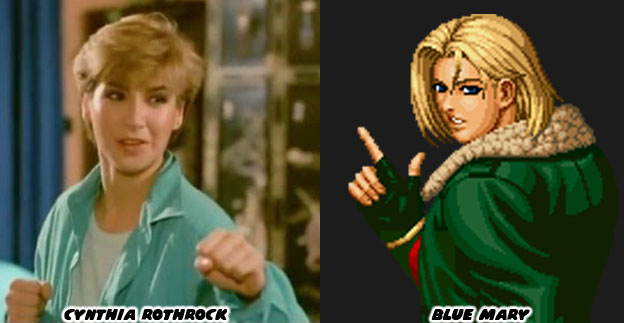
 

Cynthia’s trademark short haircut, lightning fast kicks and array of martial arts moves made her a stand out star. She had been actively involved in martial arts for a long time and was trained in different schools, including Tang Soo Do, Tae Kwon Do, Eagle Claw, Wu Shu, and both Southern and Northern Shaolin. She was able to hold her own against many men and women artists from Hong Kong, some of which learned fighting and acrobatics from the Chinese Opera, just like Jackie Chan. Cynthia often played a street smart cop, nicknamed China O’Brien in one of her more famous recurring roles. She was such a formidable figure that I would argue she not only influenced the design behind King but also Blue Mary, who turned up in the Fatal Fury series. This made Cynthia one of the rare real world figures that inspired the creation of more than one character, in more than one game series.
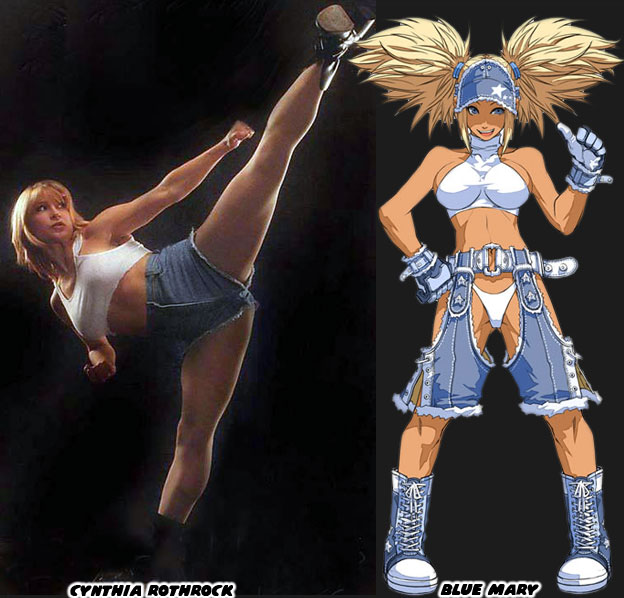
 

Cynthia was not shy about using her good looks in the roles she played. When the part called for it she would show some skin, tastefully of course. The people working at SNK were keenly aware of how the actress sexed up some of her parts or modeling shoots. Shinkiro did not outright try to make King a voluptuous, overly sexualized character. It would have destroyed any surprise waiting for audiences when they first saw her. It was the other artists working at the studio that started putting her in form-fitting suits, they turned her vest into a bustier and starting pushing her breasts out further and further. She would not longer appear androgynous following the AoF. Blue Mary had always been presented as the more sexualized of the designs. She was top heavy with an exposed midriff, wearing uniforms that were not standard law-enforcement. A very skimpy white top and denim bottom was created as an alternate costume for her in King of Fighters (KOF): Maximum Impact 2 Regulation A. This costume was inspired by an outfit worn by Rothrock in a modeling shoot. However we should confuse the two. The design behind King and her planning extended far into the lore or the SNK universe.
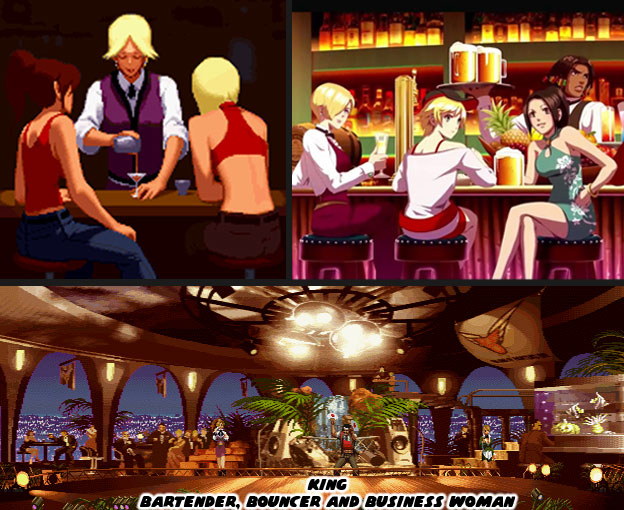
 

On the surface King was a very simple design. She had the skills and grace of a top bartender but with the power of a no-nonsense bouncer. On top of everything she was not going to remain as a bit player in South Town. The figures in the SNK universe had room to grow and the did in the various KOF sequels. The Sakazaki family opened Kyokygenryu schools, with Ryo entering tournaments to help spread its name. Andy and Terry Bogard travelled the globe following the trail of Geese Howard and making new allies along the way. King made fast friends with the other leading females in the KOF series. She partnered with the ninja Mai Shiranui and Kyokugenryu prodigy Yuri Sakazaki to form an all-women team. This was a first in fighting game history. She also partnered with them to open a club in a later timeline. King had taken her experience, including learning from Capoeira master Richard Meyer and his infamous Pao Pao Cafe, and applied it to her own business. She was ambitious and was destined to be a major player in South Town, yet unlike Geese Howard she was going to do this without resorting to extortion. King was an exceptional character design and easily one of the greatest fighting game characters ever created, female or otherwise. Artists and developers try to break into the genre should learn from SNK and see how they were able to hide these martial artists in plain site. The studio was able to hide masters in many ways. We will explore the ways they were able to do this in the next blog. As always if you enjoyed this blog and would like to sponsor me please visit my Patreon page and consider donating each month, even as little as $1 would help make better blogs and even podcasts!
 follow the Street Writer on Patreon!

Wednesday, July 29, 2015

How fight culture became fighting game history, part 13

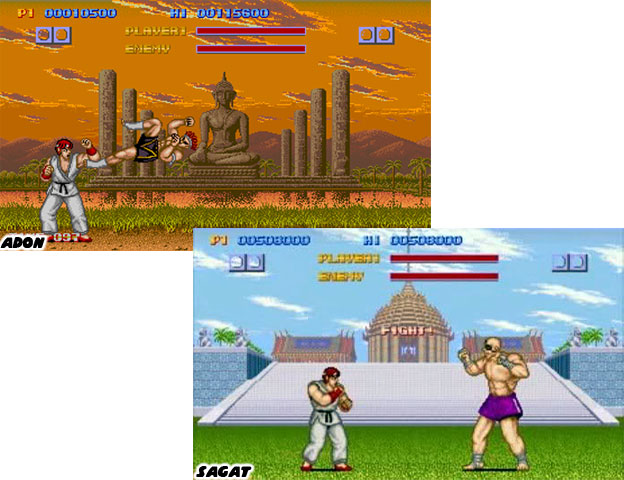
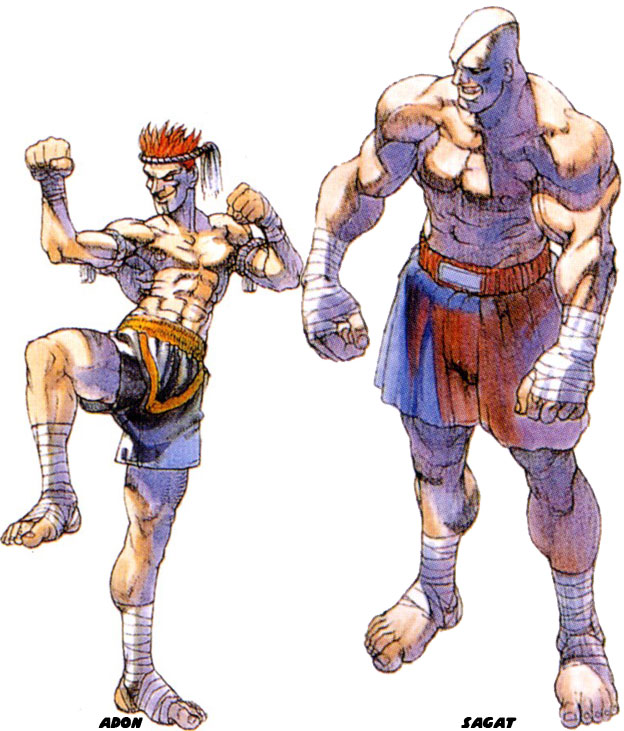
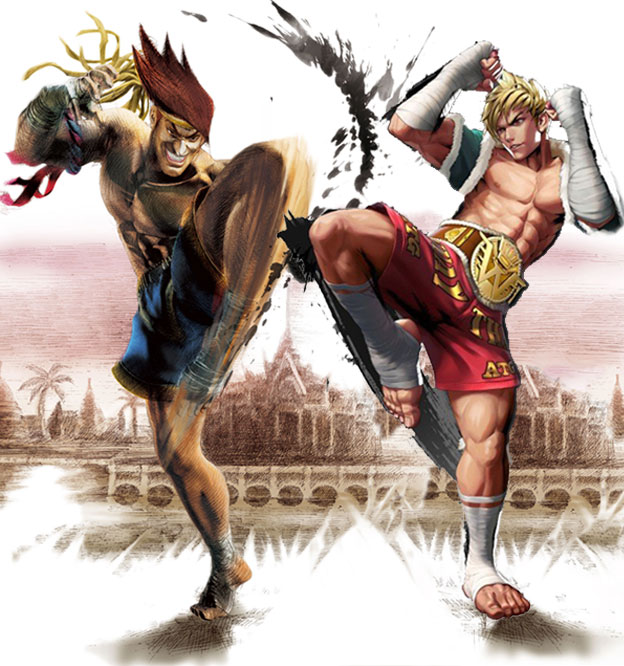
Capcom featured Muay Thai as the final style that gamers had to overcome in the original Street Fighter. Released in 1987 each stage told a story about the culture that Capcom was trying to recreate. The designers did not have the internet to rely on, perhaps they would watch some tapes or look at travel guides for reference material but they didn't have the luxury of digging too deep while creating the levels. Each stage was nonetheless quite memorable, especially for the final opponents in the game. The reflecting pool, sunset orange sky and seated Buddha were serene. They sharply contrasted the aggressive style that Muay Thai master Adon would become known for. A similar observation could be made of Sagat and his level. The beautiful temple backdrop beguiled a fighter that was feared by his peers. To impressionable gamers in Japan and the United States these were caricatures of Thailand that seemed true.


The designers at Capcom had done a wonderful job at setting a standard that all future fighting games would be measured against. Although both characters practiced Muay Thai both Adon and Sagat had very distinct variations on the form. Adon used leaping heel strikes against players while Sagat focused on quick punches and rising knee strikes. Like the level backgrounds themselves these attacks were caricatures of reality. From a character design standpoint both fighters were very unique personalities. Adon was not a humble understudy, he had grown tired of living in the shadows of his mentor. He hoped to defeat Sagat and assume his status as the worlds greatest fighter. Sagat on the other hand was a cold, calculating and brutal master. He had taken the life of an opponent in combat and his reputation had colored his presence in each and every game within the series. These details would become important to the evolution of the franchise as well as the genre.

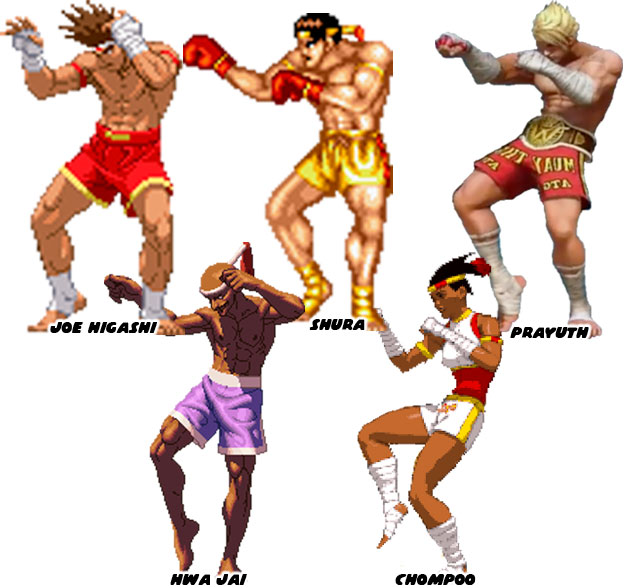
In 1991 Sagat would return in Street Fighter II' as a sub-boss. Other developers took notice of the genre and created their own version of a fighting game. Takashi Nishiyama was a Producer at SNK, he was previously a planner on the original Street Fighter. He wanted to create his own fighting game for the Neo Geo arcade platform. Instead of two main characters he helped create three main characters for players to choose from, one of which was a Muay Thai fighter named Joe Higashi. The game also featured a hot-tempered Muay Thai opponent named Hwa Jai. Fatal Fury was released at the end of 1991, the same year that Street Fighter II came out. Higashi and Jai would turn up again in various SNK games but they would not be the only Muay Thai masters in the universe. Other game studios would also try to incorporate the fighting art into their own releases. Also for the Neo Geo platform but developed by ADK there was a fighter named Shura. He was featured in World Heroes circa 1992, it was one of the first blatant clones of Street Fighter. More than two decades later the first notable female Muay Thai master would make her debut. Chompoo appeared in Capoeira Fighter 3 circa 2004. The character had a host of traditional moves, elbow and knee strikes, that were made fantastic when combined with leaping and tumbling attacks. The most recent Muay Thai master in the 2D, or rather 2.5D genre was inspired by several of the SNK icons, The blonde-haired Prayuth made his debut in 2013. The Chinese developers at Tencent had borrowed liberally from the icons created by both SNK and Capcom in their game the King of Combat.


Something that the most successful studios learned to do over the '90s was to add depth to their cast. Audiences might think that a fighting game character did not need a backstory, a history or even origin. Yet Capcom, SNK, Namco and Sega each learned that a memorable fighting game franchise needed more than a colorful cast or some fancy graphics. The game needed to be balanced, the control dialed in, music catchy and sound just right. The fighters needed to be memorable, they had to be more substance than flash. In order to achieve that the studios had to put as much planning into their design as they would for a AAA adventure star. The characters would not simply be just fighters, they had day jobs and families to go to. Some were soldiers, some were gang members and some were even aristocrats. These histories would not necessarily be spelled out for gamers though. The stages, the rivalries, the dialogue and occasional cut scene would reveal the motivation behind the best characters. Some of these histories would be unveiled over the course of several games, spanning 10 or even 20 years. The best fighters would become icons to the gaming community.


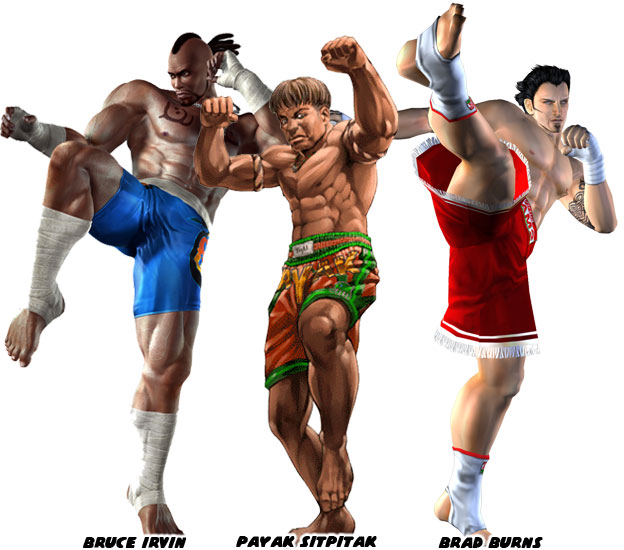
Something that contributed to the evolution of the genre was the shift from 2D to 3D graphics. As the various fighting arts were adapted to 3D they had to undergo some changes. The strikes of the artform were often simplified and some lost their presence. One technique that worked very well in 3D was Muay Thai. Namco introduced the Muay Thai hitman Bruce Irvin to audiences in 1995. The character featured in the Tekken series would gain a following. A few years later, in 1999 to be precise, SNK introduced their first 3D Muay Thai master. The character did not have the youthful brashness of Adon or rather Joe Higashi but he was still a part of the Fatal Fury universe. The middle-aged Payak Sitpitak was a more level-headed person, a fighter and family man. In canon he was talked into entering the Buriki One tournament by Higashi. Payak lacked a flashy style, to be fair the entire cast in the game was actually grounded in more realistic attacks than the 2D fighters. Payak was still a dangerous man who let his hard strikes do all the talking. The Neo Geo platform was not great at rendering 3D graphics, especially when compared to Namco's proprietary System 11 arcade board. These were the steps that the studios needed to make in order to reinvigorate the genre. Unfortunately the teams working at Capcom on the Street Fighter series were rehashing 2D sprites and falling behind the 3D development curve. Even Sega, a long-time rival to Namco would eventually add a Muay Thai fighter to their franchise. The ever-cocky Brad Burns made his debut in 2003 with Virtua Fighter 4.


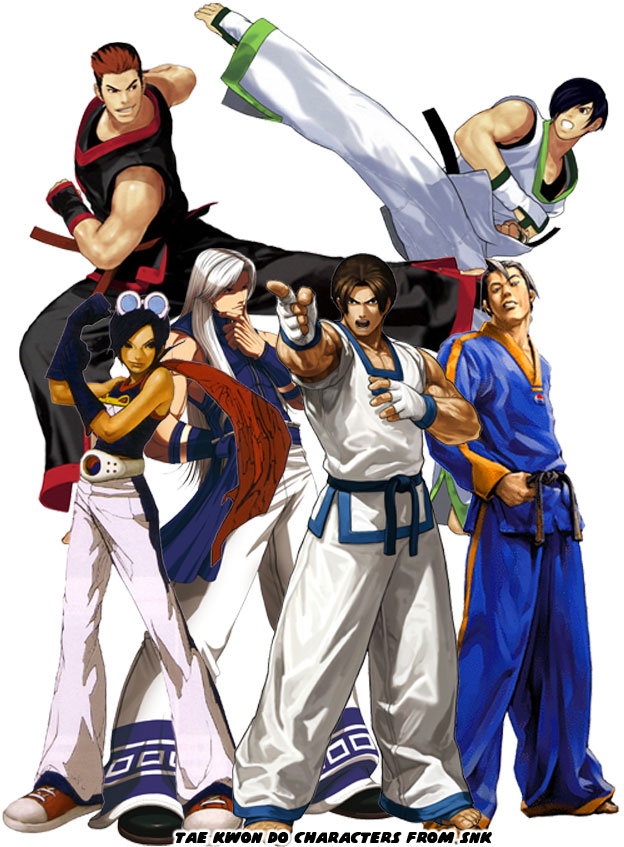
Muay Thai was considered one of the "exotic" martial arts in early fighting games. Its evolution was unique given the region that it came from and how native customs mixed with Hindu and Buddhist cultures to shape the art. Something similar happened in the far North where different cultures adapted the fighting arts of China and Japan into something unique. The Korean system of Taekwondo (TKD) was seen as a modern striking form, it did not come into its own until the late '40s. At the same time it enjoyed an appeal almost as exotic as Muay Thai. SNK was a perennial rival to Capcom, especially in the fighting game genre. The planners and some staff working on the Fatal Fury, Art of Fighting and King of Fighters games were ex-Capcom employees. They wanted to diversify the fighting styles featured in their games and provide a bigger library of characters than what was featured in the Street Fighter series. In order to do this they looked at other popular striking arts and no form came to mind more immediately than TKD.

The style of fighting was very calculated, it reflected the nation of origin. Korea was a culture that based its language on mathematics, the importance of science was not lost on the people. In Taekwondo kicks were the main attacks. Practitioners did not only learn all the types of kicks they could perform but which were the most effective at different ranges. The form was distilled from Okinawan Karate and Chinese Kung-Fu however there was a distinct fight science to the art. Students had to learn how to angle opponents, restrict their movement, find openings and isolate weak spots. Practitioners learned to be light on their feet and remain in a constant state of movement. This was not a fighting art developed from warfare so the strikes were optimized for speed and efficiency rather than lethality. It was especially important in point-based tournaments. From a gaming standpoint the sweeping kicks looked amazing when animated by studio artists. The lion's share of TKD fighters were featured in SNK games through most of the '90s. Kim Kaphwan started the tradition in 1992. He was a new star in Fatal Fury 2. Kim was notable not just for his amazing kicks but because he was the first to have children appear as fighters as well. His sons Dong Hwan and Jae Hoon debuted in 1999's Garou Mark of Wolves. Muay Thai and Karate looked unique depending on the practitioner, the same could be said of the TKD fighters. The Kim children were not simply clones of their father but instead had their own personalities and moves.


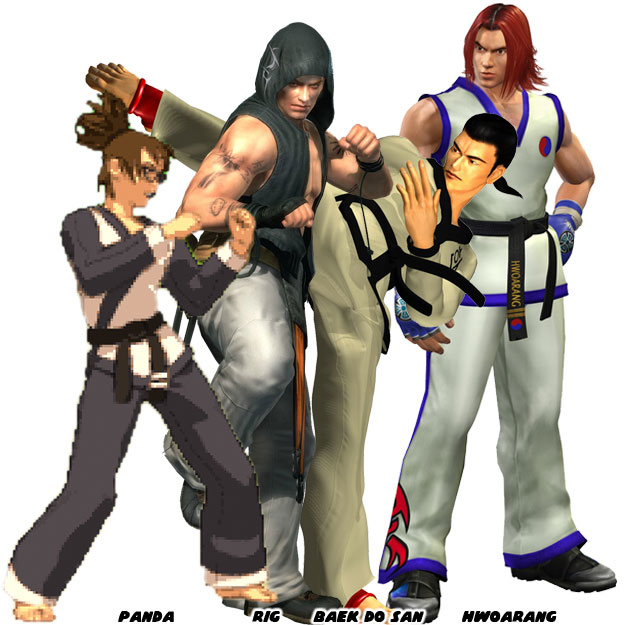
Enemies and allies of the Kim family were added to other SNK games. Seo Yong Song from Buriki One (whom also debuted in 1999), Jhun Hoon from King of Fighters '99 and May Lee from King of Fighters 2001 were all distinct practitioners and proud Koreans. The layers of storytelling that went into the rivalries and relationships helped add depth to the universe and made the characters stand out. Audiences enjoyed the diversity they were presented with. Taekwondo was one of the fighting arts that made the transition from real life to 2D seamlessly. When technology allowed the form to be presented in a 3D fighting games it was a perfect fit. Part of the reason that the moves looked so well in 3D was because they were not traditionally animated. Instead there were athletes and martial artists performing motion capture animations for the programmers to work from. Baek Doo San was the first in a TKD master in a major title. He appeared in Tekken 2 in 1995. Namco went the extra mile and had an actual Olympian perform the moves for Baek and his understudy Hwoarang in Tekken 3, released in 1997. Panda from the 2008 game Capoeira Fighter 3 was the first female 3D TKD practitioner.


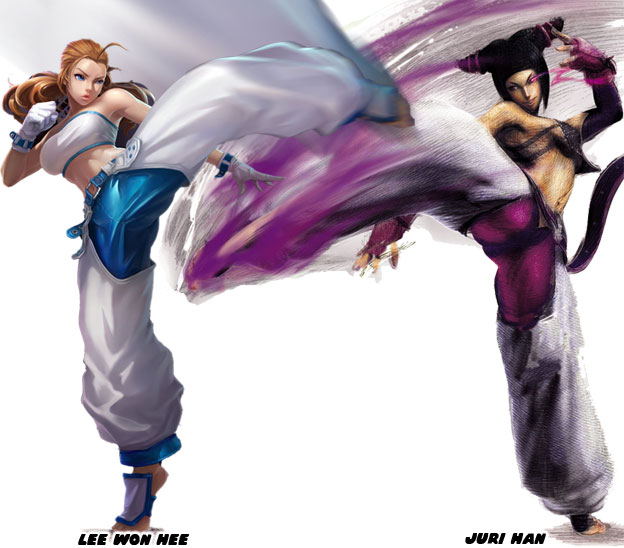
Sega's Virtua Fighter was the only major 3D series yet to feature a TKD master. According to canon Sarah Bryant, who debuted in 1993, was accomplished in Jeet Kune Do. In later iterations she added the French art of Savate and TKD to her repertoire. Rival studio Tecmo was also late in bringing the Korean fighting art to fans. Dead or Alive 5 was released in 2012 and introduced a mysterious TKD fighter known only as Rig. His moves were familiar to audiences because of the other TKD characters that came before him. The 3D mold created by Baek Doo San would not be broken until 2010. While Panda did set the precedence most fighting game fans would identify the assassin Juri Han as the most revolutionary new TKD character of the past 20 years. The character actually had many design elements pulled from Chun-Li however that was besides the point. The powerful kicks, blinding speed and brutal moves made her stand out from her peers. She became such a powerful icon that a few short years later the studio Tencent would more or less copy her design. Lee Won Hee debuted in King of Combat in 2013. She had a blend of moves from Juri but also from the Kim family and other TKD gaming pioneers. What was interesting was that there was a male South Korean Judo grappler named Lee Won-hee that was the World Champion in 2003 and Olympic Gold Medal Champion in 2004. I am not sure why the Chinese developer would use the same name.


Pop culture had a lot to do with which styles would be featured in fighting games. The more well known arts would be included in almost every franchise developed. The games that deviated from the formula, or made up their own fighting arts were hit or miss with audiences. Muay Thai and Tae Kwon Do were standout forms from the early days of the genre. So how did the classic fighting arts remain "untouched" even as technology changed? Find out about this shift on the next blog. As always if you enjoyed this blog and would like to sponsor me please visit my Patreon page and consider donating each month, even as little as $1 would help make better blogs and even podcasts!